行政院國家科學委員會專題研究計畫 成果報告
音樂對設計師創造力與聯想力提升之探討(I) 研究成果報告(精簡版)
計 畫 類 別 : 個別型
計 畫 編 號 : NSC 100-2410-H-011-032-
執 行 期 間 : 100 年 08 月 01 日至 101 年 07 月 31 日 執 行 單 位 : 國立臺灣科技大學工商業設計系
計 畫 主 持 人 : 張文智
計畫參與人員: 碩士班研究生-兼任助理人員:許敬安 碩士班研究生-兼任助理人員:林芳葆 博士班研究生-兼任助理人員:廖繼盟
報 告 附 件 : 出席國際會議研究心得報告及發表論文
公 開 資 訊 : 本計畫可公開查詢
中 華 民 國 101 年 10 月 14 日
中 文 摘 要 : 鑒於過去許多研究顯示聽音樂過程產生諸多的效益,因此本 研究探討設計時聽音樂是否會對設計產生效益以及提升設計 師之聯想力。第一階段經由與部分設計師訪談後,發現大部 分受訪者進行設計時有聽音樂習慣與產生聯想經驗。第二階 段採用問卷調查法,廣泛了解設計系學生、設計師以及設計 主管們設計時是否有聽音樂習慣,以及聽音樂對設計效益與 聯想力之影響。調查結果得到以下發現:(1)大多數的受測者 工作時有聽音樂習慣,且認為聽音樂具有正面效益者居多。
(2)受測者認為聽音樂對於設計構想發展階段之助益最大,聽 音樂過程中有哼唱經驗者,對於聽音樂產生之設計效益及聯 想力的認同度較高。(3)受測者對於聽特定音樂引發聯想力有 高度認同感。(4)音樂類型和設計風格聯想有相關性,例如聽 重金屬與搖滾樂會產生前衛風格聯想。
中文關鍵詞: 音樂、聯想力、設計效益
英 文 摘 要 : Music is closely related to people. Many studies had pinpointed the effects of music in different areas.
In this study, the authors aim to explore the effects of music on design activity and designer’s
association ability. To achieve this goal, designers were first interviewed and we found that most
designers have the habit of listening to music during their design routines. Then, a quantitative survey was conducted in which design students, product designers, and design managers were invited to express their opinions regarding their habits in music listening as well as the utility of music on designer’ s activity and association ability. Major findings from the study are listed below:
(1) Most subjects are used to listening to music in their design activities and claimed a positive effect of music. (2) Subjects considered music most helpful to the idea development stage. Those who have the habit of singing along consent more on the utility music has on design activity and association. (3) Subjects are in high agreement regarding the effects of specific music on design association. (4) Most subjects claimed that music types are related to product design styles. For example, heavy metal and
rock music are more likely to trigger the association for futuristic style.
英文關鍵詞: music, association, design performance
□期中進度報 行政院國家科學委員會補助專題 告
研究計畫
█期末報告
計畫名稱
音樂對設計師創造力與聯想力提升之探討(I)
計畫類別:■個別型計畫 □整合型計畫 計畫編號:NSC 100-2410-H-011-032-
執行期間:100 年 8 月 1 日至 101 年 7 月 31 日 執行機構及系所:國立台灣科技大學工商業設計系
計畫主持人:張文智 共同主持人:
計畫參與人員:廖繼盟
許敬安
林芳葆
I
中英文摘要及關鍵詞:
鑒於過去許多研究顯示聽音樂過程產生諸多的效益,因此本研究探討設計時聽音樂 是否會對設計產生效益以及提升設計師之聯想力。第一階段經由與部分設計師訪談後,
發現大部分受訪者進行設計時有聽音樂習慣與產生聯想經驗。第二階段採用問卷調查 法,廣泛了解設計系學生、設計師以及設計主管們設計時是否有聽音樂習慣,以及聽音 樂對設計效益與聯想力之影響。調查結果得到以下發現:(1)大多數的受測者工作時有聽 音樂習慣,且認為聽音樂具有正面效益者居多。(2)受測者認為聽音樂對於設計構想發展 階段之助益最大,聽音樂過程中有哼唱經驗者,對於聽音樂產生之設計效益及聯想力的 認同度較高。(3)受測者對於聽特定音樂引發聯想力有高度認同感。(4)音樂類型和設計 風格聯想有相關性,例如聽重金屬與搖滾樂會產生前衛風格聯想。
關鍵詞:音樂、聯想力、設計效益
Music is closely related to people. Many studies had pinpointed the effects of music in different areas. In this study, the authors aim to explore the effects of music on design activity and designer’s association ability. To achieve this goal, designers were first interviewed and we found that most designers have the habit of listening to music during their design routines.
Then, a quantitative survey was conducted in which design students, product designers, and design managers were invited to express their opinions regarding their habits in music listening as well as the utility of music on designer’ s activity and association ability. Major findings from the study are listed below:
(1) Most subjects are used to listening to music in their design activities and claimed a positive effect of music. (2) Subjects considered music most helpful to the idea development stage. Those who have the habit of singing along consent more on the utility music has on design activity and association. (3) Subjects are in high agreement regarding the effects of specific music on design association. (4) Most subjects claimed that music types are related to product design styles. For example, heavy metal and rock music are more likely to trigger the association for futuristic style.
Keywords: music, association, design performance.
1
報告內容:
一、前言
早晨音樂取代鬧鐘聲音喚醒人們展開一天的活動,在上班或上學途中收聽音樂,以 打發單調的交通時間。中午用餐的場所經常會播放音樂,增進用餐氣氛。下班或下課回 家,聽幾首喜歡的音樂舒解一天疲憊的身體,相信是許多人都有的經驗,可見音樂在人 們日常生活中占有重要的地位並且接觸相當頻繁(Schäher & Sedlmeier, 2009)。關於聽音 樂的效用過去有許多相關研究,如播放音樂可以提升顧客購買率(Miliman, 1982; North &
Hargreaves, 1998),播放古典音樂可提高消費者購買較高價格商品的意願(Areni & Kim, 1993),以及 Jacob、Gue´guen、Boulbry 和 Sami(2009)的研究指出,在花店播放羅曼蒂 克氣息的音樂,可以提升顧客購買花卉的意願與金額,以上顯示特定的音樂類型對人們 行為產生影響。並且有的研究顯示聽音樂可提升工作績效(Fox & Embery, 1972),有聽音 樂的員工對組織滿意度以及情緒狀態都有顯著性改善(Oldham, Cummings, Mischel, Schmidtke, & Zhou, 1995),以及觀賞圖片過程播放音樂可以強化記憶效果(Baumgartner, Esslen & Jäncke, 2006)。在設計方面,Lesiuk(2005)對於加拿大 4 個軟體公司之 56 位軟 體設計師進行持續 5 週的實驗結果顯示,聽音樂對工作績效有正面的影響,聽音樂時間 較多者對於任務的滿意度較高。以上呈現音樂諸多方面的影響,本文研究者觀察設計師 在設計時有聽音樂的習慣,因此覺得聽音樂對設計產生的影響值得深入了解。
設計是一種有目的、有流程、有限制條件的創意活動,設計者依據習得之相關知識 與技能,應用創意產生美感與機能兼具而且方便操作的產品(Roozenburg & Eekels, 1995)。而設計創意根植於既有知識基礎,人類無法無中生有,舊有知識是創造力發展 的基礎(Barron,1969),缺乏以知識為基礎的設計宛如在沙地上蓋大樓般的不可靠。設計 師在進行設計時須透過記憶將以往習得之知識與經驗產生聯結(Oxman, 1990),因此設計 師在創意構想發展階段,藉由研究過去案例、閱讀資料、或與人交談等許多方式等尋求 創意靈感(Eckert & Stacey, 2000),以提升生設計效益。設計師在高度工作壓力之下,聽 音樂除了改善情緒之外(Rentfrow & Gosling, 2003),是否藉由聆聽音樂引發的聯想力,
讓人產生許多的想像空間(汪青彥等人,2003)。故在進行設計時聆聽適當類型的音樂,
引發設計師產生與設計主題相關的聯想,是否會比較容易設計出契合設計主題的產品,
值得我們詳加探討。本研究採用深入訪談與問卷調查方式,廣泛了解設計師應用音樂的 狀況。期盼研究成果可提供產業界設計師應用音樂於設計活動的參考,以及提供學術界 以聽覺刺激設計構想的另一種思維。
二、研究目的
本研究主要目的有以下三點:
1. 探討設計師應用音樂的狀況以及聽音樂對設計師是否有益。
2. 探討聽音樂對於設計師之設計效益與聯想力的影響狀況。
3. 探討聽某種音樂類型與設計風格的關係
2
三、文獻探討 3-1 聯想理論
聯想就是經由某種事物想到和它相關的事物,它是人類的一種心理活動(朱光潛,
2003)。英國哲學家洛克(John Locke)是首位提出概念聯想(association of idea)的學者 (Warren, 1921),Locke 認為我們的某些構想產生,會自然的聯結至另一個構想。但是依 每個人的性格傾向、教育程度與志趣等會衍生不一樣的聯想(Locke, 1700/ 2011 )。關於 應用聯想理論的起源可推至希臘時期的哲學家柏拉圖(Plato)和亞里斯多德(Aristotle);在 柏拉圖的「斐多篇」記載著,只要看到一件事物會讓你想起另一件事物,那麼它就是產 生回憶的原因(王曉朝譯,2007)。亞里斯多德在「論記憶與回憶」時提出,當我們在回 憶時,經由某些事件的相似性(similarity)、對比性(contrast)或者相鄰關係(contiguity),找 到我們所要尋求的事物,這些體驗建構了回憶的歷程(Aristotle, trans, 2007)。上面這兩位 希臘哲學家有系統的應用聯想概念說明回憶歷程,可謂是聯想主義的開端者。早期的聯 想學者大衛休莫(David Hume)也扮演著重要的角色,他認為構想聯結方式可透過以下的 三個原則中的至少一個產生:相似(resemblance)、在時間和地點的接近(Contiguity in time or place)以及因果關係(Cause or Effect),尤其他認為因果關係是聯想概念的核心(Hume, 1748/2012 )。英國學者 Alexander Bain(1875)的聯想觀點,除了接近聯想與類似聯想之 外,他還提出組混合聯想(Law of Compound Association),意指經由相似性或相鄰性的作 用更容易產生聯想。以及建設性的想像(Constructive Imagination),是指聯想的心智有能 力形成有別於過去經驗的現象而產生新的想像組合(引自 Warren, 1921)。Eysenck 和 Keane (2000)認為亞里斯多德和以上的學者聯想觀念,形成後來普遍應用的聯想法三大 法則,所謂的類似聯想(Association by Similarity):就是由某一事物的現象想到與它相似 的其它事物或現象,接近聯想(Association by Contiguity):是根據事物在空間或時間上彼 此接進產生的聯想,對比聯想(Association by Contrast):是指對事物產生相反的屬性與特 點的聯想。
近代的聯想學者 Mednick(1962)提出的「創造歷程的聯想理論」(The association basis of the creative process),以聯想說明創意思考的過程。Mednick 認為具有創意的構想大多 是逐步聯結出來的,他採用實驗的方式檢視聯想力,並發展出 Remote Associate Test(RAT) 以字詞的相關性檢視聯想能力,成為往後檢視聯想或創造力的方法之一。而
Koestler(1964)提出雙向聯想(Bisociation)的觀念,有別於以既定技術產生的單一面向思考 模式,他認為創意思考應該超過兩個面向以上的思考聯結。因此設計師在設計過程中,
聽取音樂是否產生聯想,以及設計師如何運用聯想力,值得近一步研究。
3-2 音樂的聯想
音樂意象是多重感知的,著重個體經驗的主觀感受,以及個人認知到外界刺激和想 像力投射的結果(Reybrouck, 2001)。因此聽到熟悉的音樂,樂曲的旋律會從耳朵經由聽 覺神經將訊息傳遞至大腦,基於先前的聽覺經驗而形成各種不同的影像(郭美女,2000)。
Lowis(2002)的研究也指出,聽音樂產生哼哼唱唱以及聯想幾乎是許多人共同的經驗。聯 想是一種心靈上的自由起伏,無拘無束的活動,各種藝術都可以經由聯想力而增加感
3
受。郭長揚(1996)認為欣賞音樂時常會引起聆聽者心靈上的活動,而聯想到與音樂相關 的事項。例如:高音有光輝明朗的特性,會有趨向白色的感覺。中音較為溫柔,會有灰 色的感覺。而低音則渾厚沉重,會有類似黑色的感覺,顯示聽音樂的感覺與心理上的聯 想作用有相當程度的關聯。
North 和 Hargreaves(1998)以在餐廳播放古典音樂、流行音樂、輕鬆音樂和不播放音 樂四種情況,對消費行為影響之調查結果顯示,不同的音樂風格有不同的影響,播放古 典音樂會提升銷售金額。受測者認為業者播放古典音樂暗示著,消費者要有為食物付較 高的金額的心理準備。North 和 Hargreaves 表示,可能是古典音樂引發人們投射出生活 富裕的感覺,而生活富裕者可承擔較高金額消費的聯想,因而有這樣的結果。因此當設 計師須要設計高檔產品時播放古典音樂,是否會聯想到富裕的感覺而影響設計風格呈 現,值得我們探討。North、Hargreaves 和 McKendrick(1999)研究調查顯示,在超市播放 具代表性的法國和德國音樂,有助於刺激消費者購買該地方產品的意願。顯示地方色彩 濃厚的音樂引發消費者聯想到該國家的特色,因而左右了消費者的購買行為,因此在設 計過程中播放地方色彩濃厚的音樂,是否有助於設計師聯想到相關的人文特色等,並且 將這些文化意象轉化為設計元素,設計出具有地方特色的產品。音樂除了影響聽者的消 費行為之外,特定音樂也會使人產生聯想到特定族群與事物。Yeoh 和 North (2010)應用 音樂與圖片為刺激物,檢視不同音樂類型所引發回憶事項的研究顯示,聽搖滾音樂比聽 古典音樂者回憶較多有關搖滾特徵之物件,例如電吉他、刺青、長髮男性、大麻等,同 樣的播放古典音樂會先回想到古典物件,例如雪茄、手錶、香檳、鋼筆等。因此播放合 適的音樂有益於人們聯想與該音樂屬性相關之事項。上述的相關研究呈現出特定音樂對 於聽者聯想力產生的影響,因此本研究調查這些有特色的音樂是否會影響設計師的聯 想。
3-3 聯想力與創意構想
聯想是人類特有的活動,它是創意構想發展的基礎。創意是一種認知過程,包括知 識技能的獲得並轉換成新形式,而產生有價值的成果(毛連溫等,2000)。洛克(John Locke) 認為人類的知識來自後天在生存環境中學習而來的經驗,這些經驗形成觀念,經過聯想 之後變成知識(引自張春興,2002)。個人如果希望在某個領域產出新穎的想法,便必須 俱備該領域的知識(李乙明、李淑貞譯,2005)。可見知識是創造力的基本要素,可作為 建構新想法的基石。但是具有創意的想法並非只應用過去的知識與技能即可達成,創意 構想須要有新的觀念產生。Spearman(1930)認為產生新觀念可依據下列三個原則,(1)經 驗原則:每個人都具有獨特的經驗與感知。(2)關係原則:當兩個物件分別呈現時,人們 會感受到它們的相關性。(3)相關原則:當任何物件呈現在眼前時,人們的心智會產生和 它們相關性的另一個物件。Koestler(1964)認為聯結不同面向的知識,可以產生較具原創 性的想法。Lotherington 也認為創意思考能力可以經由學習獲得,最具有創意特質的思 考方式就是應用聯結思考方式來產生創意,每一個新構想都是由聯結兩個或是更多的構 想而產生的,不尋常的聯結方式可以產生不尋常的點子(劉盈君譯,2008)。由 Spearman、
Lotherington 和 Koestler 的觀點我們可以理解,當人們需要產生新構想時,會用舊有的
4
知識和經驗,將類似或不同的事物相互連結而產生新的觀念。因此,設計創意不是天馬 行空、無中生有的構想產生方式,它需要透過聯想力將當下的想法和以往的知識與經驗 相互聯結。
Mednick 的遠距聯想測試(RAT)研究提出,較高創意的受測者,產生的回應元素和聯想 主題之間的相關性較低,但可推演至較遠的相關元素,並且可投射出許多回應。反之較 低創意的受測者,產生的回應元素和聯想主題之間的相關性較高,無法推演至較遠的相 關元素,但是投射出許多回應較少。而鄧建國與莊明振(2008)以造形心理喚醒情感聯想 的設計模式,提出造型聯想的四個步驟:建立設計情境、設計特徵明確化、技術特質的 應用以及設計張力的強化。他們以設計案例透過聯結情境與故事的聯想,設計出與過去 記憶產生聯結具有情感層面的產品。
綜合以上的觀點得知,聯想是知覺、概念、記憶和想像的基礎(朱光潛,1979),設 計師在創意過程中經常應用聯想力將既有認知與知識產生聯結,產生設計構想元素。因 此設計師進行設計時,能否經由聆聽適當的音樂,提升設計師的聯想力,衍生出較多符 合設計主題的構想元素,則值得我們去探討。
四、研究方法
根據相關文獻探討所得的基礎,本研究進行兩階段調查,第一階段採用訪談的方 式,目的在於了解設計師們對於音樂的應用狀況,以及聽音樂對設計的影響。採用半開 放式的訪談方式,訪談對象為學生、年輕設計師、工作 10 年以上的資深設計師以及設 計主管共計 13 位受訪者。大多數的受訪者表示進行設計時有聽音樂的習慣,並且有產 生回想過去的人、事、物以及生活經驗,風格比較特殊的音樂類型與異國音樂樂特別容 易有畫面產生,聽歌唱音樂容易融入歌詞情境以及樂器音樂有較多想像空間等。在訪談 過程也發覺受訪者對於音樂類型的理解,絕大多數採用坊間販售音樂者的音樂分類方 式,無法如專業音樂工作者般的精確分辨。第二階段實施問卷調查,根據第一階段深入 訪談所獲得結果,施以廣泛的問卷調查,確立設計師聽音樂的情況、對於設計效益、以 及特定音樂對聯想力與設計風格等看法。問卷調查之問卷設計與實施方式分述如下。
4-1 問卷設計
問卷內容除受測者基本背景資料之外包括「聽音樂的習慣」、「音樂對設計之效益」、
「特定音樂與設計聯想之認同度」與「音樂類型與設計風格聯想」四部分,其問題內容 與方式分述如下。
4-1.1 聽音樂的習慣
擷取訪談階段之「聽音樂習慣」整理出 4 個問題,分別是「設計時是否有聽音樂習 慣」、「聽音樂時間」、「聽取音樂來源」以及「聽音樂時是否有跟著哼唱的習慣」,以單 選題方式請受測者填寫。
4-1.2 音樂對設計效益之問項內容
5
詢問聽音樂對設計效益的態度、聽音樂產生是否聯想經驗、以及在不同的設計階 段,聽音樂對設計的哪一個階段最有益等,採用單選的方式。另外有關聽音樂對設計效 益認同度有 3 個問題,分別是聽音樂有助於提升工作效率、聽音樂有助於設計風格聯想 與聽音樂有助於設計構想產出。其量測方式採用李克尺度(Likert scale)之 7 個評量等級 進行檢測。
4-1.3 特定音樂與設計聯想之認同度
採用在訪談階段受訪者表示,風格比較特殊的異國或地方音樂別容易有畫面產生,
聽歌唱音樂容易融入歌詞情境以及樂器音樂有較多想像空間等,調查受測者「聽設計目 標族群喜好的音樂有助於聯想他們的生活經驗」、「聽異國音樂有助於聯想到該國的民情 風俗」、「聽地方色彩濃厚的音樂有助於聯想到當地文化特色」、「聽歌唱音樂的歌詞會引 發聯想到歌詞所敘述的情境」、「聽樂器音樂可以產生較廣泛的聯想」、「聽快樂音樂可以 產生較多的聯想」等 6 題有關於聽特定音樂產生聯想之認同度調查,量表採用李克尺度 7 向度量表。
4-1.4 音樂類型與設計風格聯想之問項內容
基於訪談階段獲知大多數的受訪設計師對於音樂風格分類方式,採用坊間販售音樂 者之音樂分類方式進行分類。因此本研究之音樂風格分類採用多數受訪者熟悉之坊間音 樂銷售者的分類方式,以 Amazon 網路公司及台灣誠品網路書局之音樂分類為主要參考 架構。也適度剔除不符合國人民情的音樂分類,同時加入具有華人風格的音樂類型如華 語流行音樂和中國音樂,旨在探求在地設計師是否會偏好本國音樂。並且增列「其它」
選項的空格,讓受測者填寫不在選項裡面之音樂類型,以彌補音樂類型分類表不足之 處,最後音樂類型分類如表 1 所示。由於大多數人們聽音樂的類型並不侷限於一種,因 此音樂類型偏好與設計風格聯想調查表,受測者可複選(1-5 種)他們認同的音樂類型。
表 1. 音樂類型分類表
○ 01. 藍調音樂 ○ 08. 爵士音樂 ○ 15. 搖滾樂
○ 02. 古典音樂 ○ 09. 新世紀音樂 ○ 16. 電影/電視原聲、配樂
○ 03. 西洋鄉村音樂 ○ 10. 歌劇與聲樂 ○ 17. 華語流行音樂
○ 04. 電子音樂/電音舞曲 ○11. 西洋流行音樂 ○ 18. 懷念老歌
○ 05. 宗教音樂 ○ 12. 節奏藍調音樂 ○ 19. 中國音樂
○ 06. 民謠/民俗音樂 ○ 13. 饒舌與嘻哈音樂 ○ 20. 世界音樂(非西方音樂)
○ 07. 重搖滾與金屬音樂 ○ 14. 雷鬼音樂 ○ 21. 其他( )
4-2 問卷實施方式
本研究採用立意抽樣方式進行,可確定參與填寫問卷之受測者符合研究目的。調查 對象包括台灣北部、中部與南部之大三與大四的設計系學生,以及產業界與設計服務業 之設計師。問卷調查實施時間,從 2011 年 3 月至 5 月。由研究者執行問卷調查,請受 測者當場填寫紙本的調查表,部分無法現場填寫問卷者,委託聯絡人代為發放及收取問 卷,或以電子郵件填寫調查表。總受測人數 555 人,共計學生 349 人參與問卷調查,業
6
界設計人士有 206 人參與問卷調查;分別是產業界 10 家公司 128 位設計師,設計服務 業 9 家公司 78 位設計師,合計有效樣本 538 份。茲將受測樣本之背景資料整理如表 2 所示。
表2.受測樣本之背景資料
基本資料 屬性變項 受測人數 百分比 基本資料 屬性變項 受測人數 百分比
男性 260 48.3% 年齡 21-25歲 364 67.6%
女性 278 51.7% 26-30歲 69 12.8%
性別
合計 538 100% 31-40歲 88 16.4%
職稱 學生 339 63.0% 41歲以上 17 3.2%
設計師 153 28.4% 合計 538 100%
設計主管 46 8.6% 工作經驗 3年以下 386 71.7%
合計 538 100% 3-5年 54 10.0%
專業別 平面設計 86 16.0% 6-10年 60 11.2%
多媒體設計 11 2.0% 10年以上 38 7.1%
產品設計 441 82.0% 合計 538 100%
合計 538 100%
五、調查結果與分析 5-1 設計師聆聽音樂習慣
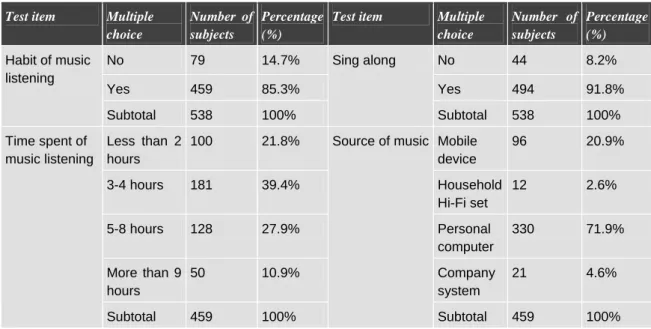
表 3 為 538 位受測者聆聽音樂習慣所整理之資料,分述如下。85.3%的受測者進行 設計活動時有聽音樂的習慣,驗證研究者觀察設計師在從事設計活動普遍有聽音樂的現 象。有聽音樂習慣之受測者,一天聽音樂時間 3-4 小時者占最多數,有 39.4%的受測者。
其次 27.9%的受測者聽音時間 5-8 小時,聽音樂時間超過 9 小時以上者有 10.9%的受測 者,顯示多數受測者每天聽音樂的時間相當長。應用「電腦播放音樂」是最多受測者們 經常聽取音樂的方式,有 71.9%的受測者採用此種方式,其次是 20.9%的受測者採用「隨 身播放裝置」聽取音樂。超過 9 成的受測者表示,在聽音樂的過程中有跟著音樂「哼哼 唱唱」的經驗,這顯示受測者聽音樂時都很投入。
表3. 聽音樂習慣
檢測項目 評選項目 受測人數 百分比 檢測項目 評選項目 受測人數 百分比
無聽音樂 79 14.7% 哼唱經驗 沒有 44 8.2%
有聽音樂 459 85.3% 有 494 91.8%
聽音樂習慣
合計 538 100% 合計 538 100%
2小時以內 100 21.8% 聽音樂來源 隨身播放裝置 96 20.9%
3-4小時 181 39.4% 家庭音響 12 2.6%
5-8小時 128 27.9% 電腦播放 330 71.9%
9小時以上 50 10.9% 公司播放 21 4.6%
聽音樂時間
合計 459 100% 合計 459 100%
7
5-2 聽音樂對設計之效益
從表 4 可以看出,64.3%的受測者認為在從事設計活動過程中聽音樂具有正面的效 益,35.7%的受測者抱著中立的態度,僅有 5 位受測者持負面的看法。並且有 90.5%的 受測者有聽音樂產生聯想的經驗,顯示聆聽音樂時樂曲的旋律經由聽覺神經將訊息傳遞 至大腦,引起過去的聽覺經驗產生的現象,因而聽音樂引發聯想及回憶是多數設計師的 經驗。許多受測者認為聽音樂對於設計之構想發展階段的幫助最大,占全體受測者 38.1%,其次為模型製作階段占 24.2%,如表 5 所示。
表4. 聽音樂對設計效益之態度與聯想經驗
檢測項目 評選項目 受測人數 百分比 檢測項目 評選項目 受測人數 百分比
負面效益 5 0.9% 沒有 51 9.5%
中立 192 35.7% 有 487 90.5%
正面效益 341 64.3%
聽音樂產生聯 想經驗
合計 538 100%
聽 音 樂 對 設計 是否有益
合計 538 100%
表5. 聽音樂最有益之設計階段
設計階段 資料收集 構想發展 細部設計 3D建檔 模型製作
分數 86 205 29 88 130
百分比 16.0% 38.1% 5.4% 16.3% 24.2%
排序 4 1 5 3 2
關於聽音樂對設計效益認同度檢測,以李克尺度 7 向度量表檢測結果如表 6 所示。
以「聽音樂有助於提升工作效率」的平均值為 5.086,獲得較高的認同程度,與 Lesiuk(2005) 的研究指出聽音樂對於軟體程式設計師工作績效有正面幫助的結果相同。其次是「聽音 樂有助於提升設計風格聯想」獲得受測者第二高的認同度,其平均值為 4.855,而「聽 音樂有助於設計構想產出」的設計認同度平均值為 4.730。以上的檢測項目其平均值都 接近 5 的等級,顯示受測者對於聽音樂有助於提升工作效率、設計風格聯想與設計構想 產出皆有高度的認同感。
表 6.聽音樂對設計效益認同度描述性統計
檢測項目 個數 平均值 標準差
聽音樂有助於提升工作效率 538 5.086 1.293
聽音樂有助於設計風格聯想 538 4.855 1.381
聽音樂有助於設計構想產出 538 4.730 1.401
應用單因子變異數分析(one way ANOVA)檢定受測樣本之背景資料與受測者聽音樂 習慣,引發設計助益認同度之評量項目關係,結果顯示受測者之職稱、年齡、工作經驗、
聽音樂習慣、聽音樂時間、哼唱經驗等 p 值<0.05 達顯著性差異。將達顯著性差異之變 項施以 Duncan 進行事後檢定,以了解不同群組間之差異趨向,彙整如表 7 所示,分述
8
如下。
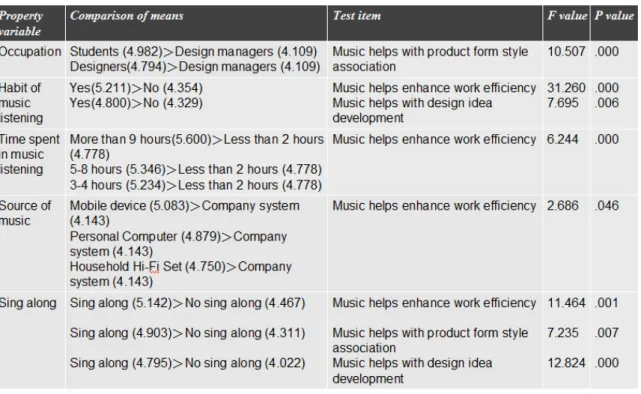
在「聽音樂有助於設計風格聯想」之認同度方面,學生的認同度(4.982)明顯高於設計主 管的認同度(4.109),年齡 25 歲以下的受測認同度(4.978)者明顯高於 41 歲以上的受測者 認同度(4.235),工作經驗 3 年以下設計師的認同度(4.974)明顯高於工作資歷超過 10 年 以上資深設計師的認同度(4.316),顯示學生、年齡 25 歲以下以及工作經驗 3 年以下的 設計師,對於「聽音樂有助於設計風格聯想」有較高的認同度。在「聽音樂有助於提升 工作效率」之認同度方面,受測者有聽音樂習慣之認同度(5.211)明顯高於無聽音樂習慣 之認同度(4.354),並且聽音樂時間超過 9 個小時以上之認同度(5.600)與 5-8 小時之認同 度(5.346)明顯高於聽音樂 2 小時以下的受測者之認同度(4.778),可見有聽音樂習慣與聽 音樂時間較長的受測者,對於「聽音樂有助於提升工作效率」的認同度較高。並且有聽 音樂習慣的受測者在「聽音樂有助於設計構想產出」方面,有聽音樂習慣之設計師認同 度(4.800)也明顯高於無聽音樂習慣之設計師認同度(4.329)。特別的是,有哼唱經驗者對 於「聽音樂有助於提升工作效率」之認同度(5.142) 明顯高於無哼唱經驗者之認同度 (4.467),在「聽音樂有助於設計風格聯想」方面,有哼唱經驗者之認同度(4.903) 明顯 高於無哼唱經驗者之認同度(4.311),以及在「聽音樂有助於設計構想產出」方面,有哼 唱經驗者之認同度(4.759) 也明顯高於無哼唱經驗者之認同度(4.022)。可見有哼唱經驗 者,對於「聽音樂有助於提升工作效率」、「聽音樂有助於設計風格聯想」與「聽音樂有 助於設計構想產出」皆有較高的認同度。
以上顯示,參與調查的設計師相當認同聽音樂對設計產生的效益。學生、年紀較輕 與工作經驗較少的設計師,可能期望藉由聽音樂進行多方面的探索與擴大體驗層面,以 彌補經驗不足之處,因此對於聽音樂有助於設計風格聯想有較高的期許。有聽音樂習慣 及聽音樂時間較長的設計師,經常接觸音樂接觸且聽音樂時間較長,比較能夠體會聽音 樂的益處,故高度認同聽音樂有助於提生工作效率。尤其是有哼唱經驗的受測者,在哼 唱過程沉浸在音樂之中,感受到樂曲傳達的訊息而有多方面的聯想,提升了設計構想產 出,進而提升了工作效率,因而對聽音樂產生的效益有較高的認同度。
表7. 聽音樂對設計效益認同度達顯著性差異彙整表
屬性變項 平均數差異比較 檢測項目 F值 P值
職稱 學生(4.982)>設計主管(4.109) 聽音樂有助於設計風格聯想 10.507 .000
年齡 25歲以下(4.978)>41歲以上(4.235) 聽音樂有助於設計風格聯想 3.757 .011
工作經驗 3年以下(4.974)>10年以上(4.316) 聽音樂有助於設計風格聯想 3.949 .008
聽音樂習慣 有聽音樂(5.211)>無聽音樂(4.354) 有聽音樂(4.800)>無聽音樂(4.329)
聽音樂有助於提升工作效率 聽音樂有助於設計構想產出
31.260 7.695
.000 .006 聽音樂時間 9小時以上(5.600)>2小時以下(4.778)
5~8小時(5.346)>2小時以下(4.778)
聽音樂有助於提升工作效率 6.244 .000
哼唱經驗 有哼唱(5.142)>無哼唱(4.467) 有哼唱(4.903)>無哼唱(4.311) 有哼唱(4.795)>無哼唱(4.022)
聽音樂有助於提升工作效率 聽音樂有助於設計風格聯想 聽音樂有助於設計構想產出
11.464 7.235 12.824
.001 .007 .000
9
5-3 聽特定音樂對設計聯想之認同度
關於聽特定音樂對設計聯想力之認同度調查,以李克尺度 7 向度量表進行檢測,結 果如表 8 所示。受測者對於「聽異國音樂有助於聯想到該國的民情風俗」之認同度平均 值(5.409),「聽地方色彩濃厚的音樂有助於聯想到當地文化特色」之認同度平均值 (5.455),顯示受測者有高度認同感。North、Hargreaves 和 McKendrick(1999)研究調查指 出,具有地方特色的音樂會讓人們產生國籍的聯想,支持了本研究受測者的想看法。在
「聽歌唱音樂的歌詞會引發聯想到歌詞所敘述的情境」之認同度平均值為(5.669),呈現 出受測者給予高度認同。如同 Anderson、Carnagey 和 Eubanks(2003)的研究指出,歌詞 會影響人們的認知,因此歌詞的暗示作用引發設計師產生聯想,故受測者對此有較高的 認同感。受測者對於「聽設計目標族群喜好的音樂有助於聯想他們的生活經驗」之認同 度平均值(5.134),「聽樂器音樂可以產生較廣泛的聯想」的認同度平均值(4.935)也接近 5,而「聽快樂音樂可以產生較多的聯想」則呈現(4.657)的認同度平均值。從以上的調 查結果顯示,受測者對於聽特定音樂引發聯想力的諸多現象皆有高度認同感。
表 8.聽特定音樂引發聯想力之認同度描述性統計
檢測項目 個數 平均值 標準差
聽設計目標族群喜好的音樂有助於聯想他們的生活經驗 538 5.134 1.446
聽異國音樂有助於聯想到該國的民情風俗 538 5.409 1.300
聽地方色彩濃厚的音樂有助於聯想到當地文化特色 538 5.455 1.287
聽歌唱音樂的歌詞會引發聯想到歌詞所敘述的情境 538 5.669 1.244
聽樂器音樂可以產生較廣泛的聯想 538 4.935 1.554
聽快樂音樂可以產生較多的聯想 538 4.657 1.446
再應用單因子變異數分析(one way ANOVA)檢定受測樣本之背景資料與聽音樂習 慣,引發聽特定音樂對設計聯想力與創意構想之影響,結果顯示受測者之職稱、工作經 驗、哼唱經驗等 p 值<0.05 達顯著性差異。茲將達顯著性差異之變項施以 Duncan 事後 檢定,彙整如表 9 所示,分述如下。
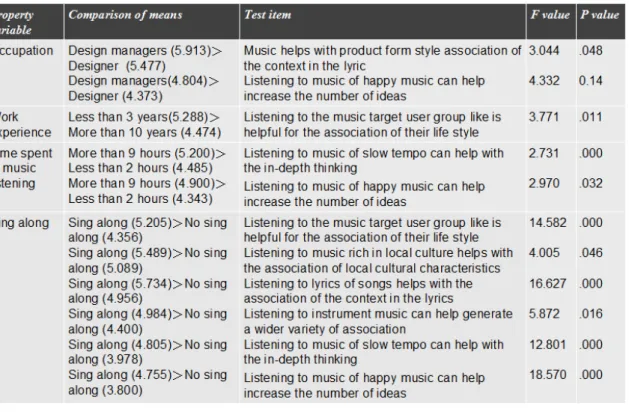
在職稱方面,參與問卷調查之設計主管、設計師與學生對於「聽歌唱音樂的歌詞會引發 聯想到歌詞所敘述的情境」皆有很高的認同度,但設計主管之認同度(5.913)明顯高於設 計師之認同度(5.477)。在工作經驗方面,對於「聽設計目標族群喜好的音樂有助於聯想 他們的生活經驗」的認同度,工作經驗 3 年以下的設計師之認同度(5.288),明顯高於工 作經驗 10 年以上的設計師之認同度(4.474),呈現出工作經驗較少者認同度較高,可能 是工作經驗較少的設計師,期望藉由聽音樂提升設計聯想力,以彌補經驗不足之處所 致。在聽音樂過程產生哼唱經驗方面,對於「聽設計目標族群喜好的音樂有助於聯想他 們的生活經驗」之認同度,有哼唱經驗者之認同度(5.205)明顯高於無哼唱經驗者之認同 度(4.356)。在「聽地方色彩濃厚的音樂有助於聯想到當地的文化特色」之認同度,有哼 唱經驗者與無哼唱經驗者皆有高度的認同度,而有哼唱經驗者之認同度(5.498)明顯高於 無哼唱經驗者之認同度(5.089)。在「聽歌唱音樂的歌詞會引發聯想到歌詞所敘述的情境」
10
之認同度,有哼唱經驗者之認同度(5.734)明顯高於無哼唱經驗者之認同度(4.956)。關於
「聽樂器音樂可以產生較廣泛的聯想」之認同度,有哼唱經驗者之認同度(4.984)明顯高 於無哼唱經驗者之認同度(4.400)。顯示有哼唱經驗的受測者比無哼唱經驗者,在多項聽 特定音樂對聯想力之檢測項目有較高的認同度。
表9. 聽特定音樂引發聯想力之認同度達顯著性差異彙整表
屬性變項 平均數差異 比較檢測項目 F值 P值
職稱 設計主管(5.913)>設計師(5.477) 歌唱音樂的歌詞會引發聯想到歌詞所敘述的情境 3.044 .048
工作經驗 3年以下(5.228)>10年以上(4.474) 聽設計目標族群喜好的音樂有助於聯想他們的生 活經驗
3.771 .011
哼唱經驗 有哼唱(5.205)>無哼唱(4.356) 有哼唱(5.489)>無哼唱(5.089) 有哼唱(5.734)>無哼唱(4.956) 有哼唱(4.984)>無哼唱(4.400)
聽設計目標族群喜好的音樂有助於聯想他們的生 活經驗
聽地方色彩濃厚音樂有助於聯想到當地文化特色 歌唱音樂的歌詞會引發聯想到歌詞所敘述的情境 聽樂器音樂可以產生較廣泛的聯想
14.582 4.005 16.627
5.872 .000 .046 .000 .016
上述結果呈現,人生歷練豐富的設計主管,高度認同音樂之歌詞會引發聯想到所敘述的 情境。工作經驗較少的設計師,希望聆聽與設計目標族群相同喜好的音樂,有助於聯想 他們的生活經驗。尤其是聽音樂過程有哼唱經驗的受測者,在哼唱過程中隨著音樂歌詞 敘述的故事,樂曲之旋律、曲調、節奏起伏等音樂的特性,在與音樂互動過程中,特別 容易感受到聽音樂對於設計聯想力產生的影響,因而有著較高的認同度。然而以上的現 象,有賴於未來研究施以實驗方式獲得證實。
5-4 音樂類型與設計風格聯想
基於人們平常所聽的音樂類型並不局限於一種,以及音樂意象的感知是多重的,因 此音樂類型與設計風格聯想調查採用複選的方式,受測者可複選(1-5 種)他們認同的音樂 類型,結果如表 10 所示。「西洋流行音樂」是最多受測者經常聽的音樂,約有 57%的受 測者,其次是「華語流行音樂」有 55%的受測者,第三是「電影/電視原聲、配樂」有 50%的受測者。顯示流行音樂廣為受測者歡迎,並且受測者並不特別偏好本國音樂。比 較能想起特定事物之音樂類型,以「華語流行音樂」獲得最多受測者認同,大約有 55%
的受測者,其次是「懷念老歌」獲得 48%受測者認同,第三是「電影/電視原聲、配樂」
獲得 47%的受測者支持。
產生前衛風格的聯想的音樂類型,以「重搖滾與金屬音樂」獲得最多的認同度,獲 得 205 位受測者支持,其次是「搖滾樂」獲得 199 位受測者認同,兩者約占 37%得受測 者,第三是「電子音樂/電音舞曲」獲得 33%受測者贊同。產生簡約風格聯想之音樂類 型,以「新世紀音樂」獲得最多受測者認同,計有 27%。其次是「藍調音樂」獲得 138 位受測者贊同,第三是「古典音樂」獲得 135 位受測者認同,兩者約占 25%的受測者。
產生活潑風格聯想之音樂類型,受到最多認同的是聽「搖滾樂」,獲得 38%受測者認同,
其次有 35%得受測者認為聽「饒舌與嘻哈音樂」,第三是聽「西洋流行音樂」有 33%受
11
測者支持。產生華麗風格聯想的音樂類型,以聽「歌劇與聲樂」得到超過 60%的受測者 認同,其次是聽「古典音樂」獲得 34%受測者支持。
雖然聽音樂感受是個別的主觀經驗呈現,然而本研究調查顯示,多數受測者經常聽的音 樂類型有其共通性,並且音樂類型和設計風格聯想也呈現出某種程度的相關性,顯示聽 某幾種音樂確實會引起受測者某些特定的設計風格聯想。以上發現結果將於未來採用實 驗方式,挑選適當的音樂類型驗證與設計風格聯想的相關性。
表10. 音樂類型與設計風格聯想 音樂類型 藍調音樂 古典音樂 西洋鄉村音樂 電子音樂
/ 電
音舞曲 宗教音樂 民謠 / 民俗音
樂 重搖滾與金屬音樂 爵士音樂 新世紀音樂 歌劇與聲樂 西洋流行音樂 節奏藍調音樂 饒舌與嘻哈音樂 雷鬼音樂 搖滾樂 電影 / 電視原
聲、配 華語流行音樂 懷念老歌 中國音樂 世界音樂 ( 非 西方音 其他
(
)
經常聽的音樂
類型 154 146 113 88 9 40 97 166 102 41 *
305 127 107 41 200 * 271
*
298 117 22 50 29 百分比 29% 27% 21% 16% 2% 7% 18% 31% 19% 8% 57% 24% 20% 8% 37% 50% 55% 22% 4% 9% 5%
較能想起特定
事物之音樂 67 69 77 17 39 65 44 62 35 54 148 38 31 19 68 * 251
* 296
*
256 36 20 9 百分比 12% 13% 14% 3% 7% 12% 8% 12% 7% 10% 28% 7% 6% 4% 13% 47% 55% 48% 7% 4% 2%
產生前衛風格
聯想之音樂 30 10 3
*
177 6 5 *
205 63 75 10 125 71 167 110 *
199 45 44 2 1 18 6 百分比 6% 2% 1% 33% 1% 1% 37% 12% 14% 2% 23% 13% 31% 20% 37% 8% 8% 0% 0% 3% 1%
產生簡約風格 聯想之音樂
* 138
*
135 131 22 40 65 3 117 *
147 16 29 72 4 3 8 36 10 49 21 27 9 百分比 25% 25% 24% 4% 7% 12% 1% 22% 27% 3% 5% 13% 1% 1% 1% 7% 2% 9% 4% 5% 2%
產生活潑風格
聯想之音樂 23 7 99 78 3 90 57 63 18 14
*
179 105 *
187 103 *
203 76 128 7 4 14 11 百分比 4% 1% 18% 14% 1% 17% 11% 12% 3% 3% 33% 20% 35% 19% 38% 14% 24% 1% 1% 3% 2%
產生華麗風格
聯想之音樂 37
*
185 9 59 16 14 72 90 60 *
328 55 37 33 17 71 68 26 10 32 15 5 百分比 7% 34% 2% 11% 3% 3% 13% 18% 11% 61% 10% 7% 6% 3% 13% 13% 5% 2% 6% 3% 1%
表格內的數字表示該項音樂類型之認同人數,表格內%表示該項音樂類型之認同人數占全體受測者之百分比。
*之符號表示前三項認同之音樂類型,而且超過全體之25%受測者認同。
六、結論
本研究探討設計師在設計活動中聽音樂對於設計效益及聯想力產生的影響,經研究 分析調查結果可歸納出以下幾點結論。
1. 大多數參與調查的設計師工作時有聽音樂習慣,而近八成的設計師聽音樂的時間長 達 3 個小時以上。設計師聽音樂的來源以應用電腦播放音樂者居多,並且在聽音樂 過程中有哼唱經驗者占多數,可見音樂與設計師關係之密切。
2. 多數的受測者同意聽音樂對設計活動是有益的。同時有 90.5%的受測者有聽音樂產
12
生聯想的經驗,顯示聽音樂引發聯想及回憶是多數設計師的經驗,而較多的受測者 認為聽音樂對於設計流程之構想發展階段之助益最大。聽音樂對設計效益受測者皆 有高度認同感,而學生、年紀輕、工作資歷淺的受測者,對於聽音樂有助於設計風 格聯想有較高的期望。受測者與音樂的互動關係影響了聽音樂對於設計助益認同 度,聽音樂時間較長的受測者,對於聽音樂有助於提升工作效率之認同度較高。而 設計時有聽音樂習慣的受測者,除了認同音樂有助於提升設計效率之外,對於聽音 樂有助於設計構想產出也有高度認同。特別是聽音樂過程有哼唱經驗的受測者,對 於聽音樂有助於提升工作效率、聽音樂有助於產生設計聯想與聽音樂有助於設計構 想產出,皆有較高的認同度。
3. 受測者對於聽特定音樂引發聯想力有高度認同感,先前的聽覺經驗有助於聽音樂過 程投射出各種不同的影像,受測者認同聽地域性鮮明的音樂有益於引發特定聯想,
如「聽異國音樂有助於聯想到該國的民情風俗」,「聽地方色彩濃厚的音樂有助於聯 想到當地的文化特色」。並且對於「聽設計目標族群喜好的音樂有助於聯想他們的生 活經驗」,「聽歌唱音樂的歌詞會引發聯想到歌詞所敘述的情境」有高度認同感。也 對於「聽樂器音樂可以產生較廣泛的聯想」,有很高的認同度。而設計資歷淺的受測 者,對於「聽設計目標族群喜好的音樂有助於聯想他們的生活經驗」,有較高的認同 度,並且參與調查之設計主管高度認同「聽歌唱音樂的歌詞會引發聯想到歌詞所敘 述的情境」。尤其是有哼唱經驗者,在與音樂互動過程特別容易感受到聽音樂產生的 聯想力,除了與設計資歷較淺和設計主管有相同看法之外,也對於「聽地方色彩濃 厚的音樂有助於聯想到當地的文化特色」及「聽樂器音樂可以產生較廣泛的聯想」, 有高度認同感。
4. 音樂類型和設計風格聯想有某種程度的相關性,多數受測者認為聽「重搖滾與金屬 音樂」會產生前衛風格聯想。產生簡約風格聯想之音樂類型,以聽「新世紀音樂」
獲得最多受測者支持。產生活潑風格聯想之音樂類型,以聽「搖滾樂」得到最多受 測者認同。而多數的受測者認為聽「歌劇與聲樂」會產生華麗風格影響。
從上述的結論中顯示,聽音樂對設計活動是有益的,以及聽音樂引發聯想及回憶是 多數設計師的經驗。因此,設計主管對於設計師聽音樂的行為,在不干擾其他同仁工作 狀態下,應給予適度支持與引導。對於設計經驗較少的設計師及學生,經由聆聽不同類 型的音樂可增加不同的體驗,可能有助於提升設計效益及聯想力。至於聽何種音樂類型 對於聯想力的幫助較多,以及聽何種類型音樂對於哪一種設計風格之助益較大,將於後 續研究中以實驗法驗證。
誌謝
本文感謝國科會計畫 NSC 100-2410-H-001-032 給予部分經費補助。
參考文獻
王曉朝(譯) (2007) Plato 著。斐多篇。台北市。左岸文化。
13
毛連塭、郭有遹、陳龍安、林幸台著 (2000)。創造力研究。台北市:心理出版社。
朱光潛 (1979)。文藝心理學。台北縣:漢京文化。
朱光潛 (2003)。談美。台北縣: 名田文化。
李乙明、李淑貞(譯) (2005)。Sternberg 著。創造力。台北市。五南。
汪清彥、林芳蘭、吳佳慧、張乃文、張初穗、蔡安悌 (2003)。音樂與治療。台北縣:星 定石文化。
張春興 (2002)。現代心理學。台北市:東華書局。
郭長揚 (1996)。音樂美的尋求。台北市:樂韻出版社。
郭美女 (2000)。聲音與音樂教育。台北市:五南圖書。
劉盈君 (譯) (2008)。W. Lotherington 著。創意沒甚麼大不了。台北市: 天下雜誌。
鄧建國、莊明振 (2008)。應用情感喚醒的造形聯想設計模式探討。設計學報,13(3),
81-97。
Anderson, C. A., Carnagey, N. L., & Eubanks, J. (2003). Exposure to Violent Media: The Effects of Songs with Violent Lyrics on Aggressive Thoughts and Feelings. Journal of Personality and Social Psychology, 84(5), 960-971.
Areni, C. S., & Kim, D. (1993). The influence of background music on shopping behavior:
Classical versus top-forty music in a wine store. Advances in Consumer Research 20, 336-340.
Aristotle, Beare, J. I.(Trans)(2008), On Memory and Reminiscence. Retrived October 11, 2011, from The University of Adelaide Library Web site:
http://ebooks.adelaide.edu.au/a/aristotle/memory/
Barron, f. (1969). Creativity person and creative process. New York: Holt, Rinehart and Winston.
Baumgartner, T., Esslen, M., & Jäncke, L. (2006). From emotion perception to emotion experience: Emotions evoked by pictures and classical music. International Journal of Psychophysiology, 60(1), 34-43.
Eckert, C., & Stacey, M. (2000). Source of inspiration: a language of design. Design Studies, 21(5), 523-538.
Eysenck, M. W., & Keane, M. T. (2000). Cognitive psychology : a student's handbook (4 ed.).
New York: Psychology Press.
Fox, J. G., & Embrey, E. D. (1972). Music -- an aid to productivity. Applied Ergonomics, 3(4), 202-205.
Hume, D. (1748). An Enquiry Concerning Human Understanding. Retrived February 21, 2012, from The University of Adelaide Library Web site:
http://ebooks.adelaide.edu.au/h/hume/david/h92e/
Jacob, C. l., Gue´guen, N., Boulbry, G. l., & Sami, S. (2009). ‘Love is in the air’: congruence between background music and goods in a florist. The International Review of Retail, Distribution and Consumer Research, 19(1), 75-79.
14
Koestler, A. (1964). The Act of Creation. New York: The Macmilla.
Lesiuk, T. (2005). The effect of music listening on work performance. Psychology of Music, 33(2), 173-191.
Locke, J. (1700). An Essay Concerning Human Understanding. Retrived October 24, 2011, from The University of Adelaide Library Web site:
http://ebooks.adelaide.edu.au/l/locke/john/l81u/B3.html
Lowis, M. J. (2002). Music as a Trigger for Peak Experiences Among a College Staff Population. Creativity Research Journal, 14, 351-359
Mednick, S. A. (1962). The Associative Basis of The Creative Process. Psychological Review, 69(3), 220-232.
Milliman, R. E. (1982). Using Background Music to Affect the Behavior of Supermarket Shoppers. Journal of Marketing, 46, 86-91.
North, A. C., & Hargreaves, D. J. (1998). The Effect of Music on Atmosphere and Purchase Intentions in a Cafeteria. Journal of Applied Social Psychology, 28(24), 2254-2273.
North, A. C., Hargreaves, D. J., & McKendrick, J. (1999). The influence of in-store music on wine selections. Journal of Applied Psychology, 84(2), 271-276.
Oldham, G. R., Cummings, A., Mischel, L. J., Schmidtke, J. M., & Zhou, J. (1995). Listen While You Work? Quasi-Experimental Relations Between Personal-Stereo Headset Use and Employee Work Responses. Journal of Applied Psychology, 80(5), 547-564.
Oxman, R. (1990). Prior knowledge in design: a dynamic knowledge-based model of design and creativity. Design Studies, 11(1), 17-28.
Rentfrow, P. J., & Gosling, S. D. (2003). The Do Re Mi's of Everyday Life: The Structure and Personality Correlative of Music Preferences. Journal of Personality and Social Psychology, 86(6), 1236-1256.
Reybrouck, M. (2001). Musical Imagery between Sensory Processing and Ideomotor Simulation. In R.I.Godøy & H.Jörgensen (Eds.), Musical Imagery. Lisse: Swets &
Zeitlinger, 117-136.
Roozenburg, N. F. M., & Eekels, J. (1995). Product Design: Fundamentals and Methods.
England: John Wiely & Sons.
Schäher, T., & Sedlmeier, P. (2009). From the functions of music to music preference.
Psychology of Music, 37(3), 1-22.
Spearman, C. (1930). Creative Mind. London: NISBET .
Warren, H. C. (1921). A History of the Association Psychology. New York: Charles Scribner's Sons.
Yeoh, J. P. S., & North, A. C. (2010). The effect of musical fit on consumers' memory.
Psychology of Music, 38(3), 368-378.
16
附錄
本計畫已有論文發表於 2012 Design Research Society (DRS) international conference Bangkok,其內容如下。
The effects of music on designer’s association ability
Wen-chih Changa, Chi-Meng Liaoa
aNational Taiwan University of Science and Technology
Many designers have made it a rule to listen to music in their design routines. It is, therefore, an issue worth investigation whether music will influence designer’s behaviors in designing activity. In this study, designers were first interviewed and then a total of 538 subjects, including design students, product designers, and design managers were interviewed for a survey. Major findings from the study as follow.
(1) Most designers have the habit of listening to music in their design activity. More than 60% of subjects claimed a positive effect of music. (2) Subjects considered music would be helpful to every design stage, especially at the idea development stage. (3) Designers’ attitudes towards music and their interaction with music influence the viewpoint that music is helpful for design. Those with positive view and higher interactions with music have a higher degree of agreement on the positive effect of music. (4) Specific category of music will trigger designer’s association and the tempo of music will influence the designer’s creative thinking. (5) Specific category of music is helpful for designers to have association of special product styles. For instance, hard rock and metal music, rock, as well as dance and electronic music are more likely to trigger futuristic style.
Keywords : design activity, music, association, utility to design, product styles
Introduction
From the morning call of the alarm clock, people like to listen to some pieces of music on their way to the office or school, to kill time when they are waiting for the traffic signal to change, after work or on the way home. It is a sharing experience for everyone to relax his or her mind and body to listen to music.
Schäfer and Sedlmeier (2009) invited 170 German college students to rate their musicality and found that music play a very imortant role in their life; averagely, German college students spent about three hours listening to music. This indicates that music is closely related to our everyday life.
Regarding the effects of music in our life, many scholars claim that music has positive effects. In promoting work performance, Fox and Embrey (1972) reported that music could influence the efficiency of operators carrying out visual quality control tasks. Moreover, Oldham, Oldham, Cummings, Mischel, Schmidtke and Zhou (1995) claimed that employees in the stereo condition exhibited significant improvements in their performance. Music can also help push customers to buy commodity(e.g., Milliman,1982; Jacob, Gue´guen, Boulbry and Sami,2009). Particularly, Rauscher, Shaw and Ky (1993) found that the subjects performed better on the abstract/spatial reasoning tests after listening to Mozart
17
than after listening to eithr the relaxation tape or to nothing. An emotion brain study made by Baumgartner, Esslen and Jäncke (2006) revealed that music could significantly enhance the emotional experience evoked by affective pictures. Listening to relaxing music can prevent subjective anxiety, blood pressure, and heart rate in healthy males and females (Knight & Rickard, 2001). Furthermore, Kreutz, Ott, Teichmann, Osawa and Vaitl (2008) maintained that happy and peaceful categories of music could trigger strong and positive emotion. As far as effects of music on design is concerned, Lesiuk (2005) invited 56 software designers at four Canadian companies for five weeks and found that listening to music had a positive impact upon work performance and could lead to a higher degree of satisfaction with their duties.
However, negative effects of music have also been claimed by scholars. For example, Ransdell and Gilroy (2001) reported that background music would significantly disrupt writing fluency and efficiency.
If college students listen to violent songs, they would feel more hostile than those who heard a similar but nonviolent song (Anderson, Carnagey and Eubanks, 2003). At last, Cassidy and Macdonald (2007) claimed that performance was lessened across all cognitive tasks in the presence of background music or noise compared to silence. The above mentioned studies on music indicate the diversity of functions of music. In product design, however, how music influences the designer’s job is an issue worth in-depth investigation.
Design is a creative goal-directed thinking process in which designers applied what they have learned under some constraints (Roozenburg and Eekels, 1995). Human beings are unable to make something out of nothing and their act of creation involves a reshape of given knowledge (Barron, 1969). In the associative basis of the creative process proposed by Mednick (1962), association falls between elements that are more remote and is more likely to lead to creative solutions. Therefore, the idea we get often comes from the connection of two other things we already know about (Lotherington, 2007).
Some study shows that the presence of visual stimuli and their nature have an effect on quality of the solutions they arrive at (Goldschmidt and Smolkov, 2006). And according to Goldschmidt and Serve (2011), the reading of different types of text containing ideas can be inspiring and enhances originality and creativity. Hence, listening to some certain category of music in design activity may help us link to the experience and knowledge we already possess and work out ideas appropriate for the goal of design project. It is, therefore, worth investigating the effects of specific categories of music have on design.
Method
The study is conducted in two stages. At Stage 1, 13 subjects, including design students, designers, and design managers, were interviewed by a semi-structured questionnaire from which the format of survey was decided. At Stage 2, a questionnaire survey was carried out to explore the status of how designers listen to music and the effect music has on their association activity.
Questionnaire design
The questionnaire is composed of questions for habits in listening to music, benefits to design from listening to music, effects of listening to specific music on design association and idea development, and the association of categories of music with design styles. From previous interview, most designers interviewed were not much familiar with the classification of music, the classification systems of music in popular websites such as Amazon (http://www.amazon.com) and Taiwan Eslite (http://www.eslite.com) were adopted and an “other” choice was added for the subjects to fill in for the shortage of the category of music. The category of music adopted in this study is listed in Table 1.
○ 01. Blues ○ 08. Jazz ○ 15. Rock
○ 02. Classical music ○ 09. New age ○ 16. Soundtracks
○ 03. Western Country ○ 10. Opera & Vocal ○ 17. Chinese pop
○ 04.Electronic/Dance& Electronic ○ 11. Western pop ○ 18. Old songs
○ 05. Gospel ○ 12. R&B ○ 19. Chinese music
○ 06. Folk music ○ 13. Rap & Hip-Hop ○ 20. World music (non-western)
○ 07. Hard Rock & Metal ○ 14. Reggae ○ 21. Other ( ) Table 1. Categories of music
The execution of questionnaire survey
A purposive sampling was adopted in this study. A total of 555 subjects were interviewed, including junior and senior design students from 6 universities, designers and design managers at ten design departments and nine design houses in Taiwan. The valid questionnaires are 538 obtained. The subject profile is listed in Table 2. The survey was conducted from March to April 2011 by paper hard copies; a few were made by email.
Table 2. Basic data of the subjects
Results and analysis
Habits designers have in listening to music
Table 3 shows the result of designers’ habits of music listening. 459 subjects (85.3%) have the habit of listening to music in their design routines, indicating the popularity of listening to music in design activity.
Most of these subjects spend 3-4 hours a day in listening to music. And 71.9% subjects use their personal computers to play music. More importantly, more than 90% subjects report that they will sing along with the music they play. This indicates that there exist frequent interactions between designers and music.
18
19 Test item Multiple
choice
Number of subjects
Percentage (%)
Test item Multiple choice
Number of subjects
Percentage (%)
No 79 14.7% No 44 8.2%
Yes 459 85.3% Yes 494 91.8%
Habit of music listening
Subtotal 538 100%
Sing along
Subtotal 538 100%
Less than 2 hours
100 21.8% Mobile
device
96 20.9%
3-4 hours 181 39.4% Household
Hi-Fi set
12 2.6%
5-8 hours 128 27.9% Personal
computer
330 71.9%
More than 9 hours
50 10.9% Company
system
21 4.6%
Time spent of music listening
Subtotal 459 100%
Source of music
Subtotal 459 100%
Table 3. Habit of music listening
Benefit to design from listening to music
The results of the effects music has on design are listed in Table 4. In the subjects, 64.3% report a positive effect of music on design; 35.7% hold a neutral attitude; only five subjects have a negative point of view. This indicates that most subjects agree that music is helpful for design activity.
Meanwhile, 90.5% subjects have the experience of association from music, reflecting that most subjects feel that music will touch their hearts and help trigger their association and recall. In addition, Table 5 also demonstrates subjects considered music would be helpful to every design stage but most subjects (38.1%) consider music help most at the idea development stage.
Test item Multiple choice Number of subjects Percentage (%)
Negative effect 5 0.9%
Neutral 192 35.7%
Positive effect 341 64.3%
Does listening to music Good to design
Subtotal 538 100%
No 51 9.5%
Yes 487 90.5%
Experience of Association from music
Subtotal 538 100%
Table 4. Effect of music on design
Design stage Data collection Idea development
Detail design
3D modeling Model making
Subtotal
Number 86 205 29 88 130 538
Percentage (%) 16.0% 38.1% 5.4% 16.3% 24.2% 100%
Ranking order 4 1 5 3 2