行政院國家科學委員會專題研究計畫 成果報告
WiMAX 與 Mobile WiMAX 之研究 - 公平排程機制、單一連 線類型下之 PSC I 節能機制以及考慮異質連線類型共存之
PSC I 節能機制的設計與整合 研究成果報告(精簡版)
計 畫 類 別 : 個別型
計 畫 編 號 : NSC 100-2221-E-011-108-
執 行 期 間 : 100 年 08 月 01 日至 101 年 07 月 31 日 執 行 單 位 : 國立臺灣科技大學資訊工程系
計 畫 主 持 人 : 馮輝文
報 告 附 件 : 出席國際會議研究心得報告及發表論文
公 開 資 訊 : 本計畫可公開查詢
中 華 民 國 101 年 10 月 09 日
中 文 摘 要 : 於本計畫,我們提出適用於行動 WiMAX 非即時性連線之能源 節省類型 I 的預測式動態睡眠時間規劃節能機制,其利用預 測之封包間隔時間以動態地規劃行動用戶站之睡眠模式,讓 行動用戶站可於適當的時間清醒以服務封包,而在其它時間 則儘量處於睡眠狀態中,以達到同時改善封包延遲與能源節 省的效果。
中文關鍵詞: 節能機制, 睡眠模式, IEEE 802.16e, 節能
英 文 摘 要 : In this project, three predictive and dynamic sleep time planning (PDSTP) energy-efficient mechanisms able to simultaneously improve energy efficiency and packet delay for IEEE 802.16e are designed. First of all, a prediction method is proposed to estimate when a mobile station (MS) should wake up because of the downlink packet arrival. With the predicted time instant, an MS is then allowed to sleep as much as possible using multiple maximum sleep intervals followed by a smaller sleep interval before the predicted time instant. After the predicted time instant, a few smaller sleep intervals with a trend of constant level (CL), exponential decrease (ED), or linear decrease (LD) can be further arranged for our three proposed mechanisms, namely, PDSTP-CL, PDSTP- ED, and PDSTP-LD. To react to the outlier of
prediction, exponential increase for sleep intervals can be extended. Via simulations, we show that PDSTP- CL not only performs better than PDSTP-ED and PDSTP- LD under general situations but also outperforms the standard sleep mode operation of the type-I power saving class (PSC-I) in IEEE 802.16e and the
exponential sleep time backoff mechanism (ESTBM) in the literature in terms of energy efficiency and packet delay.
英文關鍵詞: Energy-efficient mechanism, sleep mode, IEEE 802.16e, power saving
NSC Project Report
Study on WiMAX and Mobile WiMAX - Design and Integration of the Fair Scheduling Scheme, Energy-Efficient Mechanism for PSC I under a Single Type of Connection, and Energy-Efficient Mechanism for PSC I Considering Coexistence of
Heterogeneous Connections
Project Number: NSC 100-2221-E-011-108 Project Duration: 2011/07/31–2012/07/31
Project Investigator: Huei-Wen Ferng
Department of Computer Science and Information Engineering National Taiwan University of Science and Technology, Taipei 106, Taiwan
Abstract—In this project, three predictive and dynamic sleep time planning (PDSTP) energy-efficient mechanisms able to simultaneously improve energy efficiency and packet delay for IEEE 802.16e are designed. First of all, a prediction method is proposed to estimate when a mobile station (MS) should wake up because of the downlink packet arrival. With the predicted time instant, an MS is then allowed to sleep as much as possible using multiple maximum sleep intervals followed by a smaller sleep interval before the predicted time instant. After the predicted time instant, a few smaller sleep intervals with a trend of constant level (CL), exponential decrease (ED), or linear decrease (LD) can be further arranged for our three proposed mechanisms, namely, PDSTP-CL, PDSTP-ED, and PDSTP-LD.
To react to the outlier of prediction, exponential increase for sleep intervals can be extended. Via simulations, we show that PDSTP- CL not only performs better than PDSTP-ED and PDSTP-LD under general situations but also outperforms the standard sleep mode operation of the type-I power saving class (PSC-I) in IEEE 802.16e and the exponential sleep time backoff mechanism (ESTBM) in the literature in terms of energy efficiency and packet delay.
Index Terms—Energy-efficient mechanism, sleep mode, IEEE 802.16e, power saving.
I. I NTRODUCTION
In the past, the IEEE 802.11 wireless local area network (WLAN) [7], [8] has been widely deployed to provide conve- nient wireless access. However, its coverage is small because of some restrictions, e.g., power limitation, caused by the operation around 2.4 GHz of the industrial, scientific, and medical (ISM) radio band [7], [8]. On the other hand, the need of a high-speed mobile and wireless network is desirable as the mobile communications and services go rapidly. Targeting at offering a high-speed and reliable network with a wider service
Time MO
B_S LP _RSP MO B_S LP _REQ
1st S leep Perio d Listening
Win dow
List enin g
Win dow
List enin g
Win dow
Awake State Sleep State
Listen
State Sleep Listen
∫∫
∫∫ ∫∫
Sleep Listen Awake
Mode Sleep Mode
n-th Sleep Period 2nd Sleep
Period
Fig. 1. Two operational modes for IEEE 802.16e.
area, the IEEE 802.16 wireless metropolitan area network (WMAN) [9] was proposed in 2001 to fulfill the broadband wireless access (BWA) system for fixed subscriber stations (SSs). The IEEE 802.16 WMAN not only enlarges the service area but also increases the number of SSs. Since only fixed SSs are supported in IEEE 802.16, IEEE 802.16e [10] was proposed later for supporting MSs. To take care of mobility, IEEE 802.16e further addresses the handover process and sleep mode. Because batteries are main energy sources for MSs, how to save energy/power to prolong the operational time becomes an extremely important issue in IEEE 802.16e [24].
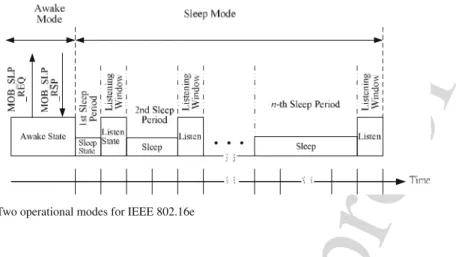
In the IEEE 802.16e WMAN, an MS does not always listen
to the base station (BS). It has awake and sleep operational
modes as shown in Fig. 1. An MS can transmit/receive data
in the awake mode, while the power of wireless interfaces is
temporarily switched off to save power when the MS is in the
sleep mode. There might be several sleep cycles in the sleep
mode. Each sleep cycle is formed by a listening window in
which the MS can still receive data and a sleep period in which no transmissions and receptions are allowed [10]. Note that the length of the listening window is quite short as compared to the length of the sleep period. For convenience, one usually associates the awake state and sleep state with the awake mode and sleep mode, respectively, to indicate the state of an MS.
In IEEE 802.16e, there are three power saving classes defined for different types of connection, i.e., PSC-I for the best effort (BE) and non-real-time variable rate (NRT-VR) with a variable length of the sleep period in a different sleep cycle, the type-II power saving class (PSC-II) for the unsolicited grant service (UGS) and real-time variable rate (RT-VR) with a fixed length of the sleep period, and the type-III power saving class (PSC-III) for management and multicast [4] with one sleep cycle only. To activate PSC-I, the MS sends MOB SLP REQ with related parameters, including the minimum sleep interval (T
min) which is the shortest length of a sleep period, to the BS when all packets are completely served and waits for the response (denoted by MOB SLP RSP) from the BS. If a positive response is gotten, then the MS enters the sleep mode using the negotiated parameters pertinent to the sleep mode.
Note that the minimum sleep interval is used during the first sleep cycle for PSC-I. Once the MS enters the sleep mode, it switches its state from the awake state to the sleep state. After the sleep period, it changes its state to the listening state to receive the traffic indication message (TIM) to check whether there are any packets for the MS in the buffer at the BS or not? If yes, the MS enters the awake mode to receive packets.
Otherwise, it enters the next sleep cycle and doubles the sleep interval (if the maximum sleep interval (T
max), which is the largest length of a sleep period, is reached, the length of the sleep period is kept at T
max). For PSC-II, exchange of messages MOB SLP REQ and MOB SLP RSP between the MS and the BS is still necessary before entering the sleep mode. Different from PSC-I, the length of the sleep period is fixed at T
minand no TIM messages will be received from the BS. The sleep mode is stopped through exchange of another pair of MOB SLP REQ and MOB SLP RSP or other control messages. Likewise, the sleep mode for PSC-III is activated by exchanging MOB SLP REQ and MOB SLP RSP between the MS and the BS. However, only one sleep cycle with the maximum sleep interval is allowed.
Like the extensively studied power saving issue in the cellular system, e.g., [14], [29], power saving is also a very important issue in IEEE 802.16e. Therefore, some power saving schemes have been proposed in the literature to improve the power saving mechanisms of IEEE 802.16e, e.g., [3], [5], [6], [11]. Because scheduling mechanisms affect when to enter awake and sleep modes, Huang et al. [6] and Shi et al. [22] proposed energy-efficient scheduling schemes to improve the energy efficiency and performance for the IEEE 802.16e WMAN. In [18], Lei and Tsang introduced the sleep modes for different power saving classes in IEEE 802.16e and studied their performance via simulations. In [19], Lei and Tsang applied the semi-Markov decision process to properly select the power saving class based on the network status and the delay requirement by the MS. Since it is hard to design an enhanced sleep mode for PSC-II employed by UGS and
RT-VR service flows with stringent delay requirements, most papers in the literature focused on the sleep mode of PSC- I, e.g., [1], [3], [5], [11], [12], [13], [17], [20], [21], [23], [25], [26], [27], [28], [30], [31]. In the next section, a detailed literature review on the status of the related work is to be done.
Noting that no traffic information is utilized for the sleep mode of PSC-I in IEEE 802.16e [10], a fixed mechanism regardless of traffic patterns and rates is employed by the sleep mode of PSC-I in IEEE 802.16e, resulting in long packet delay and low energy efficiency when the traffic load is low. For the improved schemes in [3] and [28] with a proper setting of the initial sleep interval based on packet arrival rates, the energy efficiency can be greatly improved when the traffic load is low because a longer initial sleep interval is set. However, a longer packet delay is still inevitable. As for ESTBM [12], the same problem still exists. Unlike these papers, we propose three energy-efficient mechanisms in this project with the following salient features: i) the information of the downlink inter- packet arrival time is utilized by employing a simple predictive method; ii) dynamic sleep time planning for different traffic patterns and rates is fulfilled with the aid of the prediction about the downlink inter-packet arrival time; iii) flexibility is provided by a factor called minification factor associated with the prediction method; iv) simultaneous improvement for both energy efficiency and packet delay can be achieved.
Let us give a bit more details about our proposed energy- efficient mechanisms as follows. To design traffic-pattern-and- rate-aware energy-efficient mechanisms, it needs the traffic in- formation naturally. Rather than seeking a complicated method to get the full information of traffic, a simple predictive method on the downlink inter-packet arrival time, which partially reflects the traffic pattern and rate, is proposed. In fact, it is a very hard task to totally capture the traffic. Such a simple predictive method is designed according to the exponential smoothing technique and poses low complexity to the resul- tant mechanisms. With this predictive method, an estimated downlink inter-packet arrival time is possibly yielded with an inevitable estimation error. Instead of pursuing low estimation error which may be brought by a design with high complexity, we try to properly plan the dynamic sleep time intervals to let the resultant mechanisms be able to respond appropriately.
Taking the estimated downlink inter-packet arrival time as a reference value, it is feasible to approximately estimate when an MS needs to wake up. Based on the estimated time instant, our three mechanisms first allow an MS to sleep as much as possible using multiple maximum sleep intervals followed by a smaller sleep interval before the estimated time instant with full trust on the estimation. As mentioned earlier, estimation error is inevitable. Therefore, some extra actions are required once the estimated time instant is reached but no packet arrives (note that our previous arrangement is still okay for the case in which a packet arrives earlier than expected). Once the estimated time instant is exceeded given that no packet arrives before that time instant, the possibility to have a packet arrival is extremely high. Therefore, a few smaller sleep intervals should be arranged further for avoiding a longer packet delay.
To arrange these sleep intervals, the following three ways can
be utilized. If the same sleep interval (i.e., the arrangement
with a trend of constant level) is employed, PDSTP-CL is made accordingly. Of course, the sleep intervals can arranged with a trend of exponential/linear decrease to form PDSTP- ED/PDSTP-LD. To tackle the outlier of prediction, exponential increase for sleep intervals can be further extended for PDSTP- CL, PDSTP-ED, and PDSTP-LD.
The rest of this report is organized as follows. Section II reviews the status of related work. In Section III, our proposed mechanisms are depicted in detail. Section IV gives numerical results with the corresponding detailed discussions. Finally, Section V gives the self evaluation.
II. R ELATED W ORK
Let us now give the literature review on the status of related work. Xiao [25] investigated the performance of the sleep mode under different downlink packet arrival rates, while both uplink and downlink packet arrivals were considered in [27] by Xiao to get analytical performance metrics. In [5], Han and Choi analyzed the sleep mode based on the semi- Markov chain and proposed a suitable method to determine the parameters of the sleep mode. Jang et al. [11] set different sleep parameters for different traffic patterns. In [3], Cho and Kim utilized the inter-packet arrival time of downlink packets to adjust the minimum sleep interval, while the minimum and maximum sleep intervals were adjusted based on both uplink and downlink packet arrival rates by Xu et al. [28]. In [13], Kim et al. proposed an algorithm to dynamically adjust both minimum and maximum sleep intervals. Lee and Choi [17] proposed a new power-saving mechanism based on the probabilistic sleep interval decision algorithm by considering the delay of response packets with performance evaluation.
Baker et al. [1] studied the relationship between energy consumption and delay by using a mathematical approach.
Then, a scheduling method is newly proposed to adjust the periods of sleep cycle. In [1], a small increment is added to the next sleep cycle. Unlike our designs proposed in this project, the adjustment on the sleep cycle proposed in [1] does not consider the downlink packet arrival rate and the period of sleep cycle still starts from the minimum sleep interval.
In [23], Vatsa et al. adjusted the minimum sleep interval using the estimated inter-packet arrival time by the MS, while Nga et al. [21] proposed a scheme called delay guaranteed energy saving (DGES) to suitably determine the maximum sleep interval based on the delay requirement by the MS.
In [20], Nejatian and Nayebi discussed the performance of power saving using the non-Poisson process rather than the Poisson process frequently employed by most related papers in the literature. In [12], Jeong and Jeon proposed ESTBM, which works similarly to the sleep mode of PSC-I in IEEE 802.16e except changing the initial sleep interval to half of the previous sleep interval, to improve the sleep mode for IEEE 802.16e. Although ESTBM can save more power, it greatly increases packet delays. As for the analytical performance of ESTBM, Xiao et al. have thoroughly studied it in [26] by using the embedded Markov chain. Later, Zhu and Wang [30]
enhanced ESTBM by using the number of downlink packets to determine the initial sleep interval, while Zhu et al. [31]
further considered the requirement of delays when determining the initial sleep interval. Different from the aforementioned papers, Lee and Bahk [15] proposed a method to properly determine the sleep interval based on the speed of the MS to ensure that the MS will stay within the serving area of the BS when the MS is in the sleep state to avoid disconnection with the serving BS and searching for new BSs. In [16], Lee et al.
applied a scheme with multiple weighted decisive conditions to determine whether an MS needs to wake up for receiving packets or not.
III. D ESIGN OF THE P ROPOSED M ECHANISMS
In this section, the three proposed PDSTP mechanisms for improving the sleep mode of PSC-I in IEEE 802.16e are described. PDSTP mechanisms utilize past downlink inter- packet arrival times to predict the next inter-packet arrival time with which the sleep time of an MS can be dynamically planned so that the MS can use a shorter sleep interval when the probability of having downlink packets is larger and set a larger/maximum sleep interval otherwise. By doing so, downlink packets are expected to be served quickly and fewer listening windows and numbers of state transitions are required, enabling the simultaneous improvement of the packet delay and energy/power consumption. Moreover, a minifica- tion factor is provided by these PDSTP mechanisms to allow MSs flexibility to conveniently adjust performance according to their requirements on the packet delay and energy/power consumption. In the following, let us first elaborate on the prediction of the downlink inter-packet arrival time.
A. Prediction of the Downlink Inter-Packet Arrival Time In our PDSTP mechanisms, a simple and cost-effective exponential smoothing technique (EST) [2] is employed to predict the downlink inter-packet arrival time with consider- ation of the minification factor γ
1. Obviously, the proposed prediction method is simple to implement. However, it not ordinary since a minification factor γ is further incorporated to make the proposed method flexible and adjustable. Noting that the prediction/estimation error is inevitable, we need to prop- erly plan the sleep time as described in Subsection 3.2 so that the prediction error can be absorbed accordingly. Of course, a more complicated prediction method can be further developed.
However, this may serve as another issue. Therefore, we do not pursue this way in this project. Furthermore, the mathematical analysis on estimation accuracy for the proposed prediction method is almost intractable. Therefore, we will not focus on this in this project. Rather than focusing on the estimation accuracy, we pay our attention to the interplay between the proposed prediction method and the dynamic sleep time planning and the performance improvements as compared to the related energy-efficient mechanisms. Finally,
1
Assuming that the traffic model of downlink packets can be exactly
characterized, a more detailed traffic model considering more factors is
definitely better than a simple one. With such a traffic model, the probability
expected to have an arrival of downlink packets might not be related to the
length of the inter-packet arrival time only. However, such an assumption is
not posed in this project because a practical system is considered.
Prediction of the Downlink Inter-Packet Arrival Time ( , ) 1. // setting the initial value
2. Get the latest downlink inter-packet arrival time ( );
3. , n > 1
// is the predictive downlink inter-packet arrival time with the minification factor 4. , n > 1
1
ˆ 1
) 1 ˆ (
−
− +
−
= n n
n T T
T
α
γα
n
n T
Tˆγ =
γ
ˆγ
Tˆn
−1
Tn min
ˆ1 T
Tγ =
α γ
Fig. 2. Pseudo codes of the prediction of the downlink inter-packet arrival time.
this part focuses on prediction. Therefore, it is hard to have mathematical derivations.
In the EST employed, the previous actual downlink inter- packet arrival time and the previous predicted downlink inter- packet arrival time (with minification) are used to predict the next downlink inter-packet arrival time. After getting the predicted downlink inter-packet arrival time, the minification factor is then associated with it to have the final predicted value. The prediction of the downlink inter-packet arrival time with minification based on EST is now given as follows:
T ˆ
1γ= T
min, (1)
T ˆ
n= (1 − α) ˆ T
n−1γ+ αT
n−1, n > 1, (2) T ˆ
nγ= γ ˆ T
n, n > 1, (3) where T
n−1denotes the (n − 1)-th actual downlink inter- packet arrival time, ˆ T
nrepresents the n-th predicted downlink inter-packet arrival time, ˆ T
nγstands for the n-th predicted downlink inter-packet arrival time with minification, and α is a weight used to reflect the effect of the downlink traffic
2. As for the pseudo codes of the prediction of the downlink inter-packet arrival time (called Prediction of the Downlink Inter-Packet Arrival Time (α, γ)), one can refer to Fig. 2.
With the predicted downlink inter-packet arrival time with minification, the dynamic sleep time planning (DSTP) schemes to be described in the next subsection allow MSs to enter the sleep mode using multiple maximum sleep intervals if the elapsed time is less than this value (in this case, the probability of having packets should be small) and using smaller sleep intervals if the elapsed time is larger than this value (in this case, the probability of having packets is expected to be large).
Further noting that the predicted downlink inter-packet arrival time without minification is longer than the predicted downlink inter-packet arrival time with minification when γ < 1, DSTP schemes using the predicted downlink inter-packet arrival time with minification are able to allow MSs to use shorter sleep intervals earlier than DSTP schemes using the predicted downlink inter-packet arrival time without minification to shorten packet delays. Moreover, the downlink inter-packet arrival time with minification when γ < 1 results in more packets with actual inter-packet arrival times longer than this value, further reducing packet delays and eliminating some possible drawbacks caused by the decision merely based on the moving average, e.g., exception/outlier of packet arrivals.
Obviously, the smaller γ is, the more reduction of packet
2α may depend on application scenarios. Therefore, determination of α is
also discussed in the section of numerical examples and discussions. As for
γ, it is up to the designer for different purposes.delays can be gotten. On the contrary, the larger γ is, the better efficiency of power saving can be reached. Because of this tradeoff, the following range 0.8 ≤ γ ≤ 1 is suggested for our DSTP schemes to well take care of both packet delay and energy/power consumption. Of course, one may choose a larger γ (or even γ > 1) for some special cases in which efficiency of power saving is much important than reduction of packet delays. Hence, the minification factor γ is adjustable according to different performance requirements. Finally, one should note that the predication method here solely provides a reference time for the dynamic sleep time planning to be discussed later no matter the prediction accuracy (in fact, the prediction error is hard to avoid) is. To well plan the sleep time without causing a long packet delay, a short reference time is preferable. That is why a minification factor is included in our prediction method. Rather than pursuing towards an accurate prediction method which may require high complexity, only a simple EST-based prediction method is employed in this project. It can be seen later, this simple method can help us reach our preset goal easily with significant performance improvement on both energy consumption and packet delay.
B. The Dynamic Sleep Time Planning
With the predicted downlink inter-packet arrival time with minification, the three DSTP schemes are depicted in this subsection. The main ideas of these DSTP schemes lie on i) smaller sleep intervals are arranged for MSs in the time period with a large probability of packet arrivals; ii) larger (maximum) sleep intervals are set for MSs in the time period with a small probability of packet arrivals. The above ideas are expected to make DSTP schemes have less power consumption (energy wastage) and shorter packet delays. Although the main ideas of i) and ii) seem to be known results, the decision on “how the probability is” is still undetermined yet.
Furthermore, the sleep mode of PSC-I in IEEE 802.16e totally ignores these results. Therefore, we believe that designing our proposed schemes by utilizing these ideas has some novelties.
However, exact mathematical presentation is infeasible for the proposed schemes since a prediction method gets involved. As mentioned in the previous subsection, the prediction error is inevitable. Therefore, the design of the three DSTP schemes will be able to interplay with the prediction method to elimi- nate the impact caused by the prediction error.
Since the minimum sleep interval T
min, the maximum sleep interval T
max, and etc. can be negotiated between the MS and the BS when activating the sleep mode, we now design DSTP schemes based on these negotiated parameters. Given the predicted downlink inter-packet arrival time denoted by T ˆ
nγand the length of the listening window represented by L
w, we can get the following two parameters:
Q = b ˆ T
nγ/(T
max+ L
w)c, (4)
R = min(T
max, max(T
min, ( ˆ T
nγmod (T
max+ L
w)))). (5) Obviously, Q is the quotient regarding ˆ T
nγdivided by T
max+ L
w. R is the remainder regarding ˆ T
nγdivided by T
max+ L
wbut it is confined to the range [T
min, T
max] with suitable
truncation and adjustment. The two parameters Q and R
Second Stage
Packet
Packet Awake
state R R
Awake state R
: Sleep state : Listen state
2R 2R Third Stage
+ Tmax
r
Tˆn
Predicted inter-packet arrival time
First StageQ
* (
Tmax+ Listening Window)
N* (
R+ Listening Window)
t0 t0
(a) DSTP-CL.
Packet
Packet Awake
state R
Awake state : Sleep state : Listen state
Third Stage
+ Tmax
r
Tˆn
Predicted inter-packet arrival time
First StageQ
* (
Tmax+ Listening Window)
t0 t0
R/2 Tmin 2Tmin 4Tmin
Second Stage
(b) DSTP-ED.
Packet
Packet Awake
state R
Awake state : Sleep state : Listen state
Third Stage
+ Tmax
r
Tˆn
Predicted inter-packet arrival time
First StageQ
* (
Tmax+ Listening Window)
t0 t0
R - Tmin 2Tmin 4Tmin
Second Stage δ
(c) DSTP-LD.
Fig. 3. The three proposed DSTP schemes.
enable us to plan the sleep time for MSs to be described in the subsequent paragraphs.
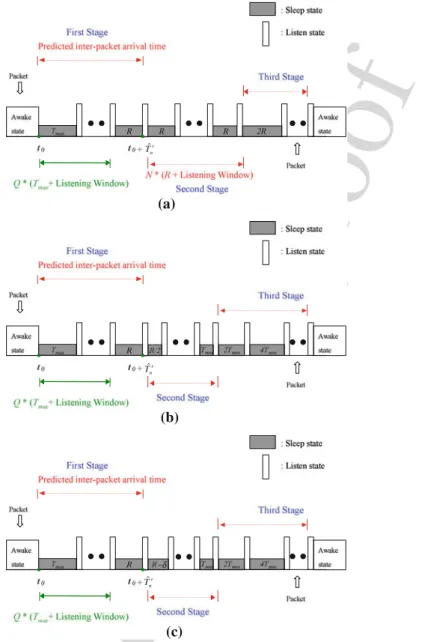
For our DSTP schemes as shown in Fig. 3, three main stages are set. In the first stage starting at the time instant when the MS begins to enter the sleep mode (say t
0) and ending at the predicted time instant that the next downlink packet will arrive (i.e., t
0+ ˆ T
nγ), the probability expected to have an arrival of downlink packets is low with the full trust on the prediction, enabling the MS to sleep as much as possible. Hence, the MS contiguously have Q sleep cycles with the maximum sleep interval followed by one sleep cycle with a sleep interval of length R. Note that the first stage is a common stage to the three proposed DSTP schemes.
The second stage right follows the first stage. For this stage, the interplay between the proposed DSTP schemes and the prediction method is addressed. If the second stage is reached,
it means that no packet arrives during the first stage. Hence, a higher probability is expected to have an arrival of downlink packets within this stage since it starts at t
0+ ˆ T
nγ. As for when the second stage ends, it depends on which of the following three designs for the second stage is used: a constant level (i.e., CL) for the sleep interval, a trend of exponential decrease (i.e., ED) for the sleep interval, or a trend of linear decrease (i.e., LD) for the sleep interval. Because of these designs, the resultant DSTP schemes are then denoted by DSTP-CL, DSTP-ED, and DSTP-LD, respectively. For the second stage of DSTP-CL (as shown in Fig. 3(a)), N (which is an integer) sleep cycles with a sleep interval of length R is set. Here the setting of N can rely on the accuracy of the estimation of the downlink inter-packet arrival time. If the accuracy is high, the choice of N is not so serious. However, it is expected to have a bit larger value of N if the accuracy is not good enough so that an arrival of downlink packets can occur within this stage to possibly minimize the packet delay. As for the second stage for DSTP-ED and DSTP-LD (as shown in Figs. 3(b)–(c)), a decreasing trend of the sleep interval is set to further shorten the packet delay until the minimum sleep interval is reached because an arrival of downlink packets is highly expected within this stage. Therefore, the sleep interval of each sleep cycle in the second stage for DSTP-ED halves with respect to the sleep interval of the previous cycle if the sleep interval of the previous cycle is larger than 2T
min, or it is set to T
minand let this stage end right after this sleep cycle. As for the sleep interval of each sleep cycle in the second stage for DSTP- LD, it linearly decreases using the step of δ with respect to the sleep interval of the previous cycle if the sleep interval of the previous cycle is larger than T
min+ δ, or it is set to T
minand let this stage end right after this sleep cycle like DSTP-ED. If no downlink packet arrivals before the end of the second stage caused by the outlier of prediction, the MS will enter the third stage of the sleep mode (see Fig. 3). Due to the outlier of prediction, the sleep interval for the third stage adopts the exponential increase for the sleep interval like IEEE 802.16e. For DSTP-CL, DSTP-ED, and DSTP-LD, the sleep interval of each sleep cycle doubles with respect to the sleep interval of the previous sleep cycle until the maximum sleep interval is reached or exceeded and then it is fixed at T
max. More specifically, the series of the sleep intervals for DSTP- CL could be
2R, 4R, . . . , 2
kR, T
max, T
max, . . . ,
where 2
kR < T
max≤ 2
k+1R, and the series of the sleep intervals for DSTP-ED and DSTP-LD could be
2T
min, 4T
min, . . . , T
max, T
max, . . . .
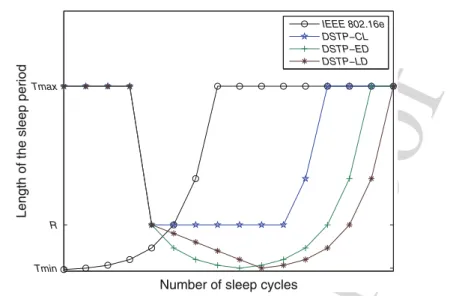
To ease the understanding of the three proposed DSTP schemes, Fig. 4 illustrates the relationship between the sleep interval and the sleep cycle for the standard sleep mode operation of PSC-I in IEEE 802.16e, DSTP-CL, DSTP-ED, and DSTP-LD.
The previous design only considers downlink packets. We
now further incorporate the consideration of uplink packets
which result in the interruption to the sleep mode, i.e., the
Tmin Tmax
R
Number of sleep cycles
Length of the sleep period
IEEE 802.16e DSTP−CL DSTP−ED DSTP−LD
Fig. 4. The relationship between the sleep interval and the sleep cycle for the standard sleep mode operation of PSC-I in IEEE 802.16e, DSTP-CL, DSTP-ED, and DSTP-LD.
immediate wake-up, to let our design fit real network opera- tions much more. To avoid the similar drawbacks discussed previously and to keep the simultaneous improvement of the energy/power efficiency and packet delay, some adjustments on prediction of the downlink inter-packet arrival time are required for DSTP-CL/DSTP-ED/DSTP-LD to let the MS can keep its original sleep planning when re-entering the sleep mode after serving uplink packets. In the following, different cases are given to illustrate how the prediction of the downlink inter-packet arrival time should be adjusted. If the buffer at the BS has downlink packets to the MS when the MS wakes up from the sleep mode because of arrivals of uplink packets, it forms the first case. Since these downlink packets can be received by the MS during the awake mode as well after serving these uplink packets, the prediction of the downlink inter-packet arrival time can be updated accordingly for the MS and be used for the sleep planning later. If the buffer at the BS has no downlink packets to the MS when the MS wakes up from the sleep mode because of arrivals of uplink packets, it forms the second case. Since only an old predicted downlink inter-packet arrival time is available, the updated predicted downlink inter-packet arrival time is obtained by subtracting the shift time, which is a time period between the time instant performing the latest prediction and the time instant at which the last uplink packet arrives, from the old predicted downlink inter-packet arrival time. Of course, only a positive value is valid for the prediction and is expected for the above difference. If the difference is not positive because uplink packets arrive in the second or third stage, then the previous sleep interval (in the second or third stage) is directly set to the updated predicted downlink inter-packet arrival time to let the sleep planning can directly skip the first stage and starts from the second stage. As for the procedure for dealing with arrivals of uplink packets called Uplink Packet Procedure (), it is given in the Appendix (see Fig. 12). As for the pseudo codes for the three proposed DSTP schemes, i.e., DSTP-CL, DSTP-ED, and DSTP-LD, one can refer to Figs. 13–15 in the Appendix.
Our proposed energy-efficient mechanisms, that is, predic- tive DSTP-CL (i.e., PDSTP-CL), predictive DSTP-ED (i.e.,
PDSTP-ED), and predictive DSTP-LD (i.e., PDSTP-LD), are then the combination of the prediction of the downlink inter- packet arrival time with minification and DSTP-CL, DSTP- ED, and DSTP-LD, respectively. Since downlink packets may arrive during the sleep mode, an MS may not directly know when downlink packets arrive. Therefore, PDSTP-CL, PDSTP-ED, and PDSTP-LD ask the BS rather than the MS to do the prediction of the downlink inter-packet arrival time.
Certainly, the BS needs to continuously update the predicted downlink inter-packet arrival time with minification upon arrivals of downlink packets. Further noting that an MS in the IEEE 802.16e WMAN will necessarily connect to the BS when it starts up or when it needs to re-negotiate parameters, the parameters negotiation about α, γ, N (for PDSTP-CL only), and δ (for PDSTP-LD only) plus the other parameters specified in IEEE 802.16e for PDSTP-CL, PDSTP-ED, and PDSTP-LD are then additionally arranged in the necessary connection procedure between the MS and the BS. After the parameters negotiation, the BS is then able to predict the downlink inter-packet arrival time and passes it to the MS that would like to enter the sleep state via adding an extra field storing the value of the predicted downlink inter-packet arrival time with minification to the message MOB SLP RSP which is used to respond the message MOB SLP REQ previously sent by some MS that wants to enter the sleep state for PDSTP-CL, PDSTP-ED, and PDSTP-LD to inform the MS so that DSTP-CL, DSTP-ED, and DSTP-LD schemes can be performed at the MS. With the aid of DSTP-CL, DSTP-ED, and DSTP-LD schemes, the BS can easily determine when the MS needs to wake up, when the MS stays in the listening state, and when the MS stays in the sleep state. In the Appendix, the pseudo codes for PDSTP-CL, PDSTP-ED, and PDSTP-LD are shown (see Fig. 16).
Note that few modifications are required for the IEEE 802.16e WMAN when implementing the proposed mecha- nisms. Those simple extra modifications are definitely desir- able when a specific network, i.e., IEEE 802.16e WMAN, gets involved. Avoiding unnecessary extra modifications for the IEEE 802.16e WMAN when implementing the proposed mechanisms then serves as a contribution, too.
IV. N UMERICAL R ESULTS AND D ISCUSSIONS
In this section, extensive simulations are done for different mechanisms, including the standard sleep mode operation of PSC-I in IEEE 802.16e [5], [10], ESTBM [12], PDSTP-CL, PDSTP-ED, and PDSTP-LD to get the performance metrics of the average packet delay, average energy wastage, and sleep ratio. In the following, let us first describe the simulation arrangement and then discuss the simulation results in detail.
A. Simulation Arrangement
Our simulation programs are written in the C programming
language and run on an IBM compatible PC. Noting that two
network topologies are defined in IEEE 802.16e, i.e., point to
multipoint (PMP) and mesh, the PMP topology is employed
in our simulations, namely, a BS serves several MSs over the
shared media. Hence, an MS can receive packets from the BS
Mobile Station
Mobile Station
Base Station
Mobile Station Mobile Station
A connection of Power Saving Class of Type I
Fig. 5. The network topology used in simulations.
TABLE I
S
LEEP MODE PARAMETERS OFPSC-I
Attribute Value
Frame duration 2 ms Minimal sleep interval 2 ms Maximal sleep interval 256 ms Listening window 2 ms
and send packets to the BS by using the time division duplex (TDD) [28]. Based on the PMP topology, all communications of MSs are directed to the BS and centrally coordinated by the BS. Since our simulations focus on the comparison of mechanisms for PSC-I in terms of the aforementioned performance metrics, we shall pay attention to the connection between an MS and the BS as shown in Fig. 5. In our simulations, Poisson processes are used to model arrivals of downlink and uplink packets. We observe the performance metrics under various downlink packet arrival rates, while the uplink packet arrival rate is fixed at 0.001 packet/ms. As for the sleep mode parameters used, they are given in Table I. Shown in Table II is the related power and energy consumption [19].
Let us now define the performance metrics used in sim- ulations. i) Average packet delay is the average delay of a downlink packet incurred caused by the sleep mode opera- tion. Note that each packet delay can be measured from the difference of the time instant that the MS waking up from the sleep mode is ready to receive the downlink packet and the time instant that the downlink packet arrives at the BS. ii)
TABLE II
P
ARAMETERS OF THE POWER AND ENERGY CONSUMPTIONAttribute Value
Active state power consumption 750 mW Listen state power consumption 170 mW Sleep state power consumption 50 mW Energy of states switching 1.5 J
TABLE III
T
HE IMPACT ONPDSTP-CL
CAUSED BY DIFFERENT VALUES OFαα = 0.02 α = 0.04 α = 0.06 α = 0.08 α = 0.1
Avg pkt delay (ms) 26.32 24.72 25.15 26.39 27.73
Energy wastage (J) 10.98 9.24 8.18 7.43 6.86
Sleep ratio 0.91 0.92 0.92 0.93 0.93
Average energy wastage is the average energy consumption of non-productive work [12] in listening and states switching to receive a (downlink) packet. Here, the non-productive work means that listening in the listening window and states switching when no downlink packet arrivals. It is then clear that the energy consumption in receiving (downlink) packets when the MS wakes up is excluded from the average energy wastage. iii) Sleep ratio R
sleepis the ratio of the total sleep period (T
sleep) and the total working time (T
total) as defined by (6).
R
sleep= T
sleepT
total. (6)
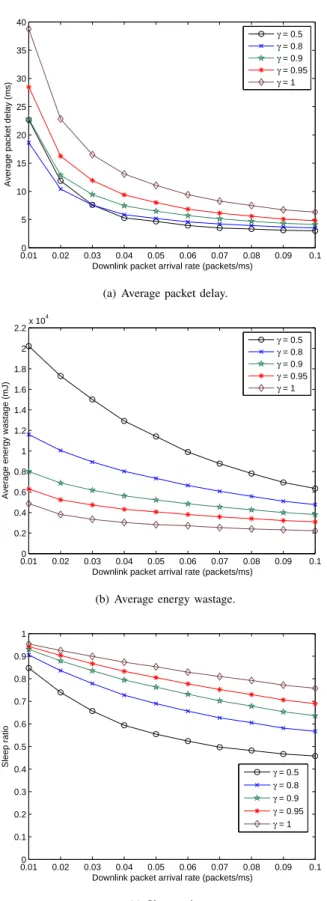
Because we only investigate power saving of sleep modes in this project, handover is not taken into account in our simulations for simplicity. Fixing γ and N at 0.9 and 6, respectively, with α varying among 0.02, 0.04, 0.06, 0.08, and 0.1 under 0.01 packet/ms downlink packet arrival rate, we have Table III to show the impact on PDSTP-CL caused by different values of α. From this table, one can see that α = 0.1 leads to the best energy efficiency and sleep ratio but the longest packet delay, while α = 0.08 can keep the same sleep ratio and reduce the packet delay with a bit higher energy wastage only. Therefore, α = 0.08 is set for the following simulations under this observation.
B. Simulation Results and Discussions
Let us first examine the performance of PDSTP-CL when different values are set to the corresponding parameters to facilitate the choice of these parameters. Then, we compare PDSTP-CL to PDSTP-ED and PDSTP-LD. Finally, the per- formance of the standard sleep mode operation of PSC-I in IEEE 802.16e (denoted by IEEE 802.16e for simplicity) and ESTBM, respectively, is further incorporated and compared with the best mechanism among PDSTP-CL, PDSTP-ED, and PDSTP-LD (i.e., PDSTP-CL as shown later).
1) Determination of the parameters of PDSTP-CL: First,
let us investigate the impact caused by the minification factor
γ by fixing N at 10 and letting γ vary among 0.5, 0.8, 0.9,
0.95, and 1. Shown in Fig. 6 is the corresponding performance
metrics of PDSTP-CL. From Fig. 6(a), one can see that a
larger γ leads to a longer average packet delay except γ = 0.5
since the minification factor γ affects when the MS to start the
second stage in which small sleep intervals are set. Of course,
the smaller γ is, the earlier the MS starts the second stage,
resulting in reduction of packet delays because of more packets
in the second stage. However, more packets in the second stage
cause more listening windows and states switching before the
arrival of the downlink packet. This increases the average
energy wastage and reduces the sleep ratio accordingly as
shown in Figs. 6(b)–(c). The above observation says that a
0.010 0.02 0.03 0.04 0.05 0.06 0.07 0.08 0.09 0.1 5
10 15 20 25 30 35 40
Downlink packet arrival rate (packets/ms)
Average packet delay (ms)
γ = 0.5 γ = 0.8 γ = 0.9 γ = 0.95 γ = 1
(a) Average packet delay.
0.010 0.02 0.03 0.04 0.05 0.06 0.07 0.08 0.09 0.1 0.2
0.4 0.6 0.8 1 1.2 1.4 1.6 1.8 2 2.2x 10⁴
Downlink packet arrival rate (packets/ms)
Average energy wastage (mJ)
γ = 0.5 γ = 0.8 γ = 0.9 γ = 0.95 γ = 1
(b) Average energy wastage.
0.010 0.02 0.03 0.04 0.05 0.06 0.07 0.08 0.09 0.1 0.1
0.2 0.3 0.4 0.5 0.6 0.7 0.8 0.9 1
Downlink packet arrival rate (packets/ms)
Sleep ratio
γ = 0.5 γ = 0.8 γ = 0.9 γ = 0.95 γ = 1
(c) Sleep ratio.
Fig. 6. The impact to the performance of PDSTP-CL caused by γ.
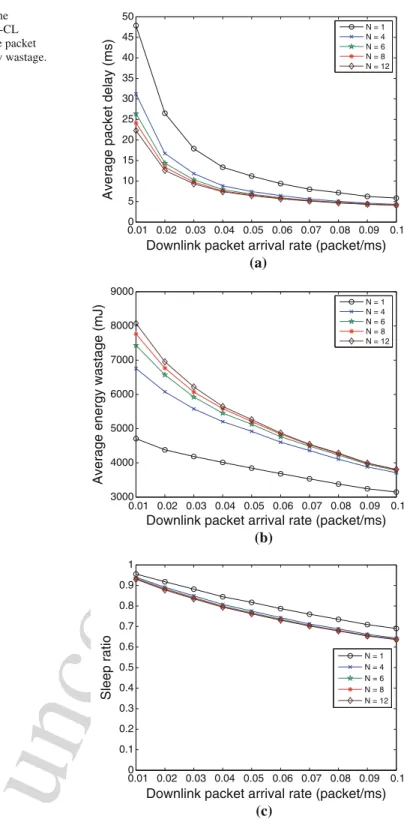
tradeoff exists between the packet delay and energy efficiency and it can be controlled by the minification factor γ. To improve the energy efficiency, one can choose a larger γ, while a smaller γ (but not too small, say γ = 0.5 in Fig. 6, since both packet delay and energy efficiency may not be improved because the third stage for PDSTP-CL may be involved to make the packet delay and energy efficiency get even worse) can be chosen to improve the packet delay. To achieve the balanced packet delay and energy efficiency for PDSTP-CL so that the simultaneous improvement of the packet delay and energy efficiency is viable, γ = 0.9 is suggested. Next, we continue to study the impact to the performance of PDSTP- CL caused by different choices of N (N = 1, 4, 6, 8, 12) which is the maximum number of sleep cycles in the second stage for PDSTP-CL when γ = 0.9. It is evidently from Fig. 7 that a larger N might cause more packets associated with shorter sleep intervals, making the packet delay lower but the energy efficiency worse. For the purpose to get the simultaneous improvement of the packet delay and energy efficiency for PDSTP-CL, N = 6 is employed in the following simulations.
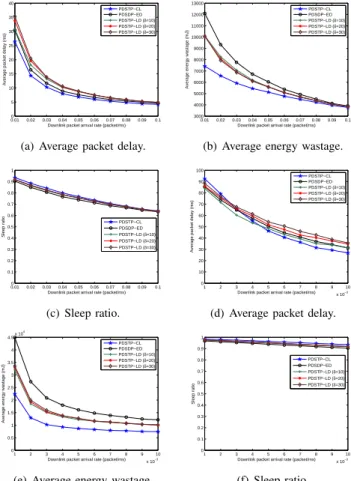
2) Performance comparison among PDSTP-CL, PDSTP- ED, and PDSTP-LD: Further investigating performance of PDSTP-LD (with δ varying among 10 ms, 20 ms, and 30 ms), and PDSTP-ED, Fig. 8 gives the performance compari- son among PDSTP-CL, PDSTP-ED, and PDSTP-LD. From Figs. 8(a)–(c), one can see that PDSTP-CL outperforms PDSTP-ED and PDSTP-LD in terms of average packet delay, average energy wastage, and sleep ratio when the down- link packet arrival rate falls within the range [0.01, 0.1] (in packet/ms). The reasons are given as follows. First, more times of states switching are required for PDSTP-ED and PDSTP-LD as compared to PDSTP-CL before a downlink packet arrival because of the decreasing sleep intervals in the second stage for PDSTP-ED and PDSTP-LD. This says that the average energy wastage (sleep ratio) of PDSTP- ED and PDSTP-LD is more (less) than that of PDSTP-CL.
Further noting that PDSTP-ED performs worst in terms of average energy wastage and sleep ratio as shown in Figs. 8(b)–
(c) among PDSTP-CL, PDSTP-ED, and PDSTP-LD, this is
caused by its exponentially decreasing trend of sleep intervals
in the second stage. When the downlink packet arrival rate
is 0.01 packet/ms, we see that the average energy wastage
of PDSTP-ED (PDSTP-LD) is more than that of PDSTP-CL
63% (35% or so). As for the sleep ratio, the percentage of
improvement gained by PDSTP-CL is not really big. Next,
R (see (5)) approximately falls within the range [90, 9] (in
ms) when the downlink packet arrival rate falls within the
range [0.01, 0.1] (in packet/ms). Hence, most of packets will
be received when the MS wakes up from the third stage
of the sleep mode with a longer latest sleep interval for
PDSTP-ED and PDSTP-LD because the probability of having
a smaller value of R is high for this case. This explains
why PDSTP-CL can still perform better than PDSTP-ED
and PDSTP-LD in terms of average packet delay. One can
see that the average packet delay of PDSTP-ED (PDSTP-
LD) is 16.7% (16%–29%) longer than that of PDSTP-CL
when the downlink packet arrival rate is 0.01 packet/ms. In
0.010 0.02 0.03 0.04 0.05 0.06 0.07 0.08 0.09 0.1 5
10 15 20 25 30 35 40 45 50
Downlink packet arrival rate (packet/ms)
Average packet delay (ms)
N = 1 N = 4 N = 6 N = 8 N = 12
(a) Average packet delay.
0.01 0.02 0.03 0.04 0.05 0.06 0.07 0.08 0.09 0.1 3000
4000 5000 6000 7000 8000 9000
Downlink packet arrival rate (packet/ms)
Average energy wastage (mJ)
N = 1 N = 4 N = 6 N = 8 N = 12
(b) Average energy wastage.
0.010 0.02 0.03 0.04 0.05 0.06 0.07 0.08 0.09 0.1 0.1
0.2 0.3 0.4 0.5 0.6 0.7 0.8 0.9 1
Downlink packet arrival rate (packet/ms)
Sleep ratio
N = 1 N = 4 N = 6 N = 8 N = 12
(c) Sleep ratio.
Fig. 7. The impact to the performance of PDSTP-CL caused by N .
0.010 0.02 0.03 0.04 0.05 0.06 0.07 0.08 0.09 0.1 5
10 15 20 25 30 35 40
Downlink packet arrival rate (packet/ms)
Average packet delay (ms)
PDSTP−CL PDSDP−ED PDSTP−LD (δ=10) PDSTP−LD (δ=20) PDSTP−LD (δ=30)
(a) Average packet delay.
0.01 0.02 0.03 0.04 0.05 0.06 0.07 0.08 0.09 0.1 3000
4000 5000 6000 7000 8000 9000 10000 11000 12000 13000
Downlink packet arrival rate (packet/ms)
Average energy wastage (mJ)
PDSTP−CL PDSDP−ED PDSTP−LD (δ=10) PDSTP−LD (δ=20) PDSTP−LD (δ=30)
(b) Average energy wastage.
0.010 0.02 0.03 0.04 0.05 0.06 0.07 0.08 0.09 0.1 0.1
0.2 0.3 0.4 0.5 0.6 0.7 0.8 0.9 1
Downlink packet arrival rate (packet/ms)
Sleep ratio
PDSTP−CL PDSDP−ED PDSTP−LD (δ=10) PDSTP−LD (δ=20) PDSTP−LD (δ=30)
(c) Sleep ratio.
1 2 3 4 5 6 7 8 9 10
x 10−3 0
10 20 30 40 50 60 70 80 90 100
Downlink packet arrival rate (packet/ms)
Average packet delay (ms)
PDSTP−CL PDSDP−ED PDSTP−LD (δ=10) PDSTP−LD (δ=20) PDSTP−LD (δ=30)
(d) Average packet delay.
1 2 3 4 5 6 7 8 9 10
x 10−3 0
0.5 1 1.5 2 2.5 3 3.5 4 4.5x 10⁴
Downlink packet arrival rate (packet/ms)
Average energy wastage (mJ)
PDSTP−CL PDSDP−ED PDSTP−LD (δ=10) PDSTP−LD (δ=20) PDSTP−LD (δ=30)
(e) Average energy wastage.
1 2 3 4 5 6 7 8 9 10
x 10−3 0
0.1 0.2 0.3 0.4 0.5 0.6 0.7 0.8 0.9 1
Downlink packet arrival rate (packet/ms)
Sleep ratio
PDSTP−CL PDSDP−ED PDSTP−LD (δ=10) PDSTP−LD (δ=20) PDSTP−LD (δ=30)
(f) Sleep ratio.
Fig. 8. Performance comparison among PDSTP-CL, PDSTP-ED, and PDSTP-LD.
Figs. 8(d)–(f), the three performance metrics for PDSTP- CL, PDSTP-ED, and PDSTP-LD under the extremely low downlink packet arrival rate ranging from 0.001 packet/ms to 0.01 packet/ms are exhibited. With the same reasoning for the interval [0.01, 0.1] (in packet.ms) of the downlink packet arrival rate, PDSTP-CL still performs better than PDSTP- ED and PDSTP-LD in terms of average energy wastage and sleep ratio as shown in Figs. 8(e)–(f) and the percentages of improvement in energy wastage can be further improved. As for the average packet delay in Fig. 8(d), a crossing between the curve of PDSTP-CL and the curve of PDSTP-ED occurs approximately at 0.0032 packet/ms; a crossing between the curve of PDSTP-CL and the curve of PDSTP-LD (δ = 10 ms) occurs approximately at 0.0044 packet/ms; a crossing between the curve of PDSTP-CL and the curve of PDSTP- LD (δ = 20 ms) occurs approximately at 0.003 packet/ms;
and a crossing between the curve of PDSTP-CL and the curve
of PDSTP-LD (δ = 30 ms) occurs approximately at 0.0025
packet/ms. It is evidently that better average packet delays
for PDSTP-ED and PDSTP-LD as compared to PDSTP-CL
when the downlink packet arrival rate is lower than the value
of the crossing can be obtained because most of packets for
PDSTP-ED and PDSTP-LD can be received when the MS
wakes up from the second stage of the sleep mode with a
shorter latest sleep interval than R. When the downlink packet
arrival rate is 0.001 packet/ms, the average packet delay of
PDSTP-CL is 10%, 8%, 5%, and 8% longer than those of PDSTP-LD (δ = 10 ms), PDSTP-LD (δ = 20 ms), PDSTP- LD (δ = 30 ms), and PDSTP-ED, respectively. Combining all observations above reveals that i) PDSTP-CL can always outperform PDSTP-ED and PDSTP-LD much in terms of average energy wastage and can always keep a bit better sleep ratio than PDSTP-ED and PDSTP-LD; ii) PDSTP-CL can still perform better than PDSTP-ED and PDSTP-LD in terms of average packet delay except for the case with an extremely low downlink packet arrival rate. Even for that case, the performance degradation of PDSTP-CL is small (at most 10% increase of the average packet delay is observed). Hence, PDSTP-CL is most suggested for the use in the IEEE 802.16e WMAN among the three proposed mechanisms under general situations. For this reason, we merely use the simulation results of PDSTP-CL for the following performance comparison with the standard sleep mode operation of PSC-I in IEEE 802.16e and ESTBM.
3) Performance comparison between PDSTP-CL and IEEE 802.16e: We now compare PDSTP-CL to the standard sleep mode operation of PSC-I in IEEE 802.16e under different downlink packet arrival rates using Fig. 9 which reveals that PDSTP-CL not only possesses a bit higher sleep ratio than IEEE 802.16e but also greatly improves the average packet de- lay and average energy wastage as compared to IEEE 802.16e because of the new design of sleep planning for PDSTP-CL which allows an MS to sleep as longer as possible before the predicted downlink packet arrival time instant and to sleep by using a shorter sleep interval after the predicted downlink packet arrival time instant. When the packet arrival rate is 0.01 packet/ms, 33% of improvement in packet delay and 38%
of improvement in energy wastage achieved by PDSTP-CL as compared to IEEE 802.16e can be observed from Fig. 9.
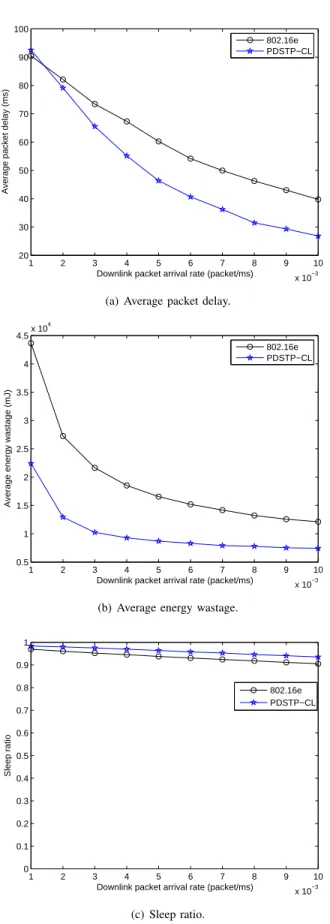
Of course, percentages of improvement in both packet delay and energy wastage shrink as the downlink packet arrival rate increases since the sleep planning is mainly designed for the low traffic load rather than the median or even the high traffic load for both mechanisms. To further elaborate on the performance comparison between PDSTP-CL and IEEE 802.16e under the extremely low downlink packet arrival rate, Fig. 10 is given. From Fig. 10, one can see that more than 25% of improvement in packet delay can be reached when the downlink packet arrival rate falls within the range [0.005, 0.01]
(in packet/ms). One may note that percentages of improvement in packet delay decrease as the downlink packet arrival rate drops from 0.005 packet/ms to 0.001 packet/ms since the standard sleep mode operation of PSC-I in IEEE 802.16e works well when the downlink packet arrival rate is very low and the accuracy in the prediction of the downlink inter-packet arrival time for PDSTP-CL degrades for this case. As for the percentage of improvement in energy wastage, it gets better as the downlink packet arrival rate gets lower since much more sleep cycles are required for IEEE 802.16e as compared to PDSTP-CL. When the downlink packet arrival rate is fixed at 0.001 packet/ms, 48% of improvement in energy wastage is achieved by PDSTP-CL as compared to IEEE 802.16e even though the comparable packet delay is observed for PDSTP- CL and IEEE 802.16e. Regarding the sleep ratio, only a bit
0.010 0.02 0.03 0.04 0.05 0.06 0.07 0.08 0.09 0.1 10
20 30 40 50 60
Downlink packet arrival rate (packet/ms)
Average packet delay (ms)
802.16e PDSTP−CL ESTBM
(a) Average packet delay.
0.010 0.02 0.03 0.04 0.05 0.06 0.07 0.08 0.09 0.1 2000
4000 6000 8000 10000 12000
Downlink packet arrival rate (packet/ms)
Average energy wastage (mJ)
802.16e PDSTP−CL ESTBM
(b) Average energy wastage.
0.010 0.02 0.03 0.04 0.05 0.06 0.07 0.08 0.09 0.1 0.1
0.2 0.3 0.4 0.5 0.6 0.7 0.8 0.9 1
Downlink packet arrival rate (packet/ms)
Sleep ratio
802.16e PDSTP−CL ESTBM
(c) Sleep ratio.
Fig. 9. Comparison among PDSTP-CL, IEEE 802.16e, and ESTBM.
1 2 3 4 5 6 7 8 9 10 x 10−3 20
30 40 50 60 70 80 90 100
Downlink packet arrival rate (packet/ms)
Average packet delay (ms)
802.16e PDSTP−CL
(a) Average packet delay.
1 2 3 4 5 6 7 8 9 10
x 10−3 0.5
1 1.5 2 2.5 3 3.5 4 4.5x 10⁴
Downlink packet arrival rate (packet/ms)
Average energy wastage (mJ)
802.16e PDSTP−CL
(b) Average energy wastage.
1 2 3 4 5 6 7 8 9 10
x 10−3 0
0.1 0.2 0.3 0.4 0.5 0.6 0.7 0.8 0.9 1
Downlink packet arrival rate (packet/ms)
Sleep ratio
802.16e PDSTP−CL
(c) Sleep ratio.
Fig. 10. Comparison between PDSTP-CL and IEEE 802.16e under the extremely low downlink packet arrival rate.
higher gain is obtained for PDSTP-CL as shown in Fig. 10.
4) Performance comparison between PDSTP-CL and ES- TBM: In Fig. 9, PDSTP-CL is compared to ESTBM, too. It is clear from Fig. 9(c) that ESTBM can greatly improve the sleep ratio as compared to PDSTP-CL since ESTBM gradually decreases the sleep interval with an initial sleep interval of half of the latest sleep interval when an MS needs to enter the sleep mode after all packets are received in the awake mode to maintain a much longer sleep interval for the MS in the sleep mode. For the same reasoning, the average energy wastage as shown in Fig. 9(b) can be well-improved by ESTBM as com- pared to PDSTP-CL. However, much longer average packet delays as shown in Fig. 9(a) occur for ESTBM as compared to PDSTP-CL (or even IEEE 802.16e). Fixing the downlink packet arrival rate at 0.01 packet/ms, the average packet delay of PDSTP-CL is lower than half of the average packet delay of ESTBM. As the downlink packet arrival rate increases, the percentage of improvement in packet delay shrinks because the initial sleep interval for ESTBM decreases as well to possibly avoid longer packet delays incurred. The above observations reflect the fact that ESTBM is more suitable for the delay- tolerable network. Given a delay-tolerable network, PDSTP- CL is actually applicable by choosing a larger value of γ (> 1) so that the energy wastage and sleep ratio can be kept at a satisfactory level as possible as the designer wishes.
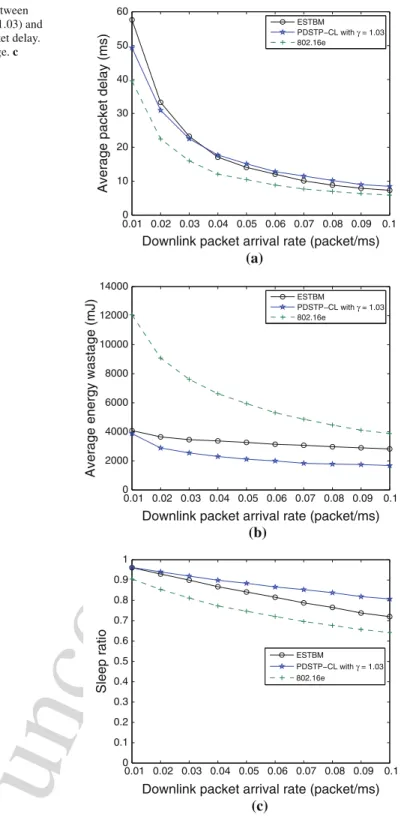
In Fig. 11, γ is set to 1.03 for PDSTP-CL so that almost comparable average packet delays for PDSTP-CL and ESTBM can be reached. Since the initial sleep interval for ESTBM decreases as the downlink packet arrival rate increases, the dropping tendency of the packet delay is a bit steep than that of PDSTP-CL with γ = 1.03 which lessens the number of packets arriving in a smaller sleep interval as compared to PDSTP-CL with a smaller γ, resulting in a bit longer packet delays accordingly. This explains why a crossing occurs for the curves of PDSTP-CL and ESTBM in Fig. 11(a). From Figs. 11(b)–(c), one can see that PDSTP-CL can outperform ESTBM in terms of average energy wastage and sleep ratio.
For the downlink packet arrival rate more than 0.05 packet/ms, more than 36% of improvement in energy wastage and more than 5% of improvement in sleep ratio for PDSTP-CL can be reached as compared to ESTBM.
V. S ELF E VALUATION
With the aid of the predicted downlink inter-packet arrival
time based on the exponential smoothing technique with
minification along with DSTP-CL, DSTP-ED, and DSTP-LD
dynamic sleep planning schemes for MSs, three predictive
energy-efficient mechanisms, i.e., PDSTP-CL, PDSTP-ED,
and PDSTP-LD, designed for PSC-I of IEEE 802.16e are
proposed in this project. Setting a maximum sleep interval
when the probability of having packets is low enables the three
mechanisms to reduce the energy wastage caused by listening
and states switching. When the probability of having packets
becomes high, setting a smaller sleep interval is able to reduce
the possible packet delay for the three mechanisms. Although
the prediction error is inevitable, an extra consideration for
the outlier is included. Furthermore, uplink packet arrivals are
0.010 0.02 0.03 0.04 0.05 0.06 0.07 0.08 0.09 0.1 10
20 30 40 50 60
Downlink packet arrival rate (packet/ms)
Average packet delay (ms)
ESTBM
PDSTP−CL with γ = 1.03 802.16e
(a) Average packet delay.
0.010 0.02 0.03 0.04 0.05 0.06 0.07 0.08 0.09 0.1 2000
4000 6000 8000 10000 12000 14000
Downlink packet arrival rate (packet/ms)
Average energy wastage (mJ)
ESTBM
PDSTP−CL with γ = 1.03 802.16e
(b) Average energy wastage.
0.010 0.02 0.03 0.04 0.05 0.06 0.07 0.08 0.09 0.1 0.1
0.2 0.3 0.4 0.5 0.6 0.7 0.8 0.9 1
Downlink packet arrival rate (packet/ms)
Sleep ratio
ESTBM
PDSTP−CL with γ = 1.03 802.16e
(c) Sleep ratio.
Fig. 11. Comparison between PDSTP-CL (under γ = 1.03) and ESTBM.
taken into account to make the resultant mechanisms more complete.
With the extensive numerical results from simulations, we demonstrate that PDSTP-CL significantly outperforms PDSTP-ED, PDSTP-LD, the standard sleep mode operation of PSC-I in IEEE 802.16e, and ESTBM in terms of average energy wastage, sleep ratio, and average packet delay. Because of the capability to reach the simultaneous improvement of the energy efficiency and packet delay and the flexibility offered by the minification factor, PDSTP-CL is highly recommended for the use in the IEEE 802.16e WMAN.
Note that the current results obtained in this project have been published in Springer Wireless Personal Communica- tions, published online on Feb. 26, 2012. Besides, one journal paper different from the above content has been published online in ACM/Springer Wireless Networks on September 21, 2012 and two journal paper different from the above content have been published online in Springer Wireless Personal Communications on March 1, 2012 and August 4, 2012, respectively, under the financial support of this project. No doubt, the outcome in this project is fruitful. Finally, we need to mention that the original research topic, which was planned for three-year study, is broader than that done in this project, which focuses on the design of energy-efficient mechanisms for PSC I under a single type of connection in Mobile WiMAX.
R EFERENCES
[1] A. M. Baker, C. K. Ng, N. K. Noordin, A. Mustafa, and A. Akbari, “An optimized energy saving mechanism in IEEE 802.16e Mobile WiMAX systems,” Journal of High Speed Networks, vol. 17, no. 3, pp. 147–161, Aug. 2010.
[2] L. Burgstahler and M. Neubauer, “New modifications of the exponential moving average algorithm for bandwidth estimation,” in Proc. ITC
Specialist Seminar ’02, 2002.[3] S. K. Cho and Y. G. Kim, “Improving power savings by using adaptive initial-sleep window in IEEE802.16e,” in Proc. IEEE VTC ’07, 2007, pp.
1321–1325.
[4] R. Cohen, L. Katzir, and R. Rizzi, “On the trade-off between energy and multicast efficiency in 802.16e-like mobile networks,” IEEE Trans.
Mobile Computing, vol. 7, no. 3, pp. 346–357, Mar. 2008.
[5] K. Han and S. Choi, “Performance analysis of sleep mode operation in IEEE 802.16e mobile broadband wireless access systems,” in Proc. IEEE
VTC ’06, 2006, pp. 1141–1145.[6] S. C. Huang, R. H. Jan, and C. Chen, “Energy efficient scheduling with QoS guarantee for IEEE 802.16e broadband wireless access networks,”
in Proc. ACM IWCMC ’07, 2007, pp. 547–552.
[7] IEEE Computer Society LAN MAN Standards Committee, “IEEE Std 802.11: Wireless LAN medium access control and physical layer speci- fications,” 1999.
[8] IEEE 802.16-2001, “IEEE standard for local and metropolitan area networks - Part 16: Air interface for fixed broadband wireless access systems,” 2002.
[9] IEEE 802.16-2004, “IEEE standard for local and metropolitan area networks - Part 16: Air interface for fixed broadband wireless access systems,” 2004.
[10] IEEE 802.16e-2005, “IEEE standard for local and metropolitan area networks Part 16: Air interface for fixed and mobile broadband wireless access systems amendment 2: physical and medium access control layers for combined fixed and mobile operation in licensed bands and corrigendum 1,” 2006.
[11] J. Jang, K. Han, and S. Choi, “Adaptive power saving strategies for IEEE 802.16e mobile broadband wireless access,” in Proc. IEEE APCC
’06, 2006, pp. 1–5.
[12] D. G. Jeong and W. S. Jeon, “Performance of adaptive sleep period
control for wireless communications systems,” IEEE Trans. Wireless
Communications, vol. 5, no. 11, pp. 3012–3016, Nov. 2006.[13] M. G. Kim, J. Y. Choi, and M. Kang, “Adaptive power saving mechanism considering the request period of each initiation of awakening in the IEEE 802.16e system,” IEEE Commun. Lett., vol. 12, no. 2, pp. 106–108, Feb.
2008.
[14] S. J. Kwon, Y. W. Chung, and D. K. Sung, “Queueing model of sleep- mode operation in cellular digital packet data,” IEEE Trans. Vehicular
Technology, vol. 52, no. 4, pp. 1158–1162, Jul. 2003.[15] N. H. Lee and S. Bahk, “MAC sleep mode control considering downlink traffic pattern and mobility,” in Proc. IEEE VTC ’05, 2005, pp. 2076–
2080.
[16] J. W. Lee, W. S. Jeon, and D. G. Jeong, “Power saving with p-persistent sleep decision for ubiquitous mobile communications,” in Proc. IEEE
VTC ’06, 2006, pp. 633–637.[17] J. R. Lee and D. H. Cho, “Performance evaluation of energy saving mechanism based on probabilistic sleep interval decision algorithm in IEEE 802.16e,” IEEE Trans. Vehicular Technology, vol. 56, no. 4, pp.
1773-1780, Jul. 2007.
[18] K. Lei and D. H. K. Tsang, “Performance study of power saving classes of type I and II in IEEE 802.16e,” in Proc. IEEE LCN ’06, 2006, pp.
20–27.
[19] K. Lei and D. H. K. Tsang, “Optimal selection of power saving classes in IEEE 802.16e,” in Proc. IEEE WCNC ’07, 2007, pp. 1836–1841.
[20] N. M. P. Nejatian and M. M. Nayebi, “Evaluating the effect of non- Poisson traffic patterns on power consumption of sleep mode in the IEEE 802.16e MAC,” in Proc. IEEE WOCN ’07, 2007, pp. 1–5.
[21] D. T. T. Nga, M. G. Kim, and M. Kang, “Delay-guaranteed energy saving algorithm for the delay-sensitive applications in IEEE 802.16e systems,”
IEEE Trans. Consumer Electronics, vol. 53, no. 4, pp. 1339–1347, Nov.
2007.
[22] J. L. Shi, G. F. Fang, Y. Sun, G. H. Zhou, Z. C. Li, and E. Dutkiewicz,
“WLC17-5: Improving mobile station energy efficiency in IEEE 802.16e WMAN by burst scheduling,” in Proc. IEEE GLOBECOM ’06, 2006, pp.
1–5.
[23] O. J. Vatsa, M. Raj, K. Ritesh, D. Panigrahy, and D. Das, “Adaptive power saving algorithm for mobile subscriber station in 802.16e,” in Proc.
IEEE COMSWARE ’07, 2007, pp. 1–7.
[24] Y. Xiao, H. Li, Y. Pan, K. Wu, and J. Li, “On optimizing energy consumption for mobile handsets,” IEEE Trans. Vehicular Technology, vol. 53, no. 6, pp. 1927–1941, Nov. 2004.
[25] Y. Xiao, “Energy saving mechanism in the IEEE 802.16e wireless MAN,” IEEE Commun. Lett., vol. 9, no. 7, pp. 595–597, Jul. 2005.
[26] J. F. Xiao, S. H. Zou, B. Ren, and S. D. Cheng, “WLC17-6: An enhanced energy saving mechanism in IEEE 802.16e,” in Proc. IEEE GLOBECOM
’06, 2006, pp. 1–5.