Extractive Contents and DPPH-Scavenging Activities of Bamboo Leaf Extracts from Gigantochloa atter, Dendrocalamus asper, and Gigantochloa verticillata
Rini Pujiarti,
1,2)Sri Suryani,
1)Sigit Sunarta,
1)Ganis Lukmandaru,
1)Brandon Aristo Verick Purba
1)【 Summary】
In this study, we investigated the extractive contents, phenolic content, and DPPH-scavenging activity of leaf extracts of 3 commonly cultivated bamboo species (Gigantochloa atter, Dendro- calamus asper, and G. verticillata) from Tlogoadi Village, Yogyakarta, Indonesia. Extractions were successively done by reflux, using n-hexane, ethyl acetate, methanol, and hot water. The ex- tracts were subjected to the following procedures: phytochemical screening for alkaloids, saponins, and tannins; a colorimetric assay for total phenolic and flavonoid contents; and a DPPH radical- scavenging capacity assay. Results showed that hot water produced the highest yields of G. atter (3.62%) and D. asper (3.16%), while n-hexane produced the highest yield of G. verticillata (2.46%).
Phytochemical screening detected saponins in the hot-water extract of G. atter, and tannins were present in the ethanol (70%, v v
-1) extract of all 3 bamboo species. Total phenolic and flavonoid contents were highest in the ethyl-acetate extract of D. asper (26.09 mg gallic acid equivalents g
-1) and G. verticillata (92.67 mg quercetin equivalents g
-1), respectively. The hot water-soluble extract of G. verticillata showed the lowest 50% inhibitory concentration of 662.41 µg ml
-1. The present study indicates that the 3 bamboo leaf extracts can potentially be used as natural sources of anti- oxidants and phytochemicals, especially the polar extract of G. verticillata with its high flavonoid content and mild DPPH-scavenging activity.
Key words: phytochemical screening, phenolic, antioxidant, flavonoid, successive extraction.
Pujiarti R, Suryani S, Sunarta S, Lukmandaru G, Purba BAV. 2020. Extractive content and DPPH-scavenging activity of bamboo leaf extracts from Gigantochloa atter, Dendrocala- mus asper, and Gigantochloa verticillata. Taiwan J For Sci 35(1):1-12.
1)
D e p a r t m e n t o f F o r e s t P r o d u c t Te c h n o l o g y, F a c u l t y o f F o r e s t r y , U n i v e r s i t a s G a d j a h M a d a , Yogyakarta, Indonesia. Jl. Agro, No.01, Bulaksumur, Yogyakarta 55281, Indonesia..
2)
Corresponding author, e-mail:[email protected] 通訊作者。
Received August 2019, Accepted February 2020. 2019年8月送審 2020年2月通過。
研究報告
三竹種
(Gigantochloa atter, Dendrocalamus asper, Gigantochloa verticillata)竹葉萃取物含量
及清除
DPPH自由基活性
Rini Pujiarti
1,2)Sri Suryani
1)Sigit Sunarta
1)Ganis Lukmandaru
1)Brandon Aristo Verick Purba
1)摘 要
本 研 究 旨 在 調 查 印 度 尼 西 亞 日 惹 特 區 Tlogoadi村三種常見栽培竹種( Gigantochloa atter,
Dendrocalamus asper, Gigantochloa verticillata)竹葉中萃取物與酚類的含量及清除DPPH自由基活性。試驗方法是採用回流法,依序使用正己烷、乙酸乙酯、甲醇和熱水進行萃取。萃取物之生物鹼、皂苷和單 寧含量透過植物化學篩選程序測定,總酚、類黃酮含量及和DPPH自由基清除能力則透過比色法測定。
研究結果顯示,
G. atter和D. asper以熱水萃取產率最高,G. verticillata以正己烷萃取產率最高,產率分別為 3.62,3.16和2.46%。植物化學篩選檢測結果,皂苷可在G. atter以熱水萃取,以乙醇(70%, v/v)萃取 可在三竹種中取得單寧。總酚和類黃酮含量以乙酸乙酯萃取,含量最高分別是
D. asper的26.09 mg GAE/g及G. verticillata的92.67 mg QE/g。G. verticillata的熱水溶性萃取產物顯示IC
50值最低,為 662.41μg/ ml。
總結,本研究顯示三種竹葉萃取物具備被用來萃取抗氧化劑和植物化學物質天然來源的潛力,尤其是
G.verticillata含有高含量的類黃酮和溫和清除DPPH自由基活性的極性萃取產物。
關鍵詞:植物化學篩選、酚類、抗氧化劑、類黃酮、連續提取。
Pujiarti R、Suryani S、Sunarta S、Lukmandaru G、Purba BAV。2020。三竹種(Gigantochloa atter, Dendrocalamus asper, Gigantochloa verticillata)竹葉萃取物含量及清除DPPH自由基活
性。台灣林業科學35(1):1-12。
INTRODUCTION
Bamboos are large lignocellulosic plants in the family Gramineae. They are distributed in many tropical, subtropical, and temperate countries such as Indonesia, Brazil, China, Africa, Australia, Japan, and India. Bamboo is an important non-wood forest product (NWFP), since some parts of the stem are ex- tensively utilized (Agustino et al. 2011). The plant is often used as an ornamental and to provide environmental service; the main stem is used as a construction material for build- ing houses and bridges. Generally, bamboo
is used in furniture and handicrafts because
it is cheap and lightweight (Benton 2015). In
Indonesia, there are about 7 genera and more
than 60 known species of bamboo. Legi (Gi-
gantochloa atter), Petung (Dendrocalamus
asper), and Wulung bamboo (G. verticillata)
are bamboo species cultivated especially on
Java island, Indonesia. Gigantochloa atter
and D. asper are mostly utilized for construc-
tion, while G. verticillata is mostly used for
handicrafts and musical instruments (Rifai
1995).
Bamboo has been used as medicine since ancient times. The leaves of some bamboo species are used to treat stomach heat, colds, and arthritis (Hossain and Islamm 2015). Sev- eral compounds, such as flavones, phenolic acids, quinones, glycosides, and fatty acids, are found in bamboo leaf extracts (Gong et al. 2014). Previous studies found some bio- activity in leaf extracts of various species.
Fatty acids and their derivatives found in G.
apus leaves exhibited antibacterial activity against pathogenic Escherichia coli (Mulyono et al. 2013). Further, fatty acids are never mentioned in term of antioxidant activity.
The diverse chemical structures of alkaloids and saponins are thought to contribute to the antioxidant activity. Leaves of Bambusa arundinacea are known to exhibit antileprotic and anticoagulation activities, and they are also utilized to alleviate hemoptysis symp- toms (Khare 2007). Meanwhile, an extract of leaves of Phyllostachys nigra bamboo was shown to exhibit antioxidant activity, and it is used as a standardized food antioxidant in China (Hu et al. 2000, Gong et al. 2014).
Antioxidants are molecules, ions, or stable radicals that are able to prevent the oxi- dation of other molecules; oxidation can be caused by the activities of free radicals such as reactive oxygen species (ROS) and reac- tive nitrogen species (RNS) (Pinchuk et al.
2012). Some radical reactions are suspected of causing oxidative stress, which can lead to various diseases such as diabetes, arterioscle- rosis, aging disorders, and cancers (Halliwell and Aruoma 1991, Apak et al. 2007, Pinchuk et al. 2012). Further, antioxidant agents are often used as additives by the food industry to preserve products for longer periods (Caro- cho and Ferreira 2013). In recent times, both synthetic and natural antioxidants have been used in many kinds of industries. However, some common synthetic antioxidants, such as
butylated hydroxyl anisole (BHA) and butyl- ated hydroxy toluene (BHT), were associated with toxicity and carcinogenicity (Ito et al.
1985, Kahl and Kappus 1993, Caleja et al.
2017). This concern has increased interest in naturally derived antioxidants as safer alter- natives than synthetic antioxidants, as well as increasing the popularity of products that use natural antioxidants (Kumar and Pruthi 2014, Carocho and Ferreira 2013).
Due to limited information on leaf ex- tracts of G. atter, D. asper, and G. verticilla- ta, the purpose of this study was to investigate the extractive contents of G. atter D. asper, and G. verticillata leaves by analyzing total phenolic (TPC) and flavonoid contents (TFC), and qualitatively detecting certain compounds and antioxidant activities. The information obtained by this research is expected to en- courage people to explore the possibility of using bamboo leaf extracts as a source of natural antioxidants.
MATERIALS AND METHODS Preparation of bamboo leaf extracts
Fresh young bamboo leaves of G. atter, D. asper, and G. verticillata were harvested from Tlogoadi Village, Sleman, Yogyakarta, Indonesia (175 m in elevation). Young leaves that had a lighter green color and were lo- cated near or at the tip of bamboo stems were selected from 2 m in height of the trunk.
These were further dried at room tempera- ture, milled, sieved with a 20~40 mesh, and analyzed for moisture content following the ASTM D 4442-92 (Reapproved 03).
Successive extraction
Powdered leaf samples of each species
(50 g in dry weight; DW) were successively
extracted by reflux, using the solvents, n-
hexane, ethyl acetate, methanol, and hot
water, for 6 h for each solvent. Meanwhile, ethanol (70%, v v
-1) extraction (48 h, cold extraction) was conducted separately as a control. The extracts were filtered and evaporated before being stored separately in bottles. The extracted contents were calcu- lated based on the leaf DW, and all analyses were run in triplicate.
Phytochemical screening for alkaloids, saponins, and tannins
The n-hexane, ethyl-acetate, methanol, hot-water, and ethanol 70% extracts were subjected to phytochemical screening fol- lowing methods described by Pochapski et al. (2011) with slight modifications. Phyto- chemical screening was then used to iden- tify some classes of secondary metabolites (Table 2). Each test was replicated 3 times.
Result are presented as a summary of the replications.
Screening for alkaloids
Alkaloids were screened by adding 50 mg of extract to 5 ml of a chloroform-ammo- nia mixture; this was then filtered into a test tube. A few drops of 2 M H
2SO
4were added to the filtrate and shaken to form 2 layers. Af- ter that, the top layer (which was clear) was placed in a glass container. Drops of Meyer reagent were added to the top layer. If a white precipitate formed, then the extract was posi- tive for alkaloids.
Screening for saponins
In total, 50 mg of an extract was dis- solved in 5 ml of water in a test tube. After heating for about 5 min, the extract was filtered and shaken. After shaking, if a vis- ible froth appeared that did not disappear for 10 min and remained stable after add- ing 2 N HCl, then the extract was positive for saponins.
Screening for tannins
Methanol (5 ml) was added to dissolve 50 mg of an extract in a test tube. After heat- ing the tube, the extract was filtered through filter paper (8µm pore size). To the filtrate was added 5~10 drops of 1% FeCl
3. If the fil- trate became dark blue or dark green, then the extract was positive for tannins.
Colorimetric assay for TPC and TFC The assay for the TPC was carried out using Folin-Ciocalteau reagent according to the method described by Baba and Malik (2015) with slight modifications. An aliquot (0.5 ml) of the extract was diluted with meth- anol to a concentration 1 mg ml
-1. Folin-Cio- calteau reagent at 2.5 ml that had been diluted 10 times was added to diluted extracts, and the solution was further incubated for 2 min at room temperature. After incubation, 2 ml of Na
2CO
3(7.5%) was added and the solution was incubated for 30 min. The absorbance was analyzed using an ultraviolet-visible (UV-VIS) spectrophotometer at a wavelength of 765 nm. Furthermore, a blank test was also carried out with no extract. A calibration curve was prepared using gallic acid with the same procedure. The TPC was expressed as milligrams gallic acid equivalents (GAE) per gram of sample. All analyses were run in trip- licate, and average values are reported.
The TFC was measured using an alu- minum chloride assay method described by Diouf et al. (2009) with slight modifications.
An aliquot (2 ml) of the extract at a concen- tration of 1 mg ml
-1was added to 2 ml of 2%
AlCl
3.6H
2O. After being incubated for 1 h
at 20℃, the absorbance was analyzed with a
UV-VIS spectrophotometer at a wavelength
of 415 nm. Furthermore, a blank test was car-
ried out with no extract. A calibration curve
was made using quercetin with the same pro-
cedure, and the TFC was expressed as mil-
ligrams quercetin equivalents (QE) per gram of sample. All analyses were run in triplicate, and the average is reported.
Scavenging activity of 2,2-diphenyl- 1-picrylhydrazyl (DPPH) radicals
The antioxidant activity was analyzed using a DPPH-scavenging capacity assay described by Gong et al. (2014) with slight modifications. An aliquot (0.1 ml) of an ex- tract at various concentrations (250, 500, 1000, and 2000 μg ml
-1) was added to 5 ml of a DPPH solution. The mixture was shaken by hand and incubated in a dark place for 30 min. A blank determination was done without the addition of the extract. The absorbance was analyzed using a UV-VIS spectropho- tometer at 516 nm. Inhibition was calculated using the following equation:
Inhibition (%) = ((A
0- A
1)×100) /A
0where A
0is the absorbance of the blank, and A
1is the absorbance of the sample. The antioxidant activity was expressed as the con- centration that can inhibit DPPH radicals by 50% (IC
50) using a graph function created for the inhibition. In this experiment, gallic acid and catechin were used as positive controls of natural antioxidants. All analyses were run in triplicate, and their average was calculated.
Statistical analysis
Data were analyzed using SPSS soft-
ware (vers. 25, IBM, New York, NY, USA).
A two-way analysis of variance (ANOVA) at a confidence level of 95% was used to deter- mine the effects of bamboo species (G. atter, G. verticillata, and D. asper) and solvents (n- hexane, ethyl acetate, methanol, and hot wa- ter). Thereafter, a post-hoc test was performed using Tukey’s honest significant difference (HSD) method to determine the significance level of the data.
RESULTS
Extraction yield, TPC, and TFC
Extractive yields of leaf extracts of the 3 bamboo species (G. atter, D. asper, and G. verticillata) were determined using sol- vents with successively increasing polarity.
Each extract, except for the n-hexane-soluble extract, was analyzed with colorimetric as- says. Extraction yields are shown in Table 1.
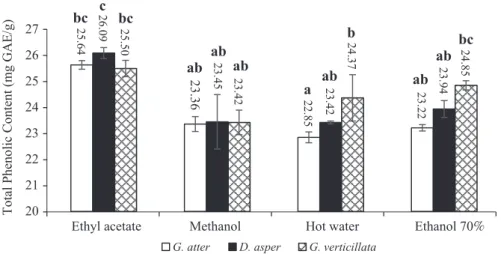
Gigantochloa verticillata revealed the high- est soluble extract with n-hexane (2.46%), ethyl acetate (1.68%), and total extractive yield (8.81%), while G. atter had the high- est yields of soluble extracts with methanol extraction (2.58%), hot water (3.62%), and 70% ethanol (4.96%). Further, the TPC and TFC are shown in Figures 1 and 2. The ANOVA revealed a significant difference in the interaction of the two factors of TPC (p <
0.05) and TFC (p < 0.01). The highest TPC
Table 1. Percentage of extraction yield with successive extraction
Bamboo species Extraction yield (%)
n-hexane ethyl acetate Methanol hot water Total extractive
1)ethanol 70%
2)G. atter
0.93 0.91 2.58 3.62 8.04 4.96
D. asper 1.76 1.43 2.12 3.16 8.47 4.75
G. verticillata 2.46 1.68 2.40 2.27 8.81 4.58
Data shown are mean from three replication
1)
Total extractive yield is a sum of the successive extraction yield.
2)
n-hexane – hot water extractions were done successively, ethanol 70% extraction were done separately.
and TFC were found in the ethyl acetate- soluble extract of D. asper (26.09 mg GAE g
-1) and G. verticillata (92.67 mg QE g
-1), re- spectively. Meanwhile, TPCs were found to be lower in methanol- and hot water-soluble extracts, and no flavonoids were measured in the hot water-soluble extracts.
Phytochemical screening for alkaloids, saponins, and tannins
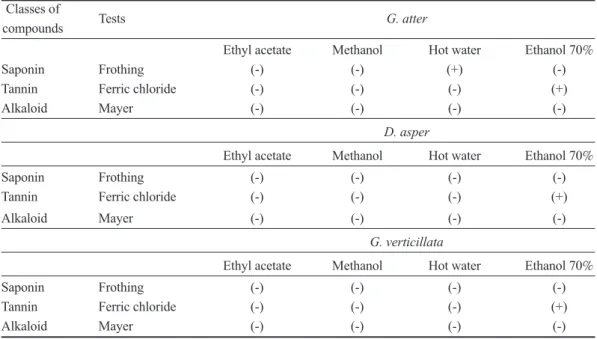
Amounts of alkaloids, saponins, and tan- nins detected in leaf extracts of the 3 bamboo species (G. atter, D. asper, and G. verticil- lata) are shown in Table 2. Saponins, tannins, or alkaloids were not detected in ethyl-acetate or methanol extracts of the 3 bamboo species.
The presence of saponins was only detected in the hot-water extract of G. atter. Tannins were detected in the ethanol (70%) extracts of all 3 bamboo species.
25.64 23.36 22.85 23.22
26.09 23.45 23.42 23.94
25.50 23.42 24.37 24.85
20 21 22 23 24 25 26 27
Total Phenolic Content (mg G AE/g)
G. atter D. asper G. verticillata
bc c bc
ab ab
ab a ab ab
ab bc b
Ethyl acetate Methanol Hot water Ethanol 70%
Fig. 1. A: Total phenolic content of ethyl acetate, methanol, hot water, and ethanol 70 soluble extract.
84.03 20.80 0.00 3.50
84.23 22.58 0.00 5.18
92.67 18.49 0.00 17.18
0 20 40 60 80 100 120
Ethyl acetate Methanol Hot water Ethanol 70%
Total Flavonoid Content (mg QE/g)
G. atter D. asper G. verticillata
c c d
b b b
a a a a a
b
Fig. 2. Total flavonoid content G. atter, D. asper, and G. verticillata on ethyl acetate,
methanol, hot water, and ethanol 70 soluble extract.
Table 2. Phytochemical screening for saponin, tannin, and alkaloid
Classes of Tests G. atter
compounds
Ethyl acetate Methanol Hot water Ethanol 70%
Saponin Frothing (-) (-) (+) (-)
Tannin Ferric chloride (-) (-) (-) (+)
Alkaloid Mayer (-) (-) (-) (-)
D. asper
Ethyl acetate Methanol Hot water Ethanol 70%
Saponin Frothing (-) (-) (-) (-)
Tannin Ferric chloride (-) (-) (-) (+)
Alkaloid Mayer (-) (-) (-) (-)
G. verticillata
Ethyl acetate Methanol Hot water Ethanol 70%
Saponin Frothing (-) (-) (-) (-)
Tannin Ferric chloride (-) (-) (-) (+)
Alkaloid Mayer (-) (-) (-) (-)
The results are average from three replications. (-) = no presence; (+) = presence of compound.
DPPH radical-scavenging capacity The DPPH radical-scavenging assay is a method that depends on the ability of a compound to reduce DPPH radicals. A hydrogen atom that has been donated by a donor compound or antioxidant forms a non- radical form of DPPH-H. The antioxidant activity of the extract was expressed as the IC
50value as shown in Figure 3. The highest antioxidant activity is shown by the lowest IC
50value. In general, mild antioxidant activi- ties were exhibited by polar solvents (ethyl acetate, methanol, hot water, and 70% etha- nol). Meanwhile, n-hexane-soluble extracts showed low antioxidant activity. Gallic acid and quercetin were used as positive controls, and a comparison showed respective values of 92.51 and 169.05 µg ml
-1. An ANOVA of the antioxidant activity of various polar solvents showed a significant interaction between the various species and solvent factor (p = 0.032).
Tukey’s HSD test showed that polar- soluble extracts had no significant antioxidant activity, except for the ethyl acetate-soluble
extract of G. verticillata which was signifi- cantly milder. The ethanol (70%)-soluble ex- tract of G. verticillata showed the highest an- tioxidant activity with an IC
50value of 566.79 µg ml
-1. Compared to the positive controls, the extract showed mild antioxidant activity (Ethanol soluble extract of G. verticillata IC
50was ±6.12 and ±3.35 times the IC
50values of gallic acid and quercetin, respectively).
DISCUSSION
Successive extraction is a method used
to extract a broad range of compounds using
solvents with increasing polarity from non-
polar (n-hexane) to polar (hot water). G.atter
showed the highest yield of polar compounds,
while G. verticillata showed the highest yield
of apolar compounds. The apolar n-hexane-
soluble extracts showed a dark color, and it
was assumed to contain phenolics, albeit to a
lesser extent. The highest yield of polar com-
pounds was obtained using 70% ethanol in all
species. Further, TPCs of the 3 bamboo spe-
cies were higher in semi-polar (ethyl acetate) extracts, while the polar extractive showed lower amounts with no significant difference among the solvents. Meanwhile, TFCs of the 3 species declined as the polarity of the solvent increased, and flavonoids were not present in hot water-soluble extracts. These results indicate that the 3 bamboo leaf extracts with relatively low polarity were dominated by phe- nolic compounds as seen with quercetin. This was in alignment with a previous study on the ethyl acetate-soluble peel extract of Citrus hys- trix, where the amount of phenolic compounds varied based on the polarity of the solvent used (Wijaya et al. 2017).
Phytochemical screening detected that saponins were present in the hot-water ex- tract of G. atter. Saponins are glycosides that consist of an aglycone, either a choline steroid or triterpenoid, and a sugar side chain
that attaches through a bond in C3 (Vicken et al. 2007). Previous studies explained some of the benefits of ingesting saponins by humans because of the hypocholesterolemic, immunostimulatory, antioxidant, and anticar- cinogenic properties they possess (Coffie et al. 2014). However, glycosidation of pheno- lics lowers the antioxidant potency (Merrilon et al. 1997; Hopia and Heinonen 1999). In some cases, saponins are also known to be toxic at high doses, as they have hemolytic properties (Price et al. 1987). Therefore, their detection in the hot-water extract of G.
atter could indicate additional health benefits to humans. However, their safety and toxic- ity should be further studied before they are applied to human diets.
Tannins were detected by phytochemi- cal screening in 70% ethanol-soluble ex- tracts. Tannins are hydrophilic polyphenol
4988 .7 8 1450 .1 7 2504 .9 3 1993 .1 2 1825 .0 7
3869 .1 8 1566 .1 7 1459 .9 1 1039 .7 2 1017 .2 0
4446 .5 5 4085 .0 0 1674 .2 4 662 .4 1 566 .7 9
169.05 92.51
0 1,000 2,000 3,000 4,000 5,000 6,000 7,000
IC
50(µ g/ m l)
ab b
a a
a ab
b a ab
c c c
ab ab c
G. atter D. asper G. verticillata