Significant Association of Cyclin D1 Single Nucleotide Polymorphisms with Oral
Cancer in Taiwan
MING-HSUI TSAI1,4,8, CHIA-WEN TSAI4,5,8, YUNG-AN TSOU1,4,8, CHUN-HUNG
HUA1,4, CHIA-FANG HSU4,7, and DA-TIAN BAU4,5,6,
1 Departments of Otolaryngology, 2 Hematology Oncology, 3 Pediatrics, 4 Terry Fox
Cancer Research Lab, China Medical University Hospital, Taichung, Taiwan, R.O.C.
5 Graduate Institute of Basic Medical Science, 6 Graduate Institutes of Clinical Medical
Science, China Medical University, Taichung, Taiwan, R.O.C.
7 Department of Otolaryngology, Chang-Hua Hospital, Chang-Hua, Taiwan, R.O.C
8 These authors contribute equally to this work
Correspondence to: Da-Tian Bau Ph.D., Terry Fox Cancer Research Lab, Department of
Medical Research, China Medical University Hospital, 2 Yuh-Der Road, Taichung, 404
Taiwan, R.O.C. Tel: +886422053366 Ext 3312, Fax: +886422053366 Ext 1511, e-mail:
[email protected]; [email protected]
Running title: Tsai et al: Cyclin D1 genotypes in oral cancer
Abstract. Aim: The cell cycle regulator cyclin D1 (CCND1) is thought to play a
major role in the transition of cell cycle from G1 to S phase. It is known that cancer
cells have an unbalanced cell cycle regulation. The study aimed at investigating the
association of CCND1 and examining the gene-environment interaction among
CCND1 and smoking habits. Materials: In this hospital-based case-control study, the
associations of CCND1 single nucleotide polymorphisms A870G (rs9344) and
C1722G (rs678653) with oral cancer risk were investigated in 620 patients and 620
age-and gender-matched controls. Results: The results confirmed that there were
significant differences between oral cancer and control groups in the distribution of
the genotypes (P=0.0014) and allelic frequency (P=0.0027) in the CCND1 rs9344
genotype. Individuals who carried at least one G allele (GG or AG) had a 0.64-fold
increased risk of developing oral cancer compared to those who carried the AA wild
type genotype (95% CI: 0.50-0.81). There are obvious joint effects of CCND1 rs9344
genotypes with smoking habits on oral cancer. Conclusion: These findings support
the conclusion that the cell cycle regulation may play a role in oral carcinogenesis and
that CCND1 rs9344 polymorphism maybe a useful biomarker for oral oncology.
Key Words: Cyclin D1, polymorphism, oral cancer, smoking.
Oral cancer is commonly diagnosed cancers all over the world (1-4). With
continuously increasing incidence and mortality for the past two decades, oral cancer
has become the fourth most common cause of male cancer death in Taiwan. (5).
Smoking may induce oxidative insults to the human genome, with the major DNA
adducts of 8-hydroxy-2-deoxyguanine (8-OH-dG) (6, 7). The 8-OH-dG is mutagenic
which if not repaired on time, can cause severe transversions of GC to TA in several
oncogenes and tumor suppressor genes and in turn lead to carcinogenesis (6, 7). Thus,
smoking habit is one of the environmental factors for oral oncology.
Cyclin D1 (CCND1) plays a critical role in the G1-S phase transition of the cell
cycle (8, 9). CCND1 accomplishes this key function by forming complex with its
kinase partners CDK 4 or CDK6 (8, 9). Some reports has demonstrated CCND1 may
involved in the development of some cancers in a CDK-independent pattern (10, 11).
Dysregulation of CCND1 is a commonly observed character of human cancers, and
frequently an overexpression of CCND1 has been reported as a potential biomarker in
human cancers, such as oral carcinoma (12-14). However, the underlying mechanisms
of the CCND1 overexpression and its relationship to oral oncology is poorly
understood. In the literature, limited information is available of the genetic role of
CCND1 in oral cancer, except on in head and neck cancer (15), one in oral
premalignant lesion(16), and two in oral cancer (17, 18). In this study, we aimed at
evaluating the contribution of CCND1 polymorphisms to oral cancer in Taiwan. In
addition, we also investigated the genotype joint interaction with smoking behaviors.
Materials and Methods
Study population and sample collection. Six hundred and twenty cancer patients
diagnosed with oral cancer were recruited at the outpatient clinics of general surgery
between 1998-2010 at the China Medical University Hospital, Taichung, Taiwan. The
clinical characteristics of patients including histological details were all graded and
defined by expert surgeons. All patients voluntarily participated, completed a
self-administered questionnaire and provided peripheral blood samples. As many
non-oral cancer healthy volunteers as controls were selected by matching for age,
gender and habits after initial random sampling from the Health Examination Cohort
of the hospital. The exclusion criteria of the control group included previous
malignancy, metastasized cancer from other or unknown origin, and any familial or
genetic diseases. Both groups completed a short questionnaire which included habits.
Smokers were defined as daily or almost daily smokers, who had smoked at least five
packs of cigarettes in their lifetime. Smokers were asked for the age of initiation,
whether they were currently smoking or had already quit, and if so, when they had
quit, and on average, how many cigarettes they smoked or had smoked daily. Our
University Hospital and written-informed consent was obtained from all participants.
Genotyping conditions. Genomic DNA was prepared from peripheral blood
leucocytes using a QIAamp Blood Mini Kit (Blossom, Taipei, Taiwan) and stored as
previously published (19-24). The primers used for CCND1 A870G (rs9344) were:
forward 5’-GTG AAG TTC ATT TCC AAT CCG C-3’, and reverse 5’-GGG ACA
TCA CCC TCA CTT AC-3’; for CCND1 C1722G (rs678653) were: forward 5’-CTC
TTG GTT ACA GTA GCG TAG C-3’, and reverse 5’-ATC GTA GGA GTG GGA
CAG GT-3’. The following cycling conditions were performed: one cycle at 94oC for
5 min; 35 cycles of 94oC for 30 s, 55oC for 30 s, and 72oC for 30 s; and a final
extension at 72oC for 10 min.
RFLP conditions. As for the CCND1 rs9344, the resultant 167 bp PCR product was mixed with 2 U Nci I and incubated for 3 h at 37°C. The G form PCR products could be further digested while the A form could not. Two fragments 145 bp and 22 bp were
present if the product was digestible G form. As for the CCND1 rs678653, the
resultant 159 bp PCR product was mixed with 2 U Hae III and incubated for 3 h at
37°C. On digestion with Hae III, the PCR product arising from the G allele was cut
into fragments of 111, 26 and 22 bp, whereas C allele was cut into fragments of 137 and 22 bp. Then, 10 μl of product was loaded into a 3% agarose gel containing
ethidium bromide for electrophoresis. The genotype analysis was performed by two
researchers independently and blindly. Ten percent of the samples were randomly
selected for direct sequencing and the results were 100% concordant.
Statistical analyses. To ensure that the controls used were representative of the
general population and to exclude the possibility of genotyping error, the deviation of
the genotype frequencies of CCND1 single nucleotide polymorphisms in the control
subjects from those expected under the Hardy-Weinberg equilibrium was assessed
using the goodness-of-fit test. Pearson’s Chi-square test or Fisher’s exact test (when
the expected number in any cell was less than five) was used to compare the
distribution of the CCND1 genotypes between cases and controls. Cancer risk
associated with the genotypes was estimated as odds ratio (ORs) and 95% confidence
intervals (CIs) using unconditional logistic regression. Data was recognized as
significant when the statistical P-value was less than 0.05.
Results
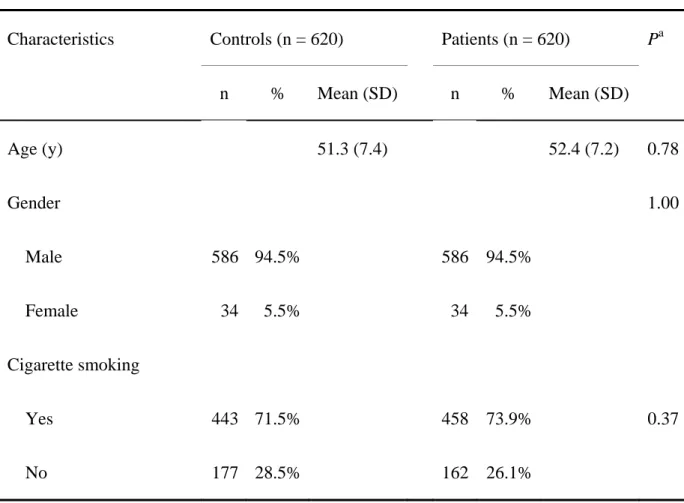
There were no significant differences between both groups in their age, sex, and
smoking status (Table I). The frequencies of the genotypes and alleles of the CCND1
A870G (rs9344) in the oral cancer and control groups were shown in Table II. There
were significant differences between both groups in the distribution of genotype
(P=0.0014) and allelic frequency (P=0.0027). The odds ratios of the AG and GG were
0.64 (95%CI=0.50-0.81) and 0.61 (95%CI=0.43-0.87), respectively, compared to the
AA wild-type genotype. Hence, individuals who carried at least one G allele (AG and
GG) had a 0.64-fold increased risk of developing oral cancer compared to those who
carried the A/A wild type genotype (95%CI: 0.50-0.81). Allele G had a 0.78-fold
increased risk of developing oral cancer compared to allele A (95%CI: 0.67-0.92). On
the contrary, as for the CNND1 C1722G, there was no difference in the distributions
of either genotype or allelic frequency between oral cancer patient and control groups
(Table III). The conclusive finding deduced from the data in Tables II and III is that
the G allele of CNND1 A870G seems to be protective factor for oral cancer in
Taiwan.
The interaction of genotype of CNND1 A870G and the smoking habits was of
our interest. The genotype distribution of various genetic polymorphisms of CNND1
A870G was significantly different between oral cancer and control groups who have
smoking habit (P=0.0006) (Table IV). Consistent with the findings in Table II, the
GG genotype frequency was still significantly lower (12.9%) in cancer patients who
have smoking habit than in smoking controls (16.6%). There was no such distribution
difference in the non-smoking groups (P>0.05).
Discussion
In order to examine the role of CNND1 in oral cancer, in this study, we selected the
most commonly studied two polymorphic sites of the CNND1 gene, A870G (rs9344)
and C1722G (rs678653), and clarify their associations with the susceptibility for the
oral cancer risk in Taiwan, where the oral cancer density is the highest worldwide. We
found that the G variant genotypes of CNND1 A870G were significantly associated
with a lower susceptibility for oral cancer (Tables II), and this genotype had joint
effects with individual smoking habits on oral cancer susceptibility (Table IV), while
the CNND1 C1722G polymorphism may play a minor role in oral carcinogenesis. As
we supposed, the effects of CNND1 gene on oral carcinogenesis are complex, exerting
either an adverse effect or an advantageous influence on determining oral cancer risk.
Several studies showed that the genotypes of CNND1 A870G were associated
with cancer risks, however which genotype plays more critical remains unclear and it
is quite disease- and ethic-dependent. Consistent with our findings, the G allele seems
to be protective factor in hepatocellular carcinoma (25), larynx (26), breast (27),
colorectal (28, 29), and bladder cancers (30). But several controversial findings
reported that the G allele was risky in oral (18) and colorectal cancer (31), or not
associated in oral (17, 32) and other cancers (33-35). Among the studies, the sample
sizes all needed to be enlarged and certificated, and a conclusion of the genetic role of
CNND1 play in carcinogenesis are still not easily deduced so far.
In literature, the overexpression of CNND1 were found to be associated with oral
cancer risk (12, 36). However, the underlying mechanism leading to this aberrant
expression remains poorly understood. One of the probable mechanisms of CNND1
overexpression is alternate splicing modulated by A870G (37, 38) to sustain the
protein for a longer time. Recently, in esophageal adenocarcinomas, The A allele of
A870G was found to promote cyclin D1 expression (39). Contradictory to the study,
also performed in head and neck cancer, no association between A870G
polymorphism and cyclin D1 expression was reported (39). Therefore, the
genotype-phenotype correlation, and their relation to oral oncology need to be further
conformed in the future.
To sum up, this is so far the largest study which focuses on the CNND1 and its
joint effects with smoking habit on oral cancer risk. The genotype of CNND1 A870G,
interacts with smoking habits, may play an important role in the oral carcinogenesis.
Acknowledgements
We thank Wen-Hsing Chang for the technical assistance. This study was supported by
research grants from the China Medical University and Hospital (DMR-100-044),
Terry Fox Cancer Research Foundation and the National Science Council (NSC
98-2320-B-039-010-MY3 and 98-2218-E-039-001).
References
1 Caplan DJ and Hertz-Picciotto I: Racial differences in survival of oral and
pharyngeal cancer patients in North Carolina. J Public Health Dent 58: 36-43,
1998.
2 Moore RJ, Doherty DA, Do KA, Chamberlain RM and Khuri FR: Racial
disparity in survival of patients with squamous cell carcinoma of the oral
cavity and pharynx. Ethn Health 6: 165-177, 2001.
3 Shiboski CH, Shiboski SC and Silverman S, Jr.: Trends in oral cancer rates in
the United States, 1973-1996. Community Dent Oral Epidemiol 28: 249-256,
2000.
4 Swango PA: Cancers of the oral cavity and pharynx in the United States: an
epidemiologic overview. J Public Health Dent 56: 309-318, 1996.
5 Department of Health, Taiwan. Cancer registration system annual report.
Taiwan, Department of Health; 2008.
6 Chen L, Elahi A, Pow-Sang J, Lazarus P and Park J: Association between
polymorphism of human oxoguanine glycosylase 1 and risk of prostate cancer.
J Urol 170: 2471-2474, 2003.
7 Xu J, Zheng SL, Turner A, Isaacs SD, Wiley KE, Hawkins GA, Chang BL,
Bleecker ER, Walsh PC, Meyers DA and Isaacs WB: Associations between
hOGG1 sequence variants and prostate cancer susceptibility. Cancer Res 62:
2253-2257, 2002.
8 Sherr CJ: D-type cyclins. Trends Biochem Sci 20: 187-190, 1995.
9 Sherr CJ: Cancer cell cycles. Science 274: 1672-1677, 1996.
10 Coqueret O: Linking cyclins to transcriptional control. Gene 299: 35-55, 2002.
11 Fu M, Wang C, Li Z, Sakamaki T and Pestell RG: Minireview: Cyclin D1:
normal and abnormal functions. Endocrinology 145: 5439-5447, 2004.
12 Jayasurya R, Sathyan KM, Lakshminarayanan K, Abraham T, Nalinakumari
KR, Abraham EK, Nair MK and Kannan S: Phenotypic alterations in Rb
pathway have more prognostic influence than p53 pathway proteins in oral
carcinoma. Mod Pathol 18: 1056-1066, 2005.
13 Bova RJ, Quinn DI, Nankervis JS, Cole IE, Sheridan BF, Jensen MJ, Morgan
GJ, Hughes CJ and Sutherland RL: Cyclin D1 and p16INK4A expression
predict reduced survival in carcinoma of the anterior tongue. Clin Cancer Res
5: 2810-2819, 1999.
14 Michalides R, van Veelen N, Hart A, Loftus B, Wientjens E and Balm A:
Overexpression of cyclin D1 correlates with recurrence in a group of
forty-seven operable squamous cell carcinomas of the head and neck. Cancer
Res 55: 975-978, 1995.
15 Holley SL, Parkes G, Matthias C, Bockmuhl U, Jahnke V, Leder K, Strange
RC, Fryer AA and Hoban PR: Cyclin D1 polymorphism and expression in
patients with squamous cell carcinoma of the head and neck. Am J Pathol 159:
1917-1924, 2001.
16 Huang M, Spitz MR, Gu J, Lee JJ, Lin J, Lippman SM and Wu X: Cyclin D1
gene polymorphism as a risk factor for oral premalignant lesions.
Carcinogenesis 27: 2034-2037, 2006.
17 Sathyan KM, Nalinakumari KR, Abraham T and Kannan S: Influence of single
nucleotide polymorphisms in H-Ras and cyclin D1 genes on oral cancer
susceptibility. Oral Oncol 42: 607-613, 2006.
18 Sathyan KM, Nalinakumari KR, Abraham T and Kannan S: CCND1
polymorphisms (A870G and C1722G) modulate its protein expression and
survival in oral carcinoma. Oral Oncol 44: 689-697, 2008.
19 Chang CH, Chiu CF, Wang HC, Wu HC, Tsai RY, Tsai CW, Wang RF, Wang
CH, Tsou YA and Bau DT: Significant association of ERCC6 single nucleotide
polymorphisms with bladder cancer susceptibility in Taiwan. Anticancer Res
29: 5121-5124, 2009.
20 Chang CH, Wang RF, Tsai RY, Wu HC, Wang CH, Tsai CW, Chang CL, Tsou
YA, Liu CS and Bau DT: Significant association of XPD codon 312 single
nucleotide polymorphism with bladder cancer susceptibility in Taiwan.
Anticancer Res 29: 3903-3907, 2009.
21 Liu CJ, Hsia TC, Wang RF, Tsai CW, Chu CC, Hang LW, Wang CH, Lee HZ,
Tsai RY and Bau DT: Interaction of cyclooxygenase 2 genotype and smoking
habit in Taiwanese lung cancer patients. Anticancer Res 30: 1195-1199, 2010.
22 Liu CS, Tsai CW, Hsia TC, Wang RF, Liu CJ, Hang LW, Chiang SY, Wang CH,
Tsai RY, Lin CC and Bau DT: Interaction of methylenetetrahydrofolate
reductase genotype and smoking habit in Taiwanese lung cancer patients.
Cancer Genomics Proteomics 6: 325-329, 2009.
23 Wang HC, Chiu CF, Tsai RY, Kuo YS, Chen HS, Wang RF, Tsai CW, Chang
CH, Lin CC and Bau DT: Association of genetic polymorphisms of EXO1
gene with risk of breast cancer in Taiwan. Anticancer Res 29: 3897-3901,
2009.
24 Wang HC, Liu CS, Chiu CF, Chiang SY, Wang CH, Wang RF, Lin CC, Tsai
RY and Bau DT: Significant association of DNA repair gene Ku80 genotypes
with breast cancer susceptibility in Taiwan. Anticancer Res 29: 5251-5254,
2009.
25 Akkiz H, Bayram S, Bekar A, Akgollu E and Ozdil B: Cyclin D1 G870A
polymorphism is associated with an increased risk of hepatocellular carcinoma
in the Turkish population: case-control study. Cancer Epidemiol 34: 298-302.
26 Rydzanicz M, Golusinski P, Mielcarek-Kuchta D, Golusinski W and Szyfter K:
Cyclin D1 gene (CCND1) polymorphism and the risk of squamous cell
carcinoma of the larynx. Eur Arch Otorhinolaryngol 263: 43-48, 2006.
27 Canbay E, Eraltan IY, Cercel A, Isbir T, Gazioglu E, Aydogan F, Cacina C,
Cengiz A, Ferahman M, Zengin E and Unal H: CCND1 and CDKN1B
polymorphisms and risk of breast cancer. Anticancer Res 30: 3093-3098,
2010.
28 Jiang J, Wang J, Suzuki S, Gajalakshmi V, Kuriki K, Zhao Y, Nakamura S,
Akasaka S, Ishikawa H and Tokudome S: Elevated risk of colorectal cancer
associated with the AA genotype of the cyclin D1 A870G polymorphism in an
Indian population. J Cancer Res Clin Oncol 132: 193-199, 2006.
29 Grunhage F, Jungck M, Lamberti C, Berg C, Becker U, Schulte-Witte H,
Plassmann D, Rahner N, Aretz S, Friedrichs N, Buettner R, Sauerbruch T and
Lammert F: Association of familial colorectal cancer with variants in the
E-cadherin (CDH1) and cyclin D1 (CCND1) genes. Int J Colorectal Dis 23:
147-154, 2008.
30 Yuan L, Gu X, Shao J, Wang M, Wang M, Zhu Q and Zhang Z: Cyclin D1
G870A polymorphism is associated with risk and clinicopathologic
characteristics of bladder cancer. DNA Cell Biol 29: 611-617.
31 Yaylim-Eraltan I, Arikan S, Yildiz Y, Cacina C, Ergen HA, Tuna G, Gormus U,
Zeybek U and Isbir T: The influence of cyclin D1 A870G polymorphism on
colorectal cancer risk and prognosis in a Turkish population. Anticancer Res
30: 2875-2880, 2010.
32 Gomes CC, Drummond SN, Guimaraes AL, Andrade CI, Mesquita RA and
Gomez RS: P21/ WAF1 and cyclin D1 variants and oral squamous cell
carcinoma. J Oral Pathol Med 37: 151-156, 2008.
33 Gangwar R and Mittal RD: Association of selected variants in genes involved
in cell cycle and apoptosis with bladder cancer risk in North Indian population.
DNA Cell Biol 29: 349-356, 2010.
34 Jain M, Kumar S, Upadhyay R, Lal P, Tiwari A, Ghoshal UC and Mittal B:
Influence of apoptosis (BCL2, FAS), cell cycle (CCND1) and growth factor
(EGF, EGFR) genetic polymorphisms on survival outcome: an exploratory
study in squamous cell esophageal cancer. Cancer Biol Ther 6: 1553-1558,
2007.
35 Satinder K, Chander SR, Pushpinder K, Indu G and Veena J: Cyclin D1
(G870A) polymorphism and risk of cervix cancer: a case control study in
north Indian population. Mol Cell Biochem 315: 151-157, 2008.
36 Jayasurya R, Francis G, Kannan S, Lekshminarayanan K, Nalinakumari KR,
Abraham T, Abraham EK and Nair MK: p53, p16 and cyclin D1: molecular
determinants of radiotherapy treatment response in oral carcinoma. Int J
Cancer 109: 710-716, 2004.
37 Betticher DC, Thatcher N, Altermatt HJ, Hoban P, Ryder WD and Heighway J:
Alternate splicing produces a novel cyclin D1 transcript. Oncogene 11:
1005-1011, 1995.
38 Sawa H, Ohshima TA, Ukita H, Murakami H, Chiba Y, Kamada H, Hara M
and Saito I: Alternatively spliced forms of cyclin D1 modulate entry into the
cell cycle in an inverse manner. Oncogene 16: 1701-1712, 1998.
39 Izzo JG, Wu TT, Wu X, Ensor J, Luthra R, Pan J, Correa A, Swisher SG, Chao
CK, Hittelman WN and Ajani JA: Cyclin D1 guanine/adenine 870
polymorphism with altered protein expression is associated with genomic
instability and aggressive clinical biology of esophageal adenocarcinoma. J
Clin Oncol 25: 698-707, 2007.
Table I. Age, gender and cigarette smoking status of oral cancer patients and controls
Characteristics Controls (n = 620) Patients (n = 620) Pa
n % Mean (SD) n % Mean (SD)
Age (y) 51.3 (7.4) 52.4 (7.2) 0.78
Gender 1.00
Male 586 94.5% 586 94.5%
Female 34 5.5% 34 5.5%
Cigarette smoking
Yes 443 71.5% 458 73.9% 0.37
No 177 28.5% 162 26.1%
Table II. Distribution of CCND1 A870G (rs9344) genetic and allelic frequencies among oral cancer
patient and control groups.
A870G (rs9344) Controls % Patients % OR (95% CI)a P-valueb
Genetic frequency
AA 155 25.0% 213 34.4% 1.00 (Reference) 0.0014
AG 365 58.9% 323 52.1% 0.64 (0.50-0.83)
GG 100 16.1% 84 13.5% 0.61 (0.43-0.87)
Carrier comparison
AA+AG 520 83.9% 536 86.5% 1.00 (Reference) NS
GG 100 16.1% 84 13.5% 0.81 (0.60-1.12)
AA 155 25.0% 213 34.4% 1.00 (Reference) 0.0004
AG+GG 465 75.0% 407 65.6% 0.64 (0.50-0.81)
Allele frequency
Allele A 675 54.4% 749 60.4% 1.00 (Reference) 0. 0027
Allele G 565 45.6% 491 39.6% 0.78 (0.67-0.92)
a OR: odds ratio, CI: confidence interval; b Based on Chi-square test, NS: non-significant.
Table III. Distribution of CCND1 C1722G (rs678653) genetic and allelic frequencies among oral cancer
patient and control groups.
C1722G (rs678653) Controls % Patients % OR (95% CI)a P-valueb
Genetic frequency
GG 434 70.0% 450 72.6% 1.00 (Reference) NS
CG 136 21.9% 127 20.5% 0.90 (0.68-1.19)
CC 50 8.1% 43 6.9% 0.83 (0.54-1.27)
Carrier comparison
GG+CG 570 91.9% 577 93.1% 1.00 (Reference) NS
CC 50 8.1% 43 6.9% 0.85 (0.56-1.30)
GG 434 70.0% 450 72.6% 1.00 (Reference) NS
CG+CC 186 30.0% 170 27.4% 0.88 (0.69-1.13)
Allele frequency
Allele G 1004 81.0% 1027 82.8% 1.00 (Reference) NS
Allele C 236 19.0% 213 17.2% 0.88 (0.72-1.08)
a OR: odds ratio, CI: confidence interval; b Based on Chi-square test, NS: non-significant.
Table IV. Distribution of CCND1 A870G (rs9344) genotypes in oral cancer patients after stratification by cigarette smoking habits.
Variable CCND1 A870G (rs9344) genotype
AA (%) AG (%) GG (%) P-valuea
Smokers
Controls 100 (23.1%) 261 (60.3%) 72 (16.6%) 0.0006b
Patients 159 (34.7%) 240 (52.4%) 59 (12.9%)
Non-smokers
Controls 55 (29.4%) 104 (55.6%) 28 (15.0%) NS
Patients 54 (33.3%) 83 (51.2%) 25 (15.5%)
a Based on Chi-square test, NS: non-significant.