Minority Issues in the First Cycle of the Universal Periodic Review (UPR)
An analysis by the
UN Special Rapporteur on minority issues, Rita Izsák
Table of Content
Foreword by the UN Special Rapporteur on minority issues………3
Research methodology………4
Summary of Key Findings………..4
Areas of Concern………11
Specific Minority Groups in Focus……….14
Intersectionality: Women and Children……… 27
Regional Group Analysis ! Africa………..34
! Asia………..37
! Eastern European Group………..41
! Western European and Others Group……….50
! Group of Latin American and Caribbean States………57
Some observations………..59
Recommendations………60
Foreword by the UN Special Rapporteur on minority issues
As the entire international community, especially the UN family, I have followed with curiosity and great interest the first sessions and the first full cycle of the Universal Periodic Review. I was eager to see the commitment of Member States to minority issues in this revolutionary peer review process both as recommending and receiving States. One could expect in advance that the situation of minorities will often be in focus and indeed, with 895 recommendations it was the 9
thmost discussed topic at the 1
stcycle of the Human Rights Council’s UPR process. I believe that it is essential that we analyze these recommendations in more detail and draw the possible lessons so we can further improve the discussion on minority issues in the 2
ndand future cycles. It is my privilege to offer this brief overview, which has been prepared by myself and is entirely based on the UPR Info database.
I must express my gratitude to the UPR Info team
1and its director, Roland Chauville for their cooperation in overviewing the relevant recommendations in the UPR Info
database so to make sure that all those addressing the situation of national or ethnic, religious and linguistic minorities can be part of this research. A special thanks goes to the Fletcher School of Law and Diplomacy, Human Rights Practicum, namely to Andra Bosneag, Kathryn Joyce, and Rachel Rosenberg for contributing to this important work.
I hope that this analysis will be interesting and useful for all those working on and being interested in minority issues.
1 Please note: not identical with the UPR Team within the UN Office of the High Commissioner for Human Rights
Research methodology
This research is based entirely on the UPR Info statistics and database
2, which has introduced the “minorities” label into the search system from the very beginning. The Special Rapporteur on minority issues with the cooperation of the UPR Info team did their best to make sure that the labelling is in full compliance with the UN Declaration on the Rights of Persons belonging to National or Ethnic, Religious and Linguistic
Minorities. However, as the full database contains more than 35,000 recommendations at the moment
3, there might be cases when certain relevant recommendations are not labelled under “minorities” as they should be. The Special Rapporteur on minority issues is constantly monitoring such possibilities and is working closely with UPR Info to ensure consistency. This current analysis is therefore based on the status of the database as of 1 September 2014 and does not reflect changes in labelling that might have occurred after this date. The research uses rounded numbers to ease the understanding of the reader. The research is analyzing the recommendations based on regional groups according to the United Nations geographical regional arrangement which is the following: African Group (Africa), Asia-‐Pacific Group (Asia), Eastern European Group (EEG), Latin American and Caribbean Group (GRULAC), Western European and Others Group (WEOG), and Others
4.
Summary of Key Findings
The analysis of the 1
stcycle of the Universal Periodic Review revealed that 112 Member States (MSs) issued 895 recommendations about national, ethnic, religious or linguistic minorities to 137 MSs. Minorities were the 9
thmost discussed topic at the 1
stcycle of the Human Rights Council’s UPR process and constituted 4.2% of the total 21,353 recommendations
5. Recommendation on minorities centered on Europe, 43 European MSs received such recommendations, followed by 28 African MSs.
2
http://www.upr-‐info.org
3
As of 1 September 2014
4
For the full list of countries, check: http://www.un.org/depts/DGACM/RegionalGroups.shtml
5
The first 10 most discussed issues were the following: international instruments (4317), women’s rights (3698), rights of the child (3459), torture and other CID treatment (1722), justice (1556), detention conditions (1399), human rights education and training (929), death penalty (914), minorities (895) and special procedures (881).
The Eastern European Group received most recommendations on minorities (368), followed by the Western European and Others Group (230) and Asia (169) (see charter below):
Regional groups receiving minority-‐related recommendations:
It was the Western European and Others Group (WEOG) which made most
recommendations on minorities (361), followed by Asia (159) and the Eastern European Group (154) (see charter below).
Regional groups making minority-‐related recommendations:
The top 3 regional organizations receiving most minority-‐related recommendations were the European Union, the International Organisation of La Francophonie and the Organisation of Islamic Cooperation (see full list below).
Regional organizations receiving minority-‐related recommendations
The top 3 regional organizations making minority-‐related recommendations were the European Union, the Organization of American States and the Organisation of Islamic Cooperation (see full list below).
Regional organizations making minority-‐related recommendations
The top 5 MSs receiving minority-‐related recommendations were: Slovakia (54),
Hungary (38), Italy (29), Croatia (29) and Bulgaria (29). The top 10 recipients are the
following:
The top 5 MSs making minority recommendations were: Austria (38), Canada (35), United Kingdom (33), Russian Federation (30) and the United States (29). The top 10 recommending states were the following:
It is important to note the general rise of recommendations per each session. While the very first UPR session resulted in 430 recommendations, the 6
thsession in 1670, the last 12
thsession in 2434 recommendations. Consequently, recommendations on minorities rose gradually too: the 1
stsession produced 31, the 6
thsession 54 and the last 12
thsession 80 recommendations. The highest number of minority-‐related
recommendations was made on the 10
thsession, namely 107. The below charter shows
the percentage of minority recommendations in each session (horizontally are the sessions, vertically the percentage of minority recommendations of all
recommendations).
Of the recommendations on minorities, 78% were accepted, 22% were noted. 59% of MS accepted all of their recommendations but since many of these MSs received very few, often only 1-‐2 recommendations, the below chart shows those that have received a significant number of recommendations in their respective Regional Group and have accepted the highest ratio from those.
Member States with the highest number of accepted recommendations on minorities (percentages show acceptance ratio of all received recommendations)
Some countries have not accepted any of the received recommendations but since many of these have received very few, often only 1 or 2 recommendations, the below chart shows those that have received a significant number of recommendations in their respective Regional Group and have accepted the lowest ratio from those.
Member States with the highest number of non-‐accepted recommendations on minorities (percentages show non-‐acceptance ratio of all received recommendations) 0
5 10 15 20 25 30 35 40
Total Accepted
Member States in the African region received 74 recommendations in total. Most recommendations were received by Egypt (6), Namibia (5), Nigeria (8), Sudan (5) and Tanzania (6).
Member States in the Asian region received 169 recommendations in total. Most were received by China (11), Iran (17), Iraq (11), Kyrgyzstan (10), Myanmar (20), Nepal (13) and Viet Nam (14).
Most recommendations were received by the Eastern European Group (368). Countries that received most recommendations were the following: Bulgaria (28), Croatia (29), Georgia (21), Hungary (38), Lithuania (20), and Slovakia (50).
The Western European and Others group has received 230 recommendations in total, most by Austria (21), Greece (15), Ireland (15), Italy (29) Portugal (19) and Turkey (21).
Member States in the Group of Latin American and Caribbean States received 54
recommendations in total. Most were received by Guyana (7), Panama (9) and Honduras (5).
The recommendations received by these 27 top recipient Member States are summarized in the last chapter of this analysis.
0 5 10 15 20 25
Total
Non-‐accepted
Areas of Concern
A search for key words gives us a better understanding of the main areas of concern (when words are divided by slash, it is because they often appeared in different format but sometimes jointly in the same recommendation, so for the sake of accuracy, they are highlighted separately). They refer to recommendations both accepted or noted.
Areas of Concern Times Mentioned
Access 76
Citizenship 11
Culture/Cultural 16/51
Education 119
Employment 38
Equality 19
Ethnic/Ethnicity 190/10
Hate/Hatred 12/13
Health/Health care 39/19
Housing 25
Human rights 108
Language/Linguistic 47/16
Media 15
National 148
Participation 38
Police 25
Religion/Religious 37/103
Respect 40
Segregation 7
Training 23
Violent/violence 37
Xenophobia/Intolerance 11/12
Under the keyword access, most recommendations referred to access to education (especially in mother tongue). Other fields such as access to civil and birth registration, health, legal aid, justice, housing, employment, social services, sanitation, electricity or water were also mentioned.
Combating discrimination in the field of citizenship and the need to ensure access to citizenship was the main focus of recommendations addressing citizenship.
The word cultural or culture referred to the need to protect and promote the cultural heritage, identity, rights and needs of minorities and cultural diversity in the society in general. Several recommendations mentioned the need for inter-‐cultural dialogue and inter-‐cultural harmony.
A very high number of recommendations addressed the field of education. Most of them focused on support and access to education and enforcing the principle of non-‐
discrimination. Many recommended human rights awareness raising initiatives or media campaigns to deepen understanding of minority issues. A high percentage put an
emphasize on mother tongue education and many highlighted the particular
vulnerability of minority girls. A few mentioned the ban of segregation, the need for participation of minorities in educational institutions, or the importance of
disaggregated data.
Most employment-‐related recommendations focused on the need to eliminate discrimination and provide access to employment. Four singled out the importance of ensuring employment opportunities for minority women and one raised the issue of disaggregated data revealing employment conditions of minorities.
Member States found it important to provide recommendations on the need to condemn all incitement to violence or hatred, to enact or amend national legislation banning incitement to hatred, prosecute the perpetrators of such incitement, and pay more attention to hatred also through newspaper articles. They also urged to deal with the problems of hate speech by politicians, to have proper legislation and disaggregated data on hate speech, to ensure that hate crimes and racially motivated violence are fully and effectively investigated, to encourage victims to report hate crimes and to ensure their protection from reprisal when they do so.
With just a few exceptions, most health related recommendations focused on access to health care. Some highlighted the need for anti-‐discrimination legislation or strategies to be in place. Half a dozen singled out minority women and one urged for the
abolishment of separated maternity wards.
Most recommendations on housing urged for access to housing, one mentioned the need for social housing.
The issue of human rights was mainly mentioned in the context of ensuring the full range of human rights for minorities and of providing human rights education in schools and training for various officials (such as police, public authorities, prison, judiciary etc).
Recommendations on media were primarily focusing on the importance of awareness
raising, on protection and promotion of different cultures, traditions and religions
through media, on the media’s role in strengthening reconciliation and tolerance, and in
tackling stereotypes. Some also mentioned the importance of media access to certain
areas, the need for stable and systematic funding of minority media and for free and independent media, which reflect minority opinion.
Most recommendations related to training referred to the need of human rights training to be provided to law enforcement bodies and judiciary, others urged training for minorities themselves so they acquire a profession or for citizens to learn about equal treatment.
Participation was mentioned mainly in the context of public and political life and decision-‐making processes. In several cases, participation in cultural, social or economic life and in the labour market was mentioned too. In a few cases, focus has been on elections and one recommendation urged ensuring participation of civil society organizations representing minorities in the UPR process.
Recommendations regarding police mainly focused on the need for human rights training and sensitization of law enforcement officials. A large number of them referred to harassment, ill-‐treatment or racial profiling of police, several focused on the need to have minorities recruited into police forces. One recommendation mentioned the need to have a body that can supervise the acts of police.
Respect in most cases was related to international provisions, obligations and to the full enjoyment of human rights. In several recommendations, it referred to the need to respect freedom of religion or belief, including religious memorials and sites, freedom of expression and association. One recommendation mentioned respect for self-‐
identification.
All recommendations about segregation were made to European countries. With two exceptions, all recommendations referred to educational segregation of Roma children.
One focused on general school segregation of children from various ethnic backgrounds and one referred to the need to end segregation in health care facilities and in
maternity wards.
Violence was mentioned in rather general terms, in the context to combat and end violence against minority groups. “Cyber-‐racism” and the need to condemn incitement were also mentioned. Several recommendations explicitly focused on the need to stop violence, including sexual violence against minority women.
Xenophobia/intolerance – related recommendations addressed the need to strengthen measures and have awareness-‐raising campaigns to fight against them, a few talked about the need for police training and actions to be taken against perpetrators of racist and xenophobic speeches and public statements.
Specific Minority Groups in Focus
More than 25% of all minority recommendations referred to the situation of Roma.
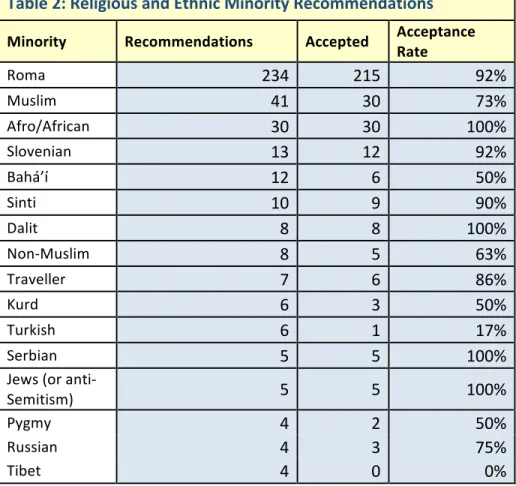
Other groups in focus included Muslims, Afro-‐descendants, Slovenians, Bahá’ís, Sinti, non-‐Muslims, Dalits, Travellers, Kurdish, Turkish, Jewish and Pygmy communities (see table below). Some recommendations referred to particular areas, see for example Tibet.
Table 2: Religious and Ethnic Minority Recommendations
Minority Recommendations Accepted AcceptanceRate
Roma
234 215 92%
Muslim
41 30 73%
Afro/African
30 30 100%
Slovenian
13 12 92%
Bahá’í
12 6 50%
Sinti
10 9 90%
Dalit
8 8 100%
Non-‐Muslim
8 5 63%
Traveller
7 6 86%
Kurd
6 3 50%
Turkish
6 1 17%
Serbian
5 5 100%
Jews (or anti-‐
Semitism)
5 5 100%
Pygmy
4 2 50%
Russian
4 3 75%
Tibet
4 0 0%
Roma
Roma were the most frequently cited minority group in the first cycle of the UPR process. It is important to mention here that although the term “Roma” usually covers several subgroups
6, a few recommendations used references to specific Roma
communities such as “Sinti” or “Traveller”. Due to the fact that the word Sinti was always mentioned together with the word Roma, they are included here. (There were 10 recommendations made on the situation of Sinti. Germany received 3 and Italy received 7. With one exception, all were accepted.) However, recommendations referring to Travellers are discussed separately at the end of this section.
As the charter shows below, a total of 234 recommendations mentioned the situation of Roma, in a total of 27 MSs, all in the Eastern and Western European region: 182
recommendations were made to the Eastern European Group and 52 to the Western European and Other Group.
Overall, states under review accepted 218 of these recommendations, an acceptance rate of 93%. The below chart shows the top 10 MSs with most Roma-‐related
recommendations.
6 The term “Roma” used at the Council of Europe for example refers to Roma, Sinti, Kale and related groups in Europe, including Travellers and the Eastern groups (Dom and Lom), and covers the wide diversity of the groups concerned, including persons who identify themselves as Gypsies.
Regional groups receiving recommendations on Roma
EEG (182) WEOG (52)
All regions were active in making recommendations on Roma. The Western European and Other States Group made 121 recommendations: Finland made 17, Austria made 15, and the United States made 10. The Asian Group made 44 recommendations: 23 by Bangladesh, 7 by Iran. The Group of Latin American and Caribbean States made 33 recommendations: Brazil made 7, Mexico 6, Cuba 6, and Argentina 5. The Eastern
European Group made 20 recommendations: 6 by the Russian Federation, 5 by Slovenia.
The African Group made 15 recommendations, 10 came from Algeria. Observers made 1 recommendation, the Holy See to Hungary.
0 5 10 15 20 25 30 35 40 45 50
Total (see exact numbers next to country names)
Accepted
Regional groups making recommendations on Roma
WEOG (52%) Asia (19%) GRULAC (14%) EEG (8,5%) Africa (6%) Observers (0,5%)
Recommendations on Roma addressed the following areas:
Forty-‐nine (49) recommendations to 20 Member States addressed the education of Roma, 47 were accepted: they mainly stressed that increased efforts need to be made to foster educational attainment of Roma and to ensure access to education, including pre-‐school education (to Albania, Croatia, Italy, etc). One recommended Bulgaria that there should be more efficient communication in place with Roma parents about the positive effect of education and the importance of literacy. One recommendation to the Czech Republic was to collect disaggregated data. A few mentioned the need to reduce or end segregation (to Estonia, Hungary). Germany was encouraged that national curriculum includes lessons on the contribution of Roma and Sinti to the society and its culture. One recommended to Hungary to address the formal educational gap of Roma girls and women. Slovakia noted to enact and implement new legislation as well as practical measures to end discriminatory practices against Roma in the education system perpetuating their segregation, and Austria noted to adopt measures to
guarantee Roma children the right to education in their own language and in a relevant way with their own culture.
Employment came up 24 times to 13 Member States and all of them were accepted:
they mainly addressed the need to ensure non-‐discrimination and equal access to employment (to Bulgaria, Croatia, Czech Republic etc). One recommendation to the Czech Republic stressed the importance of disaggregated data, Hungary was
recommended to consider affirmative action, Spain to increase Roma women's awareness and access to services and programmes in education, employment and healthcare. Slovakia accepted to take measures to increase employment of members of the Roma minority by public institutions.
Housing was mentioned 21 times to 9 Member States. They were all accepted. Almost all of them addressed the need to ensure access to housing and to introduce positive action in order to strengthen integration efforts in this field (for example to Bulgaria, Croatia, Czech Republic, Italy etc). Slovakia accepted the need to increase efforts to provide adequate social housing (Austria to Slovakia, accepted).
Member States made recommendations on Roma and health care 25 times to 13 countries and were all accepted. They mainly stressed the need for non-‐discrimination and ensuring access to health services (for example to Italy, Lithuania, Serbia etc).
Croatia accepted to have media-‐campaigns targeting Roma communities on important issues including health services, Czech Republic again accepted the need for
disaggregated data and Hungary accepted to prevent segregation in hospitals.
As far as Roma women and children are concerned, relevant recommendations are
analyzed later in the chapter dealing with intersectionality.
As mentioned at the beginning, a few recommendations, namely 7 referred specifically to the situation of Travellers. They were all made to Ireland and were accepted with one exception. They concerned overall integration, representation, participation in decision-‐
making, education, health care and housing of Travellers. The only one recommendation that was only noted requested Ireland to get Travellers recognized as an official minority group.
Muslims
There were 34 recommendations made on Muslims in the context of minority issues.
Twenty-‐six were accepted which constitutes 76%. Most recommendations were made to the Western European and Others Group.
Most recommendations were made to Germany (4), Greece (4) and Ireland (4).
Germany and Ireland accepted all, Greece noted 2 of them. Belgium and Myanmar noted all the 2-‐2 recommendations they received, Comoros and Israel also noted the only one recommendation received.
Most recommendations were made by the Asian group, followed by the Western European and Others Group.
Regional groups receiving recommendations on Muslims
Africa (2) Asia (4) EEG (2) GRULAC (0) WEOG (26)
Most recommendations on Muslims (13) urged for combating racism, Islamophobia and discrimination in general and to ensure integration of Muslims (for example to Australia, Canada). Eight (8) recommendations mentioned explicitly freedom of religion and State non-‐interference into practicing of Islam (for example to Iceland, Germany, Slovenia).
Several recommendations addressed the challenge with racial or religious profiling (for example to Canada, United States), violence against Muslims (to Australia, Canada and Germany) or the particular situation of Muslim women (to Germany, Greece, Thailand).
Slovenia accepted the need to build or protect places of worship. There were a few recommendations referring to specific circumstances or concerns, for example food security (Nepal accepted), on citizenship (Myanmar noted), opening one of the historical mosques in Greece (Greece accepted), repeal legislation regarding the appointment of imams (Greece noted), allowing conversion from Islam and proselyfication (Comoros noted), give more support and consideration to Muslims, in particular on financial support, places of worship, cemeteries and other special concerns (Liechtenstein accepted).
African and Afro-‐descendant minorities
33 recommendations mentioned people from African origin or Afro-‐descendants either in the context of minorities or migrants to 15 countries. All of them were accepted.
Most recommendations were made to Panama (8), Honduras and the United States both received 4-‐4. Most recommendations (15) addressed the need for general human rights protection, to combat discrimination and ensure integration of Afro-‐descendents (for example to Colombia, Dominican Republic, the United States etc). Five (5) dealt with economic, social and cultural life specifically, including access to labour market or health care (for example to Canada, Costa Rica, Panama etc). Other topics included: ill-‐
treatment or excessive use by law enforcement officials (to Austria, United States), hate
Regional groups making recommendations on Muslims
Africa (6) Asia (18) EEG (3) GRULAC (0) WEOG (7)
speech (Austria accepted), land rights (Brazil accepted), violence (Australia and Honduras accepted), racial profiling (the United States accepted), birth registration (Panama accepted), one recommendation addressed the need for legal aid for Afro-‐
descendant women (Venezuela accepted). There was one recommendation about non-‐
Africans, which requested urgent solution for the “anomaly regarding citizenship status for residents of non-‐African descent” (Sierra Leone accepted).
Slovenians
Slovenians were mentioned in 13 recommendations (all by Slovenia with the exception of one from the United States). Italy accepted to implement relevant laws, including bilingual topography in areas populated by the Slovenian minority, to increase the visibility of Slovenian television programmes, and to respect the institutions of the Slovenian minority. Austria accepted to implement court decisions concerning bilingual topography and Slovenian as an official language in the province of Carinthia and noted to increase financial support there. Hungary accepted to ensure continued functioning of Slovenian media and the two bilingual Slovenian-‐Hungarian schools and to implement the Agreement on Guaranteeing Special Rights of the Slovenian Minority and the
recommendations of the mixed Slovenian-‐Hungarian Commission tasked with the monitoring of the implementation of the Agreement. Croatia accepted to provide for persons belonging to the Slovenian minority all guaranteed rights.
Bahá’ís
The situation of the Bahá’í minority was mentioned in 12 recommendations to Egypt (1), Iran (10) and Yemen (1). Iran took note of 6 recommendations, all the others were accepted. Egypt accepted the recommendation regarding the expediting of the
provision of all official documents, particularly identity documents to all members of its Baha'i community. Yemen accepted to continue to make all efforts to adopt effective measures to prevent the recurrence of threats against Baha'i communities.
Iran accepted to deal with ensuring fair and transparent trials of Bahá’ís, extending the rights guaranteed in Iranian legislation to all religious groups, including Bahá’ís, respect freedom of religion and judicially prosecute those inciting hatred. Iran took note on recommendations referring to acts of repression, policy of fanatic Islamism and intolerance, discrimination and persecution, intimidation or discrimination against Bahá’í children in schools, incitement to hatred and on releasing detained Bahá'i leaders and end policies of discrimination against Baha'i and other religious and ethnic
minorities.
Turkish minority
Turkish minority groups were mentioned in 12 recommendations to Bulgaria (2), Georgia (4), Greece (4), Iraq (1) and Turkmenistan (1), with three exceptions, all made by Turkey. Bulgaria took note of the 2 recommendations it received to take concrete action to bring to justice those who committed human rights violations against the members of the Turkish minority in the period 1984-‐1989 and to take necessary action to address the impediments faced by the Turkish minority. Georgia received 4
recommendations, 1 was noted, 3 accepted. The one noted asked to take effective measures to facilitate the return of Meskhetian Turks to Georgia, and to guarantee their rights. The other recommendations accepted included the adoption of a relevant law to create appropriate conditions for the integration of the Meskhetian Turks returnees, to launch an awareness campaign and adopt a comprehensive strategy addressing issues such as language learning, access to education and employment. Greece got 4
recommendations, all from Turkey, out of which only 1 was accepted and 3 noted. The one accepted recommended the implementation of relevant judgments of the European Court of Human Rights. The ones noted included recommendations to open Turkish-‐
language kindergartens, to take necessary steps to ensure the election of the muftis by the Turkish Muslim Minority and to start a dialogue with the NGOs of the Turkish communities. Iraq accepted to respect and guarantee the rights of Iraqi Turkmen (and other religious and ethnic minorities). Turkmenistan accepted to eliminate all norms and practices that lead to the discrimination of members of national minorities, such as Russians, Uzbeks, Kazakhs, Turks and Kurds.
Caste-‐discrimination and Dalits
Caste-‐discrimination was mentioned in 9 recommendations: 4 to India, 3 to Nepal and 2 to Pakistan. India took note of all the 4 recommendations: maintain disaggregated data on caste and related discrimination and strengthen human rights education, specifically in order to address effectively the phenomenon of gender-‐based and caste-‐based discrimination. Nepal accepted: to ensure full participation of ethnic groups and castes in the Constitution-‐making process, in particular in the Constituent Assembly; to take further steps to eliminate discrimination against vulnerable or marginalized groups, including on the basis of gender or caste; and to review and adopt relevant legislation and policies, including bills related to caste-‐based discrimination. Pakistan accepted to take measures to eliminate discrimination against castes and high degree of poverty suffered by castes.
Dalits were mentioned in 8 recommendations, all made to Nepal and all being accepted.
They included: continue promoting the work of the National Commissions for Dalits,
through the reinforcement of resources that allows them to work in an efficient
manner; to improve food safety for Dalits; to ensure that Dalit children have equal
access to quality education; to take the necessary legal and policy measures to end
discrimination; to review and adopt relevant legislation and policies, including bills
related to caste-‐based discrimination and the Dalit Commission; to formulate effective
strategies and programmes in order to provide employment and income-‐generating opportunities for Dalits; and to pay special attention to helping Dalit children and girls to complete their education cycle, and to ensure their employment opportunities.
Non-‐Muslims
The expression “non-‐Muslims” have been used in 7 recommendations, out of which 5 were accepted. The following countries received those: Nigeria (1), Sudan (1)
7and Turkey (5). Nigeria accepted to ensure that non-‐Muslims are not subjected to Sharia law and are able to practice their own religion without hindrance. Sudan accepted to foresee measures that would guarantee the right of non-‐Muslims. Turkey accepted to undertake effective efforts and policies to eliminate discriminatory practices,
dissemination of hate speech and to stop persistent hostile attitudes on the part of the general public, including attacks to non-‐Muslim minorities. Turkey also accepted to allow for the functioning of non-‐Muslim religious communities and to take steps to prevent and combat hostile attitudes against persons belonging to non-‐Muslim minorities, by putting in place awareness-‐raising campaigns as well as education and training programmes for judges and law enforcement agents. Turkey noted the recommendations to set a time frame within which restrictions with regard to
deprivation of legal personality of non-‐Muslim minorities and to take effective measures to combat persisting hostile attitudes and discrimination towards persons belonging to non-‐Muslim minorities.
Kurdish minority
Kurdish minorities were part of 6 recommendations to Syria (2), Turkey (3) and
Turkmenistan (1). Syria accepted to comply with commitments enshrined in the Durban Declaration and Plan of Action, particularly as regards the prevention and punishment of discrimination against the population of Kurdish origin. Syria noted to guarantee the civil, political, economic, social and cultural rights of persons belonging to the Kurdish minority.
Turkey accepted to undertake effective efforts and policies to eliminate discriminatory practices, dissemination of hate speech and to stop persistent hostile attitudes on the part of the general public, including attacks towards Kurds. Turkey noted to take effective measures to combat persisting hostile attitudes and discrimination towards Kurds and to implement further reforms to ensure full recognition of the rights of the Kurdish minorities. Turkmenistan accepted to eliminate all norms and practices that lead to the discrimination of Kurds.
7