Research Express@NCKU Volume 6 Issue 9 - December 5, 2008 [ http://research.ncku.edu.tw/re/articles/e/20081205/2.html ]
Effect of soil texture and excitation frequency on the propagation and attenuation of
acoustic waves at saturated conditions
Wei-Cheng Lo
1,*, Chao-Lung Yeh
1, and Chyan-Deng Jan
1,21Department of Hydraulic and Ocean Engineering, National Cheng Kung University, Tainan 701, Taiwan
2Sustainable Environment Research Center, National Cheng Kung University, 1 University Road, Tainan 701, Taiwan
Journal of Hydrology, 357, 270-281, 2008
1.
R
ESEARCH OBJECTIVESIn recent decades, exploration of porous medium structures and interstitial fluid properties in subsurface environments with seismic waves has become a powerful, non-destructive technique extensively used in the field of hydrogeology. One of the critical goals of subsurface exploration is the use of seismic data to infer hydrological parameters of soils, such as porosity and permeability, the knowledge of which is essential for accurate modeling of the transport of water and solutes in
groundwater aquifers and the vadose zone. However, successful application of seismic waves to these problems requires a detailed appreciation of the phase speed and attenuation coefficient of those waves as they travel through unconsolidated sedimentary materials.
A macroscopic model of wave propagation and attenuation through an elastic porous medium permeating a viscous compressible fluid was developed decades ago by Biot, in which wave energy dissipation is primarily attributed to viscous losses caused by the relative motion of the pore fluid to the skeletal framework. One of the key findings of the Biot theory of poroelasticity is that in a fluid-
containing porous medium, three types of elastic wave may exist: one shear (rotational) wave and two modes of dilatational (acoustic, compressional) wave. One dilatational wave, termed the Biot fast wave, propagates faster when the displacements of the solid and fluid phases are in-phase; the other, called the Biot slow wave, propagates slower when the solid moves out-of-phase with the fluid. The Biot theory of poroelasticity has been demonstrated to be successful not only in analyzing the dynamic response of fluid flow through deformable porous media to an oscillatory stress, but also in providing a basic
frequency independent. The porosity and intrinsic permeability are shown to be two critical physical parameters controlling acoustic wave propagation and attenuation.
3.ACCOMPLISHMENTS
Our result shows that two different modes of dilatational wave, typically termed the Biot fast and slow waves in descending order of the phase speed, exist in such fluid-containing media. When the pore space is filled by water, the fastest and slowest phase speeds of the Biot fast wave occur in sandy clay loam and silt loam, respectively; however, the difference in speed is not significant (Fig. 1). The variation in speed becomes more profound when the pore fluid is air, in which the Biot fast wave propagates fastest in sand and slowest in clay (Fig. 1). The latter is only 40% of the former. A further numerical assessment demonstrates that in the frequency range we examined, the phase speed of the Biot fast wave is in fact equal to the Biot reference speed, a result obtained as the fluid moves in the same direction and amplitude as the solid.
Figure 1 The phase speed (m/s) of the Biot fast wave for eleven soil texture classes fully saturated either by water or by air
In contrast to the phase speed of the Biot fast wave that is independent of excitation frequency, the attenuation coefficient of the Biot fast wave is directly related to the square of excitation frequency (Fig.
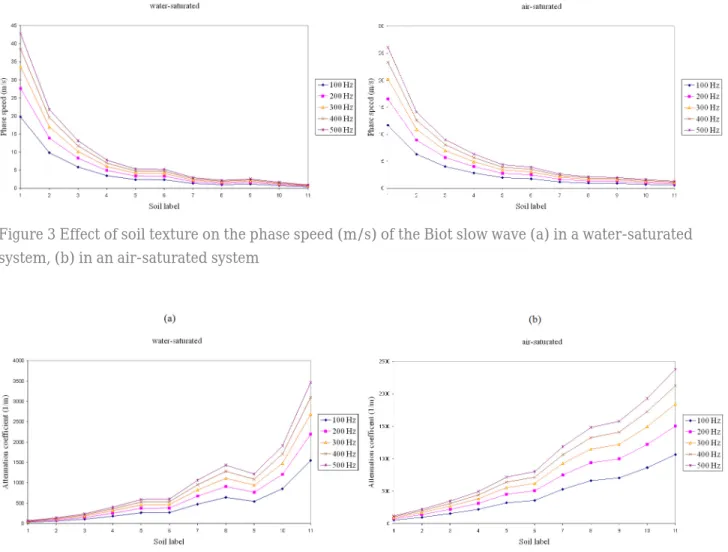
2). In reference to the Biot slow wave, we find that a proportional relation exists between its phase speed and the square root of excitation frequency (Fig. 3), as true for its attenuation coefficient (Fig. 4). The influence of pore fluid on acoustic wave dissipation was also examined in the present study, indicating that the Biot fast wave attenuates more in the water-saturated system than in the air-saturated system;
an exception occurs in clay (Fig. 2). The reverse trend is observed for the attenuation coefficient of the Biot slow wave (Fig. 4). The phase speed of the Biot slow wave is inversely correlated to its attenuation coefficient. The greater the phase speed, the lower the attenuation coefficient.
Figure 3 Effect of soil texture on the phase speed (m/s) of the Biot slow wave (a) in a water-saturated system, (b) in an air-saturated system
Figure 4 Effect of soil texture on the attenuation coefficient (1/m) of the Biot slow wave (a) in a water- saturated system, (b) in an air-saturated system
Lastly, it is shown that porosity and intrinsic permeability are two critical physical parameters affecting the acoustic behavior of the Biot fast and slow waves. In a water-filled system, the phase speed and attenuation coefficient of the Biot fast wave are inversely and positively proportional to porosity and intrinsic permeability with a linear relation, respectively (Fig. 5). This trend is not observed in an air- filled system. In reference to the Biot slow wave, a quadratic relation was found to exist between its phase speed and intrinsic permeability when air permeates the pore space, wherein the attenuation coefficient also bears a quadratic relation with the inverse of intrinsic permeability (Fig. 6).
Figure 5 (a) Relation between porosity and the phase speed (m/s) of the Biot fast wave in a water- saturated system. (b) Relation between intrinsic permeability (m2) and the attenuation coefficient (1/m) of the Biot fast wave in a water-saturated system
Figure 6 (a) Relation between intrinsic permeability (m2) and the phase speed (m/s) of the Biot slow wave in an air-saturated system. (b) Relation between the inverse of intrinsic permeability (1/m2) and the attenuation coefficient (1/m) of the Biot slow wave in an air-saturated system.
4.SIGNIFICANCE OF FINDINGS
It has been widely recognized that strong changes in acoustic wave velocity and attenuation can provide qualitative clues to explore subsurface physical properties. Traditional borehole sampling obtains only local hydrologic data and is an invasive method because it disturbs in-situ environments and, in turn, creates new contaminant pathways. The results we obtained in the present study should play an