• 沒有找到結果。

Morphology and phase transformation at a solder joint in a solid-state reaction

N/A
N/A
Protected

Academic year: 2022

Share "Morphology and phase transformation at a solder joint in a solid-state reaction"

Copied!
5
0
0

加載中.... (立即查看全文)

全文

(1)

Morphology and Phase Transformation at a Solder Joint in a Solid-State Reaction

Tao-Chih Chang, a,z Min-Hsiung Hon, a and Moo-Chin Wang b

a

Department of Materials Science and Engineering, National Cheng Kung University, Tainan 70101, Taiwan

b

Department of Mechanical Engineering, National Kaohsiung University of Applied Sciences, Kaohsiung 80782, Taiwan

Morphology and phase transformation at a solder joint of the Sn-9Zn-xAg lead-free solders and Cu substrate in a solid-state reaction have been investigated in this study. The Cu

6

Sn

5

intermetallic compound is formed at the Sn-9Zn/Cu interface but the Cu

5

Zn

8

layer decomposes as aged at 180°C, which causes microvoid formation at the solder joint. However, microvoid formation is suspected at the Sn-9Zn-xAg/Cu interface due to the Ag

3

Sn formation. A bistructural Cu

6

Sn

5

layer is found at the Sn-9Zn-xAg/Cu interface after soldering due to the Ag dissolution in it. As aged at 180°C, the Ag is repelled from the ␩ ⬘ -Cu

6

Sn

5

and makes it transform to the ␩-Cu

6

Sn

5

.

© 2003 The Electrochemical Society. 关DOI: 10.1149/1.1635772兴 All rights reserved.

Manuscript submitted June 16, 2003; revised manuscript received July 11, 2003. Available electronically December 15, 2003.

Due to the toxicity of Pb, various lead-free solders have been used to substitute for 63Sn-37Pb solder alloy to be an interconnect- ing material in electronic packaging, such as Sn-3.5Ag, Sn-9Zn, Sn-3.5Ag-0.9Cu, and Sn-8.55Zn-0.45Al. 1-4 However, some prob- lems like high melting point of Sn-3.5Ag and Sn-3.5Ag-0.9Cu, oxi- dation of Sn-9Zn, and Kirkendall void formation at the solder joint must be resolved before these alloys can be used in practice.

The formation of microvoids at the Sn-9Zn/Cu interface during aging has been observed by Shohji et al. 2 and Suganuma et al. 5 They have shown that microvoids are formed at the solder joint after Cu 6 Sn 5 appears at the interface, which deteriorated solder joint re- liability. However, the formation mechanism of the microvoids is not clear although Suganuma et al. 5 demonstrated that microvoids are due to the inferior wettability between the Sn-9Zn solder alloy and Cu substrate. But Kim et al. 6 have proposed that the formation of the microvoids is attributed to the diffusion of Sn.

Sn-9Zn-xAg solder alloys are promising materials to take the place of 63Sn-37Pb solder alloy because of better wettability and mechanical properties than Sn-9Zn solder alloy, 7,8 and Kirkendall void formation at the solder joint are inhibited as aged. 9 However, the effect of Ag addition on the formation of microvoids has not been discussed in detail. The objectives of this study are to (i) discuss the formation mechanism of microvoids, (ii) hinder the for- mation of microcracks at the Sn-9Zn/Cu interface by Ag addition, and (iii) investigate phase transformation at a solder joint.

Sn-9Zn-xAg lead-free solders were made with pure Sn, Zn and Ag with x of 0, 0.5, 1.5, 2.5, and 3.5 wt %. The pure metals were degreased and deoxidized in 5 wt % NaOH and 5 vol % HCl solu- tions, respectively, and rinsed in deionized water after each step. The substrate was an oxygen-free, high conductivity Cu plate 60 ⫻ 20

⫻ 2.5 mm. The cleaning process for the Cu substrate was con- ducted like the pure metals. After pretreating, the Cu substrate was immersed in a 3.5 wt % DMAHCl solution 共3.5 wt % dimethylam- monium chloride and ethanol as a solvent 兲 for 10 s to enhance the surface activity of the Cu substrate and avoid reoxidizing of the surface. Afterward, the Cu substrate was soldered in the melted Sn-9Zn-xAg lead-free solders at 250 and 350°C for 10, 20 and 30 s, respectively. The temperature of 250°C corresponds to the practical reflowing temperature. However, a higher soldering temperature of- fered better wettability of solder alloy on Cu substrate, so samples soldered at 350°C for 30 s were aged at 180°C for 100, 250, 400, 750, and 1000 h, respectively. Phase transformation of ␩-Cu 6 Sn 5 to

␩ ⬘ -Cu 6 Sn 5 at 170°C can be prevented under the chosen tempera-

ture. The morphology of the Sn-9Zn-xAg/Cu interface was ob- served by a scanning electron microscope 共M-SEM, JXA-840, JEOL, Japan 兲 and the chemical composition of the intermetallic compounds 共IMCs兲 formed at the interface was determined by an energy dispersive spectrometer 共EDS, AN10000/85S, Links, U.K.兲.

Twenty values of the IMC thickness were estimated and averaged. A transmission electron microscope 共TEM, HF-2000, Hitachi, Japan兲 with an EDS 共Voyager 1000, Noran兲 was used to observe the inter- face and electron diffraction 共ED兲 was utilized to identify the struc- ture of the Cu 6 Sn 5 IMC layer.

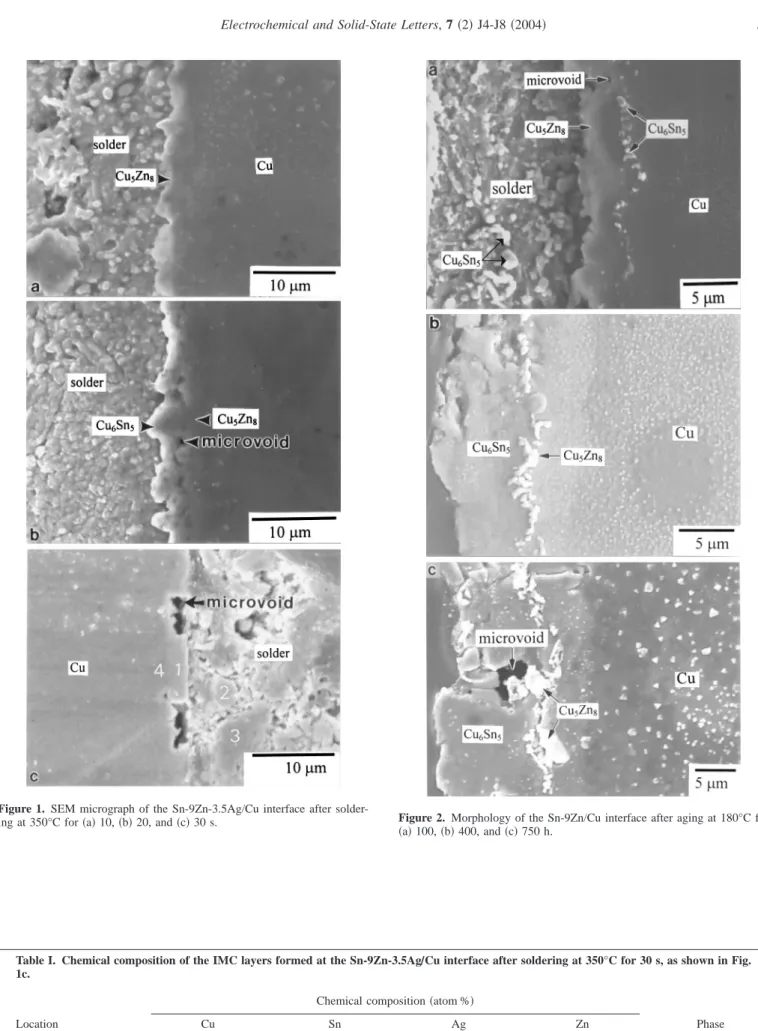
From the thermodynamic calculation, the Cu 5 Zn 8 IMC layer is the most stable phase at the Sn-9Zn/Cu interface as reported by Lee et al. 10 It also has been demonstrated by Chang et al. 11 that the IMC layer at the Sn-9Zn/Cu interface after soldering at 350°C for 30 s was Cu 5 Zn 8 . Figure 1a-c shows SEM micrographs of the Sn-9Zn- 3.5Ag/Cu interface after soldering at 350°C for 10, 20, and 30 s, respectively. The scallop-shaped Cu 5 Zn 8 layer is found at the inter- face after soldering for 10 s 共Fig. 1a兲 but the scallop-shaped Cu 6 Sn 5

layer replaced the Cu 5 Zn 8 to form at the interface close to the solder alloy after soldering for 20 s 共Fig. 1b兲. The morphology of Cu 5 Zn 8 transformed from scallop-shaped to planar. Besides, the microvoids are found at the Cu 6 Sn 5 /Cu 5 Zn 8 layer, while Suganuma et al. 5 have reported the formation at the Sn-9Zn/Cu interface.

However, the planar IMC layer 3.30 ⫾ 0.24 ␮m thick was formed at the interface close to the solder alloy after soldering for 30 s 共Fig. 1c兲. The EDS analyses of Fig. 1c are listed in Table I, indi- cating that the planar IMC layer is Cu 6 Sn 5 . A planar Cu 5 Zn 8 layer is also found at the interface close to the Cu substrate. Besides at the interface, the Cu 6 Sn 5 IMC is also found in the solder matrix, show- ing that Cu diffused to the Sn-9Zn-3.5Ag solder alloy rapidly during soldering because Ag increased the solubility of Cu in Sn. 12 How- ever, the solubility of Cu in Sn decreased during solidification, hence, the precipitates in the solder matrix reacted with Sn to form Cu 6 Sn 5 , as reported by Jang et al. 13 The high diffusivity of Cu not only caused the Cu 6 Sn 5 formation in the solder matrix, but also induced the formation of microvoids at the interface. It deteriorates the solder joint reliability as reported by Chang et al. 14

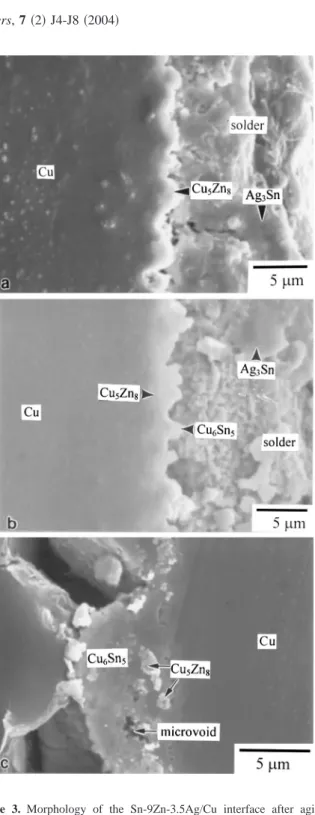
Figure 2a shows the morphology of the Sn-9Zn/Cu interface af- ter aging at 180°C for 100 h, which exhibits that the Sn diffused to the interface close to the Cu substrate and reacted with Cu to form the Cu 6 Sn 5 particulates, and the Zn diffused to the Sn-9Zn/Cu inter- face close to the solder alloy and reacted with Cu to form Cu 5 Zn 8 , the result agrees with the previous report. 2 The white particles were also determined as Cu 6 Sn 5 because Cu diffused rapidly in the Sn- 9Zn solder alloy 2 and reacted with Sn to form Cu 6 Sn 5 . Yu et al. 4

z
E-mail: [email protected]

Electrochemical and Solid-State Letters, 7 共2兲 J4-J8 共2004兲

0013-4651/2003/7

共2兲/J4/5/$7.00 © The Electrochemical Society, Inc.

J4

(2)

Figure 1. SEM micrograph of the Sn-9Zn-3.5Ag/Cu interface after solder-

ing at 350°C for 共a兲 10, 共b兲 20, and 共c兲 30 s. Figure 2. Morphology of the Sn-9Zn/Cu interface after aging at 180°C for 共a兲 100, 共b兲 400, and 共c兲 750 h.

Table I. Chemical composition of the IMC layers formed at the Sn-9Zn-3.5AgÕCu interface after soldering at 350°C for 30 s, as shown in Fig.

1c.

Location

Chemical composition 共atom %兲

Phase

Cu Sn Ag Zn

1 53.40 40.89 2.11 3.60 Cu

6

Sn

5

2 55.52 39.02 0.23 5.23 Cu

6

Sn

5

3 46.73 36.36 4.42 12.49 Cu

6

Sn

5

4 38.36 6.95 1.40 53.29 Cu

5

Zn

8

(3)

showed a similar result when the Sn-9Zn/Cu interface was aged at 150°C for 600 h. Besides, microvoids were found at the Cu 6 Sn 5 /Cu 5 Zn 8 interface.

Cu-Zn compounds are not stable in heating, as demonstrated by Shohji et al., 2 and Cu-Sn compound was formed at the Sn-9Zn/Cu interface after aging at 125°C for 300 h. Suganuma et al. 5 also showed that Cu-Zn compounds started to transform to Cu-Sn com- pounds after aging at 150°C for 100 h. The decomposition of the Cu-Zn compound and microvoid formation are often found at the solder joint when Cu-Sn compounds form. Microvoids cause crack formation and deteriorate solder joint reliability, as reported by Shi- mano et al. 15 Suganuma et al. 5 demonstrated that the formation of microvoids is due to the inferior wettability of Sn-9Zn solder alloy on Cu substrate. However, a theory based on the diffusion of Sn atoms has been proposed by Kim et al. 6

From a previous study, 16 Cu 6 Sn 5 particulates were not found at the Sn-9Zn/Cu interface but Kirkendall voids were formed at the Sn-9Zn/Cu 5 Zn 8 interface after aging at 180°C for 250 h, showing that Cu 6 Sn 5 particulates decomposed and Sn diffused to the Cu sub- strate.

The morphology of the Sn-9Zn/Cu interface after aging at 180°C for 400 h is shown in Fig. 2b, which indicates that Sn-9Zn solder alloy has been consumed to form the Cu 6 Sn 5 with the thickness of 12.24 ⫾ 0.56 ␮m. The IMC particulates embedded in the Cu 6 Sn 5

layer were determined as Cu 5 Zn 8 , showing that the Cu 5 Zn 8 dis- rupted and the Cu 6 Sn 5 grew rapidly in this stage. However, Kirken- dall voids were not observed at the interface after aging at 180°C for 400 h, which is because Cu 6 Sn 5 formed and filled them up.

Figure 2c shows the morphology of the Sn-9Zn/Cu interface af- ter aging at 180°C for 750 h, which indicates that the thickness of the Cu 6 Sn 5 increased from 12.24 ⫾ 0.56 to 14.87 ⫾ 0.53 ␮m with increasing aging time from 400 to 750 h at 180°C. The Cu 5 Zn 8 particulates were still embedded in the Cu 6 Sn 5 layer. Besides, mi- crovoids were observed at the interface due to the growth of Cu 6 Sn 5 . The small particles formed at the Cu substrate were also determined as Cu, because Sn and Zn dissolved to the Cu substrate during aging, the supersaturated Cu atoms precipitated in the matrix.

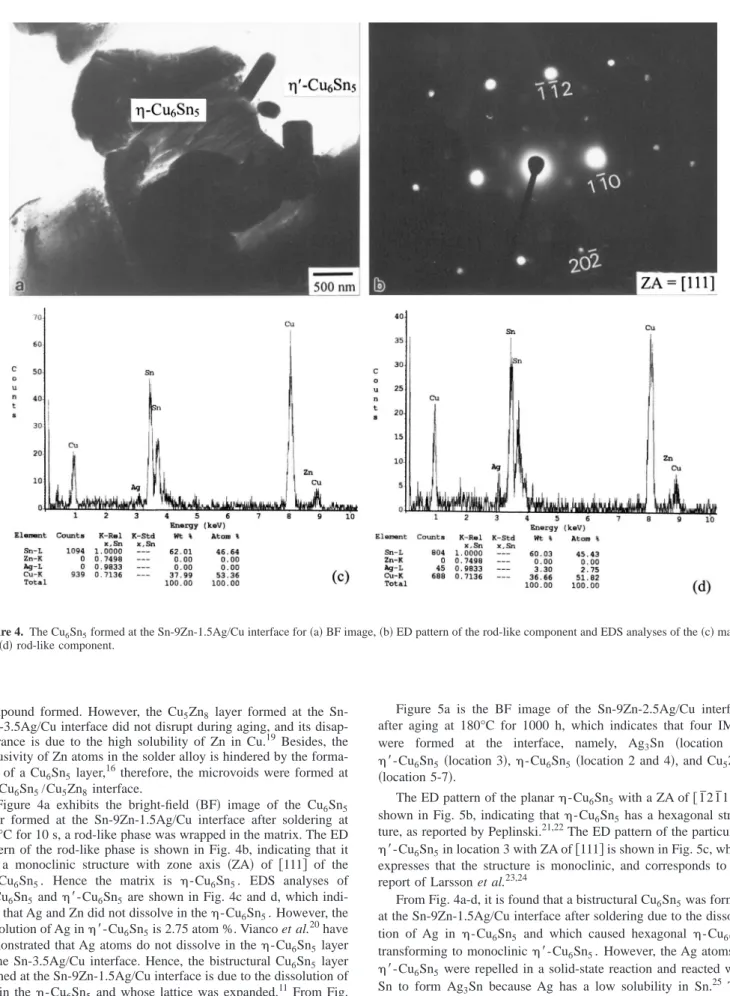
Figure 3a shows the morphology of the Sn-9Zn-3.5Ag/Cu inter- face after aging at 180°C for 100 h, which indicates that the scallop- shaped Cu 5 Zn 8 is located at the interface without forming Cu-Sn compound, which is different from that of the Sn-9Zn/Cu interface after the same aging process.

A planar Cu 6 Sn 5 layer was formed at the Sn-9Zn-3.5Ag/Cu in- terface after soldering at 350°C for 30 s and microvoids were found at the interface as shown in Fig. 1c. Hence, Cu diffused through the interface via the microvoids and reacted with Zn to form Cu 5 Zn 8 , which replaced Cu 6 Sn 5 located at the interface because Cu 5 Zn 8 has a lower Gibbs free energy than Cu 6 Sn 5 . 17 Some Kirkendall voids were formed at the interface of the Cu 5 Zn 8 layer and solder alloy, which were caused by Zn atoms at the interface being consumed to form Cu 5 Zn 8 .

After aging at 180°C for 400 h, a scallop-shaped Cu 6 Sn 5 layer was formed at the interface close to the Sn-9Zn-3.5Ag solder alloy and a scallop-shaped Cu 5 Zn 8 layer formed after aging at 180°C for 100 h transformed to a planar one close to the Cu substrate, as shown in Fig. 3b. This indicates that formation of Cu 6 Sn 5 is not due to the disruption of Cu 5 Zn 8 at the Sn-9Zn/Cu interface, 2 which is caused by that Cu diffused to the solder alloy and reacting with Sn to form the Cu 6 Sn 5 layer. Besides, no microvoid was found at the interface at this time because Cu 5 Zn 8 did not disrupt as that at the Sn-9Zn/Cu interface.

Figure 3c shows the morphology of the Sn-9Zn-3.5Ag/Cu inter- face after aging at 180°C for 1000 h. It indicates that the rough scallop-shaped Cu 6 Sn 5 was formed at the interface close to the sol- der alloy, but Cu 5 Zn 8 particulates were located at the interface close to the Cu substrate. Microvoids were found until the aging time attained 1000 h. This result shows that Ag addition is beneficial in

suspending the formation of microvoids because it promoted Cu 6 Sn 5 formed at the interface close to the solder alloy and which slowed the diffusion rate of elements.

Tu et al. 18 have demonstrated that the scallop-shaped IMC layer is stable in soldering but is transformed slowly to a planar layer during aging. A planar Cu 6 Sn 5 layer was found at the Sn-9Zn/Cu interface after aging at 180°C for 1000 h. However, the rough scallop-shaped Cu 6 Sn 5 still existed at the Sn-9Zn-3.5Ag/Cu inter- face as aged for 1000 h, which shows that the reaction rate of the Cu substrate with the Sn-9Zn solder alloy is higher than that of the Sn-9Zn-3.5Ag solder alloy.

Shohji et al. 2 have pointed out that the formation of Cu-Sn com- pounds at the Sn-9Zn/Cu interface is due to the disruption of the Cu-Zn compounds. Sn diffused to the interface and reacted with Cu directly. Microvoids were formed at the solder joint as the Cu-Sn Figure 3. Morphology of the Sn-9Zn-3.5Ag/Cu interface after aging at 180°C for 共a兲 100, 共b兲 400, and 共c兲 1000 h.

Electrochemical and Solid-State Letters, 7 共2兲 J4-J8 共2004兲

J6

(4)

compound formed. However, the Cu 5 Zn 8 layer formed at the Sn- 9Zn-3.5Ag/Cu interface did not disrupt during aging, and its disap- pearance is due to the high solubility of Zn in Cu. 19 Besides, the diffusivity of Zn atoms in the solder alloy is hindered by the forma- tion of a Cu 6 Sn 5 layer, 16 therefore, the microvoids were formed at the Cu 6 Sn 5 /Cu 5 Zn 8 interface.

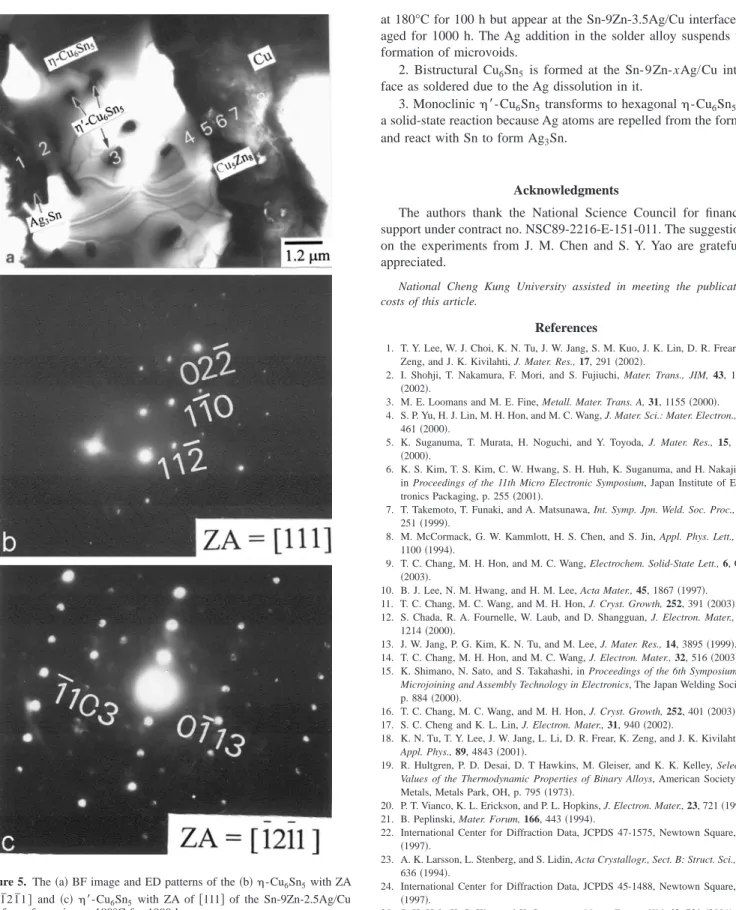
Figure 4a exhibits the bright-field 共BF兲 image of the Cu 6 Sn 5 layer formed at the Sn-9Zn-1.5Ag/Cu interface after soldering at 250°C for 10 s, a rod-like phase was wrapped in the matrix. The ED pattern of the rod-like phase is shown in Fig. 4b, indicating that it has a monoclinic structure with zone axis 共ZA兲 of 关111兴 of the

␩ ⬘ -Cu 6 Sn 5 . Hence the matrix is ␩-Cu 6 Sn 5 . EDS analyses of

␩-Cu 6 Sn 5 and ␩ ⬘ -Cu 6 Sn 5 are shown in Fig. 4c and d, which indi- cate that Ag and Zn did not dissolve in the ␩-Cu 6 Sn 5 . However, the dissolution of Ag in ␩ ⬘ -Cu 6 Sn 5 is 2.75 atom %. Vianco et al. 20 have demonstrated that Ag atoms do not dissolve in the ␩-Cu 6 Sn 5 layer at the Sn-3.5Ag/Cu interface. Hence, the bistructural Cu 6 Sn 5 layer formed at the Sn-9Zn-1.5Ag/Cu interface is due to the dissolution of Ag in the ␩-Cu 6 Sn 5 and whose lattice was expanded. 11 From Fig.

1c and EDS analysis listed in Table I, a Cu 6 Sn 5 layer containing Ag is found at the Sn-9Zn-3.5Ag/Cu interface after soldering at 350°C for 30 s, hence the bistructural Cu 6 Sn 5 layer should also appear at the interface.

Figure 5a is the BF image of the Sn-9Zn-2.5Ag/Cu interface after aging at 180°C for 1000 h, which indicates that four IMCs were formed at the interface, namely, Ag 3 Sn 共location 1兲,

␩ ⬘ -Cu 6 Sn 5 共location 3兲, ␩-Cu 6 Sn 5 共location 2 and 4兲, and Cu 5 Zn 8 共location 5-7兲.

The ED pattern of the planar ␩-Cu 6 Sn 5 with a ZA of 关1¯21¯1兴 is shown in Fig. 5b, indicating that ␩-Cu 6 Sn 5 has a hexagonal struc- ture, as reported by Peplinski. 21,22 The ED pattern of the particulate

␩ ⬘ -Cu 6 Sn 5 in location 3 with ZA of 关111兴 is shown in Fig. 5c, which expresses that the structure is monoclinic, and corresponds to the report of Larsson et al. 23,24

From Fig. 4a-d, it is found that a bistructural Cu 6 Sn 5 was formed at the Sn-9Zn-1.5Ag/Cu interface after soldering due to the dissolu- tion of Ag in ␩-Cu 6 Sn 5 and which caused hexagonal ␩-Cu 6 Sn 5 transforming to monoclinic ␩ ⬘ -Cu 6 Sn 5 . However, the Ag atoms in

␩ ⬘ -Cu 6 Sn 5 were repelled in a solid-state reaction and reacted with Sn to form Ag 3 Sn because Ag has a low solubility in Sn. 25 The formation of Ag 3 Sn inhibited microvoid formation at the Sn-9Zn-xAg/Cu interface as aged.

The results of this study can be concluded as follows

1. Microvoids are formed at the Sn-9Zn/Cu interface after aging

Figure 4. The Cu

6

Sn

5

formed at the Sn-9Zn-1.5Ag/Cu interface for 共a兲 BF image, 共b兲 ED pattern of the rod-like component and EDS analyses of the 共c兲 matrix

and 共d兲 rod-like component.

(5)

at 180°C for 100 h but appear at the Sn-9Zn-3.5Ag/Cu interface as aged for 1000 h. The Ag addition in the solder alloy suspends the formation of microvoids.

2. Bistructural Cu 6 Sn 5 is formed at the Sn-9Zn-xAg/Cu inter- face as soldered due to the Ag dissolution in it.

3. Monoclinic ␩ ⬘ -Cu 6 Sn 5 transforms to hexagonal ␩-Cu 6 Sn 5 in a solid-state reaction because Ag atoms are repelled from the former and react with Sn to form Ag 3 Sn.

Acknowledgments

The authors thank the National Science Council for financial support under contract no. NSC89-2216-E-151-011. The suggestions on the experiments from J. M. Chen and S. Y. Yao are gratefully appreciated.

National Cheng Kung University assisted in meeting the publication costs of this article.

References

1. T. Y. Lee, W. J. Choi, K. N. Tu, J. W. Jang, S. M. Kuo, J. K. Lin, D. R. Frear, K.

Zeng, and J. K. Kivilahti, J. Mater. Res., 17, 291

共2002兲.

2. I. Shohji, T. Nakamura, F. Mori, and S. Fujiuchi, Mater. Trans., JIM, 43, 1797

共2002兲.

3. M. E. Loomans and M. E. Fine, Metall. Mater. Trans. A, 31, 1155

共2000兲.

4. S. P. Yu, H. J. Lin, M. H. Hon, and M. C. Wang, J. Mater. Sci.: Mater. Electron., 11, 461

共2000兲.

5. K. Suganuma, T. Murata, H. Noguchi, and Y. Toyoda, J. Mater. Res., 15, 884

共2000兲.

6. K. S. Kim, T. S. Kim, C. W. Hwang, S. H. Huh, K. Suganuma, and H. Nakajima, in Proceedings of the 11th Micro Electronic Symposium, Japan Institute of Elec- tronics Packaging, p. 255

共2001兲.

7. T. Takemoto, T. Funaki, and A. Matsunawa, Int. Symp. Jpn. Weld. Soc. Proc., 17, 251

共1999兲.

8. M. McCormack, G. W. Kammlott, H. S. Chen, and S. Jin, Appl. Phys. Lett., 65, 1100

共1994兲.

9. T. C. Chang, M. H. Hon, and M. C. Wang, Electrochem. Solid-State Lett., 6, C82

共2003兲.

10. B. J. Lee, N. M. Hwang, and H. M. Lee, Acta Mater., 45, 1867

共1997兲.

11. T. C. Chang, M. C. Wang, and M. H. Hon, J. Cryst. Growth, 252, 391

共2003兲.

12. S. Chada, R. A. Fournelle, W. Laub, and D. Shangguan, J. Electron. Mater., 29, 1214

共2000兲.

13. J. W. Jang, P. G. Kim, K. N. Tu, and M. Lee, J. Mater. Res., 14, 3895

共1999兲.

14. T. C. Chang, M. H. Hon, and M. C. Wang, J. Electron. Mater., 32, 516

共2003兲.

15. K. Shimano, N. Sato, and S. Takahashi, in Proceedings of the 6th Symposium on Microjoining and Assembly Technology in Electronics, The Japan Welding Society, p. 884

共2000兲.

16. T. C. Chang, M. C. Wang, and M. H. Hon, J. Cryst. Growth, 252, 401

共2003兲.

17. S. C. Cheng and K. L. Lin, J. Electron. Mater., 31, 940

共2002兲.

18. K. N. Tu, T. Y. Lee, J. W. Jang, L. Li, D. R. Frear, K. Zeng, and J. K. Kivilahti, J.

Appl. Phys., 89, 4843

共2001兲.

19. R. Hultgren, P. D. Desai, D. T Hawkins, M. Gleiser, and K. K. Kelley, Selected Values of the Thermodynamic Properties of Binary Alloys, American Society for Metals, Metals Park, OH, p. 795

共1973兲.

20. P. T. Vianco, K. L. Erickson, and P. L. Hopkins, J. Electron. Mater., 23, 721

共1994兲.

21. B. Peplinski, Mater. Forum, 166, 443

共1994兲.

22. International Center for Diffraction Data, JCPDS 47-1575, Newtown Square, PA

共1997兲.

23. A. K. Larsson, L. Stenberg, and S. Lidin, Acta Crystallogr., Sect. B: Struct. Sci., 50, 636

共1994兲.

24. International Center for Diffraction Data, JCPDS 45-1488, Newtown Square, PA

共1997兲.

25. S. H. Huh, K. S. Kim, and K. Suganuma, Mater. Trans., JIM, 42, 739

共2001兲.

Figure 5. The 共a兲 BF image and ED patterns of the 共b兲 ␩-Cu

6

Sn

5

with ZA of 关1¯21¯1兴 and 共c兲 ␩-Cu

6

Sn

5

with ZA of 关111兴 of the Sn-9Zn-2.5Ag/Cu interface after aging at 180°C for 1000 h.

Electrochemical and Solid-State Letters, 7 共2兲 J4-J8 共2004兲

J8

數據

Figure 2a shows the morphology of the Sn-9Zn/Cu interface af- af-ter aging at 180°C for 100 h, which exhibits that the Sn diffused to the interface close to the Cu substrate and reacted with Cu to form the Cu 6 Sn 5 particulates, and the Zn diffused to the
Table I. Chemical composition of the IMC layers formed at the Sn-9Zn-3.5AgÕCu interface after soldering at 350°C for 30 s, as shown in Fig.
Figure 2c shows the morphology of the Sn-9Zn/Cu interface af- af-ter aging at 180°C for 750 h, which indicates that the thickness of the Cu 6 Sn 5 increased from 12.24 ⫾ 0.56 to 14.87 ⫾ 0.53 ␮m with increasing aging time from 400 to 750 h at 180°C
Figure 4a exhibits the bright-field 共BF兲 image of the Cu 6 Sn 5 layer formed at the Sn-9Zn-1.5Ag/Cu interface after soldering at 250°C for 10 s, a rod-like phase was wrapped in the matrix
+2

參考文獻

相關文件

• The  ArrayList class is an example of a  collection class. • Starting with version 5.0, Java has added a  new kind of for loop called a for each

Now given the volume fraction for the interface cell C i , we seek a reconstruction that mimics the sub-grid structure of the jump between 0 and 1 in the volume fraction

Attributes characterized in this campaign for the turboshaft engine emissions include, for particulate phase, engine smoke number (SN) (which currently is the only accepted method

Based on [BL], by checking the strong pseudoconvexity and the transmission conditions in a neighborhood of a fixed point at the interface, we can derive a Car- leman estimate for

Understanding and inferring information, ideas, feelings and opinions in a range of texts with some degree of complexity, using and integrating a small range of reading

 Promote project learning, mathematical modeling, and problem-based learning to strengthen the ability to integrate and apply knowledge and skills, and make. calculated

• Introduction of language arts elements into the junior forms in preparation for LA electives.. Curriculum design for

[This function is named after the electrical engineer Oliver Heaviside (1850–1925) and can be used to describe an electric current that is switched on at time t = 0.] Its graph