Journal of Population Studies No. 32, June 2006, pp. 123-152
The Emergence of the Neo-Extended Family in Contemporary Taiwan
An-Chi TUNG
*, Chaonan CHEN
**and Paul Ke-Chih LIU
***
* Associate Research Fellow, Institute of Economics, Academia Sinica
** Professor, Institute of Healthcare Administration, Asia University; Adjunct Research Fellow, Institute of Economics, Academia Sinica
*** Corresponding Research Fellow, Institute of Economics, Academia Sinica Received: 2005/05/26,Accepted: 2006/05/18
Abstract
In response to industrialization and urbanization, changes in the form and function of family seem inevitable. In the study of family decline, a new typology of family is advanced that is based on kin relationships beyond co-residence boundaries. Four sub- types of family are distinguished according to contact frequency and spatial proximity, namely, the neo-extended, dispersed, alienated, and detached sub-types of family. Analyzing data collected from the fourth round of Taiwan Social Change Survey, we have identified the main determinants in the formation of a neo- extended family, which include respondents’ socioeconomic status (education, wages, homeownership, religiousness), degree of adherence to traditional value, and whether or not family property has been divided. Moreover, we have found that most respondents belong to the neo-extended family, and exchanges between the respondents and their close relatives are relatively high. These findings point out that family function has been maintained despite of the progress of the nuclearization, due mainly to frequent contact and residential proximity between non-coresiding families.
Key Words: Extended family, Informal social support, Family
change
台灣新式擴大家庭之興起
董 安 琪
*陳 肇 ㊚
* *劉 克 智
* * *摘 要
本文依受訪者與不同住親屬之互動關係提出㆒個新的家庭 分類法,不但可與傳統分類法互補,而且可以用來檢視親㆟間的 互動是否可以跨越同住的限制。文㆗以互動頻率與居住距離兩個 面向來界定互動關係,兩個面向各再分兩類,共計㆕種類型,即 新式擴大家庭、散居家庭、疏離家庭,與孤立家庭。我們利用台 灣社會變遷第㆕期第㆓次調查資料進行實證分析,發現新式擴大 家庭在㆕種類型㆗所佔比例最高,此類家庭的主要決定因素包括 教育、工資、宗教、住屋所有權、子女奉養,與是否分產等。其
㆗,後兩點顯示傳統價值與財產的積聚或分享乃是臺灣家庭型式 變化相對較少的主因。而新式擴大家庭對社會支持的交換較他類 家庭比例為高,說明互動頻繁與居住鄰近是家庭維繫的主因。
關鍵字:擴大家庭、非正式社會支持、家庭變遷
* ㆗研院經濟所副研究員
** 亞洲大學健康管理研究所教授、㆗研院經濟所兼任研究員
*** ㆗研院經濟所通信研究員
Ⅰ. Introduction
In response to industrialization and urbanization, changes in the form and function of families seem inevitable. In the study of family decline, the use of a broader definition that removes co-residence from the definition of family is widely accepted. This is evident from the proliferation of research concepts such as the modified extended family (Litwak, 1960; Hoyert, 1991), the local family circle (Bonvalet, 2003), the federal family (Chuang, 1972), and the cooperative group (Silverstein, 2002). The multiplicity of these concepts suggests that family decline is a common phenomenon worldwide. Yet the diversity of the concepts also indicates that there are fundamentally different reasons for the changes of family structure across countries.
The United States is a prime example of a country that has experienced a series of changes in family structure. The transitions of American family structure are well depicted by four hypotheses (Bengtson, 2001). The first and earliest hypothesis is concerned with the emergence of the “modern”
nuclear family form following the Industrial Revolution, where there was a shift from the extended family to the nuclear family. The second hypothesis has to do with the decline of the modern nuclear family as an institution. The third hypothesis is about the increasing heterogeneity among family forms, which implies a trend of extending family relationships beyond biological or conjugal relationship boundaries. The fourth hypothesis follows from the third one and is about the increasing importance of multigenerational bonds.
It stresses that the increase in marital instability and divorce has weakened the function of the nuclear family, and has consequently given rise to the need for grandparents’ support in nurturing the children and helping them socialize.
In brief, the recent research interest in family decline has focused on whether
or not the transition in the family structure reduces the family’s function of childrearing and the provision of affection and companionship to its members (Popenoe, 1993; Bumpass, 1990; Bengtson, 2001).
In contrast, Taiwan serves as a good example of a society that has experienced relatively few transitions in family structure. Its current status regarding family decline is close to the second hypothesis stated above, with the modal family structure changed from extended to nuclear. After the drastic socio-economic changes in the 1960s and 1970s, many patrilocal extended families have broken down, with each becoming several nuclear families. Among these spatially separated families, however, exchanges have continued via frequent contact (Shi, 1993; Lee et al., 1994). Two types of inter-family connections have been found. In cases where these nuclear families have agreed to submit to a central authority in certain areas of common interest or to hold common property, they have been referred to as a
“federal family” (Chuang, 1972). When no shared property is involved, these separate households have formed a new type of extended family referred to as a “corporate group” (Silverstein et al., 2002).
In view of the complexity of family changes, a reconsideration of the definition of family seems necessary, and a systematic typology of family forms beyond co-residence boundaries is particularly useful, for reasons discussed in the beginning paragraph. In the literature on the reclassification of family forms, one line of study deserves special attention, which sought to test whether or not geographic distribution affects the cohesion among the households of close relatives (for example, Bonvalet, 2003). The results are important because they contradict the celebrated family decline hypothesis of Parsons, which was deemed to hold when urbanization proceeded.
To be more specific, Bonvalet (2003) divided respondents within a sample of 1,946 cases in France into three groups – dispersed family circle, local family circle, and others, with three criteria – affinities, frequency of contacts, and mutual help. The first group included respondents who main- tained strong ties with at least one close relative but did not live in the same community or in an adjacent community. The second group corresponded to respondents living near a close relative with whom they had close ties. When the “close” relatives were restricted to parents and children, the former and latter each accounted for 15% and 26% of all respondents, respectively. If in-laws were included, the corresponding percentages rose to 16.7% and 29.8%, respectively. In total, as high as 46.5% of the respondents enjoyed relationships with their relatives that involved frequent contacts, emotional closeness and exchange of mutual services.
By adapting Bonvalet’s (2003) framework to fit the Taiwan data, this paper proposes a new family typology based on the contact frequency and spatial proximity. With the new typology, we are able to examine whether or not the spatial-separately households in Taiwan have overcome the barrier of a certain spatial distance via frequent contact, and have maintained vital social support exchanges. We also look into the determinants of the neo-extended family, which would help to explain why Taiwan has experienced relatively few changes in family form. Finally, we study the differential support functions among the new types of family, so as to check the usefulness of the new typology.
The paper is organized as follows. After a brief review of the research setting in Section 2, a description of the data and our new typology follow in section 3. In Section 4, families are categorized according to the new typology advanced, and the determinants of the most important sub-type are
identified. The effect of the new family types on informal social support is then examined in Section 5. Finally, Section 6 summarizes and concludes the paper.
II. The Research Setting
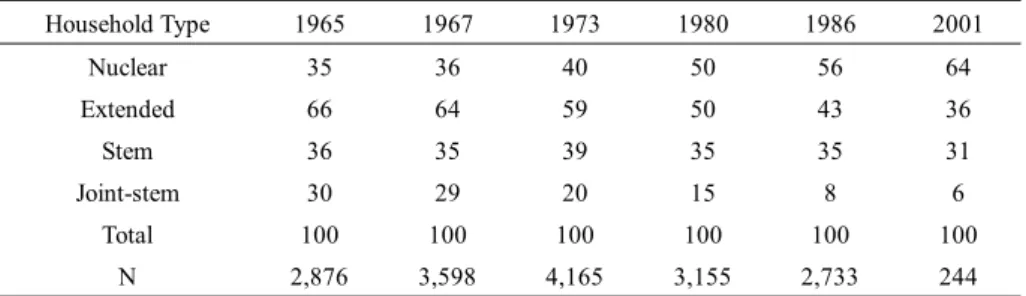
Prior to the eighteenth century, family patterns in the West underwent changes as families interacted with both industrialization and urbanization (Thornton and Thomas, 1987; Hutter, 1998). While it took two to three hundred years to complete the process of nuclearization in the West, this process was condensed into only fifty years in Taiwan. Table 1 below shows that, based on samples of currently-married women aged 20-39, the percentage of Taiwan’s nuclear households rose from 35% in 1965 to 56% in 1986, and increased further to 64% by 2001. Meanwhile, the proportion of the extended households steadily declined from 66% in 1965 to about 36% in 2001. Specifically, when extended families are subdivided into stem and joint-stem families, a sharp decline in the joint-stem family from 30% in 1965 to 6% in 2001 becomes quite noticeable. Although the figures of each year come from separate surveys with different sample sizes, the trend toward nuclearization is amazingly clear. To provide the background for a better understanding of the rapid evolution in Taiwan’s family structure over the last five decades, this section reviews the social and economic development that has taken place in Taiwan, as well as the urban development that has ensued.
1. Social, economic and urban development
Starting in the early 1950s, industrialization rapidly took root on the island. Between 1950 and 2004 the proportion of the work force engaged in agriculture steadily declined from 57.0% to 6.6%. Over that same period, gross national product (GNP) per capita increased almost 97 times, rising from
Table 1. Percentage Distributions of Household Types*: Taiwan 1965-2001
Household Type 1965 1967 1973 1980 1986 2001
Nuclear 35 36 40 50 56 64
Extended 66 64 59 50 43 36
Stem 36 35 39 35 35 31
Joint-stem 30 29 20 15 8 6
Total 100 100 100 100 100 100
N 2,876 3,598 4,165 3,155 2,733 244
*Including married women aged 20-39.
Notes: 1. Nuclear: Contains only one married couple, that of the respondent. May contain other unmarried children or relatives (except parents or parents-in-law).
2. Extended: Contains, in addition to the married couple of the respondent, at least one parent or parent-in-law or other married relatives of the respondent.
a. Stem: In addition to the married couple of the respondent, contains one or more parents or parents-in-law or a grandparent or a grandparent-in-law of the respondent.
b. Joint-stem: Contains one other married couple (or more) related to the respondent of the same generation, or both vertical and horizontal linkages, i.e. one or more parents or grandparents and at least one married couple of the same generation as the respondent.
Sources: 1. 1965-1986 figures are from Weinstein et al. (1994).
2. 2001 figures are calculated from the Taiwan Social Change Survey (IV/2).
US$145 to US$14,032. The percentage of total population in cities of over 100,000 people increased from 20% to 69%. Expectancy of life at birth increased from 55 to 76 years. The total fertility rate fell from 6 births per woman of childbearing age to the replacement level of 2.1 in 1983 and continued to fall further to 1.18 in 2004.
Along with these rapid social and economic changes, Taiwan experienced fast urbanization in the 1950s and 1960s, which was followed by a period of rapid growth in the suburban areas in the next two decades. In the 1990s, the island started to move ahead from the suburbanization stage into the de- urbanization stage (Balchin, 2000; Liu and Tung, 2003).
2. Changes in family structure
With the rapid and continuous changes in the social, economic and urban environment, Taiwan’s family structure has also transformed over time. The first phase may be characterized by the spreading of families (the 1950s and 1960s). Along with the rapid urbanization, many young people left their parents’ homes and settled down in urban regions due to employment or schooling, which led to the breaking down of extended families into smaller household units. It should be noted that during this period nearly all junior colleges and universities were located in big cities, and urban non-farm jobs increased at a faster rate than rural farm jobs. A study by Yang and Chen (2002) has shown that the percentage of sons leaving their parents’ homes for schooling increased from 4.4% of all sons leaving home in 1956-1966 to 7.8%
in 1966-1970, while the corresponding percentages for daughters increased from 1.7% to 3.1%; the percentage of sons leaving home for employment outside the farms increased slightly from 36.7% to 38.8%, and that for the daughters increased more rapidly from 7.8% to 15.8%. Further- more, the majority of single migrants from the rural areas got married and settled down in the city after they obtained a secure job. In a study of migrants into Taichung city in 1969, it was found that 96% of married male migrants had their spouses move from the rural areas to live with them in the city one or two years after their own migration (Speare et al., 1988).
The change in firm organization and the increase in income brought further changes to family patterns during the second phase (the 1970s and 1980s). Before this period, a typical business firm in the city was small in size, and usually owned and managed by members of one single extended family. And most of the firms were located in the same place of residence (Pannell, 1973; Liu, 1979). As large, modern enterprises gradually replaced
the tiny family businesses, there were fewer incentives left to maintain extended families. The improvements in transportation and the increase in income also prompted the formation of new and small families. In particular, the rising standard of living increased the demand for larger residential space, which was usually more available in the suburban areas. The proportion of sons leaving their parents’ homes for an improved dwelling situation jumped from 17.4% of all sons leaving home in the 1960s, to 20.2% in the 1970s, and to 36.3% in the 1980s (Yang and Chen, 2002). By the late 1980s, the nuclear family had already become the dominant family type (Table 1).
III. Data and Methodology
1. Data
The main data source of this study was the 2001 Taiwan Social Change Survey (IV/2, Questionnaire No. 1), which was conducted by the Institute of Sociology, Academia Sinica in July to September 2001. The survey includes adults aged 20 or older as its sampling population. To acquire the sampling frame, the townships in Taiwan Province were stratified into seven classes based on the level of urbanization. On top of that, there were the two metropolitan cities of Taipei and Kaohsiung and a number of provincial cities.
The townships for each class were based on their population size as reported in the Taiwan-Fukien Demographic Quarterly 25(3), ROC (Ministry of Interior 1999). In terms of the selection of primary sampling units, the probability proportional to size (PPS) sampling method was employed to select sample townships. Villages, the secondary sampling unit, were also selected from the sampled townships using the PPS method. Finally, observations were systematically selected from the sampled villages.
Since the sample was selected from Taiwan’s household registration
system, which was a de jure one, a substantial proportion of the households selected were unavailable for interviewing at the registered addresses. A larger sample was thus drawn. In total, 3,659 cases were selected, and 1,979 interviews were successfully held with a reasonable completion rate at 54.1%
(Chang and Fu, 2002). When the factor of not being available for interviews at the registered address is adjusted for, the completion rate is estimated around 70.5%.
The sample had about an equal number of males and females, with about 46.2% of the sample being made up of people aged 35-54, 25.8% aged 55 and above and 28.0% aged 20-34. The sample was relatively well educated.
The proportion of respondents that have attended junior college or universities was 27.0%, and another 41.4% had at least a junior high-school diploma.
The majority of them were married (82.1%) and religious (72.0%). A high percentage (56.4%) of these people or their spouses owned the house they lived in. About 52.1% of them had a monthly income below NT$20,000, 25.1% had between NT$20,000 and NT$39,999, and the rest 23.8% had NT$40,000 or more.
2. The new typology
The nationwide Taiwan Social Change Survey collects data on affinity, residential proximity, frequency of contacts, and exchanges with relatives who live separately. With this information, we are able to study Taiwan’s family more broadly than in the case where the conventional definition is based on dwelling units. This new typology is classified on the basis of three elements – affinity, residential proximity, and frequency of contacts. They are defined as follows:
a. Affinity: “Close” relatives including parents, children, and siblings.
b. Residential proximity:
(b1) near – living at a distance within 30 minutes by car;
(b2) far – living at a distance of more than 30 minutes by car.
c. Frequency of “contacts” (including meetings, phone conversations, and mail):
(c1) frequent – at least once a week;
(c2) infrequent – less than once a week.
We take affinity as the precondition for our new typology, and use residential proximity and the contact frequency to classify respondents into four categories as shown in Table 2. Those respondents having frequent contact with at least one non-coresiding close relative who lives nearby, such as a parent, son, daughter, brother or sister, are included in the “neo-extended”
family type; those who maintain frequent contact, but live far away from any non-coresiding close relative are classified as the “dispersed family” type.
Among the respondents who do not have frequent contact with any non- coresiding close relatives, those who live near at least one close relative are categorized as the “alienated” type, while those who live far away are categorized as the “detached” type.
Table 2. New Family Types Classified by Residential Proximity & Contact Frequency
Contact Proximity
Frequent Infrequent Near Neo-extended family Alienated family
Far Dispersed family Detached family
It is worth mentioning that if the neo-extended family is combined with the dispersed family, we come close to the “modified extended family” in the
literature (Litwak, 1960; Hoyert, 1991). However, there is an advantage in singling out the neo-extended family from the dispersed family. As geographical remoteness may hinder certain kinds of support exchanges (such as help with housework), the neo-extended family, which includes only those families with less of a distance barrier, is a more refined concept than the modified extended family, and thus provides a better framework for the study of family changes. In other words, the neo-extended family can be seen as an extension of the conventionally-defined extended family beyond co-residence boundaries.
IV. The Components and Determinants of the Neo-Extended Family
This section examines the family structure using the new typology introduced above. The relationships between the conventionally-defined families and the new types are considered, and the determinants of the neo- extended family, the sub-type that most respondents belong to, are studied.
1. The components
Under the new typology, the percentage shares of the neo-extended, dispersed, alienated, and detached families are 53.9%, 20.6%, 15.1% and 10.4%, respectively. The proportion of the neo-extended family (53.9%) is some- what higher than Bonvalet’s estimate for France of 45.0% in 1990 (2003, p.16), which should be further deflated by a couple of percentage points as in-laws were included. But given that a large proportion of Taiwanese respondents have brothers (72.9%) or sisters (73.6%) living separately from them than the French respondents (6.5% for any sibling), the percentage share of neo-extended family in Taiwan seems reasonable.
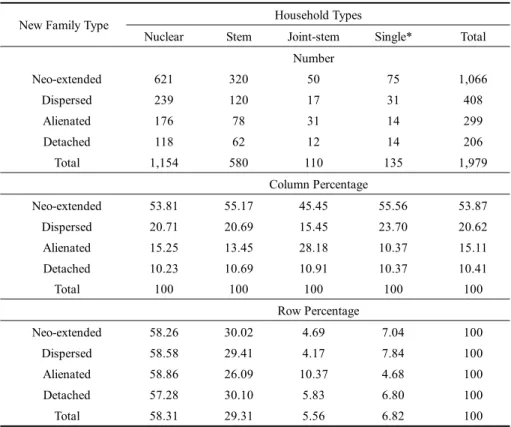
Next, it is important to know how the traditionally-defined family types are related to the new family types. The column percentages in Table 3 show that the respondents of nuclear families (by traditional typology) are classified as follows: 53.8% into the neo-extended families (by our new typology), 20.7% dispersed families, 15.3% alienated families and 10.2% detached families. Respondents of the stem families or single families have similar distributions. But respondents of the joint-stem families have a higher percentage (28.2%) than other groups falling into the alienated type, and a smaller percentage into either the neo-extended (45.5%) or dispersed (15.5%) families. A plausible reason is that there are more horizontal linkages in joint-stem families by structure as compared with nuclear and stem families, and these linkages may not generate strong ties as vertical linkages do.
The last section in Table 3 summarizes the row distributions. Around 58.3% of the neo-extended families are composed of nuclear families and non- coresiding relatives. Another 34.7% comprise traditional extended families (stem and joint-stem) and non-coresiding family members. The remaining 7.0% are composed of single families, made up mostly of elderly respondents, and their non-coresiding relatives. The composition of the dispersed and detached families is much alike, but the pattern of the alienated type differs slightly, having 5.7% more joint-stem families than the neo- extended type, likely due to explanation mentioned earlier.
2. The determinants
In this section we explore the underlying reasons for the formation of the major type – the neo-extended family. A logit regression is employed to identify its determinants. Variables that are insignificant theoretically or statistically, such as age, occupation, residential region (rural vs. urban),
Table 3. Distribution of New Family Types by Household Type: Taiwan 2001
Household Types New Family Type
Nuclear Stem Joint-stem Single* Total
Number
Neo-extended 621 320 50 75 1,066
Dispersed 239 120 17 31 408
Alienated 176 78 31 14 299
Detached 118 62 12 14 206
Total 1,154 580 110 135 1,979
Column Percentage
Neo-extended 53.81 55.17 45.45 55.56 53.87 Dispersed 20.71 20.69 15.45 23.70 20.62 Alienated 15.25 13.45 28.18 10.37 15.11 Detached 10.23 10.69 10.91 10.37 10.41
Total 100 100 100 100 100
Row Percentage
Neo-extended 58.26 30.02 4.69 7.04 100 Dispersed 58.58 29.41 4.17 7.84 100
Alienated 58.86 26.09 10.37 4.68 100
Detached 57.28 30.10 5.83 6.80 100
Total 58.31 29.31 5.56 6.82 100
*Here “single” includes both single-person households and households otherwise not categorized.
family income and father’s socioeconomic status, are excluded. Subsequently, the set of explanatory variables in the model consists of the usual set of socioeconomic factors, an attitude variable and a dummy for the status of family property division.
Separate logit regressions are run for males and females, as well as for both sexes together. The rationale is that married daughters, traditionally described as “spilled water”, no longer belong to the original family and carry very different obligation to parents from sons. The factors affecting a
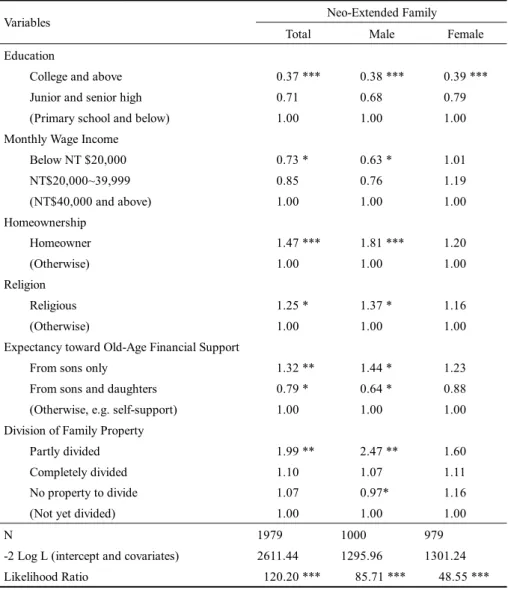
female’s willingness and capacity to form a neo-extended family with her close relatives are thus expected to vary from those of males. Table 4 presents the odds ratios of our best logit models, with asterisks indicating the level of statistical significance of the regression coefficients.
The logit analysis suggests that the formation of a neo-extended family is subject to the influence of education, income, homeownership, religiousness, expectancy of source of old-age living expenses, and the status of the division of family property. But females are affected by education only.
The main findings are as follows. First, education has a negative effect on the formation of a neo-extended family. Other things being equal, the odds ratio of the male respondents with a high educational level (that is, college or higher) is only 0.38 times as much as that for those with low education (primary school or below). The odds ratios for respondents with a high education level are 0.39 and 0.37 for females and for both sexes, respectively. These results reflect the special nature of human capital formation in Taiwan, which is a combination of Western ideas and Confucian ethics. In comparison with the Western mode of education, Confucianism emphasizes filial piety, parental authority, and harmony among families and clans. While higher education places more emphasis on Western ideas, both Confucianism and Western morals are taught in the early years of schooling (Liu, 1992). Consequently, a person who receives fewer years of education is more likely to stick to the traditional idea of forming strong ties with close relatives by living close by and have frequent contact with the latter.
Second, monthly wage income has a somewhat significant positive effect on men, after controlling for other independent variables. This is consistent with past findings that those who earn a higher income had a stronger
Table 4. Probability of Belonging to a Neo-Extended Family: Taiwan 2001 (Odds Ratio)
Neo-Extended Family Variables
Total Male Female
Education
College and above 0.37 *** 0.38 *** 0.39 ***
Junior and senior high 0.71 0.68 0.79 (Primary school and below) 1.00 1.00 1.00 Monthly Wage Income
Below NT $20,000 0.73 * 0.63 * 1.01 NT$20,000~39,999 0.85 0.76 1.19 (NT$40,000 and above) 1.00 1.00 1.00
Homeownership
Homeowner 1.47 *** 1.81 *** 1.20
(Otherwise) 1.00 1.00 1.00
Religion
Religious 1.25 * 1.37 * 1.16
(Otherwise) 1.00 1.00 1.00
Expectancy toward Old-Age Financial Support
From sons only 1.32 ** 1.44 * 1.23 From sons and daughters 0.79 * 0.64 * 0.88 (Otherwise, e.g. self-support) 1.00 1.00 1.00 Division of Family Property
Partly divided 1.99 ** 2.47 ** 1.60 Completely divided 1.10 1.07 1.11 No property to divide 1.07 0.97* 1.16 (Not yet divided) 1.00 1.00 1.00
N 1979 1000 979
-2 Log L (intercept and covariates) 2611.44 1295.96 1301.24 Likelihood Ratio 120.20 *** 85.71 *** 48.55 ***
Note: * significant at 5% level; ** significant at 1% level; *** significant at 0.1% level.
motivation to move out, because they were more competent, and were thus more capable of building up ties across households (Coombs and Sun, 1981;
Thornton and Thomas, 1987; Chang, 1988). The impact of income on females is not significant.
Third, homeowners are more likely to keep a neo-extended family than non-homeowners. The odds ratio for those who or whose spouses own their houses, is 1.47 for both sexes combined and 1.81 for males. This result is similar to what was found in France, where homeowners tended to reside closer to their close relatives due to the wish to “create a family” (Bonvalet 2003). For females, the odds ratio of a homeowner is also high but insignificant.
Fourth, religious persons, regardless of which religion it is, have a large odds ratio to belong to a neo-extended family for men (1.25) and for both sexes (1.37), significant at the 5% level. This is consistent with past findings that religious participation enhances the social resources of individuals and increases their social support exchanges (Ellison and George, 1994).
Fifth, those who expect to be financially supported only by a son (or sons) in their old age are much more inclined to maintain a neo-extended family than those who plan otherwise. In particular, the odds ratios of those who expect to be supported by their daughters as well as sons are the lowest. The expectancy of the sources of old-age living expenses is in fact a measure of the degree of adherence to Chinese traditional family values. Those who look to both sons and daughters for old-age support, as compared with those who do not count on daughters, are likely to be more Westernized, and may thus choose a living arrangement with more privacy and less frequent contact with close relatives.
Finally, the status of the division of the family property has an effect. In Taiwan, both sons and daughters are legal beneficiaries of their parents’
property, but sons inherit most of the property in practice. More importantly, family property is sometimes divided among children before the demise of their parents (Chu et al., 2005). Table 4 shows that property division has a stronger effect on males than on females, and the odds ratio is the highest for those whose parents have partially divided the family property. For men, the order of the odds ratios, from high to low, is partial division, complete division, not divided yet, and nothing to divide, though not all items are statistical significantly. For women, none is significant.
The finding that a partial division has a larger odds ratio than a full division is consistent with the “strategic bequest” hypothesis raised by Bernheim et al. (1985). The strategic bequest hypothesis states that in the U.S., children of a multiple-child family visit their parents more often if the latter have more bequeathable assets, because bequests are frequently used as compensation for services rendered by beneficiaries. However, the finding that a complete division has a larger odds ratio than the case of not divided yet seems to conform to a competing hypothesis advanced by Chu et al. (2005).
The kinship pressure hypothesis of Chu et al. (2005) states that after a full division of the property takes place, children tend to visit their parents more often than in the case of those whose family property is yet to be divided, due to peer pressure calling for filial piety. By singling out the case of partial division, our results illustrate that the status of family property division is a complicated issue that invites further study in the future.
It is worth noting that both property division and old-age support involve resource pooling and sharing among separately-living families, which may be critical to not only the prevalence of the neo-extended family, but also the
relatively little change in Taiwan’s family form. An examination of the differences in informal social support exchanges among various new family types may provide some clues in relation to this.
V. The Effect of Family Type on Informal Social Support Exchanges
This section looks into the consequences of family transformation in terms of informal social support exchanges, and the determining factors of the give and take of such support.
1. Types of support
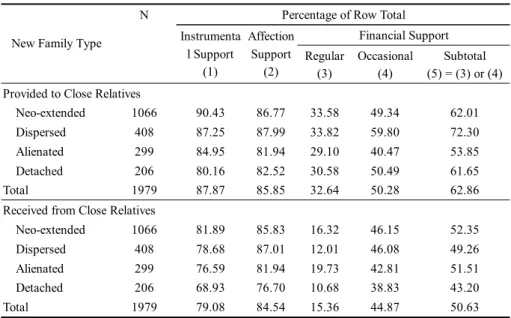
Table 5 summarizes the proportion of respondents who exchanged informal social support with non-coresiding close relatives. There are three groups of exchanges, each requiring different kinds of input. The first group of support, instrumental support, includes exchanges of sick care, childcare, and doing household chores. It requires some input of labor (or time). As mentioned above, some instrumental supports (such as the help of housework) are more conveniently delivered within shorter distance than otherwise (Silverstein et al., 2002). The second group, affection support, comprises mainly of oral advice, which involves only a little time input. The last group, financial support, includes both regular and occasional transfers of money.
Although the exact relationship between these three types of support is not yet clear, previous studies have shown that there exist trade-offs between time and money in the allocation of resources in intergenerational or interfamilial exchanges (Couch et al., 1999). In Table 5, it appears that the respondents resorted more to instrumental or affection support than to financial support, and more to occasional financial support than to regular financial support.
Table 5. Proportion of Respondents Having Informal Social Support Provided to And Received from Close Relatives: Taiwan 2001
N Percentage of Row Total Financial Support New Family Type Instrumenta
l Support (1)
Affection Support
(2)
Regular (3)
Occasional (4)
Subtotal (5) = (3) or (4) Provided to Close Relatives
Neo-extended 1066 90.43 86.77 33.58 49.34 62.01 Dispersed 408 87.25 87.99 33.82 59.80 72.30 Alienated 299 84.95 81.94 29.10 40.47 53.85 Detached 206 80.16 82.52 30.58 50.49 61.65 Total 1979 87.87 85.85 32.64 50.28 62.86 Received from Close Relatives
Neo-extended 1066 81.89 85.83 16.32 46.15 52.35 Dispersed 408 78.68 87.01 12.01 46.08 49.26 Alienated 299 76.59 81.94 19.73 42.81 51.51 Detached 206 68.93 76.70 10.68 38.83 43.20 Total 1979 79.08 84.54 15.36 44.87 50.63
Moreover, respondents belonging to the neo-extended family or the dispersed family provide and receive more informal social support than those belonging to the other two types. This suggests that contact frequency intensifies the exchanges of informal social support, while residential proximity plays a less obvious role. There is only one exception. The proportion of respondents of the alienated family receive regular financial support is higher than the other family types, but the average percentage share of the four types is only 15.4%.
Thirdly, given the level of contact frequency, respondents living nearby close relatives make more instrumental support exchanges than in the case when they live afar. For example, a higher percentage of respondents in the neo-extended families (90.4%) provide instrumental supports than respondents
in dispersed families (87.3%), just as instrumental support is great for respondents respondents in alienated families (85.0%) than for those detached families (80.16%). This finding points out the relevance of geographical distance in affecting support exchanges.
Finally, the proportion of support provided is higher than that in the case of support received, especially with respect to regular financial support. The proportion of respondents who have received regular financial support (15.4%) is less than half the share of respondents who report to have provided it (32.6
%). These discrepancies suggest that providing and receiving support may be subject to different determining factors, which will be studied next.
2. Determinants of support
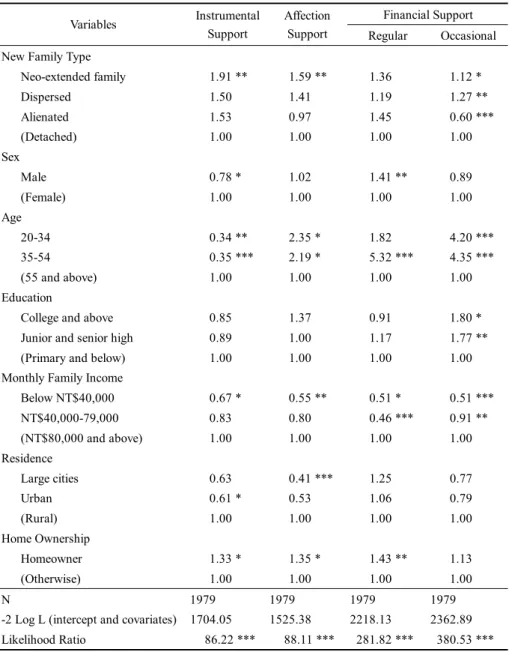
In terms of the support provided, the explanatory variables that give the best fit for the logit model are reported in Table 6, which consist of the family type, sex, age, education, family income, residential region, and home owner- ship. Three age groups are distinguished, 20-34, 35-54, and 55 and above, these covering the different lifecycle stages. Monthly family income is subdivided into three groups, namely, below NT$40,000, NT$40,000-80,000, and NT$80,000 and above. Residential region is subdivided into large cities, urban area and rural area. Statistically insignificant variables are excluded.
Table 6 shows that the neo-extended family is the family type most likely to provide instrumental and affection support to close relatives. Its odds ratios regarding financial support are high, but not significant for regular financial support. As for gender, male respondents are more likely to provide regular financial support than females, but are less likely to provide instrumental support. With respect to age, the young and the middle-aged cohorts tend to provide less instrumental support, but more affection and
Table 6. Factors Affecting Support Provided to Close Relatives: Taiwan 2001 (Odds Ratio)
Financial Support Variables Instrumental
Support
Affection
Support Regular Occasional New Family Type
Neo-extended family 1.91 ** 1.59 ** 1.36 1.12 * Dispersed 1.50 1.41 1.19 1.27 **
Alienated 1.53 0.97 1.45 0.60 ***
(Detached) 1.00 1.00 1.00 1.00
Sex
Male 0.78 * 1.02 1.41 ** 0.89
(Female) 1.00 1.00 1.00 1.00
Age
20-34 0.34 ** 2.35 * 1.82 4.20 ***
35-54 0.35 *** 2.19 * 5.32 *** 4.35 ***
(55 and above) 1.00 1.00 1.00 1.00
Education
College and above 0.85 1.37 0.91 1.80 * Junior and senior high 0.89 1.00 1.17 1.77 **
(Primary and below) 1.00 1.00 1.00 1.00 Monthly Family Income
Below NT$40,000 0.67 * 0.55 ** 0.51 * 0.51 ***
NT$40,000-79,000 0.83 0.80 0.46 *** 0.91 **
(NT$80,000 and above) 1.00 1.00 1.00 1.00
Residence
Large cities 0.63 0.41 *** 1.25 0.77
Urban 0.61 * 0.53 1.06 0.79
(Rural) 1.00 1.00 1.00 1.00
Home Ownership
Homeowner 1.33 * 1.35 * 1.43 ** 1.13 (Otherwise) 1.00 1.00 1.00 1.00
N 1979 1979 1979 1979
-2 Log L (intercept and covariates) 1704.05 1525.38 2218.13 2362.89 Likelihood Ratio 86.22 *** 88.11 *** 281.82 *** 380.53 ***
Note: * significant at 5% level; ** significant at 1% level; *** significant at 0.1% level.
financial supports than the cohort of age 55 and above. In particular, the middle-aged group (aged 35-54) is more than five times as likely to provide regular financial support to close relatives than the old cohort. In terms of education, respondents with a middle or high level of education have large odds ratios in providing occasional financial support. The lower the family income is, the lower the odds ratio is in the provision of all kinds of supports.
Dwellers in non-rural areas provide less instrumental and affection support than their rural counterparts. Finally, homeowners, who are likely to be more secure economically and are less likely to move, have greater odds ratios in providing instrumental, affection and regular financial support to non- coresiding close relatives.
In short, those who are in the neo-extended family, young and middle- aged, male, with high family income, and homeowners are more likely to provide affection support and financial support to close relatives; those who are in the detached family, young, male, with low family income, living in urban environment, and non-homeowners tend to provide less instrumental support. These results indicate that the provision of informal social support may be based on the amount of resources owned by the respondent. In other words, a rule of capability is pertinent.
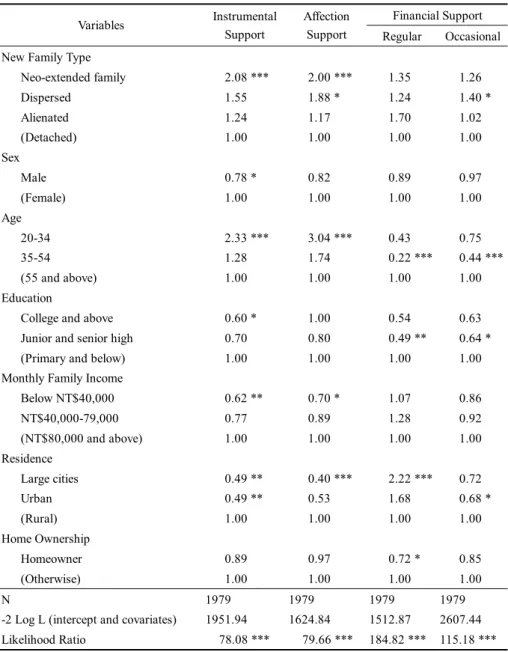
A matching regression is performed to analyze the support received from close relatives. Results are reported in Table 7. Again the neo-extended family has a greater odds ratio in instrumental and affection support than the other types. Its odds ratios for both regular and occasional financial support are large but insignificant. Males are less likely to receive instrumental support than women. The young cohort is more likely to receive instrumental and affection support, and the middle-aged cohort is the least likely to receive financial support. Those with higher education tend to receive less instrumental
Table 7. Factors Affecting Support Received from Close Relatives: Taiwan 2001 (Odds Ratio)
Financial Support Variables Instrumental
Support
Affection
Support Regular Occasional New Family Type
Neo-extended family 2.08 *** 2.00 *** 1.35 1.26 Dispersed 1.55 1.88 * 1.24 1.40 *
Alienated 1.24 1.17 1.70 1.02
(Detached) 1.00 1.00 1.00 1.00
Sex
Male 0.78 * 0.82 0.89 0.97
(Female) 1.00 1.00 1.00 1.00
Age
20-34 2.33 *** 3.04 *** 0.43 0.75 35-54 1.28 1.74 0.22 *** 0.44 ***
(55 and above) 1.00 1.00 1.00 1.00 Education
College and above 0.60 * 1.00 0.54 0.63 Junior and senior high 0.70 0.80 0.49 ** 0.64 * (Primary and below) 1.00 1.00 1.00 1.00 Monthly Family Income
Below NT$40,000 0.62 ** 0.70 * 1.07 0.86 NT$40,000-79,000 0.77 0.89 1.28 0.92 (NT$80,000 and above) 1.00 1.00 1.00 1.00 Residence
Large cities 0.49 ** 0.40 *** 2.22 *** 0.72
Urban 0.49 ** 0.53 1.68 0.68 *
(Rural) 1.00 1.00 1.00 1.00
Home Ownership
Homeowner 0.89 0.97 0.72 * 0.85
(Otherwise) 1.00 1.00 1.00 1.00
N 1979 1979 1979 1979
-2 Log L (intercept and covariates) 1951.94 1624.84 1512.87 2607.44 Likelihood Ratio 78.08 *** 79.66 *** 184.82 *** 115.18 ***
Note: * significant at 5% level; ** significant at 1% level; *** significant at 0.1% level.
support, and those with middle level education tend to receive less financial support. Respondents with low family income are less likely to receive instrumental and affection support. Those who live in the cities receive less instrumental, affection and occasional financial support, but are more likely to receive regular financial support than those who live in a rural area. Finally, homeowners tend to receive less regular financial supports than non- homeowners. In sum, those who own fewer resources are more likely to receive support from non-coresiding close relatives. A rule of needs seems to apply.
To summarize, the above analysis suggests that the support exchanges between respondents and close relatives are based on the rules of needs and capability. More specifically, respondents belonging to a neo-extended family are more likely to engage in informal social support exchanges. In addition, there is a gender pattern. Men tend to provide more regular financial support but receive less support of all kinds. There is also an age pattern. The young and middle-aged cohorts provide less instrumental support but receive more, while they provide more financial support and receive less. The middle-aged group, in particular, is the main provider of regular financial support. The trade-off between time input and money input is quite obvious.
Yet both age groups provide and receive more affection support than the old cohort. The better educated provide and receive less instrumental support, those with high school degrees tend to provide more financial support but receive less. Those with low family income are likely to provide less support of all kinds, and receive less instrumental and affection support. City- dwellers provide and receive less instrumental and affection support, but give and take more financial support. Finally, homeowners provide more but receive less of all types of informal social support.
VI. Concluding Remarks
In this study, an evolutionary perspective is adopted to examine Taiwan’s family changes, with the underlying assumption that changes in family form following rapid industrialization and urbanization are inevitable. In Taiwan, however, there have been relatively few family changes as compared with countries in the West. Although the traditionally-defined extended families have gradually broken down into nuclear families, most respondents (53.9%) are still classified as having “neo-extended” families because they live at short distances from relatives, maintain frequent contact with them, and are also very likely to engage in informal social support exchanges with them.
The analytical results of this study indicate that, after controlling for the socioeconomic effects such as education and home ownership, two factors remain highly associated with the formation of the neo-extended family, namely, the expectancy toward old-age financial support and the status of family property division. The former is a measure of the degree of adherence to traditional Chinese values, and the latter involves resource pooling and sharing among separately-living families. The persistence of these two important considerations serves to unite the non-coresiding families, and thus helps to explain why there are relatively few changes in the Taiwan family system.
While there are still questions that remain to be answered, such as how specific patterns and amount of exchanges are determined across family types, it is clear that the new typology provides a useful framework to capture the changes in family structure and function in contemporary Taiwan.
References
Balchin, P. N., D. Isaac, and J. Chen. 2000. Urban Economics: A Global
Perspective. New York: Palgrave Macmillan.
Bengtson, V. L. 2001. “Beyond the Nuclear Family: The Increasing Importance of Multigenerational Bonds.” Journal of Marriage and the Family 63(1): 1-16.
Bernheim, B. D., A. Shleifer, and L. H. Summers. 1985. “The Strategic Bequest Motive.” Journal of Political Economy 93: 1045-1076.
Bonvalet, C. 2003. “The Neo-Extended Family Circle.” Population - An English
Selection 58(1): 9-41.
Bumpass, L. L. 1990. “What’s Happening to the Family? Interactions Between Demographic and Institutional Change.” Demography 27(4): 483-498.
Chang, M. C. 1988. “Changing Family Network and Social Welfare in Taiwan.”
Pp. 459-482 in Economic Development and Social Welfare in Taiwan, edited by K. C. Liu, Y. S. Lee, and C. L. Wu. Taipei, Taiwan: Institute of Economics, Academia Sinica.
Chang, I. H., and Y. T. Fu. 2002. Taiwan Social Change Survey IV/2. Taipei, Taiwan: Institute of Sociology, Academia Sinica. (in Chinese)
Chu, C. Y. Cyrus, R. R. Yu, and R. Tsay. 2005. “Bequeathable Assets, Kinship Pressure and Visits by Adult Children.” mimeo.
Chuang, Y. C. 1972. “The Adaptation of Family to Modernization in Rural Taiwan:
A Case Study.” Bulletin of the Institute of Ethnology 34: 85-98. (in Chinese) Coombs, L. C., and T. H. Sun. 1981. “Family Values in A Developing Society: A
Decade of Change in Taiwan.” Social Forces 59: 1229-1255.
Couch, K. A., C. D. Mary, and D. A. Wolf. 1999. “Time? Money? Both? The Allocation of Resources to Older Parents.” Demography 36(2): 219-232.
Ellison, C. G. and L. K. George. 1994. “Religious Involvement, Social Ties, and Social Support in a Southeastern Community.” Journal for the Scientific
Study of Religion 33(1): 46-61.
Hoyert, D. L. 1991. “Financial and Household Exchanges Between Generations.”
Research on Aging 13(2): 205-225.
Hutter, M. 1998. The Changing Family. Boston: Allyn and Bacon.
Lee, Y. J., W. L. Parish, and R. J. Willis. (1994) “Sons, Daughters, and Intergenerational Support in Taiwan.” American Journal of Sociology 99(4):
1010-1041.
Litwak, E. 1960. “Geographic Mobility and Extended Family Cohesion.”
American Sociological Review 25(3): 385-394.
Liu, K. C. 1979. “Economic Aspects of Rapid Urbanization in Taipei.” Academia
Economic Papers 7(1): 151-87.
Liu, K. C. 1992. “Science, Technology and Human Capital Formation.” Pp. 357- 394, in Taiwan from Developing to Mature Economy, edited by G. Ranis.
Boulder: Westview Press.
Liu, K. C. and A. C. Tung. 2003. “Urban Development in Taiwan: Retrospect and Prospect.” Journal of Population Studies 26:1-25. (In Chinese)
Pannell, C. W. 1973. T’ai-Chung, Taiwan: Structure and Function. Chicago:
University of Chicago Press.
Popenoe, D. 1993. “American Family Decline, 1960-1990: A Review and Appraisal.” Journal of Marriage and the Family 55(3): 527-555.
Shi, L. 1993. “Family Financial and Household Support Exchange between Generations: A Survey of Chinese Rural Elderly.” Gerontologist 33(4): 468- 480.
Silverstein, M., S. Li, and W. Zhang. 2002. “Intergenerational Exchange in Rural Chinese Families.” Presented at the International Conference on Allocation of Social and Family Resources in Changing Societies. Taipei, Taiwan: Sun Yat-Sen Institute for Social Sciences and Philosophy, Academia Sinica, December 4-6, 2002.
Speare, Jr., Alden, K. C. Liu, and C. L. Tsay. 1980. Urbanization and Develop-
ment: The Rural-Urban Transition in Taiwan. Boulder: Westview Press.
Thornton, A., and E. F. Thomas. 1987. “Social Change and the Family: Compara- tive Perspective From the West, China, and South Asia.” Sociological Forum 2(4): 746-779.
Weinstein, M., T. H. Sun, M. C. Chang, and R. Freedman. 1994. “Co-Residence and Other Ties Linking Couples and Their Parents.” Pp. 305-334 in Social
Change and the Family in Taiwan, edited by A. Thornton and H. S. Lin.
Chicago: University of Chicago Press.
Yang, C. L., and K. J. Chen. 2002. “The Reasons and Schedules for Leaving the Parental Home in Taiwan.” Journal of Population Studies 25: 120-144. (in Chinese)