行政院國家科學委員會補助專題研究計畫
■ 成 果 報 告
□期中進度報告
(計畫名稱)
戶外冒險教育效益之影響因素模式建構
Model Construct on the Influential Factors of Outdoor Adventure Education Benefits
Title: Model Construct on the Influential Factors of Outdoor Adventure Education
Benefits
Chih-mou Hsieh, Department of Recreation & Leisure Industry Management,
Author identification notes:
Chih-mou Hsieh is an assistant professor in National College of Physical Education and
Model Construct on the Influential Factors of
Outdoor Adventure Education Benefits
摘要
戶外冒險教育 (outdoor adventure education) 自西元 1941 年開始發展,在相關組 織超過六十年時間的推廣下,目前在世界各地已經是蓬勃發展。在臺灣,戶外冒險教育的 發展起步雖然較晚,但是在近年教育改革的聲浪,推動體驗教育逐漸成為教育發展的主流, 加上產官學三方共同分工的大力推動下,戶外冒險教育的活動形式逐漸被各級學校單位所 接受,同時一些體育運動休閒系所也開設戶外冒險教育課程,並提供各個年齡層參與者體 驗戶外冒險教育課程的機會。隨著參與者數日增,針對戶外冒險教育所能產生的效益探究 因而成為重要。因此,研究者在本研究中,藉由介紹回顧、歸納整理與評論國內外以「戶 外冒險教育效益」為主題研究文獻,嘗試建構一個戶外教育的理論模式,並于以驗證。 本研究採取立意抽樣,分別對不同的機構活動學員採取問卷施測,總計發出 360 問卷, 有效回收 340 份,利用 SPSS 13.0 及 LISREL 統己軟體,以項目分析,信度檢驗及線性結構 方程模式來檢驗模式之適配度。 在模試驗證上,理論模式被拒絕,接下來進入修正模式的驗證,根據理論及數據 所提供之建議,最後之修正模式之適配度指數良好,【X2(132)= 242.75; P<.05, GFI=0.91, AGFI=0.89, SRMR=0.04, RMSEA=0.05; NNFI=0.98, CFI=0.98, PNFI=0.82, Normed
X2=1.84】。
綜合上述結果,研究者建構出參與者學前經驗與準備、活動歷程、活動特性與活動效 益之整體模式進行討論,並針對未來研究與實務提出具體建議。
關鍵詞:體驗教育、戶外冒險教育、效益 ABSTRACT
Positive benefits for intrapersonal and interpersonal brought out by outdoor adventure education had been proved in past researches since 1950s. However,thereason “why”and the process“how” these benefitsgenerated from outdooradventureeducation remained unclearin the black box and needed further research. Therefore, the main purpose of this study was to open the black box of benefits mechanisms for challenge ropes courses. By adopting concepts from multi-disciplines as well as inducting mechanisms mentioned in past researches, this study proposed a hypothetic structural equation model. In order to test the hypothesis, LISREL 8.54 was employed for the procedure of model identification, modification and cross validation. The hypothesized model was rejected and then replaced by an alternative model. The goodness of fit statisticsforthismodelwere acceptable:χ2(132)=242.75;p<.05;GFI=0.91;AGFI=0.89; SRMR=0.04;RMSEA=0.05;NNFI=0.98;CFI=0.98;PNFI=0.82;CN=213;Normed χ2=1.84.
Thecrossvalidation aswellasthemodel’sstability wereboth confirmed.Asaresult,the model of the mechanisms for challenge ropes courses benefits was constructed. The paper concluded with discussions for the results and suggestions for the following research and implications for experiential education practitioners.
Introduction
Benefits of outdoor adventure education
Positive benefits brought out by outdoor adventure education had been proved in past researches since 1950s. According to research results from many countries such as Australia, New Zealand, USA and UK, outdoor adventure education programs carried out not only intrapersonal benefits in physical, psychological, social and educational self-concept (Ewert, 1989; Sibthrop, 2000) as well as interpersonal benefits for leadership, communication and interactions (Hattie, Neill, Marsh & Richards, 1997; Priest, 1990) but also benefits for life effectiveness1, including: time management, social competence, achievement motivation, intellectual flexibility, task leadership, emotional control, active initiative and self confidence (Neill, 1999, 2000, 2002; Stenger, 2001; Terry, 2002).
Among many formsofoutdooradventureeducation activities,the“challengeropescourses” was the most popular one (Rohnke, 1986; Rogers, 2000) and also proved to derive beneficial growth (Combs, 2001; Constantine, 1993; Eagle, 2000; Faubel, 1998; Hatch & McCarthy, 2005; Finkenberg, Shows & DiNucci, 1994; Robitschek, 1996) for participants of all ages.
The black box for benefits mechanism
According totheaboveresults,theanswersto thequestion of“what”benefitstheoutdoor adventureeducation could obtain hasbeen offered,however,thereason “why”and theprocess “how”thesebenefitsbroughtoutby outdooradventureeducation remained unclear(Allison & Pomeroy, 2000; Ewert, 1989; McKenzie, 2000; Reddrop, 1997; Warner, 1999) in the“black box”(Baldwin, Persing & Magnuson, 2004) and further quest for discovering the black box for benefits mechanism was eagerly required.
Discover the secrets in the black box
In order to discover the secrets in the black box, practitioners and researchers in outdoor adventure education field started to claim their ideas about the benefits mechanism in the black box. Some researches (Ewert, 1988; Marsh & Richards, 1989; Sibthorp & Arthur-Banning, 2004)suggested participants’intention and expectation to take partin outdooradventure activities as well as their willing to change before coming to these adventures play important roles as antecedent variables resulting in benefits.
Outward Bound instructors, Hopkins and Putnam (1993) examined the reason why adventure education could derive benefits for participants from their practice and observation, then pointed out several key characteristics, including: the power of group process, the problem-solving situation, the concrete experiences, structured reflection and the element of adventure.
Luckner and Nadler (1997) argued the main reason why learners might benefit from outdoor adventure education was because the specific process such as the quickly-built relationships, decreased cycle time, kinesthetic imprint and risk-taking encourage in
1 Life effectiveness is essentially “the psychologicaland behavioralaspects ofhuman functioning which
adventure learning. In Australia, Neill and Dias (2002) examined 41 young adults participated in Outward Bound School program and found out social support from instructors and group members could significantly predict the program outcome of psychological resilience2.
Several other studies mainly conducted by McKenzie and Sipthorp also provided important findings for the benefits mechanisms. After literature review, McKenzie (2000) indicted six characteristics (including: the physical environment, activities, processing, the group, instructors and the participant) for adventure education program to achieve outcomes. Later, in the year of 2003, McKenzie examined 92 participants of outdoor adventure education program in Outward Bound Western Canada and by the methods of survey, in-depth interview and participant observation. According to the results, five influential factors for outdoor adventure education benefits were physical environment, social environment, course activities, instructors and the group. After a series of studies, Sibthorp and his colleague (Sibthorp 2000, 2003; Sibthorp & Arthur-Banning, 2004) found three characteristicsforadventure education experience to derive benefits,including:“personal empowerment” and “socialsupport” both from instructorsand group membersaswellas “learning relevance3”.
More recently, Haras and Bunting (2005) took 360 young adolescents who participated in a full-day ropes courses program as the subjects and used the method of survey to find out four benefits mechanisms for ropes courses, including: elements of challenge, uncertainty, risk, novelty and fun; variety of activity choices; self-select role for participants and variety of challenge options.
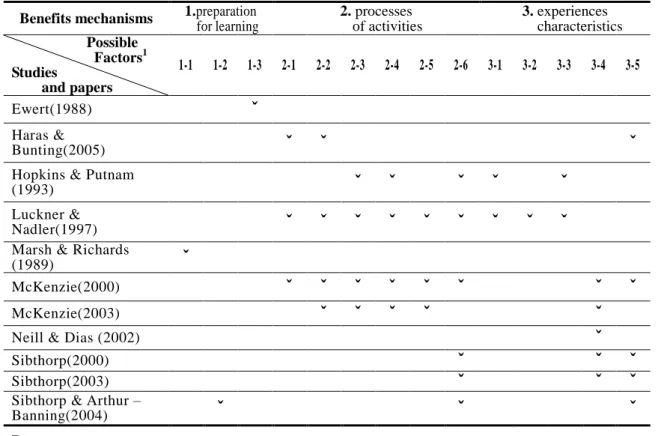
After literature review from above studies and papers, three broad concepts, namely 1.preparation for learning, 2.processes of activities and 3.characteristics of experiences, including fourteen possible factors for benefits mechanisms of challenge ropes courses were induced as shown in Table 1.
While examining past studies and papers, some perspectives about the issue of what remained in the black box of benefits mechanisms were either a lack of empirical studies or shortage of integration. For example, in the study by Neill and Dias (2002), focus was only on thesinglepossiblemechanism of“socialsupport”orin thepapersfrom Hopkins and Putnam (1993) as well as Luckner and Nadler (1997) were shorting of empirical researches. Further efforts to integrate many of the possible factors to empirically construct a testified model were consequently necessary.
2 Resilience refers to an individual’s capacity to survive and thrive in differentcircumstances (Neill & Dias,
2002, p.33).
3 Learning relevance refers to student’s connections between the course contentand theirown lives
Table 1. Possible mechanisms for benefits of challenge ropes courses
Benefits mechanisms 1.preparationfor learning 2. processesof activities 3. experiencescharacteristics Possible Factors1 Studies and papers 1-1 1-2 1-3 2-1 2-2 2-3 2-4 2-5 2-6 3-1 3-2 3-3 3-4 3-5 Ewert(1988) ˇ Haras & Bunting(2005) ˇ ˇ ˇ
Hopkins & Putnam
(1993) ˇ ˇ ˇ ˇ ˇ
Luckner &
Nadler(1997) ˇ ˇ ˇ ˇ ˇ ˇ ˇ ˇ ˇ
Marsh & Richards
(1989) ˇ
McKenzie(2000) ˇ ˇ ˇ ˇ ˇ ˇ ˇ ˇ
McKenzie(2003) ˇ ˇ ˇ ˇ ˇ
Neill & Dias (2002) ˇ
Sibthorp(2000) ˇ ˇ ˇ
Sibthorp(2003) ˇ ˇ ˇ
Sibthorp & Arthur –
Banning(2004) ˇ ˇ ˇ
Ps:
1. possible factors for benefits mechanisms:
1-1.participating intention; 1-2.participating expectation; 1-3. will to change; 2-1.state of disequilibrium; 2-2.mission to challenge; 2-3.team building; 2-4.mastery experience; 2-5.process of facilitation; 2-6.debrief and reflection; 3-1.kinesthetic imprint; 3-2.immediate feedback; 3-3.encouraging for adventure; 3-4.social support; 3-5.empowerment.
2.「ˇ」means factors mentioned in studies and papers.
Therefore, by adopting concepts from multi-disciplines as well as inducting mechanisms mentioned in former researches, this study proposed a hypothetic model as seen in Figure 1.
In this hypothesized model, the researchers proposed to clarify the mechanisms for challenge ropes courses by examining and testifying the relations between the variables of “preparation forlearning”,“processesofactivities”,“characteristics”and “benefitsforactivities”.
Research questions
Against this background, the purpose of this research was to discover the secrets in the black box through constructing a testified model of mechanisms for challenge ropes courses benefits. The main research questions were as follows:
1. Was the hypothesized model accepted with good statistics fitness? 2. Was the cross validation of the model acceptable?
Methods
Participants
In order to test the hypothesis, purposive sampling was used. Research participants were male and female high school and undergraduate students aged from 13-24 participating in challenge ropes courses (including: warm-up games, ice-break games, low and high elements) at National College of PE and Sports, Oriental Team Adventure Learning Institute, and the Methodist church in Taiwan during November 2005 to April 2006.
Total 1,150 questionnaires were distributed, with 963 valid questionnaires collected. Among these 963 valid questionnaires, the first 196 samples were used for exploratory factor analysis(EFA) of scales, the following 209 samples were used for confirmatory factor analysis(CFA) of scales and the last 558 samples were equally divided into two sets by the SPSS12.0 random procedure then used for model identification and cross validation.
Variables measured and validation of the scales
After a series of analytic procedures, including: item analysis, EFA, reliability analysis and CFA,reliableand valid scalesformeasuring challengeropescoursesparticipants’perceptions about“preparation forlearning”,“processesofactivities”,“characteristicsofexperiences”and “benefitsforactivities”(including fourfactors:physicalfitness,socialskills,specificskillsand life effectiveness) were developed.
Analysis
LISREL 8.54 was then employed in the procedure of model identification, modification and
Results
Model identification and modification
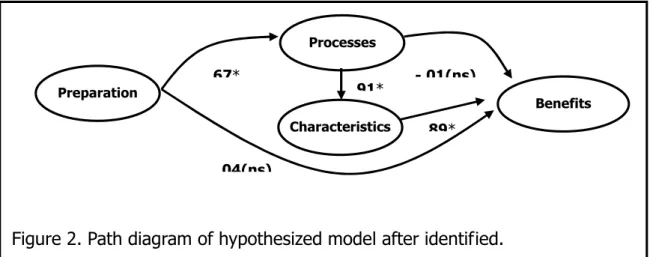
The hypothesized model was rejected (as shown in Figure 2) and then replaced by an alternative model. After modification between observed variables and relations between construct variables, the alternative model with good fitness was constructed as seen in Figure 3. Standardized path coefficients which could be interpreted as regression βweights or correlations were shown in parentheses. The variable of preparation for learning significantly predicted processes of activities (.67) which could then predict characteristics of experiences with significant (.91). Significant relationships (.89) between characteristics of experiences and benefits for activities were reported. The goodness of fit statistics for this model were acceptable: χ2(132)=242.75;p<.05;GFI=0.91;AGFI=0.89;SRMR=0.04;RMSEA=0.05;NNFI=0.98; CFI=0.98;PNFI=0.82;CN=213;Normed χ2=1.84.
Figure 3. Path diagram of alternative model after modified. Ps: Preparation for learning Processes of activities Characteristics of experiences Benefits for activities .67* .91* .89*
Model cross validation
With the purpose of testifying the stability of the constructed model for same type of samples, the method of cross validation was used. The cross validation with another samples was then tested and wasalso acceptablewith good fitness:χ2(132)=257.18;p<.05;GFI=0.91; AGFI=0.88;SRMR=0.04;RMSEA=0.06;NNFI=0.98;CFI=0.98;PNFI=0.82;CN=193; Normed χ2=1.95 asshown in Figure4.Thestability ofthismodelwasconfirmed.Following the above-mentioned results, the model of the mechanisms for challenge ropes courses benefits was constructed.
Discussions
According to the above results, the model of mechanisms for benefits was constructed. Three important concepts (preparation for learning, processes of activities and characteristics of experiences) which brought out benefits for participants in challenge ropes courses could be viewed as the mediating variables or mechanisms. This finding was fully consistent with previous research.
First of all, “preparation for learning” played an important role in deriving benefits for activities. These results were also supported by other studies (Ewert, 1988; Marsh & Richards, 1989; Sibthorp & Arthur-Banning, 2004). Participants attended the challenge ropes courses with intention, expectation and willing to change would derive personal improvement.
Meanwhile,the elementsof“processesofactivities”could also lead participantsto thegoal of personal growth. These findings were in accord with former researches (Haras & Bunting, 2005; Hopkins & Putnam, 1993; Luckner & Nadler, 1997; McKenzie, 2000, 2003; Sibthorp, 2000, 2003; Sibthorp & Arthur-Banning, 2004). In the beginning, challenge ropes courses particular with atmosphere of unfamiliar, uncertain and uncomfortable provided the state of disequilibrium, then the missions to challenge were given to the participants. Afterwards, through warm-ups, ice-breakers and low-elements activities, participants achieved the aim of team building while groups members learned and practiced new skills to obtain mastery experience for finishing the challenge under the process of facilitation and finally ended with debrief and reflection for meaningful experience for future application.
Furthermore, the unique “characteristics of experiences” from challenge ropes courses, Figure 4. Path diagram of model for cross validation.
including kinesthetic imprint which meant participants needed to learn by doing, then obtained immediate feedback and social support from group members or facilitators as well as the encouraging for taking adventure and individual or group empowerment to take responsibility in decisions, might guarantee the positive benefits. These findings also documented in former papers (Haras & Bunting, 2005; Hopkins & Putnam, 1993; Luckner & Nadler, 1997; McKenzie, 2000, 2003; Neill & Dias, 2002; Sibthorp, 2000, 2003; Sibthorp & Arthur-Banning, 2004).
With the statistical numbers in Figure 3, three paths of mechanisms for benefits were revealed:
1.“Preparation forlearning” “processesofactivities” “characteristicsofexperiences” “benefitsofactivities”.Thispath waswith indirecteffects as well as the standardized coefficients of .54 (=.67×.91×.89).
2.“Processesofactivities” “characteristicsofexperiences” “benefitsofactivities”. This path was also with indirect effects as well as the standardized coefficients of .81 (=.91×.89).
3.“Characteristicsofexperiences” “benefitsofactivities”.Thispath waswith direct effects of highest standardized coefficients (.89).
With comparing thelevelofeffectsforthesethreepaths,themechanism of“characteristics of experiences”contributed more to bring benefitsofchallenge ropescoursesto participantsthan the other two mechanisms- “processesofactivities”and “preparation forlearning”.Thisresult also revealed an interesting point for future notice. With only set participants’preparation for learning in advance and put every process of challenge ropes courses in order might bring out the after-activity benefits. But since the most important reason for challenge ropes courses different from other learning activities to derive positive benefits for participants in this model was because of these unique characteristics such as kinesthetic imprint, immediate feedback, encouraging for adventure, social support and empowerment, these characteristics actually played more significant roles in withholding positive benefits. However, possible reasons for this interesting finding still needed more future efforts to clarify.
Implications
For the following research
One limitation of this study was the sample. All the participants in this study were students at school for purpose of outdoor adventure education. However, other large portions of challenge ropes courses participants were for business training or therapeutic purposes. The extension and application for this adventure education model to corporate adventure training or adventure therapy groups would need further efforts. Also, different approaches to discover the secrets in the black box were necessary. Qualitative methods such as in-depth interview or participant observation might offer new insights.
In accordance with findingsofmechanismsforbenefitsin thisstudy,thereason “why” and theprocess“how”these benefitsbroughtoutby challenge ropescourseswereclarified. Hence, one key information for the practitioners working for experiential or adventure education field to keep in mind when programming was to assure contain as many as factors for benefits mechanismsaspossible.To enforce participants’preparation for learning in advance then set orderly processes of activities to create the atmosphere with characteristics of adventure experiences would finally carry out positive benefits for the participants.
Reference
Allison, P., & Pomeroy, E. (2000). How shall we“know”? “Epistemologicalconcernsin research in experientialeducation”.Journal of Experiential Education, 3(2), 91-97.
Baldwin, C., Persing, J., & Magnuson, D. (2004). The role of theory, research, and evaluation in adventure education. Journal of Experiential Education, 26(3), 167-183. Combs, S. E. (2001). The evaluation of adventure based counseling with at risk youth. Boston
College, MA. Doctoral Dissertation.
Constantine, M. (1993). The effects of a rope course experience on perceived self-efficacy: A study designed to examine the effects of an adventure program. Pennsylvania Journal of
Health, Physical Education, Recreation, and Dance, 63(2), 10.
Diamantopoulos, A., & Siguaw, J. A. (2000). Introducing LISREL: A guide for the
uninitiated. Thousands Oaks, CA: Sage.
Eagle, H. A. (2000). Long-term differences between participants and non-participants in
“Beyond the Limits” adventure education program. College Park, MD: University of
Maryland. Doctoral Dissertation.
Ewert, A. W. (1988). The identification and modification of situational fears associated with outdoor recreation. Journal of Leisure Research, 20(2), 106-117.
Ewert, A. W. (1989). Outdoor adventure pursuits: Foundations, models, and theories. Columbus, OH: Horizons Publishing.
Faubel, G. (1998). An efficacy of a school-based for intervention program for emotionally
handicapped students. Miami, FL:Miami Institute of Psychology. Doctoral Dissertation.
Finkenburg, M. E., Shows,D., & DiNucci, J. M.(1994). Participation in adventure-based activities and self- concepts of college men and women. Perceptual and Motor Skills,
78, 119-122.
Hair, J. F., Anderson, R. E., Tatham R. L., & Black, W. C. (1998). Multivariate data analysis(5th ed.). Prentice Hall International: UK.
Haras, K., & Bunting, C. J. (2005). The differences in meaningful involvement opportunities provided by ropes courses programs. Journal of Experiential Education,
27(3), 297-299.
Hatch,K.D.,& McCarthy,J.C.(2005).Exploration ofchallengecourses’long-term effects on members of college student organizations. Journal of Experiential Education, 27(3), 245-264.
Research, 67(1), 43-87.
Hopkins, D., & Putnam, R (1993). Personal growth through adventure. London: David Fulton.
Hu, L. T., & Bentler, P. M. (1995). Evaluating model fit. In R. H. Hoyle(Ed.), Structural equation
modeling: Concepts, issues and applications (pp.76-99). Thousand Oaks, CA: Sage.
Luckner, J., & Nadler, R. (1997). Processing the experience: Strategies to enhance and
generalize learning. Dubuque, IA: Kendall/Hunt.
Marsh, H. W., & Richards, G. E. (1989). A test of bipolar and androgyny perspectives of masculinity and femininity: The effect of participation in an Outward Bound program.
Journal of Personality, 57(1), 115-138.
McKenzie, M. D. (2000). How are adventure education program outcome achieved?: A review of the literature. Australian Journal of Outdoor Education, 5(1), 19-28.
McKenzie, M. D. (2003). Beyond the Outward Bound Process: Rethinking student learning.
Journal of Experiential Education, 26(1), 8-23.
Neill, J. T. (1999). The melting pot of outdoor education effects: Testing the flavors of program
type, duration and participant age. Paper presented to the 11th National Outdoor Education
Conference. Perth, Western Australia,
Neill, J. T. (2000). The impact of Outward Bound Challenge Courses on disadvantaged youth
sponsored by Colonial Foundation. Unpublished report, University of Canberra, Australia.
Neill, J. T. (2002). Meta-analytic research on the outcomes of outdoor education. Paper presented in the 6th Biennial Coalition for Education in the Outdoors Research Symposium, Bradford Woods, IN.
Neill, J. T., & Dias, K. L. (2002). Social support helps people grow. Horizons, 17, 32-34. Neill, J. T., Marsh, H. W., & Richards, G. E. (1997).The Life Effectiveness Questionnaire
development and psychometrics. Department of Education, University of Western Sydney,
Australia.
Priest, S. (1990). The semantics of adventure education. In J. Miles & S. Priest (Eds.), Adventure
education (pp. 113-114). State College, PA: Venture.
Reddrop, S. (1997). Outdoor programs for young offenders in detention: An overview. Hobat, Tasmania: National Clearninghouse for Youth Studies.
Robitschek, C. (1996). At-risk youth and hope: Incorporating ropes courses into a summer jobs program. The Career Development Quarterly, 45, 163-169.
Rogers, D. (2000). To the top: Challenge courses for persons with disabilities. Parks and
Recreation, 35(3), 76-87.
Rohnke, K. (1986). Project Adventure a widely used generic product. Journal of Physical
Education, Recreation, Dance, 57, 68-70.
Sibthorp, R. J. (2000). Instrument validation and multivariate assessment of life skill
development in adolescents through the adventure education process. Indiana
University, Bloomington. Doctoral dissertation.
Sibthorp,R.J.(2003).An empiricallook atWalsh and Golins’adventure education process model: Relationships between antecedent factors, perceptions of characteristics of an adventure education experience, and changes in self-efficacy. Journal of Leisure
Sibthorp, R. J., & Arthur-Banning, S. (2004). Developing life effectiveness through adventure education: The roles of participant expectations, perceptions of empowerment, and learning relevance. Journal of Experiential Education, 27(1), 32-50. Stenger, T. (2001). Sequence of adventure-based resident outdoor education programs and
middle school students perceptions of Life Effectiveness. Unpublished doctoral dissertation,
Oklahoma University, OK.
Terry, L. (2002). A quantitative and qualitative analysis on the effects of an adventure course: An
intervention with female Adolescents. Undergraduate Thesis, Scripps College, Claremont,
CA.
Warner, A. (1999). Improving program quality through evaluation. In J. C. Miles & S. Priest (Eds.), Adventure programming(pp.65-70). State College, PA: Venture Publishing.
計劃成果自評: