Research Express@NCKU - Articles Digest
Research Express@NCKU Volume 19 Issue 3 - July 15, 2011 [ http://research.ncku.edu.tw/re/articles/e/20110715/2.html ]
Acute Stress Impairs Hippocampal Mossy Fiber-CA3 Long-Term Potentiation by Enhancing cAMP-Specific Phosphodiesterase 4 Activity
Chien-Chung Chen, Chih-Hao Yang, Chiung-Chun Huang and Kuei-Sen Hsu*
Department of Pharmacology, College of Medicine, and Center for Gene Regulation and Signal Transduction Research, National Cheng Kung University, Tainan 701, Taiwan
Neuropsychopharmacology 35(7): 1605-1617, 2010.
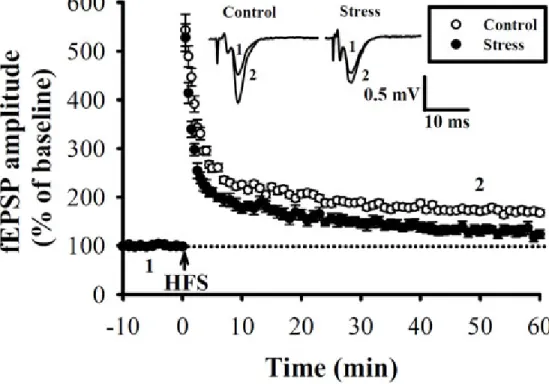
The mossy fiber synapses onto hippocampal CA3 neurons show unique molecular features and a wide dynamic range of plasticity. Although acute stress has been well recognized to alter bidirectional long-term synaptic plasticity in the hippocampal CA1 region and dentate gyrus, it remains unclear whether the same effect may also occur at the mossy fiber-CA3 synapses. Here, we provide the first evidence that acute behavior stress can impair the induction of mossy fiber LTP through the activation of glucocorticoid receptors, leading to a sustained increase in the cAMP-specific phosphodiesterase 4
(PDE4) activity to accelerate cAMP degradation and subsequently resulting in an increase in the levels of adenosine, which act on the adenosine A1 receptors to counteract the enhancement of transmitter release in response to LTP induction protocol. To the extent that mossy fiber synaptic plasticity is important for the establishment of hippocampus-dependent associative learning and spatial memory, the processes involved in the impairment of mossy fiber LTP may contribute to the development of associative and spatial learning and memory deficits.
Figure 1. Stress impairs subsequent LTP induction at the mossy fiber-CA3 synapses.
1 of 1