
• 沒有找到結果。

The First Contact

N/A
N/A
Protected

Academic year: 2021

Share "The First Contact "

Copied!
40
0
0

加載中.... (立即查看全文)

全文

(1)

CHAPTER SIX: JOYCE AND IVY Background Information

The First Contact

As mentioned in Chapter 3, one of the methods I used to find potential participants was to contact each individual school in Hsinchu City. In mid-July of 2006, I made a phone call to School C. The staff who answered my call was an administrator. He explained to me that he did not really know the current status of their English teachers. He suggested that I call back in late August to talk to the head teacher.

In late August, I made another phone call to School C. My call was immediately transferred to the English head teacher Stacy. I briefly introduced myself and my research project to her. She told me that their school had the teachers I was looking for—there were two new Taiwanese English teachers, and they were expecting a new foreign teacher. Stacy suggested that I could talk to one of the Taiwanese teachers, Joyce. She then went to Joyce’s office, but Joyce was not there. She gave me her cellular phone number and told me to call her again in the afternoon. I called Stacy again later that day, and she gave her cellular phone to Joyce, who told me she would be happy to help me with my project. We agreed to meet at her school the next day. She told me to find her at the Office of General Affairs.

The next day, I arrived at School C and found the Office of General Affairs. I

walked in and asked for Joyce. One of the staff told me that Joyce was expecting

me and she would be back right away. Soon, a young woman walked in the office

and greeted me. She told me that she just joined the English department this

semester. She also told me that her master thesis was on the qualifications of

elementary school English teachers. She said that they were expecting a new

(2)

foreign teacher who should be on board in a couple of days.

I began my observation at School C on September 5, a few days after I first met Joyce. In an email Joyce sent me earlier, she had told me that their new foreign teacher Ivy had arrived in Taiwan and would start teaching on September 4. After arriving at the school for my first observation, I found Joyce in her office, and she introduced Ivy to me. Ivy kindly agreed to participate in my project. We three then walked to the classroom together. There was not much exchange of conversation on the way. Ivy was an extremely quiet person who looked nervous and confused. She told me after class that at the moment, she was staying at a hotel and came to school by taxi. She has not found a place to settle down.

School C: A School Near the Hsinchu Science Park

School C, a school with 50 years of history, is located in the East School District of Hsinchu City. It is also close to the Hsinchu Science Park. A lot of parents in this region are well-educated and have a high socioeconomic status (Lin, 2006). In Lin’s city-wide survey (2006), among the three school districts in Hsinchu City, the East School District had the highest approval rating of the team teaching program. Like School A and B, School C also participated in the pilot project of team teaching in 2000. Some classrooms of School C were used as classrooms for a newly established junior high school in the district whose school buildings were still under construction at the time of my fieldwork.

In a talk with the consultant of the foreign-teacher company, Dr. Lee,

45

during her visit to School C on September 26, I was told that the English program of School C has been quite successfully run in the past few years. She also told me that according to her observation, the students of this school probably have the highest English proficiency level in the entire Hsinchu City (fieldnote, 2006/09/26). At

45 For more information about Dr. Lee, refer to Note 15 on p. 52 of this dissertation.
(3)

School C, all the students, from the first to the sixth grades, have two periods of English class per week. This is quite unusual, as the first two graders in all the other public elementary schools in the city usually just have one period of English lesson per week.

Another unique feature of the English education of School C was that it is the only school in the city which uses imported textbooks. The series they used for all the six grades in the 2006 school year was the Hip Hip Hooray! series published by Longman. In my interview with the head teacher Stacy in the first semester, I had an opportunity to ask her about their choice of the textbooks. Stacy told me that she felt that the textbooks written by local publishers are too easy and their school has been using textbooks from foreign publishers for quite a few years (interview, 2006/11/17). In the interview, she also told me that the Hip Hip Hooray! series was chosen because the language patterns presented in the books are closer to the daily usage. According to Stacy, another advantage of this series is that it has many written exercises in each unit; therefore, there is no need for teachers to spend time making extra worksheets. At the end of each unit, there is also a short story;

Stacy felt that it is important to provide students with opportunities to read short English articles.

With regard to its English department, in 2006, School C had four local English teachers (Stacy, Joyce, Amanda, and John) and two foreign teachers (Carol and Ivy;

Ivy did not come back to Taiwan in February, 2007, so it was Rachel who served as

the other foreign teacher at School C in the second semester. See later for more

details). Stacy served as the head teacher in the 2006 school year; she also had this

position in 2003 and 2004. Both Stacy and John have taught English at School C

for quite a few years. Amanda is actually a music teacher. She just got her

master degree from an American university (also in music) and was asked to teach

(4)

the Grade 1 English classes in the new school year. Carol was a returning South African foreign teacher who started working at School C in the 2005 school year.

Joyce co-taught two periods of Grade 6 classes with Ivy; she also had a solo lesson with each of the two classes every week. She also taught all the six Grade 2 classes by herself. Besides English, she was assigned to teach Computer Studies to four of the Grade 5 classes. As for Ivy, she taught all the Grades 2 and 4 classes with the homeroom teachers. She also co-taught two Grade 6 classes with Joyce, two with John, and three with Stacy.

Joyce’s seat was at the Office of General Affairs where she had worked as the Section Chief of the Purchase and Maintenance Section since 2005. Ivy’s seat was located in what is referred to as the “big office” at School C; it is where all the administrators (except the principal and those from the Office of General Affairs) and subject teachers could be found. She sat next to Carol and very close to all the other English teachers (except Joyce).

Unlike School A and B, there was no regular meeting for English teachers at School C. In the first week of the first semester, all the English teachers of School C had a lunch meeting in a restaurant, which I was invited to attend. In the casual lunch gathering, they briefly talked about issues like who would set the test papers for which exam. Before the exam papers were finalized, all the six English teachers would also get together in the big office to go over the items during the lunch break. When they had free time, many of the English teachers would go out and have lunch together outside school. I was often invited to attend these gatherings in the first semester, and because of this, I got to know all the English teachers of School C quite well.

Joyce: A Novice English Subject Teacher With Diverse Teaching Experiences

Joyce, a native of Hsinchu, graduated from the English Department of a

(5)

prestigious public university in Taiwan. She did her master study in Education at a teachers college. It was where she also completed the elementary school teacher certification program. Her master thesis was about the design of elementary school English teacher education programs and the qualifications of English teachers.

After she got her master degree, she did her practicum as a substitute teacher at School A where she worked as a homeroom teacher and an English teacher for eight classes.

After she completed her one-year practicum at School A, she found a job at School C. In her first year at School C, she was a homeroom teacher, and she also taught English to her own class. In the next few years, she has worked as a lower-grade homeroom teacher and a subject teacher for various subjects, including Physical Education, Social Studies, and Computer Studies. She became the Section Chief of the Purchase and Maintenance Section in 2005, a job which kept her very occupied. She always wanted to be an English subject teacher, but there was no vacancy. Just before the 2006 school year began, two English teachers left School C. Joyce asked her school if she could teach English, and the school agreed.

Joyce was the winner of the “Teacher of Excellence Award in Hsinchu City” in September, 2006. She is passionate about acting and has been an active participant in local drama clubs.

Ivy: A South African Teacher From the JET Program

Ivy is a black woman in her early 40s. She comes from the east coast of South

Africa. She holds an undergraduate degree in Education from South Africa. In

her country, she had several secretarial jobs before working as an English tutor for

Grades 6 and 7 students for two years. This part-time job required her to provide

after-school remedial instruction to black students. She went to Japan to join the

(6)

JET program in 2004. When she was there, her base school was a middle school where she worked for two days a week. For the other school days, she needed to go around the other schools (including elementary and middle schools) that she was assigned to in the region.

After working in Japan for two years, she went back to South Africa in the summer of 2006. In my interview with her at the end of the first semester (2006/12/28), she told me that she felt “out of place” after going back to South Africa, so she decided to look for an oversea teaching job again. She came across the advertisement for the Hsinchu program on the Internet and decided to come to Taiwan. She arrived in Taiwan in early September, a couple of days after the new school year had started.

Description and Perception of Team Teaching Experience

Joyce and Ivy’s Definitions of Team Teaching and Perceptions of Their Role At the beginning of the school year, Joyce defined team teaching in these words,

“Team teaching is cooperation. To cooperate well, I need to know this person’s background, ways of handling matters, and her personality” (interview, 2006/09/07).

She continued, “Without this knowledge, I can’t team teach well with her.

Although we focus on teaching, not on private life, I feel that I cannot cooperate well with my partner if I don’t know what kind of person she is.” For Joyce, before she could cooperate well with Ivy, she felt that she needed to establish a close personal relationship with her partner. This view concurs with Carless’s (2006a) idea that an important condition for successful team teaching is the development of relationships both inside and outside the classroom.

Regarding the roles she expected herself and Ivy to play, Joyce remarked, “I

see my role in the classroom as helping to maintain discipline and help the students

when they have questions. With regard to the foreign teacher, I hope she can give

(7)

our students an all-English environment where there’s a lot of English input”

(interview, 2006/09/07).

Turning now to Ivy, I conducted the background interview with her on her fifth day in Taiwan. At that time, she was looking very shy and nervous. During the interview, she did not really talk much. Earlier that week, after the first class observation was over, she told me that she was amazed by the English ability of the Taiwanese students. She told me that her students in Japan could not understand her as well (fieldnote, 2006/09/05).

Ivy defined team teaching in these words, “I think team teaching is all about sharing—sharing responsibilities, sharing ideas, like helping each other. That’s how I define it” (interview, 2006/09/07). She thought that her role was to teach and make sure her lesson is successful. She expected Joyce to help her with activities and to explain things to students.

It was in this background interview that I learned Ivy came from the JET program. When the interview was near the end, I asked her to share her experience in Japan. In her words, “The Japanese teachers were responsible for teaching.

We were like assistants, helping students to read the sentences, helping the students to pronounce the words, helping with games and things like that. But the main teacher was the Japanese teacher” (interview, 2006/09/07). She told me that she felt she had a reverse role here and that teaching in Taiwan was a great opportunity for her to grow as a teacher.

Joyce and Ivy’s Metaphors for Team Teaching

At the end of the first semester, Joyce provided the following metaphor for team teaching (she responded to the prompt in English) —“Team teaching is like rowing a boat. The teammates should work together toward the same direction.

Otherwise, the boat may stop in the middle of a lake and go nowhere. In teaching,

(8)

it means the teaching goals couldn’t be reached.”

The feeling of getting stuck in the middle of a lake was exactly how Joyce was feeling in the first semester. Soon after Ivy began to teach at School C, it became obvious that she was a very introverted person. Her heavy South African black accent confused many students, especially the younger ones. The only teaching aid she often used was the flashcards. Many of the Grade 6 lessons I observed in the first semester contained endless drill practices. In the middle of the class, Ivy often turned her back to the students and started writing some sentences on the blackboard in a very slow manner, leaving students nothing to do for a few minutes.

As an experienced teacher, Joyce soon detected her partner’s problems. She told me on one occasion that she felt very helpless because she did not know how to help Ivy (fieldnote, 2006/10/19). Even though she was frustrated, Joyce reserved her criticisms. Before my first interview with her began on September 7, 2006, she told me that her view of foreign teacher’s qualification had changed since the semester began. She said that one of the important conclusions of her master thesis was that it is very important for teachers to have a formal certificate. She told me that before Ivy arrived in Taiwan and started teaching at her school, the company sent a substitute teacher who had very good teaching skills. He could not be hired as a formal teacher because he did not have a teacher certificate. After working with Ivy for a week, Joyce felt that at the real teaching sites, good teaching skills should come first before a teacher certificate when it comes to the recruitment of foreign teachers. Although Joyce did not criticize Ivy directly, her change of view on the qualification of English teachers reflects her ongoing struggle with working with a certified teacher who has limited teaching skills.

As for Ivy, the metaphor she provided at the end of the first semester was that

team teaching is like a marriage—“Team teaching is like marriage, need to know

(9)

and understand each other, know your co-teacher’s personality, strength and weaknesses. To be there for each other during the lesson delivery.” She seemed to feel that it is important for her to get to know her teaching partner well before they can cooperate together. This statement matches with Joyce’s initial definition of team teaching. In other words, both of them felt that they needed to know their partners well to teach effectively together.

On the same questionnaire (Appendix F), Ivy also compared team teaching to a two-way street. I asked her for elaboration in the follow-up interview on December 28, and she answered, “Team teaching is about giving and taking.

You’re taking from this teacher, ‘Oh, I like this idea.’ And obviously, your teaching won’t go unnoticed.” She continued, “They will notice something as well, from you, that they will take it from you and use it in the future. That was what I was referring to. It must be a two-way street. Giving and taking.” Following the same line, Ivy felt that the contribution she made to her team was her knowledge and teaching skills.

Joyce’s Most Memorable Incident in Team Teaching

Joyce’s most memorable incident in team teaching took place when Ivy played

a game called “crisscross” with one of the Grade 6 classes for the first time. I

happened to be in their classroom on that day. To play the game, Ivy first asked all

the students in a vertical row to stand up. She then asked students in that row some

questions. Students had to raise their hands if they knew the answers. Joyce

helped by picking a student to answer a question; the student who answered the

question correctly could sit down. Ivy kept asking questions until there was only

one student left standing. Then all the students who sat in the same horizontal row

had to stand up and play the game. Teachers can keep playing the game for as long

as they feel appropriate. Ivy’s first try-out of the game lasted for about 20 minutes.

(10)

Before Ivy started the game on that day (September 19), she followed her usual teaching routines by first asking students to read the dialogue in the textbook together. She then asked a few comprehension questions based on the dialogue, like “Where was Tom?” and “What did Tom do?” before reviewing the keywords with flashcards. Many students were not paying attention to what Ivy was doing on the stage until she announced that they were going to play the “crisscross” game.

After the game started, the classroom atmosphere turned quite lively, as students were quite interested in this game.

Part of the prompt on Appendix G asked teachers to reflect on what they have learned from their most memorable experience. Joyce reflected (in English):

All the kids love games, even the sixth graders. Although they often show coldness in class, the game still drives them crazy. A powerful English class includes not only knowledge but also fun. Only when students are motivated, learning could be effective. When the other teacher has difficulty in arranging the activities, the co-teacher can arrange one during the class if there’s enough time. In this part, I think I should do better.

In the first interview, Joyce mentioned that she would like to facilitate students’

learning via activities (interview, 2006/09/07). Seeing Ivy play a game with the sixth graders for the first time was a memorable experience for Joyce. As evident from the above excerpt, Joyce stated that she learned that even older students would enjoy games. She also felt that she could step up more in her co-teaching classes with Ivy to lead more activities.

Ivy’s Most Memorable Incident in Team Teaching

Ivy described a negative experience as the most memorable incident in the first

semester. She wrote, “I had this plan for the day and the materials to be used in the

lesson. On my way to the class, the co-teacher asked me why I had these materials

(11)

because they have shift [sci] that lesson to the following week.” She continued, “I was very surprised to be told at the last minute that I had to teach another lesson, instead of the one you have prepared.” Ivy also explained what she learned from this incident—“What I have learned is that as a team, you have a [sci] same goal.

Therefore, it is very important to discuss the lesson beforehand. As teachers, need [sci] to open the lines of communication as much as possible.” She continued,

“Communication is very important in team teaching. Without that, there will be problems all the time. That will end up attacking one another personally.”

Ivy’s Perception About Communication Among Teachers

Lack of communication was something that Ivy did not like at her school. In one of the interviews, I asked her why there was a lack of communication between her and her co-teachers. She answered:

I have no idea. I don’t know what it is. The thing is we don’t sit down as team teachers to talk about the things we want to do in class.

For example, let’s go back to the lesson plan, things like that. You know, lesson plans or activities. I want the school or team teachers to tell me, “This is what I want you to put in your lesson plan”

because I am still new. I am still learning things. It doesn’t happen here (interview, 2006/12/28).

As mentioned earlier, unlike School A and B, regular teacher meetings were not held in School C. I once asked Stacy about their teacher meetings in my interview with her, and she responded, “We are supposed to have a lesson planning meeting every month. The November meeting was not held because I don’t really think there are things worth discussing.” She continued, “Next week, we will have a meeting to go over the test papers. We will have regular meetings when the semester begins.

As the semester goes by and things seem to go smoothly, we will not have regular

meetings” (interview, 2006/11/17). While Stacy felt that regular meetings seemed

(12)

to be unnecessary, Ivy felt that she did not have a chance to sit down with her co-teachers to discuss their lesson plans and teaching ideas. She also seemed to expect others to tell her what to do.

Cruz and Zaragoza (1997) discuss the paramount role that effective communication plays in a collaborative teaching relationship. They remark,

“Successful communication helps to initiate the expression of respect and trust for the development and continued growth of a positive endeavor” (p. 148). They further suggest that effective communication requires regularity and frequency.

Ideally, teachers involved in collaborative teaching need to communicate before and after each teaching session, and regular meetings need to take place during the semester for teachers to discuss their concerns.

In School C, as aforementioned, the head teacher Stacy did not see the need for regular meetings. Before the test paper for each grade was finalized and sent to the printing room, all the English teachers would gather after lunch to go over the items that each of them had prepared earlier. This was the rare occasion that everyone in the English department would gather together. However, the purpose was not to discuss their teaching.

A lot of complaints about Ivy came from the Grade 2 homeroom teachers, most of whom lacked adequate English ability to communicate directly with her.

They often talked to Stacy instead. Although Stacy tried to help Ivy improve her teaching according to these teachers’ suggestions, Ivy was not always responsive.

During the first semester, Stacy made a few formal and informal complaints about Ivy to the foreign-teacher company, which then passed these messages to Ivy when she showed up in the company.

Ivy felt frustrated that her school did not directly tell her about the problems

they had with her. In my interview with her at the end of the first semester, she

(13)

told me that she often received messages from her company, telling her that the school did not like something she was doing. Ivy described the situation, “I got some messages from the company, telling me that the school doesn’t like this and that. People here don’t really tell me directly.” She continued, “Why don’t they approach me and tell me before they take it further? I would get some messages from the company, and then the school would tell me that they have sent this and that to the company” (interview, 2006/12/28). However, according to my observation, direct comments from the school did reach Ivy before they were taken to the foreign-teacher company, as Stacy often talked with Ivy about her problems.

It seems that it was only when these comments were taken further (i.e., to the company) would Ivy respond to them by trying to make some changes.

Ivy’s Self-Perception

Throughout the first semester, I found that many of Ivy’s self-descriptions were inconsistent with my observation and her colleagues’ perceptions of her. For example, in the background interview, I first asked Ivy to introduce herself. After telling me her name and where she came from, she said, “I think I’m a hard-working person, and I’m a fast learner as well. I just cope very easily in a foreign environment” (interview, 2006/09/07). At that time, I found it quite peculiar that one would introduce herself in this way. Gradually, I found that this description strayed from the reality. In fact, Ivy’s lack of efforts and absent-mindedness were two major complaints that Stacy, a very experienced head teacher who had worked with many different foreign teachers in the past, had on her. Ivy could not cope well with the new environment, as she often looked scared and nervous in the first half of the semester.

On the questionnaire which she completed at the end of the first semester, Ivy

wrote that her weakness was that she is a perfectionist who wants things to be

(14)

accurately done in team teaching. Feeling quite perplexed about her answer, I brought up the issue of being a perfectionist in the follow-up interview:

Researcher: I have a quick question about something you mentioned in the questionnaire. You mentioned that your weakness is that you are a perfectionist. Isn’t being a perfectionist a strength?

Ivy: It’s not a strength. It’s a weakness. You get so frustrated all the time. If you set a lesson plan, you want things to be done exactly like that. You want the things exactly the same as the way you have designed your lesson plan. Once the co-teacher jumps in and does other things, you get frustrated because you think it should not be done like that. It’s a weakness (interview, 2006/12/28).

When Ivy wrote on the questionnaire that she was a perfectionist, I thought she was referring to the fact that she set high standards for herself when it came to the effectiveness of her teaching. However, from the interview, I learned that she seemed to define a perfectionist as someone who rigidly follows her lesson plan when she teaches. She was annoyed by the fact that her co-teachers would jump in and do other things, leaving her unable to execute her plan for the day. On the other side of Ivy’s frustration is that both Stacy and Joyce once commented that they often found Ivy did not follow her lesson plans.

Doubts on Ivy

There were many doubts on Ivy’s accent and her teaching skills at School C,

especially when Ivy first started teaching. As a result, throughout the first semester,

Ivy had to continuously face the uncertainty of being replaced. Before Dr. Lee

came to observe her for the first time (see later for more details), Ivy told me that if

she could not continue to work at School C, she would just leave the program and

find another job in a private language school. At that time, she was very

demotivated by all the negative comments she received at School C.

(15)

In the semester-end interview, she talked about the comments about her accent as “unconstructive criticisms.” She had a hard time cooperating with some of her co-teachers because their negative attitudes toward her accent. In her words:

When we are on the stage teaching, you could see that I say a word with my accent, the one that they say is not good, and you feel that the co- teacher would just look at you with that look in front of the students. Or maybe they will correct you in public, in front of the students. Even if you make a mistake, it’s not wise to be corrected this way. I’m the professional, and I expect that I’m corrected in a professional manner.

For example, don’t give me that look in front of the students. By doing so, you’re sending the wrong message to the students (interview, 2006/12/28).

In the same interview, Ivy also told me she felt that she had been unfairly judged

because most of the negative comments about her came from the second graders,

who she thought could not comprehend her instruction because they were too young,

not just because of her accent. She said, “I’m feeling that I’m unfairly judged

because they listen to what Grade 2 are saying. They are very young. They are

not exposed to this language.” She continued, “Even if they bring in an American,

they won’t understand the instruction. It’s not about my accent, but I’m told it’s

my accent.” She then recalled her own experience of learning English when she

grew up in South Africa, “You know we have another language, Zulu. When I was

learning English, it was difficult for me. But the more it was spoken to me, I

grabbed until I understood.” She went on to say that she wanted to challenge

people’s criticism on her confusing the children with her accent—“I want to

challenge that one, but I don’t want to cause problems. The Grade 2 can’t

understand my instruction because of my accent? That’s not true. Language itself

is a problem to these kids.”

(16)

Ivy stated that she would much prefer criticisms that are constructive—“I want the criticism to be helpful, rather than coming to me and tell me that the parents don’t like your accent. I was repeatedly told that the school won’t employ me next semester. It’s very demoralizing for me” (interview, 2006/12/28). She continued,

“Every day I come to school, I feel not healthy. It’s a wake-up call for me to look for another job. I don’t know what I am going to do. It’s the end of everything.”

Ivy was not the only person who was feeling frustrated. While it is true that the lines of communication might not be open enough at School C, many of Ivy’s colleagues did try to provide assistance to Ivy. In my interview with Stacy, she told me that Carol was very tired of helping Ivy. At the time of my interview with Stacy, Carol wanted Ivy to be replaced in the second semester because she wanted someone who she could talk to and form some bond with. Stacy told me that Ivy did not show enough efforts and passion, and the English teachers who co-taught with her were disappointed.

Perhaps Joyce’s comment best sums up why Ivy could not adapt well to the new school—“I think Ivy probably senses some hostility toward her when she first came to the school. Maybe hostility is not the right word.” She continued,

“Because of her pronunciation, some of our teachers have doubts on her. And I think her skin color is also a factor. She is an introverted person. I think if you keep cringing on the corner, other people will not approach you” (interview, 2006/12/21).

Development in Skills and Knowledge

Joyce’s Growth

Areas Joyce wanted to improve on

At the beginning of the school year, Joyce stated that she would like to learn

more activities for teaching the higher graders. She stated in the first interview

(17)

(2006/09/07), “I want to learn more about the activities that I can use with Grades 5 and 6 students. My prior knowledge mainly comes from teaching the lower graders. They are happy and satisfied with singing and jumping.” She continued,

“I think I need to find more activities that are cognitively demanding and challenging. As a teacher, I really want to know more practical ideas. I really want to know other teachers’ teaching ideas for this group of students.” I asked her if she thought team teaching would help her to grow in this area, and she answered, “I will ask other Chinese teachers for their ideas. Because Ivy is also new, maybe I can’t get too many ideas from her. I also bought some teaching resource books. I hope I can get some inspiration from them” (interview, 2006/09/07).

Indeed, how to motivate the sixth graders was a challenge for Joyce throughout the school year. She was very concerned about arousing these students’ interest in learning English. Having worked with the lower graders for quite a few years, Joyce felt comfortable with teaching these young learners. She talked about her Grade 2 students in one of the interviews, “The biggest problem with the second graders is that some of them want your attention. They will say, ‘Teacher, teacher’

and this will interrupt the flow of the lesson. But I think I can handle the second graders well” (interview, 2006/12/21). She explained to me that her second graders treated English teachers like “Gods,” and that they enjoyed their English lessons because they could play games.

On the contrary to her confidence with the lower graders, Joyce was quite worried about not being able to cope with the sixth graders, who are at an awkward age and experiencing lots of changes both on the physical and emotional level.

Joyce thought that she could not interact very well with these older students—“I’m

still not very used to talking to them. Probably because I’m used to talking to the

(18)

young kids, the way I talk with the higher graders and the reasons I use to persuade them sound more child-like.” She continued, “I sometimes think, ‘How can I persuade them?’ ‘How can I reason with them?’ I feel quite confused, so I am a little bit worried about their changes next semester.” At the end of the first semester, she felt that trying to discipline the sixth graders was a big challenge she faced in team teaching. In her words, “I found that gradually, classroom discipline is going to be a problem in my Grade 6 classes. They are not very stable recently.

And if teachers don’t plan the lesson well, students will be more impatient”

(interview, 2006/12/21).

Another aspect which Joyce wanted to improve on was knowledge about the

foreign culture. As an English major who never lived or studied in an

English-speaking country, she felt that her cultural knowledge was inadequate and

that she did not know “the real ways of speaking English.” She remarked, “I want

to know how things are really expressed in English. I also want to learn how

foreigners deal with things, what their attitudes are like.” She continued, “I can

also pass this knowledge to our students. They should find it quite fascinating and

will be more motivated to learn English” (interview, 2006/09/07). In terms of

teaching, Joyce explained, “I think I can handle teaching the vocabulary and

grammar in textbooks, but if students ask me something outside the textbook, I may

not have the cultural knowledge to answer them well.” She then talked about Stacy,

who lived in the U.S. for many years before she became an elementary school

teacher, “Take Stacy for example. She always spends the summer in Boston with

her husband. I feel that she has a lot of cultural knowledge, and she also knows

how to communicate with our foreign teachers.” She further commented, “For me,

I just have a very general idea on how to interact with foreign teachers” (interview,

2006/09/07).

(19)

Joyce’s gains in the first semester

At the end of the first semester, Joyce stated that she had learned some activities which she could use with her Grade 6 students from Stacy, Ivy, and her personal reading. From Ivy, Joyce told me that she learned a few games, like the crisscross and word chain. More importantly, from her experience of teaching the sixth graders in the past semester, she learned that these older students enjoyed playing more challenging games. In her words, “This semester is the first time that I teach English to the higher graders. Through many trials and errors, I found that they preferred challenging activities, for example, something to do with vocabulary, guessing, or memory” (interview, 2006/12/21).

With regard to cultural knowledge, she talked about the experience of working with Ivy as “eye-opening.” She felt surprised after learning that there are many different languages in South Africa, and she remarked, “For me, the biggest impact is I learned that language is just a communication tool; one’s pronunciation or accent is not that important. As long as you can express your thoughts, everything should be fine” (interview, 2006/12/21). She further elaborated, “For me, personally, I feel that I have learned a good lesson about the different accents. My view of what English represents is not so narrow anymore. It’s an eye-opening experience for me.” She then talked about the situation in Taiwan, “In Taiwan, we do not have many opportunities to get to know so many different kinds of foreigners. We, including students and ourselves, may have some stereotypes toward people of different colors.”

Although on the personal level, Joyce stated that she had learned a great lesson

about accents from working with Ivy, she felt that her partner’s strong accent was

still an issue in her school because students would imitate her. In fact, from the

first day that Ivy worked at School C, there were many doubts about Ivy’s accent.

(20)

What made her even more incomprehensible for many students and teachers who could not speak English well was her low voice. Soon in my visits to School C in the first month, I found that the Grade 6 students started to imitate Ivy’s pronunciation of words like “soccer” (which she pronounced as [saka]) and made fun of her pronunciation when she was teaching on the stage. As the head teacher, Stacy was under a lot of pressure because many parents of the Grade 2 students complained about Ivy’s accent and demanded the school to find another foreign teacher.

In the interview at the end of the first semester, Joyce did not mention that she gained knowledge about the real way of expressing things in English, an area she felt she needed to improve on. Her partner Ivy is not a very talkative person, although she did look more relaxed and talked more in the second half of the semester. The two teachers also sat in different offices, and they only taught together for two periods a week. As mentioned earlier, Joyce was also extremely busy with her administrative duties. Therefore, there were not many opportunities for them to interact when they were not teaching. In other words, Joyce did not have many chances to talk to Ivy, who might help her improve her knowledge on the language.

More importantly, when Ivy taught, there was not a lot of spontaneous

interaction between her and the students. She mainly followed the textbook and

led students to read one page after another. Therefore, there was not much

naturalistic language input in the classroom for students and Joyce. The only time

that Ivy would talk naturally was when she was providing instruction for an activity

or an assignment, but she often did so in a very brief and unclear manner, leaving

most students confused. Joyce often had to ask for clarification before she could

begin to explain to students.

(21)

Ivy also followed the teacher’s manual to teach. I noticed this in my first classroom visit, but I did not really pay attention to it at that point. Later in other visits, I found that she often used very difficult words to introduce new materials.

For example, on October 3, the grammar point was “have to.” Ivy explained to students that “I have to” is an obligation, similar to the word “must.” She did not provide any further explanation and was about to go on to drill students on the new phrases with the help of flashcards. At the point, I was thinking how students could know what the word “obligation” means. Seeing that students were quite confused, Joyce jumped in and explained in Chinese what Ivy just said.

In another class later in the same month, Ivy began a new lesson by telling students in a way that sounded peculiar to me, “Today, we are going to learn how to invite people to do certain activities. We will also learn how to decline an invitation” (fieldnote, 2006/10/19). After I left School C on that day, I got myself a copy of the teacher’s manual and found that the words Ivy often used to introduce a certain lesson are written in the manual as a way to orient teachers on the content of the lesson. It seems that she simply read out what is written on the teacher’s manual as her way of explaining the new materials to students.

Another reason for the lack of naturalistic language input is that a lot of class

time in Joyce and Ivy’s co-teaching lessons was spent on completing written

exercises. In my fieldwork at School C, I found that students at this school had to

do a lot of writing practices both in class and after class (i.e., homework). Even the

second graders were sometimes given many pages of worksheets to practice writing

the alphabets. In the Grade 6 textbook, there are many pages of written exercises

in each unit. In Joyce and Ivy’s co-teaching lessons, students often spent the last

few minutes of the class on completing these pages; Ivy and Joyce would go around

the classroom to check how students did. Once in while, they would also prepare

(22)

extra worksheets for students to complete.

Dr. Lee’s visit and Joyce’s changes

Dr. Lee came to visit Ivy’s class on September 26, 2006. It was a Grade 6 class that Ivy co-taught with Joyce. Because I already planned to pay the two teachers a visit on that day before I learned about Dr. Lee’s observation, I sent an email to Dr. Lee to ask her if she minded my presence in the same classroom. She kindly told me that she did not mind at all and that I could also observe how she conducted the teacher conference afterwards. On the morning of September 26, Dr.

Lee arrived at the classroom with a clerk from the foreign-teacher company, and we three sat at the back of the classroom for the 40-minute lesson.

After the class was over, Dr. Lee, the clerk from the foreign-teacher company, Stacy, Joyce, Ivy, and I walked to a room for the teacher conference. Dr. Lee first discussed about Ivy’s accent and teaching skills; she also made some suggestions to Ivy (see later for more details). An important message which Dr. Lee delivered in the teacher conference is that Joyce speaks English with “very beautiful pronunciation” so that she should play a more active role when co-teaching with Ivy (fieldnote, 2006/09/26). Dr. Lee’s advice was a wake-up call for Joyce. As mentioned earlier, when the semester began, Joyce defined her role as an assistant in her team teaching with Ivy. As she told me in the background interview (2006/09/07), “When we co-teach, I really respect my co-teacher’s idea of conducting the lesson because I believe she has her reasons to teach the lesson in this way. My role is to assist her.” She then provided me with an example, “For example, in today’s class, the writing activity was taking too long, and I reminded Ivy that it was time to move on to the next activity.” She continued, “So when I teach with the foreign teacher, I feel I should totally support what she wants to teach.

My role in the classroom is to try to discipline the students and help the slower

(23)

learners.”

Before Dr. Lee’s visit, Joyce was not an active teacher in her co-teaching lessons with Ivy. Like her self-description in the background interview, when she taught with Ivy, she often walked around the classroom to help the slower students and helped her partner to discipline the class. On October 3, a week after Dr. Lee’s visit, I went to School C to observe Ivy and Joyce’s class as planned. This class was usually quite a cooperative and well-behaved class; some students in this class were also advanced learners with strong interest in learning English. On that particular day, the class did not respond to Ivy well—they looked very tired and did not follow Ivy’s drills (fieldnote, 2006/10/03). To get students’ attention, Ivy led the drills again by raising her voice, but it did not work at all. Then Joyce stepped in. She asked Ivy if she could ask students to stand up and answer questions. Ivy agreed, so Joyce walked to the stage. She told students that whoever answered a question could sit down, and the winning team (i.e., the first group that had all the students sit down) could get five points. Although what Joyce did was a simple move, it did wake up the students, and Ivy was able to continue with her teaching.

This was also the first time I saw Joyce stepped up and took control of the whole class.

Near the end of this class, Ivy turned to the blackboard and started writing a

few sentences. Unlike May and Amy, who always wrote things they would teach

on the board during the break (before the next class began), Ivy would not enter the

classroom until the bell rang. When she needed to write something on the board,

she would turn her back to students and wrote silently in a very slow manner in the

middle of a lesson. When they first started to cooperate, Joyce did not seem to

know what to do as Ivy wrote silently and slowly on the board. She would often

watch Ivy writing and wait until her partner finished. I noticed that after the

(24)

teacher conference with Dr. Lee, Joyce tried to talk to the students whenever Ivy turned to the board. In the October 3 class, Joyce went to the front of the classroom, did some actions, and asked students to guess what she was doing to fill in the silence (fieldnote, 2006/10/03). In another class, she told students what Ivy was writing was very important for the test and tried to get students to pay attention to Ivy (fieldnote, 2006/10/19).

On the questionnaire which Joyce completed at the end of the first semester, she talked about her change of role in her co-teaching classes with Ivy. She wrote (in English), “In the beginning, I presumed myself in team teaching as a supporter, who supported the foreign teacher when she needs me. Gradually, I found that I only focused on maintaining discipline and couldn’t help students step further in learning English.” She continued, “Now, I should be an active supporter in team teaching. When the foreign teacher couldn’t handle the class, I have to be able to bring some activities for students to practice.”

Although Joyce modified the way she cooperated with Ivy, she felt that she

made the change too late. In the follow-up interview on December 21, I asked her

to evaluate her team-teaching experience in the past semester. She felt that her

experience was not very successful and went on to talk about how successful team

teaching should be—“When I was completing your questionnaire, I was thinking

about what I have done this semester. I think successful team teaching means very

good cooperation between the two teachers. The Chinese co-teacher should not

just assist from the side.” She continued, “I think I should have made some

changes earlier. Dr. Lee reminded me that I could play a more active role, but I

think I made the change too late.” She thought that the meeting with Dr. Lee in

late September was very thought-provoking. In her words, “She provoked some of

my thoughts. My previous thinking was that the foreign teacher should have the

(25)

total control.” She further explained, “Because of the talk with Dr. Lee, I realized that I should change my way of thinking. I now think it’s possible that I do 20 or even 30% of the teaching in class. I should plan for this” (interview, 2006/12/21).

Joyce thought that when the semester began, she was not sure about how she should teach with Ivy. She explained how she used to cooperate with foreign teachers when she worked as a homeroom teacher, “The kind of co-teaching I did when I was a homeroom teacher is not really co-teaching. The foreign teacher would teach the whole lesson, and if he/she needs help, we will help.” She continued, “This is the way that the Grade 1 and 2 homeroom teachers co-teach with foreign teachers. This is why I need so much time to figure out what to do now”

(interview, 2006/12/21). She also learned from her experience in the past semester that there was not an “optimal model” of team teaching. She remarked in the same interview, “I now feel that the way we cooperate is different every day. Previously, I always pondered if there is an optimal model.” She continued, “Now, I found that every time is so different. Sometimes, you need to take the lead. Sometimes, students are just having a bad day.”

Whether there is an optimal model of collaboration between local and foreign

teachers has been a widely-discussed issue. To improve the efficacy of team

teaching, some (e.g., Luo, 2005; 2006; 2007) call for a search for a “viable model of

collaborative teaching” (Luo, 2005, p. 11) while others suggest that there should be

a clearer definition of what role each team teacher should play (e.g., Lin, 2002; Tsai,

2006). However, as Joyce suggests, a single optimal model of team teaching

probably does not exist in real teaching sites, as there are so many factors which

come into play in determining how team teachers should collaborate. Teachers

should remain flexible and responsive in order to implement their teaching as well

as to meet the needs of their students.

(26)

Ivy’s Growth

Areas Ivy wanted to improve on

At the beginning of the school year, Ivy stated that she hoped to improve on her classroom management skills. In her words, “As a person, I’m very soft. I need to strengthen my authority. Sometimes, students just talk and don’t listen. I want to improve on my classroom management skills.” She continued, “I’m eager to learn from my co-teacher. Not to be harsh, but to be firm, so that students know I’m the authority, I’m the teacher” (interview, 2006/09/07).

In the background interview, Ivy also mentioned that she needed to gain different kinds of knowledge to enable her to teach the students in Taiwan. She stated, “To be able to teach the kids, I need to know the culture. I need to know the school culture, and I need to know the teachers better” (2006/09/07). As a newcomer to Taiwan, Ivy did not have much knowledge about the school and her new students when the semester began. In the first week of my fieldwork, she told me that she found it amazing that everyone in Taiwan could speak English.

Although she was impressed by her sixth graders’ English ability, she did a review of numbers one to nine in the second class I observed (fieldnote, 2006/09/07). She did not seem to know what to do or how to teach her new students at this point.

Ivy’s gains

One fact which Ivy gradually learned was that she played an important role in

the English program at School C. As the semester progressed, she became more

talkative and relaxed when she was with her colleagues and students. In our

interview at the end of the first semester, she was quite talkative and shared a lot of

her thoughts with me. In that interview, which lasted for more than an hour, she

compared the situation in Taiwan and in Japan:

(27)

I was thinking that as a foreign teacher, maybe students won’t take me seriously as a teacher. But I found out that they respect me as a teacher. So that thing along (pause) that empowers me to move forward and set rules because now I know they take me seriously. They take me as a teacher as well. I get the same treatment as other teachers. This has helped me a lot. I came with this mind frame from Japan because they didn’t take us as

teachers. They used to take us as people who (pause) I don’t know (pause) as what? They didn’t take us as teachers. I was repeatedly told that I was not taken as a teacher because you didn’t qualify in their country (interview, 2006/12/28).

Ivy said that she was disappointed with the way she was treated in Japan. After she learned that she was respected as a teacher in Taiwan, she felt empowered and was able to step forward to set rules for her students. Indeed, in the last few weeks of the first semester, I noticed that Ivy began to look more confident and showed more authority when she taught on the stage. In one of the classes in December, Ivy explained how to play the game “reading race” to students. The game then started, but students did not really follow the rules and were making a lot of noises. Ivy stopped the game. She talked about the rules again and told students that they needed to follow the rules and not to make unnecessary noises. The game then progressed quite smoothly (fieldnote, 2006/12/02).

In the semester-end interview, I had an opportunity to ask Ivy about her classroom management skills. She responded, “I think getting to know the students helps me a lot because now, I can say, ‘Hey, people. What are you talking about?’ I can tell them that if you keep talking, I will take points away from you”

(interview, 2006/12/28). She continued, “You know now, I can put my feet and say that things should be done like this. Before, I was passive and very shy. I think it’s all about getting to know students.”

At the end of the first semester, Ivy stated that she also learned about how to

(28)

teach phonics from her Taiwanese co-teachers. She talked about phonics in these words, “I was blank. These are the things we overlook because we are from an English-speaking country. So how to teach phonics? I really don’t have ideas.”

She continued, “But I’ve learned how to teach phonics in this school. They would teach students how to combine and segment the sounds. So I’ve learned it here”

(interview, 2006/12/28). Although Ivy stated that she observed how her Taiwanese colleagues led students to segment and combine sounds as a way to teach phonics, I did not see her use this technique to help students read words in her own classes.

Therefore, it is uncertain whether she can apply what she claimed she has learned to her own teaching.

In addition to phonics, Ivy told me that she learned from her co-teachers that using flashcards is a good idea. In her words, “They are the real objects (pause) the real visuals. It’s very much helpful. For example, I would say ‘Play baseball,’

thinking students know what it looks like. I learned from them that it’s very useful to use flashcards” (interview, 2006/12/28). However, from my observation, using flashcards as the main teaching aid does not seem to be something that Ivy learned from her co-teachers. I found that Ivy heavily relied on using flashcards to drill students from the beginning to the end of the first semester. In one of my visits, Ivy forgot to bring flashcards to her class. In that class, Ivy looked very insecure and did not really know how to teach without her flashcards. She finished what she had to teach in about 20 minutes. Joyce had to take over the lesson by leading students to do an activity (fieldnote, 2006/10/24).

Toward the end of the first semester, Ivy did try to make her teaching more

interesting. One technique she started to use was team competition. In the class

on December 26, she divided the class into three teams. She told students that if

they could give a word with the long [o] song, they could get a point for their team

(29)

(fieldnote, 2006/12/26). Many students raised their hands and made some noises.

Joyce tried to discipline the students by telling them if any team was too noisy, she would give points to the other two teams. When students gave wrong words, Joyce would also write the words on the board and discuss them with the class. When the class was over, Joyce suggested to Ivy that next time, she could try to divide students into smaller groups so that everyone could be involved. Ivy agreed.

I asked Ivy about her use of team competition at the semester-end interview:

Researcher: I noticed that starting from this week, you divided students into teams.

Ivy: I’ve been doing observation at other schools, and I learned that if you put them into teams, it actually encourages them. You know like

competition among students. It kind of encourages them to work toward certain point, you know? It encourages them to participate. I was trying to engage all of them to the lesson. Rather than dealing with the whole group, I put them in teams. Many schools have been doing this, and I thought this is wise (interview, 2006/12/28).

Besides team competition, Ivy stated that from one of the training sessions organized by her company, she learned using “line drill” to get to know who the weaker learners are. She explained, “Students have to form a line and they come to you.

You show them a flashcard and they will say the word or sentence.” She then compared this activity from having the whole class to answer at the same time, “If you just ask the whole class, everyone kind of answers in chorus. But if you get them one by one, you will know who the slow learners are” (interview, 2006/12/28).

She continued, “Before, it was difficult for me to know the slow learners. When I am doing the line drill, I know these are the slow learners and they need extra help.”

Ivy’s old habit of using flashcards died hard, but toward the end of the semester, she

started trying different group activities which enabled her to hear individual voices

(30)

and locate the weaker learners.

Dr. Lee’s role in Ivy’s development

One person who played an important role in Ivy’s development was Dr. Lee who came to observe Ivy for the first time on September 26. Before the observation, there were already some discussions at School C about whether to replace Ivy. Before the class began, Ivy looked extremely nervous. Joyce tried to calm her down and asked her what she was going to teach. The bell rang, and Ivy began the lesson by playing the crisscross game. She added a little variation to the game by asking some questions beyond the textbook content, e.g., “What time is it now?” and “What did you do last weekend?” She then briefly reviewed the vocabulary on the textbook (in a drill manner) and moved on to the pronunciation practice on the next page. She did a good job by inviting students to give her examples with the long [e] sound. Students were quite cooperative, and Ivy was able to elicit many words from them. After the pronunciation practice was over, she asked a few volunteers to read a short story from the textbook. She finished the lesson by asking students to complete some written exercises. During the entire lesson, Ivy looked confident and spoke with a louder voice than usual.

After the lesson was over, Dr. Lee immediately told Ivy that she did a good job.

In the teacher conference, Dr. Lee first told Ivy that she thought Ivy’s accent “is not that bad,” but they had to take parents’ concern into account (fieldnote, 2006/09/26).

Both Dr. Lee and Stacy suggested that Ivy could listen to the textbook CD to see

how the keywords are pronounced and modify her pronunciation a little bit, which

Ivy seemed to agree. Then Dr. Lee moved on the teaching techniques. She told

Ivy that she could think about what to do with the content of the book by doing

different activities, like strip stories, pair reading (instead of choral reading all the

time), and information gap activity. She also told Ivy that she is very fortunate to

(31)

have these advanced students at School C, and that she should try to extend her teaching beyond the textbook, for example, by asking students to make sentences with the keywords. Dr. Lee also stressed the importance of hearing individual voices in class. She then talked about teaching these very capable students extra materials, like social and classroom language. She thought that Ivy used too many drill-based practices and encouraged her to put students into groups so that she could hear more individual voices. During the teacher conference, Ivy was very attentive, and I noticed that she jotted down some words on her notebook. Dr. Lee ended the meeting by saying, “It would be a waste to let you go. You are a teacher with a lot of potential.”

As mentioned earlier, the meeting with Dr. Lee was a wake-up call for Joyce, who began to play a more active role in the classroom. I was curious about how Ivy would respond to Dr. Lee’s suggestions. On September 28, I paid the two teachers another visit. The focus of the lesson was on accepting and rejecting someone’s invitation. At one point in the lesson, Ivy told students that if they did not want to say “Sure, that sounds like fun” to accept an invitation, they could also say, “Sure, that sounds good/great.” She seemed to be taking in Dr. Lee’s suggestion by extending the lesson beyond the textbook content. However, she did not elaborate on the different ways of accepting an invitation and ended the instruction rather abruptly. It seems difficult for Ivy to quit the habit of asking students to do choral reading and drills, as she still conducted most of the lesson by using these two techniques for that day as well as for most of the remaining semester.

Ivy’s inconsistent performance after Dr. Lee’s visit

Ivy’s performance on September 26 (the day of Dr. Lee’s visit) was surprising.

As her partner Joyce described afterwards, it was the best class Ivy had taught since

(32)

the semester began. The discussion of whether to replace Ivy kind of died off at School C in the following month. However, the complaints from Grade 2 parents and homeroom teachers did not stop. Ivy’s Taiwanese co-teachers also noticed that Ivy’s performance was inconsistent. On most days, she would teach a lesson by following her routines of prompting students with flashcards and asking them to do choral reading. By the second month of the first semester, I found that Ivy’s Grade 6 students became quite impatient with the way Ivy conducted a lesson. In a conversation in mid-October, Joyce told me that she felt her sixth graders had lost their confidence in Ivy, and she was worried about how she could help Ivy to teach for the rest of the school year (fieldnote, 2006/10/19).

In early December, Stacy finally filed a formal complaint about Ivy to the foreign-teacher company, demanding Ivy to be replaced in the second semester. In a visit to School C during that period of time, Stacy told me that she noticed Ivy tried to teach harder after she learned about the complaint. However, she said that working with Ivy was exhausting; she stated, “Ivy will move one step when I lash my whip once” (fieldnote, 2006/12/08). She also told me that the homeroom teachers did not really want to have a new foreign teacher, since they felt that they had become familiar with Ivy and knew how to help her in class. At that time, they were still waiting for further notification from the company, and it was uncertain whether Ivy would stay.

One thing which both Joyce and I noticed was that Ivy always seemed more

confident on the stage when she came back from her observation of other foreign

teachers or her in-service training provided by the foreign-teacher company. After

coming back from these professional development activities, she would also add

more variation to her teaching for a short while before going back to her usual

teaching routine of drilling students. Because Ivy’s performance was unstable, her

數據

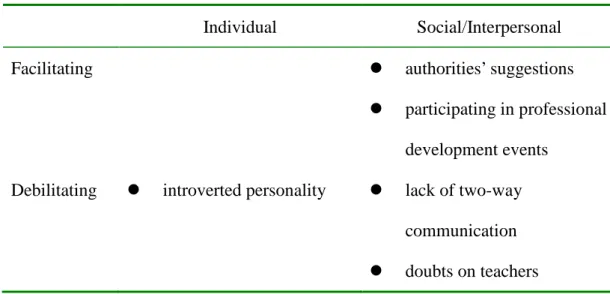
Table  7  summarizes  the  individual  and  social/interpersonal  factors  which  facilitate  or  debilitate  Joyce  and  Ivy’s  growth  in  the  first  semester

參考文獻

相關文件

• e-Learning Series: Effective Use of Multimodal Materials in Language Arts to Enhance the Learning and Teaching of English at the Junior Secondary Level. Language across

Understanding and inferring information, ideas, feelings and opinions in a range of texts with some degree of complexity, using and integrating a small range of reading

Writing texts to convey information, ideas, personal experiences and opinions on familiar topics with elaboration. Writing texts to convey information, ideas, personal

 develop a better understanding of the design and the features of the English Language curriculum with an emphasis on the senior secondary level;..  gain an insight into the

• helps teachers collect learning evidence to provide timely feedback & refine teaching strategies.. AaL • engages students in reflecting on & monitoring their progress

Strategy 3: Offer descriptive feedback during the learning process (enabling strategy). Where the

Guiding students to analyse the language features and the rhetorical structure of the text in relation to its purpose along the genre egg model for content

  Whether the complaint is made in written form or in person, the complainant should provide his/her name, correspondence/e-mail address and/or contact phone