Chapter 4 Discussion
This chapter further interprets the results of the present study and addresses the answers to the five research questions stated in Chapter 1. Section 4.1 discusses the difficulty levels of semantic topics, section 4.2 that of syntactic topics. Section 4.3 analyzes how the subjects used topic chains, and section 4.4 discusses whether our findings support the behaviorist or the nativist approach. Section 4.5 examines the task effects. Finally, section 4.6 summarizes the main points of this chapter.
4.1 Difficulty Levels of Semantic Topics
Definite and generic nouns are different in their referentiality (Li and Thomson 1981). Definite nouns refer to a particular item known to both speakers and listeners, so they are referential (Chafe 1976). However, generic nouns are non-referential, since they do not refer to individuals but kinds which are essential and broad in scope (Prasada 2000).
The present study investigated the difficulty levels of generic topics and definite topics in the Chinese children’s acquisition. To understand the subjects’
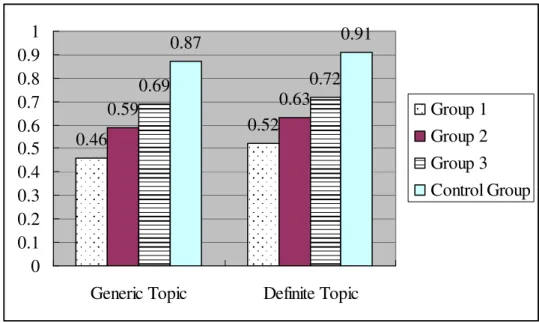
performance on the two topics, the mean scores in the SS task and the EI task were calculated. Figure 4-1 shows the results of the two semantic topics by our subjects.
0.460.590.69 0.520.630.72
0.87 0.91
0 0.1 0.2 0.3 0.4 0.5 0.6 0.7 0.8 0.9 1
Generic Topic Definite Topic
Group 1 Group 2 Group 3 Control Group
Figure 4-1: Subjects’ Performance on Generic Topics and Definite Topics As can be seen in Figure 4-1, the subjects’ correct responses to generic topics grew with their age (0.46 for Group 1; 0.59 for Group 2; 0.69 for Group 3; 0.87 for the control group). Such tendency was also found in the subjects’ performance on definite topics (0.52 for Group 1; 0.63 for Group 2; 0.72 for Group 3; 0.91 for the control group). Moreover, no subjects used indefinite nouns as topics in the EI task, indicating that our subjects have acquired that genericness and definiteness, but not indefiniteness, are semantic features of Chinese topics. This finding supports Li and Thompson’s (1976, 1981) claim that Chinese topics are definite or generic.
Moreover, the result partially agrees with Chen and Shi (1999), who found that, compared with the Chinese native controls, the Japanese and English learners have not acquired generic and definite features in the ordering task, but they have found that indefiniteness is not one of the features of Chinese topics. However, in their acceptability judgment task, indefinite topics were found to be most difficult for the L2 learners to acquire. Thus, our results only support their finding in the ordering task.
In addition, Figure 4-1 shows that Group 1, Group 2, Group 3, and the control
group all performed better on definite topics than on generic topics. The result argues against some L1 studies on the acquisition of generic nouns and definite nouns.
Peterson (1974) found that definite nouns in Moore1 are difficult for young children.
He found that 4-year-old children made numbers of erroneous definite references when they described real-life events and accidents. According to Pan and Gleason (1997), nouns with the terms such as this and that are also complex to children because they require children to understand the reference point. To comprehend this and that, children have to know the relative relation between the speaker and the fixed point (Pan and Gleason 1997). However, we found that definite topics were easier to acquire than generic topics to all the subjects. This tendency can be explained in by the difference between definite nouns and generic nouns. As defined by Li and Thompson (1981), definite nouns are referential and they refer to an entity that both the speaker and the listener know. Although generic nouns are known to the speaker and the listener, they refer to types, rather than a particular item of the type. The difference between definite nouns and generic nouns can be further explained by Gundel, Hedberg, and Zacharski’s (1993) Givenness Hierarchy, as (1) shows.
(1) The Givenness Hierarchy
In focus>activated>familiar>uniquely identifiable>referential>type identifiable The Givenness Hierarchy encodes constraints on the use of noun phrases. The NP on the higher position of the Givenness Hierarchy is more restrictive and conveys more given information, and thus is more appropriate to be a topic (Hu and Pan 2002).
Gundel et al. (1993) also argue that the Givenness Hierarchy is universal and can be applied to different languages such as Chinese, Japanese, and Spanish. The Chinese form of references corresponding to the status of the Givenness Hierarchy can be seen in Table 4-1.
1 Moore is an African language.
Table 4-1: The Givenness Hierarchy in Chinese (Gundel, Hedberg, and Zacharski 1993:284)
Cognitive Statuses
In Focus Activated Familiar
Uniquely Identifiable
Referential
Type Identifiable
Form of Reference
Ø
ta ‘she, he’
zhe ‘this’
nei ‘that’
zhe N
nei N
yi N ‘a N’
Ø N
As Table 4-1 shows, Chinese generic nouns are type-identifiable, while Chinese definite nouns are activated and uniquely identifiable. According to Gundel et al., the NP that is type-identifiable allows the addressee to access a representation of the type of object described by the expression. The NP on the uniquely identifiable status enables the addressee to identify the speaker’s intended referent. The NP that is activated occurs in the immediate context, and is known to the speech participants.
Since definite nouns are higher on the hierarchy than generic nouns, they are easier for children to perceive as topics than generic nouns. Our finding also supports Liao’s (1999) study in which definite topics were found easier to both Chinese native controls and Japanese and English L2 learners than generic topics in the comprehension task and production task.
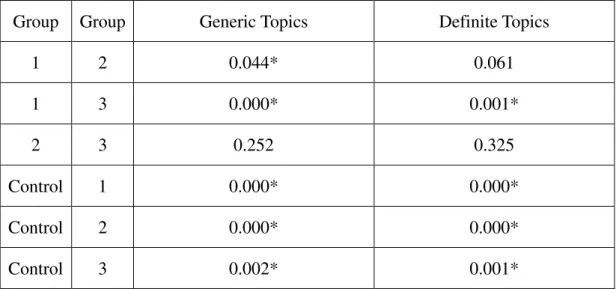
The present results were further analyzed by one-way ANOVA, as shown in Table 4-2.
Table 4-2: Results of ANOVA for Semantic Topics by the Subjects
Group Group Generic Topics Definite Topics
1 2 0.044* 0.061
1 3 0.000* 0.001*
2 3 0.252 0.325
Control 1 0.000* 0.000*
Control 2 0.000* 0.000*
Control 3 0.002* 0.001*
As Table 4-2 shows, the experimental groups performed significantly differently from the control groups on generic topics (F (3,73)=29.975, p=0.000 by Group 1 and the control group; F (3,73)=29.975, p=0.000 by Group 2 and the control group; F (3,73)=29.975, p=0.002 by Group 3 and the control group), indicating that the all the subjects have not achieved the adult’s level of proficiency in acquiring generic nouns.
Regarding the performances of the three experimental groups, the difference between the responses to generic topics by Group 1 and Group 2 was significant (F (3,73)=29.975, p=0.044), but there was no significant difference between Group 2 and Group 3 in responding to generic topics (F (3,73)=29.975, p=0.252). Thus, the 5-year-old and 6-year-old children performed better than the 4-year-olds. There was a developmental gap between the 4-year-olds and the 5-year-olds in acquiring generic topics.
As for definite topics, the experimental groups also performed significantly differently from the control group (F (3,73)=30.705, p=0.000 by Group 1 and the control group; F (3,73)=30.705, p=0.000 by Group 2 and the control group; F (3,73)=30.705, p=0.001 by Group 3 and the control group). Thus, similar to their acquisition of generic topics, our six-year-old subjects have not reached the adult’s
proficiency level in acquiring definite topics. Although Group 1 and Group 2 did not perform significantly differently on definite topics (F (3,73)=30.705, p=0.061), neither did Group 2 and Group 3 (F (3,73)=30.705, p=0.325), the p-value was small and close to the significant value (0.05) set for ANOVA. Thus, we may conclude that the 5-year-old and 6-year-old children indeed performed better on definite topics than the 4-year-olds. The developmental gap between ages 4 and 5 in the acquisition of definite topics is similar to the findings of generic topics.
To sum up, section 4.1 presents the results of generic and definite topics by our subjects. There are three main points in this section. First, generic and definite topics were found to share the same trend in which our subjects’ correct responses increased steadily with their age. Thus, the subjects gradually acquired the semantic features of Chinese topics. Second, our subjects performed better on definite topics than on generic topics. Therefore, definite topics were easier to acquire. Third, hierarchical tendency was observed in the acquisition of the semantic topics in Chinese. Moreover, it was found a developmental gap between the 4-year-olds and the 5-year-olds. However, the 5-year-old children seemed to be at the same proficiency level as the 6-year-olds.
4.2 Difficulty Levels of Syntactic Topics
This section discusses the subjects’ performance on the three syntactic topics:
base-generated, possessive-like, and moved. Figure 4-2 shows the subjects’
responses to the three syntactic topics.
0.48
0.66
0.33 0.55
0.82
0.47 0.58
0.93
0.6 0.88
0.99
0.8
0 0.1 0.2 0.3 0.4 0.5 0.6 0.7 0.8 0.9 1
Base-generated Topic
Possessive-like Topic
Moved Topic
Group 1 Group 2 Group 3 Control Group
Figure 4-2: Subjects’ Performance on the Three Syntactic Topics
As can be seen from Figure 4-2, the subjects’ correct responses to base-generated topics, possessive-like topics, and moved topics increased with their age (base-generated topics: 0.48 for Group 1, 0.55 for Group 2, 0.58 for Group 3, 0.88 for the control group; possessive-like topics: 0.66 for Group 1, 0.82 for Group 2, 0.93 for Group 3, 0.99 for the control group; moved topics: 0.33 for Group 1, 0.47 for Group 2, 0.60 for Group 3, and 0.80 for the control group), showing that our subjects gradually acquired the three syntactic topics.
Moreover, Group 1, Group 2, and the control group shared the same tendency in responding to possessive-like topics best, followed by base-generated topics and moved topics (0.66, 0.48, 0.33 for Group 1; 0.82, 0.55, 0.47 for Group 2, 0.99, 0.88, 0.80 for the control group). Thus, the difficulty levels of the three syntactic topics were: possessive-like topics > base-generated topics > moved topics. This result supports what was found in our pilot study, in which a different task, the story-retelling task, was adopted. And it agrees with Chen and Shi’s (1999) finding that moved topics were more challenging to their L2 learners of Chinese than base-generated topics. They attributed the difficulty to the movement involved in
the formation of moved topics. However, possessive-like topics showed different tendencies in the two tasks adopted in their study because they were the easiest topic in the ordering task while they were the most difficult topic to acquire in the acceptability task. According to Chen and Shi, the incongruity could be due to the fact that the L2 learners regarded possessive-like topics as a genitive construction in the ordering task, but they were forced to choose in the acceptability task.
The difficulty levels of the three syntactic topics in the present study can be explained by the positions of the three syntactic topics in the structure and the movement involved in their generation. The distance of the topic and the comment determines their levels of difficulty, as shown in (2).
(2) Topic P NP CP Spec C’
C IP NP IP NP I’
I VP
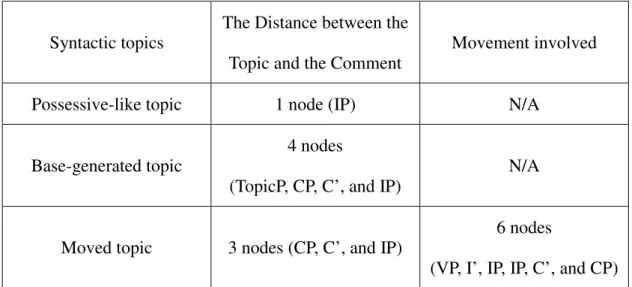
As can be seen in (2), the possessive-like topic and the comment is closest in distance among the three syntactic topics. According to O’Grady’s Structural Distance Hypothesis (O’Grady 1997:179), ‘the distance traversed by a syntactic operation, calculated in terms of the number of nodes crossed, determines a structure’s relative complexity.’ There is only one node (IP) between the possessive-like topic and the comment, but four nodes (TopicP, CP, C’, and IP) for the base-generated topic and three nodes for the moved topic (CP, C’, and IP). Therefore, the possessive-like topic is less complex and easier to acquire than the other two topics. Although the base-generated
topic
moved topic
possessive-like
topic comment
moved topic is closer to the comment than the base-generated topic, it is more difficult because the way it is derived should be taken into consideration, as shown by Table 4-3.
Table 4-3: Possible Factors Determining the Complexity of the Syntactic Topics
Syntactic topics
The Distance between the Topic and the Comment
Movement involved
Possessive-like topic 1 node (IP) N/A
Base-generated topic
4 nodes
(TopicP, CP, C’, and IP)
N/A
Moved topic 3 nodes (CP, C’, and IP)
6 nodes
(VP, I’, IP, IP, C’, and CP) As can be seen in Table 4-3, in addition to the four nodes intervening between the moved topic and the comment, the moved topic is generated by movement across six nodes (VP, I’, IP, C’, and CP) to the Spec of CP, which leads to more complexity in acquisition. Thus, the moved topic is most difficult to acquire.
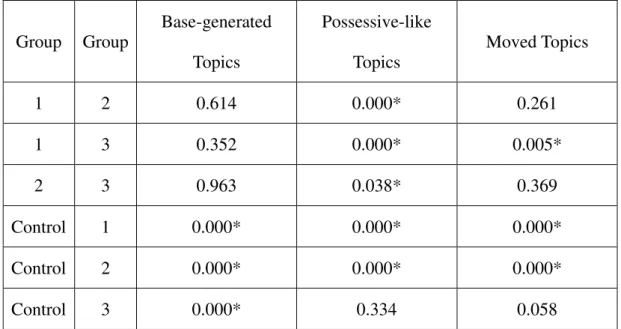
The results presented in Figure 4-2 were further analyzed by one-way ANOVA, as shown in Table 4-4.
Table 4-4: Results of ANOVA for Syntactic Topics by the subjects
Group Group
Base-generated Topics
Possessive-like Topics
Moved Topics
1 2 0.614 0.000* 0.261
1 3 0.352 0.000* 0.005*
2 3 0.963 0.038* 0.369
Control 1 0.000* 0.000* 0.000*
Control 2 0.000* 0.000* 0.000*
Control 3 0.000* 0.334 0.058
As can be seen in Table 4-4, Group 3 and the control group performed significantly differently on base-generated topics (F(3,73)=20.523, p=0.000), but the group effect on both possessive-like topics (F(3,73)=20.523, p=0.334) and moved topics (F(3,73)=20.523, p=0.058) was not found, implying that the 6-year-old children have acquired possessive-like topics and moved topics, but not base-generated topics.
Table 4-4 also shows that Group 1 and Group 2 performed significantly differently on possessive-like topics (F(3,73)=34.207, p=0.000), so did Group 2 and Group 3 (F(3,73)=34.207, p=0.038), indicating that the three groups of subjects used possessive-like topics in a very different way. One possible explanation for the difference among the three experimental groups is that Group 1 and Group 2 considered the possessive-like topic as a genitive construction as the L2 learners did in Chen and Shi (1999). However, like the control group, Group 3 might have put the possessive-like topics at the adjoined position of IP. Regarding base-generated topics, the difference between the responses of Group 1 and Group 2 was not significant (F(3,73)=20.523, p=0.614), neither was that of Group 2 and Group 3 (F(3,73)=20.523, p=0.963), showing that Group 1, Group 2, and Group 3 all used
base-generated topics in a similar way. However, as mentioned previously, all the subjects have not acquired base-generated topics. Therefore, our children might generate the base-generated topics at a position different from TopicP as adults did.
One possible position is Spec of CP, the position for a moved topic in Chen (1995).
With regards to moved topics, the significant difference between Group 1 and Group 2 was not found (F(3,73)=16.670, p=0.261), and it was not found between Group 2 and Group 3 (F(3,73)=16.670, p=0.369), either. The finding indicates that the three experimental groups used moved topics in a similar way. Because moved topics were the most difficult one among the three topics, the unachievement of adult’s proficiency in moved topics by Group 1 and Group 2 could be due to the fact they placed the moved topics in a position different from Spec of CP. However, some subjects in Group 3 have acquired adult grammar and used moved topics as adults did.
Therefore, the 6-year-olds and the control group did not perform significantly differently.
To sum up, this section reports the findings of the syntactic topics. First, the correct responses to the three syntactic topics increased with the subjects’ age. Our children gradually acquired three syntactic topics. Second, the difficulty levels of the three topics were: possessive-like topics > base-generated topics > moved topics.
The relative position of the topic and the comment and the way the topic is generated decide the complexity of the three topics. Third, the six-year-olds have learned to use possessive-like topics and moved topics like our adult controls. However, the subjects seemed to construct their own grammar and the positions of the topics were different from those positions in the adult grammar. For example, the 4-year-old and 5-year-old children tended to regard possessive-like topics as a genitive construction.
As for base-generated topics, the subjects might put them in the Spec of CP, but not in the Spec of TopicP. Regarding moved topics, some of the 6-year-old subjects have
learned to put them in the Spec of CP. However, the 4-year-old, 5-year-old, and other 6-year-old subjects did not seem to have fully acquired the correct position of moved topics.
Although the difficulty levels of the three syntactic topics were found, whether the subjects indeed know the correct position of these topics is questionable. Since the elicited comprehension task adopted in the present study was a controlled production task, a free production task that allows children to produce their own sentences can be adopted in the future to examine whether children use the three syntactic topics in the same way as adults do.
4.3 The Use of Topic Chains
According to Tsao (1979), a topic chain is formed by a topic and a sequence of sentences that comment on the topic under the semantic domain of the topic. The topic occupies the S-initial position of the first sentence and controls the Topic-NP deletion in a topic chain. (3) is an example of a topic chain.
(3) Daxiang, bizi chang, ø erduo da.
elephant nose long ear large
‘Elephants, their noses are long, and their ears are large.’
As (3) shows, the two sentences comment on the same topic daxiang “elephant.”
The second sentence contains a gap correferential with the topic in the initial position of the string. To understand the subjects’ performance on the two topics, the mean scores of the SS task and the EI task were calculated. In the EI task, only an utterance that contained a sentence-initial topic and the Topic-NP deletion was given one point. Other constructions such as the combination of a sentence-initial topic were not given any points. Figure 4-3 shows the use of topic chains by our subjects:
0.29
0.38 0.43
0.67
0 0.1 0.2 0.3 0.4 0.5 0.6 0.7 0.8 0.9 1
Group 1 Group 2 Group 3 Control Group
Figure 4-3: Subjects’ Correct Use of Topic Chains
As can be seen in Figure 4-3, there were not many correct uses of topic chains by the three experimental groups (0.29, 0.35, 0.34). Group 2 and Group 3 outperformed Group 1, but the three groups performed much worse than the control group (0.67).
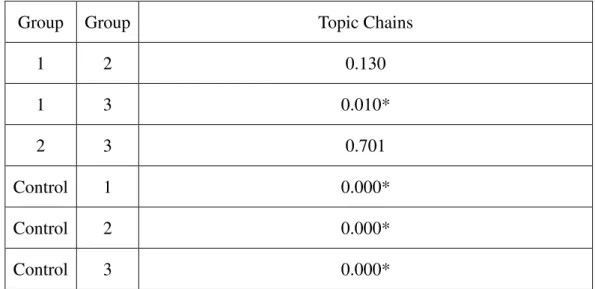
The results were further analyzed by one-way ANOVA, as reported in Table 4-5.
Table 4-5: Results of ANOVA for Subjects’ Correct Use of Topic Chains
Group Group Topic Chains
1 2 0.130
1 3 0.010*
2 3 0.701
Control 1 0.000*
Control 2 0.000*
Control 3 0.000*
As Table 4-5 indicates, all three experimental groups performed significantly differently from the control group (Group 1 and the control group: F(3,73)=36.268, p=0.000; Group 2 and the control group: F(3,73)= 36.268, p=0.000; Group 3 and the control group: F(3,73)= 36.268, p=0.000). Moreover, there was no significant
difference in their use of topic chains by Group 1 and Group 2 (F(3,73)=36.268, p=0.130). No significant difference was obtained in their production of topic chains
by Group 2 and Group 3 (F(3,73)=0.833, p=0.701), either. Only Group 1 and Group 3 performed significantly differently in producing topic chains (F(3,73)=0.833, p=
0.010). The results in Figure 4-3 and Table 4-5 showed that topic chains were difficult to all the subjects. The 4-year-old, 5-year-old, and 6-year-old subjects had few correct uses of topic chains, and none of the groups has achieved the adults’ use of topic chains. This finding supports Erbaugh’s (1982) study in which children learned to use topics in the discourse very slowly even after they were 3 years old.
According to Erbaugh, topic chains are challenging because in producing a topic chain, children have to choose a presentational topic, and then comment it over several following sentences. Therefore, the 4-year-olds, 5-year-olds, and 6-year-olds in our study have not fully acquired topic chains because they have not had firm control of the relation between the sentence-initial topic and its subsequent sentences which function as comments of the topic.
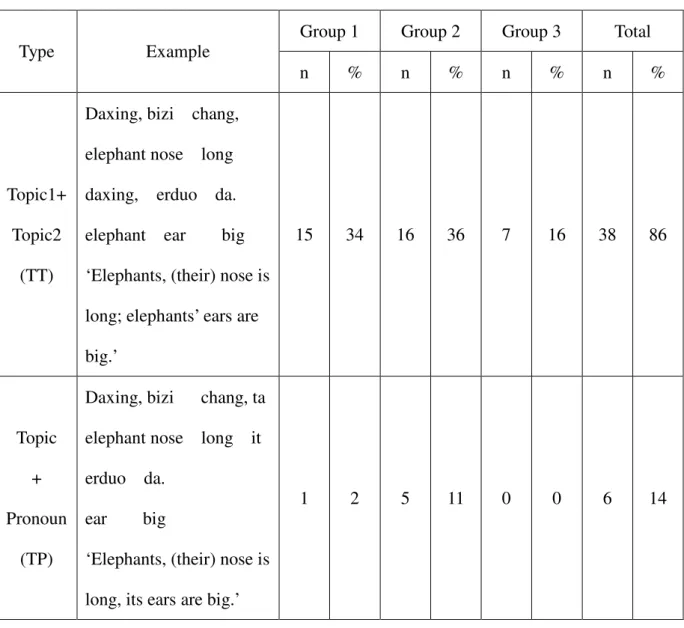
In our subjects’ production in the EI task, some children were found not to apply the Topic-NP deletion rule; instead, they used pronouns or topics to replace with the Topic-NP deletion rule, as shown in Table 4-6.
Table 4-6: Error Analysis of Topic Chains in the EI Task (in percentages)
Group 1 Group 2 Group 3 Total
Type Example
n % n % n % n %
Topic1+
Topic2 (TT)
Daxing, bizi chang, elephant nose long daxing, erduo da.
elephant ear big
‘Elephants, (their) nose is long; elephants’ ears are big.’
15 34 16 36 7 16 38 86
Topic + Pronoun
(TP)
Daxing, bizi chang, ta elephant nose long it erduo da.
ear big
‘Elephants, (their) nose is long, its ears are big.’
1 2 5 11 0 0 6 14
As Table 4-6 shows, in addition to the typical topic chain, our subjects produced two types of topic chains: Topic 1 + Topic 2 (TT) and Topic + Pronoun (TP). The use of the topic chains TT and TP indicated that the concept of topic chain was triggered early. In their production, TT (86%) was more frequently used by our subjects than TP (14%). This may be attributed to the pragmatic knowledge involved in the use of pronouns. Our subjects used pronouns to replace with topics, implying that they were aware of the pragmatic constraint to avoid redundant nouns in sentences. In addition, Group 1 (34%) and Group 2 (36%) produced more TT than Group 3 (16%).
The topic chain TP was also found in the production by Group 1 (2%) and Group 2 (11%), but not in the production by Group 3 (0%). The findings can be explained by
the discourse strategy proposed as proposed by Chu (1990). According to Chu, a discourse strategy like the deletion of pronouns was acquired at a later stage of language acquisition. Therefore, Group 3 reduced the pronoun in the topic chain TP because they might have acquired the discourse strategy of deleting pronouns, while Group 1 and Group 2 have not.
To sum up, topic chains were found to be difficult for the-4-year-olds, 5-year-olds, and 6-year-olds. None of the three groups achieved adult’s proficiency levels. Moreover, our children might replace the typical topic chain with the Topic 1 + Topic 2 or the Topic + Pronoun, implying that the concept of topic chains was triggered although the typical topic chain has not been used. The subjects used Topic 1 + Topic 2 more frequently than Topic + Pronoun because they have to apply their knowledge on pragmatic constraints against redundant topics in the production of TP. Furthermore, only Group 1 and Group 2 used the TP chain; Group 3 has acquired the discourse strategy to delete pronouns in the TP chain.
4.4 The Behaviorist Approach or the Nativist Approach
This section examines two language acquisition theories, the behaviorist approach and the nativist approach by discussing the findings presented in the previous section. Skinner (1957), a behaviorist, applies his techniques of conditioning and reinforcement to human beings. He argues that the nature of language acquisition is similar to the way animals’ behaviors are formulated. What children say is the response to the stimuli in the environment. Children imitate adults’ languages, and rewards such as adults’ feedback reinforce their production.
However, many researchers propose contrary evidence to show that children do not learn a language through imitation. McNeill (1966) provided an example in which a child still could not say the correct sentence ‘nobody don’t like me’ after the adult
repeated the sentence for eight times. This shows that no matter how hard children try to imitate adults’ utterances, they cannot produce grammatical sentences when their grammar has not matured
Nativists such as Chomsky (1981) argue that language is innate in human.
According to Chomsky, children are biologically endowed with Universal Grammar (UG), which facilitates their course of language acquisition. UG helps children acquire languages easily in a rapid fashion and avoid possible mistakes that they are assumed to make. Moreover, UG contains principles and parameters, which are universal in all human’s language. The process of language acquisition requires children to set language-specific values of parameters.
Our findings argue against the behaviorist approach, but support the nativist approach. First, it was found that our subjects did not imitate the input provided by the experimenter in the EI task. For instance, the experimenter said daxiang, daxiang bizi chang, daxiang erduo da ‘elephants, elephants’ nose is long, and elephants’ ears are big.’ When the subjects were asked to imitate the experimenter’s input, they systematically reduced the redundant topics by saying daxiang, bizi chang, erduo da ‘elephants, (their) nose is long, and (their) ears are big.’ If the subjects
indeed acquired languages through stimulus-response association and imitation as the behaviorists argue, all the subjects would utter sentences the same as the provided input. However, they reduced the redundant topics, providing a pronoun, or reorganizing the sentences when they were asked to imitate the sentences given.
Second, Chinese topics involve different degrees of difficulty. Definite topics were found easier to acquire than generic topics. Possessive-like topics were the easiest topic, followed by base-generated topics and moved topics. If the children indeed imitated the experimenter’s sentences when acquiring their native languages, there would be no difficulty levels of topics as we argued in sections 4.1 and 4.2. Third,
the subjects were found to construct their own grammar in their acquisition of topics in Chinese. As discussed in section 4.2, the subjects put the syntactic topics in the positions according to their own grammar. Base-generated topics and the moved topics were put in the same position because our subjects have not acquired TopicP.
Possessive-like topics were considered as a genitive construction in their grammar.
That is, they did not produce any ungrammatical sentences or wild grammar.
To sum up, there are three points arguing against the behaviorist approach in the present study. In the EI task, the subjects did not imitate the experimenter’s input in the EI task. They systematically reduced the redundant topics or replaced the topics with pronouns. Moreover, the three topics were not treated equally difficult to them.
Third, the subjects did not make any wild grammar in acquiring topics in Chinese.
Therefore, from these points mentioned in this section, the nativist approach is supported in the present study.
4.5 Methodological Effects
According to White (1989), there is no direct way to tap competence, but various aspects of performance can give into competence. To understand our subjects’
competence of topic constructions in Chinese, two tasks were desingned to reduce the bias of the subjects’ responses. The methodological issue has been paid attention in many studies on first language acqusisition (Fletcher and MacWhinney 1995). In this section, we are going to discuss about the task effect.
One of the tasks we employed was the sentence selection task, which aimed to examine whether the subjects comprehended the meaning and the functions of topic constructions by asking them to choose the topic construction in a correct word order.
The SS task has been widely employed in SLA research. It requires children to make grammaticality judgment, and thus the input is more controlled. Another was
the elicited production task, which aimed to examine how the subjects used different types of topics in single sentence constructions and topic chains. As Vinther (2002) pointed out, the EI task has been used in child language research and second language research. Some researchers argued that an EI task did not examine subjects’
production (Fraser et al. 1963). However, other researchers compared the results found in the EI task, and found the results of the EI task agreed with those in other tests and thus valid (Gallimore and Tharp 1981). The EI task was also used by Chien and Lust (1983) to investigate whether Chinese children have the concept of subjects. As reviewed in Chapter 2, they found that Chinese children systematically reorganized the experimenter’s sentences by reducing redundant topics and subjects.
Therefore, both the SS task and the EI task are valid in observing children’s language acquisition.
Presented in Figure 4-6 are our subjects’ performances on two semantic topics and three syntactic topics in the two tasks.
0.59 0.62 0.61 0.68
0.56 0.61 0.53
0.56
0.88
0.32
0.10 0.20.3 0.40.5 0.60.7 0.80.91
Generic Topics
Definite Topics
Base-generated Topics
Possessive-like Topics
Moved Topics
SS Task EI Task
Figure 4-4: Subjects’ Performance on Syntactic Topics and Semantic Topics in the Two tasks
As Figure 4-4 shows, the subjects generally performance better on the SS task than in
the EI task (0.59, 0.56 for generic topics; 0.62, 0.61 for definite topics; 0.61, 0.56 for base-generated topics; 0.53, 0.32 for moved topics), except for their responses to possessive-like topics (0.68, 0.88). The finding that the subjects responded better on the SS task than on the EI task can be accounted for by the general tendency in language acquisition: children’s linguistic ability in production lags behind their ability in comprehension (Smolensky 1996). This trend was also shown by the ‘fis phenomenon,’ demsonstrating children perceive more than they produce. The ‘fis phenomenon’ was pointed out by Berko and Brown (1960), who found that a child could distinguish the difference between ‘fis’ and ‘fish,’ but could not produce the correct sound ‘fish.’
In addition, the results of semantic topics and syntactic topics in both the SS task and the EI task supported our previous findings. In the SS task, definite topics were found to be easier than generic topics because they are uniquely identifiable and more prone to be topics. This tendency was also found in the EI task. As for syntactic topics, possessive-like topics were found to be the easiest, followed by base–generated topics and moved topics in the SS task. The EI task also shared the same tendency.
Furthermore, our finding that the children responded to possessive-like topics in the EI task better than in the SS could be explained by the differences between the two tasks. The SS task adopted in the present study is a controlled comprehension task. When the subjects were given two sentences to choose, as (4) shows, they were forced to unscramble the sentences to their preference, still yielding a sentence with topics they might not like.
(4) a. Daxiang, bizi chang, erduo da.
elephant nose long ear big
‘Elephants, (their) noses are long and (their) ears are big.’
b. *Bizi chang, erduo da, daxiang.
nose long ear big elephant
However, the EI task was less complex than the SS task because it gave the subjects an opportunity to produce their own sentences. Therefore, the subjects could produce their own possessive-like topics in the EI task.
To sum up, a task effect was found in our subjects’ performance on the Chinese topic constructions. The SS task was generally easier than the EI task for our subjects, which supports the general trend that comprehension precedes production in children’s language acquisition (Brown 2000). Moreover, the results found in this section support our findings discussed in sections 4.1 and 4.2. However, the two tasks differed in the subjects’ response to possessive-like topic because the EI task was less controlled, and children were able to produce their own possessive-like topics.
4.6 Summary of Chapter 4
In this chapter, the results presented in Chapter Three were further analyzed and discussed. Definite topics were found easier to acquire than generic topics. No subjects in the present study have fully achieved the adult’s level of proficiency in their use of generic and definite topics.
As for syntactic topics, possessive-like topics were found to be the easiest, followed by base-generated topics and move topics. The 6-year-olds have acquired possessive-like topics and moved topics, but not base-generated topics. It was also found that the children tended to consider possessive-like topics as a genitive construction, and put moved topics and base-generated topics in the same position in their syntactic tree diagram.
The use of topic chains was also discussed in this chapter. Topic chains were
difficult for our subjects, and none of them have reached the adults’ level of proficiency. Instead of applying the Topic-NP deletion rule, the subjects were found to use a pronoun or an overt topic to replace with the zero topic.
The theoretical approaches were also examined in this chapter. It was found that the subjects did not imitate adults’ input, but systematically reduced the redundant topics in the EI task. In addition, the difficulty levels of topics were found.
Furthermore, our subjects were found to construct their own grammar in the acquisition of topics in Chinese. Therefore, our findings supported the innativist approach.
Significant methodological effects were observed in the present study.
Children generally performed better on the SS task than on the EI task. However, the subjects were found to perform better on the possessive-like topics in the EI task than in the SS task because they could produce their own possessive-like topics in the SS task.