Intelligent Cache Capacity Allocation and Relocation Schemes in a Mobile Proxy
Jiun-Long Huang and Ming-Syan Chen Department of Electrical Engineering
National Taiwan University Taipei, Taiwan, ROC
E-mail: [email protected], [email protected]
Abstract
In a mobile environment, since a mobile user is able to freely move around these cells, an inter service area hand- off occurs when a user moves from the service area of one proxy to that of another. Some cache misses may be in- curred by inter service area handoffs since the data objects interest may not be cached in the new proxies. To address this problem, we propose in this paper a novel cache ca- pacity allocation scheme to combine the advantages of the prior cache capacity allocation schemes. A cache reloca- tion scheme is then proposed on the basis of the designed cache capacity allocation scheme to address the problem caused by user mobility.
Keyword: Cache capacity allocation, cache relocation, mobile proxy, mobile computing
1 Introduction
The rapid growth of wireless communication has re- sulted in strong demand of WWW access for mobile de- vices, and hence attracted much research attention on sys- tem design to support WWW access in wireless and mobile environments [2][6]. The characteristics of mobile envi- ronments and the long access latency caused by the low speed wireless communication call for the design of new mobile proxies [4][5].
Figure 1 shows a typical mobile environment with mo- bile proxies. In a cellular network architecture, the whole service area of a mobile environment is divided into sev- eral cells. A mobile proxy is in charge of servicing several adjacent cells, and these cells form the service area of the mobile proxy. These mobile proxies are connected by a high speed, fixed network, and are able to access Internet via gateways. In a mobile environment, since a mobile user
Mobile Proxy
Service Area
Internet
Mobile Proxy
Service Area
Gateway
Router
Figure 1. Network architecture
is able to freely move around these cells, an inter service area handoff occurs when a user moves from the service area of one proxy to that of another. Some cache misses may be incurred by inter service area handoffs since the data objects of interest may not be cached in the new prox- ies. The problem of cache relocation deals with how to move the cached data objects from the original proxy into the new one when an inter service handoff occurs.
In addition, the problem of cache capacity allocation deals with how to organize the cache capacity of a proxy to fulfill the given requirements. Two categories of cache capacity allocation schemes, global and personal cache ca- pacity allocation schemes, have been employed in the lit- erature. Although global cache capacity allocation is able to optimize the overall performance, it may cause the prob- lem of fairness especially to the users with different ac- cess interest from others. In addition, it is difficult to de- sign a cache relocation for global cache capacity alloca- tion, and therefore, the system performance degrades due to the cache misses incurred by inter service area handoffs.
On the other hand, authors in [4] and [5] had proposed a Proc. of the 3rd Intern'l Conference on Intelligent Multimedia Computing and Networking (IMMCN), Sep. 2003.
personal cache capacity scheme by allocating a personal cache, which is exclusively used by its owner, for each user in order to facilitate cache relocation. However, due to the characteristics of personal cache capacity allocation, the overall cache capacity of the proxy might not be fully utilized.
Consequently, we develop in this paper a Hybrid Cache capacity Allocation scheme (referred to as scheme HCA) to combine the respective merits of both schemes. Explicitly, the whole cache capacity is first divided into two pools, a global pool and a personal pool. The global pool stores data objects of high interest from the system’s respect. To avoid the fairness problem in global cache capacity allocation, each user is assigned a personal cache allocated in the per- sonal pool to store data objects which are hot from the sys- tem’s respect but of the user’s interest. Moreover, personal cache of each user is shared with others, and each data ob- ject is cached at most once in a proxy in order to avoid the problem of personal cache capacity allocation. Each user is also assigned a CacheInfo which records the data ob- jects of his or her interest. These data objects recorded in a CacheInfo are the candidates to be relocated when an inter service area handoff is incurred by the owner of the Cache- Info. Therefore, with the aid of CacheInfoes, we devise a cache relocation scheme on the basis of scheme HCA which is able to cooperate with a moving path prediction algorithm to eliminate possible cache misses incurred by inter area service handoffs.
The rest of this paper is organized as follows. The re- lated work is described in Section 2. The design of the proposed cache capacity allocation scheme is presented in Section 3. The proposed cache relocation scheme is de- scribed in Section 4. Finally, Section 5 concludes this pa- per.
2 Related Work
2.1 Cache Capacity Allocation
The problem of cache capacity allocation deals with how to organize the cache capacity of a proxy to fulfill the given requirements. Cache capacity allocation schemes used in prior studies can be categorized as the following two categories.
Global cache capacity allocation: Global cache capac- ity allocation is a common assumption in most research studies of proxies [1][8]. In global cache capacity allo- cation, the whole cache capacity is shared by all users.
Data objects which are hot in global view will be cached, and those which are not hot enough will be replaced. The advantage of global cache capacity allocation is that it optimizes the overall performance, and hence, is able to achieve good overall system performance. However, the
fairness issue is a problem. Consider a user with distinct access behavior. The data objects of the user’s interest are of high likelihood to be replaced since global cache capac- ity allocation only concerns overall system performance.
Hence, the user’s average access time is longer than oth- ers’. In addition, it is difficult to design cache relocation schemes in global cache capacity allocation since global cache capacity allocation only concerns the overall cache utilization. Therefore, several cache misses may occur due to inter area service handoffs.
Personal cache capacity allocation: In personal cache capacity allocation, each user is allocated with a cache ca- pacity dedicated to him or her with a predetermined size [4][5]. The advantage of personal cache capacity alloca- tion is that it not only avoids the fairness problem caused by global cache capacity allocation, but also facilitates cache relocation to be described later in this subsection. How- ever, the problems of personal cache capacity allocation are twofold. First, many copies of one data object may be stored in the proxy, hence reducing the storage utiliza- tion and the scalability of the proxy. Second, each personal space is of equal size and is exclusive for its owner. This arrangement wastes the storage if the required size of the personal cache of a user is smaller than that of allocated one. On the other hand, the personal cache is not efficient enough if the required size of the personal cache of a user is larger than that of allocated one.
2.2 Cache Relocation
When an inter service handoff occurs, some cache misses may occur since the data objects of the user’s in- terest may not be cached in the new proxy. The problem of cache relocation deals with how to move the cached data objects from the original proxy into the new one when an inter service handoff occurs.
The issue of cache relocation was addressed in [5]. The system designed in [5] employed personal cache capacity allocation and a cache relocation scheme was proposed on the basis of personal cache capacity allocation. To facilitate the proposed cache relocation scheme, a learning automata was designed [5] to capture the users’ moving patterns and to predict the users’ next movements among cells. When sensing that an inter service handoff is likely to be triggered by a user, the system uses the learning automata to deter- mine the probabilities of all adjacent proxies where the user may move. Then, the system moves the objects cached in the user’s personal proxy to these possible new proxies ac- cording to the obtained probabilities. The amount of the cached objects that the system moves to each proxy is in proportion to the probability that the user moves into the proxy.
3 Design of Scheme HCA
We propose in this section scheme, to combine the ad- vantages of global and personal cache capacity allocation schemes. The characteristics of scheme HCA are as fol- lows.
• Each mobile user is allocated a personal cache to store interesting data objects for this mobile user.
• Each allocated personal cache is not for its owner’s exclusive use. That is, data objects cached in personal spaces can be accessed by other users, and the unused space in each personal cache can be lent to other users if necessary.
• Each data object is stored at most once in the proxy at the same time.
3.1 Organization of the Cache Capacity
In scheme HCA, the whole cache capacity (denoted as CT otal) is logically divided into two portions, a global pool and a personal pool, with capacity CGlobaland CP ers., re- spectively. Each cached object may be in the PERSONAL, GLOBAL or UNPOINTED state. A cache replacement policy [1][8] is chosen as the underlying cache replacement policy. Since most cache replacement policies employ an evict function to determine the cache priorities of all data objects, each cached data object here is also associated with an access information block to store the access informa- tion of the object used by the underlying cache replace- ment policy to calculate cache priority of the data object.
An access information block associated with a data object is called a system-wide access information block since it stores the access information from the system’s point of view. The CacheInfo, which is stored in the personal pool, is assigned to each user using the proxy to store meta data of its owner. In addition, a personal pool also stores data objects in the PERSONAL or UNPOINTED states. Simi- larly, a global pool is the place to store data objects in the GLOBAL states.
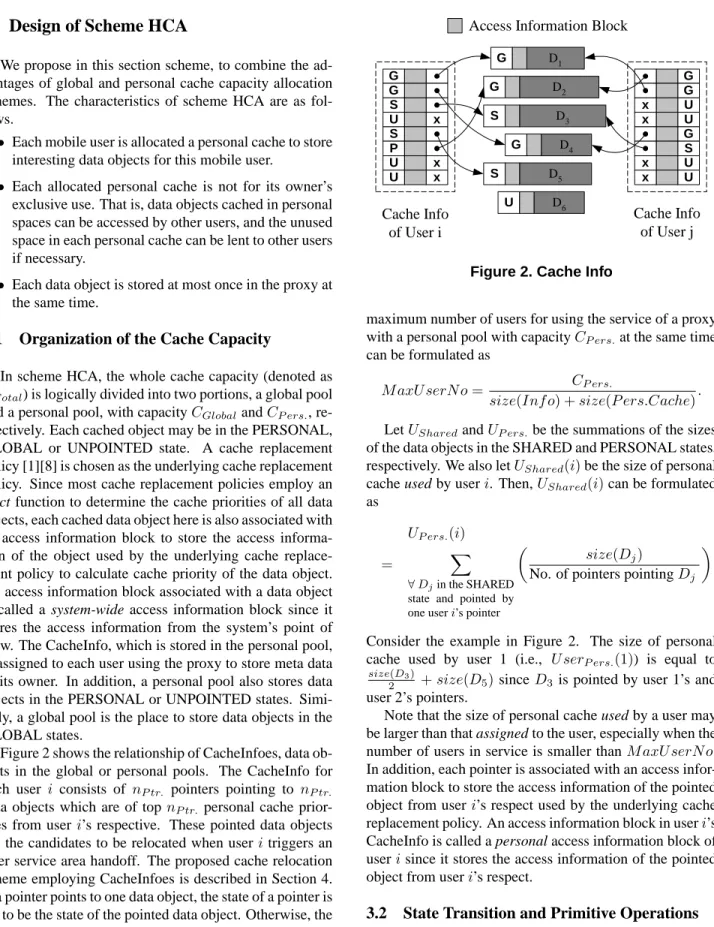
Figure 2 shows the relationship of CacheInfoes, data ob- jects in the global or personal pools. The CacheInfo for each user i consists of nP tr. pointers pointing to nP tr.
data objects which are of top nP tr. personal cache prior- ities from user i’s respective. These pointed data objects are the candidates to be relocated when user i triggers an inter service area handoff. The proposed cache relocation scheme employing CacheInfoes is described in Section 4.
If a pointer points to one data object, the state of a pointer is set to be the state of the pointed data object. Otherwise, the state of the pointer is UNUSED. Suppose that the size of a CacheInfo is size(Inf o) and each user is assigned a per- sonal cache with capacity size(P ers.Cache). Then, the
D2 x
D1
D5 x
x
D3
D4
Cache Info of User i
x x
x x
Cache Info of User j
G G S U S P U U
G G U U G S U U G
G S
G S
D6 U
Access Information Block
Figure 2. Cache Info
maximum number of users for using the service of a proxy with a personal pool with capacity CP ers.at the same time can be formulated as
M axU serN o = CP ers.
size(Inf o) + size(P ers.Cache). Let USharedand UP ers.be the summations of the sizes of the data objects in the SHARED and PERSONAL states, respectively. We also let UShared(i) be the size of personal cache used by user i. Then, UShared(i) can be formulated as
UP ers.(i)
= X
∀ Djin the SHARED state and pointed by one user i’s pointer
µ size(Dj)
No. of pointers pointing Dj
¶ .
Consider the example in Figure 2. The size of personal cache used by user 1 (i.e., U serP ers.(1)) is equal to
size(D3)
2 + size(D5) since D3is pointed by user 1’s and user 2’s pointers.
Note that the size of personal cache used by a user may be larger than that assigned to the user, especially when the number of users in service is smaller than M axU serN o.
In addition, each pointer is associated with an access infor- mation block to store the access information of the pointed object from user i’s respect used by the underlying cache replacement policy. An access information block in user i’s CacheInfo is called a personal access information block of user i since it stores the access information of the pointed object from user i’s respect.
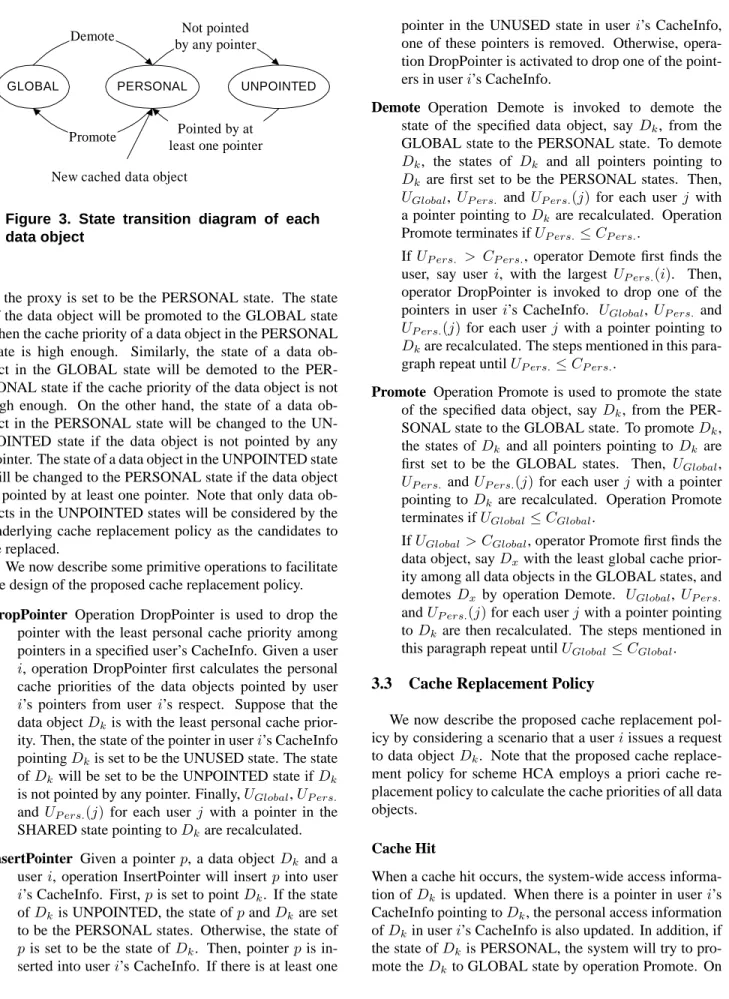
3.2 State Transition and Primitive Operations Figure 3 shows the state transition diagram of each data object. The state of each data object which is newly cached
GLOBAL PERSONAL UNPOINTED
Demote Not pointed
by any pointer
Promote Pointed by at least one pointer New cached data object
Figure 3. State transition diagram of each data object
in the proxy is set to be the PERSONAL state. The state of the data object will be promoted to the GLOBAL state when the cache priority of a data object in the PERSONAL state is high enough. Similarly, the state of a data ob- ject in the GLOBAL state will be demoted to the PER- SONAL state if the cache priority of the data object is not high enough. On the other hand, the state of a data ob- ject in the PERSONAL state will be changed to the UN- POINTED state if the data object is not pointed by any pointer. The state of a data object in the UNPOINTED state will be changed to the PERSONAL state if the data object is pointed by at least one pointer. Note that only data ob- jects in the UNPOINTED states will be considered by the underlying cache replacement policy as the candidates to be replaced.
We now describe some primitive operations to facilitate the design of the proposed cache replacement policy.
DropPointer Operation DropPointer is used to drop the pointer with the least personal cache priority among pointers in a specified user’s CacheInfo. Given a user i, operation DropPointer first calculates the personal cache priorities of the data objects pointed by user i’s pointers from user i’s respect. Suppose that the data object Dk is with the least personal cache prior- ity. Then, the state of the pointer in user i’s CacheInfo pointing Dkis set to be the UNUSED state. The state of Dk will be set to be the UNPOINTED state if Dk is not pointed by any pointer. Finally, UGlobal, UP ers.
and UP ers.(j) for each user j with a pointer in the SHARED state pointing to Dkare recalculated.
InsertPointer Given a pointer p, a data object Dk and a user i, operation InsertPointer will insert p into user i’s CacheInfo. First, p is set to point Dk. If the state of Dk is UNPOINTED, the state of p and Dk are set to be the PERSONAL states. Otherwise, the state of p is set to be the state of Dk. Then, pointer p is in- serted into user i’s CacheInfo. If there is at least one
pointer in the UNUSED state in user i’s CacheInfo, one of these pointers is removed. Otherwise, opera- tion DropPointer is activated to drop one of the point- ers in user i’s CacheInfo.
Demote Operation Demote is invoked to demote the state of the specified data object, say Dk, from the GLOBAL state to the PERSONAL state. To demote Dk, the states of Dk and all pointers pointing to Dk are first set to be the PERSONAL states. Then, UGlobal, UP ers. and UP ers.(j) for each user j with a pointer pointing to Dk are recalculated. Operation Promote terminates if UP ers.≤ CP ers..
If UP ers. > CP ers., operator Demote first finds the user, say user i, with the largest UP ers.(i). Then, operator DropPointer is invoked to drop one of the pointers in user i’s CacheInfo. UGlobal, UP ers. and UP ers.(j) for each user j with a pointer pointing to Dkare recalculated. The steps mentioned in this para- graph repeat until UP ers.≤ CP ers..
Promote Operation Promote is used to promote the state of the specified data object, say Dk, from the PER- SONAL state to the GLOBAL state. To promote Dk, the states of Dk and all pointers pointing to Dk are first set to be the GLOBAL states. Then, UGlobal, UP ers. and UP ers.(j) for each user j with a pointer pointing to Dk are recalculated. Operation Promote terminates if UGlobal≤ CGlobal.
If UGlobal> CGlobal, operator Promote first finds the data object, say Dxwith the least global cache prior- ity among all data objects in the GLOBAL states, and demotes Dx by operation Demote. UGlobal, UP ers.
and UP ers.(j) for each user j with a pointer pointing to Dk are then recalculated. The steps mentioned in this paragraph repeat until UGlobal≤ CGlobal. 3.3 Cache Replacement Policy
We now describe the proposed cache replacement pol- icy by considering a scenario that a user i issues a request to data object Dk. Note that the proposed cache replace- ment policy for scheme HCA employs a priori cache re- placement policy to calculate the cache priorities of all data objects.
Cache Hit
When a cache hit occurs, the system-wide access informa- tion of Dk is updated. When there is a pointer in user i’s CacheInfo pointing to Dk, the personal access information of Dkin user i’s CacheInfo is also updated. In addition, if the state of Dk is PERSONAL, the system will try to pro- mote the Dkto GLOBAL state by operation Promote. On
the other hand, if there is no pointer in user i’s CacheInfo pointing to Dk, operation InsertPointer will be invoked to insert a pointer pointing to Dk and with the same state as Dkinto user i’s CacheInfo.
Cache Miss
When a cache miss occurs, the proxy first retrieves Dk
from the corresponding data server, returns Dk to user i, and sets the state of Dk as PERSONAL. Operation In- sertPointer is then invoked to insert a pointer pointing to Dk and in the PERSONAL state into user i’s Cache- Info. The procedure to handle cache misses terminates if UGlobal+ UP ers.≤ CT otal.
If UGlobal + UP ers. > CT otal, some data objects should be replaced since storage space is not enough. If there are some data objects in the UNPOINTED states, the data object with the least system-wide cache priority among them is dropped in turn until UGlobal+ UP ers. ≤ CT otal. It is possible that UGlobal + UP ers. is still larger than CT otal even when all data objects in the UN- POINTED states are dropped. Suppose that user j is of the largest UP ers.(j) among all users³
i.e., UP ers.(j) = max∀ user x{U serP ers.(x)}
´
. Under this situation, oper- ator DropPointer is invoked to drop one of user j’s pointer.
The steps in this paragraph repeat until UGlobal+ UP ers.≤ CT otal.
4 Design of Cache Relocation Scheme
We now design a cache relocation scheme on the basis of scheme HCA. When an inter area service handoff from proxy Pato proxy Pbis triggered, proxy Pbfirst allocates a CacheInfo for user i and resets all pointers in the CacheInfo to be the UNUSED states. The data objects pointed by pointers in user i’s CacheInfo in proxy Pa are considered to be moved to proxy Pbin turn according to their personal cache priorities.
For each considered data object Dk, the pointer in user i’s CacheInfo in proxy Pa pointing to Dk is first set to be in the UNUSED state. If Dkis not pointed by any pointer in proxy Pa, the state of Dk in proxy Pa is then set to be the UNPOINTED state. If Dk has been cached in proxy Pb, operation InsertPointer is invoked to insert a pointer pointing to Dk in user i’s CacheInfo in proxy Pb. If Dk is not cached in proxy Pb, proxy Pbautomatically issues a request of Dkfor user i. Then, a cache miss on Dkoccurs and the procedure to handle cache misses is invoked. Fi- nally, the space of user i’s CacheInfo in proxy Pais marked as unused when all pointers in user i CacheInfo in proxy Pa
are in the UNUSED states.
In addition, the system can further employ a moving path prediction algorithm [5][7] to pre-relocate the cached objects when the users are likely to trigger an inter service area handoff to reduce the possible cache misses during the process of relocation.
5 Conclusion and Future Work
In this paper, we proposed scheme HCA which com- bines the advantages of global and personal cache capac- ity schemes. In addition, a cache relocation was proposed based on scheme HCA to eliminate cache misses incurred by inter service area handoffs.
In our future work, we will design a service ad- mission control scheme since one proxy can only serve M axU serN o users at a time. In addition, a scheme to dynamically determine the ratio of the sizes of object and CacheInfo pools will also be designed. We shall extend our schemes to be applied to mobile transcoding proxies [3].
Finally, we shall conduct several experiments to evaluate the performance of scheme HCA.
References
[1] C. Aggarwal, J. L. Wolf, and P. S. Yu. Caching on the World Wide Web. IEEE Transactions on Knowledge and Data En- gineering, 11(1):94–107, 1999.
[2] C. Baquero, V. Fonte, F. Moura, and R. Oliveira. MobiScape:
WWW Browsing under Disconnected and Semi-Connected Operation. In Proceedings of First Portuguese WWW Na- tional Conference, July 1995.
[3] C.-Y. Chang and M.-S. Chen. Exploring Aggregate Effect with Weighted Transcoding Graphs for Efficient Cache Re- placement in Transcoding Proxies. In Proceedings of the 18th IEEE International Conference on Data Engineering, Febu- rary 2002.
[4] S. Hadjiefthymiades, V. Matthaiou, and L. Merakos. Support- ing the WWW in Wireless Communications Through Mobile Agents. ACM Wireless Networks, 7(4):305–313, 2002.
[5] S. Hadjiefthymiades and L. Merakos. Using Proxy Cache Relocation to Accelerate Web Browsing in Wireless/Mobile Communications. In Proceedings of the 10th International Conference on World Wide Web, pages 26–35, May 2001.
[6] B. C. Housel, G. Samaras, and D. B. Lindquist. WebExpress:
A Client/Intercept Based System for Optimizing Web Brows- ing in a Wireless Environment. ACM Mobile Networks and Applications, 3(4):419–431, 1998.
[7] W.-C. Peng and M.-S. Chen. Developing Data Allocation Schemes by Incremental Mining of User Moving Patterns in a Mobile Computing System. IEEE Transactions on Knowl- edge and Data Engineering, 15(1), February 2003.
[8] J. Shim, P. Scheuermann, and R. Vingralek. Proxy Cache Al- gorithm: Design, Implementation, and Performance. IEEE Transactions on Knowledge and Data Engineering, 11(4), July-August 1999.