國立台灣大學工學院工業工程學研究所 碩士論文
Graduate Institute of Industrial Engineering College of Engineering
National Taiwan University Master Thesis
O2O 資訊共享平台對於供應鏈成本分擔效果之分析 Allocation of Cost Savings in an O2O Information-sharing
Supply Chain 陸安妮 An-Ni Lu
指導教授:洪一薰 博士 Advisor: I-Hsuan Hong, Ph.D.
中華民國 105 年 6 月
June, 2016
謝辭
一轉眼剛脫下學士畢業袍的我,兩年又過去了,如今又再度披上碩士袍,碩 士論文完成的同時,象徵我的學生生涯暫時畫下休止符,尤其是在台大六年橫跨 學士及碩士;文學院、管理學院及工學院的學生生活。暫時離開台大不代表與學 術的分離,但是從我離開高中,負笈北上求學開始,台大就如同我的第二個家,
給了我許許多多的資源。老師、學長姐、同學們所給予的許多鼓勵與意見總是對 我的人生抉擇產生了許多重大的影響,也才有今天的我。
這篇論文能夠完成,首先要感謝的就是指導教授 洪一薰老師為學生在論文 指導上所花費的精力與時間,從老師身上學到了做研究認真的態度,與做學問精 確嚴謹的方法,並解提供了寶貴且專業的意見與指正,使得本論文的內容更加地 圓融與充實,同時也給我許多啟發與收穫,安妮在此衷心的感謝。感謝老師不只 做為論文指導教授,在我的修課以及人生規劃:申請學校、求職等等的決定上,
給予我最多的建議、最大的支持、以及更多的發揮空間去真正追尋我心中的目標 以及方向,也讓自己不受限於眼前所看到的,不至於迷惑慌張。
我還要感謝實驗室的所有成員,所有幫助過我的學長姐、學弟和同學們,除 了陪伴我兩年多的研究所生涯,也樂於幫助我解決各式各樣的問題。感謝源懋學 長,樂於指導以及傳承分享經驗,讓我在對學業或生涯規劃有所困惑之時,有無 條件的支持與建議。感謝錦辰、嘉駿、Lukas、仲瑋,這兩年在研究室的相處,不 論是課業、研究或生活上都得到許多扶持。感謝學弟們,也在我的研究上提供了 許多幫助,讓我能更加地順利完成我的研究。 最後還要感謝我最愛也最愛我的 家人爸爸、媽媽、妹妹、哪英、在天上的外公外婆、春翰學長,感謝您們一直以 來對我的關心與照顧,讓我能夠專注於課業與研究、申請、求職。我將這份喜悅 與您們分享!
安妮 於民國 105 年 6 月 27 日
中文摘要
隨著互聯網時代的到來,透過網路串起的共享經濟日漸崛起,資源共享成了 供應鏈裡減少成本相當重要的議題,尤其是透過資訊共享,從大數據分析以及顧 客關係等方式中去掌握需求,得以從下游精準地行銷到上游正確預測銷量進而在 備貨上減少倉儲或者缺貨成本。過去在供應鏈管理上,也有許多廠商亟思如何透 過結盟、消費資訊的共享來減少成本,然而卻尚未有文獻結合今日創新商業模式 -線上線下 O2O(Online-to-offline)模式的優勢去解決成本分擔的問題,因此本研究 將利用虛擬平台準確掌握消費者資訊的特點,透過資訊共享使整個供應鏈合作,
以達到使上中下游大大縮減成本且共同分擔成本的效果。本研究提出合作賽局 (Cooperative game)模型並利用夏普利值(Shapley value)結合班佐夫指數(Banzahf index)進行成本分擔之分析。此模型中包含 O2O 商業模式中,串聯線上使用者以 及線下實體商店的虛擬資訊平台,以及供應鏈中的製造商、物流商、和零售商。
為達到整個供應鏈體系中,四位參賽者共享需求資訊進而減少最大成本的目的,
本研究首先找出結合實務、可行的合作架構。進而在合作賽局模型中,進行資訊 共享後之期望成本分析,並且透過特徵函數去衡量不同合作架構下節省成本之效 果。模型中,本研究期望能找到節省最大成本且穩定的合作架構,以增進參賽者 進入合作模式的動機,因此再利用夏普利值結合班佐夫加權指數去進行不同參賽 者間的成本分擔後,結合合作賽局中重要的核心概念一一檢驗合作架構的穩定性。
最後,本研究提出數值案例分析,以了解需求資訊的準確度及有效性,針對不同 合作架構下節省成本、參賽者成本分擔的影響。本研究提供了一個資訊共享的決 策系統給零售供應鏈,四位參賽者能透過此決策系統權衡結盟後的成本節省效果、
以及所分擔到的成本,再進行是否參與合作的決策。此決策系統能協助供應鏈上 下游透過分享需求資訊,省下因為需求預測落差所造成的缺貨和存貨成本,有效 提升整個供應鏈的效率,進而最終提升獲利。
關鍵字:資訊共享、成本節省、O2O 線上線下商業模式
Abstract
This paper investigates how information sharing in O2O (online-to-offline) business model, in which the platform is a website or mobile application that acts as a liaison between physical stores and Internet users, influences allocation of cost savings of a four-player supply chain with an upstream supplier, a downstream retailer, logistics service provider and platform. We aim to maximize cost saving through information sharing in different coalitions of O2O business models, which take advantage of information sharing among demand and product-inventory data collected by the platform for increasing in-store sales. We analyze the effect of cost savings in various feasible coalitions followed by the computation of the expected cost incurred in various coalitions. This paper adopts the Shapley value and Banzahf index to allocate cost savings to associated stakeholders in the chain. We present numerical analysis to examine the impacts of information sharing on cost savings in different allocation scheme.
Keywords: Information sharing, Cost saving, O2O business model
Contents
謝辭 ... i
中文摘要 ... ii
Abstract ... iii
Contents ... iv
List of Figures ...v
List of Tables ... vi
Chapter 1 Introduction ...1
Chapter 2 Literature Review ...5
Chapter 3 Model Analysis ...8
3.1 Problem Description ... 8
3.2 The Cost of Supply Chain Members in Different Coalitions ... 12
Chapter 4 Analysis and Discussion ... 24
4.1 Model and Analysis of the Cooperative Game ... 24
4.2 An O2O Cooperative Game in Characteristic Function ... 25
4.3 Evaluation of Stability of O2O Coalition Scheme ... 28
4.4 Solution concepts ... 35
Chapter 5 Numerical Analysis ... 45
5.1 The impact of 𝛒𝛒 on the coalition stability, cost savings of different allocation schemes ... 49
Chapter 6 Conclusion ... 54
References ... 57
List of Figures
Figure 1. Four supply chain members P, M, L and R ... 8 Figure 2. Feasible Information sharing structure for the four supply chain members P,
M, L and R ... 10 Figure 3. The impact of ρ on the allocation schemes in the four level supply chain . 50 Figure 4. The impact of ρ on the allocation schemes in the grand coalition ... 52
List of Tables
Table 1. The expected cost of four players for each coalitional structure ... 17
Table 2. The feasible, infeasible coalitions and winning coalitions of O2O model .... 39
Table 3. The marginal cost allocations of different players ... 41
Table 4. Simulation results for Example1... 45
Table 5. Characteristic value of the cooperative game of O2O business model ... 46
Table 6. Shapley value with Banzhaf power index method... 46
Table 7. Simulation results for Example 2... 48
Table 8. Characteristic value of the cooperative game of O2O business model ... 48
Table 9. Shapley value with Banzhaf power index method... 49
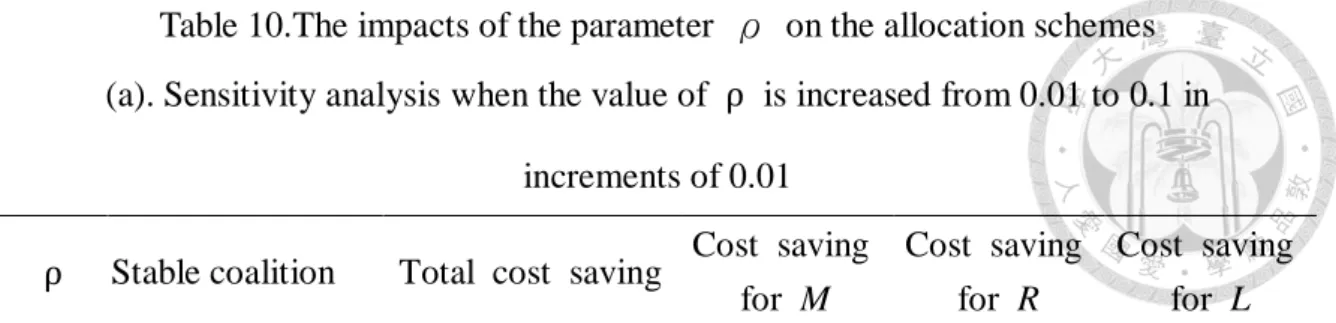
Table 10.The impacts of the parameter ρ on the allocation schemes ... 51
Chapter 1 Introduction
Cost savings have consistently been the important issue in the supply chain management. By reducing expenses, the players in a chain can increase profits quickly.
Instead of cutting price for competing market share with red ocean strategy, the players in creative and cultural industry should seek to cut down cost as well as increase additional value at the same time with blue ocean strategy to increase competitive advantage. To minimize waste cost which results from duplication of resources, sharing and using products and services on an as-needed basis instead of owning them helps to increase the operation efficiency in the whole supply chain. That’s the reason why for perfect storm of sharing economy which response validly to social and environmental challenges dominated by internet.
Since internet, network infrastructure of information, plays the main role of promotor of sharing economy, it motivates development of information sharing, the key of innovative industries these days. Therefore, the Internet has contributed to both increasing needs and opportunities for improved supply chain management (Lee, 2015).
Information sharing, a coordinated effort between manufactures (M), logistics service providers (L), retailers (R), and moreover, platform (P), in e-commerce edge, increases transparency as well as transaction integrity, and reduce risk in price competition as well as information searching cost for operation. Through exchange of information, it helps innovative business models to emerge, expand the industry boundary as well as realize economic scale.
In conventional Taiwan’s cultural creative industry, people usually regard cultural products as high art whose target market segment is professional art collectors. To promote Taiwan’s culture with cultural and creative products to the public and even the whole world, we hope that we can increase market penetration rate by applying O2O
(online-to-offline), one of the most popular business models that intrigues lots of interests, to integrate the virtual and real channel for competition in the electronic commerce (EC) world.
The key of the innovative model, O2O platform, with a website or mobile app that acts as a middleman between physical stores and internet users to transmit funds or data over the Internet, is to attract online users and direct them to physical stores in the offline realm. It is a combination of payment model and foot traffic generator for merchants and also creates offline purchases (Kang et al., 2015). Instead of selling souvenir directly to customers through traditional channel in a supply chain which does not share demand information, we are in pursuit of an innovative supply chain, where the manufacture, retailers and logistics service provider can cooperate with a business, who serves as an O2O platform to take over the responsibility of point of sale (POS) data from end customers, who place orders through virtual channel, as well as inventory levels, and sell products to customers for increasing in-store sales. Hence, in order to achieve supply chain efficacy, each channel member is expected to pay attention to cost savings and profit enlarging by collaborating on supply chain integration.
In this paper, we aim to find out how O2O business models can influence supply chain in an efficient way by information sharing. As the core of information flow system, virtual platform plays the role of congregating demand data as well as liaison of upstream supplier, downstream retailers and logistics provider. Therefore, we would like to know that under the structure of O2O business model, where the platform is necessary, how platform interacts with other players to maximize the allocation of cost savings in the whole supply chain, how information sharing is conducted in different coalitions, which coalitions bring more profits and maximize cost savings and what mechanism could distribute allocation of cost savings brought by coalitional schemes in an unique and efficient way to motivate and stabilize participants in coalitions.
We explored the implications of game theory as a context for providing useful insights into the cooperative strategic decisions in our model. Firstly, we tried to indicate all the possible coalitions in O2O model, inclusive of virtual platform, to define the feasible number of paths of information flow and calculate every player’s cost savings in different situation. The analysis helped to discover the influence of participation of players. Secondly, we calculate characteristic functions to find out all conditions in coalitions to ensure feasibility of cooperative mechanism and stability of every coalition.
To take an in-depth look into what the best ways are to approach decisions when there are multiple decision makers, each of them with different information, motives, and goals, we applied Shapley value to a four-player game. A solution concept that applies the Shapley value to cooperative games can calibrate empirical estimates of demand among coalition structures of multi-players that have significant power in prediction most of the time. Yet, in the practice, some infeasible coalitions shouldn’t be counted. Thus, we apply Banzhaf index to complete our analysis of distribution of cost allocation.
Finally, we discuss the boundary conditions of our results as well as the implications for managerial and policy issues to enhance the market share and sales revenue of products so that consumers actively make purchases rather than passive purchase behaviors.
This paper is organized as follows. In §3, we present a model of an O2O business model supply chain with four-level players. By analyzing the retailer’s, the logistics service provider, and the manufacturer’s ordering decisions based on demand data exchanged through platform, we develop different coalitions with different information-transmission pathway to simulate real situations of information flow for
the benefits (cost savings) of information sharing in different coalitions, and we try to determine which coalitions or players have significant impacts on the benefits of information sharing in characteristic form. After we get characteristic values, in §4, we present some conditions for cooperation in the four-level system to ensure the stability and feasibility of coalitions. On the other hand, we use Shapley value and Banzahf index to distribute cost allocations to stakeholders in the system to get a unique balance and reach maximum efficiency. In §5, we use some numerical results to prove the efficacy of the model on the benefit of information sharing. Also, we present and examine the impact of the demand process on the benefits of information sharing. The paper ends with a discussion.
Chapter 2 Literature Review
In this section, we review related literature, which can be categorized into four streams:
cooperative game theory, cost allocation, O2O business model, and information sharing.
There exists academics and practitioners paying considerable attention to applying cooperative game theory to supply chain management problems. One type of cooperative game concerns achievement of lower inventory under demand uncertainty.
Joint replenishments for multiple companies can be regarded as one of the continuously reviewed strategies in lots of papers. In this setting, a set of players, who face random demands of a single product, place a joint order before observing the demands. After the predicted demands are realized, the inventory is optimally allocated to the retailers and retailers can place joint orders to reduce setup costs. This issue has been studied by Zhang (2009), Timmer et al. (2013) and Moshe et al. (2012). More general models about inventory management with cooperative procurement are studied by Drechsel (2010).
The second type of collaborative game considers allocation of cost savings problem, especially logistics cost. Joint costs provide an incentive for the companies to cooperate due to that any group of companies having lower costs than the individual companies become popular issue discussed in supply chain management. In this setting, Cooperative game theory studies the class of games in which selfish players form collaborations to obtain greater benefits and cost savings of transmission instead of operating their industries independently. The investigation of fair allocation can be found in Okamoto (2008) dealing minimizing the total cost for units under their conflict in real-world situations with cooperative games. Examples of practical problem in transmission cost and solution proposals can be found in Lima (2008) dealing with
based on pricing mechanism of multiple goods is mentioned by Kru’s (2000).
Moghaddam (2009) discuss the method considering time difference based on the marginal costs and the production elasticity of input factors to achieve a pattern of allocation of cost savings. Under the assumption, the distinguished feature of their approach requires less iterative computations. Jia (2003) studied the coalitional scheme deciding profit allocation in the electric power markets, and they prove that coalitions can help to obtain best solutions for retailers. In this paper, the authors develop a methodology based on formation of coalitions to sell electricity to the customers more efficiently and economically. Obviously, selecting good coalitional schemes to obtain a lower total transportation cost needed to satisfy customer demand over the planning horizon with information sharing has been more and more important thing these days, with the development of internet.
Our paper deals with the type of cost savings-allocation cooperative game, which concerns the cost savings-allocation problem for an infinite time horizon information sharing model. This paper is closely related to Lee et al. (2000) and Leng (2009). We discuss these works briefly, since it will be referred to in the paper. The authors analyze the problem of allocating cost savings through sharing demand information in a chain.
To find unique allocation scheme, both researches put emphasis on coalitional schemes in cooperative games, and then analyze expected cost as well as distribute cost savings among different players.
Their models are essentially the same as ours, with two key differences. In their models, the practice of information sharing does not combine the situations in the real world. However, to really apply the coalitional scheme on today’s e-commerce era, we try to combine these cooperative concepts with innovative O2O business models.
On the other hand, through cooperation among different stakeholders, Cruijssen et al.
(2007) discuss different coalitions correspond to identifying and exploiting win–win
situations among companies at different levels of the supply chain in order to improve performance, platform economics would be the focus in our paper. Kang (2014) mentions that, since the core of our model, characterized by its information flow and cash flow on the line, as well as logistics and commerce flow off the line, greatly expanded the scope of business of e-commerce to store offline messages, we rely virtual platform, which plays the main role of reducing costs in the supply chain through sharing information to eliminate cost of information asymmetry among players and prevent forecast error of demand. Besides, to accurately practice the cooperative schemes in O2O business models, we eliminate some infeasible allocations to match platform economics, and we break the traditional rules about power of Shapley value.
Instead, we adopt the Banzahf power index to cater to real conditions. K'oczy (2010) study the possibility to block formation of infeasible coalitions and discuss power of winning coalitions.
With an aim to realize cooperative models to discover truly effective coalitional schemes in the real world of internet era, we hope to develop methods of allocation of cost savings that obtain more cost savings through information sharing with virtual platform, which dominate the O2O business models with platform economics to coordinate virtual and real business fields.
Chapter 3 Model Analysis
In this section, we first formally define the information shared by a coalition as the demand data obtained from the point of sale information system (POS) by the retailer and list our assumptions. Next, we identify all possible information-sharing coalitional structures for the supply chain and compute total cost savings for each possible coalition in which the participants share demand information faced by their downstream members.
3.1 Problem Description
To simplify the analysis, there is only a single product traded in the supply chain inclusive of four players. The upper stream of the supply chain is the manufacture, the logistics service provider stands for middle stream, the retailer is the downstream member and the platform plays the role of intermediary of information booth. The customers can reach the product information and place orders through the platform, then the platform retrieves demand information from end users and shares it with the upper stream manufacture, downstream retailer or logistics service providers to corporate for cost down and reach learning effects rapidly.
Figure 1. Four supply chain members P, M, L and R
The demand data from ultimate customers is the most important piece of information worthy of sharing. We define the demand information shared in these coalitions as the demand data confronted with the platform and assume that the end demand is forecasted by the simple auto correlated AR(1) process:
𝐷𝐷𝑡𝑡 = 𝑑𝑑 + 𝜌𝜌𝐷𝐷𝑡𝑡−1+ 𝜀𝜀𝑡𝑡, (1)
where 𝐷𝐷𝑡𝑡 represents the consumption rate in period t, 𝑑𝑑 is a positive contant, 𝜌𝜌 is a autocorrelation parameter with |𝜌𝜌| ≤ 1 (The value of information sharing in a two- level supply chain (Lee et al. 2000) provided empirical evidence to show that for most products the autocorrelation coefficient 𝜌𝜌 is positive.), and 𝜀𝜀𝑡𝑡 is the error term that is identically and independently distributed (i.i.d.) with a symmetric distribution (e.g., normal) having mean 0 and variance 𝜎𝜎2. After predicting the future demand, we treat the model as demand process for retailer’s and manufacture’s order quantity and compute cost savings generated by information sharing in this chapter. When 𝜌𝜌 = 0, the end demand is reduced to 𝐷𝐷𝑡𝑡= 𝑑𝑑 + 𝜀𝜀𝑡𝑡, which is independent from the past demand information. In that way, end-demand information sharing of last term does not change the retailer’s and the manufacture’s ordering decisions.
We now derive the expression for the order-up-to-level 𝐶𝐶𝑡𝑡, that minimizes the total expected holding and shortage costs in period t. We assume the previous order is received in this term, and the retailer will make orders depend on demand of the last term. Therefore, the retailer’s optimal order-up level 𝐶𝐶𝑡𝑡, at the end of period t is
𝐶𝐶𝑡𝑡= 𝑑𝑑 + 𝜌𝜌𝐷𝐷𝑡𝑡−1+ 𝑘𝑘𝜎𝜎, (2)
where 𝑘𝑘 = ∅−1[𝑠𝑠/(𝑠𝑠 + ℎ)]; h and s denote unit holding cost and the unit shortage cost respectively; ∅−1 is the distribution function of the standard normal random variable (r.v.) (see Lee et al. 2000).
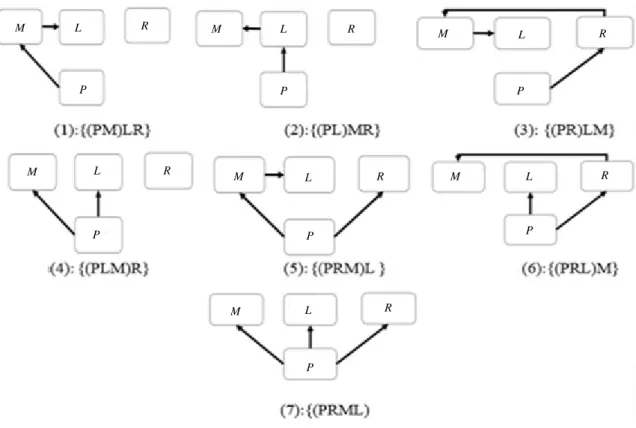
After considering the cost of demand data and clarifying the relationship between demand information and different players in the supply chain, we seek to find out the stable and effective coalitional structures for cost saving in the system. In the supply chain under study, platform is a mediator of O2O model, responsible for allocating sales information and consumer perception toward products, plays the leading role to control information flow and connect other players in the chain. As a result, in the whole possible coalitional structures, platform would never be absent in different feasible coalitions. In this case, we can find out seven feasible coalitions:
Figure 2. Feasible Information sharing structure for the four supply chain members P, M, L and R
P P P
P P P
P
L L L
L L L
L
M M M
M M M
M
R R R
R R R
R
The paper examines the cases of specific allocation schemes to analyze the cost savings effects. Therefore, we still assume the original structure {P, M, L, R} as base to compare the difference of cost before cooperation with after cooperation which would be discussed later.
Figure 1 corresponds to the coalitional scheme {P, M, L, R}, prime condition before cooperation, that the supply chain members do not share end-demand information in original situation. For this case, the expected costs of the manufacturer, the logistics service provider, the retailer and the platform are 𝑀𝑀𝑃𝑃1, 𝐿𝐿𝑃𝑃1, 𝑅𝑅𝑝𝑝1, and 𝑃𝑃𝐿𝐿𝑝𝑝1 respectively.
To illustrate the examination, we refer to Figure 2 that depicts seven possible coalitional structures for information sharing among supply chain members. Figure 2 corresponds to the situation where platform and manufacture can form a two, three, or four-player coalitions. The manufacture can therefore receive end-demand information from the platform. In {(PM)LR} case, the expected costs of the manufacturer, the logistics service provider, the retailer and the platform are 𝑀𝑀𝑃𝑃2, 𝐿𝐿𝑃𝑃2, 𝑅𝑅𝑝𝑝2, and 𝑃𝑃𝐿𝐿𝑝𝑝2 respectively. The remaining parts Figure2 (2)-Figure2 (7) have similar interpretations.
To realize the goal of minimizing total cost in souvenir industry system where the players share demand information gained from platform which get orders and operate O2O service, we then compute the joint cost savings of each possible coalition which is equal to the sum of cost reductions incurred by all members in the coalition. Moreover, we aim to analyze cost savings for different allocation schemes and appropriately allocate expected cost savings in characteristic-function form in the next chapter.
3.2 The Cost of Supply Chain Members in Different Coalitions
In the supply chain under study, as the innovative O2O business model is operated, the platform must be considered as the most important player in different coalition who leads the direction of information flow. Hence, after we identify all possible coalitional structures, we compute the unit cost of information sharing of the platform first.
Let 𝑖𝑖𝑖𝑖>0 be the fixed operation cost of platform, which is spent on managing its customer relationship, search behavior and purchase intention and is larger than variable cost of other players; let the information transmission cost of platform without partners is 1, which stands for that the cost of coordinating information even there is no receiver. We also let 𝑟𝑟𝑃𝑃𝑃𝑃 denote number of paths of information flow that the platform share with partners for coalition 𝑝𝑝𝑃𝑃. As constructing a database of customer relationship and maintaining a virtual platform would be an inevitable expenditure, the platform who expands its boundary to offer information service to more partners in the supply chain would realize economies of scale to decrease unit cost of operation of platform gradually. In this way, there would be inverse relationship between fixed information transmission cost of platform without partners plus number of paths of information flow for coalition 𝑝𝑝𝑃𝑃: 𝑟𝑟𝑃𝑃𝑃𝑃+ 1 , and fixed operation cost of platform, 𝑖𝑖𝑖𝑖, then the unit cost of information sharing of the platform is
𝑖𝑖𝑖𝑖 ∙ 1/(𝑟𝑟𝑃𝑃𝑃𝑃+ 1) (3)
The reciprocity stands for economies of scale that can help the platform gain more profits and reduce average cost at the same time from sharing information with more partners (i.e. advertising income, commission from sale).
While deciding the cost of manufacture, the set up cost in the lead time captures the effort involved in predicting future demand for retailers over time and based on users’ characteristics as well as outcome measurements. However, since the manufacturer is the most upstream member, we assume that it can make decisions on production quantity at will without interference from other players. This helps us to compute the expected cost of manufacture more accurately.
The production plan scheduled by manufacture relies on the actual demand at the end of the period t-1, so we make set up cost in the leading time in the coalition structure 𝑝𝑝𝑃𝑃 be based on retailer’s orders in the previous term. Let 𝑠𝑠𝑚𝑚 be the shortage cost at manufacture’s level per unit and ℎ𝑚𝑚 be the holding cost at manufacture’s level per unit. The set up cost would be unit holding cost ℎ𝑚𝑚 or shortage cost 𝑠𝑠𝑚𝑚
multiplied by retailer’s order up level, the base stock level, in the previous term 𝐶𝐶𝑡𝑡−1 and growth rate of order, 𝐶𝐶𝑡𝑡−𝐶𝐶𝑡𝑡−1
𝐶𝐶𝑡𝑡−1 , since manufacture usually prepares stock for orders in current period, yet retailer sells current order in next term. In this case, the cost of manufacture without receiving and transmitting information is
𝑠𝑠𝑚𝑚∙ 𝐶𝐶𝑡𝑡−1∙𝐶𝐶𝑡𝑡𝐶𝐶−𝐶𝐶𝑡𝑡−1
𝑡𝑡−1 if 𝐷𝐷𝑡𝑡 ≥ 𝐶𝐶𝑡𝑡−1 (4)
−ℎ𝑚𝑚∙ 𝐶𝐶𝑡𝑡−1∙𝐶𝐶𝑡𝑡𝐶𝐶−𝐶𝐶𝑡𝑡−1
𝑡𝑡−1 if 𝐷𝐷𝑡𝑡 < 𝐶𝐶𝑡𝑡−1 (5)
Practically, manufactures usually schedule their production plan according to retailer’s orders in the previous term 𝐶𝐶𝑡𝑡−1, therefore, growth rate of order𝐶𝐶𝑡𝑡−𝐶𝐶𝑡𝑡−1
𝐶𝐶𝑡𝑡−1 , represents the rate of difference between current orders and production plan, equal to holding rate or shortage rate of manufacture.
For the logistics service provider, let tc be the truck capacity and Tr be the transportation cost per path and per truck capacity. Let 𝐿𝐿𝑝𝑝𝑃𝑃 be the number of paths of logistics flow that a truck runs for in coalitional scheme 𝑝𝑝𝑖𝑖. In this model, we fix 𝐿𝐿𝑝𝑝𝑃𝑃 at two due to consideration of receiving goods from the manufacture and delivering goods to the retailer. We assume that there would be only one truck in transit at one time, then the cost of logistic providers is
𝑇𝑇𝑟𝑟 ∙ 𝐿𝐿𝑝𝑝𝑃𝑃 ∙ 𝑡𝑡𝑖𝑖. (6)
On the other hand, if the retailor prepares stock up based on orders of last term, they would confront with holding cost and shortage cost in current period. We let 𝐶𝐶𝑡𝑡= 𝑑𝑑 + 𝜌𝜌𝐷𝐷𝑡𝑡−1 + 𝑘𝑘𝜎𝜎 be retailer’s order-up-to level in current period t. In this way, both kinds of cost are computed through multiplying order up level in the previous term, 𝐶𝐶𝑡𝑡−1 , and growth rate of order, 𝐶𝐶𝑡𝑡𝐶𝐶−𝐶𝐶𝑡𝑡−1
𝑡𝑡−1 , is equal to holding or shortage rate of retailor in current period, to obtain the quantity of holding or shortage. Let 𝑠𝑠𝑟𝑟 be the shortage cost at retailer’s level per unit, and let ℎ𝑟𝑟 be the holding cost at retailer’s level per unit.
As a result, total cost of retailor in the supply chain is
𝑠𝑠𝑟𝑟∙ 𝐶𝐶𝑡𝑡−1∙𝐶𝐶𝑡𝑡𝐶𝐶−𝐶𝐶𝑡𝑡−1
𝑡𝑡−1 if 𝐷𝐷𝑡𝑡 ≥ 𝐶𝐶𝑡𝑡−1, (7)
−ℎ𝑟𝑟∙ 𝐶𝐶𝑡𝑡−1∙𝐶𝐶𝑡𝑡𝐶𝐶−𝐶𝐶𝑡𝑡−1
𝑡𝑡−1 if 𝐷𝐷𝑡𝑡< 𝐶𝐶𝑡𝑡−1, (8)
where ℎ𝑟𝑟 stands for unit holding cost and 𝑠𝑠𝑟𝑟stands for shortage cost at retailer’s level.
Therefore, the minimize cost function in different coalitional structure 𝑝𝑝𝑃𝑃 is
𝑀𝑀𝑖𝑖𝑀𝑀 [(𝑇𝑇𝑟𝑟 ∙ 𝐿𝐿𝑝𝑝𝑃𝑃∙ 𝑡𝑡𝑖𝑖) + (𝑠𝑠𝑚𝑚∙ 𝐶𝐶𝑡𝑡−1∙𝐶𝐶𝑡𝑡− 𝐶𝐶𝑡𝑡−1
𝐶𝐶𝑡𝑡−1 ) + (𝑠𝑠𝑟𝑟∙ 𝐶𝐶𝑡𝑡−1∙
𝐶𝐶𝑡𝑡−𝐶𝐶𝑡𝑡−1
𝐶𝐶𝑡𝑡−1 ) + (𝑖𝑖𝑖𝑖 ∙𝑟𝑟 1
𝑃𝑃𝑃𝑃+1)] if 𝐷𝐷𝑡𝑡 ≥ 𝐶𝐶𝑡𝑡−1,
𝑀𝑀𝑖𝑖𝑀𝑀 [(𝑇𝑇𝑟𝑟 ∙ 𝐿𝐿𝑝𝑝𝑃𝑃∙ 𝑡𝑡𝑖𝑖)− (ℎ𝑚𝑚∙ 𝐶𝐶𝑡𝑡−1 ∙𝐶𝐶𝑡𝑡− 𝐶𝐶𝑡𝑡−1
𝐶𝐶𝑡𝑡−1 )− (ℎ𝑟𝑟∙ 𝐶𝐶𝑡𝑡−1∙𝐶𝐶𝑡𝑡− 𝐶𝐶𝑡𝑡−1 𝐶𝐶𝑡𝑡−1 ) +(𝑖𝑖𝑖𝑖 ∙𝑟𝑟 1
𝑃𝑃𝑃𝑃+1)] if 𝐷𝐷𝑡𝑡 < 𝐶𝐶𝑡𝑡−1.
However, since our model put emphasis on influence on cost of information sharing, therefore we let|δ|, |α| ≤ 1 be a revise cost due to information sharing. Whenever a player (i.e. manufacture or retailer) receives information from others, it can prevent some error of prediction. Therefore, its unit cost can be (1-δ) times smaller than the original one; in this way the cost of manufacture with reception of information is
𝑠𝑠𝑚𝑚∙ 𝐶𝐶𝑡𝑡−1∙𝐶𝐶𝑡𝑡𝐶𝐶−𝐶𝐶𝑡𝑡−1
𝑡𝑡−1 ∙ (1 − δ) if 𝐷𝐷𝑡𝑡 ≥ 𝐶𝐶𝑡𝑡−1, (9)
−ℎ𝑚𝑚∙ 𝐶𝐶𝑡𝑡−1∙𝐶𝐶𝑡𝑡𝐶𝐶−𝐶𝐶𝑡𝑡−1
𝑡𝑡−1 ∙ (1 − δ) if 𝐷𝐷𝑡𝑡 < 𝐶𝐶𝑡𝑡−1 (10)
Similarly, total cost of retailor in the supply chain with reception of information is
𝑠𝑠𝑟𝑟∙ 𝐶𝐶𝑡𝑡−1 ∙𝐶𝐶𝑡𝑡𝐶𝐶−𝐶𝐶𝑡𝑡−1
𝑡𝑡−1 ∙ (1 − δ) if 𝐷𝐷𝑡𝑡 ≥ 𝐶𝐶𝑡𝑡−1, (11)
−ℎ𝑟𝑟∙ 𝐶𝐶𝑡𝑡−1∙𝐶𝐶𝑡𝑡𝐶𝐶−𝐶𝐶𝑡𝑡−1
𝑡𝑡−1 ∙ (1 − δ) if 𝐷𝐷𝑡𝑡 < 𝐶𝐶𝑡𝑡−1. (12)
Otherwise, if a player gives information to others, it might lose some advantages of private information. In this case, its cost would be (1+α) times larger than the original one due to constructing information network among different players in the supply chain; in this way the cost of manufacture with transmission of information is
𝑠𝑠𝑚𝑚∙ 𝐶𝐶𝑡𝑡−1∙𝐶𝐶𝑡𝑡𝐶𝐶−𝐶𝐶𝑡𝑡−1
𝑡𝑡−1 ∙ (1 + α) if 𝐷𝐷𝑡𝑡≥ 𝐶𝐶𝑡𝑡−1, (13)
−ℎ𝑚𝑚∙ 𝐶𝐶𝑡𝑡−1∙𝐶𝐶𝑡𝑡𝐶𝐶−𝐶𝐶𝑡𝑡−1
𝑡𝑡−1 ∙ (1 + α) if 𝐷𝐷𝑡𝑡 < 𝐶𝐶𝑡𝑡−1. (14)
Similarly, total cost of retailor in the supply chain with transmission of information is
𝑠𝑠𝑟𝑟∙ 𝐶𝐶𝑡𝑡−1 ∙𝐶𝐶𝑡𝑡𝐶𝐶−𝐶𝐶𝑡𝑡−1
𝑡𝑡−1 ∙ (1 + α) if 𝐷𝐷𝑡𝑡≥ 𝐶𝐶𝑡𝑡−1, (15)
−ℎ𝑟𝑟∙ 𝐶𝐶𝑡𝑡−1∙𝐶𝐶𝑡𝑡𝐶𝐶−𝐶𝐶𝑡𝑡−1
𝑡𝑡−1 ∙ (1 + α) if 𝐷𝐷𝑡𝑡< 𝐶𝐶𝑡𝑡−1. (16)
Obviously, if a player gives information and receives information from others at the same time, then the cost of manufacture is
𝑠𝑠𝑚𝑚∙ 𝐶𝐶𝑡𝑡−1 ∙𝐶𝐶𝑡𝑡𝐶𝐶−𝐶𝐶𝑡𝑡−1
𝑡𝑡−1 ∙ (1 + α) ∙ (1 − δ) if 𝐷𝐷𝑡𝑡≥ 𝐶𝐶𝑡𝑡−1, (17)
−ℎ𝑚𝑚∙ 𝐶𝐶𝑡𝑡−1 ∙𝐶𝐶𝑡𝑡𝐶𝐶−𝐶𝐶𝑡𝑡−1
𝑡𝑡−1 ∙ (1 + α) ∙ (1 − δ) if 𝐷𝐷𝑡𝑡 < 𝐶𝐶𝑡𝑡−1. (18)
Similarly, total cost of retailor is
𝑠𝑠𝑟𝑟∙ 𝐶𝐶𝑡𝑡−1 ∙𝐶𝐶𝑡𝑡𝐶𝐶−𝐶𝐶𝑡𝑡−1
𝑡𝑡−1 ∙ (1 + α) ∙ (1 − δ) if 𝐷𝐷𝑡𝑡≥ 𝐶𝐶𝑡𝑡−1, (19)
−ℎ𝑟𝑟∙ 𝐶𝐶𝑡𝑡−1 ∙𝐶𝐶𝑡𝑡𝐶𝐶−𝐶𝐶𝑡𝑡−1
𝑡𝑡−1 ∙ (1 + α) ∙ (1 − δ) if 𝐷𝐷𝑡𝑡 < 𝐶𝐶𝑡𝑡−1. (20)
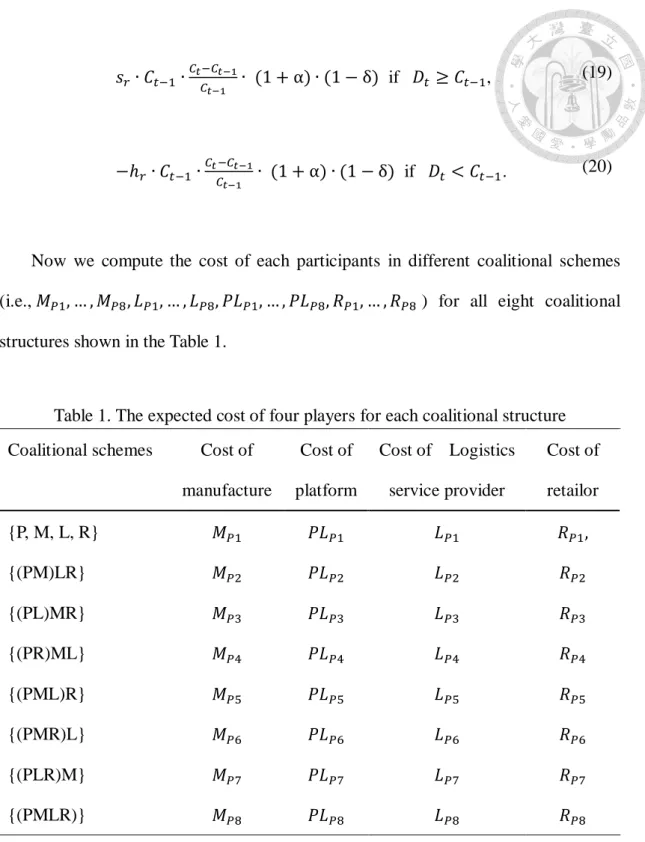
Now we compute the cost of each participants in different coalitional schemes (i.e.,𝑀𝑀𝑃𝑃1, … , 𝑀𝑀𝑃𝑃8, 𝐿𝐿𝑃𝑃1, … , 𝐿𝐿𝑃𝑃8, 𝑃𝑃𝐿𝐿𝑃𝑃1, … , 𝑃𝑃𝐿𝐿𝑃𝑃8, 𝑅𝑅𝑃𝑃1, … , 𝑅𝑅𝑃𝑃8) for all eight coalitional structures shown in the Table 1.
Table 1. The expected cost of four players for each coalitional structure Coalitional schemes Cost of
manufacture
Cost of platform
Cost of Logistics service provider
Cost of retailor
{P, M, L, R} 𝑀𝑀𝑃𝑃1 𝑃𝑃𝐿𝐿𝑃𝑃1 𝐿𝐿𝑃𝑃1 𝑅𝑅𝑃𝑃1,
{(PM)LR} 𝑀𝑀𝑃𝑃2 𝑃𝑃𝐿𝐿𝑃𝑃2 𝐿𝐿𝑃𝑃2 𝑅𝑅𝑃𝑃2
{(PL)MR} 𝑀𝑀𝑃𝑃3 𝑃𝑃𝐿𝐿𝑃𝑃3 𝐿𝐿𝑃𝑃3 𝑅𝑅𝑃𝑃3
{(PR)ML} 𝑀𝑀𝑃𝑃4 𝑃𝑃𝐿𝐿𝑃𝑃4 𝐿𝐿𝑃𝑃4 𝑅𝑅𝑃𝑃4
{(PML)R} 𝑀𝑀𝑃𝑃5 𝑃𝑃𝐿𝐿𝑃𝑃5 𝐿𝐿𝑃𝑃5 𝑅𝑅𝑃𝑃5
{(PMR)L} 𝑀𝑀𝑃𝑃6 𝑃𝑃𝐿𝐿𝑃𝑃6 𝐿𝐿𝑃𝑃6 𝑅𝑅𝑃𝑃6
{(PLR)M} 𝑀𝑀𝑃𝑃7 𝑃𝑃𝐿𝐿𝑃𝑃7 𝐿𝐿𝑃𝑃7 𝑅𝑅𝑃𝑃7
{(PMLR)} 𝑀𝑀𝑃𝑃8 𝑃𝑃𝐿𝐿𝑃𝑃8 𝐿𝐿𝑃𝑃8 𝑅𝑅𝑃𝑃8
Coalition {P, M, L, R}:
The situation before cooperation, where every member in the supply chain does not save any cost, is unreasonable in practice due to the fact that the platform would not exist independently. However, we still assume it to be the prime state, where each player
in the coalitions operates their own business with original cost, to compare allocation of cost savings with other coalitional schemes.
Total cost =
⎩⎪
⎪⎪
⎨
⎪⎪
⎪⎧(𝑇𝑇𝑟𝑟 ∙ 2 ∙ 𝑡𝑡𝑖𝑖) + �𝑠𝑠𝑚𝑚∙ 𝐶𝐶𝑡𝑡−1 ∙𝐶𝐶𝑡𝑡− 𝐶𝐶𝑡𝑡−1
𝐶𝐶𝑡𝑡−1 � + �𝑠𝑠𝑟𝑟∙ 𝐶𝐶𝑡𝑡−1∙𝐶𝐶𝑡𝑡− 𝐶𝐶𝑡𝑡−1
𝐶𝐶𝑡𝑡−1 � + �𝑖𝑖𝑖𝑖 ∙ 1
𝑟𝑟𝑃𝑃𝑃𝑃+ 1� if 𝐷𝐷𝑡𝑡 ≥ 𝐶𝐶𝑡𝑡−1
(𝑇𝑇𝑟𝑟 ∙ 2 ∙ 𝑡𝑡𝑖𝑖) −(ℎ𝑚𝑚∙ 𝐶𝐶𝑡𝑡−1∙𝐶𝐶𝑡𝑡− 𝐶𝐶𝑡𝑡−1
𝐶𝐶𝑡𝑡−1 ) −(ℎ𝑟𝑟∙ 𝐶𝐶𝑡𝑡−1∙𝐶𝐶𝑡𝑡− 𝐶𝐶𝑡𝑡−1 𝐶𝐶𝑡𝑡−1 ) +(𝑖𝑖𝑖𝑖 ∙ 1
𝑟𝑟𝑃𝑃𝑃𝑃+ 1) if 𝐷𝐷𝑡𝑡< 𝐶𝐶𝑡𝑡−1
Coalition {(PM)LR}:
In the coalition {(PM)LR}, the platform only shares information with manufacture provider. Then the manufacture would transmit information of customer orders to the logistics provider, so that logistics provider can conduct transport management and schedule for the transport process to retailer. Thus, the information sharing also occur among L and M.
Total cost =
⎩⎪
⎪⎪
⎨
⎪⎪
⎪⎧[𝑇𝑇𝑟𝑟 ∙ (1 − δ) ∙ 2 ∙ 𝑡𝑡𝑖𝑖] + �𝑠𝑠𝑚𝑚∙ 𝐶𝐶𝑡𝑡−1∙𝐶𝐶𝑡𝑡− 𝐶𝐶𝑡𝑡−1
𝐶𝐶𝑡𝑡−1 ∙ (1 − δ) ∙ (1 + α)�
+ �𝑠𝑠𝑟𝑟∙ 𝐶𝐶𝑡𝑡−1 ∙𝐶𝐶𝑡𝑡− 𝐶𝐶𝑡𝑡−1
𝐶𝐶𝑡𝑡−1 � + �𝑖𝑖𝑖𝑖 ∙1
2� if 𝐷𝐷𝑡𝑡≥ 𝐶𝐶𝑡𝑡−1 [𝑇𝑇𝑟𝑟 ∙ (1 − δ) ∙ 2 ∙ 𝑡𝑡𝑖𝑖]−[ℎ𝑚𝑚∙ 𝐶𝐶𝑡𝑡−1∙𝐶𝐶𝑡𝑡− 𝐶𝐶𝑡𝑡−1
𝐶𝐶𝑡𝑡−1 ∙ (1 − δ) ∙ (1 + α)]
−[ℎ𝑟𝑟∙ 𝐶𝐶𝑡𝑡−1∙𝐶𝐶𝑡𝑡− 𝐶𝐶𝑡𝑡−1
𝐶𝐶𝑡𝑡−1 ] + [𝑖𝑖𝑖𝑖 ∙ 1/2] if 𝐷𝐷𝑡𝑡< 𝐶𝐶𝑡𝑡−1
Coalition {(PL)MR }:
In the coalition {(PL)MR}, the platform only shares information with logistics provider. Then the logistics provider would transmit information of customer orders to the manufacture, so that manufacture would prepare stock accurately for retailer’s orders. Thus, the information sharing also occurs among L and M.
Total cost=
⎩⎪
⎪⎪
⎨
⎪⎪
⎪⎧[Tr ∙ (1 − δ) ∙ (1 + α) ∙ 2 ∙ 𝑡𝑡𝑖𝑖] + �𝑠𝑠𝑚𝑚∙ 𝐶𝐶𝑡𝑡−1∙𝐶𝐶𝑡𝑡− 𝐶𝐶𝑡𝑡−1
𝐶𝐶𝑡𝑡−1 ∙ (1 − δ)�
+ �𝑠𝑠𝑟𝑟∙ 𝐶𝐶𝑡𝑡−1 ∙𝐶𝐶𝑡𝑡− 𝐶𝐶𝑡𝑡−1
𝐶𝐶𝑡𝑡−1 � + �𝑖𝑖𝑖𝑖 ∙1
2� if 𝐷𝐷𝑡𝑡≥ 𝐶𝐶𝑡𝑡−1 [Tr ∙ (1 − δ) ∙ (1 + α) ∙ 2 ∙ 𝑡𝑡𝑖𝑖]−{ℎ𝑚𝑚∙ 𝐶𝐶𝑡𝑡−1∙𝐶𝐶𝑡𝑡− 𝐶𝐶𝑡𝑡−1
𝐶𝐶𝑡𝑡−1 ∙ (1 − δ)}
−{ℎ𝑟𝑟∙ 𝐶𝐶𝑡𝑡−1∙𝐶𝐶𝑡𝑡− 𝐶𝐶𝑡𝑡−1
𝐶𝐶𝑡𝑡−1 } + {𝑖𝑖𝑖𝑖 ∙ 1/2} if 𝐷𝐷𝑡𝑡< 𝐶𝐶𝑡𝑡−1
Coalition {(PR)ML}:
In the coalition {(PR)ML}, the platform only shares information with retailer.
Since only the downstream firm get demand information, the retailer would give orders up to the manufacture in preparation for stock. Then the manufacture would transmit information of customer orders to the logistics provider. In this way, the logistic provider can conduct transport management and schedule for the transport process.
Thus, the information sharing also occur among R, L and M.
Total cost=
⎩⎪
⎪⎪
⎨
⎪⎪
⎪⎧ [Tr ∙ (1 − δ) ∙ 2 ∙ 𝑡𝑡𝑖𝑖] + �𝑠𝑠𝑚𝑚∙ 𝐶𝐶𝑡𝑡−1∙𝐶𝐶𝑡𝑡− 𝐶𝐶𝑡𝑡−1
𝐶𝐶𝑡𝑡−1 ∙ (1 − δ) ∙ (1 + α)�
+ �𝑠𝑠𝑟𝑟∙ 𝐶𝐶𝑡𝑡−1∙𝐶𝐶𝑡𝑡− 𝐶𝐶𝑡𝑡−1
𝐶𝐶𝑡𝑡−1 ∙ (1 − δ)(1 + α)� + �𝑖𝑖𝑖𝑖 ∙1
2� if 𝐷𝐷𝑡𝑡 ≥ 𝐶𝐶𝑡𝑡−1
[Tr ∙ (1 − δ) ∙ 2 ∙ 𝑡𝑡𝑖𝑖]−[ℎ𝑚𝑚∙ 𝐶𝐶𝑡𝑡−1∙𝐶𝐶𝑡𝑡− 𝐶𝐶𝑡𝑡−1
𝐶𝐶𝑡𝑡−1 ∙ (1 − δ) ∙ (1 + α)]
−[ℎ𝑟𝑟∙ 𝐶𝐶𝑡𝑡−1∙𝐶𝐶𝑡𝑡− 𝐶𝐶𝑡𝑡−1
𝐶𝐶𝑡𝑡−1 ∙ (1 − δ)(1 + α)] + {𝑖𝑖𝑖𝑖 ∙ 1/2} if 𝐷𝐷𝑡𝑡< 𝐶𝐶𝑡𝑡−1
Coalition {(PML)R}:
In the coalition {(PML)R}, the platform shares information with manufacture and logistic provider. Since they get enough information, the logistic provider can conduct transport management and schedule for the transport process right after receiving products from the manufacture. Besides, it could directly ship the orders to retailer, and the customer can just pick up their products faster. In this case, the retailer plays a passive role and does not have to make orders to the manufacture due to that the manufacture already has demand information.
Total cost=
⎩⎪
⎪⎪
⎨
⎪⎪
⎪⎧[Tr ∙ (1 − δ) ∙ 2 ∙ 𝑡𝑡𝑖𝑖] + �𝑠𝑠𝑚𝑚∙ 𝐶𝐶𝑡𝑡−1∙𝐶𝐶𝑡𝑡− 𝐶𝐶𝑡𝑡−1
𝐶𝐶𝑡𝑡−1 ∙ (1 − δ)�
+ �𝑠𝑠𝑟𝑟∙ 𝐶𝐶𝑡𝑡−1 ∙𝐶𝐶𝑡𝑡− 𝐶𝐶𝑡𝑡−1
𝐶𝐶𝑡𝑡−1 � + �𝑖𝑖𝑖𝑖 ∙1
3� if 𝐷𝐷𝑡𝑡 ≥ 𝐶𝐶𝑡𝑡−1 [Tr ∙ (1 − δ) ∙ 2 ∙ 𝑡𝑡𝑖𝑖]−[ℎ𝑚𝑚∙ 𝐶𝐶𝑡𝑡−1 ∙𝐶𝐶𝑡𝑡− 𝐶𝐶𝑡𝑡−1
𝐶𝐶𝑡𝑡−1 ∙ (1 − δ)]
−[ℎ𝑟𝑟∙ 𝐶𝐶𝑡𝑡−1∙𝐶𝐶𝑡𝑡− 𝐶𝐶𝑡𝑡−1
𝐶𝐶𝑡𝑡−1 ] + {𝑖𝑖𝑖𝑖 ∙ 1/3} if 𝐷𝐷𝑡𝑡 < 𝐶𝐶𝑡𝑡−1
Coalition {(PMR)L}:
In the coalition {(PMR)L}, the platform shares information with manufacture and retailor. After getting the demand information from platform, the manufacture would transmit information of customer orders to the logistics provider. In this way, the logistic provider can conduct transport management and schedule for the transport process to deliver goods on time to retailor. Thus, the information sharing occurs among R, L and M.
Total cost=
⎩⎪
⎪⎪
⎨
⎪⎪
⎪⎧[Tr ∙ (1 − δ) ∙ 2 ∙ 𝑡𝑡𝑖𝑖] + �𝑠𝑠𝑚𝑚∙ 𝐶𝐶𝑡𝑡−1∙𝐶𝐶𝑡𝑡− 𝐶𝐶𝑡𝑡−1
𝐶𝐶𝑡𝑡−1 ∙ (1 − δ) ∙ (1 + α)�
+ �𝑠𝑠𝑟𝑟∙ 𝐶𝐶𝑡𝑡−1 ∙𝐶𝐶𝑡𝑡− 𝐶𝐶𝑡𝑡−1
𝐶𝐶𝑡𝑡−1 ∙ (1 − δ)� + �𝑖𝑖𝑖𝑖 ∙1
3� if 𝐷𝐷𝑡𝑡 ≥ 𝐶𝐶𝑡𝑡−1 [Tr ∙ (1 − δ) ∙ 2 ∙ 𝑡𝑡𝑖𝑖]−[ℎ𝑚𝑚∙ 𝐶𝐶𝑡𝑡−1∙𝐶𝐶𝑡𝑡− 𝐶𝐶𝑡𝑡−1
𝐶𝐶𝑡𝑡−1 ∙ (1 − δ) ∙ (1 + α)]
−[ℎ𝑟𝑟∙ 𝐶𝐶𝑡𝑡−1∙𝐶𝐶𝑡𝑡− 𝐶𝐶𝑡𝑡−1
𝐶𝐶𝑡𝑡−1 ∙ (1 − δ)] + {𝑖𝑖𝑖𝑖 ∙ 1/3} 𝑖𝑖f 𝐷𝐷𝑡𝑡< 𝐶𝐶𝑡𝑡−1
Coalition {(PLR)M}:
In the coalition {(PLR)M}, the platform shares information with logistics provider and retailor. After getting the demand information from platform, the retailer would give orders up to the manufacture. Thus, the information sharing occur among L, R and M.
Total cost=
⎩⎪
⎪⎪
⎨
⎪⎪
⎪⎧ [Tr ∙ (1 − δ) ∙ 2 ∙ 𝑡𝑡𝑖𝑖]+[𝑠𝑠𝑚𝑚∙ 𝐶𝐶𝑡𝑡−1∙𝐶𝐶𝑡𝑡− 𝐶𝐶𝑡𝑡−1
𝐶𝐶𝑡𝑡−1 ∙ (1 − δ)]
+[𝑠𝑠𝑟𝑟∙ 𝐶𝐶𝑡𝑡−1∙𝐶𝐶𝑡𝑡− 𝐶𝐶𝑡𝑡−1
𝐶𝐶𝑡𝑡−1 ∙ (1 − δ) ∙ (1 + α)] + {𝑖𝑖𝑖𝑖 ∙ 1/3} if 𝐷𝐷𝑡𝑡≥ 𝐶𝐶𝑡𝑡−1
[Tr ∙ (1 − δ) ∙ 2 ∙ 𝑡𝑡𝑖𝑖]−[ℎ𝑚𝑚∙ 𝐶𝐶𝑡𝑡−1 ∙𝐶𝐶𝑡𝑡− 𝐶𝐶𝑡𝑡−1
𝐶𝐶𝑡𝑡−1 ∙ (1 − δ)]
−[ℎ𝑟𝑟∙ 𝐶𝐶𝑡𝑡−1∙𝐶𝐶𝑡𝑡− 𝐶𝐶𝑡𝑡−1
𝐶𝐶𝑡𝑡−1 ∙ (1 − δ) ∙ (1 + α)] + {𝑖𝑖𝑖𝑖 ∙ 1/3} if 𝐷𝐷𝑡𝑡< 𝐶𝐶𝑡𝑡−1
Coalition {(PMLR)}:
In the coalition {(PMLR)} which would fully exert its effect of information sharing, the platform would disseminate demand information to other three players. In the case, the other three players can save the cost of transmitting information to each other. At the same time, the platform can play the full role of information coordinator and realize economies of scale of information sharing.
Total cost=
⎩⎪
⎪⎪
⎨
⎪⎪
⎪⎧ [Tr ∙ (1 − δ) ∙ 2 ∙ 𝑡𝑡𝑖𝑖]+[𝑠𝑠𝑚𝑚∙ 𝐶𝐶𝑡𝑡−1∙𝐶𝐶𝑡𝑡− 𝐶𝐶𝑡𝑡−1
𝐶𝐶𝑡𝑡−1 ∙ (1 − δ)]
+[𝑠𝑠𝑟𝑟∙ 𝐶𝐶𝑡𝑡−1∙𝐶𝐶𝑡𝑡− 𝐶𝐶𝑡𝑡−1
𝐶𝐶𝑡𝑡−1 ∙ (1 − δ)] + {𝑖𝑖𝑖𝑖 ∙ 1/4} if 𝐷𝐷𝑡𝑡≥ 𝐶𝐶𝑡𝑡−1 [Tr ∙ (1 − δ) ∙ 2 ∙ 𝑡𝑡𝑖𝑖]−[ℎ𝑚𝑚∙ 𝐶𝐶𝑡𝑡−1 ∙𝐶𝐶𝑡𝑡− 𝐶𝐶𝑡𝑡−1
𝐶𝐶𝑡𝑡−1 ∙ (1 − δ)]
−[ℎ𝑟𝑟∙ 𝐶𝐶𝑡𝑡−1∙𝐶𝐶𝑡𝑡− 𝐶𝐶𝑡𝑡−1
𝐶𝐶𝑡𝑡−1 ∙ (1 − δ)] + {𝑖𝑖𝑖𝑖 ∙ 1/4} if 𝐷𝐷𝑡𝑡 < 𝐶𝐶𝑡𝑡−1
Proposition 1. The unit cost of information sharing of the platform 𝑃𝑃𝐿𝐿𝑃𝑃𝑃𝑃, i=1,...,8 have the characteristic of economic scale that 𝑃𝑃𝐿𝐿𝑃𝑃1> 𝑃𝑃𝐿𝐿𝑃𝑃2= 𝑃𝑃𝐿𝐿𝑃𝑃3 = 𝑃𝑃𝐿𝐿𝑃𝑃4> 𝑃𝑃𝐿𝐿𝑃𝑃5= 𝑃𝑃𝐿𝐿𝑃𝑃6= 𝑃𝑃𝐿𝐿𝑃𝑃7 > 𝑃𝑃𝐿𝐿𝑃𝑃8.
Proof.
In the four-player cooperative game, there are eight coalitions, i.e., {P, M, L, R}
{(PL)MR},{(PM)LR},{(PR)LM},{(PML)R},{(PLR)M},{(PMR)L},{(PMLR)}. With the definition of the unit cost of information sharing of the platform, we can calculate 𝑃𝑃𝐿𝐿𝑃𝑃𝑃𝑃 with (3) and get that:
𝑃𝑃𝐿𝐿𝑃𝑃1= 𝑖𝑖𝑖𝑖 ∙1 1, 𝑃𝑃𝐿𝐿𝑃𝑃2= 𝑖𝑖𝑖𝑖 ∙1
2 = 𝑃𝑃𝐿𝐿𝑃𝑃3= 𝑃𝑃𝐿𝐿𝑃𝑃4, 𝑃𝑃𝐿𝐿𝑃𝑃5= 𝑖𝑖𝑖𝑖 ∙1
3 = 𝑃𝑃𝐿𝐿𝑃𝑃6= 𝑃𝑃𝐿𝐿𝑃𝑃7, 𝑃𝑃𝐿𝐿𝑃𝑃8= 𝑖𝑖𝑖𝑖 ∙1
4.
From a straightforward comparison of 𝑃𝑃𝐿𝐿𝑃𝑃𝑃𝑃, i=1,...,8, it is easy to see that as members of a coalition increase, the unit cost of information sharing of the platform would decrease. The unit cost of the platform of the grand coalition is smaller than that of three-player coalitional structures, which are smaller than two-player coalitional structures’ unit cost of the platform. That is to say, it has the property of economic scale, the cost advantages that platform obtains due to size of coalitional structure, as fixed operation costs are spread out over more supply chain members.
Chapter 4 Analysis and Discussion
4.1 Model and Analysis of the Cooperative Game
To find the characteristic-function values of various coalitions, we compute total cost savings for each possible coalition in which the participants share demand information faced by their downstream members in the last section. Then in this part, we develop a cooperative game in characteristic-function form as well as analyze models to find the appropriate allocation scheme which “fairly” allocating expected cost savings for stakeholders in the supply chain.
In our paper, we discuss the problem of O2O model, a business strategy that draws potential customers from online channels to physical stores. In our game model, we consider the e-commerce platform to be the virtual channel, which plays the most important intermediary in the business model. Therefore, we are not going to discuss the situations that a subset of players forms some coalitions exclusive of the platform.
In that way, the allocation of cost savings among those players, exclusive of online platform, would deviate from our main goal of discussing with the influence of information sharing through virtual platform in cost allocation, one of the main competitive strengths of O2O business. As a result, in this paper, the definition of O2O coalition is given as follows:
Definition 1.
In the O2O business information-coordinated cooperative game, a scheme for allocating cost savings among all members in supply chain in a coalition is valid only if the platform, online channel, is inclusive in any multi-player coalitions and plays the coordinator of information sharing.
4.2 An O2O Cooperative Game in Characteristic Function
A cooperative game is given by specifying a value for every coalition. Formally, the (coalitional game) consists of a finite set of players N, called the grand coalition. In our paper, the grand coalition is a four-person game. In practice, with the definition of O2O model which always includes online channel, we can obviously define some coalitions as infeasible coalitions and block them from all possible sets of players. Therefore, we still have seven feasible coalitions:
{(PL)MR}, {(PM)LR}, {(PR)LM}, {(PML)R}, {(PLR)M}, {(PMR)L}, {(PMLR)}.
In the theory of cooperative games, the characteristic value is the minimum collective payoff that the coalition can attain with a set of players. In our paper, the characteristic value of a coalition is the amount of cost saving and improvements in profits the coalitions could at least attain from its own effort when the coalitions is feasible in O2O model: v(PL), v(PM), v(PR), v(PMR), v(PML), v(PLR), v(PMLR).
A characteristic function 𝓋𝓋: 2𝑁𝑁 → ℝ from the set of all possible coalitions of players to a set of cost allocations that satisfies v(∅) = 0. The function describes how much cost allocations a set of players can save by forming a coalition. Even more, after we get characteristic values, we will present some conditions for cooperation in the four- level system to ensure the stability and feasibility of coalitions. On the other hand, we use Shapley value and Banzahf index to distribute cost allocations to stakeholders in the system to get unique allocation scheme.
We now compute the characteristic values of all possible coalitions. First, the characteristic value of an empty coalition is naturally zero: v(∅) = 0.
Next, we are going to discuss single-player coalitions. According to the definition of O2O business information-coordinated cooperative game, there is no possibility that the platform independently exists under the condition that other members but it make up coalitions. If other player in the supply chain can coordinate and getting better result of allocation of cost savings without involvement of platform, then the business model of O2O would not be efficient. In that case, the platform would be a meaningless dummy player, and there is no need for constructing the platform. Therefore, the value of v(P), the minimum amount the coalition with only platform can attain using its own efforts, would be zero.
On the other hand, when the retailer, manufacture, or logistics service provider does not share information with other members in the system, characteristics value of each member: v(M), v(L), v(R) depends on whether other members but itself share demand information. If they don’t share information with each other, then the individuals will have no cost savings, and the characteristics value is zero. Otherwise, the cost savings they can at least get under the cooperation of other members will be presented as follows:
v(M) = min(𝑀𝑀𝑃𝑃1−𝑀𝑀𝑃𝑃3, 𝑀𝑀𝑃𝑃1−𝑀𝑀𝑃𝑃4, 𝑀𝑀𝑃𝑃1−𝑀𝑀𝑃𝑃7, 0), v(L)= min (𝐿𝐿𝑃𝑃1−𝐿𝐿𝑃𝑃2, 𝐿𝐿𝑃𝑃1−𝐿𝐿𝑃𝑃4, 𝐿𝐿𝑃𝑃1−𝐿𝐿𝑃𝑃6, 0), v(R)=min(𝑅𝑅𝑃𝑃1−𝑅𝑅𝑃𝑃2, 𝑅𝑅𝑃𝑃1−𝑅𝑅𝑃𝑃3, 𝑅𝑅𝑃𝑃1−𝑅𝑅𝑃𝑃5, 0).
As mentioned above, the characteristic function of p does not exist: v(P)=0.
Next, we consider other feasible two-player coalitions in the O2O business model:
the characteristic value v(PM) of the coalition {(PM)LR} is the minimum expected allocation of cost savings that the two players can create when only they cooperate.
Therefore, the retailer and the logistics service provider don’t share demand information with each other. Thus, we can get the value:
v(PM) = Min [(𝑃𝑃𝐿𝐿𝑃𝑃1−𝑃𝑃𝐿𝐿𝑃𝑃2), �𝑃𝑃𝐿𝐿𝑝𝑝1−𝑃𝑃𝐿𝐿𝑝𝑝5�, �𝑃𝑃𝐿𝐿𝑝𝑝1−𝑃𝑃𝐿𝐿𝑝𝑝6�] + Min [(𝑀𝑀𝑃𝑃1−𝑀𝑀𝑃𝑃2), (𝑀𝑀𝑃𝑃1−𝑀𝑀𝑃𝑃5), (𝑀𝑀𝑃𝑃1−𝑀𝑀𝑃𝑃6)].
Also, the characteristics functions of other feasible coalitions: v(PR), v(PL), are calculated as follows:
v(PR) = Min [(𝑃𝑃𝐿𝐿𝑃𝑃1−𝑃𝑃𝐿𝐿𝑃𝑃4), �𝑃𝑃𝐿𝐿𝑝𝑝1−𝑃𝑃𝐿𝐿𝑝𝑝6�, �𝑃𝑃𝐿𝐿𝑝𝑝1−𝑃𝑃𝐿𝐿𝑝𝑝7�] + Min [(𝑅𝑅𝑃𝑃1−𝑅𝑅𝑃𝑃4), (𝑅𝑅𝑃𝑃1−𝑅𝑅𝑃𝑃6), (𝑅𝑅𝑃𝑃1−𝑅𝑅𝑃𝑃7)],
v(PL) = Min [(𝑃𝑃𝐿𝐿𝑃𝑃1−𝑃𝑃𝐿𝐿𝑃𝑃3), �𝑃𝑃𝐿𝐿𝑝𝑝1−𝑃𝑃𝐿𝐿𝑝𝑝5�, �𝑃𝑃𝐿𝐿𝑝𝑝1−𝑃𝑃𝐿𝐿𝑝𝑝7�] + Min [(𝐿𝐿𝑃𝑃1−𝐿𝐿𝑃𝑃3), (𝐿𝐿𝑃𝑃1−𝐿𝐿𝑃𝑃5), (𝐿𝐿𝑃𝑃1−𝐿𝐿𝑃𝑃7)].
Now we consider the three-member coalitions and the grand four-player coalition.
The characteristic value v(PML) of the coalition {(PML)R} is the minimum expected allocation of cost savings that the three players can create when only they cooperate.
Therefore, we calculate the cost savings incurred at the manufacture, platform and logistics service provider level. In this case, the retailer does not share demand information with any other member. Then when the other three members share information with each other, they can gain the expected cost savings:
v(PML)=�𝑃𝑃𝐿𝐿𝑝𝑝1−𝑃𝑃𝐿𝐿𝑝𝑝5� + (𝑀𝑀𝑃𝑃1−𝑀𝑀𝑃𝑃5) + (𝐿𝐿𝑃𝑃1−𝐿𝐿𝑃𝑃5).
v(PMR)= �𝑃𝑃𝐿𝐿𝑝𝑝1−𝑃𝑃𝐿𝐿𝑝𝑝6� + (𝑀𝑀𝑃𝑃1−𝑀𝑀𝑃𝑃6) + (𝑅𝑅𝑃𝑃1−𝑅𝑅𝑃𝑃6), v(PLR) = �𝑃𝑃𝐿𝐿𝑝𝑝1−𝑃𝑃𝐿𝐿𝑝𝑝7� + (𝐿𝐿𝑃𝑃1−𝐿𝐿𝑃𝑃7) + (𝑅𝑅𝑃𝑃1−𝑅𝑅𝑃𝑃7),
v(PMLR)= �𝑃𝑃𝐿𝐿𝑝𝑝1−𝑃𝑃𝐿𝐿𝑝𝑝8� + (𝐿𝐿𝑃𝑃1−𝐿𝐿𝑃𝑃8) + (𝑅𝑅𝑃𝑃1−𝑅𝑅𝑃𝑃8) + (𝑀𝑀𝑃𝑃1−𝑀𝑀𝑃𝑃8).
4.3 Evaluation of Stability of O2O Coalition Scheme
We now analyze the cooperative game to realize the stability of possible coalitions. A coalition will be stable only if leaving the coalitions makes it worse off. In our game model, we consider the problem of fairly allocating cost savings among multi players under the condition of stability. Only if the coalition is stable, then the members in the coalition accept the allocation of cost savings and have no incentive to deviate. On the other hand, if the coalition is unstable, then the members might deviate to seek for more profits, or there would be no incentive for independent members to join coalitions due to uncertainty of that if others will stay in the collaborative scheme. We first find necessary conditions for stability of different coalitions.
Proposition 2. The necessary conditions for stability of each coalition in the cooperative game are given as follows:
(1) The grand coalition {(PMLR)} is stable only if:
𝑣𝑣(𝑃𝑃𝑀𝑀𝐿𝐿𝑅𝑅) ≥ 𝑚𝑚𝑚𝑚𝑚𝑚{𝑣𝑣(𝑃𝑃) + 𝑣𝑣(𝐿𝐿) + 𝑣𝑣(𝑀𝑀) + 𝑣𝑣(𝑅𝑅), (𝑀𝑀𝑃𝑃1−𝑀𝑀𝑃𝑃3 𝑜𝑜𝑟𝑟 𝑀𝑀𝑃𝑃1−𝑀𝑀𝑃𝑃7) + 𝑣𝑣(𝑃𝑃𝐿𝐿𝑅𝑅), (𝐿𝐿𝑃𝑃1−𝐿𝐿𝑃𝑃2 𝑜𝑜𝑟𝑟 𝐿𝐿𝑃𝑃1−𝐿𝐿𝑃𝑃6) + 𝑣𝑣(𝑃𝑃𝑀𝑀𝑅𝑅), 0 + 𝑣𝑣(𝑃𝑃𝑀𝑀𝐿𝐿) } and
v(PMLR)≥ 𝜔𝜔𝑃𝑃 + 𝜔𝜔𝐿𝐿+ 𝜔𝜔𝑅𝑅 + 𝜔𝜔𝑚𝑚,