New high-fidelity medical image compression
based on modified set partitioning in hierarchical
trees
Shen-Chuan Tai Yen-Yu Chen Wen-Chien Yan
National Cheng Kung University Institute of Electrical Engineering Number 1, Ta Hsueh Road Tainan, Taiwan
E-mail: [email protected]
Abstract. Medical images must be compressed before transmission
due to bandwidth and storage limitations. The set partitioning in hierar-chical trees (SPIHT) algorithm is an efficient method for lossy and loss-less coding of medical images. We propose some modifications to the SPIHT algorithm. It is based on the idea of the insignificant correlation of wavelet coefficients among medium- and high-frequency subbands. In this scheme, insignificant wavelet coefficients that correspond to the same spatial location in the medium subbands can be used to reduce the redundancy by a combined function proposed in associated with the modified SPIHT. In high-frequency subbands, the modified SPIHT pro-poses a dictator to reduce the interband redundancy. Experimental re-sults indicate that the proposed technique improves the quality of the reconstructed medical image in terms of both the peak signal-to-noise ratio (PSNR) and the perceptual results over JPEG2000 and the original SPIHT at the same bit rate. © 2003 Society of Photo-Optical Instrumentation Engi-neers. [DOI: 10.1117/1.1578645]
Subject terms: set partitioning in hierarchical trees; JPEG2000.
Paper 020317 received Jul. 22, 2002; revised manuscript received Nov. 26, 2002; accepted for publication Dec. 13, 2002.
1 Introduction
In diagnoses, medical images including those obtained by computer tomography 共CT兲, magnetic resonance imaging 共MRI兲, ultrasonography 共US兲, and x-ray diffraction are an important basis. The modalities provide a flexible means of viewing anatomical cross sections and physiological states, and may reduce patient radiation dosage and examination trauma. However, medical images have large storage re-quirements. The limits on storage capacity are such that medical image compression techniques must be employed to reduce the storage requirements. In medical applications, large volumes of digitized images are presented, so image compression is indispensable. In recent years, some Ameri-can industrial standards such as the AmeriAmeri-can College of Radiology/National Electrical Manufacturers Association 共ACR/NEMA兲1 and Digital Imaging and Communication in medicine 共DICOM兲,2 and others have been established. All apply the method of lossy compression. Lossy method compression is the main area of research.
The set partition in hierarchical tree共SPIHT兲 algorithm is an efficient method for lossy and lossless coding of still images.3 The quality of compressed medical images must reach an acceptable level to avoid misdiagnosis. Wavelet transform coding is a special case of subband coding.4 Sub-band coding has been generally adopted for compressing medical images. In Ref. 5, wavelet transform coding was suggested to outperform subband coding at the same bit rate. The SPIHT algorithm represents an advancement over the innovative wavelet-based image coding method, which employs a tree representation of the zero wavelet coeffi-cients. Other wavelet-based image compression methods,
such as trellis-coded quantization6 in place of the scalar quantization of the original SPIHT algorithm, has much higher complexity and better performance than the original SPIHT algorithm. Trellis-coded quantization can improve performance, but this advantage does not justify the raising of the time complexity. Therefore, scalar quantization is needed. The modified SPIHT algorithm employs scalar quantization. We consider the modification of the algo-rithm.
Section 2 reviews the original SPIHT algorithm of Ref. 6. Section 3 proposes the modification and details the algo-rithm. Section 4 presents the simulation results and com-pares the modified SPIHT with JPEG2000 and the original SPIHT algorithm for several kinds of medical images. Sec-tion 5 draws conclusions.
2 Original SPIHT Algorithm
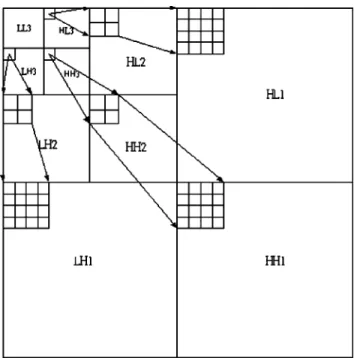
A wavelet-transformed image typically has a nonuniform distribution of energy within and across subbands. This dis-tribution motivates the partitioning of each subband into regions, and the assigning of each region to a class, based on region energy. This classifying approach has led to very effective image compression algorithms. The SPIHT algo-rithm, introduced by Said and Pearlman, is an efficient method for lossy and lossless coding of natural images. The SPIHT algorithm adopts a hierarchical quadtree7data struc-ture on a wavelet-transformed image. The energy of a wavelet-transformed image is centered on the low-frequency coefficients. The coefficients are ordered in hier-archies. Figure 1 presents the parent-child relationship
through the subbands. According to this relationship, the SPIHT algorithm saves many bits that specify insignificant coefficients.
Normally, most of an image’s energy is concentrated in the low-frequency components. Therefore, the variance de-creases from the highest to the lowest levels of the subband pyramid. Moreover, a spatial self-similarity has been ob-served to exist between subbands, and the coefficients are expected to be more effectively magnitude ordered as the pyramid descends. For instance, large, low-activity areas are identified in the highest levels of the pyramid, and they are replicated in the lower levels at the same spatial loca-tions. A tree structure, called a spatial orientation tree 共SOT兲, naturally defines the spatial relationship on the hi-erarchical pyramid. Figure 1 shows how a spatial orienta-tion tree is defined in a pyramid constructed with recursive four-subband splitting. Each node of the tree corresponds to a pixel and is identified by the pixel’s coordinate. Its direct descendants 共offspring兲 correspond to the pixels of the same spatial orientation in the next finer level of the pyra-mid. The tree is defined such that each node has either no offspring共the leaves兲 or four offspring, which always form a group of 2⫻2 adjacent pixels. In Fig. 1, the arrows are oriented from the parent node to its four offspring. The pixels in the highest level of the pyramid are the tree’s roots and are also grouped in groups of 2⫻2 adjacent pixels. In the original SPIHT algorithm, the set of the root node and corresponding descendents are defined as a SOT, and three lists are used in encoding the list of significant pixels 共LSP兲, the list of insignificant pixels 共LIP兲, and the list of the insignificant sets共LIS兲. All lists have the queue struc-ture; the order is first-in first-out共FIFO兲. Initially, the LSP is empty, and the LIP is formed by the elements of the lowest-frequency subband, and the LIS is the roots of the SOT. The wavelet coefficients are encoded and transmitted in multiple passes in the SPIHT algorithm, as follows.
Eqs.共1兲 and 共2兲.
2. Sorting pass: when u⫽n, n is the integer. The pixel that satisfies T(n)⭐兩c(i, j)兩⬍2T(n) is identified as significant. c(i, j ) is the coefficient. The pixel’s posi-tion and sign bit must be encoded.
3. Refinement pass: the pixels that satisfy 兩c(i, j)兩 ⭓2T(n) are refined by encoding the n’th most sig-nificant bit of those whose coordinates were transmit-ted in the previous sorting pass.
4. Increase u by 1, and go to step 2.
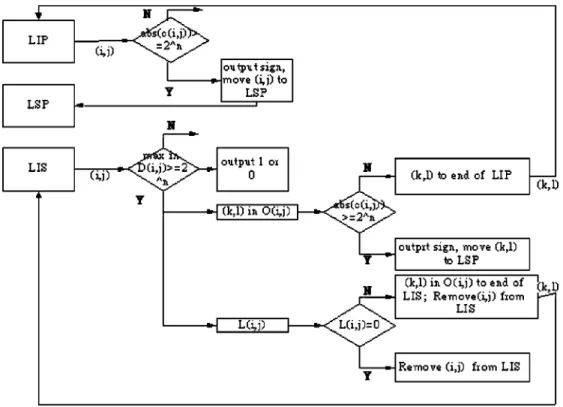
Figure 2 shows the encoding process in the SPIHT algo-rithm. If the coefficient is significant 关T(n)⭐兩c(i, j) 兩⬍2T(n)兴, then the coefficient is moved to the LSP, and the sign bit is encoded. For each node in the LIS, if any descendent is found to be significant, 兩D(i, j)兩⭓T(n), D(i, j ) refers to the nodes of the quadtree of which c(i, j ) is a root, then the children are moved to the LSP and re-moved from the LIP. The child nodes are placed at the end of the LIS. The SPIHT algorithm can define recursively using the sequence of thresholds.8
3 Proposed Method
A method is proposed to modify the original SPIHT algo-rithm to make it suitable for medical images. The original SPIHT algorithm was an efficient method for lossy and lossless coding of natural images. The original SPIHT al-gorithm is modified according to the characteristic that the wavelet coefficients of the medical images are more cen-tered on the low frequency than those of natural images. The contours of medical image contents have less edge than those of natural image contents. Additionally, the qual-ity of medical compressed images must support the diagno-sis.
The original SPIHT algorithm ignores the correlation within the same level of subbands, such as LH3, HL3, and HH3. For the insignificant coefficients at high frequency, the original SPIHT algorithm saves space using the quadtree concept. The modified SPIHT algorithm not only inherits the quadtree concept, but also deals with the corre-lation within the same level subbands to reduce the bit rate. In Fig. 1, the nodes共coordinates in LL3) have no descen-dent trees; the nodes共coordinates in LH3, HL3, and HH3) are the roots of the quadtree, and the rest of the nodes 共coordinates in other subbands兲 are tree nodes. LH3, HL3, Fig. 1 Parent-child relationship.
and HH3 are strongly correlated. Table 1 shows the corre-lation at the corresponding coordinate in LH3, HL3, and HH3 in several types of medical images 共Fig. 3兲. The ‘‘same’’ condition implies that the coefficients at corre-sponding coordinates in LH3, HL3, and HH3 have unim-portant values. The ‘‘different’’ condition implies that the coefficients at corresponding coordinates in LH3, HL3, and HH3have at least one important value. For example, if the image decomposed into seven subbands and the first threshold value is 32 in Fig. 4, then the coefficients at cor-responding coordinates in LH3, HL3, and HH3 subbands and their offspring are all lower than the threshold value 32. In Fig. 4, the coefficients in the ellipse are insignificant, and this situation is defined as the ‘‘same’’ condition and the value 0 is sent to the decoder. The coefficients at corre-sponding coordinates in LH3, HL3, and HH3 subbands and their offspring exceed the threshold value 32 by at least one. In Fig. 4, the coefficients in the dotted rectangle are at least significant, and this situation is defined as the
‘‘differ-ent’’ condition, and the value 1 and the position of the significant coefficient are sent to the decoder. In the Xhead1 test image关Fig. 3共b兲兴, the percentage of insignificant coef-ficients at corresponding coordinates in LH3, HL3, and HH3 subbands is 97.5%. This statistic shows that the per-centage of significant coefficients in subbands共not include LL3) is rare. These coefficients are essential in reconstruct-ing image edges. Large redundancies were hidden in these coefficients. In the Utheart3 test image, the percentage as-sociated with the ‘‘different’’ condition was higher than other test images, primarily because the Utheart3 sample context is more complex than the others. Table 2 indicates the correlation of the corresponding coordinate in LH1, HL1, HH1, LH2, HL2, and HH2 in all recursions in sev-eral types of images. The ‘‘same’’ condition implies that the treenode’s coefficients are unimportant on a quadtrees whose roots are at corresponding coordinates in LH3, HL3, and HH3. The ‘‘different’’ condition implies that the treenode’s coefficients are at least important on a quadtree whose roots are at corresponding coordinates in LH3, HL3, and HH3. That is, the medical image encoded by the original SPIHT algorithm has several redundancies.
The same level subband relationship that is ignored by the original SPIHT algorithm is exploited here to reduce redundancy. After a wavelet is transformed, the energy is centered on the wavelet coefficients in the low-low band. Accordingly, the modified SPIHT algorithm divides a wavelet-transformed image into three partitions.
␣⫽兵C共x,y兲兩共x,y兲 in LL3其,
⫽兵C共x,y兲兩共x,y兲 in LH3,HL3,HH3其, Fig. 2 Original SPIHT algorithm flowchart.6
Table 1 Percentages of important coefficients at corresponding
co-ordinates inLH3, HL3, andHH3for several kinds of medical im-ages. Same condition (inLH3,HL3,HH3) Different condition (inLH3,HL3,HH3) Xhead1 97.5% 2.5% Angio2 95.0% 5.0% Ctbone2 93.4% 6.6% Ercp2 95.6% 4.4% Utheart3 80.4% 19.6%
␥⫽兵C共x,y兲兩共x,y兲 in LH2,HL2,HH2,LH1,HL1,HH1其. The partitions include␣as a partition of the low-frequency coefficients,as a partition of the middle-frequency coef-ficients, and ␥ as a partition of the high-frequency coeffi-cients. C determines whether wavelet coefficients are sig-nificant, and (x, y ) is the coordinate of the image. If the wavelet coefficient c(x,y ) exceeds the threshold value T, then C(x,y ) is set to 1. If the wavelet coefficient c(x,y ) is below the threshold value T, then C(x,y ) is set to 0. 3.1 For␣⫽兵C(x,y)兩(x,y) inLL3其
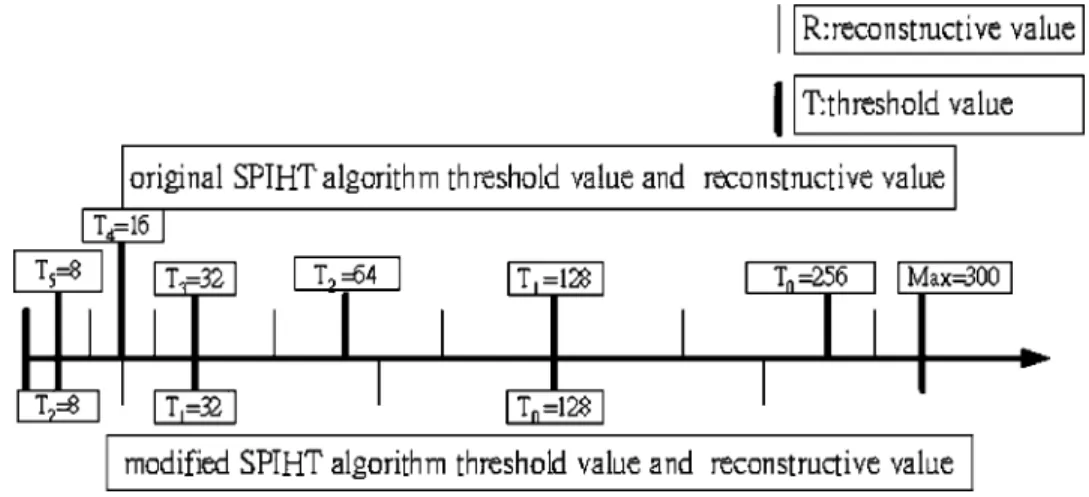
Each recursion in the original SPIHT algorithm must send a bit map C(x,y ) in LL3, from the threshold value at T0 to T1(T1⫽T0/2), and reduce the reconstructive value from R0 to R1(R1⫽R0/2). Both the threshold value T and the re-constructive value R follow geometric progressions. The threshold value must be decreased to reduce the number of encoding bits. The threshold value T1 was changed from T0/2 into T0/4 in each recursion. It follows also a geometric progression. Meanwhile, if the reconstructive value R is changed from T0/2 to T0/4, the exact value would yield an
unbalanced distribution. To prevent this phenomenon, the reconstructive value R should be calculated by R1⫽(T1 ⫹R0)/2, and the exact value would yield a balanced distri-bution. The reduction in the recursive number yields a con-siderable compression advantage, and the bit rate is re-duced by 0.05 to 0.1 bpp. Figure 5 shows that the original SPIHT algorithm needed six recursions, and the modified SPIHT algorithm needed just three. The exact value is not changed and balanced.
3.2 For⫽兵C(x,y)兩(x,y) inLH3,HL3,and HH3其 The modified SPIHT algorithm uses a set w to reduce the redundancy of partition . The original SPIHT algorithm does not consider the correlation in the same level sub-bands. The modified SPIHT algorithm adopts a set w, and w records which subband among LH3, HL3, and HH3has a significant coefficient. The modified SPIHT algorithm adopts a set w to eliminate the correlation in the same level subbands.
w⫽兵w共x,y兲兩LH3共x,y兲艛HL3共x,y兲艛HH3共x,y兲其.
The partition w must be sent to the decoder. If w(x,y ) ⫽1, then the values in LH3(x, y ), HL3(x, y ), and HH3(x,y ) would be send to the decoder. If w(x, y )⫽0, nothing is sent to the decoder, unlike the original SPIHT, which sends all the bits of LH3(x,y ), HL3(x,y ), and HH3(x,y ) to the decoder. The method can reduce the bit rate about 0.1 to 0.2 bpp at a given peak signal-to-noise ratio共PSNR兲.
Fig. 3 Test image.
Table 2 Percentages of important coefficients in treenodes whose
roots are at corresponding coordinates inLH3,HL3, andHH3in all recursions for several kinds of medical images.
Same condition Different condition
Xhead1 99.7% 0.3%
Angio2 97.3% 2.7%
Ctbone2 97.6% 2.4%
Ercp2 97.4% 2.6%
3.3 For ␥⫽兵C(x,y)兩(x,y)
inLH2,HL2,HH2,LH1,HL1,and HH1其
The modified SPIHT algorithm proposes a method共called the dictator兲 to reduce the redundancy in partition ␥. This partition includes few significant coefficients, and the origi-nal SPIHT algorithm suggests the use of one bit to repre-sent whether the significant coefficient is in the quadtree. The fact that a quadtree includes at least one significant coefficient is represented as 1. That all of the nodes in the quadtree are insignificant coefficients is presented as 0. The subbands originally neglected by the SPIHT algorithm ex-hibit quite a large correlation among the same level sub-bands, and the modified SPIHT algorithm presents the dic-tator to solve this problem. According to the quadtree concept, a correlation exists between LH1 and LH2. Equally the correlation exists between HL1 and HL2, and the correction exists between HH1 and HH2. Therefore, LH2, LH1, HL2, HL1, HH2, and HH1 are divided into three partitions, Qt, t⫽1, 2, and 3.
Q1⫽兵LH2艛LH1其, Q2⫽兵HL2艛HL1其, Q3⫽兵HH2艛HH1其.
The set Su, u⫽1, 2, and 3 is defined. The set Su indicates whether the subtree coefficients in Qt are significant.
S1is modified by the following conditions in the set Q1: S1共I,J兲⫽1, if LH1共x,y兲⫽1, I⫽bx/4c and J⫽by/4c. S1共I,J兲⫽1, if LH2共x,y兲⫽1, I⫽bx/2c, and J⫽by/2c. S1共I,J兲⫽0, otherwise.
Q2 and Q3 in the same steps result in S2 and S3. The correlation among the three sets (S1,S2,S3) is greater than, so the modified SPIHT algorithm creates the dictator that determines what subband has significant coefficients. The dictator d will decide what needs to be sent.
d⫽兵d共m,n兲兩T1共m,n兲艛T2共m,n兲艛T3共m,n兲其.
Figure 6 shows the concept and framework of the dictator. The oblique-line block is the set Su, u⫽1, 2, and 3. This saves in the bits required to represent insignificant coeffi-cients.
From d, the subband with significant coefficients can be identified. The subbands with significant coefficients are classified into seven types, encoded according to the sig-nificant coefficients in the various subbands.
Seven types are as follows. (LH means LH1 or LH2; HL means HL1 or HL2; and HH means HH1 or HH2.)
Type 1: the significant coefficients are in LH. Type 2: the significant coefficients are in HL. Type 3: the significant coefficients are in HH. Type 4: the significant coefficients are in LH and HL. Type 5: the significant coefficients are in LH and HH. Type 6: the significant coefficients are in HL and HH. Fig. 5 In each recursion, thresholdTand reconstructive valueR.
Fig. 6 The modified SPIHT algorithm uses the dictator concept and framework.
Type 7: the significant coefficients are in LH, HL, and HH.
For example, type 6 refers to significant coefficients in HL and HH. Accordingly, the bitmap of LH and HH is encoded to indicate the positions of significant coefficients. The sign information of significant coefficients is also en-coded.
The modified SPIHT algorithm differs from the original SPIHT algorithm in reducing redundancy of the same level subband. Figure 7 presents the complete block diagram of the encoder for compressing still images. First, we input the test image, and the test image passes through three wavelet transforms. Then, the modified SPIHT algorithm finds the maximum MAX that is sent to the decoder, and calculates
the number of recursions, RUN. Then, the modified SPIHT algorithm deals with partition␣in a sorting pass that is the same as that of the original SPIHT algorithm. The modified SPIHT algorithm sends Q, which includes the bitmap and the sign information of significant coefficients. Partition is handled by a combined function that reduces the inter-band redundancy in partition, and then outputs B, which includes information indicating which subband has signifi-cant coefficients. The modified SPIHT algorithm deals with partition␥ using a dictator function and outputs W, which decides what should be sent. According to output W, sub-bands with significant coefficients are classified into seven types to save bits and output information R. The modified SPIHT algorithm also uses the refinement pass and sends G that includes the bits to correct the reconstructed value. Finally, entropy coding is used to improve performance.
4 Simulation Result
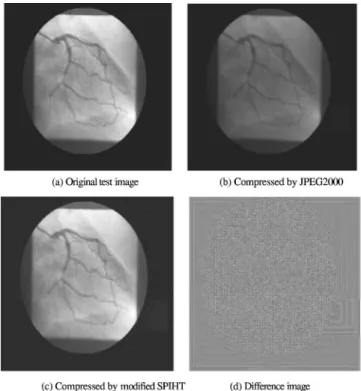
Various kinds of medical images are selected as test data. They include angiogram 关Fig 8共a兲兴, sonogram 关Fig. 9共a兲兴, and x-ray 关Fig. 10共a兲兴 images. All are gray-level images with a size of 512⫻512 pixels with 8 bpp. The proposed algorithm is compared with JPEG2000, which adopts origi-nal SPIHT and trellis-coded quantization 共TCQ兲. The per-formance is evaluated by PSNR. PSNR is mathematically evaluated as PSNR⫽10 log10 255 2 1 T
兺
i⫽0 n⫺1兺
j⫽0 n⫺1 共xi, j⫺xi, j⬘
兲 2 . 共3兲Fig. 8 (a) Angiogram test image; (b) compressed by JPEG2000 with a bit rate⫽0.1 bpp and PSNR value⫽44.1 dB; (c) compressed by modified SPIHT with a bit rate⫽0.1 bpp and PSNR value⫽45.2 dB; and (d) difference image.
Fig. 7 Modified SPIHT algorithm flowchart.
Fig. 9 (a) Sonogram test image; (b) compressed by JPEG2000 with a bit rate⫽1.4 bpp and PSNR value⫽40.6 dB; (c) compressed by modified SPIHT with a bit rate⫽1.4 bpp and PSNR value⫽43.3 dB; (d) difference image.
PSNR has been accepted as a widely used measure of qual-ity in the field of image compression.
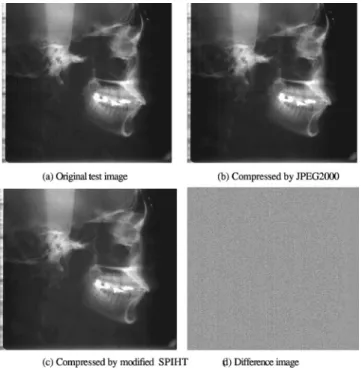
Figures 8, 9, and 10 present test images. Figure 8共a兲 shows the original image. Figure 8共b兲 shows an angiogram image decoded by JPEG2000 at a bit rate of 0.1 bpp with a PSNR of 44.1 dB. Figure 8共c兲 shows an angiogram image decoded by modified SPIHT at a bit rate of 0.1 bpp with a PSNR of 45.2 dB. Figure 8共d兲 shows the difference image. The quality of the modified SPIHT is excellent and the only difference is in the outline of the circular. Table 3 compares the PSNR values at various bit rates obtained using the original SPIHT, JPEG2000, and the modified SPIHT. At a given bit rate, the modified SPIHT PSNR values are abso-lutely higher than these of JPEG2000 and the original SPIHT. Figure 9共a兲 is a sonogram image with text to record information about the patient. This property of the image raises difficulties in compression and is not displayed by other images. Even so, the decoded quality of texts and electrocardiogram 共ECG兲 waveforms is acceptable for di-agnosis, as shown in Fig. 9共c兲, which shows an electrocar-diogram image decoded by a modified SPIHT algorithm at
a bit rate of 1.4 bpp with a PSNR value of 43.3 dB. Figure 9共b兲 shows an electrocardiogram image decoded by JPEG2000 at a bit rate of 1.4 bpp with a PSNR value of 40.6 dB. Figure 9共d兲 shows that the difference has no in-tention. In Table 4, the PSNR values at different bit rates are compared for the original SPIHT, JPEG2000, and the modified SPIHT. At a given bit rate, the modified SPIHT PSNR values are absolutely higher than those of the origi-nal SPIHT and JPEG2000. Figure 10共a兲 shows an X-ray image. Figure 10共b兲 shows an electrocardiogram image de-coded by JPEG2000 at a bit rate of 0.8 bpp with a PSNR of 41.9 dB. Figure 10共c兲 shows an electrocardiogram image decoded by modified SPIHT at a bit rate of 0.8 bpp with a PSNR of 43.6 dB. Table 5 compares the PSNR at various bit rates for the original SPIHT, JPEG2000, and the modi-fied SPIHT. At a given bit rate, all of the modimodi-fied SPIHT PSNR values are higher than those of the original SPIHT and JPEG2000.
5 Conclusion
The challenges posed by medical imaging involve the de-velopment of compression algorithms that are nearly loss-less for diagnoses, yet support high-compression ratios to reduce storage, transmission, and processing. We state that while the original SPIHT algorithm was proposed to achieve good performance, the modified SPIHT algorithm is a modification to suit medical images. This is the first technique that has employed a SPIHT algorithm to com-press medical images. Employing this strategy to comcom-press a huge volume of medical images reduces bandwidth and capacity. Moreover, the high-decoded quality prevents mis-diagnosis, making the management of medical images more effective.
The main aim of this work is to find a bit-rate-reduced method for saving on storage and achieving fast transmis-sion of a remote diagnosis. The modified SPIHT algorithm reduces the redundancy more than the original SPIHT al-Fig. 10 (a) X-ray test image; (b) compressed by JPEG2000 with a
bit rate⫽0.8 bpp and PSNR value⫽41.9 dB; (c) compressed by modified SPIHT with a bit rate⫽0.8 bpp, PSNR value⫽43.6 dB; and (d) difference image.
Table 3 PSNR for the original SPIHT, JPEG2000, and modified SPIHT at various bit rates in an angiogram test image.
Bit rate (bpp) Original SPIHT PSNR (dB) JPEG2K PSNR (dB) Modified SPIHT PSNR (dB) 0.025 33.4 36.1 39.5 0.10 40.3 44.1 45.2 0.24 45.4 47.6 48.4 0.50 49.8 50.5 52.0
Table 4 PSNR values for the original SPIHT, JPEG2000, and modi-fied SPIHT at various bit rates in a sonogram test image.
Bit rate (bpp) Original SPIHT PSNR (dB) JPEG2K PSNR (dB) Modified SPIHT PSNR (dB) 0.35 31.5 34.5 35.0 0.80 37.4 37.9 38.4 1.40 41.2 40.6 43.3 2.77 49.3 48.00 50.6
Table 5 PSNR values for the original SPIHT, JPEG2000, and modi-fied SPIHT at various bit rates in an x-ray test image.
Bit rate (bpp) Original SPIHT PSNR (dB) JPEG2K PSNR (dB) Modified SPIHT PSNR (dB) 0.15 34.2 37.0 37.2 0.37 37.6 39.4 39.8 0.80 42.1 41.9 43.6 2.00 49.3 47.7 50.0
gorithm and JPEG2000. The modified SPIHT algorithm is better suited than JPEG2000 for compressing medical im-ages.
The simulation results indicate that the modified SPIHT algorithm can produce a reconstructed image with better medical images. The PSNR values of our proposed method are better than the PSNR values of JPEG2000, and those of Ref. 9 at a given bit rate. Figure 11 illustrates the PSNR values.
References
1. American College of Radiology共ACR兲/National Electrical Manufac-turers Association共NEMA兲 standards Publication for Data
Compres-sion Standards, NEMA Publication PS-2, Washington, D.C.共1989兲.
2. Digital Imaging and Communication in Medicine (DICOM), version 3, American College of Radiology共ACR兲/National Electrical Manu-facturers Association共NEMA兲 standards draft, 共Dec. 1992兲. 3. A. Said and W. A. Pearlman, ‘‘A new, fast, and efficient image codec
based on set partitioning in hierarchical trees,’’ IEEE Trans. Circuits
Syst. Video Technol. 7共3兲, 243–250 共Jun. 1996兲.
gineering from the National Taiwan University, Taipei, in 1982 and 1986, respectively, and PhD degree in computer science from the National Tsing Hua University, Hsinchu, Taiwan, in 1989. He is cur-rently a professor of electrical engineering at the National Chen Kung University, Tainan, Taiwan. His teaching and research inter-ests include design automation of very large scale integration, data compression, biomedical engineering, and computer algorithms. Yen-Yu Chen received his BS and MS in computer science from Tamkang University, Tamsui, Taiwan, in 1991 and 1993, respec-tively. He is currently working toward his PhD degree at the Institute of Electrical Engineering, National Cheng Kung University, Tainan, Taiwan. His research interests include biomedical signal processing, image processing, and data compression.
Wen-Chien Yan received the BS degree in information and com-puter engineering from Chung Yung Christian University, Chung Li, Taiwan, in 2001. She is now working toward an MS degree in elec-trical engineering with the Institute of Elecelec-trical Engineering at the National Chen Kung University, Tainan, Taiwan. Her current re-search interests include image processing and data compression.