Self-assembled monolayer-modified Ag anode for top-emitting polymer light-emitting diodes
Lai-Wan Chong, Yuh-Lang Lee,
a兲and Ten-Chin Wen
b兲Department of Chemical Engineering, National Cheng Kung University, Tainan, Taiwan 701, Republic of China and Advanced Optoelectronic Technology Center, National Cheng Kung University, Tainan, Taiwan 701, Republic of China
Tzung-Fang Guo
Institute of Electro-Optical Science and Engineering, National Cheng Kung University, Tainan, Taiwan 701, Republic of China
共Received 28 August 2006; accepted 6 November 2006; published online 7 December 2006兲 A self-assembled monolayer 共SAM兲, 4-fluorothiophenol 共4-FTP兲, is employed to modify the Ag anode of a top-emitting polymer light-emitting diode 共T-PLED兲 to enhance the hole injection and the performance of a T-PLED device. The results show that the reflectivity of the Ag anode does not decrease due to the formation of a SAM. A brightness of 68 981 cd/ m
2and a luminous efficiency of 10.3 cd/ A have been achieved for the 4-FTP-modified device. The improved performance is attributed to the work function increase of the Ag/4-FTP anode due to the presence of fluorine atoms at the outer surface of the modified anode. © 2006 American Institute of Physics.
关DOI: 10.1063/1.2404589兴
Top-emissive organic and polymer light-emitting devices 共T-OLEDs and T-PLEDs兲 have attracted increasing attention in recent years due to their potential in the fabrication of flat panel displays with high-contrast, full-color, low drive volt- age and head up displays. Because light is emitted from the semitransparent top cathode, T-O/PLEDs provide a feasible fabrication of organic light-emitting diode 共OLED兲 displays on opaque substrates 共such as silicon wafer兲 with pixel cir- cuits of thin-film transistors. Therefore, T-O/PLEDs are de- sirable to assure a high aperture ratio in active-matrix OLED displays.
In order to increase the luminous efficiency 共LE兲 in T-O/
PLEDs, an anode with a high reflectivity and a low electrical resistivity is necessary. Ag is a suitable material to fit these requirements due to its high reflectivity 共⬃94% at 520 nm兲 and low electrical resistivity 共1.47 ⍀ at 298 K兲.
1However, Ag is not considered an ideal anode for OLEDs due to the poor hole-injection efficiency from the Ag anode to the or- ganic layer. This result is caused by the low work function of Ag 共⬃4.3 eV兲 共Refs. 1 and 2 兲 and the mismatching between this work function and the ionization potential of organic materials commonly used in OLEDs. In previous studies, a thin silver oxide 共Ag
2O 兲 inserted between the Ag anode and organic layer was used to increase the Ag work function and to enhance hole-injection efficiency. However, the reflectiv- ity of the Ag anode decreased due to the formation of a silver oxide layer, which is known to be disadvantageous to the efficiency of a T-OLED device.
1,2Here, we report a facile method, self-assembled monolayer 共SAM兲, to modify the Ag anode without reducing its reflectivity. Moreover, the perfor- mance of T-PLEDs is dramatically enhanced by using a suit- able SAM.
SAMs have been applied to modify the anode surface of traditional OLEDs. The functions of SAMs reported in the literature for OLED applications include enhancing the inter-
facial compatibility between indium tin oxide 共ITO兲 anode and the hole transport layer 共HTL兲, enhancing adhesion and stability of HTL, acting as a surface dipolar layer to enhance charge injection,
3–8changing the work function of anode,
9acting as a current blocking layer,
10,11and acting as a mois- ture penetration blocking layer.
12,13Silane derivatives were always employed to form the SAMs on ITO in bottom- emitting OLEDs. For T-O/PLEDs with a Ag anode, thiol derivatives should be used as surface modifiers. In this letter, two kinds of benzene thiols, 4-fluorothiophenol 共4-FTP兲 and thiophenol 共TP兲, are used to modify the Ag anode. The pres- ence of a fluorine atom at the para position of the 4-FTP molecule is expected to induce a strong dipole due to its high electronegativity, leading to a higher work function of the Ag anode.
9The performance of the 4-FTP modified T-PLEDs should be different from a device modified by TP, which does not have a fluorine atom. The performance of the de- vices was found to be significantly affected by the introduc- tion of SAMs.
Two T-PLEDs 共Ag/HY-PPV/Ca/Ag and
Ag/ SAM/ HY-PPV/ Ca/ Ag兲 were prepared in this study. A silver film of 150 nm thickness was deposited on a glass substrate by thermal evaporation and used as an anode. The deposition was performed under a base pressure of 10
−6torr.
After the formation of a silver film, the Ag anode was im- mediately surface modified by immersing in 1 mM 4-FTP 共98%, Aldrich兲 or TP 共98%, Fluka兲 ethanol solution for 30 min. After the reaction, the substrates were rinsed with ethanol and dried in a nitrogen steam. “High-yellow” phenyl- substituted poly共para-phenylenevinylene兲 copolymer 共HY- PPV兲 was spin coated onto the Ag anodes and used as the light-emissive layer. Finally, a semitransparent top cathode, Ca 共12 nm兲/Ag 共17 nm兲, was vapor deposited under 10
−6torr. The active pixel area of the device was 6 mm
2. The current-voltage 共I-V兲 and luminance-voltage 共L-V兲 mea- surements were carried out by a current/voltage source mea- surement unit 共Keithley 2400兲 and a calibrated silicon pho- todiode driven by a Keithley source. All the measurements
a兲Electronic mail: [email protected]
b兲Electronic mail: [email protected]
APPLIED PHYSICS LETTERS 89, 233513 共2006兲
0003-6951/2006/89共23兲/233513/3/$23.00 89, 233513-1 © 2006 American Institute of Physics
Downloaded 20 Nov 2008 to 163.28.112.100. Redistribution subject to AIP license or copyright; see http://apl.aip.org/apl/copyright.jsp
were performed in a nitrogen-filled glovebox. X-ray photo- electron spectroscopy 共XPS兲 共VG ESCA-210兲 equipped with a Mg K ␣ source 共1253.6 eV兲 was used to analyze the surface composition of the modified Ag substrates. The reflectivity of the Ag surfaces was measured by a Hitachi U-4100 UV- Vis-NIR spectrometer. The work functions of the anode elec- trodes were measured by a Riken Keiki AC-2 photoelectron spectroscopy in air.
The Ag anodes modified by the SAM were first analyzed by XPS. High resolution XPS scans over the S
2pand F
1sbinding energy regions of the SAM-modified Ag anodes are presented in Fig. 1, as well as the result recorded for a bare Ag surface. In Fig. 1共a兲, the feature peak of S
2phas a doublet structure at 161.9/ 163.2 eV, corresponding to the S
2p3/2and S
2p1/2peaks of silver thiolate sulfur species 共Ag–S–R兲. This result is consistent with the result reported for a thiolate on a gold surface.
14,15The S
2ppeaks appear only on 4-FTP- and TP-modified anodes, demonstrating that the two thiol mol- ecules have bound to the Ag surface. In Fig. 1 共b兲 , the peak at 686.5 eV appearing on the 4-FTP-modified anode is consis- tent with the binding energy of a fluorine atom bonded to an aromatic ring.
16It is reasonable that the F
1speak does not appear on the TP-modified and unmodified Ag anodes.
The reflectivity measurement reveals that the reflectivity of the Ag anode did not decrease after the modification of SAMs. The measured reflectivities on Ag/4FTP and Ag/TP surfaces were 97.5% at 541 nm, which is slightly higher than the reflectivity measured on a bare Ag surface 共96.9%兲. It is inferred that the SAM formed on the Ag surface can prevent the oxidation of a Ag surface and is thus responsible for the slight increase in reflectivity.
The effect of the SAMs on hole injection was studied first by using aluminum as a cathode. Due to the high work function of aluminum, the electron injection was inhibited
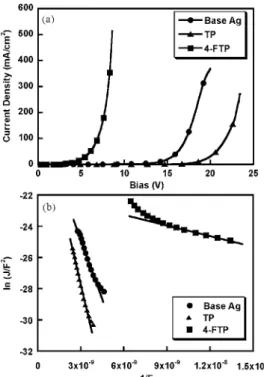
and the devices should be hole dominated. The I-V charac- teristics of Ag/ HY-PPV/ Al and Ag/ SAM/ HY-PPV/ Al de- vices are shown in Fig. 2共a兲. The threshold voltage of the charge injection of the 4-FTP-modified device is greatly re- duced compared with the base one. However, an increase of the threshold voltage is observed for the TP-modified device.
This result is attributable to the change in work function due to the formation of SAM. The work functions of the three anodes measured by AC-2 photoelectron spectroscopy are 4.6 eV for the bare Ag, 5.2 eV for Ag/4FTP, and 4.1 eV for Ag/TP. The higher work function of the Ag/4-FTP anode is attributed to the presence of the fluorine at the para position of the benzene ring. The high electronegativity of fluorine atoms leads to a polarization of electrons toward the fluorine atom, which also increases the work function of the Ag/4- FTP anode. Therefore, the hole-injection barrier between the Ag/4-FTP anode and HY-PPV is greatly decreased. This re- sult is consistent with the effect of perfluorinated alkanethiol SAMs reported by de Boer et al.
9For the Ag/TP anode, without the presence of fluorine on the benzene ring, the polarization of electrons have an opposite direction to that of Ag/4-FTP. Therefore, the TP SAM demonstrates the opposite effect on the work function and hole injection.
The hole injection of these devices was also examined by the Fowler-Nordheim 共FN兲 tunneling theory J⬀F
2exp共
− / F兲, where J is the current density of device, F is the electric field under bias, and is a parameter related to the shape of the injection barrier height 共 兲. Figure 2共b兲 shows the plots of ln共J/F
2兲 vs 1/F for the hole-only devices. The straight-line FN curves shown for these devices indicate that the holes are injected through the tunneling process and are the dominant charge carriers. It has been reported that the slope of the line is proportional to
3/2.
11,17The slope of these curves indicates that the hole-injection barrier for these devices increase in the order Ag/ 4-FTP ⬍Ag⬍Ag/TP. This result is consistent with the barrier height evaluated from the direct measurement of the work function. The higher work
FIG. 1. High resolution XPS scans of S2p共a兲 and F1s共b兲 regions for the Ag anodes with or without the modification of SAM.
FIG. 2. I-V characteristics 共a兲 and Fowler-Nordheim plots 共b兲 for the Ag/ HY-PPV/ Al and Ag/ SAM/ HY-PPV/ Al devices.
233513-2 Chong et al. Appl. Phys. Lett. 89, 233513共2006兲
Downloaded 20 Nov 2008 to 163.28.112.100. Redistribution subject to AIP license or copyright; see http://apl.aip.org/apl/copyright.jsp
function of the Ag/4-FTP anode leads to a lower barrier for the injection of holes, resulting in a lower onset potential and higher current density of the related device.
To enhance the electron injection and the device effi- ciency of the top-emission device, a semitransparent Ca/ Ag layer was used as a cathode. The I-V characteristics shown in Fig. 3共a兲 demonstrate that the effect of the SAMs on the onset potential is similar to the hole-dominant devices shown in Fig. 2共a兲. The voltages required to obtain a current density of 1 mA/ cm
2are 3.2, 5.4, and 7.5 V for Ag/4-FTP, base Ag, and Ag/TP anodes, respectively. The effect of the SAMs on luminance performance is very significant, as shown in Fig.
3共b兲. For the Ag/4-FTP anode, the maximum brightness is 68 981 cd/ m
2biased at 9 V. However, the brightness for the unmodified Ag and Ag/TP anodes are only 1006 and 65 cd/ m
2, respectively, at the same bias. The luminous effi- ciencies of the devices are shown in the inset of Fig. 3共b兲. At a light intensity of 1000 cd/ m
2, the LE of the Ag/4-FTP device is as high as 9.9 cd/ A, which is fivefold higher than the efficiency of a base device 共1.7 cd/A兲. Although the lu- minous efficiency decreases slightly with an increase of cur- rent density, the efficiency remains high in the higher bright-
ness regime. For the Ag/TP anode, the efficiency is only 0.8 cd/ A at 1000 cd/ cm
2, attributable to the blocking effect on hole injection.
In summary, SAM is found to be a facile method to modify the Ag anodes for application in T-PLED. A 4-FTP- modified Ag electrode can be utilized as an effective anode to improve the emitting characteristic of a T-PLED. The Ag/
4-FTP anode can enhance the hole injection, reduce the op- eration voltage, and significantly increase the current inten- sity and luminous efficiency of the device, without decreasing the reflectivity of the Ag anode. The improved performance of the device is mainly attributed to the higher work function of the Ag/4-FTP anode induced by the pres- ence of fluorine atoms at the outer surface of the modified anode. For the TP-modified device, a contrary result is ob- tained due to the absence of fluorine atoms.
The authors would like to thank the National Science Council 共NSC兲 of Taiwan 共NSC95-2221-E-006-324 and NSC95-2221-E-006-409-MY3 兲. Sung-Nien Hsieh is grate- fully acknowledged for his helpful discussion. Ruei-Tang Chen from Eternal Chemical Co., Ltd., is appreciated for providing the HY-PPV polymer. Ching-Chang Tseng from Chi Mel EL Corporation is thanked for detecting the work functions of the anode electrodes.
1H.-W. Choi, S.-Y. Kim, K.-B. Kim, Y.-H. Tak, and J.-L. Lee, Appl. Phys.
Lett. 86, 012104共2005兲.
2C.-W. Chen, P.-Y. Hsieh, H.-H. Chiang, C.-L. Lin, H.-M. Wu, and C.-C.
Wu, Appl. Phys. Lett. 83, 5127共2003兲.
3J. Lee, B.-J. Jung, J.-I. Lee, H. Y. Chu, L.-M. Do, and H.-K. Shim, J.
Mater. Chem. 12, 3494共2002兲.
4M. Carrard, S. Goncalves-Conto, L. Si-Ahmed, D. Adès, and A. Siove, Thin Solid Films 352, 189共1999兲.
5S. F. J. Appleyard, S. R. Day, R. D. Pickford, and M. R. Willis, J. Mater.
Chem. 10, 169共2000兲.
6R. A. Hatton, M. R. Willis, M. A. Chesters, F. J. M. Rutten, and D. Briggs, J. Mater. Chem. 13, 38共2003兲.
7J. Cui, Q. Huang, J. G. C. Veinot, H. Yan, and T. J. Marks, Adv. Mater.
共Weinheim, Ger.兲 14, 565 共2002兲.
8S. Khodabakhsh, D. Poplavskyy, S. Heutz, J. Nelson, D. D. C. Bradley, H.
Murata, and T. S. Jones, Adv. Funct. Mater. 14, 1205共2004兲.
9B. de Boer, A. Hadipour, M. M. Mandoc, T. van Woudenbergh, and P. W.
M. Blom, Adv. Mater.共Weinheim, Ger.兲 17, 621 共2005兲.
10J. E. Malinsky, G. E. Jabbour, S. E. Shaheen, J. D. Anderson, A. G.
Richter, T. J. Marks, N. R. Armstrong, B. Kippelen, P. Dutta, and N.
Peyhambarian, Adv. Mater.共Weinheim, Ger.兲 11, 227 共1999兲.
11C.-C. Hsiao, C.-H. Chang, M.-C. Hung, N.-J. Yang, and S.-A. Chen, Appl.
Phys. Lett. 86, 223505共2005兲.
12Y. Koide, Q. Wang, J. Chu, D. D. Benson, and T. J. Marks, J. Am. Chem.
Soc. 122, 11266共2000兲.
13B. Choi, J. Rhee, and H. H. Lee, Appl. Phys. Lett. 79, 2109共2001兲.
14H. Rieley, G. K. Kendall, F. W. Zemicael, T. L. Smith, and S. Yang, Langmuir 14, 5147共1998兲.
15D. G. Castner, Langmuir 12, 5083共1996兲.
16N.-O. Persson, K. Uvdal, O. Almquist, I. Engquist, H. Kariis, and B.
Liedberg, Langmuir 15, 8161共1999兲.
17T.-F. Guo, F.-S. Yang, Z.-J. Tsai, T.-C. Wen, S.-N. Hsieh, and Y.-S. Fu, Appl. Phys. Lett. 87, 013504共2005兲.
FIG. 3. I-V 共a兲 and L-V 共b兲 characteristics for the Ag/HY-PPV/Ca 共12 nm兲/Ag 共17 nm兲 and Ag/SAM/HY-PV/Ca 共12 nm兲/Ag 共17 nm兲 de- vices. The inset is the luminous efficiency共LE兲 characteristics of the top- emitting devices.
233513-3 Chong et al. Appl. Phys. Lett. 89, 233513共2006兲