Effect of Kapitza contact and consideration of tube-end transport on the effective conductivity in nanotube-based composites
Tungyang Chen
a兲Department of Civil Engineering, National Cheng Kung University, Tainan 70101, Taiwan George J. Weng
Department of Mechanical and Aerospace Engineering, Rutgers University, New Brunswick, New Jersey 08903
Wen-Ching Liu
Department of Civil Engineering, National Cheng Kung University, Tainan 70101, Taiwan
共Received 15 July 2004; accepted 21 February 2005; published online 4 May 2005兲Recent studies reported that the theoretical predictions of the effective thermal conductivity of nanotube-based composites by conventional micromechanical models are anomalously higher than those measured experimentally and suggested that the contact resistance on the interface could be the contributing factor to the lower measured value. We explore theoretically whether the large disagreement could be attributed to the effect of Kapitza contact resistance. Our simulations show that the thermal contact resistance on the lateral surfaces of the nanotubes could not be a major factor of this marked disparity. By contrast, the heat transport mechanisms at the ends of the nanotubes could be a significant factor to influence the value. We propose a few simple models to simulate the thermal conductivity at the ends of the nanotubes, similar to two springs in serial and/or in parallel. Under the propositions, we find that the experimental data can be better predicted than the conventional theory and that the tube-end transport is, in general, poor. © 2005 American Institute of Physics.
关DOI: 10.1063/1.1896094兴I. INTRODUCTION
Carbon nanotubes have drawn enormous amount of ba- sic research because of the unique properties enabled by their nanoscale structure.
1–3Particularly, carbon nanotubes have unusually high thermal conductivities, axial Young’s modu- lus, and high strength. Among various applications, the de- velopment of nanocomposites based on carbon nanotubes is a promising direction in nanotechnology. For example, car- bon nanotubes have been embedded into polymers, epoxy resins, or silicone elastomer to get materials with good elec- tric and thermal transport properties.
4–8Recent experiments revealed that the effective thermal conductivity of carbon nanotube composites can be dramatically enhanced even with a very small amount
共less than 1 vol %兲 of nanotubes.7,8As such, it would be desirable to have a simple theoretical model to characterize the thermal transport behavior of car- bon nanotube composites. In a recent Letter, Choi et al.
7studied the effective conductivity of a nanotube-fluid suspen- sion. They found experimentally that at 1 vol % fraction of nanotubes the effective conductivity of the system can be dramatically enhanced, k
*/ k
1= 2.6. With the thermal conduc- tivity of nanotubes k
2at 2000 W / m K and that of the oil
共thematrix
兲 k1at 0.1448 W / m K, the conventional theoretical predictions
9–13using spherical inclusions give the ratio k
*/ k
1= 1.03. This means that the measured data is much greater than that given by the theoretical models using spherical inclusions. Since nanotubes are not spherical and they are randomly oriented in the matrix Nan et al.
14later
incorporated the effect of the aspect ratio of the nanotubes and their random orientations, and found that a conventional effective medium theory similar to Maxwell–Garnett ap- proximation could lead to a higher estimate and give reason- able agreement with the experiment if one adopts the con- ductivity ratio of k
2/ k
1= 500. However, if we adopted the phase conductivity data suggested by Choi et al.,
7namely k
2/ k
1= 13800, the theoretical prediction
14now gives k
*/ k
m= 47.041, a factor of
⬃18 larger than the value measuredexperimentally. As remarked by Nan et al.
14and others,
15,16the marked disparity between the predictions and the experi- mental observation may be due to the interfacial contact re- sistance between the matrix and the nanotubes, as the pres- ence of nanotube/matrix interfacial thermal resistance may result in an energy loss and subsequently lead to a degrada- tion in the effective thermal conductivity. The objective of this work is to assess theoretically whether the effect of ther- mal contact resistance is a major source of this large discrep- ancy and, if not, to propose a model that can better predict the effective conductivity of this high-contrast problem.
II. THE KAPITZA CONTACT ON THE LATERAL SURFACE
To develop such a model, we have performed a theoret- ical analysis which incorporates the mechanism of Kapitza thermal contact resistance
17along the interfaces of the phases. We assume that both phases
共the nanotubes and thematrix
兲 obey the Fourier’s law of heat conduction, in whichthe thermal conductivities of the matrix
共phase 1兲 and thenanotube
共phase 2兲 are represented as k1and k
2respectively.
a兲Electronic mail: [email protected]
JOURNAL OF APPLIED PHYSICS 97, 104312共2005兲
0021-8979/2005/97共10兲/104312/4/$22.50 97, 104312-1 © 2005 American Institute of Physics
Downloaded 14 Apr 2010 to 140.116.208.53. Redistribution subject to AIP license or copyright; see http://jap.aip.org/jap/copyright.jsp
The mechanism of Kapitza thermal contact resistance as- sumes that the normal component of the heat flux is continu- ous across the interfaces, while the temperature T undergoes a discontinuity which is proportional to the normal compo- nent of the heat flux through an interface parameter
k
1T
1
n = k
2
T
2
n =
兩共T1− T
2兲兩⌫,
共1兲where n is the unit normal on the interface
⌫ defined by theinclusion to the matrix. Specifically, the thermal contact re- sistance can be constructed by a limiting process by assum- ing a thin interphase between the two phases with low conductivity.
18The constant
is non-negative and has the dimension of conductivity divided by length. The case of
→0 is usually referred to as the “adiabatic” boundary con- dition, while
→⬁ represents the perfect bonding condition.
We now consider a nanotube-based composite with carbon nanotubes randomly dispersed in a matrix. In analyzing the thermal transport behavior, an effective medium theory based on dilute approximation was employed to determine the ef- fective thermal conductivity. This theory, which simulates the composite as a single inclusion embedded in an infinite medium, is well suited in modeling the nanotube-based com- posite, particularly when the volume concentration of the inclusion phase is very small. To proceed, let us introduce a thermal intensity influence tensor T, which is defined as the average of the thermal intensity of the nanotubes versus the uniform intensity H
0japplied on the boundary. Also, let us define a jump factor J in the following
1
V
2冕⌫共T2− T
1兲nids
⬅ JijH
0j.
共2兲The geometry of the nanotube is simulated as a prolate spheroid characterized by an aspect ratio. As in microme- chanical estimates, the corresponding dilute influence func- tion can be written in terms of some elementary functions for a prolate spheroid.
19The effective thermal conductivity k
*of the composite, with thermal contact resistance on the inter- faces, can then be derived in the form
20k
*= k
1+ c
具共k2− k
1兲T典 − c具k1J
典, 共3兲where c
共⬅V2/ V
兲 is the volume fraction of the nanotubesand the angular bracket
具·典 stands for an average for all ori-entations of the nanotubes. Typically, nanotubes
7have a mean diameter of
⬃25 nm and a length of ⬃50m, which is nearly equal to an aspect ratio of 2000. Now, upon substi- tution of formulas of T and J into
共3兲, the effective conduc-tivity of the nanotube-based composite can be derived as
k
*= k
1+ c
冉3a
共1 + k8a
2/k k
11兲 + 6k2− 5 3 k
1+ 1
3 k
2冊,
共4兲where the constant a denotes the radius of the nanotube. To check the obtained formula, we first reduce the formula
共4兲to the perfect bonding situation by letting
→⬁ and k
2Ⰷk1. Interestingly, this exactly recovers Eq.
共9兲 ofNan et al.
14k
*k
1= 1 + ck
23k
1.
共5兲We mention that if one assumes that the inclusion is of spherical shape, the present dilute approximation gives k
*/ k
1= 1 + 3c, which also exactly agrees with the Maxwell–
Garnett formula
14and also agrees with Maxwell,
9Jeffrey,
10Hamilton and Crosser,
11Davis,
12and Lu and Lin,
13for k
2 Ⰷk1to the order of O共c兲.
Back to
共4兲, to examine the effect of thermal contactresistance we have made numerical calculations for k
*for various
ranging from
⬁ 共perfect bonding兲 to zero 共debond-ing
兲. To our surprise, the effect of thermal contact resistanceis not significant. Specifically, both the cases of
= 0 and

→⬁ yield the same value 共5兲, but the value k
*varies in between with no more than 6% for different values of
and for different ratios of k
2/ k
1. In particular, we notice that for a spheroidal tube with an aspect ratio greater than 100 the estimated conductivity
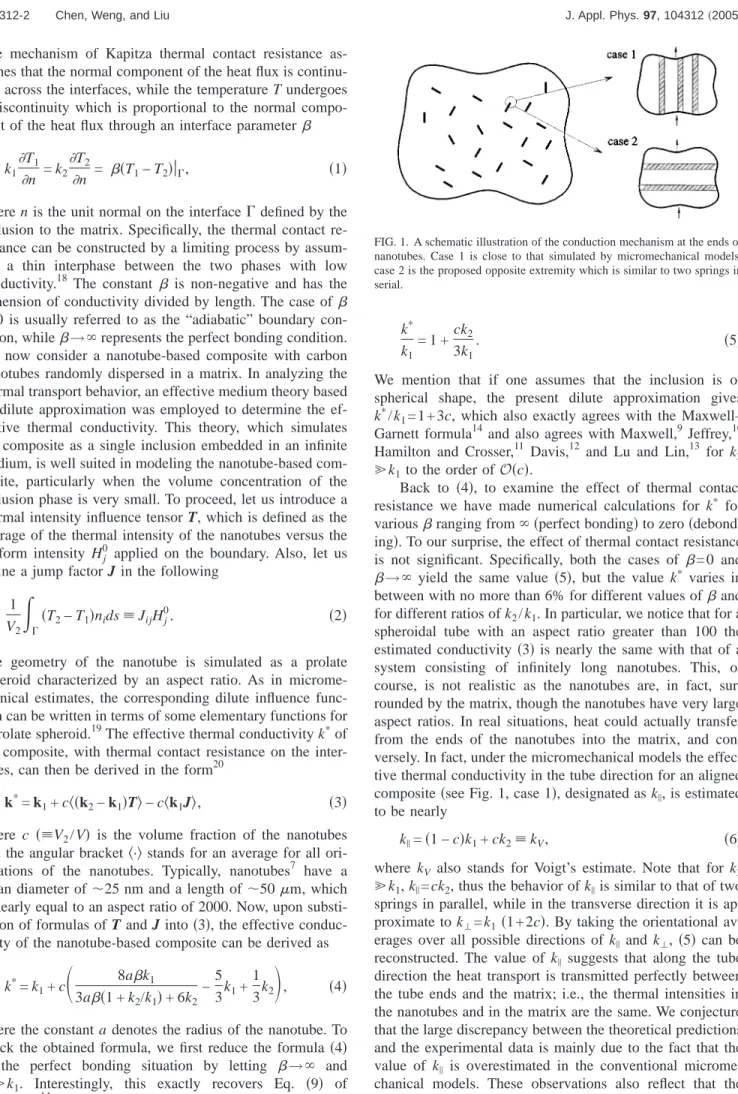
共3兲 is nearly the same with that of asystem consisting of infinitely long nanotubes. This, of course, is not realistic as the nanotubes are, in fact, sur- rounded by the matrix, though the nanotubes have very large aspect ratios. In real situations, heat could actually transfer from the ends of the nanotubes into the matrix, and con- versely. In fact, under the micromechanical models the effec- tive thermal conductivity in the tube direction for an aligned composite
共see Fig. 1, case 1兲, designated as k储, is estimated to be nearly
k
储=
共1 − c兲k1+ ck
2⬅ kV,
共6兲where k
Valso stands for Voigt’s estimate. Note that for k
2 Ⰷk1, k
储= ck
2, thus the behavior of k
储is similar to that of two springs in parallel, while in the transverse direction it is ap- proximate to k
⬜= k
1共1+2c兲. By taking the orientational av-erages over all possible directions of k
储and k
⬜,
共5兲 can bereconstructed. The value of k
储suggests that along the tube direction the heat transport is transmitted perfectly between the tube ends and the matrix; i.e., the thermal intensities in the nanotubes and in the matrix are the same. We conjecture that the large discrepancy between the theoretical predictions and the experimental data is mainly due to the fact that the value of k
储is overestimated in the conventional microme- chanical models. These observations also reflect that the marked disparity is not due to the thermal contact resistance
FIG. 1. A schematic illustration of the conduction mechanism at the ends of nanotubes. Case 1 is close to that simulated by micromechanical models;
case 2 is the proposed opposite extremity which is similar to two springs in serial.
104312-2 Chen, Weng, and Liu J. Appl. Phys. 97, 104312共2005兲
Downloaded 14 Apr 2010 to 140.116.208.53. Redistribution subject to AIP license or copyright; see http://jap.aip.org/jap/copyright.jsp
共i.e., the
effect
兲 on the lateral interface but could likely beattributed to the transport energy loss on the tube ends that has not been accounted for in the conventional microme- chanical models.
III. PROPOSITIONS FOR THE TUBE-END TRANSPORT A more realistic modeling in simulating the transport behavior of the tube ends is to consider the nanotube as a cylindrical inclusion with a finite length in which the tube ends are covered by hemisphere caps, and then examine the

effect on the tube ends. But to solve such a boundary-value problem, it would have to call for some complex mathemati- cal formulation. For the simplicity of studying the transport characteristics of the tube ends and to provide a simple jus- tification to support our conjecture, we now assume that the conduction behavior along the tube direction is similar to two springs in serial; that is, the heat flux along the tube direction is the same in the nanotubes as well as in the matrix
共see Fig. 1, case 2兲. This is the opposite extremity in contrastto that simulated by the micromechanical models
共Fig. 1,case 1
兲. Under this assumption, the effective thermal conduc-tivity along the tube direction for an aligned composite
共Fig.1, case 2
兲 is approximated ask
储=
关共1 − c兲k1−1
+ ck
2−1兴−1⬅ kR,
共7兲where k
Ralso stands for Reuss’s estimate. This tube-end con- ductivity
共7兲 allows us to determine the 33 components ofthe thermal intensity influence tensor T
33as
T
33= k
1ck
1+
共1 − c兲k2.
共8兲While in the transverse direction, the components of T and J are still extracted from the conventional micromechanical approach
20as those for k
*. Upon substitution of these back
共3兲, carrying out the orientational average, we can derive theaveraged effective conductivity as
k
∧=
冉1 − 4 3 c
冊k
1+ c
冉3a
共1 + k8a
2/k k
21兲 + 6k2+ 1 3
k
1共k2− k
1兲ck
1+
共1 − c兲k2冊.
共9兲Here, in distinction with the conventional micromechanical estimate k
*,
共4兲, we have designated this value as k∧. Note that for both k
*and k
∧, the Kapitza contact was not consid- ered in the tube ends but only on the lateral surface. This is due to the reasoning that the micromechanical models treat a high-aspect-ratio—say, larger than 100—spheroidal inclu- sion as an infinite long cylinder, and thus the
effect could not be incorporated in the formulation. To unravel the impli- cations of
共4兲 and 共9兲, we have made numerical calculationsfor k
*and k
∧for various
ranging from
⬁ 共perfect bonding兲to zero
共debonding兲. As anticipated, the values of k*and k
∧do differ a lot for each
value, while, by contrast, the effect of thermal contact resistance on the lateral surface of the nanotubes is rather minor. That is, for different
, the values of either k
*or k
∧do not vary much
共within 6%兲 for differentratios of k
2/ k
1. Since both k
*and k
∧are relatively insensitive
to
, we simplify
共4兲 and 共9兲 by letting →⬁ for conve- nience of application and making use of the fact that k
2 Ⰷk1. Under the simplications,
共4兲 will exactly recover Eq.共9兲 of Nan et al.,14
while
共9兲 is simply given byk
*k
1= 1 + ck
23k
1, k
∧k
1⬟ 1 +5
3 c.
共10兲We note that we did not claim that the estimate of k
∧is a better prediction nor a better lower bound, but rather that the estimate of k
∧simply serves here as a justification of our conjecture that the real tube-end transport phenomena is not perfect and is, in fact, rather poor.
Since the conventional micromechanical estimate for the axial conductivity along the tube ends k
储is analogous to that of Voigt’s estimate, while the present series model for k
储is like Reuss’s assumption in that direction, this suggests that the real effective behavior must lie somewhere between these two predictions. To further explore the significance of k
储, we now follow a recent idea proposed by Chiang and Weng
21in their examination of Hill’s
22theory of composite elasticity and simulate the value of k
储by the arithmetic mean, the geometric mean, and the reciprocal mean based on the Voigt’s and Reuss’s estimates of k
1and k
2, i.e.,
k
储A= 1
2
共kV+ k
R兲, k储G=
冑k
Vk
R, k
储Re= 2
冉k 1
V+ 1
k
R冊−1.
共11兲As for k
∧, the components of T and J in the transverse di- rection, counting the effect of
, are still extracted from the conventional micromechanical approach and the effective conductivity is derived by incorporating the orientational av- erages, while the component of T
33follows the step as in
共8兲.For clarity, we designate the resulting effective conductivity of nanotube-based composites based on these three different mean values for k
储, as k
A, k
G, and k
Re, respectively. The ex- plicit forms for k
A, k
G, and k
Recan be derived as
k
A= k
1+ c
共k2− k
1兲冉2 3 a
共1 + k2a
2/k
1兲 + 2k2+ 1 3 A
冊+ D,
k
G= k
1+ c
共k2− k
1兲冉2 3 a
共1 + k2a
2/k
1兲 + 2k2+ 1
3 B
冊+ D,
共12兲k
Re= k
1+ c
共k2− k
1兲冉2 3 a
共1 + k2a
2/k
1兲 + 2k2+ 1 3 C
冊+ D,
where the constants A, B, C, and D are defined as
A = 1 2
ck
1+ k
1+ k
2− ck
2k
2− ck
2+ ck
1,
B =
冑共共1 − c兲k1+ ck
2兲共1 − c兲kk
1k
22+ ck
1− k
1c
共k2− k
1兲,
共13兲
C =
2
冉共1 − c兲k1
1+ ck
2+
共1 − c兲k2+ ck
1k
1k
2 冊−1− k
1c
共k2− k
1兲,
104312-3 Chen, Weng, and Liu J. Appl. Phys. 97, 104312共2005兲
Downloaded 14 Apr 2010 to 140.116.208.53. Redistribution subject to AIP license or copyright; see http://jap.aip.org/jap/copyright.jsp
D = 2
3 c
2k
1冉a
2a
共1 + k共1 + k2/k
12兲 + 2k/k
1兲 2− 2
冊.
The variations for these predictions are demonstrated in Fig. 2 which shows a comparison for
共10兲 and 共12兲 and thereal experimental data from Choi et al.
7on nanotube suspen- sions in which the phase conductivities is suggested as k
2/ k
1= 13800. Again, we found that the
effect is rather minor and, as expected, the experimental data
7are indeed bounded between the values of k
*and k
∧. Particularly, we observed that the reciprocal model k
Reis closer to the experi- mental data than the others and could possibly serve as a good estimate. This suggests that the tube-end transport is, in general, poor, which confirms our earlier conjecture, and thus the conventional micromechanical model as suggested by Nan et al.
14could give an unexpected high estimate.
IV. CONCLUDING REMARKS
In summary, conventional micromechanical estimates k
*predict higher thermal conductivity in nanotube-based com- posite than what is actually measured in experiments. We have demonstrated that the thermal contact resistance along the lateral surfaces of the nanotubes could not be a major factor in this. By contrast, depending on the thermal transfer mechanisms at the ends of the nanotubes, the effective con- ductivity could vary significantly. In this work we simulated the conduction behavior at the ends of the nanotubes by a two-spring model in serial. A simple formula for the effective
conductivity k
∧based on this proposition has been derived. It turns out that the experimental data fall into the range be- tween k
∧and k
*but are much closer to k
∧. The present study suggests that conventional models may still work in nanos- caled composites, but the conduction phenomena around the tube caps
共ends兲 need to be properly simulated. The presentmodified micromechanical approach offers a simple method to characterize the tube-end transport behavior qualitatively and to explain the much lower experimental data as com- pared to the estimate of the conventional micromechanical models. Of course, the proposed modifications still do not have a rigorous physical basis, but our analyses strongly point to the implications that the tube-end transport is poor.
We hope that the present study may interest further investi- gations on the likely transport mechanisms on the tube caps experimentally, or from the standpoint of atomic or molecu- lar dynamic simulation.
ACKNOWLEDGMENTS
T.C. was supported by the National Science Council, Taiwan, under NSC Contract No. 93-2211-E006-005. G.J.W.
was supported by the National Science Foundation under CMS Grant No. 01-14801.
1R. H. Baughman, A. A. Zakhidov, and W. A. de Heer, Science 297, 787 共2002兲.
2S. Berber, Y.-K. Kwon, and D. Tomanek, Phys. Rev. Lett. 84, 4613 共2000兲.
3S. Maruyama, Physica B 323, 193共2002兲.
4R. Andrew and M. C. Weisenberger, Curr. Opin. Solid State Mater. Sci. 8, 31共2004兲.
5I. Alexandron, E. Kymakis, and G. A. J. Amaratunga, Appl. Phys. Lett.
80, 1435共2002兲.
6M. J. Biercuk, M. C. Llaguno, M. Radosavljevic, J. K. Hyun, A. T.
Johnsond, and J. E. Fischer, Appl. Phys. Lett. 80, 2767共2002兲.
7S. U. S. Choi, Z. G. Zhang, W. Yu, F. E. Lockwood, and E. A. Grulke, Appl. Phys. Lett. 79, 2252共2001兲.
8C. H. Liu, H. Huang, Y. Wu, and S. S. Fan, Appl. Phys. Lett. 84, 4248 共2004兲.
9J. C. Maxwell, A Treatise on Electricity and Magnetism共Clarendon, Ox- ford, 1873兲.
10D. J. Jeffrey, Proc. R. Soc. London, Ser. A 335, 355共1973兲.
11R. L. Hamilton and O. K. Crosser, IE&C Fundamentals 1, 187共1962兲.
12R. H. Davis, Int. J. Thermophys. 7, 609共1986兲.
13S. Lu and H. Lin, J. Appl. Phys. 79, 6761共1996兲.
14C. W. Nan, Z. Shi, and Y. Lin, Chem. Phys. Lett. 375, 666共2003兲.
15L. Xue, P. Keblinski, S. R. Phillpot, S. U. S. Choi, and J. A. Eastman, J.
Chem. Phys. 118, 337共2003兲.
16S. T. Huxtable et al., Nat. Mater. 2, 731共2003兲.
17P. L. Kapitza, J. Phys.共Moscow兲 4, 181 共1941兲.
18H. Pham Huy and E. Sanchez-Palencia, J. Math. Anal. Appl. 47, 284 共1974兲.
19H. Hatta and M. Taya, J. Appl. Phys. 58, 2478共1985兲.
20T. Chen, Int. J. Solids Struct. 38, 308共2001兲.
21C. R. Chiang and G. J. Weng, Acta Mech. 156, 1共2002兲.
22R. Hill, Proc. Phys. Soc., London, Sect. A 65, 349共1952兲.
FIG. 2. Numerical calculations for k*, k∧, kA, kG, and kRe in which the thermal conductivity of the nanotubes k2is taken as 2000 W / m K and that of the oil共the matrix兲 k1as 0.1448 W / m K. The dots indicate experimental data recorded from Ref. 7.
104312-4 Chen, Weng, and Liu J. Appl. Phys. 97, 104312共2005兲
Downloaded 14 Apr 2010 to 140.116.208.53. Redistribution subject to AIP license or copyright; see http://jap.aip.org/jap/copyright.jsp