Chapter Two Literature Review
Linguistic competence has several modes, at least as many as four—listening, reading (comprehension competence), speaking, and writing (production competence), among which learners’ production competence can reveal a portion of their
competence in the target language at a particular stage. Bahns (1993) claimed that learners often have problems with the correct combination of two (or more) words (p.
56), and such errors in the use of word collocations have been a neglected variable in EFL classes and/or materials (Farghal & Obiedat, 1995, p. 315). In section 2.1, issues in collocation are reviewed—language proficiency, instruction effects, and strategy use, associating each with collocation competence. Then section 2.2 is concerned with studies of learners’ oral and written production. Li’s study (2003) accounted for the written part; the oral part done by Horney (1979), Liu (1999b), Chen (2002), and Lin (2002)—will be reviewed. In section 2.3, a summary of this chapter is given.
2.1 Issues in Collocation Studies
Issues concerning collocation are wide in range and variety. The following sections will discuss three major issues under collocation competence—language proficiency, instruction effects, and strategy use.
2.1.1 Language Proficiency and Collocation Competence
Previous studies revealed that learners’ knowledge of collocations lagged behind their general language proficiency. Bahns and Eldaw (1993) investigated 58 German advanced EFL students’ English collocations. Two instruments, a translation and a cloze test1, were used to test the subjects’ active knowledge of 15 English V + N
1 For the translation task, the selected collocations were translated into German and set in 15 German
collocations2. It was found that “learners are more than twice likely to select an unacceptable collocate as they are to select an unacceptable general lexical word, and that EFL learners’ knowledge of general vocabulary far outstrips their knowledge of collocation” (p. 108).
In Farghal and Obiedat’s study (1995), two questionnaires (an English
“fill-in-blank” version and an Arabic translation version3 involving 22 common collocations relating to core topics such as food, color, and weather) were
administered to junior and senior English majors at Yarmouk University and language teachers of English respectively. The results showed that both groups were seriously deficient in collocations.
Wu (1996) surveyed the collocation competence of college students through a monolingual completion test conducted at National Tsing Hua University. Most subjects had difficulties choosing the correct combination of two (or more) lexical items. Even after they were allowed to seek help from dictionaries, the results of the
“take-home” test were still discouraging.
Liu (1999a) examined Chinese Culture University Freshmen’s collocation competence. A test of 5 questions about “knowledge” was given to 128 subjects.
The results demonstrated that the participants had great difficulty producing acceptable English collocations.
sentences, the ideal translation of which would be likely to include the selected English collocations.
It was assumed that if the subjects did not know the collocations, they would try to paraphrase it. For the cloze task, the collocations were set into similar English sentences in which the missing verbal collocated to the given noun node was to be provided. The context made it clear which meaning the collocation was to express (Bahns & Eldaw, 1993, p. 104).
2 The collocations were chosen from a selection of 40 collocations from various sources. As a preliminary check, the researchers consulted a bilingual dictionary to ensure that the German
equivalents of the selected English collocations would actually likely to be translated into English with the respective English collocations (Bahns & Eldaw, 1993, p. 104).
3 In the “fill-in-the-blank” form, one member of the collocation pair was given and the other had to be produced by the subject. This questionnaire was in the English language. The second questionnaire consisted of translations from Arabic into English where Arabic collocations were given and the subjects were asked to produce the equivalent English collocations.
Wang (2001) examined the competence of English lexical collocations among English majors who learned English as a foreign language in Fu-Jen University. The results showed that there was no growth in the knowledge of English lexical
collocations among four groups of students. In other words, the English department students who did not receive explicit collocation instruction but were nevertheless exposed to the English language would not increase significantly in their English lexical collocations from on academic level to the next. She further argued that her findings did not support the issue of the acquisition, since the EFL learners’ lexical knowledge did not seem to exhibit a series of developmental stages (pp. 77-80).
A contrary view was proposed by Lien’s quasi-experimental study (2003), which was designed to examine the relationship between knowledge of collocations and reading comprehension. A total of 85 Taiwanese college students at three academic levels (Level 1: sophomores, Level 2: juniors, and Level 3: seniors) participated in her study. It was found that collocation knowledge was associated with reading
comprehension4, and the correlation between collocation knowledge and reading comprehension differed from one level to another. The difference was more obvious between Levels 1 and 3 than it was between Levels 1 and 2 or 2 and 3. Thus,
collocation knowledge might serve as a marker of the academic or proficiency levels.
2.1.2 Instruction Effects and Collocation Competence
Many studies attempted to answer three major questions: a) Should we teach collocations? (Wang, 2001; Liu, 2000a; Tseng, 2002; Lien, 2003); b) Which
collocations need to be learned? (Bahns, 1993; Bahns & Eldaw, 1993); c) How should we teach collocations in the classroom? (Wu, 1996; Liu, 1999a; Hsu, 2002)
4 In the statistical analysis, a significant positive correlation was found between the collocation test and every reading comprehension test in the study. This suggested that EFL learners who possess better knowledge of collocations may be equipped with better abilities to comprehend reading texts (Lien, 2003, p. 160).
The effects of instruction on collocation have not reached a conclusion. For instance, Wang (2001) claimed that the English training the EFL learners received at school had no significant effects on their collocation competence (p. 87).
Nevertheless, Liu (2000a)5 investigated the effects of collocation teaching upon students’ ability to produce acceptable lexical collocations in writings. She found that the students generated a greater number and variety of acceptable lexical collocations in their compositions after receiving collocation instruction.
Tseng (2002)6 examined the effects of explicit collocation instruction on the collocation knowledge of senior high school students. Her students in each group were further divided into three levels (high, middle, and low) on the basis of their scores of the first collocation test. The results showed that only after explicit instruction7 could senior high school students be aware of collocations and further acquire them. In addition, explicit collocation instruction had positive effects on the collocation knowledge of the subjects, regardless of their collocation levels.
Investigating the instruction effect on learners with higher academic levels, Hsu (2002) conducted a one-month intensive workshop on English for General Business Purposes to examine whether the teaching of lexical collocations would enhance
Taiwanese EFL learners’ development of language fluency and collocation proficiency.
It was found that the direct emphasis on lexical collocations seemed to have assisted the students to acquire new collocations in the written and spoken discourses, and possibly helped them reanalyze, divide, and use previously acquired collocations in new and creative ways.
5 Forty-nine freshmen English majors were asked to write a composition at the beginning and end of the semester without using any dictionary (Liu, 2000a, p. 165).
6 Ninety-four sophomores at National Yang Mei Senior High School were divided into two
groups—47 students in the experimental group and 47 students in the control group. Sophomores at National Yang Mei Senior High School were divided into two groups—47 students in the experimental group and 47 students in the control group.
7 The instruction lasted 12 weeks (Tseng, 2002, p. 89).
Lien (2003) looked into the effects of collocation instruction on reading
comprehension. Her results indicated that collocation instruction had more positive effects on the participants' reading comprehension than vocabulary instruction and no instruction, and that collocation instruction enhanced the participants' reading
comprehension to some degree8. The subjects at the three academic levels
performed differently on the reading comprehension tests after receiving the various types of instruction. Their performances on reading comprehension increased with their academic level; however, they performed better after receiving collocation instruction compared with the other types of instruction. The questionnaire revealed that the subjects reported positive feedback about the effects of collocation instruction on their reading comprehension.
The findings of Liu’s study (2000a) provided us with information of the English lexical collocation patterns that the subjects could produce in writings at different stages of learning. The difficult patterns were V + Adv collocations and Adv + V collocations which appeared at a later stage.
With a view to answering the question as to which collocations need to be learnt, Bahns (1993) asserted that learners seem to rely on a “hypothesis of transferability.”
The majority of collocation errors could be traced to L1 influence. Therefore, it is necessary to distinguish such collocations the learner with a particular L1 background has “known already” from those collocations a contrastive analysis has shown to be language specific (p. 61). Therefore, to reduce the learning load, the teaching of lexical collocations in EFL classrooms should focus on items for which there is no direct translational equivalence in English and in the learners’ respective mother
8 The mean score for the reading comprehension tests for the participants who received collocation instruction was significantly higher than the means of the reading comprehension tests both for the participants who received vocabulary instruction and those who received no instruction (Lien, 2003, p.
162).
tongues (p. 56). Bahns and Eldaw (1993) also suggested EFL teaching should concentrate on those collocations that cannot readily be paraphrased (p 101). Wang (2001) found that most students had difficulties with collocations that had no Chinese equivalents, e.g., file a complaint. On the other hand, most students had no difficulty with the collocation do homework and solve the problem, which had the Chinese equivalents. That is, the influence of L1 can be positive or negative (pp. 80-82).
Another finding was that the collocations used in daily life communication are much easier than those used in a formal register (p. 83). In addition, Tseng (2002)
mentioned that easy collocations were those that contained headwords the subjects were learning, which often appeared in their textbooks, or which were commonly used in their daily life.
Wu (1996) and Liu (1999a) provided us with the following pedagogical suggestions for teaching collocations. (A)~(C) are taken from Wu (1996, p. 474) and (D)~(G) are from Liu (1999a, p. 95).
(A) A number of typical collocations should be presented from the beginning of second language acquisition. Many kinds of collocations, especially the “verb + noun” type, can be learned by students with intermediate vocabulary ability, for example: fly a kite, walk a dog, set an alarm, break a code, withdrawn an offer, bridge/close/fill a gap, arouse/generate/stir up interest (in), etc. If ESL learners are exposed early enough to large numbers of collocations, vocabulary usage may not become fixed or fossilized in their second language learning.
(B) Emphasis should be placed on lexical collocations with high frequency of co-occurrence rather than on those with figurative uses.
(C) When possible, the teaching of collocations should be simplified by using contrastive analysis of lexical collocations. Those with direct Chinese equivalents sometimes need not be taught, e.g., lose one’s patience,
logical/persuasive argument, shake one’s confidence, furnish/offer/provided information, etc. However, this guideline cannot invariably apply to all lexical collocations that have Chinese counterparts. For instance, the collocation explode the myth, should be emphasized because its Chinese equivalence dapo shenhua will mislead learner to use break the myth.
(D) Introduce a word in collocations when it is first presented to students.
(E) Compare the collocation properties of synonyms.
(F) Provide exercises for students to practice the familiar words in new collocations.
(G) Concentrate on the collocations that cannot be produced by means of direct translation. For example: shuffle the cards, a practical joke, and develop films.
2.1.3 Strategy Use and Collocation Competence
Several researchers explored the strategies the learners with deficient collocation competence would employ. Farghal and Obiedat (1995) stated that these learners resorted to strategies of lexical simplification like a) synonymy: *top of the summer instead of height of the summer; b) paraphrasing: *drinks too much instead of heavy drinker; c) avoidance: *little food instead of light food, and d) transfer: positive- striped shirt in both target collocation and elicited collocation one; negative- *heavy tea instead of strong tea (pp. 321-325).
Liu (1999a) provided possible causes of this problem, generalizing them as follows. First, some students understood the basic meaning of the word but did not know its collocations, that is, which words to go with. Second, some students relied on direct translation to produce collocations. This interference of Chinese caused the generation of unacceptable collocation. Third, many students did not realize the potential collocation properties of the words they knew. For example, the majority of the students knew the collocations of a good boy, but few can generated the collocation a good knowledge. Fourth, many students did not know that some
collocation restrictions were based wholly on the meaning of the word. Therefore, without understanding the true meaning of the word, the students tended to produce unacceptable collocations like *my knowledge in Japanese, *in my knowledge, and
*grow knowledge. Fifth, some students did not know that words that collocated with each other had some semantic features in common. Consequently, they produced unacceptable collocations like *brought his knowledge to me and *study more knowledge. Sixth, some students failed to take grammar into consideration when they wrote the collocations. As a consequence, they generated unacceptable collocations like *a few knowledge, *instilled his knowledge to me, and *shared his knowledge to me (p. 94).
Liu’s (2000a) results indicated that the subjects relied very much on direct translation in producing lexical collocations. In the two compositions under study9, the number of unacceptable lexical collocations resulting from L1 interference is similar but in the second composition more unacceptable lexical collocations resulted from intralingual transfer (such as being unaware of collocation restrictions). The sources of the unacceptable lexical collocations were a) lack of knowledge of collocation restrictions, e.g., *economic support instead of financial support; b) L1 interference, e.g., *accept an operation instead of have or undergo an operation; c) incorrect word form, e.g., *rich my life instead of enrich my life; d) approximation, e.g., *attend my goal instead of attain my goal; e) incorrect use of opposite, e.g.,
*unpeaceful night.
Liu (2000b) studied L2 learners’ strategy use in producing lexical collocations.
Her subjects were 34 freshmen English majors who were further divided into two groups according to their English writing proficiency level. The subjects were
9 The two compositions were assigned in class at the beginning and end of the semester respectively (Liu, 2000a, p. 165).
required to complete three tasks: a collocation test, an optional revision task, and a task-based structured questionnaire used to elicit students’ reports on their actions and mental processes involved in producing lexical collocations. The types of strategies examined were a) retrieval, b) literal translation, c) de-lexicalized verbs, d) synonyms, e) appeal to authority, f) approximate translation, and g) appeal for assistance. The results indicated that the first five were the most effective strategies which led to the production of acceptable collocations. Concerning the ineffective types of strategy use, the top four were literal translation, retrieval, approximate translation, and use of de-lexicalized verbs.
2.1.4 Summary
Based on the previous studies of language proficiency and collocation competence, the subjects investigated varied, including English majors (Bahns &
Eldaw, 1993; Farghal & Obiedat, 1995; Wang, 2001), non-English majors (Wu, 1996;
Liu, 1999a), and language teachers of English (Farghal & Obiedat, 1995).
Regardless of their academic levels, they were all reported to be deficient in their collocation competence. Due to the limited pool in a respective study, no conclusion was claimed to be applicable to all the learners. Besides, only Liu (1999a)
investigated both grammatical and lexical collocations, whereas others focused on lexical collocations—mainly the V + N type. To gain a more accurate or complete picture of EFL students’ collocation knowledge, grammatical collocations should also be considered (Wang, 2001, p. 90; Tseng, 2002, p. 95). Wang further stated that that analysis of both discourse types might reveal more accurate assessment of students’
collocation knowledge (p. 91).
Most of the studies (Liu, 2000a; Tseng, 2002; Hsu, 2002; Lien, 2003) argued for the effect on collocation instruction except Wang (2001). L1 influence is considered the major factor that might influence learners’ production of collocation errors (Bahns,
1993; Wang, 2001). Thus, contrastive analysis is needed to elucidate the
equivalence between English and learners’ mother tongues (Bahns, 1993; Wu, 1996).
Moreover, according to Farghal and Obiedat (1995), Liu (1999a; 2000b), strategy use plays an important role in helping students produce more acceptable and fewer unacceptable collocations. Thus, EFL teachers ought to adjust their teaching methods and materials to teach more effectively and cultivate their students’
sensitivity to the properties of collocations (Liu, 2000b, p. 480).
2.2 Related Studies of Learners’ Language Production
This section reviews major studies of learners’ language production, both oral and written. Section 2.2.1 reviews Li’s study (2003) of oral production errors, and sections 2.2.2 to 2.2.5 discuss Horney’s (1979), Liu’s (1999b), Chen’s (2002), and Lin’s (2002) studies of the written production errors.
2.2.1 Li (2003)
Li (2003)10 discussed the influence of planning on adult EFL learners’ speaking performance by investigating the characteristics of the high and low achievers’ oral production, the effect of planning on the resultant discourse and the common errors made by the EFL learners.
To discuss the error types made by the learners, Li (1999) adopted Chiang’s model of classification, and made some modifications to meet the need of her study.
She categorized the errors into structural errors and lexical errors, which were further categorized into errors in content words, errors in function words, and other types of errors. Tables 2-1 to 2-3 present the errors made by the adult subjects.
10 Her findings showed that planning was more effective for the low achievers than for the high achievers. However, planning did not help the low achievers generate more fluent speech. With regard to the high achievers, planning only had a positive effect on complexity, but the effect was not significant. But here I will only review the sections discussing error types in her study, which is the main focus of the present study.
Table 2-1: Errors with Content Words (Li, 2003, p. 64)
Lexical “There are so many motorboats on the seashore.”
(sea) Errors with Nouns
Structural “A naked man is lying on one of the boat.” (boats) Lexical “I can look someone lie down on the boat.” (see) Errors with Verbs
Structural “A children runned to where the sea was.“ (ran) Lexical (This type of error was not found in the present
study.) Errors with
adjectives
Structural “An a man seems very comfortable.” (relaxed) Lexical (This type of error was not found in the present
study.) Errors with adverbs
Structural “I’d like to go to the beach with my family together.”
(redundant together) Table 2-2: Errors with Function Words (Li, 2003, p. 67)
Errors with Conjunctions
“While he said that he was too lazy, so we broke up.”
(redundant while) Errors with
Prepositions
“They prepare for the stuff to have fun.” (redundant for) Errors with Articles “The picture gave me a impression” (an)
Errors with Pronouns “And father she is sitting on the lounge chair.” (he) Table 2-3: Other Types of Errors (Li, 2003, p. 69)
Omission “So O is very good.” (it)
Misplacement “I and my boyfriend, Bob, went to the beach.” (My boyfriend and I)
L1 influence “From the picture to look, today is very sunny.”
It was found that the subjects produced five types of errors (i.e., split, new, absent, coalesced and correspondence) in their oral production. Other types of errors, such as inter- and intra-lingual errors, were also found. However, the error types were not generalizable due to the small size of the subject pool.
2.2.2 Horney (1979)
Horney (1979) investigated the errors Taiwanese students made in their English
compositions. The errors randomly selected from 80 English compositions written by 80 Taiwanese students were analyzed. Each subject in this study had gained a score of at least 500 on the TOEFL and was enrolled in English language preparatory schools. The title of these compositions was “An Analysis of an Issue.” The errors were analyzed quantitatively by recording the number and type of each error.
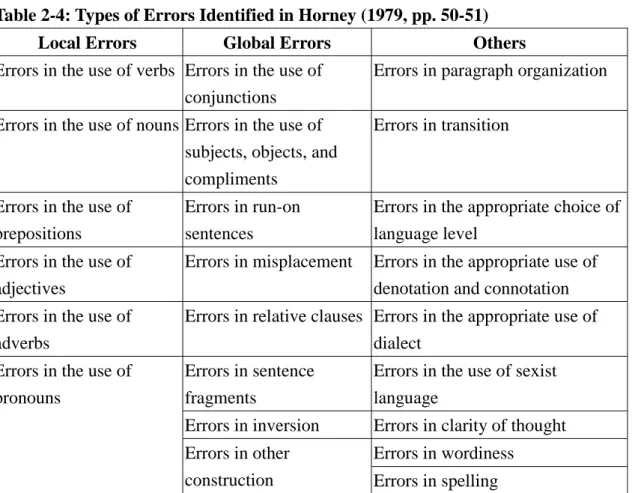
The errors were categorized into three types: local errors, global errors, and others, as shown in Table 2-4.
Table 2-4: Types of Errors Identified in Horney (1979, pp. 50-51)
Local Errors Global Errors Others
Errors in the use of verbs Errors in the use of conjunctions
Errors in paragraph organization Errors in the use of nouns Errors in the use of
subjects, objects, and compliments
Errors in transition
Errors in the use of prepositions
Errors in run-on sentences
Errors in the appropriate choice of language level
Errors in the use of adjectives
Errors in misplacement Errors in the appropriate use of denotation and connotation Errors in the use of
adverbs
Errors in relative clauses Errors in the appropriate use of dialect
Errors in sentence fragments
Errors in the use of sexist language
Errors in inversion Errors in clarity of thought Errors in wordiness
Errors in the use of pronouns
Errors in other
construction Errors in spelling
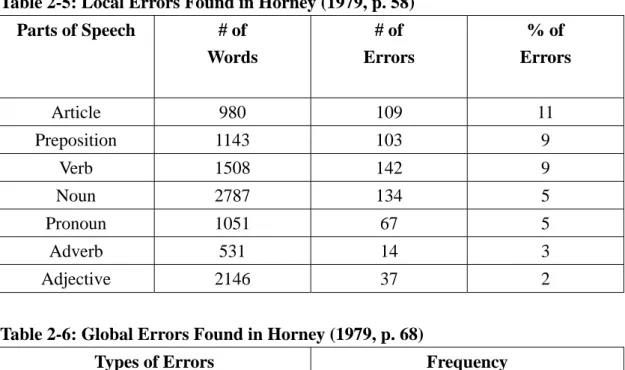
The data showed that the students’ first language interfered with the acquisition of a second language. The local errors found were further categorized, as can be seen in Table 2-5, the global errors as in Table 2-6, the other errors as in Table 2-7.
Table 2-5: Local Errors Found in Horney (1979, p. 58) Parts of Speech # of
Words
# of Errors
% of Errors
Article 980 109 11
Preposition 1143 103 9
Verb 1508 142 9
Noun 2787 134 5
Pronoun 1051 67 5
Adverb 531 14 3
Adjective 2146 37 2
Table 2-6: Global Errors Found in Horney (1979, p. 68)
Types of Errors Frequency
Sentence Fragments 10
Conjunctions 8 Table 2-7: Other Errors Found in Horney (1979, p. 69)
Types of Errors Frequency
Spelling 197
Clarity of Thought 49
Among the local errors, the highest error percentage (11%) was found in the use of articles, owing to the fact that there was no exact equivalent to the article in the Chinese language. The second highest error percentage (9%) fell into the category of prepositions, because prepositions are considered to be coverbs in Chinese. In English, however, the function of the preposition is to show the relationship between the object of the preposition and the noun to which the phrase is related. The verb errors also illustrated first language interference with second language performance.
In the Chinese language, the verb form does not change. In the usage of nouns, the subjects erred 55 of the time. These errors included making mistakes in singular and plural noun forms, choosing the wrong noun, omitting nouns, and using the incorrect
form of the possessive. Like the verb, the noun in Chinese does not change its form to show singular or plural. Table 2-8 shows a contrastive analysis of the different usage between English and Chinese.
Table 2-8: Percentage of Errors Identified by Contrastive Analysis (Horney, 1979, p. 78)
English Chinese Percentage of Errors
Article-definite & indefinite None 100
Preposition Very few 100
Verb No morpheme changes. 87
Noun No morpheme changes 68
Pronoun Use same pronoun for 3ps.
No morpheme changes.
47
Adjective No morpheme changes. 23
Adverb Very similar to English 0
The results of Horney’s study suggested that to instruct the differences between the English and Chinese languages should be necessary. The data indicated a need to adopt Contrastive Analysis in curriculum development. Finally, there should be an emphasis on the differences in basic sentence structures between English and Chinese.
2.2.3 Liu (1999b)
Liu (1999b) investigated the collocation errors in students’ writings. Her subjects involved 127 students from Chinese Culture University in Taiwan. Among them, 67 were freshmen from the Department of Journalism and 60 were sophomores from the Department of Law. 127 copies of students’ examination papers and 94 copies of their compositions were collected.
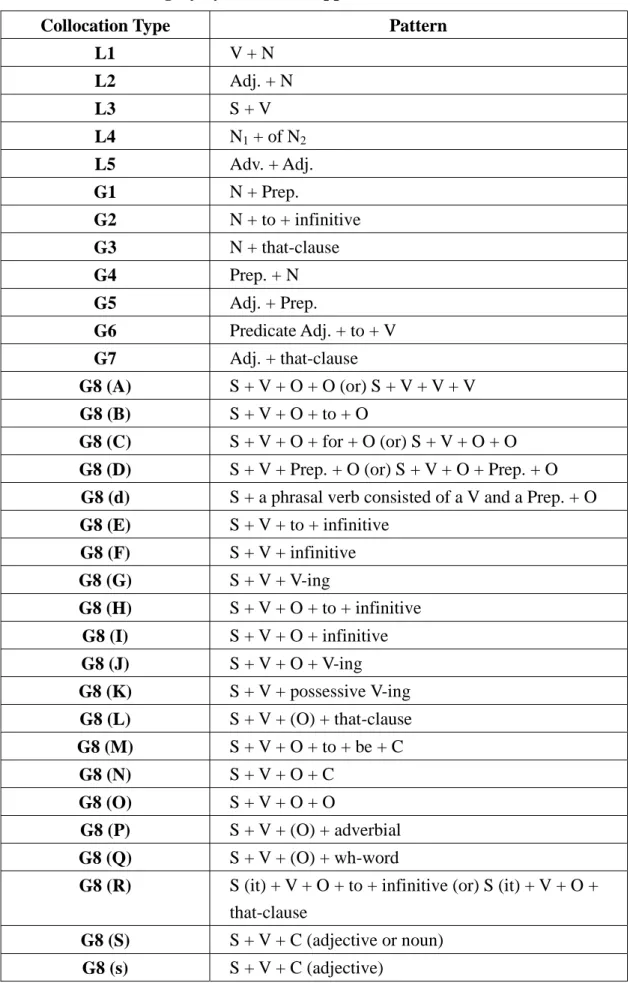
Based on a category system established by Benson et al. (1986), the errors were classified into fourteen types of lexical (represented by letter “L”) and grammatical errors (represented by letter “G”). The category system is shown in Table 2-9:
Table 2-9: Liu’s Category System (1999b, pp. 486-487)
Collocation Type Pattern
L1 V + N
L2 Adj. + N
L3 S + V
L4 N1 + of N2
L5 Adv. + Adj.
G1 N + Prep.
G2 N + to + infinitive
G3 N + that-clause
G4 Prep. + N
G5 Adj. + Prep.
G6 Predicate Adj. + to + V
G7 Adj. + that-clause
G8 (A) S + V + O + O (or) S + V + V + V G8 (B) S + V + O + to + O
G8 (C) S + V + O + for + O (or) S + V + O + O G8 (D) S + V + Prep. + O (or) S + V + O + Prep. + O
G8 (d) S + a phrasal verb consisted of a V and a Prep. + O G8 (E) S + V + to + infinitive
G8 (F) S + V + infinitive G8 (G) S + V + V-ing
G8 (H) S + V + O + to + infinitive G8 (I) S + V + O + infinitive G8 (J) S + V + O + V-ing G8 (K) S + V + possessive V-ing G8 (L) S + V + (O) + that-clause G8 (M) S + V + O + to + be + C
G8 (N) S + V + O + C G8 (O) S + V + O + O
G8 (P) S + V + (O) + adverbial G8 (Q) S + V + (O) + wh-word
G8 (R) S (it) + V + O + to + infinitive (or) S (it) + V + O + that-clause
G8 (S) S + V + C (adjective or noun) G8 (s) S + V + C (adjective)
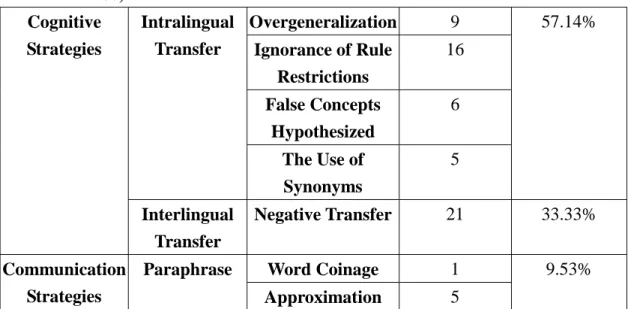
Among them, L1, V + N pattern, and G8 (D), V + Prep + O + Prep + O (or) V + Prep + O pattern, were the most obvious types of errors (p. 483). Five cognitive strategies and two communication strategies were adopted to explain the source of these collocation errors. The rates of the sources of collocation errors identified were as follows:
Table 2-10: Rates of the Sources of Collocation Errors Identified in Liu (1999b, p.
488)
Overgeneralization 9 Ignorance of Rule
Restrictions
16 False Concepts
Hypothesized
6 Intralingual
Transfer
The Use of Synonyms
5
57.14%
Cognitive Strategies
Interlingual Transfer
Negative Transfer 21 33.33%
Word Coinage 1 Communication
Strategies
Paraphrase
Approximation 5
9.53%
While a very small number of errors resulted from the adoption of
communication strategies, the majority of the errors were attributable to negative interlingual transfer and intralingual transfer, which belonged to cognitive strategies.
Of the two kinds of transfer, intralingual transfer contributed to more collocation errors than interlingual transfer. Among the four types of intralingual errors, ignorance of rule restrictions resulted in more errors than the other three.
Nonetheless, Liu (1999b) did not look into the relationship between learners’
general language proficiency levels and their collocation competence. A proficiency test should have been given to her subjects to determine their academic level, or the grade itself could have served a determinant of the proficiency level of the two groups.
2.2.4 Chen (2002)
Chen (2002) investigated the collocation errors in the writings of the high school learners in Taiwan. Thirty students participating in the study were asked to write compositions on three topics in order to explore the topic effect on collocation errors.
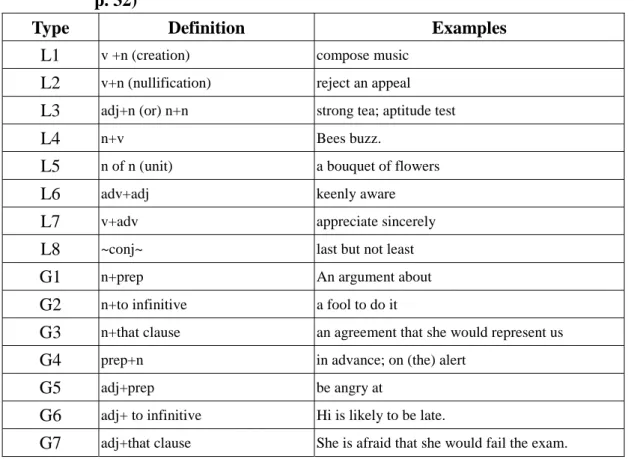
Ninety exam papers were collected and analyzed for the type of collocation errors with reference to a native-speaker corpus, the British National Corpus. Both grammatical and lexical errors were examined according to a modified classification established by Benson, et al. (1986). For the convenience of research, Chen added the 8th lexical collocation type (fixed phrase collocation which consists of
conjunctions) and simplified the 19 English verb pattern (G8 patterns) into 8 types11. The modified version is shown in Table 2-11:
Table 2-11: Modified Classification System of Collocation Patterns (Chen, 2002, p. 32)
Type Definition Examples
L1 v +n (creation) compose music
L2 v+n (nullification) reject an appeal
L3 adj+n (or) n+n strong tea; aptitude test
L4 n+v Bees buzz.
L5 n of n (unit) a bouquet of flowers
L6 adv+adj keenly aware
L7 v+adv appreciate sincerely
L8 ~conj~ last but not least
G1 n+prep An argument about
G2 n+to infinitive a fool to do it
G3 n+that clause an agreement that she would represent us
G4 prep+n in advance; on (the) alert
G5 adj+prep be angry at
G6 adj+ to infinitive Hi is likely to be late.
G7 adj+that clause She is afraid that she would fail the exam.
11 Chen pointed out that the G8 category, which consisted of 19 English verb patterns, was
complicated for error analysis, so they were simplified to 8 types for the convenience of discussion (p.
32).
G8 (ABCO) verbs with two objects (an indirect object and a direct object)
A. v+DO+to+IO
= v + IO + DO
B. v + DO + to + IO (do not allow the dative movement transform- ation)
C. v + DO + for + IO O. v + Object1 + Object 2
A. sent it to him = sent him a book B. describe it to him
C. bought a shirt for him = bought him a shirt D. forgive them their sin
G8 (D) verbs which form a collocation with a specific preposition 1. v + prep + object
2. v + object + prep + object
D1. reflect on the past year
D2. based their conclusions on the facts
G8 (EH) verbs which are followed by “to infinitive”
E. v + to infinitive
H. v + object + to infinitive
E. He decided to come.
H. She asked me to come.
G8 (FI) verbs that are followed by a second verb in “-ing”
F. v + infinitive without “to”
I. v + object + infinitive without
“to”
F. We must go.
I. We let the children go to the park.
G8 (GJK) verbs which are followed by a second verb in “-ing”
G. v + v-ing J. v + object + v-ing
K. v + a possessive and v-ing
G. They enjoy watching television.
J. I caught them stealing apples.
K. This fact justifies Bob’s coming late.
G8 (LQ) verbs which can be followed by a noun clause (wh-phrase)
L. v + that clause
O1. v+ (object) + Wh-Clause Q2. v + (object) + Wh-Clause
L. They admitted that they were wrong.
Q1. She knew when it was best to keep quiet.
Q2. She asked me how to do it.
G8 (MNS) verbs which are followed by a complement (a adjective or a noun)
M. v + object + to be + complem- ent
M. We consider her to be very capable.
N. The soldier found the village destroyed.
S. She became an engineer.
N. v + object + complement S. v + complement
G8 (P) verbs which must be followed by an adverbial
P. v (+object) + adverbial
P1. He put the book on the desk.
P2. The boy sneaked into the auditorium.
G8 (R) transitive verbs (often expressing emotion) which are precede by the dummy “it” and are followed by “to infinitive” or by
“that-clause”
R1. It + v + object + to infinitive R2. It + v + Object + that-clause
R1. It surprised me to learn of her decision.
R2. It surprised me that our offer was rejected.
The findings indicated that the topic of a composition had no significant effect on collocation errors the learners made. Adj + N (L3) and V + N (L1) were the most frequently produced lexical collocation error types, and Prep + N (G4) and verb collocations (G8) were the most frequent grammatical collocation error types.
Besides, more grammatical collocation errors were found than lexical ones, and there were more collocation errors in low achievers’ writings. L1 transfer was found to be the common source of errors, and direct translation was still a strategy commonly adopted by the students.
Finally, Chen suggested that EFL teachers should pay attention to these
miscollocations made by learners of a particular first language background and help them raise their awareness of collocations without L1 interference. She also suggested that further study might look into a large number of subjects in major exams, such as the GEPTs or the JCEEs. With a more comprehensive database of learners’ collocation errors, the database can contribute to a more “user-friendly”
computer collocation error-checking software package for the Chinese EFL learners.
However, Chen (2002) did not discuss the question as to which type of collocation errors would be frequently made by a particular group of learners.
Besides, she only investigated learners’ written production. It is believed that oral production should be included to provide a better insight of the topic.
2.2.5 Liu (2002)
Liu (2002) conducted a corpus-based investigation of lexical collocation errors in written English of Taiwanese learners. The miscollocation data used for her study showed that V + N miscollocations occupied the largest portion of the learners’
collocation errors. Thus, she focused on incorrect V + N collocations that the learners produced to see if any patterns or generalizations could be found in terms of lexical semantic relations12 and to gain insights into how the learners developed collocation competence.
The data analyzed were mainly from a web-based writing environment, IWill (Intelligent Web-based Interactive Language Learning), which is designed for Chinese learners of English in Taiwan. A learner corpus (English TLC) is thus built on the essay database. Using the learner corpus as the data source, 233 V + N
miscollocations were uncovered. The data analyzed were lexical semantic relations and verb lexicographer files of the WordNet lexical database. The findings indicated that V + N miscollocations were not arbitrary; instead, patterns of learners’
miscollocations exist. The data also indicated that L1 played a significant role in determining the lexical choices that learners made.
2.2.6 Summary
None of the previous studies reviewed looked into both learners’ oral and written production at the same time. Therefore, this might be a trial-worthy area to compare the learning product from the two different channels. In addition, in each study the error types were categorized differently based on various viewpoints. Lin (2002)
12 The lexical semantic relations used in the exploration of learners’ miscollocations included synonym, hypernym, and troponym relations (Liu, 2002, p. 18).
only examined V + N collocation types. A wide range of categories are needed to get a more complete picture of learners’ miscollocation types. Chen’s (2002) and Lin’s (2002) studies were all corpus-based, which might form a trend in this field in that corpus has become a vital tool for probing into the collocation issue.
Furthermore, as suggested by Chen (2002), to look into a large number of subjects in GEPTs or JCEEs or to investigate the oral production may help to broaden the scope of relevant studies of this issue.
2.3 Summary of Chapter Two
In this chapter, I have reviewed the issues related to collocation
competence—language proficiency, instruction effects, and strategy use as well as the related studies of learners’ oral and written language production. It was found that no study investigated both oral and written language production. Besides,
grammatical collocations were often found a neglected aspect, and V + N was the most common lexical collocation type investigated, with others left unexplored.
Which collocation errors belong to a particular group of learners remains an open issue. What still deserves our special attention is whether learners’ collocation knowledge can be an indicator of their general language proficiency, which is one of the central issues of the present study.