鐵錳鋁合金鋼未定析出相之研究*
The pr ecipitation of FCC fr om BCC matr ix in an Fe-Mn-Al alloy
計畫編號:NSC 90-2216-E-011-048執行期限:90 年 8 月 1 日至 91 年 7 月 31 日
主持人:鄭偉鈞 執行機構:國立台灣科技大學 機械系 計畫參與人員:賴一凡、劉家福 執行機構:同上 一、中文摘要
在本計畫中完成了成份為 Fe-23.0 wt%
Mn- 7.4 wt% Al-0.03 wt% C 鐵錳鋁合金鋼 低溫時效相變化之未定相之相鑑定。此合
金經 1050οC 的熱處理後,其結構為以體心
立方結構為主,而有少量面心立方結構分 佈在其中;再將此合金作低溫時效熱處理 後,有未知之魏得曼析出物產生,經穿透 式電子顯微鏡之分析,證明其為面心立方 結構相,並與體心立方基地結構有 K-S 之 方向關係。
關鍵詞:鐵錳鋁合金鋼、魏得曼析出物 ABSTRACT
A Fe-23.0wt%Mn-7.4wt%Al-0.03wt%C alloy, after water quenched following 1 hour at 1050οC in air. Aging the as-quenched alloy at higher temperatures, we found the FCC phase precipitated from the ferrite matrix.
The precipitation of the austenite phase within the ferrite matrix preferred the form of Widmanstätten side plates. TEM studies verify that the austenite phase precipitates from the ferrite matrix. A Kurdjumov-Sachs orientation relationship holds between the BCC matrix and the FCC precipitate. The proportion of the austenite phase is larger for lower temperatures aging or furnace cooling than in the as-quenched condition.
Keywor ds: quenching, aging, pr ecipitation, Widmanstätten side-plate, and K-S or ientation r elationship INTRODUCTION
In recent decades Fe-Mn-Al alloys have gained much attention as substitutes for some of the conventional Fe-Ni-Cr stainless steels.
Results concerning corrosion resistance and high temperature oxidation resistance have
been reported in several publications [1,2].
The phase equilibria of the Fe-Mn-Al ternary system have practical importance [3].
In common ferrous alloys, depending on the cooling rates for the FCC to BCC phase transformations, Widmanstätten side-plate, massive, and martensite phases have been observed within the original austenite matrix during the high temperature quenching process [4-9]. Experimental measurements on Widmanstätten side-plate ferrite phase in common ferrous alloys show that the orientation relationships close to the K-S or N-W types are usually found [10].
Fe-Mn-Al alloys have gained much attention for the formation of the FCC phase inside the BCC parent phase. It is well known that among Fe-Mn-Al alloys, Mn and Al are FCC and BCC formers, respectively.
Higher Mn content causes the higher proportion of the FCC phase to emerge at low temperatures in contrast to the full BCC phase in common ferrous alloys. If Fe-Mn-Al alloys contain low concentration of Al and high concentration of Mn, the full austenite phase could be observed even at room temperature [3]. In this unusual situation, it may seem that BCC to FCC phase transformation at high temperatures has been shifted to low temperatures. But in common ferrous alloys, this kind of phase transformation is inhibited or screened out by the formation of another BCC at low temperatures. The addition Mn into the ferrous alloy expands the FCC phase to low temperatures and the BCC to FCC phase transformation at higher temperatures can be shifted to room temperature. For BCC to FCC phase transformations in Fe-Mn-Al alloys, Widmanstätten side-plate [11], massive [12], and 18R type martensitic phases [13-15] have also been observed
within the original BCC matrix as the samples are quenched rapidly from 1300οC.
As the FCC phase is stable at low temperatures for some of the Fe-Mn-Al alloys, the purpose of the present work is to study the precipitation of the FCC phase within BCC matrix at low temperatures.
EXPERIMENTAL PROCEDURES
Slabs with the composition of Fe-23.0 wt% Mn-7.4 wt% Al-0.03 wt% C were initially prepared by air induction melting.
The 1008 plain carbon steel, electrolytic manganese, and high–purity aluminum were cast into approximately 10-kg ingots. After being homogenized at 1200οC for 4 hours under a protective argon atmosphere, the ingots were hot forged and then cold rolled to a thickness of 2 mm. These were heated at 1050οC in air for an hour, quenched to room-temperature water, and aged at higher temperatures for the study. In addition to the above treatment, samples were also heated at 1050οC in air for an hour, and cooled in furnace.
Samples in the above heat treatments were sectioned, mechanically polished and etched for light microscopic observation.
Thin foils for transmission electron microscopy were obtained by a twin jet polisher, and examined in a JEOL JEM 2010 TEM operated at 200 kV. Some of the samples were also examined in an X-ray diffractometer.
RESULTS AND DISCUSSION
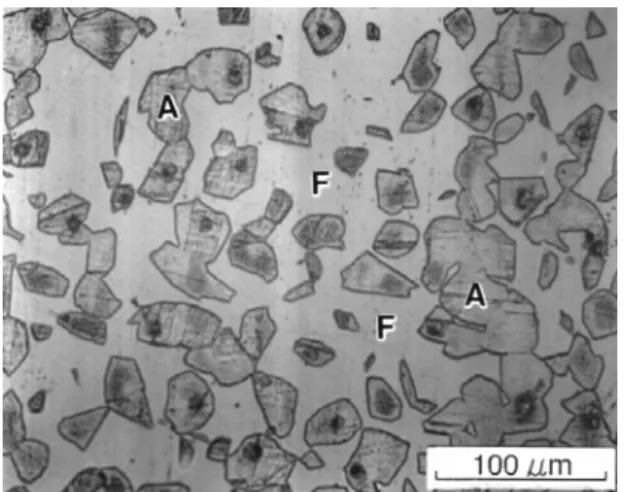
Figure 1 is the light micrograph (LM) of the Fe-Mn-Al alloy after being quenched into room temperature water following an hour at 1050οC. The alloy consists of two phases: the matrix phase and the discrete phase along the grain boundary of the matrix. In x-ray study, only ferrite and austenite phases are detected and confirmed by TEM study. The matrix phase is ferrite and the discrete phase along the grain boundaries of the matrix is austenite.
We conducted aging processes for temperatures ranging from 350 to 700οC.
Figure 2(a) is a TEM bright-field image of
the alloy after being aged at 600οC for 12 hours. It reveals the formation of the Widmanstätten side-plate precipitates within the ferrite matrix. The Widmanstätten precipitates were identified as the austenite phase, and the selected area diffraction patterns taken in these precipitates are shown in Fig. 3. The precipitation of the austenite phase preferred the grain boundaries of the ferrite phase and within the matrix, as shown in Fig. 2(b), in which the sample was aged at 540οC for 24 hours. According to the above observations, the phase transformation of the Fe-Mn-Al alloy during aging is opposite to that of conventional steels in that the low-temperature stable crystal structure is FCC rather than BCC. In the present Fe-Mn-Al alloy, during the BCC to FCC phase transformation, we found that the FCC Widmanstätten side-plate phase also had the orientation relationships with the parent matrix. Figures 4(a) and 4(b) are selected area diffraction patterns (SADPs) of the FCC phase superimposed on that of the matrix. As indicated in Figures 4(a) and 4(b), the orientation relationship between the FCC phase and the BCC matrix can be derived as (111)FCC // (110)BCC and [10 1 ]FCC //
[111 ]BCC [11 0]FCC near [100]BCC which are the well known K-S orientation relationships [13]. This result is quite similar to that in the BCC to FCC phase transformations in Fe-Mn-Al alloys, Widmanstätten side-plate [11], massive [12], and 18R type martensitic phases [13] which also have the same K-S orientation relationships with the original BCC matrix as the samples are quenched rapidly from 1300οC.
The proportion of the FCC phase was larger at lower temperatures than that at 1050οC. For the near equilibrium condition for the co-existence of the FCC and BCC phases at lower temperatures, we performed an experiment in which the slabs were heated at 1050οC for an hour and then cooled at a rate of 50οC per hour to room temperature.
Figure 5 is the light micrograph (LM) of the Fe-Mn-Al alloy after being heated at 1050οC for an hour and then cooled at a rate of 50οC per hour to room temperature. According to
the LM observation, the FCC and BCC phases in the alloy are quite different from the condition shown in Figure 1, and the proportion of the FCC phase is larger than that in the as-quenched condition. This observation demonstrates that the FCC phase is more stable than the BCC phase at low temperatures.
CONCLUSIONS
When the as-quenched alloy was aged at higher temperatures, the precipitation of the austenite phase from the ferrite matrix. The precipitation of the austenite phase within the ferrite matrix preferred the form of Widmanstätten side-plates. The orientation relationships between the FCC Widmanstätten side-plate and the BCC matrix are (111)FCC // (011)BCC [101 ]FCC //
[11 1 ]BCC [1 1 0]FCC near [100]BCC which correspond to the K-S orientation relationships.
The proportion of the austenite phase in the two-phase region of the Fe-Mn-Al alloy is larger at lower temperatures during aging or furnace cooling than that for the as-quenched condition from 1050οC for an hour. This demonstrates that the FCC phase is more stable than the BCC phase at low temperatures.
REFERENCES
[1] P.R.S. Jackson and G.R. Wallwork, Oxidation Metals, 21 (1984) 135.
[2] J.G. Duh and C.J. Wang, J. Mat. Sci., 25 (1990) 2063.
[3] K. Sato, K. Tanaka and Y. Inoue, ISIJ Int., 29 (1989) 788.
[4] T. Maki and C.M. Wayman, Acta Metall., 25 (1977) 681.
[5] M. Umemoto, T. Hyodo, T. Maeda and I.
Tamura, Acta Metall., 32 (1984) 1191.
[6] P.J. Brofman, G.S. Ansell and G.J. Judd, Metall. Trans. A, 13 (1982) 203.
[7] A. Sato, M. Kato, Y. Sunaga, T. Miyazaki and T. Mori, Acta Metall., 28 (1980) 367.
[8] X.M. Zhang, E. Gautier and A. Simon, Acta Metall., 37 (1989) 477.
[9] R.F. Mehl, C.S. Barrett and D.W. Smith, Trans. AIME, 105 (1953) 215.
[10] D.A. Porter and K.E. Eastering, Phase Transformations in Metals and Alloys, 2
ndEd.
(1992)
[11] K.H. Hwang, C.M. Wan, and J.G. Byrne, Scripta Metall., 24 (1990) 979.
[12] S.K. Chen, K.H. Hwang, C.M. Wan, and J.G. Byrne, Scripta Metall., 24 (1990) 151.
[13] K.H. Hwang, C.M. Wan, and J.G. Byrne, Mat. Sci. and Eng. A, 132 (1991) 161.
[14] W.B. Lee, F.R. Chen, S.K. Chen, G.B.
Olson, and C.M. Wan, Acta Metall., 43 (1995) 21.
[15]
H.Y. Chu, F.R. Chen, T.B. Wu, Scripta Metall., 33(8) (1995) 1269.
Figure 1. Light micrograph (LM) of the Fe-Mn-Al alloy after quenching into room temperature water from an hour at 1050οC (A
= austenite; F = ferrite)
1. (a)
2. (b)
Figure 2. TEM bright-field images of the alloy after being aged at 600οC for 12 hours (a) and at 540 οC for 24 hours (b), respectively. (F is ferrite; G.B. is grain boundary)
(a) (b) (c ) Figure 3. The selected area diffraction patterns (SADPs) taken in the precipitates shown in Fig. 2 (a). Zone axes are (a) [100], (b) [111], and (c) [011], respectively.
4(a)
4(b) Figure 4. SADPs of the FCC phase
superimposed on that of the BCC matrix in Fig. 2(b) showing the K-S orientation relationships. (a) Zone axes are [101 ]FCC and [111 ]BCC. (b) [11 0]FCC zone axis is near [100]BCC zone axis. (hkl = FCC; hkl = BCC)
Figure 5. The light micrograph (LM) of the Fe-Mn-Al alloy after heated at 1050οC for an hour then cooled at a rate of 50οC per hour to room temperature. (A=austenite; F=ferrite)
計畫成果自評:
依據本計畫之實驗成果,經整理投稿 後,已經在 Materials Science and Engineering A 之國際期刊上被接受 二篇論文,此二篇論文即將於近日內 被刊登出來。此一結果應該不負國科 會付予計畫執行人之使命。
5
附件:封面格式
行政院國家科學委員會補助專題研究計畫成果報告
※※※※※※※※※※※※※※※※※※※※※※※※※※
※ ※
※
鐵錳鋁合金鋼未定析出相之研究※
※ ※
※※※※※※※※※※※※※※※※※※※※※※※※※※
計畫類別:□個別型計畫 □整合型計畫 計畫編號:NSC 90-2216-E-011-048-
執行期間: 90 年 8 月 1 日至 91 年 7 月 31 日
計畫主持人:鄭偉鈞 共同主持人:
計畫參與人員:賴一凡、劉家福
本成果報告包括以下應繳交之附件:
□赴國外出差或研習心得報告一份
□赴大陸地區出差或研習心得報告一份
□出席國際學術會議心得報告及發表之論文各一份
□國際合作研究計畫國外研究報告書一份
執行單位:國立台灣科技大學機械工程系
中 華 民 國 91 年 10 月 30 日