PIEZOELECTRIC PROPERTIES OF CEMENT PIEZOELECTRIC COMPOSITES CONTAINING
NANO-QUARTZ POWDERS
HUANG HSING PAN1, WEI-REN LIN1 and KUAN HUANG2
1Department of Civil Engineering, National Kaohsiung University of Science and Technology Kaohsiung, Taiwan
2Department of Civil Engineering, National Cheng Kung University, Tainan, Taiwan
In order to increase piezoelectric properties of 0-3 type cement piezoelectric composites (piezoelectric cement) developed for structural health monitoring (SHM), nano-quartz powders as the replacement of cement matrix were added into PZT/cement composites.
The piezoelectric cement consists of 50% PZT as the inclusion and 50% cement as the matrix by volume. Two gradations of PZT inclusions, single-grading and medium- grading, were chosen to fabricate the piezoelectric cement. Nano-quartz powders of 1%
to 6% were added to form nano-quartz piezoelectric cement. Experimental results indicate that nano-quartz powders can reduce the porosity of piezoelectric cement. The single-grading piezoelectric cement (PSQ) with 4% nano-quartz powders and the medium-grading one (PMQ) with 2% have the lowest porosity. The maximum values on both piezoelectric strain factor d33 and relative dielectric constant ɛr always occur at the minimum porosity of nano-quartz piezoelectric cement. Both the PSQ and the PMQ have the optimum d33=104 pC/N. For the PSQ, 4% nano-quartz powders provide a 22%
enhancement on thickness electromechanical coupling coefficient Kt. However, the effect of nano-quartz powders displays less effective to the Kt of the PMQ due to non- uniform distribution of PZT particles. Nano-quartz piezoelectric cement has higher piezoelectric properties able to monitor and detect concrete structural health.
Keywords: Cement, PZT gradation, Structural health monitoring, Sensor, Impedance
1 INTRODUCTION
Cement-based piezoelectric composites as alternative piezoelectric sensors have been developed to monitor the health of concrete structures for two decades (Li et al. 2001, Shen et al. 2006, Chaipanich and Jaitanong 2008, Pan et al. 2016a). Lead zirconate titanate (PZT) ceramic as the inclusion is commonly used in cement-based piezoelectric composites. The 0-3 type of cement piezoelectric composite (named piezoelectric cement) is a two-phase composite with PZT particles randomly distributed in a cement matrix for diminishing the mismatch in acoustic impedance and in volume compatibility between PZT inclusions and the cement matrix (Li et al. 2002, Dong and Li 2005). However, the 0-3 type composite distinctly has less piezoelectric behavior than the 2-2 type and 1-3 type composites at the same amounts of PZT inclusions because of the difference of geometric alignments and distributions of PZT in the cement matrix.
Adequate additions and admixtures in piezoelectric cement are one of methods to improve piezoelectric properties of piezoelectric cement, particularly piezoelectric strain factor d33 and
relative dielectric constant r. For example, additions and admixtures such as silica fume (Chaipanich 2007), carbon (Jaitanong 2008), carbon black (Huang et al. 2009), carbon nanotube (Gong et al. 2011), slag and fly ash (Pan et al. 2011), and kaolin (Pan et al. 2015) in piezoelectric cement have been found to be effective in increasing d33 and r, when used in suitable amounts.
Piezoelectric cement with higher piezoelectric properties as a sensor always has more sensitivity for SHM, especially for d33 greater than 100 pC/N. To Increase piezoelectric properties of piezoelectric cement are still ongoing.
For evaluating the properties of piezoelectric materials, piezoelectric strain factor, dielectric constant and electromechanical coupling coefficient are often used to show the quality of piezoelectric properties. Quartz powders innately own higher dielectric constant that is advantageous to increase d33 and r of piezoelectric materials. In this study, quartz particles with nano dimension as the replacement of cement matrix in piezoelectric cement are considered to enhance its piezoelectric property. Two piezoelectric cements with PZT gradations, single-grading and medium-grading, are investigated.
2 EXPERIMENTS
The piezoelectric cement consists of ASTM type I Portland cement as the matrix and PZT ceramic as the inclusion, both with equal volume. A Ka type of PZT ceramic has the properties with specific gravity = 7.9, d33 = 470 pC/N, εr = 2100, thickness electromechanical coupling coefficient Kt = 0.72 and dielectric loss = 1.5 by courtesy of Eleceram Technology Co. Ltd. (Taiwan). The PZT ceramic without being polarized, originally a flat disk, was pulverized to particles. PZT particles were uniformly distributed in a cement matrix to form a 0-3 type PZT/cement composite. This type of piezoelectric cement is denoted as PP material.
Two PZT gradations were used in the PP. The single-grading (75–150 m) PP material is denoted as PSQ material, and medium-grading (75–600 m) one named PMQ material. The quartz particles are spherical with the size of 75–225 nm, called nano-quartz powders. Cement matrix was replaced by nano-quartz powders with six volumes, 1%, 2%, 3%, 4%, 5%, and 6% by volume. For example, PSQ2 and PMQ5 mean the PP material with single-grading PZT and 2% nano-quartz powders, and with medium-grading PZT and 5% nano-quartz powders, respectively.
To prepare specimens, fresh cement, PZT particles and nano-quartz powders were first mixed without adding water, and then the mixture was placed in a solar-planetary mill for 5 min rotation to ensure that the raw materials were thoroughly dispersed. The mixture was divided into three portions, and each portion was placed in a 15-mm-diameter cylindrical steel mold. Then, the mixture in the mold was pressed together at 80 MPa for 5 min to form a disc-like specimen. Finally, the specimens were immediately cured in a controlled chamber at 90 °C and 100% relative humidity for 24 h to ensure that the hydration produced suitable strength in these specimens. After curing, the specimens were polished to a thickness of 2 mm.
The pretreatment temperature technique (Pan et al. 2016b), a 140 °C heating before and after the manufacturing of electrodes on the specimen, was applied to promote the piezoelectricity.
Specimens were polarized using a poling voltage of 1.5 kV/mm at 150 °C (poling temperature) for 40 min (poling time) to induce piezoelectric properties. All experimental data were measured from 1 h (day 0) to 90 days after polarization completion. Piezoelectric properties were measured and calculated at controlled conditions of 23 °C and 50% relative humidity. Each experimental value is the average of three specimens.
3 RESULTS AND DISCUSSION
3.1 Porosity
Specimens were monitored through optical microscopy (OM) at 350× magnification after curing for 24 h. After the pore image analysis, the porosity of the specimens on the PSQ and the PMQ was calculated using PIA software and results are shown in Figure 1. For the PSQ, the porosity decreases from 2.56% to 2.29% as the content of nano-quartz increases from 0% to 6%. This means that adding nano-quartz powders can reduce the porosity of are single-grading piezoelectric cement.
In addition, all porosities of the PMQ are greater than those of the PSQ. This is because the medium- grading piezoelectric cement (PMQ) have three groups of PZT particle size leading to more voids within particles, compared with the size of cement and nano-quartz.
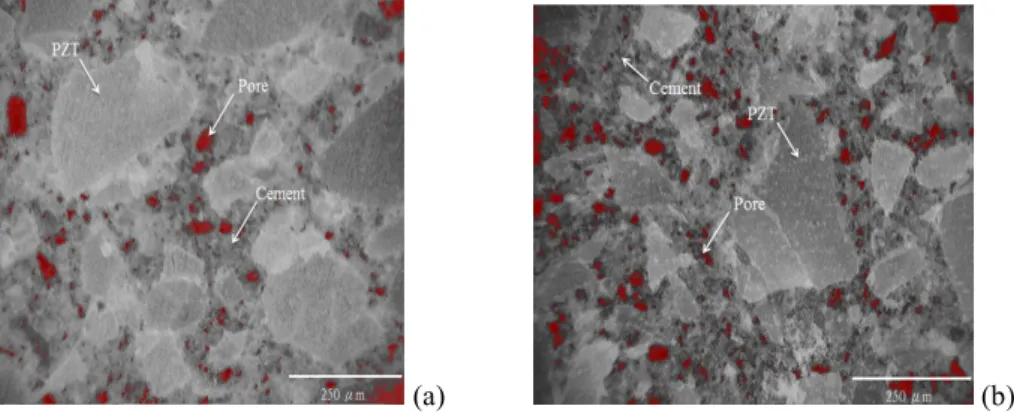
For the PMQ, the values of the porosity exhibit in Figure 1 with 3.57%, 3.14%,3.03, 3.36%, 3.97, 3.21% and 3.31% for the replacement of nano-quartz is from 0% to 6%. The porosity of PMQ first decreases to the minimum value at 2% nano-quartz, and then increases to the maximum one at 4%. From the OM images shown in Figure 2, the PZT particles showed non-uniform distribution in the PMQ containing 3%–4% nano-quartz powders, resulting in higher porosity of PMQ. The PMQ with 2% nano-quartz powders seems better choice to reduce the porosity.
Nano-Quartz Content
0% 1% 2% 3% 4% 5% 6%
Porosity (%)
2.0 2.5 3.0 3.5 4.0 4.5
PSQ PMQ
2.56
2.35 2.32 2.30 2.29 2.31 2.29 3.57
3.14 3.03 3.36
3.97
3.21 3.31
Figure 1. The relation of the porosity and nano-quartz powders for PSQ and PMQ.
(a) (b)
Figure 2. The OM image of PMQ with (a) 2% and (b) 4% nano-quartz powders.
3.2 Relative Dielectric Constant
The relative dielectric constant r of piezoelectric cement is material age-dependent and approaches to stable values after 60 days. Figure 3 is the comparison between the PSQ and the PMQ related to the relation of the relative dielectric constant and the content of nano-quartz powders at 90 days.
The PSQ4 with 4% nano-quartz and the PMQ2 with 2% one have the highest r values, with 545 and 440 respectively. The PSQ4 and the PMQ2 have the optimal r values with corresponding to the minimum porosity of piezoelectric cement shown in Figure 1. This implies that piezoelectric cement might need lower porosity for the target of pursuing higher dielectric constant.
In addition, the r values of PMQ with 3%–6% nano-quartz are lower than that with 0% nano- quartz added. After the inspection of OM images, one finds the distribution of PZT particles is the influence factor on r because the PZT dispersion within the PMQ with 3%–6% nano-quartz are not uniform.
Nano Quartz Content
0% 1% 2% 3% 4% 5% 6%
Relative Dielectric Constant, r 0 100 200 300 400 500 600
PSQ PMQ
440
545
Figure 3. Comparisons of relative dielectric constant εr between the PSQ and the PMQ.
3.3 Piezoelectric Strain Factor
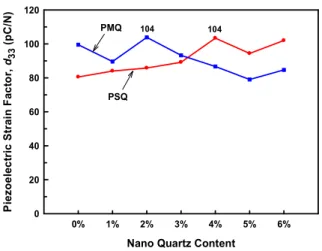
The piezoelectric strain factor d33 of piezoelectric cement is also age-dependent, and the relation of the d33 and nano-quartz content for the PSQ and the PMQ at 90 days shown in Figure 4. The d33
development with increasing nano-quartz content is similar to the r in which the PSQ at 4% nano- quartz and the PMQ at 2% have the highest d33 values. Both the PSQ and the PMQ have the same maximal d33 = 104 pC/N, providing the capability of structural health monitoring.
3.4 Thickness Electromechanical Coupling Coefficient
Electromechanical coupling coefficient is a measure of the conversion efficiency between electrical and mechanical energy in piezoelectric materials. Cement-based piezoelectric composites with higher electromechanical coupling coefficient provides higher energy harvesting in concrete structures. It is known that the thickness electromechanical coupling coefficient Kt of piezoelectric cement is age-independent (Pan et al. 2006a). Figure 5 shows the relation of the Kt and nano-quartz content in nano-quartz piezoelectric cement. Adding 1%–4% nano-quartz powders in the PSQ can enhance the Kt value from 13.7% to 16.7%, almost a 22% increment. However, the effect of nano- quartz powders in the PMQ is less effective on K.
Nano Quartz Content
0% 1% 2% 3% 4% 5% 6%
Piezoelectric Strain Factor, d33 (pC/N) 0 20 40 60 80 100 120
PMQ
PSQ
104 104
Figure 4. Comparisons of piezoelectric strain factor d33 between the PSQ and the PMQ.
Nano Quartz content
0% 1% 2% 3% 4% 5% 6%
Electromechanical Coupling Coefficient, t (%) 0 5 10 15 20
PSQ PMQ
16.4 16.7
Figure 5. Comparisons of Ktbetween the PSQ and the PMQ.
Comparing the results from Figures 3, Figure 4 and Figure 5, without nano-quartz powders (0%) the piezoelectric properties of PMQ are all higher than those of PSQ. This is because the particle size of PZT in PMQ is greater than in PSQ. Larger PZT particles in piezoelectric cement always provide higher piezoelectric properties. As the amount of nano-quartz powders increases in the PMQ, the piezoelectric properties do not have apparent increments but decrease, except for 2%
of nano-quartz. The dispersion for PZT particle and nano-quartz powders is one of dominant factors on the piezoelectric properties of the PMQ.
4 Conclusions
Two piezoelectric cements with single-grading and medium-grading PZT, respectively, were investigated by adding nano-quartz powders from 1% to 6%. The following conclusions are drawn.
(1) Adding nano-quartz powders can properly reduce the porosity of piezoelectric cement. An optimum amount of nano-quartz powders to have minimum porosity is 4% for single-grading piezoelectric cement and 2% for medium-grading one.
(2) Both r and d33 on piezoelectric cement have the optimal values at minimum porosity. For the PSQ, d33 = 104 pC/N if 4% nano-quartz powders were added, a 30% increment by comparing with no nano-quartz powders added.
(3) Adding 4% nano-quartz powders in single-grading piezoelectric cement provides a 22%
enhancement on thickness electromechanical coupling coefficient.
(4) Except for 2% content, the effect of nano-quartz powders to medium-grading piezoelectric cement exhibits less effective on the piezoelectric properties, such as r, d33 and Kt, because PZT particles show less uniform dispersion.
(5) Piezoelectric cement with suitable amounts of nano-quartz powders has d33>100 pC/N, providing the capability of structural health monitoring.
(6) To increase the piezoelectric properties of nano-quartz piezoelectric cement, suitable dispersions between PZT gradation and nano-quartz powders are needed.
5 Acknowledgments
The author would like to thank the support by the Ministry of Science and Technology of Taiwan (MOST 108-2221-E-992-008-MY3).
References
Chaipanich A. Dielectric and piezoelectric properties of PZT–silica fume cement composites, Current Applied Physics,7, 532–536, 2007.
Chaipanich, A., and Jaitanong, N. N., Effect of poling time on piezoelectric properties of 0-3 PZT-Portland cement composites, Ferroelectrics Letters Section, 35, 73–78, 2008.
Dong, B., and Li. Z. J., Cement-based piezoelectric ceramic smart composites, Composites Science and Technology, 65, 1363–1371, 2005.
Gong, H., Zhang, Y., Quan, J., and Che, S., Preparation and properties of cement based piezoelectric composites modified by CNTs, Current Applied Physics, 11, 653–656, 2011.
Huang, S., Li, X., Liu, F., Chang, L., Xu, D., and Cheng, X., Effect of carbon black on properties of 0-3 piezoelectric ceramic/cement composites, Current Applied Physics, 9, 1191–1194, 2009.
Jaitanong, N., Wongjinda, K., Tammakun, P., Rujijanagul, G., and Chaipanich, A., Effect of carbon addition on dielectric properties of 0-3 PZT-Portland cement composite, Advanced Materials Research, 55-57, 377–380, 2008.
Li, Z. J., Zhang, D., and Wu, K. R., Cement matrix 2-2 piezoelectric composite–Part 1 sensory effect, Materials and Structures, 34, 506–512, 2001.
Li, Z. J., Zhang, D., and Wu, K. R., Cement-based 0-3 Piezoelectric composites, Journal of the American Ceramic Society, 85, 305–313, 2002.
Pan, H. H., Lin, D. H., and Yeh, R. H., Influence of pozzolanic materials on 0-3 cement-based piezoelectric composites, in New Development Structure Engineering & Construction, Yazdani, S., and Singh, A.
(eds), 929–934, Research Publishing Services, 2013.
Pan, H. H., Yang, R. H., and Cheng, T. C., High piezoelectric properties of cement piezoelectric composites containing kaolin. Proceedings of SPIE, 943, 94370R, 2015.
Pan, H. H., Lin, D. H., and Yang, R. H., High Piezoelectric and dielectric properties of 0-3 PZT/cement composites by temperature treatment, Cement and Concrete Composites, 72, 1–8, 2016.
Pan, H. H., Wang, C. K., and Cheng, Y. C., Curing time and heating conditions for piezoelectric properties of cement-based composites containing PZT, Construction and Building Materials, 129, 140–147, 2016.
Shen, B., Yang, X., and Li, Z. J., A cement-based piezoelectric sensor for civil engineering structure,