Reducing Drug-Herb Interaction Risk with a Computerized Reminder System
Sheng-Shing Lin1,2, Chiu-Lin Tsai3, Ching-Yeh Tu3, Ching-Liang Hsieh2,4,5*
1Graduate Institute of Chinese Medicine, College of Chinese Medicine, China Medical University, Taichung, 40402, Taiwan, ROC
2Department of Chinese Medicine, China Medical University Hospital, Taichung, 40447, Taiwan, ROC
3Division of Chinese Medicine, Department of Pharmacy, China Medical University Hospital, Taichung, 40447, Taiwan, ROC
4Graduate Institute of Integrated Medicine, College of Chinese Medicine, China Medical University, 40402, Taichung, Taiwan, ROC
5Research Center for Chinese Medicine & Acupuncture, China Medical University, Taichung, 40402, Taiwan, ROC
*Correspondence to Dr. Ching-Liang Hsieh, Graduate Institute of Integrative Medicine, College of Chinese Medicine, China Medical University. 91 Hsueh-Shih Road,
Taichung 40402, Taiwan, ROC TEL: 886-4-22053366 (ext. 3500) Fax: 886-4-22037690
E-mail: [email protected]
Running title: Reminder System for Drug-Herb Interaction
Keywords: Drug-herb interaction, patient safety, reminder system
Abstract
Background:
Traditional Chinese medicine (TCM) and Western medicine are both popular in Taiwan.
Approximately 14.1% of Taiwanese residents use Western drugs and Chinese herbs concurrently; therefore, drug-herb interaction is critical to patient safety. This paper presents a new procedure for reducing the risk of drug interactions.
Methods:
Hospital computer systems are modified to ensure that drug-herb interactions are automatically detected when a TCM practitioner is writing a prescription. A pop-up reminder appears, warning of interactions, and the practitioner may adjust doses or herbs or leave the prescription unchanged. A pharmacist will receive interaction information through the system and provide health education to the patient.
Results:
During the 2011-2013 study period, 256 patients received 891 herbal prescriptions with potential drug-herb interactions. Three of 50 patients who concurrently used ginseng and an oral hypoglycemic agent manifested hypoglycemia (fasting blood sugar level
≤70 mg/dL).
Conclusion:
Drug-herb interactions can cause adverse reactions. A computerized reminder system can enable TCM practitioners to reduce the risk of drug-herb interactions. In addition, health education for patients is crucial in avoiding drug-herb interactions.
Keywords:
drug-herb interaction, adverse reaction, reminder
1. Background
Taiwan’s National Health Insurance program has covered both Western medicine (WM)
and traditional Chinese medicine (TCM) since its inauguration 1995.TCM is popular in
Taiwan, and more than 60% of the people in the country used it between 1996 and 2001
1. In 2007, approximately 14.1% of the people in Taiwan used TCM herbal products and
conventional WM drug concurrently 2. Therefore, the drug-herb interaction is critical to
patient safety. For example, concomitant use of Danshen (Salvia miltiorrhiza) and
warfarin may exaggerate the anticoagulant effect of warfarin and possibly cause
bleeding 3. Panax ginseng 4-6 and American ginseng 7 have antidiabetic effects; using
ginseng concurrently with oral hypoglycemic agents (OHAs) or insulin injections may
increase the risk of hypoglycemia 8. Concomitant use of red yeast rice with cyclosporine
may induce rhabdomyolysis 9. When patients disclose their use of modern drugs and
complementary and alternative medicine, TCM practitioners may tailor prescriptions to
reduce the risk of such drug-herb interactions.
In most countries, people obtain herbal products outside of hospitals; therefore,
physicians cannot determine what herbs patients have consumed through the hospital
information systems. Furthermore, people who sell herbal products may have
insufficient knowledge about modern drugs and drug-herb interactions. In Taiwan,
TCM practitioners are certified through a national board examination and have
knowledge of modern drugs because they are required to take related educational
courses. Some TCM practitioners are also physicians with a comprehensive Western
medical education.
Herbs and acupuncture are easily accessible in most cities in Taiwan. Many
hospitals have TCM services and process herbal prescriptions through a computer
system. In our hospital, the TCM department’s medical records are stored in the same
database as those of the WM department. When writing a prescription, TCM
practitioners and WM doctors may view previous drug and herbal prescriptions, or they
may switch of this function. However, drug-herb interactions may be not be identified
because doctors are too busy to assess previous prescriptions by another doctor or
because they lack the time to consider possible interactions. Most WM doctors are
educated in modern medicine but have a limited knowledge of TCM herbs, whereas
TCM practitioners have a thorough knowledge of traditional herbs but may not be
familiar with Western drugs. Some doctors have both WM and TCM licenses; however,
they focus on only one medical tradition during clinical practice, limiting their
knowledge of drug-herb interactions that requires ongoing medical education in both
fields.
In 2011, we modified the herb prescription process in our hospital’s TCM
department. A computerized reminder system was programmed to search for drug
interactions and automatically display possible interactions in a pop-up window. TCM
doctors may consider the interactions and adjust herbs or doses.
2. Methods
2.1 Literature review
2.1.1 Journals from PubMed
We performed the following keyword searches on
http://www.ncbi.nlm.nih.gov/pubmed:
(1) General concept: “drug herb interaction”; “herb interaction”; “traditional Chinese
medicine” OR “Chinese medication” OR “herbal medicine” AND “interaction.”
(2) Specifying individual herb names without drug names: for example, “ginseng” AND
“interaction”; “Danshen” AND “interaction”; “licorice” AND “interaction”; and
“Ma Huang” AND “interaction.”
(3) Specifying herb names and drug names: for example, “ginseng” AND “digoxin”;
“ginseng” AND “warfarin”; “ginseng” AND ‘hypoglycemic agent”; and “Danshen”
AND “warfarin.”
The searches were performed in 2010 and restricted to English-language results from
1986 to 2010. Articles were selected according to title and abstract by using the
following criteria: (1) At least one herb and at least one drug were mentioned, and the
interaction between the herb and drug was described; (2) Only articles about herbs that
are available in Taiwan were included.
2.1.2 Studies in Taiwan
On Taiwan’s Government Research Bulletin website,
http://grbsearch.stpi.narl.org.tw/GRB_Search/grb, searches in traditional Chinese for the
keywords “drug-herb interaction” and individual herb names AND “drug interaction”
were performed. Studies related to a single herb or to herbal combinations that were
discussed with drug interactions were included; studies related to herbs unavailable at
our hospital were excluded.
2.1.3 Theses and dissertations in Taiwan
On the Taiwan National Digital Library of Theses and Dissertations website,
http://ndltd.ncl.edu.tw/cgi-bin/gs32/gsweb.cgi, searches in traditional Chinese for the
keywords “drug-herb interaction” and individual herb names AND “drug interaction”
were performed. Theses and dissertations related to a single herb or herbal combinations
that were discussed with drug interactions were included; theses and dissertations
related to herbs unavailable at our hospital were excluded.
2.2 Creating a drug-herb interaction database
We collected drug-herb interaction data from PubMed, study reports, theses, and
dissertations. A database was created with columns for drug name, herb name,
interaction, mechanism, symptoms, management, suggestion, severity, documentation,
case number, article title and journal title.
2.3 Severity definitions and documentation
We used the definitions in Drug Interaction Facts to identify the severity of drug-herb
interactions 10.
Drug-herb interaction severity categories:
Major: Effects are potentially life-threatening or capable of causing permanent damage.
Moderate: Effects may cause deterioration in a patient’s clinical status. Further
treatment, hospitalization, or an extended hospital stay may be necessary.
Minor: Effects are mild; consequences may be regarded as bothersome or may be
unnoticeable and do not notably affect the therapeutic outcome. Further treatment is
usually not required.
Documentation:
Established: Proven to occur in well-controlled studies.
Probable: Likely but not proven clinically.
Suspected: May occur; some good data; requires more study.
Possible: Could occur, but data are limited.
Unlikely: Doubtful; no strong evidence of an altered clinical effect.
2.4 Committee conference
The Safety of Herb Usage committee comprised 3 physicians (Western-medicine
doctors), 3 TCM practitioners, 4 pharmacists, one nurse, and one computer
programmer. The severity and documentation of drug-herb interactions were discussed
at regularly held conferences. Commonly used herbs and drugs with highly significant
interactions were included in the reminder system.
2.5 Programmer adds function in Hospital Information System
A computer program was written to deliver warnings of potential drug interactions. The
interaction data selected by the committee was entered into the hospital’s computer
system. When a TCM practitioner processes a herbal prescription, the reminder program
automatically searches for related drug interactions. When there is a highly substantial
significant interaction, a pop-up window appears to inform the TCM practitioner, who
may then adjust doses or remove problematic herbs. If the practitioner does not remove
the herb or herbs related to the interaction, the computer system will inform the
pharmacist, who will explain the possible symptoms of the drug interaction to the
patient. The computer system stores basic patient, drug, and herb data in a track list.
2.6 Retrospectively analyzing patient medical records
Using the track list of potential interactions, we selectively analyzed specific drugs and
herbs by using retrospective medical record searches. We discussed possible drug-herb
interactions with the committee to ascertain the significance and severity.
3. Results
We retrieved 99 journals from PubMed and identified 648 drug-herb combinations.
From Taiwan’s Government Research Bulletin website, we retrieved 44 study reports
containing 76 drug-herb combinations. In addition, 46 drug-herb combinations were
identified from 23 theses in Taiwan. In total, 770 drug-herb combinations and
interactions were input into the database (Figure 1).
There were 122 herbs and 193 drugs or drug categories related in the 770 drug-herb
pairs. After severity and documentation categorization, our committee selected
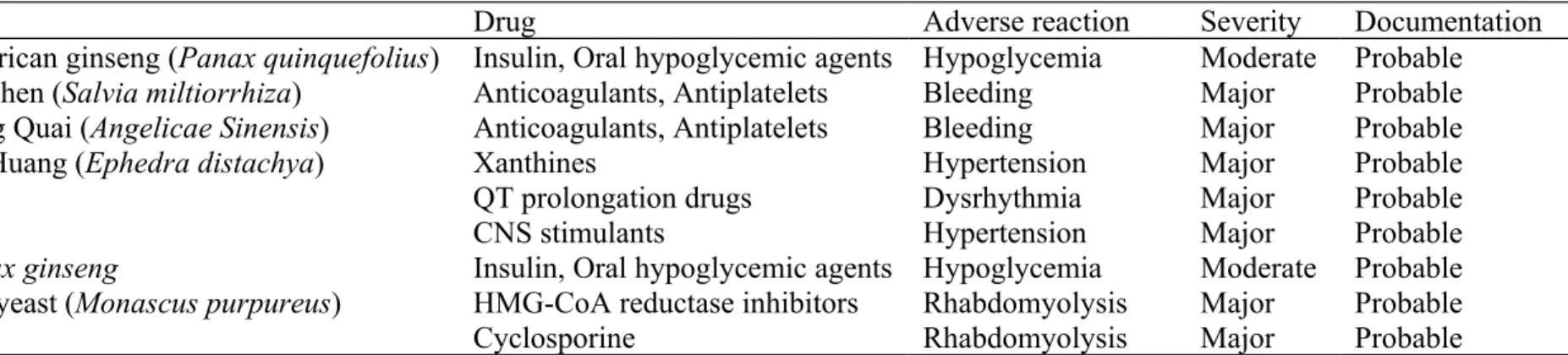
commonly prescribed medicines, namely 6 herbs (American ginseng, Danshen, Dong
Quai, Ma Huang, Panax ginseng, and red yeast rice) and 9 drug categories (insulin,
OHAs, anticoagulants, antiplatelets, xanthines, QT prolongation drugs, central nervous
system stimulants, HMG CoA reductase inhibitors, and cyclosporines) for use in the
reminder system (Table 1).
A guide was created for pharmacists to educate patients about possible interactions
when filling prescriptions (Table 2). TCM practitioners may also tell patients to monitor
for drug-interaction symptoms, and the warnings and advice from pharmacists further
emphasizes the need for vigilance against interactions.
The reminder system was inaugurated on January 1, 2011 (Figure 2), and from that day
to December 31, 2013, it identified 891 herbal prescriptions (for 256 patients) with
possible drug interactions to which no adjustments were made by the TCM practitioner.
The system recorded 227 prescriptions (for 50 patients) in which the interaction of
ginseng (Panax ginseng or American ginseng) and hypoglycemic agents was possible.
We retrospectively reviewed medical records in a pilot study and determined that 3 of
the 50 patients manifested hypoglycemia (fasting blood sugar level ≤70 mg/dL) during
concurrent use of ginseng and a hypoglycemic agent. Only one of those 3 patients
displayed symptoms of hypoglycemia. More time is required to evaluate the clinical
course of other drug-herb combinations, and further analysis is required to gain a deeper
understanding of drug-herb interactions.
The interaction of Danshen or Dong Quai with anticoagulants, such as warfarin, or
with antiplatets, such as aspirin or Plavix, as well as the interaction of red yeast rice
with statins, can be life-threatening. The interaction of American ginseng or Panax
ginseng with an OHA or insulin injection can cause clinical deterioration and require
hospitalization.
4. Discussion
We effectively designed and implemented a computerized drug-herb reminder system
that identified 891 herbal prescriptions posing possible major or moderate interactions
with WM drugs 10 in our hospital from January 1, 2011, to July 31, 2013. Pharmacists
were prompted by the system to warn patients of possible interactions and interaction
symptoms and followed-up with the patients. Three patients were discovered to have
hypoglycemia (fasting blood sugar level ≤ 70 mg/dL), but no other adverse clinical
reactions were reported by other patients. The system is simple, rapid, and convenient to
use, providing immediate drug-herb interaction information upon prescription input.
The most frequent drug-herb interaction reminders were for ginseng and OHA or
insulin injections; Danshen or Dong Quai and warfarin, aspirin or clopidogrel; and red
yeast rice and statin. Ginseng may increase insulin sensitivity, reduce insulin resistance,
and increase insulin secretion, yielding hypoglycemic effects 4,11. In addition,
ginsenoside, a component of ginseng, increases GLP1 secretion, thereby reducing blood
glucose levels 4. Dong Quai contains coumarin derivatives, which can potentiate
warfarin, elevating prothrombin time and the international normalized ratio (INR) 12.
Danshen increased the absorption of warfarin in rats and reduced the protein binding of
warfarin in serum 13. Moreover, Danshen increased the INR from 3.0 to more than 8.4
and was reported to cause the activated partial thromboplastin time to increase to more
than 120 seconds in a cardiac valve operation patient 14. Consuming 10 mg of
monacolins from red yeast rice (Monascus purpureus) for 4 weeks reduced the total
cholesterol and low-density lipoprotein (LDL) cholesterol levels substantially in
hypercholesterolemia patients 15. In addition, red yeast rice was demonstrated to reduce
the effects of LDL cholesterol in statin-intolerant hyperlipidemia patients with or
without type 2 diabetes 16. Therefore, red yeast rice, like statins, can reduce the effects
of LDL cholesterol. The main major and moderate results of drug-herb interaction are
hypoglycemia, bleeding tendency, enhancing steroid, and a reduction in the effects of
LDL cholesterol.
This study’s limitations were as follows: (1) The reminder system was used only in
our hospital, and drug-herb interactions could not be observed if patients visited other
hospital or clinics. Therefore, the system will be expanded to all hospitals and local
clinics in Taiwan. (2) The system issued warnings for all possible drug-herb interactions
from among those in the database, and indicated whether the interaction was minor,
moderate, or major. This resulted in excess information on the computer screen,
interfering with the work of the TCM practitioners. This limitation raises the critical
concern of deciding which possible interactions should be included in the system. (3)
Drug-herb interactions are largely dependent on the doses and formulas involved, and
although animal studies of interactions investigated exact doses, the effects of different
doses in humans is unclear.
Despite these limitations, the computerized reminder system improves drug and
patient safety because it alerts TCM practitioners to interactions and enables them to
change herbs or formulas, modify doses, or take no action when writing prescriptions.
Drug safety will improve if TCM practitioners pay more attention to the system’s
warnings. However, too many pop-up windows may disturb the thinking process of the
doctors; we should achieve a balance between safety and convenience. Our committee
selected commonly used herbs and drugs for inclusion in the reminder system. TCM
practitioners will be familiar with the prescription process, and pharmacists will be
acquainted with providing supplemental health education. We will add more
interactions into the reminder system after regularly held conferences.
5. Conclusion
The computerized reminder system automatically informs TCM practitioners who are
writing prescriptions of potential drug-herb interactions. TCM practitioners may choose
to adjust herbs or doses to avoid or reduce the risk of drug-herb interactions.
Pharmacists may then use information provided by the system to educate patients about
possible drug-herb interactions and resulting symptoms. This combination of reminders
and education can improve patient safety.
Acknowledgments
This study was supported by China Medical University under the Aim for Top
University Plan of the Ministry of Education, Taiwan, and by the Taiwan Ministry of
Health and Welfare’s Clinical Trial and Research Center of Excellence (MOHW103-
TDU-B-212-113002).
The authors thank computer programmer Zi-Rong Yen, who designed the reminder
system.
Disclosure
The authors have no financial relationships to disclose with regard to this study.
References
1. Chen FP, Chen TJ, Kung YY, et al. Use frequency of traditional Chinese medicine in Taiwan. BMC health services research. 2007;7:26.
2. Chen MC, Lai JN, Chen PC, Wang JD. Concurrent Use of Conventional Drugs with Chinese Herbal Products in Taiwan: A Population-based Study. Journal of traditional and complementary medicine. 2013;3(4):256-262.
3. Chan TY. Interaction between warfarin and danshen (Salvia miltiorrhiza). The Annals of pharmacotherapy. 2001;35(4):501-504.
4. Liu Z, Li W, Li X, et al. Antidiabetic effects of malonyl ginsenosides from Panax ginseng on type 2 diabetic rats induced by high-fat diet and
streptozotocin. Journal of ethnopharmacology. 2013;145(1):233-240.
5. Jeon WJ, Oh JS, Park MS, Ji GE. Anti-hyperglycemic effect of fermented ginseng in type 2 diabetes mellitus mouse model. Phytotherapy research : PTR.
2013;27(2):166-172.
6. Xie JT, McHendale S, Yuan CS. Ginseng and diabetes. The American journal of Chinese medicine. 2005;33(3):397-404.
7. Sen S, Querques MA, Chakrabarti S. North American Ginseng (Panax
quinquefolius) prevents hyperglycemia and associated pancreatic abnormalities in diabetes. Journal of medicinal food. 2013;16(7):587-592.
8. Brazier NC, Levine MA. Drug-herb interaction among commonly used
conventional medicines: a compendium for health care professionals. American journal of therapeutics. 2003;10(3):163-169.
9. Prasad GV, Wong T, Meliton G, Bhaloo S. Rhabdomyolysis due to red yeast rice (Monascus purpureus) in a renal transplant recipient. Transplantation.
2002;74(8):1200-1201.
10. Tatro DS. Drug interaction facts 2014: the authority on drug interactions. Saint Louis, Mo.: Wolters Kluwer Health/Facts & Comparisons; 2014.
11. Kim HY, Kim K. Regulation of signaling molecules associated with insulin action, insulin secretion and pancreatic beta-cell mass in the hypoglycemic effects of Korean red ginseng in Goto-Kakizaki rats. Journal of
ethnopharmacology. 2012;142(1):53-58.
12. Page RL, 2nd, Lawrence JD. Potentiation of warfarin by dong quai.
Pharmacotherapy. 1999;19(7):870-876.
13. Zhang Z, Ge B, Zhou L, Lam TN, Zuo Z. Induction of liver cytochrome P450s by Danshen-Gegen formula is the leading cause for its pharmacokinetic
interactions with warfarin. Journal of ethnopharmacology. 2014;154(3):672- 686.
14. Izzat MB, Yim AP, El-Zufari MH. A taste of Chinese medicine! The Annals of thoracic surgery. 1998;66(3):941-942.
15. Cicero AF, Derosa G, Parini A, et al. Red yeast rice improves lipid pattern, high- sensitivity C-reactive protein, and vascular remodeling parameters in moderately hypercholesterolemic Italian subjects. Nutrition research. 2013;33(8):622-628.
16. Sartore G, Burlina S, Ragazzi E, Ferraresso S, Valentini R, Lapolla A.
Mediterranean Diet and Red Yeast Rice Supplementation for the Management of Hyperlipidemia in Statin-Intolerant Patients with or without Type 2 Diabetes.
Evidence-based complementary and alternative medicine : eCAM.
2013;2013:743473.
Legends
Figure 1. Drug-Herb Interactions: from Source Articles to Database
Figure 2. Reminder System for Drug-Herb Interactions
Figure 1
Figure 2
Table 1. Drug-herb pairs in the remind system
Herb Drug Adverse reaction Severity Documentation
American ginseng (Panax quinquefolius) Insulin, Oral hypoglycemic agents Hypoglycemia Moderate Probable Danshen (Salvia miltiorrhiza) Anticoagulants, Antiplatelets Bleeding Major Probable Dong Quai (Angelicae Sinensis) Anticoagulants, Antiplatelets Bleeding Major Probable
Ma Huang (Ephedra distachya) Xanthines Hypertension Major Probable
QT prolongation drugs Dysrhythmia Major Probable
CNS stimulants Hypertension Major Probable
Panax ginseng Insulin, Oral hypoglycemic agents Hypoglycemia Moderate Probable Red yeast (Monascus purpureus) HMG-CoA reductase inhibitors Rhabdomyolysis Major Probable
Cyclosporine Rhabdomyolysis Major Probable
QT prolong: Q wave and T wave of electrocardiogram interval prolong;
HMG-CoA : 3-hydroxy-3-methylglutaryl-coenzyme A;
CNS: central nervous system.
Anticoagulants: Anagrelide, Enoxaparin, Heparin, Tinzaparin, Tirofiban Antiplatelets: Aspirin, Clopidogrel, Dipyridamole, Ticlopidine
CNS stimulants: Methylephedrine, Pseudoephedrine, Ephedrine
HMG-CoA reductase inhibitors: Atorvastatin, Fluvastatin, Rosuvastatin, Simvastatin
Oral hypoglycemic agents: Acabose, Glibenclamide, Gliclazide, Gliclazide, Glimepride, Glipizide, Glyburide, Linagliptin, Metformin,
Nateglinide, Pioglitazone , Repaglinide, Saxagliptin, Sitalgliptin QT prolongation drugs: Amiodarone, Dronedarone
Xanthines: Aminophylline, Caffeine, Theophylline
Table 2. Pharmacist guide of health education on adverse reaction of drug-herb interactions
Adverse reaction Symptoms Suggestion to patient
Bleeding Gum bleeding, ecchymosis, tarry stool Stop medication and seek medical help
Dysrhythmia Palpitation, fainting, shortness of breath, chest pain Stop medication and seek medical help
Hypertension Headache, Check blood pressure regularly
Hypoglycemia Dizziness, palpitation, cold sweating Ingest sugar and seek medical help Rhabdomyolysis Muscle pain, weakness, tea-colored urine Stop medication and seek medical help