A bstrAct
The IoT is a novel platform for making objects more intelligent by connecting to the Internet.
However, mass connections, big data process- ing, and huge power consumption restrict the development of IoT. In order to address these challenges, this article proposes a novel ECIoT architecture. To further enhance the system per- formance, radio resource and computational resource management in ECIoT are also inves- tigated. According to the characteristics of the ECIoT, we mainly focus on admission control, computational resource allocation, and power control. To improve the performance of ECIoT, cross-layer dynamic stochastic network optimi- zation is studied to maximize the system utility, based on the Lyapunov stochastic optimization approach. Evaluation results are provided which demonstrate that the proposed resource alloca- tion scheme can improve throughput, reduce end-to-end delay, and also achieve an average throughput and delay trade-off. Finally, the future research topics of resource management in ECIoT are discussed.
I ntroductIon
As an emerging platform, the Internet of Things (IoT) enables a tremendous number of objects to be connected to the Internet, such as wearable equipment, actuators, sensors, smart vehicles, and smart buildings [1]. It integrates ubiquitous and pervasive computing and allows objects to be remotely sensed and controlled. With those capabilities, IoT has great potential to improve efficiency and accuracy, and reduce costs, and is expected to play a fundamental role for many emerging services such as smart grids, intelligent transportation systems, and smart cities.
Although IoT can bring a lot of benefits, it still faces many technical challenges [2]. First, the number of devices in IoT is huge. The Europe- an Commission has reported that the number of smart devices connected to the Internet will reach 50 to 100 billion in 2020. Second, the data gener- ated by IoT devices is massive. According to Cis- co’s report, the devices in IoT will generate about 507.5 ZB/year data by 2019 [3]. Third, with vibrating devices and enormous data volume, huge power consumption is another challenging issue. In IoT, many devices are equipped with data acquisition nodes, such as micro controller units (MCUs), sensors, and wireless devices. Typ-
ically, these nodes are powered by batteries or obtained power by energy harvesting. In such a case, energy efficiency becomes very critical to guarantee the sustainable operation of these equipments.
In this article, to accommodate the mass con- nections and data, as well as achieve efficient, sus- tainable operation, we resort to edge computing and jointly study admission control and resource allocation. Specifically, the main contributions of this article can be described as:
• We propose a novel edge computing for IoT (ECIoT) architecture, to cater for the mass connections and big data processing, and achieve sustainable operation.
• We review and discuss radio resource and computational resource management for ECIoT, mainly focus on admission control, resource allocation, power control, and computational resource allocation to further improve the system performance.
• Based on the proposed ECIoT architecture, we investigate cross-layer dynamic stochastic network optimization to enhance the perfor- mance of ECIoT. In this problem, we utilize the Lyapunov dynamic stochastic optimiza- tion approach to solve the problem of joint admission control and resource allocation in ECIoT.
The remainder of the article is organized as fol- lows. First, we introduce a new ECIoT architecture and explain its scalability and efficiency. Then we introduce the radio resource and computation- al resource management in ECIoT from several aspects: admission control, resource allocation, power control, and computational resource allo- cation. After that, cross-layer dynamic stochas- tic network optimization is studied. In the next section, the future research topics of resource management in ECIoT are proposed. Finally, con- cluding remarks are provided.
E dgE c omputIng for I o t
Cloud computing, which can provision elastic computational resources on demand, is consid- ered as an appropriate way to efficiently process the mass data generated by IoT devices [4, 5].
However, the cloud computing for IoT also brings two issues: resource demand mismatch and high transmission latency. Transmitting the mass data generated by IoT devices to the cloud requires a huge amount of energy, time, and bandwidth.
Meanwhile, the heavy load will produce enor-
Joint Admission Control and Resource Allocation in Edge Computing for Internet of Things
Shichao Li, Ning Zhang, Siyu Lin, Linghe Kong, Ajay Katangur, Muhammad Khurram Khan, Minming Ni, and Gang Zhu
EDGE COMPUTING FOR THE INTERNET OF THINGS
Digital Object Identifier:
10.1109/MNET.2018.1700163 Shichao Li, Siyu Lin (corresponding author), Minming Ni, and Gang Zhu are with Beijing Jiaotong University; Ning Zhang and Ajay Katangur are with Texas A&M University-Corpus Christi; Linghe Kong is with Shanghai Jiao Tong University; Muhammad Khurram Khan is with King Saud University.
mous pressure on fronthaul and backhaul, leading to system congestion [6]. In addition, long dis- tance transmission can result in greater delay. In order to deal with those issues, edge computing (or fog computing) is proposed, which distributes a part of virtual machines (VMs) from the cloud computing centers to the network edge. By utiliz- ing the radio access network (RAN) with the fog computing paradigm, some of the control and data plane functions can be processed at the local baseband unit (BBU). Therefore, fog computing can alleviate the computing and routing burdens significantly and improve resource utilization.
Moreover, since the fog node is closer to the IoT devices, the end-to-end delay can be reduced.
By utilizing fog computing, we propose a novel ECIoT architecture in the following.
t
hEEcI
ot A
rchItEcturEThe proposed novel ECIoT architecture is shown in Fig. 1. The IoT devices transmit data to the access points (APs), which are connected to the fog nodes with data computation and storage capabilities. The fog nodes have connections with each other and with the remote cloud. Because the VMs in fog nodes have powerful information processing capabilities, the mass data generat- ed by IoT devices can be handled effectively. In addition, since the fog node is closer to the IoT devices, the end-to-end delay can be reduced. If the fog nodes do not have sufficient computation- al resources to process the data, the tasks will be uploaded to the cloud, which will consume more network resources and lead to higher end-to-end delay. In order to make the network architecture more flexible and scalable, software defined net- work (SDN)-based architecture can be employed.
By utilizing SDN-based architecture, networks can be managed easily, and network capacity can be increased [7]. The control mechanism that is provided by SDN can reduce the complexity of ECIoT architecture, and it can allocate resourc- es flexibly. If data needs to be transmitted to the
cloud node, an optimal route can be planned by SDN; this also can provide the highest quality ser- vice to the IoT devices. In order to better manage IoT services, a model for service management through SDN and its components are proposed.
Service Discovery Module: The module con- tains a mapping table that links the services with the corresponding server locations. This table will be updated periodically or when a new service arrives. By utilizing this module, the IoT devices can find the services and locations easily, and delay can be reduced.
Service Processing and Migration Module:
Since the computational capacity of a fog node is limited, when a large amount of data need to be processed, this module can decide whether the data is migrated to the cloud node or a nearby fog node. Meanwhile, when the utilization of a fog node is low, it can also process data together with other fog nodes.
Performance Monitoring and Optimization Module: This module can utilize SDN and Open- Flow capabilities to monitor the service utilization levels and flow sizes to manage the load of the fog node. Therefore, the system throughput can be improved.
User Handover Module: When IoT devices move from one fog node to another, without any mobility management, service continuity cannot be guaranteed. This module can predict the coverage of the next fog node and provide continuous services for IoT devices with certain techniques.
All the IoT devices are connected to distrib- uted fog nodes whether they are static or mov- ing. In order to support the mass connections FIGURE 1. The ECIoT architecture.
Servicediscovery UserhandoverServiceprocessing& migration Performancemonitoring &optimization Service management
SDN controller
Intelligent appliances
Smart building Solar panel
Smart factory
Control plane
Data plane
AP Control plane
Virtual machines
Fog node Fog node Databases Cloud
Data plane
AP
Smart vehicles Smart healthcare
Windmill Smart grid
Intelligent transportation system
Fog computing can alleviate computing and routing burdens significantly, and improve resource utilization. Moreover, since the fog node is closer to the IoT devices, the end-to-end delay can be
reduced. By utilizing fog computing, we propose a novel ECIoT architecture.
of IoT devices, fog nodes should be equipped with multiple wireless interfaces. In this regard, many wireless communications technologies can be leveraged in IoT, such as Bluetooth, Zigbee, LTE, infrared, massive multiple-input multiple-out- put (MIMO), WiFi, general packet radio service (GPRS), and narrowband IoT communications [8, 9]. Therefore, the multi-interface fog nodes can be connected by multiple IoT devices.
m
Assc
onnEctIonsAndA
ccEssc
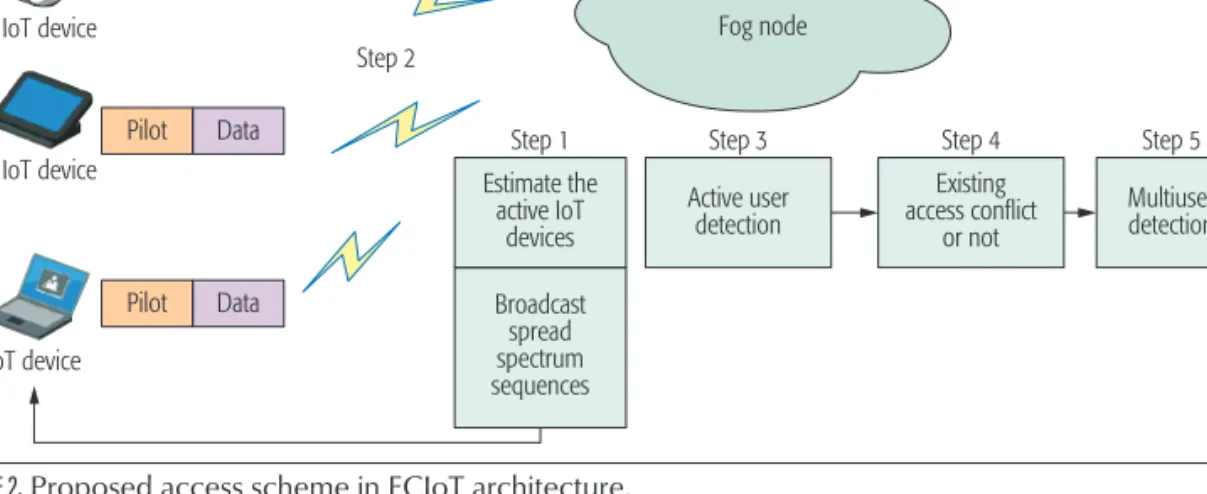
ontrol With a multi-interface ECIoT architecture, it is of significance to coordinate the access of IoT devic- es. In LTE/LTE-Advanced (LTE-A), the existing ran- dom access scheme includes four steps: random access request, random access response, sched- uling-based transmission, and collision avoidance.However, in IoT, the packet size of IoT is about 1/10 to 1/100 of a conventional cellular com- munication system [10]. Moreover, the number of devices in IoT is about 1000 times existing net- work devices. Therefore, it is inefficient to transmit the small packets of IoT devices by utilizing the existing random access scheme, and the pream- ble sequences cannot support so many devices [11]. To this end, we propose a novel access scheme, as shown in Fig. 2. Specifically, the new access scheme is performed in the following five steps.
Step 1: The fog node estimates the active IoT devices according to the statistical observation information, and transmits the variable size of spread spectrum sequences to the IoT devices.
The spread spectrum sequence size is determined by the estimated number of devices.
Step 2: According to the spread spectrum sequences in step 1, IoT devices transmit pilots and data in one short packet to achieve random access. In the process, the scheduling informa- tion of the fog node is not required, so the trans- mission delay and signaling overhead can be reduced.
Step 3: In the channel estimation phase, we
estimate the identity of all active IoT devices, that is, the device index.
Step 4: Because the transmission codeword is a function of the device index, we can estimate the transmission codeword for each IoT device based on the device index obtained in the pre- vious step. Then we determine whether there is access conflict.
Step 5: The fog node performs channel esti- mation and multiuser detection according to the received signals.
s
ustAInAblEo
pErAtIonEnergy consumption is one of the barriers that impede the development of IoT. For instance, in step 2 of the proposed access scheme, the IoT devices will transmit pilots and data to the fog node, which consumes a huge amount of energy.
In order to prolong the battery life and achieve sustainable operation, countermeasures such as energy saving and energy harvesting can be employed.
For energy saving, three methods can be considered. First, the sensing equipments in IoT devices can use low-power components, which can dynamically change the working voltage according to workload. Second, in IoT, monitor- ing events are sporadic, the system is often in an underloaded state, and the load exhibits hetero- geneity. The variation or heterogeneous charac- teristic of the workload provides the possibility for saving power. When the IoT devices are idle, they can enter low-power mode or sleep mode, and when necessary they can be awakened. Third, advanced software to manage the energy can be utilized, such as advanced power management (APM) and advanced configuration and power interfaces (ACPIs).
For energy harvesting, four types of energy sources can be leveraged.
Light: The Sun and artificial sources can con- vert visible light into usable electric power. Out- doors, devices with embedded solar panels can obtain energy from sunlight. However, the oper- ation heavily depends on the weather, which is uncontrollable. Indoors, since artificial sources can be controlled, we can get sustainable energy.
Motion/Vibration: Wind can be converted into electric power by using AC generators. In industrial equipment, vibrations generated by machines can also be exploited for energy har-
The Sun and artificial sources can convert visible light into usable electric power. Outdoors, devices
with embedded solar panels can obtain energy from sunlight. However, the operation heavily depends on the weather, which is uncontrollable. Indoors, since artificial sources can be
controlled, we can get sustainable energy.
FIGURE 2. Proposed access scheme in ECIoT architecture.
Multiuser detection Step 5 Existing
access conflict or not Step 4 Active user
detection Step 3 Estimate the
active IoT devices Broadcast
spread spectrum sequences
Step 1 Step 2
Pilot Data
Pilot Data
Pilot IoT device
IoT device
IoT device
Data
Fog node
vesting. However, it is very challenging to fabri- cate a generalized harvesting system for some special vibrating sources.
Heat: Temperature gradients can be used for energy harvesting. However, there is a fundamen- tal limit, namely the Carnot cycle, to the maxi- mum efficiency of power extraction.
Radio Frequency: By utilizing the broadcast- ing characteristic of wireless communication, RF can supply energy for battery-less IoT devices.
Indoors, electromagnetic wave signals emitted from modems, routers, and laptops are collected, and then converted into electric power.
K Ey t EchnologIEs of
r EsourcE m AnAgEmEnt In EcI o t
Radio resource and computational resource man- agement are effective methods to improve the performance of a communication system. Based on the IoT characteristics of mass connections and big data processing, we mainly focus on admission control, resource allocation, power control, and computational resource allocation in this article, due to the following reasons. First, by designing the admission control scheme, the sys- tem congestion caused by mass connections can be avoided [12]. Second, because the computa- tional resources of fog nodes are limited, we can improve the throughput of the system and guar- antee the quality of service (QoS) of IoT devices through appropriate resource allocation schemes.
Third, power control is an effective method to reduce the power consumption of the system.
In this section, we review the recent advances in radio resource and computational resource man- agement, and discuss them in ECIoT.
A
dmIssIonc
ontrolAdmission control is a useful method for QoS provisioning and congestion control. In partic- ular, there are two parts of admission control that can be considered: QoS guarantees and the remaining network resources. For an admission control scheme, a new access can be accepted only when:
• The network has adequate resources to satis- fy the QoS requirements.
• The committed QoS of the accepted access- es should not be violated.
• The new access does not cause the network congestion.
Therefore, there is a trade-off between resource utilization and QoS requirements. In ECIoT, since the QoS requirements of multiple services are different, the fairness and prioritization of different services should be considered. For instance, safe- ty-related services should be given higher priority, while other services use the remaining resources.
In the following, admission control mechanisms are reviewed and discussed for ECIoT.
Level-Based Admission Control Scheme: The level-based admission control scheme can usu- ally be divided into two categories: packet-level admission control and call-level admission control.
For packet-level admission control, each service is distinguished by the packet arrival rate, packet loss ratio requirement, and packet queuing delay.
For elastic traffic, the system can drop some excess packets according to the QoS require-
ments and the system status. For call-level admis- sion control, each call can be distinguished by its arrival rate and holding time. If the network has enough resources, the new call can be accept- ed; otherwise, it is rejected. Since IoT is a pack- et-switched system, when designing the admission control scheme, packet-level admission control should be adopted.
Priority-Based Admission Control Scheme:
In ECIoT, there are diverse services with differ- ent QoS requirements in ECIoT; hence, the ser- vice priority should be considered in admission control. For example, in an intelligent transpor- tation system [13, 14], handover services should be given higher priority, because if an ongoing service is dropped in the handover process, it will significantly degrade quality of experience (QoE) compared to blocking a new service. In general, data service should be given the lowest priority, while voice service has the highest priority.
r
AdIor
EsourcEA
llocAtIonResource allocation plays a significant role in improving the QoS performance and enhancing the data transmission efficiency in ECIoT. There are many works on the resource allocation to sat- isfy QoS requirements. However, since IoT has some special characteristics, the existing resource allocation methods cannot be directly applied in ECIoT. In addition, the dynamic characteristics of ECIoT should be considered, such as the ran- dom service/packet arrivals and the time-varying wireless channels in an intelligent transportation system. In the following, resource allocation for ECIoT is reviewed and discussed from the follow- ing two aspects: QoS-aware resource allocation and cross-layer dynamic resource allocation.
QoS-Aware Resource Allocation Scheme: In QoS-aware resource allocation, various resourc- es are allocated appropriately to maintain or improve the QoS requirement. In the context of IoT, the reliability of data transmission is essential.
Due to the massive scale and the huge number of devices in IoT, a many-to-one communication scenario will be very typical, potentially leading to packet loss. Additionally, when the IoT devices are moving, the time-varying wireless channels will cause communication instability. The other key QoS parameter is transmission delay in ECIoT.
The IoT devices are usually related to the change of environment, requiring low transmission delay.
Moreover, one objective of utilizing edge com- puting is to reduce the transmission delay. There- fore, reliability and delay requirement should be considered in ECIoT.
Cross-Layer Dynamic Resource Allocation Scheme: Cross-layer dynamic resource allocation is a useful method for QoS provisioning by jointly optimizing different layers.
In ECIoT, the dynamic characteristics should be considered, such as random service/packet arriv- als and the time-varying wireless channels in some moving systems. Therefore, in order to improve
In the context of IoT, the reliability of data transmission is essential. Due to the massive scale and the huge number of devices in IoT, a many-to-one communication scenario will be very typical, potentially
leading to packet loss.
the QoS performance and enhance resource uti- lization, a cross-layer dynamic resource allocation scheme is an effective method.
p
owErc
ontrolIn ECIoT, the fog nodes need to process and transmit a large amount of data, resulting in high energy consumption. Therefore, in order to save power in fog nodes, one efficient and feasible way is through power control. In general, there are four types of power allocation schemes for different optimization objectives, including con- stant power allocation, water-filling power allo- cation, channel inversion power allocation, and proportional power allocation. Constant power allocation ignores the variation of channel con- dition and allocates the same power to all IoT devices. The advantage lies in the simplicity of implementation, while the disadvantage is that the transmission rate is unfair. Channel inversion power allocation can help solve this issue, as it allocates more power to the IoT devices with bad channel conditions. Water-filling power alloca- tion can maximize the total network transmission rate. It allocates more power to IoT devices with good channel conditions and less power or even no power to IoT devices with bad channel condi- tions. Proportional power allocation can achieve a trade-off between fairness and the total network transmission rate. In ECIoT, because of dynamic services arrival and time-varying wireless channels, dynamic power control should be employed to improve the system performance.
c
omputAtIonAlr
EsourcEA
llocAtIonComputational resource allocation is a significant method to satisfy the delay requirements and achieve the minimization of energy consumption in ECIoT. In the following, an overview of com- putational resource allocation to satisfy the delay requirements and minimize energy consumption is given from two aspects: one is computational resource allocation from a single node, and the other is computational resource allocation from multiple nodes.
Computational Resource Allocation from a Single Node: Because the computational resourc-
es of fog nodes are limited, in order to satisfy the delay requirements of IoT devices, priorities should be given (i.e, an IoT device with a low delay requirement has higher priority). If the fog node has enough computational resources, the data can be processed according to their priori- ties. Otherwise, the data will be offloaded to the cloud nodes. When the IoT devices can choose the fog nodes, in order to minimize power con- sumption, the computational resources usage of fog nodes needs to be considered. Offloading all the data to a high utilization fog node may cause high energy consumption and fog node overload.
An effective method is that the fog nodes can broadcast the computational resources usage to the IoT devices, and the IoT devices can choose the feasible fog nodes.
Computational Resource Allocation from Multiple Nodes: When each IoT device can be serviced by multiple fog nodes, in order to guar- antee the delay requirements and minimize the power consumption, a common method is to cluster the IoT devices and then allocate the com- putational resources to the IoT devices in the clus- ter. In order to find an optimal formation of the clusters of IoT devices, some factors need to be considered, including network topology, cluster size, access technology, and so on.
c ross -l AyEr d ynAmIc
r AdIo r EsourcE m AnAgEmEnt In EcI o t
From the previous section, existing works do not consider the joint admission control and resource allocation in ECIoT well. Therefore, this section studies cross-layer joint design of admission control, computational resource allocation, and power control in ECIoT to improve the perfor- mance of ECIoT. Specifically, we consider the services characteristics information (SCI) of the application (APP) layer, queue state information (QSI) of the medium access control (MAC) layer, and channel state information (CSI) of the phys- ical (PHY) layer. We first describe the system model and then formulate an optimization prob- lem to maximize the system utility while satisfying the queue stability and average power constraints.
Then we present numerical results.
s
ystEmm
odElWe consider K types of IoT devices transmitting packets to a fog node, which can be modeled as K queues. Suppose that the packet arrival process of each IoT device is independent and identically distributed (i.i.d.). The number of new arrival packets of IoT device k at time slot t is Ak(t), which follows a truncated Poisson distribu- tion with average arrival rate lk. Denote Bk as the maximum number of arrival packets per slot. In order to capture the difference of IoT devices, we define nk > 0 and xk > 0 to represent the weight and the maximum desired processing ratio of IoT device k, respectively.
As the packets of K types of IoT devices are offloaded to the fog node, we define Qk(t) as the queue backlog at time slot t. Each queue is con- trolled dynamically by admission control, compu- tational resource allocation, and power control.
Let rk(t) [0, Ak(t)] and mk(t) [0, Qk(t)] denote the admission control action and computation- FIGURE 3. Cross-layer dynamic resource allocation framework.
1
m r1
• • • rm
Computational resource allocation Admission
control
Resource management
controller SCI
Users’ packets arrival
QSI MAC layer
Users’ QoS requirements
Channel state information The state of queues App layer
CSI PHY layer Power
control Buffers
al resource allocation action for IoT device k at time slot t, respectively. Let mtotal denote the total computational resources of the fog node, and mk(t) should satisfy SkKmk(t) ≤ mtotal. After it is pro- cessed, the data will eventually be transmitted to IoT devices. The maximum transmit power value of a fog node is Pmax, and average value is Pav. For the power allocation of a fog node at time slot t, P(t) should satisfy P(t) ≤ Pmax. Meanwhile, the average power should satisfy —P ≤ Pav. Let R(t) denote the transmission rate of the wireless chan- nel between the fog node and IoT devices at time slot t. Suppose that each packet has equal size of L bits. Let C(t) be the maximum number of pack- ets at time slot t of the wireless link between the fog node and the IoT devices. We have C(t) =
⎣
R(t)Ts/L⎦
, where Ts is one time slot duration, and L is the packet size. The packets transmitted to the IoT devices are limited by channel capacity, that is, SkKmk(t) ≤ C(t).J
oIntA
dmIssIonc
ontrolAndr
EsourcEA
llocAtIonIn what follows, we formulate a problem of joint admission control, computational resource alloca- tion, and power control to maximize a sum of util- ity with time average constraints. We define Uk(–rk) as a utility function to present average throughput benefit for IoT device k, which is nondecreasing concave continuous with rk. In this problem, we define –z as the long-term time average expecta- tion of any variable z.
Based on the analysis, we formulate the prob- lem to maximize the sum of utility function Uk(–rk).
In the problem, four constraints should be consid- ered: the stability of the queues, the power con- straint of the fog node, the total computational resources constraint, and the channel capacity constraint.
Considering the dynamic packet arrival, we propose a cross-layer dynamic resource allocation framework, as shown in Fig. 3. In this framework, we consider three layers: APP, MAC, and PHY.
At the APP layer, the fog node obtains the SCI, such as the packet arrival rate. At the MAC layer, the fog node acquires the QSI. At the PHY layer, the fog node obtains the CSI between the fog node and the IoT devices. Based on the PHY layer CSI, MAC layer QSI, and APP layer SCI, the fog
node implements resource management, includ- ing admission control, computational resource allocation, and power control. Specifically, the dynamic access of data packets is decided by admission control. Computational resource allo- cation determines the virtual machines (VMs) allo- cated to each queue. Power control determines the transmitted power of the processed data from the fog node to the IoT devices.
Due to the long-term time average expectation and K integer variables mk(t), the problem is hard to solve. We can deal with the long-term time average expectation as follows. By introducing virtual queues, the original problem can be trans- formed into a queue stability problem. By utilizing the Lyapunov stochastic optimization approach, the queue stability problem can be decomposed into three separate subproblems. For the three subproblems, the utility maximization problem and admission control problem can easily be solved. The joint computational resource alloca- tion and power control problem, due to the K integer variables mk(t), is difficult to solve. We can transform the problem into a single variable prob- lem. Due to space limitation, details are omitted.
p
ErformAncEE
vAluAtIonIn this subsection, numerical results are provid- ed to evaluate the performance of the proposed cross-layer resource management. We consider 6 IoT devices, and the system bandwidth is set to 5 MHZ. The maximum transmit power of the fog node is 45 W, while the average transmit power is 35 W. The packet size is set to 240 bits, and the time slot duration is set to 1 ms. The path loss model is given by 31.5 + 40log10(d), where d is the distance between the IoT devices and the fog node.
Figure 4 shows the trade-off between average throughput and backlog with different V, where V is a parameter that represents the emphasis on utility maximization compared to queue stability.
FIGURE 4. The trade-off between average throughput and backlogs with different V: a) average throughput with different V; b) average backlogs with different V.
V (a) 10
0 14 12
Average throughput (packets)
16 18 20 22 24 26
20 30 40 50
V (b) 35
8030
Average backlog (packets)
130 140
120
110
100
90
40 45 50
Device1, υ1 = 5 Device2, υ2 = 6 Device3, υ3 = 7 Device4, υ4 = 8 Device5, υ5 = 9 Device6, υ6 = 10 Device1, υ1 = 5
Device2, υ2 = 6 Device3, υ3 = 7 Device4, υ4 = 8 Device5, υ5 = 9 Device6, υ6 = 10
By introducing the virtual queues, the original problem can be transformed into a queue stability problem. By utilizing the Lyapunov stochastic optimization approach, the queue stability problem can
be decomposed into three separate subproblems.
In these two figures, we use the same parame- ters lk = 25 and xk = 1 and different weights for IoT devices. From Fig. 4a, we can see that with increasing V, the average throughput for each IoT device also increases and the IoT device with higher weight can get larger average throughput.
From Fig. 4b, we can see that the average queue backlogs of all IoT devices are linearly increas- ing with V. In addition, the proposed algorithm can ensure fairness, where the average queue backlogs of IoT devices with different weights are almost the same.
In order to demonstrate the efficiency of the proposed algorithm, we compare its performance with the greedy algorithm, in which order of com- putational resource allocation is from device 1 to device 6.
From Fig. 5, we can see that the total average throughput of the proposed algorithm is larger than that of the greedy algorithm. Meanwhile, the delay of the proposed algorithm is smaller than that of the greedy algorithm. That is because the computational resource allocation of the greedy algorithm does not consider the queues state for all IoT devices, and some computational resourc- es are wasted.
f uturE d IscussIon
This article investigates the joint admission control and resource allocation problem in ECIoT. Con- sidering the characteristics of IoT devices, such as group mobility, energy, and computational capability limitation, the other research topics of resource management in ECIoT can be further explored.
Mobility Management: Because a cluster of IoT devices may belong to a subsystem, such as a vehicle or a social group, the IoT devices usually have group mobility pattern. To provide seamless services for such IoT devices, group mobility man- agement should be designed. In the handover phase, the required radio resource of signaling overhead may far surpass that of data transmis-
sion; therefore, the dynamic resource allocation for control channel and traffic channel should be considered in the high mobility scenario.
Interference Management: The huge number of devices in IoT means interference management will be an inevitable issue. Although centralized signal processing on a fog node can eliminate interference via interference cancellation and interference coordination, facing the limited stor- age space and computational capability, low-com- plexity interference management techniques on the IoT device should be investigated.
Effective Energy Harvesting: As mentioned before, passive IoT devices can be powered by RF energy of fog nodes. For fog nodes with multiple antennas, energy beamforming can concentrate all the transmission energy of different antennas in the specified direction to provide better energy har- vesting gain. Considering the diversity of phase and frequency of different carriers and antennas, it is a challenge issue to design the multiple energy beam- formers to power mass IoT devices simultaneously.
c onclusIon
IoT is a new technology enabling things to interact with each other and to access the Internet. In this article, we consider the challenging issues of IoT (mass connections, big data processing, and IoT device power consumption) and propose a new ECIoT architecture. Considering that radio resource and computational resource management can improve the performance of a communication sys- tem, radio resource and computational resource management in ECIoT are considered, including admission control, resource allocation, power con- trol, and computational resource allocation. Then a cross-layer dynamic stochastic network optimi- zation problem is formulated. In order to solve this problem, the Lyapunov stochastic optimization approach is utilized. The evaluation results show that the proposed joint admission control and resource allocation scheme can achieve the trade- off between average throughput and delay. Final- ly, we propose future research topics of resource management in ECIoT.
A
cKnowlEdgmEntsThis work was partly supported by the National Key Research and Development Program of China (No.2016YFB1200102, No.2016YFE0100600) FIGURE 5. Performances comparison of two different algorithms: a) total average throughput with different V;
b) total average backlogs with different V.
V (a) 10
0 80 70
Total average throughput (packets)
90 100 110 120 130 140
20 30 40 50
V (b) 35
50030
Total average backlogs (packets)
750 800
700
650
600
550
40 45 50
Greedy algorithm Proposed algorithm Greedy algorithm
Proposed algorithm
The evaluation results show that the proposed joint admission control and resource allocation scheme can achieve the trade-off between average throughput and delay. Finally, we propose future research
topics of resource management in ECIoT.
and the National Natural Science Founda- tion of China (No.61501023, No.U1334202, No.U1534201, No.61672349). The authors extend their appreciation to the Deanship of Sci- entific Research at King Saud University for fund- ing this work through Research Group Number RGP-288.
r
EfErEncEs[1] L. Atzori, A. Iera, and G. Morabito, “The Internet of Things:
A Survey,” Computer Networks, vol. 54, no. 15, 2010, pp.
2787–2805.
[2] A. Al-Fuqaha et al., “Internet of things: A Survey on Enabling Technologies, Protocols, and Applications,” IEEE Commun.
Surveys & Tutorials, vol. 17, no. 4, 2015, pp. 2347–76.
[3] Y. Zhang et al., “A Survey on Emerging Computing Para- digms for Big Data,” Chinese J. Electronics, vol. 26, no. 1, 2017, pp. 1–12.
[4] L. Kong et al., “Millimeter-Wave Wireless Communications for IoT-Cloud Supported Autonomous Vehicles: Overview, Design, and Challenges,” IEEE Commun. Mag., vol. 55, no. 1, Jan. 2017, pp. 62–68.
[5] J. Ren et al., “Exploiting Mobile Crowdsourcing for Pervasive Cloud Services: Challenges and Solutions,” IEEE Commun.
Mag., vol. 53, no. 3, Mar. 2015, pp. 98–105.
[6] S. Barbarossa, S. Sardellitti, and P. D. Lorenzo, “Communicat- ing while Computing: Distributed Mobile Cloud Computing over 5G Heterogeneous Networks,” IEEE Signal Processing Mag., vol. 31, no. 6, 2014, pp. 45–55.
[7] N. Zhang et al., “Software Defined Networking Enabled Wireless Network Virtualization: Challenges and Solutions,”
IEEE Network, vol. 31, no. 5, Nov./Dec. 2017, pp. 42–49.
[8] X. Sun and N. Ansari, “EdgeIoT: Mobile Edge Computing for the Internet of Things,” IEEE Commun. Mag., vol. 54, no. 12, Dec. 2016, pp. 22–29.
[9] D. Wang et al., “An Overview of Transmission Theory and Techniques of Large-Scale Antenna Systems for 5G Wireless Communications,” Science China Info. Sciences, vol. 59, no.
8, 2016, pp. 88–105.
[10] V. Gazis, “A Survey of Standards for Machine-to-Machine and the Internet of Things,” IEEE Commun. Surveys & Tutori- als, vol. 19, no. 1, 2017, pp. 482–511.
[11] S. Lin et al., “Advanced Dynamic Channel Access Strategy in a Spectrum Sharing 5G System,” IEEE Commun. Mag., vol.
24, no. 5, May 2017, pp. 74–80.
[12] N. Kato et al., “The Deep Learning Vision for Heteroge- neous Network Traffic Control: Proposal, Challenges, and Future Perspective,” IEEE Commun. Mag., vol. 24, no. 3, Mar. 2017, pp. 146–53.
[13] J. Ren et al., “Serving at the Edge: A Scalable IoT Architec- ture Based on Transparent Computing,” IEEE Network, vol.
31, no. 5, Nov./Dec. 2017, pp. 96–105.
[14] Z. Fadlullah et al., “State-of-the-Art Deep Learning: Evolving Machine Intelligence Toward Tomorrow Intelligent Network Traffic Control Systems,” IEEE Commun. Surveys & Tutorials, 2017.
[15] X. Duan et al., “Distributed Algorithms to Compute Walra- sian Equilibrium in Mobile Crowdsensing,” IEEE Trans. Indus- trial Electronics, vol. 64, no. 5, 2017, pp. 4048–57.
b
IogrAphIEsShichao Li received his M.E. degree in communication and information systems from Lanzhou Jiaotong University, China, in 2012. He is currently pursuing a Ph.D. degree at Beijing Jiaotong University, China. His main research interests include high-mobility broadband wireless communications, wireless resource allocation, and cloud radio access networks.
NiNg ZhaNg received his Ph.D. degree from the University of Waterloo in 2015. He received a B.Sc. from Beijing Jiaotong University and an M.Sc. from Beijing University of Posts and Telecommunications, China, in 2007 and 2010, respectively. He was a postdoctoral research fellow at the University of Waterloo and University of Toronto. He is now an assistant professor with the Department of Computing Sciences, Texas A&M University at Corpus Christi. He is serving/has served as a Guest Editor for Wireless Communications and Mobile Computing, Mobile
Information Systems, and the International Journal of Distributed Sensor Networks. His current research interests include next generation wireless networks, software defined networking, green communication, and physical layer security.
Siyu LiN received his B.E. and Ph.D. degrees in electronics engi- neering from Beijing Jiaotong University in 2007 and 2013, respectively. From 2009 to 2010, he was an exchange student at the Universidad Politecnica de Madrid, Spain. From 2011 to 2012, he was a visiting student with the University of Victoria, British Columbia, Canada. He has been an associate professor at Beijing Jiaotong University since 2016. His main research interests include wireless communication networks and railway mobile communications.
LiNghe KoNg received his B.E. degree in automation from Xid- ian University in 2005, his Dipl.-Ing. degree in telecommunica- tion from Telecom SudParis in 2007, and his Ph.D. degree in computer science from Shanghai Jiaotong University in 2012.
From 2014 to 2015, he was a postdoctoral fellow with the School of Computer Science, McGill University. He is current- ly an associate professor at Shanghai Jiaotong University. His research interests include wireless sensor networks, mobile com- puting, and RFID.
ajay KataNgur is an associate professor and the program coordinator of the Computer Science program at TAMUCC.
He earned his B.Tech. degree in electronics and instrumen- tation engineering in 1999 from Kakatiya University, India, and his M.S. and Ph.D. degrees in computer science from Georgia State University. He has supervised to completion more than seven M.S. theses and 25 M.S. project students, and co-authored or authored more than 40 journal papers and conference proceedings papers. He currently serves as an Editor for two journal publications and is a reviewer for several journal and conference papers. His research has been funded by NSF and TRDF, primarily in the area of networks, security, and computer architecture.
MuhaMMad KhurraM KhaN is currently working as a full pro- fessor at the Center of Excellence in Information Assurance (CoEIA), King Saud University, Kingdom of Saudi Arabia. He is the Editor-in-Chief of the well reputed journal Telecommu- nication Systems. He is also on the Editorial Boards of several journals published by IEEE, Elsevier, Springer, Wiley, and others.
He is an author of 325 research publications and an inventor of 10 U.S./PCT patents. His research areas of interest are cyber security, digital authentication, biometrics, multimedia security, and technological innovation management. He is a Fellow of the IET, BCS, and FTRA, a member of the IEEE Technical Committee on Security & Privacy, and a member of the IEEE cyber security community.
MiNMiNg Ni was a postdoctoral fellow with the University of Vic- toria. He is currently an associate professor with the State Key Laboratory of Rail Traffic Control and Safety, Beijing Jiaotong University. His current research interests include performance modeling of random wireless networks and protocol design for advanced networking.
gaNg Zhu received his M.S. and Ph.D. degrees from Xi’an Jiaotong University, China, in 1993 and 1996, respectively.
Since 1996, he has been with Beijing Jiaotong University, where he is currently a professor. From 2000 to 2001, he was a vis- iting scholar with the Department of Electrical and Computer Engineering, University of Waterloo. His current research inter- ests include resource management in wireless communications, short-distance wireless communications, and GSM for railways.
He received the Top Ten Sciences and Technology Progress of Universities award in China in 2007 and the First Class Award of Science and Technology in Railway in 2009.