Soft magnetic properties of Co–Fe–Zr–B–Al–O films
L. H. Chen,a)H. K. Chen, C. T. Hsieh, and Y. H. ShihDepartment of Materials Engineering, I-Shou University, Kaohsiung, Taiwan, Republic of China I. G. Chen, S. Y. Chen, and H. P. Liu
Department of Materials Engineering, National Cheng-Kung University, Taiwan, Republic of China We have investigated magnetic and electrical properties of amorphous Co–Fe–Zr–B alloy films with Al and O additions, deposited on rotating Si substrates by dc magnetron sputtering. Microstructural characterization carried out on these films shows the amorphous nature of films. The Co–Fe–Zr–B–Al–O films do not exhibit any uniaxial anisotropy in magnetization behavior in the as-deposited condition. However, a strong uniaxial anisotropy is introduced in the film plane by annealing at 200 °C for 2 h and in an applied field of ⬃150 Oe. The observed in-plane uniaxial anisotropy field (Hk) is as high as⬃38 Oe and the easy-axis coercivity is less than 1.5 Oe for the Co–Fe–Zr–B–Al–O film with 7 at. % Al. The ferromagnetic resonance frequency reaches a high value of⬃2.05 GHz, as a result of this large anisotropy field. It is also found that the soft magnetic properties of amorphous films have a strong dependence on the film composition. This is attributed to the change in the microstructure of films, which is closely related to the film composition. © 2002 American Institute of Physics. 关DOI: 10.1063/1.1447521兴
INTRODUCTION
Recent work on Fe or Co-base metallic glasses and nanocrystalline materials which exhibit excellent soft mag-netic properties have attracted much interest. Combined with moderate susceptibility, high electrical resistivity, and large saturation, these soft magnetic films are promising for a wide range of applications such as miniaturized inductors for VHF and uhf power converters.1
The Co–Fe–共Zr,Nb兲–B alloys have been recently known as bulk amorphous alloys, which have a wide super-cooled liquid range and also a good glass formability and can be produce by conventional casting process.2,3Soft magnetic properties as well as the permeability
⬘
have been reported for these amorphous bulk alloys.4 However, little is known about the amorphous films.5In the case of thin films, sput-tering technique provides a much easier way of preparing the metallic glass, and materials with a wider composition range and additional elements can be processed. In addition, the anisotropy in magnetization can be well controlled for thin films.Soft magnetic films are generally required to have high electrical resistivity to suppress eddy currents and also in-crease the skin depth when used in high frequency applica-tions. The addition of M共Al, Si, Zr, etc.兲 and O in granular films has effectively raised their resistivily.6,7 In this work, we prepared thin films of Co–Fe–Zr–B–Al–O glass mate-rials by a cosputtering technique and investigated the effect of addition of Al and O on magnetic and electrical properties.
EXPERIMENT
The films were deposited on rotating Si substrates at ambient temperatures by dc magnetron sputtering in an Ar/O2 共0.7 vol %兲 atmosphere, using both targets of
Co52Fe20Zr8B20 共at. %兲 and Al. The deposition was carried
out with a sputtering rate of⬃4 A/s and under an atmosphere pressure of 4⫻10⫺3Torr. An external magnetic field of ⬃100 Oe was also applied parallel to the film plane during deposition. The base pressure is less than 3⫻10⫺6Torr. The Al concentration of films is in the range of 7% to 17%共at. %兲, excluding contributions from B and O. The film thickness ranged from⬃3000 to ⬃3500 A. The films were annealed in a high vacuum of ⬃2⫻10⫺6Torr and in the presence of a uniform in-plane field at 200 for 2 h.
The magnetic properties were measured using a vibrat-ing sample magnetometer. The resistivity of films was deter-mined by the four-point probe method. The crystal structure of thin film samples was checked by x-ray diffraction 共XRD兲. The uhf complex permeability was measured from 100 MHz to 2.5 GHz along the hard axis under a dc bias field of⬃10 Oe in the easy axis using a HP 8753 E network analyzer connected to a strip line.
RESULTS AND DISCUSSIONS
Figure 1 shows a typical magnetization curve of the as-deposited Co–Fe–Zr–B–Al–O film with 7% Al, which was grown on rotating Si substrate at ambient temperatures and in an applied field of⬃100 Oe. This 3100-Å-thick film does not show soft magnetic behavior. A similar magnetization behavior is observed for the other Co–Fe–Zr–B–Al–O films. This suggests that the field induced magnetic anisot-ropy of films must be suppressed in the as-deposited state. However, these films exhibit a strong uniaxial anisotropy by annealing at 200 °C for 2 h and in an applied field of ⬃150 Oe, in which an easy axis is obtained nearly parallel to the direction of the applied magnetic field during annealing and sputtering, and a hard axis perpendicular to the easy axis. Figure 2 displays the easy axis and hard axis magnetization behavior for the same film. The estimated uniaxial anisot-ropy field (Hk) is as high as⬃38 Oe and the easy-axis co-a兲Electronic mail: [email protected]
JOURNAL OF APPLIED PHYSICS VOLUME 91, NUMBER 10 15 MAY 2002
8450
0021-8979/2002/91(10)/8450/3/$19.00 © 2002 American Institute of Physics
ercivity is ⬃1.4 Oe. The saturation moment of this film is ⬃605 emu/cm3
, which is⬃10% lower than Co52Fe20Zr8B20
film. It is also found that the hard axis M – H loop is almost closed and linear. Such large anisotropy field is critical in deciding the ultrahigh frequency magnetization behavior of films.
As determined by the XRD, the as-deposited Co–Fe– Zr–B–Al–O films are found to have an amorphous structure. The crystal anisotropy is essentially absent in these as-deposited amorphous films, as a result of lack of long-range ordering in atomic arrangement. However, the residual stress as well as other microstructure irregularities are expected to exist and destroy the soft magnetization behavior of films in the as-deposited state. Thus, the as-deposited films do not exhibit a soft magnetization behavior, as shown in Fig. 1. Upon annealing at 200 for 2 h, the magnetic properties of films undergo significant changes. As shown in Fig. 2, a strong uniaxial anisotropy appears in the annealed films. We have also carried out x-ray diffraction analyses of the
samples annealed at 200 °C. No detectable change in the structure of films is observed in XRD patterns. Therefore, the observed change in magnetic properties of films induced by the annealing is tentatively attributed to the change in the state of residual stress or atomic-scale microstructure. It is well known that the macroscopic shape anisotropy of films causes the magnetization to lie in the film plane. However, there must be some other origins responsible for the ob-served uniaxial anisotropy in the film plane. The crystal an-isotropy is essentially absent in the amorphous films, as a result of the amorphous nature of the material. Then, this uniaxial anisotropy is most likely induced by the applied magnetic field during sputtering and annealing, which has been reported to result from the alignment of local atomic-pair ordering in the amorphous matrix.8 In addition, these films were grown from regions of the substrate where atomic flux arrives with an oblique angle to the film so that oblique incidence anisotropy can not be excluded.9It is also possible that some anisotropy in the stress or magnetostriction may be caused by the local atomic pairing.
As limited by the skin effect, the thickness t of films in thin film inductors for the ultrahigh frequency application must be less than the skin depth ␦. This implies that the product
⬘
t of permeability and effective thickness is the most important material design criteria in thin film inductors, although in future recording heads a large saturation will be required.10 The skin depth is given by␦⫽关/( f⬘
)兴1/2/2, where f is the frequency and is the resistivity of the film. For this reason, high resistivity will be necessary for mag-netic materials to be used for these uhf applications. In this work, we used a four-probe method to measure the resistivity of films. The as-deposited Co–Fe–Zr–B–Al–O film with 7% Al exhibits a very high resistivity of⬃480⍀ cm, which is decreased to⬃200⍀ cm after an annealing at 200 °C.The uhf permeability spectrum of this annealed film is shown in Fig. 3. The complex permeability is given by ⫽
⬘
⫹j⬙
, where ⬘
and⬙
are real and imaginary parts of permeability, respectively. In this study, the complex perme-ability was measured using a high frequency ac field with an FIG. 1. Magnetic hysteresis loop for the as-deposited Co–Fe–Zr–B–Al–Ofilm with 7% Al.
FIG. 2. Easy axis and hard axis hysteresis loops for the annealed Co–Fe– Zr–B–Al–O film with 7% Al.
FIG. 3. uhf permeability spectrum for the annealed Co–Fe–Zr–B–Al–O film with 7% Al.
8451
J. Appl. Phys., Vol. 91, No. 10, 15 May 2002 Chenet al.
intensity of ⬃10 mOe applied along the hard axis and a dc bias field of 10 Oe in the easy axis. As displayed in Fig. 3, the film exhibits an ac permeability 共
⬘
兲 of ⬃180–200 and low dissipation 共⬙
兲 of ⬃10–30 in the measurement fre-quency range up to 0.75 GHz. The Q factor 共permeability/ dissipation兲 is in the range of ⬃10–20. The ferromagnetic resonance frequency ( fres) obtained from the imaginary partof permeability curve is as high as ⬃2.05 GHz. The full width at half maximum (⌬ f ) for the peak is ⬃0.72 GHz. The combination of high ferromagnetic resonance frequency and high resistivity of this Co–Fe–Zr–B–Al–O film is be-lieved to be very useful for the potential microtransformer or microinductor applications at ultrahigh frequencies.
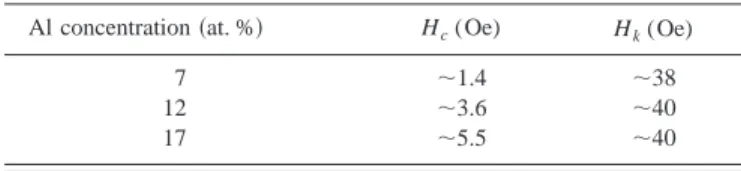
Table I lists the coercivity and anisotropy field for the annealed Co–Fe–Zr–B–Al–O films. It is found that the magnetic properties of Co–Fe–Zr–B–Al–O films are strongly affected by the film composition. The easy-axis co-ercivity increases from 1.4 to 5.5 Oe and the anisotropy field almost remains constant of ⬃38–40 Oe, as the Al concen-tration of films increases from 7% to 17%. The observed dependence of magnetic properties on the film composition is believed to be a result of variations in microstructure of films, although all films have shown a similar amorphous nature of microstructure. Essentially, the films with different Al concentrations generally exhibit different microstructures 共i.e., different local atomic pairs, their alignment, coupling
effect, etc.兲, which are closely related to the soft magnetic properties. Thus, the magnetic properties of films show a strong dependence on the film composition.
CONCLUSIONS
The magnetic and electrical properties of amorphous Co–Fe–Zr–B–Al–O thin films have been studied. Upon an-nealing at 200 °C, a strong uniaxial anisotropy is introduced in the film plane. The Co–Fe–Zr–B–Al–O film with 7% Al can be made to exhibit a low coercivity of ⬃1.4 Oe, a large anisotropy field of ⬃38 Oe, and a high resistivity of ⬃200 ⍀ cm. The film is also shown to have a ferromagnetic reso-nance frequency of ⬃2.05 GHz and a permeability
⬘
of ⬃180–200 which remains nearly constant to ⬃0.75 GHz. It is also found that the soft magnetic properties of amorphous films have a strong dependence on the film composition.ACKNOWLEDGMENT
This work was supported by the National Science Coun-cil at Taiwan under Contract No. NSC89-2218-E-214-018.
1G. Herzer, in Magnetic Hysteresis in Novel Magnetic Materials, edited by
G. C. Hadjipanayis共Kluwer, Dordrecht, 1997兲, p. 711.
2
A. Inoue and J. S. Gook, Mater. Trans., JIM 36, 1180共1995兲.
3
A. Inoue, A. Takeuchi, and T. Zhang, Metall. Mater. Trans. A 29A, 1779
共1998兲.
4A. Inoue, H. Koshiba, T. Itoi, and A. Makino, Appl. Phys. Lett. 73, 744 共1998兲.
5
L. H. Chen, S. L. Cheng, Y. H. Shih, S. Jin, and R. B. van Dover, IEEE Trans. Magn.共in press兲.
6S. Mitani, H. Furukawa, and S. Ohnuma, J. Magn. Magn. Mater. 140– 144, 429共1995兲.
7
Y. Hayakawa, A. Makino, H. Fujimori, and A. Inoue, J. Appl. Phys. 81, 3747共1997兲.
8J. C. Slonczewski, in Magnetic Annealing, Magnetism Vol. I, edited by G.
Rado and H. Suhl共Academic, New York, 1963兲, p. 205.
9T. J. Klemmer, K. Ellis, L. H. Chen, R. B. van Dover, and S. Jin, Appl.
Phys. Lett.共submitted兲.
10V. Korenivski and R. B. van Dover, IEEE Trans. Magn. 34, 1375共1998兲.
Published without author corrections
TABLE I. Magnetic properties of the Co–Fe–Zr–B–Al–O films deposited in an Ar/O2共0.7 vol %兲 atmosphere.
Al concentration共at. %兲 Hc(Oe) Hk(Oe)
7 ⬃1.4 ⬃38
12 ⬃3.6 ⬃40
17 ⬃5.5 ⬃40
8452 J. Appl. Phys., Vol. 91, No. 10, 15 May 2002 Chenet al.