科技部補助專題研究計畫成果報告
期末報告
以時空路網模型探討大眾捷運系統乘客流量尖峰分散之策略
計 畫 類 別 : 個別型計畫 計 畫 編 號 : MOST 107-2221-E-006-037-執 行 期 間 : 107年08月01日至108年07月31日 執 行 單 位 : 國立成功大學交通管理科學系(所) 計 畫 主 持 人 : 胡守任 計畫參與人員: 碩士班研究生-兼任助理:吳亭葦 碩士班研究生-兼任助理:羊以傑 碩士班研究生-兼任助理:蔡承安中 華 民 國 108 年 10 月 10 日
中 文 摘 要 : 大眾捷運系統是城市發展與民眾日常通勤重要的一環,隨著城市人 口成長與區域發展的擴大,不僅捷運路網與路線越來越複雜,同時 吸引了更多的乘客使用,尖峰時刻在某些交會站或主要路線上造成 擁擠的現象,甚至可能發生旅客推擠等意外事故。針對上述問題 ,本研究使用時空路網模型推估捷運乘客的路徑選擇行為,進行捷 運乘客的均衡流量指派,以分散尖峰時段的旅客流量,減少特定時 間和空間區域的擁擠現象,進而降低因擁擠可能產生意外事故的風 險。模式中將列車的擁擠程度、轉乘步行時間、列車運行時間,以 及轉乘次數納入隨機使用者均衡指派模型中的一般化成本函數,作 為捷運乘客流量分派的主要憑藉因素。在實證研究方面,本研究以 臺北捷運系統為例,針對尖峰時刻乘客運量資料進行瓶頸分析,以 及對應的流量指派,據以評估相關因素對於分散捷運路網尖峰時段 乘客流量的影響,研究發現若旅客考量路徑的一般化成本可使流量 轉移至一般化成本較小之路徑,達到尖峰流量分散之效果。相關研 究成果,可以提供臺北捷運公司進行尖峰流量分散運用於需求管理 策略之參考,同時可以降低尖峰時刻人員與車輛的調度成本。 中 文 關 鍵 詞 : 擁擠、大眾捷運系統、時空路網、交通量指派、尖峰分散
英 文 摘 要 : A Mass Rapid Transit (MRT) system is an important component of urban development and residents’ daily commuting. With the expansion of urban development, not only the MRT
network is more and more complex but also they attract more passengers, resulting in overcrowded passenger flows
concentrating at some interchange stations and/or main lines. The highly concentrated phenomena have caused serious crowdedness problem in peak periods and potential traffic accidents. To resolve this problem, this study applies the time-space network model to investigate the temporal and spatial distributions of passenger flows and potential traffic bottlenecks, which can achieve the goals of peak spreading on passenger flows and reducing the number of accidents due to overcrowded. Thereby, the
purpose of this study is to conduct an equilibrium traffic assignment model for over-concentrated demands and/or MRT passenger flows, and accordingly reducing severe
crowdedness problems in specific temporal periods and
spatial locations so as to increase the level of service of an MRT system. For the research target, potential
passengers’ route switching behaviors are analyzed by a time-space network model, in which penalties for the degree of crowdedness in train, transfer walking time, train
running time, and the number of transfer times are
incorporated into the generalized cost function of a SUE-based MRT passenger flow assignment model. In the empirical study, a stochastic equilibrium assignment model by using the Taipei MRT’s information and O-D data to examine the effect of passengers’ peak spreading. The results of study
can provide a reference for the Taipei Rapid Transit Corporation in preparing variable pricing and
transportation demand management strategies of spreading overcrowded passenger flows, while reducing the crew, vehicle and costs at peak time periods.
英 文 關 鍵 詞 : Crowdedness, Mass rapid transit system, Time-space network, Traffic Assignment, Peak spreading
科技部補助專題研究計畫成果報告
(□期中進度報告/期末報告)
以時空路網模型探討大眾捷運系統乘客流量尖峰分散之策略
計畫類別:個別型計畫 □整合型計畫
計畫編號:MOST 107-2221-E-006-037
執行期間:107 年 8 月 1 日至 108 年 7 月 31 日
執行機構及系所:成功大學交通管理科學系
計畫主持人:胡守任
共同主持人:
計畫參與人員:吳亭葦、羊以傑、蔡承安
本計畫除繳交成果報告外,另含下列出國報告,共零份:
□執行國際合作與移地研究心得報告
□出席國際學術會議心得報告
□出國參訪及考察心得報告
中 華 民 國 108 年 10 月 10 日
附件一中文摘要 大眾捷運系統是城市發展與民眾日常通勤重要的一環,隨著城市人口成長與區域 發展的擴大,不僅捷運路網與路線越來越複雜,同時吸引了更多的乘客使用,尖 峰時刻在某些交會站或主要路線上造成擁擠的現象,甚至可能發生旅客推擠等意 外事故。針對上述問題,本研究使用時空路網模型推估捷運乘客的路徑選擇行為, 進行捷運乘客的均衡流量指派,以分散尖峰時段的旅客流量,減少特定時間和空 間區域的擁擠現象,進而降低因擁擠可能產生意外事故的風險。模式中將列車的 擁擠程度、轉乘步行時間、列車運行時間,以及轉乘次數納入隨機使用者均衡指 派模型中的一般化成本函數,作為捷運乘客流量分派的主要憑藉因素。在實證研 究方面,本研究以臺北捷運系統為例,針對尖峰時刻乘客運量資料進行瓶頸分析, 以及對應的流量指派,據以評估相關因素對於分散捷運路網尖峰時段乘客流量的 影響,研究發現若旅客考量路徑的一般化成本可使流量轉移至一般化成本較小之 路徑,達到尖峰流量分散之效果。相關研究成果,可以提供臺北捷運公司進行尖 峰流量分散運用於需求管理策略之參考,同時可以降低尖峰時刻人員與車輛的調 度成本。 關鍵詞:擁擠、大眾捷運系統、時空路網、交通量指派、尖峰分散
英文摘要
A Mass Rapid Transit (MRT) system is an important component of urban development and residents’ daily commuting. With the expansion of urban development, not only the MRT network is more and more complex but also, they attract more passengers, resulting in overcrowded passenger flows concentrating at some interchange stations and/or main lines. The highly concentrated phenomena have caused serious crowdedness problem in peak periods and potential traffic accidents. To resolve this problem, this study applies the time-space network model to investigate the temporal and spatial distributions of passenger flows and potential traffic bottlenecks, which can achieve the goals of peak spreading on passenger flows and reducing the number of accidents due to overcrowded. Thereby, the purpose of this study is to conduct an equilibrium traffic assignment model for over-concentrated demands and/or MRT passenger flows, and accordingly reducing severe crowdedness problems in specific temporal periods and spatial locations to increase the level of service of an MRT system. For the research target, potential passengers’ route switching behaviors are analyzed by a time-space network model, in which penalties for the degree of crowdedness in train, transfer walking time, train running time, and the number of transfer times are incorporated into the generalized cost function of a SUE-based MRT passenger flow assignment model. In the empirical study, a stochastic equilibrium assignment model by using the Taipei MRT’s information and O-D data to examine the effect of passengers’ peak spreading. The results of study can provide a reference for the Taipei Rapid Transit Corporation in preparing variable pricing and transportation demand management strategies of spreading overcrowded passenger flows, while reducing the crew, vehicle and costs at peak time periods.
Keywords: Crowdedness, Mass rapid transit system, Time-space network, Traffic
1. Introduction
With the growth of the population and economic activity, the population are concentrated heavily on metropolitan areas. Environmental sustainability has been an important issue with the increasing attention of environmental awareness. To avoid the highly adverse effect of private vehicle usage on the development of urban transportation and air quality, governments are actively promoting urban transit systems; especially for the development of rail transit system which has become one of the important policies of urban transportation systems.
In an urban area, a Mass Rapid Transit (MRT) system plays an important role in a city’s transportation systems. MRT has features of mass capacity, service-intensive, quick and easy to use. With the rapid development of social and economic related aspects, short-term transport demands have been increasing and public transport demands are increasing in metropolitan areas. For example, Taipei Metro is an MRT system with high volume, the average daily passenger is more than two million trips (TRTC, 2018). Taipei MRT network has covered major tourist attractions and business areas in Taipei. The passenger flow is reaching to the transport capacity at the hours of the morning or evening peaks. Accordingly, the passenger flows usually over concentrate at peak hours and some interchange stations. The situations may result in crowdedness of metro’s cars and platforms at specific time periods and spatial locations and declining the level of service in an MRT system. The crowdedness situation may also increase the risk of accidents in an MRT system.
With the expansion gradually of the volume on MRT, the passenger flows over concentrate on the core of stations and mainline, which causing crowdedness problems at the peak period day by day. This phenomenon exists at the metro system in many countries. It makes passengers’ route choice behaviors and passenger flow assignment are more complicated, which raises challenges to a MRT’s operation and management tasks. For example, there are several JR, private railway and underground railway lines are pooled at large transfer stations in the Tokyo metro core area, such as Shinjuku Station of Tokyo metro which has about 220 thousand of daily passengers. There are about 750 thousand daily trips in Shibuya subway station, and 520 thousand trips at Ikebukuro station (Tokyo Metro, 2014). Due to overcrowded population and limited underground space, a lot of potential risks exist during operation of a subway system in most metropolitans. Because of crowdedness, it may increase the train’s delay rates and impact the passengers’ getting on/off time. Therefore, the metro operators need to deploy more crew to maintain security and order, the equipment is more prone to damage, and the accidents caused by crowdedness because push more casualties or damage. However, it will cause the increase of operating costs for crowdedness
management (Xu et al., 2015). In addition, to solve the growing road congestion and associated environment pollution problems, the Beijing government has drawn up a plan for rapidly developing its rail transit network. As Beijing rail transit network is expanding quickly, the challenge is to predict the growth of travel demand and to understand passengers’ behaviors, such as line, route, and transfer location choices and to adjust the operation and management strategies of the transit system (Si et al., 2013). Crowded situations in a metro system happens in many countries. The main interchange stations collect mass trips at the center of a city. In recent years, incidents by crowding or terrorist attacks occur in metro systems are increasing worldwide, endangering the safety and security of a metro’s operation. In China, cities are densely populated, as a modernized urban rail transit measure, MRT systems have been undertaking as important tasks of transporting large passenger flow. Under which circumstance the injury and casualty will be enormous if an accident occurs (Zhong et al., 2008). To prevent overcrowding of trains and platforms at peak hours, queuing palisades are installed out of congested stations, which have been a routine measurement of subway station operation in Beijing, Shanghai, and Guangzhou. To deal with the issues above, it should consider both a transfer station’s layout and passenger movement behaviors at peak hours (Xu et al., 2015).
In Taiwan, the Ministry of Transportation and Communications (MOTC) is solving the problem of urban traffic congestion squeeze by promoting rail transportation enthusiastically and making the cities more competitive. In 2017, MOTC proposed “the Infrastructure Plan” (MOTC, 2017), which focuses on the rail transport aiming at reducing urban traffic congestion and carbon dioxide pollution. In this plan, the rail infrastructure project brings forward the rail systems optimization at metropolitan areas, to enhance the hub function of the metropolitan transportation and service quality, and to promote industrial development along the metro. Therefore, the rail transport is an important project in city mobility and sustainability, and how to improve the existing urban traffic problems is an important issue. Characterized by its large transit volume, low pollution, and punctuality and swiftness, a metro system can effectively bring out the overall benefit of urban transit and inter-city transit, promoting effective development and utilization of land and becoming the development priority of urban transit systems.
With the urban transit system expanding, the passenger flows assignment and the crowded problems will be a challenging issue of a rapid transit system. In addition, the flow distribution in an MRT system is uneven between downtown and suburb and there’s also unbalanced between peak time and off-peak time. The crowded situations are concentrated at specific short time periods, causing the transport network underutilized before and after peak periods. If it made aware of such crowdedness
patterns, travelers could opt to depart slightly earlier or later, thus avoiding the crowdedness while still making it to work/home on time (Ceapa et al., 2012).
How can we overcome the overcrowding problem of an MRT system? The traditional ways to solve the overcrowding problem are enlarging the line capacity, shortening headways and dispersing traffic flows to different time segments and interchange stations. However, to purchase metro cars and broadening line capacity requires enormous money. These measures cannot accomplish in a short period. Recently, transport operators attempt to discourage peak-time travel by means of fare differentiation (Ceapa et al., 2012). However, how to predict the passenger route choice, to achieve the peak spreading and to reduce the number of injuries caused by accidents is an important issue to be investigated.
2. Objective
How to solve the MRT passengers’ route choice problem is important for peak spreading of a metro system. In this study, we develop a passenger flow assignment model incorporating the number of transfer stations, transfer walking time and the degree of crowdedness. The objectives of this research are as following:
⚫ to solve the MRT passenger’s over-concentrated flow problem by a stochastic passenger flow assignment approach under the expanded time-space MRT network; and
⚫ to redistribute the over-crowded passenger flows to an alternative path(s) to achieve the peak spreading objective.
3. Literature Review
The study reviews related literature on the Taipei MRT system, passengers’ route choices behaviors, traffic assignment methods and transit management strategies. Due to the page limitation, the following provides the review on transit network assignment related references.
3.1 Transit Network Assignment
In the related research of transit traffic assignment, nodes and links in a network represent stations and paths in a public transportation network and with a specific node connected different link composition of a network. Transit assignment refers to a way a given aggregate O-D passenger traffic demand is assigned to the transit route(s) of that O-D pair. As an important part of transit demand analysis, transit assignment plays an indispensable role in transit modelling. There is a substantial number of studies for transit assignment, covering facets of this complicated problem. The route choice problem involves many complexities from both transit system attributes and human
decision-making process.
Passenger flow is the foundation of making and coordinating operation plans for a metro system, while assigning passenger flow on the metro network plays an important role in analyzing passenger flows (Hong et al, 2017). Traffic assignment means assign the passenger flows among different O-D pairs to a transit network. Since passengers of a given O-D pair have enormous number of alternatives about their routes and trains in a complicated network (Myojo, 2006). This subsection thus presents a review of the studies on passengers’ route choice in the context of transit assignment.
3.2 Transit Assignment Method
As an important part of transit demand analysis, transit assignment plays an indispensable role in transit modelling. The purpose of this study is to explore passengers’ route choice behaviors given a set of O-D pairs for the Taipei MRT system. The study develops a transit assignment model by considering the temporal and spatial characteristics of the Taipei MRT network. According to the travel demand patterns and system supply capability, transit assignment models can be classified as static assignment and dynamic assignment. Static assignment model is defined as the demand between an O-D pair is fixed. Static assignment models are usually frequency-based and headway-based. Static transit assignment models are usually used for long-term transit planning. Dynamic assignment models have been developed in the last decade, and it conduct traffic assignment tasks of a set of time-dependent O-D demands.
Many metro operators build automated fare collection (AFC) systems at stations and these machines not only check tickets of passengers, but also store O-D matrix data by counting the number of passengers for each O-D pair at specific time periods. Transit O-D matrix data do not give any information about the routes of passengers (Myojo, 2006). The AFC system can record the travel demand information in smart cards (including ID card numbers, passage time at an entry gate, arrival station and passage time at an exit gate). Different from private cars, a metro system is operated according to the timetable, which is an important constraint for a passenger’s travel. In dynamic assignment models, there is usually modeling with scheduled-based or timetable-based. The study will develop a static transit assignment model to assign passenger flows by accounting for the information contained in a transit timetable. It is aimed to provide a better operational strategy for the Taipei MRT system by effectively analyzing the passenger flow distributions. Dynamic assignment models can be used to evaluate the efficiency of an existing transit system. Dynamic assignment is a common method to estimate transit passenger flows. It can also evaluate the effect of a timetable on the service performance of a transit system.
of the key inputs to the dynamic model. They employed a Monte Carlo approach to assign passenger flows. Myojo (2006) proposed a method for the estimation of passenger flow on a rail network using O-D matrix data gathered from AFC data and timetable. By applying a logit model, this study analyzed the passengers’ route choice behaviors that to obtain the change curves of the numbers of passengers on each train, the number of passengers getting on and off at each stop, the number of transferring passengers in each station, and other relevant factors. To validate the correctness of the developed model, it was verified through visual observation by the management staffs. Zhou and Xu (2012) developed passenger flow dynamic assignment model, and an algorithm process was designed. It calculates the chosen possibility of every feasible path and then matches the passengers to the most likely paths. Because of the entry and exit times and the train operation characteristics, the range of feasible paths chosen by one passenger may be narrowed down. The developed model was verified by using the case of the Beijing subway. Frumin and Zhao (2012) used the AFC data and timetable to construct a model by passenger incidence behaviors to understand how changes to a transit service will affect passengers’ waiting times.
Jong et al. (2012) considered the rationality of every passenger’s walking time to explore the possible routes and trains to assign the passenger trips and calculate the passenger flows of an MRT system’s service performance. The factors affecting passengers’ route choice behaviors include number of ridership, train capacity, passenger flow, waiting time etc. Jong and Chang (2010) explored the AFC information of Taiwan Railways Administration combined with the timetable to simulate the passenger flow distributions.
Cheu et al. (2008) mentioned that the short-term commute trip with a high degree of familiarity with the network can be used to obtain the traffic crowdedness situation, it greatly reduces the cognitive error of passengers. It can treat UE as a route choice behavior. However, using the information application and road conditions to choose the path, the passenger might have travel time cognitive error. The assumption of perfect knowledge of travel costs has been considered inadequate for modeling travel behaviors. Consequently, stochastic user equilibrium models were developed in which users were assumed to minimize their “perceived” costs given a set of routes.
Sun et al. (2016) explored considerable literature focusing on rail transit path choice, including all-or-nothing assignment, stochastic assignment based on random utility maximization (RUM), and user equilibrium. Most of those models are developed for planning purposes and are essentially static; they do not have a time dimension and their path choice is independent from time of day or day of the week. However, transit schedules differ in different time periods and on different days of a week. Passengers tend to make different decisions at different times. Therefore, schedule-based models
are more appropriate in dealing with operational needs.
There have been some applications of SUE models to transit assignment problems. Powell and Sheffi (1982) developed the Method of Successive Averages (MSA), which was applied to solve the general SUE formulation. Lam et al. (1999) proposed the first SUE transit assignment model based on multinomial logit model for the crowded transit networks, together with the equivalent mathematical programming problem. Nielsen (2000) presented a SUE transit assignment model based on the multinomial Probit model. Lam and Xie (2002) incorporated a dwell time model into a SUE transit assignment model by accounting for crowding effect to accommodate elastic transit line frequencies that were related to the passenger flows on transit lines, under the assumptions of fixed transit fleet size and constant in-vehicle travel time. Nielsen and Frederiksen (2006) proposed a SUE transit assignment model using the nested logit route choice model. This model considers the unreliable in-vehicle travel time of a congested transit network, particularly for bus systems. For the transit users’ route choice problem, Nielsen (2000) summarized the factors based on the notion of stochastic transit route choice, which encompasses: (a) people do not have full knowledge of the traffic network, which means they only choose rationally according to their perceived utilities; (b) travel times along different routes may vary from day-to-day; (c) different routes are often chosen for the sake of variation; and (d) different persons may have different preferences.
3.3 Route Choice Model
The core of any traffic assignment method is the route choice model. When passengers have a few alternative travel routes, they face the problem of how to choose the route. From other viewpoints, the operator is focusing on how to assign passenger flow to which routes. Prato (2009) analyzed passengers’ route choice behavior with the discrete choice modeling framework. To estimate a route choice model, a subset of paths needs to be defined and path generation algorithms are used. There exist deterministic and stochastic approaches for generating paths (Frejinger et al., 2009). Deterministic model means a sets of route choices is deterministic. It often employs the shortest path algorithm by continuously correcting the cost of route and restriction to search the network to find the possible routes. It determines whether travelers choose the path as the only one and divides the methods into deterministic choice model and stochastic choice model.
Deterministic choice model means only chooses the shortest path from a set of paths. All or nothing method is a casual assignment model on route choice. In all-or-nothing transit assignment, all the passengers of an OD-pair are assumed to choose that O-D pair’s shortest path, which from the analysis perspective is usually the fastest (or
the least cost, or shortest in distance). The inferior paths are assigned nothing (Liu et al., 2010). The shortest path model is in a way to solve the problem of processing route choice of passengers. In addition, the study not only considered the model of travel time and the transfer factors, but also considered the crowdedness factor to assess the passenger’s viewpoint to prepare train schedules. Assuming that each passenger chooses the shortest path that are not considered the randomness of passenger’s route choice behaviors (Nagasaki et al., 2006). All or nothing method assumes preference of every passenger is the same and the level of service will not change by the increasing passenger number.
However, passengers have different preferences in real situations. Therefore, the user equilibrium model is other method to evaluate the route choice problem that the shortest path for each starting and ending point of the road network will change with flow levels. When the shortest paths are chosen by different passengers, it will result that the travel times for each selected path are equal. It assumes that the precise route travel time and choose the fastest route (Liu, 2010).
However, stochastic model defines a set of routes whose travel times are not fixed. Traffic simulation is a common method for stochastic models. Jong et al. (2012) built a passenger route choice model considering the entry time, the exit time on a metro system and generating a set of alternative routes. The stochastic route choice model defines that every route of the alternative route set has different chosen probability. The common useful model is the utility maximization theory. Utility maximization means that when the decision maker faces different alternatives, they would choose the one(s) with maximum effectiveness. The decision makers have incomplete programmatic information, so they choose the most effective level (measurable part). Each utility level of the alternatives, in addition to the properties of the scheme itself, is related to the attributes of the decision maker.
3.4 Time-Space Network Model
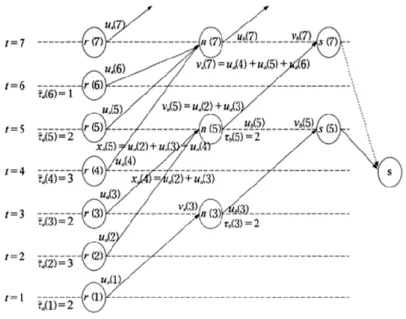
Time-space network is a time and space concept for the combination of mathematical models. The main function is described as the change in space in the continuous time domain. The two-dimensional representation of space and time for traffic flow evolution can be used to establish a three-dimensional network model. In the past, traditional traffic assignment models ignored the flow of the path of the conduction process. Time-space model overcomes the problem of excessive simplification, consider the time and space dimension of the traffic assignment model. Time-space network describes the process of flow evolution and distribution. As shown in Figure 1, the known physical road network is composed of three intersections. When the estimated actual travel time {𝜏̅𝑎(𝑡)} is temporarily fixed and the analysis period
has seven time zones. It has added the time-independent travel arrival point(s) and all time and space points {𝑠(𝑘)}, which link to this travel time point(s) by a virtual link, corresponding to a practical network of the time-space network.
Figure 1 Time-space network (Source: Chen and Hsueh, 1998)
4. Research Methods
This study applies the stochastic user equilibrium traffic (SUE) assignment method (Sheffi, 1985) for the MRT passenger flow assignment and peak spreading problem under specific time periods and spatial areas. The time-space network of an MRT system is formulated, and the algorithm for the MRT network is developed, which is applied to obtain the equilibrium flow distributions. The generalized costs associated with different selected routes are estimated and the resulted passenger flows are obtained under an equilibrium condition of an MRT network.
5. Results and Discussion 5.1 An Illustrated Example
This study uses the O-D demand information on the time-space network to find the crowded in peak hours at some of the transit stations. The transit network is selected by the passenger route choices to assemble the results. Passengers always choose the path(s) with the minimal generalized travel cost(s), and as the number of passengers choosing a specific path increases, the degree of crowdedness also increases. It results in increasing generalized costs, leading to the passengers to re-select the used routes. Therefore, the traffic assignment is an equilibrium problem. To simulate the passengers’ route choice behaviors, we assume a generalized cost can be determined for each path, which corresponds to the generalized cost of the path that the passenger chooses.
First, the study constructs the transit time-space network based on the transit network’s line configuration and train schedule. In addition, this study finds the effective routes for the network based on passenger travel behavior analysis.
Second, the main factors influencing the route choice of passengers are considered. The generalized cost model based on transit time-space expansion network is constructed. This study proposes a schedule-based equilibrium assignment model and SUE-based model by the MSA algorithm.
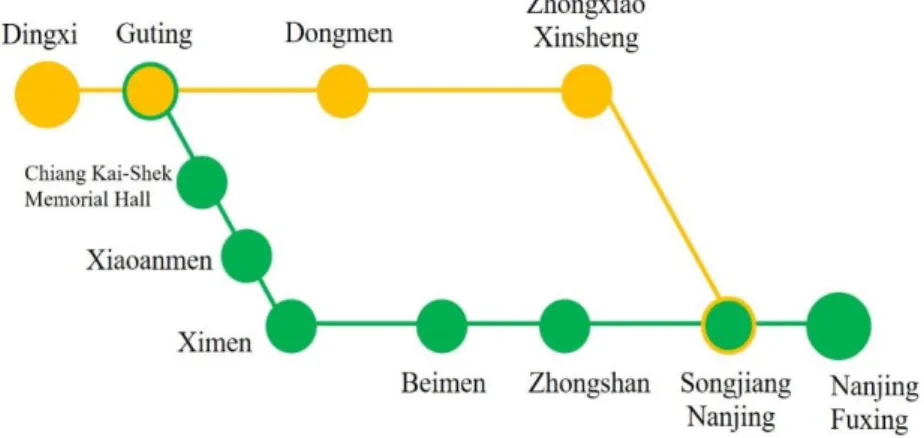
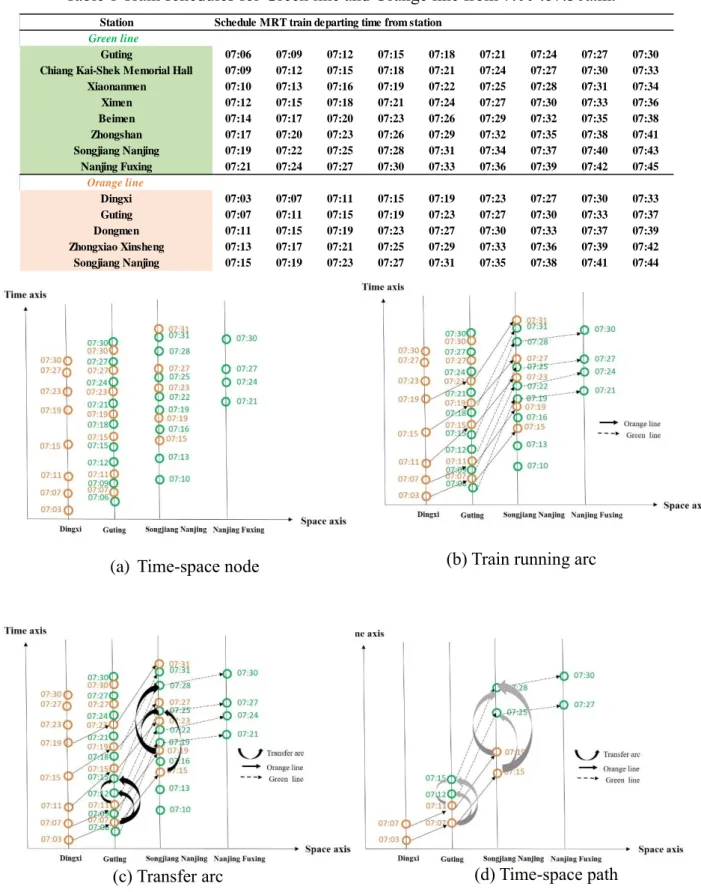
Consider a sample MRT network shown in Figure 2, the network consists of 11 stations. Based on the background demand analysis, the study assumes a route from an origin node (Dingxi station) to a destination node (Nanjing Fuxing station). The reason for choosing this origin node is that Dingxi is located at a residential area and Nanjing Fuxing station is closed to a popular business area. The study assumes two lines cover these stations. The train schedules for Green line and Orange line from 7:00 to 7:30 a.m. are shown in Table 1. Each train vehicle has a capacity of 1,900 passengers. The MSA algorithm converges very closely to the equilibrium solution, and further iterations do not generate any other minimum cost paths. According to the previously proposed MRT time-space expansion network, the study integrates the train schedule information from 7:00 a.m. to 7:30a.m. to expand the time-space network as shown in Figure .
In addition, the transfer time obtained from the TRTC, passengers who transfer at Guting station of the Zonghe-Xinlu line transferring to the Songshan-Xindian line takes 2 mins and the transfer time at Songjiang Nanjing station by the Songshan-Xindian line transferring to the Zonghe-Xinlu line takes 2 mins.
Table 1 Train schedules for Green line and Orange line from 7:00 to7:30a.m.
Figure 3 Example of schedule-based MRT time-space expanded network
Station Schedule MRT train departing time from station
Green line
Guting 07:06 07:09 07:12 07:15 07:18 07:21 07:24 07:27 07:30 07:33 07:36 07:39 07:42 07:45 07:48 07:51 07:54 07:57 Chiang Kai-Shek Memorial Hall 07:09 07:12 07:15 07:18 07:21 07:24 07:27 07:30 07:33 07:36 07:39 07:42 07:45 07:48 07:51 07:54 07:56 08:00 Xiaonanmen 07:10 07:13 07:16 07:19 07:22 07:25 07:28 07:31 07:34 07:37 07:40 07:43 07:46 07:49 07:52 07:55 07:58 08:01 Ximen 07:12 07:15 07:18 07:21 07:24 07:27 07:30 07:33 07:36 07:39 07:42 07:45 07:48 07:51 07:54 07:57 08:00 08:03 Beimen 07:14 07:17 07:20 07:23 07:26 07:29 07:32 07:35 07:38 07:41 07:44 07:47 07:50 07:53 07:56 07:59 08:02 08:05 Zhongshan 07:17 07:20 07:23 07:26 07:29 07:32 07:35 07:38 07:41 07:44 07:47 07:50 07:53 07:56 07:59 08:02 08:05 08:08 Songjiang Nanjing 07:19 07:22 07:25 07:28 07:31 07:34 07:37 07:40 07:43 07:46 07:49 07:52 07:55 07:58 08:01 08:04 08:07 08:10 Nanjing Fuxing 07:21 07:24 07:27 07:30 07:33 07:36 07:39 07:42 07:45 07:48 07:51 07:54 07:57 08:00 08:03 08:06 08:09 08:12 Orange line Dingxi 07:03 07:07 07:11 07:15 07:19 07:23 07:27 07:30 07:33 07:36 07:39 07:41 07:45 07:47 07:51 07:53 07:57 07:59 Guting 07:07 07:11 07:15 07:19 07:23 07:27 07:30 07:33 07:37 07:39 07:42 07:45 07:48 07:51 07:54 07:57 08:00 08:03 Dongmen 07:11 07:15 07:19 07:23 07:27 07:30 07:33 07:37 07:39 07:42 07:45 07:48 07:51 07:54 07:57 08:00 08:03 08:06 Zhongxiao Xinsheng 07:13 07:17 07:21 07:25 07:29 07:33 07:36 07:39 07:42 07:45 07:48 07:51 07:54 07:57 08:00 08:03 08:06 08:09 Songjiang Nanjing 07:15 07:19 07:23 07:27 07:31 07:35 07:38 07:41 07:44 07:47 07:50 07:53 07:56 07:59 08:02 08:05 08:08 08:11
(b) Train running arc
(d) Time-space path (c) Transfer arc
According to the MRT timetable information of Dingxi station, Nanjing Fuxing station and the transfer node including Guting station and Songjing Nanjing station of the four main physical nodes, it can be expanded to 24 time-space nodes, as shown in Figure 3(a). Then, the same train at the same line can be connected to the adjacent physical node on the departure node through the train running arc, such as shown in Figure 3(b). In addition, the time-space nodes of the different lines are connected by the transfer arc, as shown in Figure 3(c). Finally, the formation of the MRT time-space network is constructed, as shown in Figure 3(d).
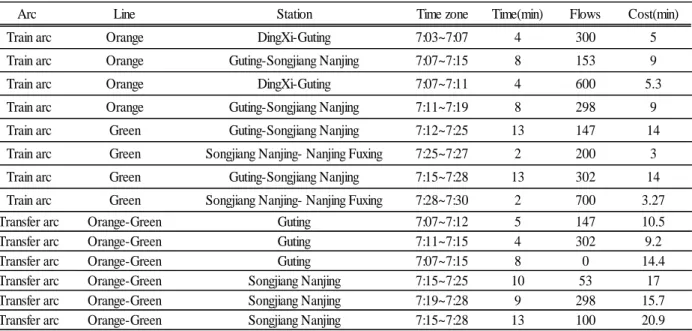
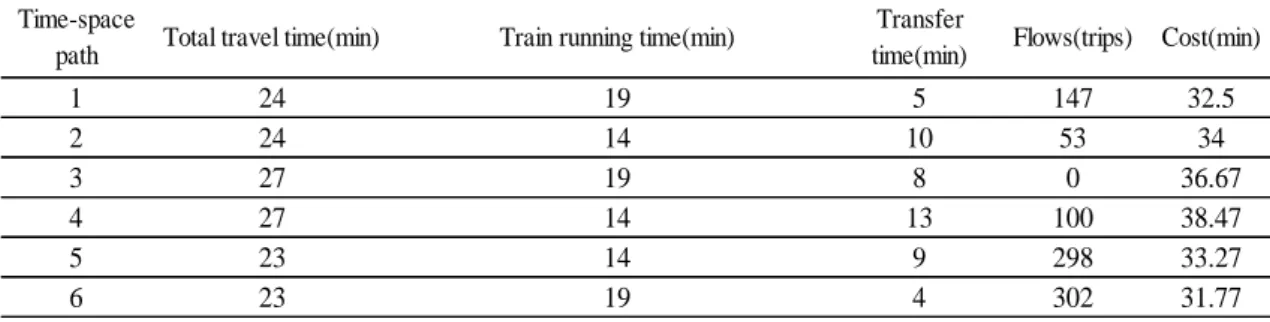
According to the above experimental setup, the results of the case study show that from the origin point to the destination point the time-space network consists of six time-space paths, as shown in Figure 3(d). During the study period, assume passengers are entering Dingxi, station at 7:03 a.m. and reaching Nanjing Fuxing station at 7:27 a.m. for 200 trips, and entering Dingxi, station at 7:03 a.m. reaching Nanjing Fuxing station at 7:30 a.m. for 100 trips, and entering Dingxi station at 7:07 a.m. and reaching Nanjing Fuxing station at 7:30 a.m. for 600 trips. Follow by the number of passengers in each interval (i.e., the running arc flow), we obtain the passenger flows and costs of each path of different O-D pairs. The MSA algorithm is used to solve the equilibrium flow of the time-space arcs. The flows of the train running arc is the number of passengers on each train in different time intervals. The passenger flows and costs of the time-space arcs for different O-D pairs are shown in Table . Further, the study obtains the flows and costs of the time-space paths by the information of the transfer arc and train running arc, as shown in Table .
Table 2 Link flow and cost of the time-space arc on the given O-D pair
Arc Line Station Time zone Time(min) Flows Cost(min)
Train arc Orange DingXi-Guting 7:03~7:07 4 300 5
Train arc Orange Guting-Songjiang Nanjing 7:07~7:15 8 153 9
Train arc Orange DingXi-Guting 7:07~7:11 4 600 5.3
Train arc Orange Guting-Songjiang Nanjing 7:11~7:19 8 298 9 Train arc Green Guting-Songjiang Nanjing 7:12~7:25 13 147 14 Train arc Green Songjiang Nanjing- Nanjing Fuxing 7:25~7:27 2 200 3 Train arc Green Guting-Songjiang Nanjing 7:15~7:28 13 302 14 Train arc Green Songjiang Nanjing- Nanjing Fuxing 7:28~7:30 2 700 3.27
Transfer arc Orange-Green Guting 7:07~7:12 5 147 10.5
Transfer arc Orange-Green Guting 7:11~7:15 4 302 9.2
Transfer arc Orange-Green Guting 7:07~7:15 8 0 14.4
Transfer arc Orange-Green Songjiang Nanjing 7:15~7:25 10 53 17 Transfer arc Orange-Green Songjiang Nanjing 7:19~7:28 9 298 15.7 Transfer arc Orange-Green Songjiang Nanjing 7:15~7:28 13 100 20.9
It is found that under a user equilibrium state, the costs of different paths for the same O-D pair are almost same. The result verifies the capability of the developed model and solution algorism. But, even the travel time is the same, different paths of the given O-D pair are assigned different flows on each path. Because besides the actual travel time, passengers also consider the penalty cost of crowdedness and transfer. Each time-space path has different feature of transfer time and the degree of crowdedness. Therefore, there is a difference on the assigned path flows.
Table 3 Flow and cost of time-space path on the given O-D pair
5.2 Discussion
This chapter presents the empirical study results based on the operational data of the Taipei MRT system in Taipei City. This study uses the operational information of O-D demand, travel time of stations and transfer time of interchange stations and stopping time of the train at each station. The study develops a time-space network combined with train schedule and the MRT physical network and applies the stochastic user equilibrium to solve the passenger flow assignment problem of an MRT system. According to the literature, several factors including train running time, transfer time, and the crowdedness penalty are significantly affecting passengers’ route choice behaviors. For the degree of crowdedness, the numerical analysis result shows that as the degree of crowdedness is increasing the passenger flow will switch to the path with less generalized cost. For the factor of transfer, with the increase of transfer time or the number of transfers, the generalized total cost is also increasing. However, the crowdedness is more sensitive in affecting the passengers’ route choice behaviors. Because the passenger almost transfers no more than three times and transfer time is less than five min(s) at an interchange station.
The study analyzes passenger flow distributions of the Taipei MRT system and identifies the potential traffic bottlenecks at peak hours. The results of the empirical study indicate that the proposed approach can provide beneficial information for crowdedness management of an MRT system. In addition, the sensitivity analysis investigates the impacts of the key model parameters, such as the crowdedness factor and transfer time on the peak spreading performance.
1 24 19 5 147 32.5 2 24 14 10 53 34 3 27 19 8 0 36.67 4 27 14 13 100 38.47 5 23 14 9 298 33.27 6 23 19 4 302 31.77 Time-space
path Total travel time(min) Train running time(min)
Transfer
6. Conclusion and Recommendation
This study proposes a stochastic user equilibrium assignment model for solving the peak spreading problem of the Taipei MRT system. From the empirical study results, we summarize the conclusions and recommendations as follows.
6.1 Conclusions
Based on the results of the study, this study summarizes the conclusions below. (1) The developed time-space model for the passenger flow assignment problem of
the Taipei MRT system can determine a path for a pair of O-D stations to minimize the passenger’s generalized total cost. At the same time, it also evaluates the passengers’ possible route choice of an O-D pair at peak periods.
(2) The network of the Taipei MRT system in Taipei City is selected as the research area in the empirical study. This study uses the operational data of the Taipei MRT system to collect O-D demand, transfer walking time, train running time and timetable of the Taipei MRT system. Transfer time and the degree of crowdedness are two parameters used for the sensitivity analysis.
(3) The empirical study results show that crowdedness bottleneck of MRT at peak hours by passenger flow analysis. The information can provide passengers who decides to transfer the path to avoid overcrowding.
(4) For a scenario where the train capacity remains the same, increasing the frequency of trains is a common method on flow management. The study develops SUE based passenger assignment models and uses the MSA algorithm to reassign passenger flows for the paths with the minimal generalized cost to achieve the goal of peak spreading for an MRT system.
6.2 Recommendations
The suggestions for future study on the MRT passenger over-concentrated problem are summarized as follows.
(1) This study applied the network consisted of the main stations of the Taipei MRT system as the testing network. With the expansion of the Taipei MRT network and the increase in ridership of MRT passengers, it is suggested that the developed models can be evaluated for a large-scale network problem.
(2) Future studies can conduct a questionnaire survey on passenger route choice behaviors, such as transfer time, degree of crowdedness, number of transfers to evaluate whether these factors will affect passenger’s route switch behaviors.
Passengers may have been affected by pricing strategies. For solving the peak over-concentrated problem, one can investigate the effects of different pricing strategies on the mitigation of passenger flow concentration at peak periods or by providing real time information about the degree(s) of crowdedness.
(3) This study assumes that the transfer walking time is constant obtained from the TRTC. In real situations, passenger’s walking speeds are different. Future studies can investigate whether the transfer walking time at different time periods will be affected by the passenger flow, degree of crowdedness or sizes of the station and platform.
(4) This study contributes to the model development part. However, model complexity will be increased with the increase of network scale, number of lines or stations. It is difficult to use a commercial optimization solver to solve the problem efficiently when the problem scale is large. Further studies could develop heuristic algorithms to solve the complex problem.
(5) This empirical study was conducted based on the amount of available data and system scale. The policy “pubic transport of NT$ 1,280 ticket package” carried out by the Department of Transportation of Taipei City government may increase the ridership of the Taipei MRT system. Therefore, a future study can use data from May 2018 to analyze the peak crowdedness situation based on the developed models in this study.
References
1. Ministry of Transportation and Communication (MOTC) (2017), website: http://stat.motc.gov.tw/mocdb/stmain.jsp?sys=100
2. Taipei City Government Data Open platform “Data Taipei” (2018), website: http://data.taipei/opendata/datalist/datasetMeta?oid=63f31c7e-7fc3-418b-bd82-b95158755b4d
3. Tokyo Metro Co., Ltd. (2017), Traffic Performance by Station. Retrieved October,
2017, website:
http://www.tokyometro.jp/en/corporate/enterprise/transportation/ranking/index.html 4. Ceapa, I., Smith, C., and Capra, L. (2012). Avoiding the Crowds: Understanding Tube
Station Congestion Patterns from Trip Data. In Proceedings of the ACM SIGKDD
International Workshop on Urban Computing, 134-141.
5. Chen, H. K., and Hsueh, C. F. (1998). A model and an algorithm for the dynamic user-optimal route choice problem. Transportation Research Part B: Methodological, 32(3),
219-234.
6. Cheu, R. L., Kreinovich, V., and Manduva, S. R. (2007). Traffic assignment for risk averse drivers in a stochastic network. Published in the Proceedings of the Annual
Meeting of the Transportation Research Board of the National Academies TRB'07,
Washington, DC, January 13-17, 2008.
7. Frejinger, E., Bierlaire, M., and Ben-Akiva, M. (2009). Sampling of alternatives for route choice modeling. Transportation Research B, 43(10), 984-994.
8. Frumin. M., Zhao. J. (2012). Analyzing passenger incidence behavior in heterogeneous transit services using smartcard data and schedule-based assignment.
Transportation Research Record, No. 2274, 52-60.
9. Hong, L., Li, W., and Zhu, W. (2017). Assignment passenger flows on a metro network based on automatic collection data and timetable. Discrete Dynamics in
Nature and Society, article ID 4373871,10 pages
10. Jong, J.C., Lin. J., Lin, J. W., and Lin, C. M. (2012). A time-space network model for MRT system passenger flows simulation. Conference on Computer Application in
Civil and Hydraulic Engineering (CCACHE 2011), Taiwan.
11. Jong, J.C., Lin. J., Lin, J. W., and Lin, C. M. (2012). Calculation of MRT service performance indicators of passenger flow with a simulation model. Transportation
Planning Journal, 41(3), 279-310
12. Jong, J.C., Chang, E.F. (2010). The simulation of passengers’ time-space characteristics using ticket sales records with insufficient data. Computers in Railways, XII, pp.419-430, WIT Press.
13. Lam, S. H., Xie, F. (2002). Transit path-choice models that use revealed preference and stated preference data. Transportation Research Record: Journal of the
Transportation Research Board, 1799, 58-65.
14. Liu, Y., Charles, P. (2013). Spreading peak demand for urban rail transit through differential fare policy: A review of empirical evidence. In Australasian Transport
Research Forum 2013 Proceedings.
15. Myojo, S. (2006a). Daily estimation of passenger flow in large and complicated urban railway network. Presented at the 7th World Congress on Railway Research, WCRR, Montreal, Canada.
16. Nagasaki, Y., Asuka, M., and Koyama, K. (2006). A fast method for estimating railway passenger flow. Computers in Railways, X, 179-187, WIT Press.
17. Nielsen, O. A. (2000). A stochastic transit assignment model considering differences in passenger utility functions. Transportation Research Part B, 34, 377-402.
18. Nielsen, O. A., Frederiksen, R. D. (2006) Optimization of timetable-based, stochastic transit assignment models based on MSA. Annals of Operations Research, 144, 263–
285.
19. Prato, C. G., Bekhor S.,Pronello, C. (2011). Latent Factors and Route Choice
Behaviour. LAP Lambert Academic Publishing.
20. Powell, W. B., Sheffi, Y. (1982) The convergence of equilibrium algorithms with predetermined step sizes, Transportation Science, 16, 45–55.
21. Sheffi, Y. (1985). Urban Transportation Networks. Prentice-Hall, INC.
22. Si, B. F., Zhong, M., Liu, J. F., Gao, Z. Y. and Wu, J. J. (2013). Development of a transfer-cost-based logit assignment model for the Beijing rail transit network using automated fare collection data. Journal of Advanced Transportation; 47, 297–318 23. Tong, C. O., Wong S. C. (1999). A stochastic transit assignment model using a
dynamic schedule-based network. Transportation Research Part B, 33(2), 107-121. 24. Xu, J., Ning, Y., Wei, H., Xie, W., Guo, J., Jia, L., and Qin, Y. (2015). Route choice
in subway station during morning peak hours: A case of Guangzhou subway. Discrete
Dynamics in Nature and Society, Article ID 151434, 8 pages.
25. Zhang, Y. S., Yao, E. J., and Yang, Y. (2013). A route-planning algorithm based on subway passenger routes choice behavior analysis. In Proceedings of the Second
107年度專題研究計畫成果彙整表
計畫主持人:胡守任 計畫編號:107-2221-E-006-037-計畫名稱:以時空路網模型探討大眾捷運系統乘客流量尖峰分散之策略 成果項目 量化 單位 質化 (說明:各成果項目請附佐證資料或細 項說明,如期刊名稱、年份、卷期、起 訖頁數、證號...等) 國 內 學術性論文 期刊論文 0 篇 研討會論文 1 胡守任、吳宜庭,「以時空路網模型探 討臺北大眾捷運系統乘客路徑轉移之行 為」,中華民國運輸學會2017年年會暨 學術論文國際研討會,臺北市,2017年 12月。 專書 0 本 專書論文 1 章 吳宜庭,「以交通量指派模型探討大眾 捷運系統尖峰旅客分流之效果」,成功 大學交通管理科學系碩士論文,2018年 。 技術報告 0 篇 其他 0 篇 智慧財產權 及成果 專利權 發明專利 申請中 0 件 已獲得 0 新型/設計專利 0 商標權 0 營業秘密 0 積體電路電路布局權 0 著作權 0 品種權 0 其他 0 技術移轉 件數 0 件 收入 0 千元 國 外 學術性論文 期刊論文 0 篇 研討會論文 1Hu, S.R. and Wu, Y. T., "A Time-space Network Model for Peak
Spreading of MRT Passenger Flows," The 47th Annual Meeting of Western Decision Sciences Institute, April 3-6, 2018, Kauai, Hawaii, U.S.A.
專書 0 本
專書論文 0 章
智慧財產權 及成果 專利權 發明專利 申請中 0 件 已獲得 0 新型/設計專利 0 商標權 0 營業秘密 0 積體電路電路布局權 0 著作權 0 品種權 0 其他 0 技術移轉 件數 0 件 收入 0 千元 參 與 計 畫 人 力 本國籍 大專生 0 人次 碩士生 3 吳亭葦、羊以傑、蔡承安等三人。 博士生 0 博士級研究人員 0 專任人員 0 非本國籍 大專生 0 碩士生 0 博士生 0 博士級研究人員 0 專任人員 0 其他成果 (無法以量化表達之成果如辦理學術活動 、獲得獎項、重要國際合作、研究成果國 際影響力及其他協助產業技術發展之具體 效益事項等,請以文字敘述填列。)