A NEW LOSSLESS VISIBLE WATERMARKING METHOD VIA THE USE OF THE PNG IMAGE
Che-Wei Lee
Department of Computer Science National Chiao Tung University, Hsinchu, Taiwan
Wen-Hsiang Tsai Department of Computer Science National Chiao Tung University, Hsinchu, Taiwan
[email protected] ABSTRACT
A new lossless visible watermarking method via the use of the PNG image is proposed. The method transforms a color host image into the PNG format with an additional alpha channel plane and a visible watermark is then embedded into the color channel plane of the host image.
During the embedding process, data of color pixels covered by the watermark are collected to form a data packet. The data packet is then embedded into the alpha channel plane in order to remove the visible watermark from the watermarked image later. Furthermore, pixel values in the alpha channel plane are mapped into a range near their maximum value of 255 to yield a nearly total transparent watermarked image. During the process of image recovery, the proposed method can remove the visible watermark from the watermarked image without the original watermark because all data that are needed to losslessly recover the watermarked image are embedded in the alpha channel plane. Experimental results demonstrating the effectiveness of the proposed method are also included.
KEY WORDS
Lossless visible watermarking, PNG image, information hiding, signal and image processing, color image.
1. Introduction
The technique of visible watermarking embeds certain visible information such as a company logo into a host media to declare the copyright or the ownership. In conventional methods of visible watermarking [1-4], the embedded visible watermark is in general irremovable and leaves permanent distortion to the host image.
However, in many applications such as medical image analysis, law enforcement or military imaging, it is important to be able to remove the visible watermark losslessly by legitimate users, yielding a recovered image which is identical to the original [5].
In the literature, several reversible visible watermarking methods have been proposed. Hu et al. [6] proposed a bit- plane-based alteration method for visible watermark embedding. They modify one significant bit plane of pixels of a region to be covered by a watermark in a host image. Data of the altered bit plane are then compressed, and the resulting compressed datastream are losslessly
hidden into the non-watermarked region of the host image.
However, some noises appear in the content of the embedded watermark laid on the host image because of the bit-plane alteration. Yip et al. [7] proposed two lossless visible watermarking Algorithms, one is named pixel value matching scheme which uses the bijective intensity mapping function to lay a visible logo on the host image; the other is a pixel position shift scheme which uses circular pixel shift to improve the visibility of the watermark in the high variance region. Tsai et al. [8]
reveal the visible watermark in the host image by mapping values of pixels underlying the watermark into a small range. Then a packet containing data for later image restoration are reversibly hidden into the watermarked image. Liu and Tsai [9] proposed a generic lossless visible watermarking method by using the deterministic one-to-one compound mappings of image pixel values to overlay a variety of visible watermarks on host images.
The capability of the lossless image recovery of their method comes from the compound mapping is reversible.
However, it is noted that, in methods of [7] through [9], the original watermark is required at the recovery stage, leading to the unsuitability for some applications when the original watermark is unavailable [10].
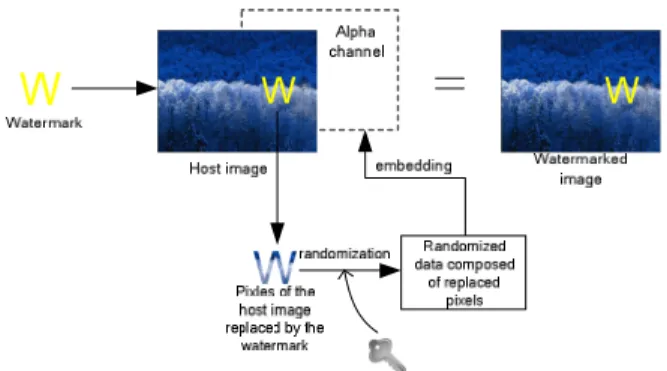
In this study, a lossless visible watermarking method, which is capable of generating a watermarked image with a clear visible watermark and is free from the need of an original watermark at the recovery stage, via the use of the PNG format is proposed. The proposed method firstly transforms a color host image into the PNG format with an appended alpha channel plane. Then, in a selected region of the host image, a watermark is embedded by replacing color values of pixels with those of the watermark. Subsequently, data composed of those replaced pixels of the host image, called recovery data, are collected and randomized with a key. The randomized recovery data then are embedded into the alpha channel plane, generating a desired watermarked image. In the process of image recovery, the embedded visible watermark can be removed from the watermarked image by utilizing the recovery data extracted from the alpha channel plane. At last, after the visible watermark removal, the appended alpha channel can be discarded and so the original host image without any loss is obtained. It is noted that the alpha channel plane including transparency information is originally used to subtly
combine a foreground image into a background image, yielding a semi-transparent image which is often applied to web designs for visual attractions or to other photo art designs. However, the proposed method utilizes the semi- transparent effect and plenty of embeddable space provided by the alpha channel to develop a lossless visible watermarking method. Fig. 1 illustrates these core ideas of the proposed method.
The remainder of this paper is organized as follows. In Section 2, the details of the proposed method are described. In Section 3, security considerations related to the proposed method are discussed. Experimental results are shown in Section 4. Finally, conclusions are made in Section 5.
Fig. 1. Illustration of proposed lossless visible watermarking method via PNG images.
2. Idea of proposed method
In the proposed method, a color host image is firstly transformed into the PNG format with an alpha channel plane, which is a valid color type of RGBA supported by the PNG format [11]. Then a user selects a region from the PNG host image, called the watermarked region, where a visible watermark is to be embedded. Color values of pixels covered by the watermark in the watermarked region will be replaced with those of the watermark. Furthermore, pixels in the alpha channel plane underlying those that have been watermarked in the color channel plane will be assigned a specific alpha value of 255. The value of 255 of an alpha pixel is used as a mark to identify its corresponding pixel in color channel plane is watermarked. Data of those replaced pixels in color channel plane will be collected to form a data packet whose content is used for restoring the watermarked image to its original version. And so, the data string for image recovery will be embedded into the alpha channel plane in the form of decimal numbers to be values of alpha pixels, and each of them is designed to fall in the range of 0 through 7. At last, in order to generate a nearly total transparent watermarked image, values of alpha pixels will be mapped into a small range of alpha values near their maximum transparency value of 255, yielding a clear watermarked image.
During the process of image recovery, the proposed method does not need the original watermark image for watermark removal because all data that we need to remove the watermark are embedded in the alpha channel plane. Furthermore, since the alpha value of 255 for a pixel in the alpha channel plane is used as the mark to identify the corresponding pixel in the color channel plane being watermarked, the proposed method is free from the need to store the additional information about the location of watermarked pixels.
Algorithm 1: visible watermark embedding.
Input: a color host image I, a color watermark W, and a key K.
Output: watermarked image I'.
Steps:
1. (Transforming the host image into the PNG format) Transform I into a PNG image with an additional alpha channel plane, denoted as L, and set all of alpha values of pixels in L to be 0.
2. (Watermarking and Collection of replaced pixel data for later recovery) Select a region G, where W is to be embedded, from I; then, replace pixels’ color values in G with those in W, and for each replaced pixel, collect its original RGB pixel data composed of 24 bits to form a bit string D.
3. (Mark the alpha pixels in L underlying the watermark) Set alpha values of pixels in L underlying the watermark in G to be 255.
4. (Randomization of Recovery Data) Use a key K to randomize the order of the bit sequence in D, obtaining a randomized bit string D'.
5. (Beginning of looping for embedding recovery data into the alpha channel) Take in order three bits as a unit from D' and an alpha pixel from L, denoted as d and p, respectively, and perform the following steps.
(1) Transform d into a decimal number d'.
(2) If p is not equal to 255, replace p with d';
otherwise, take in order the next alpha pixel from L.
6. (End of looping) If there exist bits in D' to be embedded, then go to Step 5; otherwise, continue.
7. (Mapping of alpha pixel values) Add 247 to all alpha pixels except those of value 255 in L; yielding the new values which fall in the nearly total transparency range of 247 through 254; and denote the resulting L, which contains the mapped alpha values from 247 to 254 and those of value 255 set in Step 3, to be L'.
8. (Done of the watermarked image) Take the resulting Image with the embedded W together with the L' as the desired watermarked image I'.
In the next algorithm below, the recovery data for removing the visible watermark from the watermarked image will be extracted from the alpha channel plane.
Moreover, after the watermark removal, the alpha channel
plane can be discarded so that the original color host image is obtained.
Algorithm 2: watermark removal for lossless image recovery.
Input: a watermarked image I' composed of color channels and the additional alpha channel plane L', and the key K used in Algorithm 1.
Output: the original image I recovered from I'.
Steps:
1. (Extraction of the embedded recovery data) Perform the following steps for each pixel in the alpha channel plane L' to extract the recovery data.
(1) If the value of the alpha pixel is not equal to 255, subtract 247 from it to gain the d'; otherwise, take in order the next alpha pixel from L.
(2) Transform d' into a bit string d composed of three bits.
2. (Collection of recovery data) Concatenate all of d sequentially to form a bit string D'.
3. (Restoring the bit sequence of recovery data) Use the key K to restore the order of the bit sequence in D' for obtaining the original bit string D.
4. (Removal of the watermark) Take in order a pixel in the alpha channel L' with the value 255, set the values of the corresponding pixel in color channels of RGB by the following steps.
(1) Take in order 24 bits from D.
(2) Separate the 24bits into three parts, each of them composed of 8 bits, called Rb, Gb, and Bb, respectively; and transform them into decimal values called Rd, Gd, and Bd, respectively.
(3) Replace the RGB values of the pixel with Rd, Gd, and Bd, respectively.
5. (Removal of the alpha channel to obtain the original host image) Remove the alpha channel from I' and the resulting image is the desired original image I.
3.
Security Considerations
Two issues about the security are discussed in this section.
One is the feasibility of the use of the alpha channel plane and the other is the possibility of removing the visible watermark by a malicious user.
1. Feasibility of the use of the alpha channel plane The alpha channel plane which carries the recovery data for removing the visible watermark may possibly be discarded or modified by a malicious user. How does the proposed method deal with this case? It is mentioned that in the field of visible watermarking, the major concern is to avoid the visible watermark being removed maliciously;
because the visible watermark is used to claim the ownership of the image and arrest the illegitimate use of the watermarked image. From this point of view, if the alpha channel plane is discarded or modified maliciously, the recovery data are also lost, leading to the malicious user unable to remove the visible watermark from the
watermarked image. This implies that the ownership of the watermarked image is still under the protection of the visible watermark. Accordingly, the use of the alpha channel plane is thought to be feasible.
2. Possibility of removing the visible watermark maliciously As described in Step 4 in Algorithm 1, a key is used to randomize the order of the bit sequence in the recovery data string. For ease to understand, assume a total of 64×64 = 4096 pixels are replaced with those of the watermark and so the total bits to be saved are 4096×24(RGB) = 98304 bits. Now the totals of 98304 bits are randomized by the used key. It means the possibility to correctly guess the randomized bits is 1/(98304!), which is a extremely small possibility, leaving a very hard task to do for a malicious user.
Accordingly, through the uses of the alpha channel plane and the key, the proposed method utilizes the plenty of the embeddable space provided by the alpha channel plane and simultaneously keeps the visible watermark from being removed, ensuring the function of the visible watermark.
4. Experimental results
Many experiments have been conducted to test the proposed method and two results are shown in Figs. 2 and 4, respectively. Fig. 2(a) is a color host image of size 660×405. Fig. 2(b) is a visible watermark to be embedded into the host image. The resulting watermarked image of applying Algorithm 1 to generate and embed the visible watermark into Fig. 2(a) is shown in Fig. 2(c), in which the visible watermark is located at the right-lower side of the host image. It can be observed from Fig. 2 (c), since the added alpha channel is with alpha values that are mapped into the nearly total transparency range of 247 through 255, as described in Step 7 of Algorithm 1, no perceptible opacity effect can be seen in the resulting watermarked image. Fig. 2(d) is a recovered image in which the visible watermark has been removed from Fig.
2(c), and the alpha channel has also been discarded, yielding the losslessly-recovered image.
As a comparison, a resulting watermarked image without conducting the mapping of the alpha pixel values is shown in Fig. 3(a). As can be seen, color pixels upon alpha pixels that are unmapped with values 0 through 7 appear opaquely, while color pixels consisting of the watermark appear clearly because the corresponding alpha values of them are 255. Comparatively, Fig. 3(b) is the watermarking result generated by the proposed method in which the mapping of the alpha pixel values is normally conducted.
The other color image of Lena shown in Fig. 4(a) is used as the host image to test the proposed method. Fig. 4(b) is a watermark to be embedded into the host image of Lena.
Fig. 4(c) shows the watermarking result generated by Algorithm 1. Again, it can be seen from Fig. 4(c) that the watermarked image of Lena is with nearly total transparency effect, yielding a visually-satisfactory
watermarked image. At last, a recovered image without any distortion compared with its original version, i.e. Fig.
4(a), is shown in Fig. 4(d).
(a) (b)
(c) (d)
Fig. 2. Watermarking result of a color host image. (a) Host image of size 660×405. (b) Visible Watermark composed of 5599 pixels. (c) Resulting PNG watermarked Image with the alpha channel having alpha values of 247 through 255. (d) Final losslessly-recovered result in which the alpha channel is discarded after the removal of the visible watermark.
(a) (b)
Fig. 3. Watermarking results relative to the mapping of alpha pixel values. (a) Watermarked image created without conducting the alpha pixel value mapping. (b) Watermarked image in which the mapping of the alpha pixel values is conducted.
In practical use, it is necessary for a user to know an upper bound for the size of a visible watermark with respect to a host image’s pixel size. The analysis dealing with the issue is described as follows.
As mentioned in Step 5 of Algorithm 1, the embeddable capacity provided by each alpha pixel in the alpha channel plane is three bits except that, set as 255, underlying the watermark pixel in the color channel plane. Now assume that the symbol A denotes the number of color pixels covered by the visible watermark, which is also equal to the number of pixels consisting of a visible watermark;
(a) (b)
(c) (d)
Fig. 4. Watermarking result of a color host image of Lena.
(a) Host image of size 512×512. (b) Visible Watermark composed of 7036 pixels. (c) Resulting watermarked Image. (d) Final losslessly-recovered result in which the alpha channel is discarded after the removal of the visible watermark.
and the symbol S denotes the number of pixels consisting of a color host image. Under this assumption, the data to be embedded for later image recovery are equal to 24A bits and the embeddable capacity provided by alpha pixels in the alpha channel plane are equal to (SA)3 bits. As a result, as long as the following equation is satisfied, a visible watermark can be embedded into a host image successfully.
(S A)3 24A ≧ 0
Specifically, take the Lena image, composed of 262144(=
512512) pixels, as an example, the upper bound of the size of a visible watermark that is allowed to be used can be computed by the following equation
(262144 A)3 24A ≧ 0, which may be solved to get
29127.111 ≧A.
It means that as long as a visible watermark whose total number of pixels are not larger than 29127 pixels, it can be successfully embedded into a color host image of size 512512. Furthermore, a visible watermark composed of 29127 pixels is approximately equal to an image, i.e. the visible watermark, with the size of 170170 (= 28900) pixels, which is large enough for a watermark to be used in general applications.
5.
Conclusions
A new lossless visible watermarking method using the alpha channel plane of a PNG image to carry data for image recovery has been proposed. Based on the use of the alpha channel plane, a plenty of embeddable space is provided to accommodate data for removing a visible watermark from a watermarked image; and the value of 255 of an alpha pixel is used as a mark to identify its corresponding pixel in color channel plane is watermarked and therefore the proposed method is free from the need to store the information about the location of watermarked pixels. Furthermore, the alpha channel values are mapped into a range of nearly total transparency to yield a visually satisfactory watermarked image. In the process of the lossless image recovery, data for removing the visible watermark are extracted from the alpha channel plane. Finally, in order to restore the watermarked image to the original, the alpha channel plane is discarded after the watermark removal.
Experimental results demonstrate the effectiveness of the proposed method.
References
[1] J. Meng and S. F. Chang, “Embedding visible video watermarks in the compressed domain,” in Proc.
IEEE Int. Conf. Process., Chicago, IL, Oct. 1998, 474–477.
[2] R. Lukac and K. N. Plataniotis, “Secure single-sensor digital camera,” Electron. Lett., 42(11), 2006, 627–
629.
[3] B. B. Huang and S. X. Tang, “A contrast-sensitive visible watermarking scheme,” IEEE Multimedia, 13 (2), 2006, 60–67.
[4] Y. Hu and S. Kwong, “Wavelet domain adaptive visible watermarking,” Electron. Lett., 37(20), 2001, 1219–1220.
[5] Y. J. Hu and B. Jeon, “Reversible visible watermarking and lossless recovery of original images,” IEEE Trans. Circuits Syst. Video Technol., 16(11), 2006, 1423–1429.
[6] J. Fridrich, M. Goljan, and R. Du, “Lossless data embedding—New paradigm in digital watermarking,” J. Appl. Signal Process., 2002(2), 2002, 185–196.
[7] S. K. Yip, O. C. Au, C. W. Ho, and H. M. Wong,
“Lossless visible watermarking,” in Proc. IEEE Int.
Conf. Multimedia Expo, Toronto, ON, Canada, 2006, 853–856.
[8] H. M. Tsai and L. W. Chang, “A high secure reversible visible water marking scheme,” in Proc.
IEEE Int. Conf. Multimedia Expo, Beijing, China, 2007, 2106–2109.
[9] T. Y. Liu and W. H. Tsai, “Generic lossless visible watermarking a new approach,” IEEE Transactions on Image Processing, 19(5), 2010, 12241235.
[10] Y. Yang, X. Sun, H. Yang, C. Li, and R. Xiao, “A contrast-sensitive reversible visible image watermarking technique,” IEEE Trans. Circuits Syst.
Video Technol., 19(5), 2009, 656667.
[11] W3C PNG Development Group (2003, Oct.).
Portable Network Graphics (PNG) Specification (Second Edition), Information technology — Computer graphics and image processing — Portable Network Graphics (PNG): Functional specification. ISO/IEC 15948: 2003 (E). Available:
http://www.w3.org/TR/PNG/