Origins of nonzero multiple photon emission probability from single quantum dots
embedded in photonic crystal nanocavities
Hsiang-Szu Chang, Wen-Yen Chen, Tzu-Min Hsu, Tung-Po Hsieh, Jen-Inn Chyi, and Wen-Hao Chang
Citation: Applied Physics Letters 94, 163111 (2009); doi: 10.1063/1.3125222
View online: http://dx.doi.org/10.1063/1.3125222
View Table of Contents: http://scitation.aip.org/content/aip/journal/apl/94/16?ver=pdfcov Published by the AIP Publishing
Articles you may be interested in
Control of spontaneous emission from InP single quantum dots in GaInP photonic crystal nanocavities Appl. Phys. Lett. 97, 181104 (2010); 10.1063/1.3510469
Mode identification of high-quality-factor single-defect nanocavities in quantum dot-embedded photonic crystals
J. Appl. Phys. 101, 073107 (2007); 10.1063/1.2714644
Enhancement and suppression of spontaneous emission by temperature tuning InAs quantum dots to photonic crystal cavities
Appl. Phys. Lett. 88, 131101 (2006); 10.1063/1.2189747
Optical emission from individual InGaAs quantum dots in single-defect photonic crystal nanocavity J. Appl. Phys. 98, 034306 (2005); 10.1063/1.1953885
Enhanced spontaneous emission from InAs/GaAs self-organized quantum dots in a GaAs photonic-crystal-based microcavity
J. Appl. Phys. 93, 6173 (2003); 10.1063/1.1566470
This article is copyrighted as indicated in the article. Reuse of AIP content is subject to the terms at: http://scitation.aip.org/termsconditions. Downloaded to IP: 140.113.38.11 On: Wed, 30 Apr 2014 07:27:09
Origins of nonzero multiple photon emission probability from single
quantum dots embedded in photonic crystal nanocavities
Hsiang-Szu Chang,1 Wen-Yen Chen,1 Tzu-Min Hsu,1,a兲 Tung-Po Hsieh,2 Jen-Inn Chyi,2and Wen-Hao Chang3
1
Department of Physics and Center for Nano Science and Technology, National Central University, Jhong-li 32001, Taiwan
2
Department of Electrical Engineering, National Central University, Jhong-li 32001, Taiwan
3
Department of Electrophysics, National Chiao Tung University, Hsinchu 300, Taiwan
共Received 15 September 2008; accepted 7 April 2009; published online 23 April 2009兲
This work explores the origins of nonzero multiphoton emission probability for quantum dots embedded in photonic crystal nanocavities using different excitation energies to inject excitons into either the GaAs barrier or the quantum-dot excited state. The detected multiphoton events are established to arise from both the recapture of excitons and background emissions from the wetting layer tail states. The exciton emission is analyzed using rate-equation calculations, which suggest that multiphoton emission is dominated by the recapture effect. © 2009 American Institute of
Physics. 关DOI:10.1063/1.3125222兴
The exploitation of semiconductor self-assembled quan-tum dots 共QDs兲 to develop a solid-state single photon emitter is currently of interest for quantum information applications.1–4 To produce on-demand single photon turn-stiles, QDs were incorporated into an optical cavity to en-hance the spontaneous emission 共SE兲 rate and the photon extraction efficiency. Various monolithic optical cavities in-cluding microdisks,1 microposts,2,5,6 and photonic-crystal nanocavities 共PC-NCs兲4,7 have been adopted, of which PC-NCs are the most frequently employed to enhance the SE rate because of their high quality factor共Q兲 and small modal volume 共Vm兲.4 High-coupling-efficiency single-mode single
photon emitters4 and ultralow-threshold self-tuned QD lasers8 have been demonstrated using such PC-NCs. How-ever, the probability of unwanted multiple photon emissions is usually found to increase when the single-QD line is spec-trally resonated with 共or even somewhat detuned from兲 the PC-NC cavity modes,4,9 especially when electron-hole pairs are generated in barrier materials. The multiple photon emis-sions are attributable to the recapture of excitons in the fast radiative QDs,10as well as to the QD background.5,8,9Since multiple photon emission limits the range of applications of single photon emitters—particularly to electrically driven de-vices in which carriers are injected into barrier materials, the major contributions must be examined. This study explores the origins of the nonzero multiphoton emission probability from QDs that are embedded in PC-NCs, using different ex-citation schemes—injecting excitons into either the GaAs barrier or the QD excited state. This work shows that the detected multiphoton events involve both the recapture of excitons and background emissions from the wetting layer 共WL兲 states. Finally, the recapture of excitons is analyzed using rate-equation-model calculations.
Self-assembled QD samples were grown on a GaAs 共100兲 substrate by metal-organic chemical vapor deposition. After a 500-nm-thick Al0.8Ga0.2As sacrificial layer was de-posited on the substrate, a 190 nm GaAs waveguide layer with a layer of low-density 共⬃3 m−2兲 In
0.5Ga0.5As QDs 共Ref. 11兲 embedded at the center was then grown. The
PC-NC used herein is the L3 defected cavity, which was fabricated by electron-beam lithography with air-hole period
a = 300 nm and radius r = 0.31a.7
The coupling of QD emissions with the PC-NC cavity mode was examined by measuring microphotoluminescence 共PL兲 at liquid He temperature, using either an He–Ne laser or a Ti:sapphire laser as a pumping source. Photon correla-tion measurements were made using a Hanbury–Brown and Twiss setup to record the second-order correlation function
g共2兲共兲. Both PL and correlation measurements have been
described in detail elsewhere.12 Correlation measurements were made under pulsed excitations using a mode-locked Ti:sapphire laser, which delivered a 3 ps pulse train at 76 MHz.
Two representative PC-NCs 共A and B兲 were utilized herein to explore the photon statistics of single QDs that resonated with, or were somewhat detuned from, the cavity mode. Figure 1 shows the PL spectra of both cavities at different excitation powers共P兲. For PC-NC A, a broad band WL emission near 1.36 eV and cavity mode emission near 1.315 eV are observed. At lower P, the single exciton line 共X兲 of the QD in this cavity was closed to 1.316 eV, which is on resonance with the cavity mode, as has been verified by power-dependence and polarization-resolved measurements.12 The PL spectra of PC-NC B, which is shown in Fig. 1, exhibited similar spectral features, except that the X line of the QD in this cavity is detuned from the cavity mode by about 10 meV.
a兲Electronic mail: [email protected].
FIG. 1. ThePL spectra reveal QD exciton共X兲, PC-NC cavity mode and WL emissions for PC-NC A and PC-NC B at an excitation energy of 1.96 eV and pumping powers of 1.25 W共top兲 and 2.5 nW 共bottom兲.
APPLIED PHYSICS LETTERS 94, 163111共2009兲
0003-6951/2009/94共16兲/163111/3/$25.00 94, 163111-1 © 2009 American Institute of Physics
This article is copyrighted as indicated in the article. Reuse of AIP content is subject to the terms at: http://scitation.aip.org/termsconditions. Downloaded to IP: 140.113.38.11 On: Wed, 30 Apr 2014 07:27:09
Figure2共a兲plots the measured second-order correlation functions g共2兲共兲 for both the PC-NC A and B under pulsed laser excitations at 1.55 eV. Despite the clear signature of photon antibunching observed at zero delay 共= 0兲 for both cavities, some non-negligible multiphoton events were still detected, particularly for the PC-NC A, where the QD emis-sion is on resonance with the cavity mode. For an ideal single photon emitter, g0共2兲= 0 is expected. However, the mea-sured g0共2兲 values for the PC-NC A 共on resonance兲 and the PC-NC B共off resonance兲 were 0.15 and 0.06, respectively; both increased with P关Fig.2共b兲兴. The markedly higher mul-tiphoton probability in the case of QD-cavity resonance is attributable to the exciton recapture effect. For the above band gap excitations, excitons were first created in the GaAs barrier, followed by a fast relaxation into the WL state and then captured by the QDs. When the exciton lifetime in the QD共QD兲 is short, some residual excitons remain in the WL after the QD emission. These long-lasting residual excitons would be recaptured into the QD after the recombination of the preceding exciton, causing multiphoton emissions in the same excitation cycle. This effect is expected to be stronger at higher P because of the presence of more long-lasting excitons in the WL state, in consistence with our experimen-tal results.10
The exciton lifetimes for QDs were determined by mak-ing time-resolved PL measurements. The emission lifetimes for the QDs in PC-NC A is QD,A= 0.28 ns, considerably shorter than that for QDs in the absence of PC 共QD,0 = 0.65 ns兲, because of QD-cavity resonance. For PC-NC B, a slightly longer QD emission lifetime QD,B= 0.94 ns was found, indicative of a suppressed SE rate into the photonic band gap owing to cavity detuning. The measured lifetime QD,Ais shorter thanQD,B, indicating that recapture of exci-tons are more significant for the on-resonance case. How-ever, multiple photon emission probability still occurred in an off-resonance case, implying that the multiple photon emission in our experiments was not solely due to the exci-ton recapture: background emission also contributes.
Since the WL behaves as an exciton reservoir during the recapture processes, optical excitation via QD excited states with energies below the WL may reduce the multiple photon emissions. Indeed, resonant excitations to the excited state of
single excitons ensures the generation of only one exciton per pulse since the excited states of biexcitons or multiexci-tons are a few meV’s apart due to the few-particle Coulomb interactions.2To identify the QD excited states of single ex-citon, PL excitation spectroscopy was performed, deter-mining that the excited-state energies were 1.354 and 1.350 eV for the PC-NC A and B, respectively. Figure 2共b兲 plots the measured g0共2兲 as a function of P for the two cavities under QD excited-state excitations. g0共2兲was substantially re-duced for both cavities, indicative of a rere-duced multiphoton emission probability due to the inhibited exciton recapture effect.
The nonzero g0共2兲⬃0.03 at QD excited-state excitations suggest that there still have some sources of background emissions other than the recapture effect. Figure3共a兲shows the spectra of X lines taken from the PC-NC A at different excitation energies. One can see that the PL background level is almost the same for both cases, regardless of how the excitons were created, i.e., either into the GaAs barrier or the QD excited state. The background PL is very likely to arise from the emission of WL tail states8 as well as the other QDs. For the latter, the PL of the other QDs may couple into the spectral window of interest via phonon mediation5and/or photon induced shake up process9 even if the emission en-ergy of each QD is different. In our case, the major contri-bution to background PL is WL tail states rather than the other QDs because each PC-NC contains only two to three QDs 共estimated from QD density兲. Figure 3共b兲 plots the power dependence of exciton共IX兲 and background 共IB兲
inten-sities for both cavities. In which IX saturates at P⭌ P0 共be-cause of the formation of biexciton兲 and IBincreases
persis-tently with P. Since the cavity has less absorption for excited-state excitation than for above-band-gap excitation, the pumping must be stronger to yield IX and IB signals for
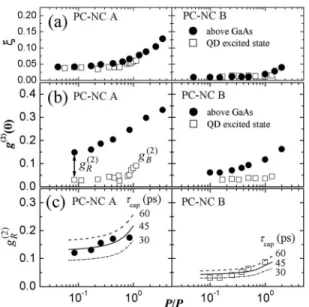
the former. The power dependence of the background emis-sion ratio⬅IB/共IB+ IX兲 is then demonstrated by using P0as the normalization factor. From Fig. 4共a兲, depends only on the normalized pumping power 共P/ P0兲, and which is inde-pendent of the excitation energies Eex. Also, the PC-NC A had a largerthan PC-NC B, indicating that the cavity mode also enhances the background emission. Figure 4共a兲reveals thatis independent of Eex, despite the measured g0
共2兲shows a strong Eex dependence. Hence, the measured g0
共2兲 under excited-state excitations can be regarded as the multiphoton probability of the background emission gB,0共2兲. Accordingly, as shown in Fig. 4共b兲, the contribution of exciton-recapture
gR,0共2兲 at the above-band-gap excitation can be deduced from
gR,0共2兲= g0共2兲− gB,0共2兲.
FIG. 2.共a兲 Second-order correlation functions g共2兲共兲 for PC-NC A and B at
Eex= 1.55 eV.共b兲 Power dependence of g0共2兲at excitation energies of 1.55
eV共쎲兲 and of excited state of QD 共䊐兲.
FIG. 3. 共a兲PL spectra of PC-NC A, showing the superposition of X and background line shapes at Eex= 1.55 and 1.354 eV. 共b兲 Power-dependent
intensities of X共IX兲 and background 共IB兲 at excitation energies of 1.55 eV
共쎲兲 and of excited state of QD 共䊐兲.
163111-2 Chang et al. Appl. Phys. Lett. 94, 163111共2009兲
This article is copyrighted as indicated in the article. Reuse of AIP content is subject to the terms at: http://scitation.aip.org/termsconditions. Downloaded to IP: 140.113.38.11 On: Wed, 30 Apr 2014 07:27:09
The exciton recapture gR,0共2兲 can be analyzed using rate-equation calculations. If the exciton number at WL is nWL, while those populating at the QD’s empty state, exciton state and biexciton state are n0, nX, and n2X, respectively. For
n0共t兲+nX共t兲+n2X共t兲=1, the time evolution of this system is expressed as10 dnWL dt = − nWL cap 共n0+ nX兲 − nWL 0 , dnX dt = nWL cap n0− nWL cap nX− nX X +n2X 2X , dn2X dt = nWL cap nX− n2X 2X , 共1兲
whereX,2X, and 0 are recombination lifetime of exciton, biexciton, and exciton in the WL state, respectively, andcap is the capture time of excitons into the QDs from WL. After exciton recombines, the QD is at empty state, and n0= 1. Then, gR,0共2兲 is given by
gR,0共2兲= 兰兰nX共t兲nX共t +兲dtd
关
兰nX共t兲dt兴
2. 共2兲
Figure 4共c兲 plots the calculated power-dependent gR,0共2兲 for PC-NC A and B,13 and reveals that the calculations agree closely with the measurements, confirming that the measured
gR,0共2兲 is dominated by exciton recapture rather than other pos-sible mechanisms.2,6The best fittingcapfor PC-NC A and B is about 45 ps, which is comparable to values presented else-where共10–40 ps兲.14 The slightly longer capture time in this work may arise from the low QD density in the samples.15 The calculations also indicate that cap is an important pa-rameter for gR,0共2兲. At a fixed nWL, a shortercapcan result in a lower gR,0共2兲 because the biexciton population increases with the reducing cap, which leads to a much faster nWL decay rate thanQD−1. Although a reliable means of controllingcapis
yet available, applying an electric field6 or increasing the temperature15may be help to reduce cap.
In summary, the origins of the nonzero multiphoton emission probability for QDs embedded in PC-NCs were investigated. Above barrier excitations usually lead to a con-siderable multiphoton probability, that arises from both the recapture of excitons and background emission. Excitations via the QD excited state substantially inhibit exciton recap-ture and the detected multiphoton events can in principle be attributable to the background emissions from WL tail states. The effect of exciton recapture is analyzed using rate equa-tion calculaequa-tions. This study suggests that exciton recapture can be suppressed by reducing the capture time of excitons into the QDs, which suppression is important to the quality control of a single photon emitter—especially the electrically driven single photon emitter, in which the electrons and holes are injected from buffer layers.
This work was supported by the National Science Coun-cil of the Republic of China under Grant No. NSC 96-2112-M-008-019-MY3.
1P. Michler, A. Kiraz, C. Becher, W. V. Schoenfeld, P. M. Petroff, L. Zhang,
E. Hu, and A. Imamoğlu,Science 290, 2282共2000兲.
2C. Santori, D. Fattal, J. Vučković, G. S. Solomon, Y. Dale, and Y.
Yama-motoPhys. Rev. Lett. 86, 1502共2001兲; C. Santori, D. Fattal, J. Vučković,
G. S. Solomon, E. Waks, and Y. Yamamoto,Phys. Rev. B 69, 205324
共2004兲.
3Z. Yuan, B. E. Kardynal, R. M. Stevenson, A. J. Shields, C. J. Lobo, K.
Cooper, N. S. Beattie, D. A. Ritchie, and M. Pepper,Science 295, 102
共2002兲.
4S. Laurent, S. Varoutsis, L. Le Gratiet, A. Lemaître, I. Sagnes, F. Raineri,
A. Levenson, I. Robert-Philip, and I. AbramAppl. Phys. Lett.87, 163107
共2005兲; D. Englund, D. Fattal, E. Waks, G. Solomon, B. Zhang, T. Na-kaoka, Y. Arakawa, Y. Yamamoto, and J. Vučković,Phys. Rev. Lett. 95,
013904共2005兲; W.-H. Chang, W.-Y. Chen, H.-S. Chang, T.-P. Hsieh, J.-I. Chyi, and T.M. Hsu,ibid. 96, 117401共2006兲; K. Hennessy, A. Badolato,
M. Winger, D. Gerace, M. Atatüre, S. Gulde, S. Fält, E. L. Hu, and A. Imamoğlu,Nature共London兲 445, 896共2007兲.
5D. Press, S. Götzinger, S. Reitzenstein, C. Hofmann, A. Löffler, M. Kamp,
A. Forchel, and Y. Yamamoto,Phys. Rev. Lett. 98, 117402共2007兲. 6S. Strauf, N. G. Stoltz, M. T. Rakher, L. A. Coldren, P. M. Petroff, and D.
Bouwmeester,Nat. Photonics 1, 704共2007兲.
7W.-Y. Chen, H.-S. Chang, T. M. Hsu, T.-P. Hsieh, and J.-I. Chyi,Appl.
Phys. Lett. 90, 211114共2007兲.
8S. Strauf, K. Hennessy, M. T. Rakher, Y.-S. Choi, A. Badolato, L. C.
Andreani, E. L. Hu, P. M. Petroff, and D. Bouwmeester,Phys. Rev. Lett.
96, 127404共2006兲.
9M. Kaniber, A. Laucht, A. Neumann, J. M. Villas-Bôas, M. Bichler, M.-C.
Amann, and J. J. Finley,Phys. Rev. B 77, 161303共2008兲.
10E. Peter, S. Laurent, J. Bloch, J. Hours, S. Varoutsis, I. Robert-Philip, A.
Beveratos, A. Lemaître, A. Cavanna, G. Patriarche, P. Senellart, and D. Martrou Appl. Phys. Lett. 90, 223118共2007兲; E. Peter, S. Laurent, J.
Bloch, J. Hours, S. Varoutsis, D. Martrou, I. Robert-Philip, A. Beveratos, A. Lemaître, A. Cavanna, G. Patriarche, and P. Senellart, Phys. Status Solidi C 5, 2520共2008兲.
11T.-P. Hsieh, H.-S. Chang, W.-Y. Chen, W.-H. Chang, T. M. Hsu, N.-T. Yeh,
W.-J. Ho, P.-C. Chiu, and J.-I. Chyi,Nanotechnology 17, 512共2006兲. 12W.-H. Chang, H.-S. Chang, W.-Y. Chen, T. M. Hsu, T.-P. Hsieh, J.-I. Chyi,
and N.-T. Yeh,Phys. Rev. B 72, 233302共2005兲. 13For a given P, n
WL共0兲 can be estimated by nWL共0兲=共␣PTL/Eex兲
⫻共Acavity/Alaser兲共1/nQD兲, where␣= 0.05 is the absorption of GaAs, TLis
the period of laser, Acavity共0.25 m2兲 and Alaser共19.6 m2兲 are the areas
of the cavity and the laser, respectively, Eexis the excitation energy of the
laser, and nQD= 3 is the number of QDs in the cavity.
14K. Mukai, N. Ohtsuka, H. Shoji, and M. SugawaraAppl. Phys. Lett. 68,
3013共1996兲; R. Heitz, M. Veit, N. N. Ledentsov, A. Hoffmann, D. Bim-berg, V. M. Ustinov, P. S. Kop’ev, and Zh. I. Alferov,Phys. Rev. B 56,
10435共1997兲; Yu. I. Mazur, B. L. Liang, Zh. M. Wang, D. Guzun, G. J. Salamo, G. G. Tarasov, and Z. Ya. Zhuchenko,J. Appl. Phys. 100, 054316
共2006兲.
15S. Marcinkevičius, and R. Leon,Appl. Phys. Lett. 76, 2406共2000兲.
FIG. 4. 共a兲 Normalized power dependence of background ratiosat exci-tation energies of 1.55 eV共쎲兲 and of excited state of QD 共䊐兲. 共b兲 Normal-ized power dependence of g0共2兲at excitation energies of 1.55 eV共쎲兲 and of excited state of QD 共䊐兲. 共c兲 Normalized power dependence of measured 共symbols兲 and calculated 共lines兲 gR,0
共2兲, with
0= 0.57 ns 共from TRPL兲 in
Eq.共1兲.
163111-3 Chang et al. Appl. Phys. Lett. 94, 163111共2009兲
This article is copyrighted as indicated in the article. Reuse of AIP content is subject to the terms at: http://scitation.aip.org/termsconditions. Downloaded to IP: 140.113.38.11 On: Wed, 30 Apr 2014 07:27:09