
ELSEVIER Journal of Crystal Growth 169 (1996) 747-751
j . . . C R Y S T A L G R O W T H
Growth and characterization of
Cdl_~_yZn
yTe crystals
W.C. Chou a.*, F.R. Chen a, T.Y. Chiang a, H.Y. Shin b, C.Y. Sun b, C.M. Lin c,
K.
Chern-Yu c, C.T. Tsai c, D.S. Chuu c
Department of Physics, Chung Yuan Christian Universit)', Chung-Li 32023, Taiwan, ROC b Department of Electronic Engineering, National Taiwan bzstitute of Technology, Taipei, Taiwan, ROC
c Department of Electro-Physics, National Chiao Tung UniuersiO', Hsinchu 30049, Taiwan, ROC
Received 20 November 1995; accepted 30 May 1996
Abstract
The Cd 1 _~ ,.ZnxMnyTe crystals, having potential in the development of magnetic field sensitive devices, were grown by the temperature gradient solution method at 940°C. All crystals were p-type with resistivity of 1 0 7 ~ ' cm. They have
novel magneto-optical properties, and could be substitutes for the Cdl_xZn~Te ternary compounds in certain optoelec- tronic/integrated-optical device applications.
1. I n t r o d u c t i o n
Over the past two decades, detailed studies have been performed on the Mn-based I I - V I diluted mag- netic semiconductors (DMS) [1,2] ternary com- pounds, A 1 - x Mn x B. The major concern of the stud- ies can be divided into two categories. One is the s p - d exchange interaction, which characterizes the interesting optical and transport properties, such as giant Faraday rotation [3], magnetic field induced band splitting [4], polaron effect [5] and the magnetic field induced metal insulator transition [6]. The other is the d - d exchange interaction, which is the driving mechanism for the spin-glass phenomena [7] and Curie-Weiss behaviour [8].
Recently, the DMS quaternary compounds have attracted more attention than the ternary compounds [9,10]. The quaternary compounds have more con- trollable parameters than the ternary compounds. For
* Corresponding author.
example, both the lattice constant and the bandgap of the quaternary compounds can be managed in an arbitrary fashion. Whereas, for the ternary com- pound, the bandgap either increases or decreases with the shortening of lattice constant. Hence, the quaternary compounds, Cd 1 - x y Zn..c Mn yTe, are bet-
ter candidates than the ternary c o m p o u n d Cdl_xMn~Te for the fabrication of optoelectrical devices and magnetic field sensor [11] or for the usage as the substrate for the unstrained devices.
Moreover, the quaternary compound bridges the two types of ternary compounds. For example,
C d l _ x yZnxMnyTe interfaces Cdl_xMnxTe and Zn 1 ~.Mn~.Te. It is interesting to study the variation of the s p - d as well as the d - d exchange interaction as the host non-magnetic semiconductor changes from CdTe to CdZnTe then ZnTe. However, little effort has been devoted to the growth of Cd~_ X yZn~MnyTe crystals.
In this study, the Cdl_ x yZnxMnyTe crystals were grown by the temperature gradient solution
0022-0248/96/$15.00 Copyright © 1996 Elsevier Science B.V. All rights reserved
748 w.c. Chou et al. /Journal of Co'stal Growth 169 (1996) 747-751
method. The molar fraction of the constituent atoms were determined by an electron probe microanalyzer (EPMA). The resistivity, X-ray, and etch pit density (EPD) measurement were also performed to charac- terize the samples for further device application. The optical properties of the Cdl x_,.Zn ~MnyTe crystals were studied by the reflectivity (R) and photolumi- nescence (PL) experiments. Finally, we have carried out the magnetization measurements to study the magnetic properties for the potential application in the magnetic field sensitive detector.
2. Experiment
The quaternary crystals Cd~_~_yZn~Mn,Te were grown by the temperature gradient solution method with the temperature gradient close to 50°C/cm. The temperature profile is shown in Fig. 1. In this work, the tellurium element was used as the solvent, the anion (Te 2 ) to cation (Cd 2+, Zn 2+, and Mn 2+) molar ratio was 7 to 3, to lower the growth tempera- ture from the congruent melting temperature of CdTe (1097°C) or ZnTe (1303°C) [12] to the temperature around 940°C. The large temperature gradient en- ables the impurities and excess Te to segregate to the higher temperature region. The other advantage is that the lower growth temperature prohibits the pro- duction of impurity from the growth ampoule at high temperature and avoids the evaporation of a large amount of Cd.
i I
• furnace c m 6 0 m 1 4 400 943 li04 CO Temperature ProfileFig. 1. The furnace set-up and temperature profile for the crystal growth.
The commercially available Te(6N) was purified by the zone refining method. The high purity Te was then loaded with a proper amount of Cd(6N), Zn(6N), and Mn(4N) elements in the graphite-coated quartz ampoule with a diameter of 15 mm. The ampoule was then evacuated to 10 - 6 TOIT and sealed by a flame. For the chlorine-doped growth, a proper amount (100 to 5000 ppm) of CdC12 was also sealed within the ampoule. The pre-growth heating took 24 h with the lowest part of the ampoule located at 940°C, 14 cm away from the lowest exit of the furnace. After one day of the pre-heating process, the motor was started with a lowering rate of 2 c m / d a y . The post-growth cooling was carried out just after the completion of the solidification. The obtained crystals were about 10 cm in length with 30% of the Cd~_ ~_~.Zn~Mn:Te crystals and the rest was the Te element containing a large amount of impurity. For further studies, the crystals were sliced into 2 mm thick pieces then polished by the A120 3 powder and 5% bromine-methanol solution.
3. Results and discussion
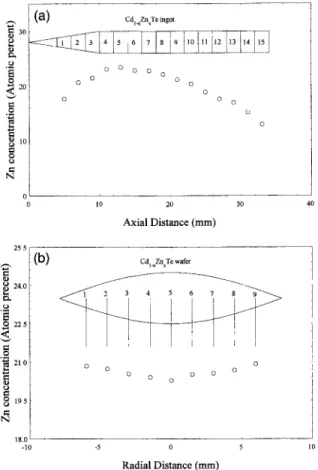
The molar fraction of constituent atoms for the Cda_x_yZnxMnyTe crystals were determined by the electron probe microanalyzer and were checked by lattice constant analysis using the X-ray diffraction and the optical measurements of the bandgap. The variation of the Zn concentration in the Cd 1 xZnxTe (Cdl_ x yZnxMnyTe, y = 0) ternary compound along the growth direction and the radial direction were shown in Fig. 2a and 2b, respectively. The variation of the Zn concentration along the growth direction is very pronounced, 10% is the largest difference. However, the variation of the Zn concen- tration along the radial direction is less than 1%. In the case of the Cdl_x_yZnxMn:,Te quaternary com- pounds, shown in Fig. 3, the change of the molar fraction for the ingredient elements is similar to the results obtained for the ternary compounds. For both ternary and quaternary compounds, the maximum Zn concentration along the growth direction occurs at the place around 12 mm from the tip of the ingot.
To study the possibility of the usage as an opto- electronic device, the resistivity and etch pit density (the etchant consisting of H20(20 ml):H202(20
W. C. Chou et al. / Journal of Crystal Growth 169 (1996) 747-751 749
I ( a )
% . z . ~0 ~go~ 3 0 8 , 6 ' 7 8 ] 9 ' 1 0 u i 1 2 13 14115 o • ",., o 0 o o o o o~
20 0 o o o o ° o~10
g e, 10 20 30 40Axial Distance (nun)
25 5 eo 24.0 o e ~ . o 22 5 210 195 O o o o o o O O 18.0 -10 -5 0 5 10 Radial Distance (mm)
Fig. 2. (a) The Zn concentration versus the growth distance plot for the C d l _ . Z n y e crystal. (b) The Zn concentration versus the radial distance plot for the Cd I _ xZn~Te crystal.
Table 1
The resistivity and etch C d l - x yZnxMnyTe crystals
pit density (EPD) for the
Sample Resistivity EPD (cm -°- )
( ~ . cm) 1: Cdo.96Zno.04Te 3.35X 10³ 2.10X 10⁵ 2: Cdo.88Zno.12Te 2.14X 10³ 7.70X 10⁴ 3: Cd0.s6Zno.14Te 3.71 X 10³ 3.70X 10⁵ 4: Cdo.80Zno.2oTe 4.71 X 10³ 4.40X 10⁴ 5: Cdo.983MnomTTe 1.51 X 10³ 9.71 X 10⁴ 6: Cdo.927Zno.o55Mno.o18Te 3.13X 10³ 3.00X 10⁴ 7: Cdo.749Zno.e25Mno o26Te 8.89 X 10³ 1.06 X 10⁵ 8: Cd0.524Zno.448Mno o28Te 7.34 X 10⁴ 5.18 X 10⁴ 9: Cd 0 309Zn0.667 Mno.oo4Te 5.53 × 10² 5.88 X 10⁴ 10: Cd 0 o94Zno 8s9Mno.olrTe 4.28 X 10² 1.05 × 10⁴ 11: Zno.987Mno.maTe 1.59X 10² 1.24X 10⁴ 12: Cdo.55Zno.4oMno.osTe 3.71 X 10⁷ - doped 1000 ppm C1 m l ) : H F ( 3 0 m l ) w a s u s e d ) [13] o f the Cd 1 - x- >. Zn x Mn yTe crystals were measured and are listed in Table 1. The Cdl_xZnxTe crystals are p-type with a resistivity o f about 103 ~ • c m and the EPD is around 1 0 4 / c m 2. With approximately 2% of Mn, both the resistivity and the EPD o f the quater- nary compound do not change significantly. The resistivity value obtained for the C d l _ x _ y Z n x M n y T e is much higher than that obtained from the CdZnTe crystals grown by the sublimation and physical vapour transport method [14]. With the doping o f chlorine, the resistivity o f the quaternary compound can even be raised to 10 7 [~" cm.
so 20 o= lO g Cd 1 _x_yZnxlVhlyTe ingot
~
2 3 4 5 6 7 8 9 10 0 0 0 0 0 0 0 o 0 0 D D D D D D D D D o 10 20 30 Axial Distance (mm)Fig. 3. The Zn ( O ) and Mn ( [] ) concentration versus the growth distance plot for the Cd I - x-~,Zn x Mn yTe crystal.
J 1.5 Sample 6 7 (R) ~ I I 1.6735 1 7891 ; i 17 8 9 10 I I / 1 9285 2.1184 2.2915 t
i
i
t
19 2.1 23Photon Energy (eV)
Fig. 4. The reflectivity and photoluminescence spectra for the Cd I - x - y Zn x Mn yTe crystals.
750 W.C. Chou et al. / J o u r n a l of Co'stal Growth 169 (1996) 747-751
In Fig. 4, the reflectivity (R) and photolumines- cence (PL) spectra are shown. The near bandgap structures from the reflectivity spectra exhibit sharp excitonic transitions, which indicate very good opti- cal quality for the Cd~_x_sZn~MnsTe crystals. The nice optical quality of the grown crystals was further verified by the PL work. The full width at half maximum (FWHM) of the main peaks from the PL spectra for all the Cdl_x_sZn~Mn~Te crystals are about 4.2 meV, the same as that of the CdZnTe crystals.
In order to investigate the magnetic field sensitive optical properties, we have carried out the magneto- PL experiments. In Fig. 5, the magneto-PL spectra for the C d l _ x yZnxMn~Te crystals at 0, 2, 4, and 6 T are shown. The free exciton, marked as X, exhibits red shift in energy at non-zero magnetic field. The energy shift is as large as 12 m e V / T at low mag- netic field, and saturate at high magnetic field. Note that for the Cd 1 .~_yZnxMnsTe crystals with 2% of Mn, the electrical properties do not noticeably change from their non-magnetic compounds. While, the magneto-optical properties of the two kinds of com- pound, non-magnetic Cdl_ x yZnxTe and magnetic Cd~_~ sZnxMnyTe, are extremely different. In Fig. 5, the impurity related structure, labelled as I, shows similar magnetic field dependent behaviour as the free exciton.
We have also measured the magnetization of the Cdl_x_yZn.~Mn~Te crystals using a superconduct- ing quantum interference device magnetometer. The
4 ~3 o - - - - o Cd ° sogZn ° 667M110 024Te I 1 t3 D Cd 0 749Zn 0 255Mn0 o?6Te ] . 0 ~ ~ ,o" y-" ~..",, - i / / l 2 3 4
Magnetic Field (Tesla)
Fig. 6. The magnetization versus magnetic field plot for the Cdo.309Zn 0 667Mn0 024Te (O) and Cdo.749Zno.255Mn 0 o26Te ([]) crystals.
representative magnetization versus magnetic field d e p e n d e n c e is shown in Fig. 6 for the C d o . 7 4 9 Z n 0 . 2 2 5 M n o . 0 2 6 T e a n d Cdo.309Zno.667Mno.025Te crystals. The magnetization exhibits typical Brillouin magnetic behaviour. With the magnetization measurements and the magneto- optical studies, the exchange constant can be deter- m i n e d
N o ( a -
/ 3 ) = 1.01 eV f o r the Cdo.309Zno.667Mno.025Te crystal. This value is closeto
No(a-/3)
= 1.10 eV [151 and 1.29 eV [161 forthe CdMnTe and ZnMnTe crystals.
4 . C o n c l u s i o n ~Z 4 Tesla ~ . ~ . ~ C d 0 927Zn0 055IV[llo 0is T e 2 Tesla 0 Tesla x l I 1 63 1 64 1 65 i 66 1 67 1 68 Photon Energy (eV)
Fig. 5. The magneto-photoluminescence spectra from the Cdo.o27Zno.o55Mno.olsTe crystal at 0, 2, 4 and 6 T.
We have grown Cd~_x_sZn.~MnyTe crystals us- ing the temperature gradient solution method. The sample quality of the Cd 1 - x - y Zn.~ Mn sTe quaternary compounds are as good as the Cd 1 xZnxTe ternary compound grown by the same method. The crystals are p-type and have a resistivity of 10 3 ~']" cm. The resistivity can be raised even to 10 7 ~ " cm by doping with chlorine. It is natural to conclude that the quaternary compounds, which have the same quality as the ternary compounds, have potential applications in optoelectronic devices. Furthermore, the typical magnetic and magneto-optical properties of the quaternary c o m p o u n d s render the Cdl_x_sZnxMnyTe crystals as possible candidates for the magnetic field sensitive sensor.
W.C. Chou et al. / J o u r n a l of Crystal Growth 169 (1996) 747-751 751
Acknowledgements
This work was supported by the National Science Council, Taiwan, ROC, by the contract numbers NSC-84-2112-M-033-005 and NSC-84-0208-M-033- 00l.
References
[1] J.K. Furdyna, J. Appl. Phys. 64 (1988) R29.
[2] J.K. Furdyna and J. Kossut, Eds., Semiconductors and Semimetals, Vol. 25 (Academic Press, New YorL 1988). [3] L.P. Fu. T. Schmiedel, A. Petrou, J. Warnock and B.T.
Jonker, Appl. Phys. Lett. 60 (1992) 583.
[4] W.C. Chou, A. Petrou, J. Warnock and B.T. Jonker, Phys. Rev. Lett. 67 (1991) 3820.
[5] D.D. Awschalom, M.R. freeman, N. Samarth, H. Luo and J.K. Furdyna, Phys. Rev. Lett. 66 (1991) 1212.
[6] S. yon Molnar, A. Briggs, J. Flouguet and G. Remenyi, Phys. Rev. Lett. 51 (1983) 706.
[7] A. Twardowski, C.J.M. Denissen, W.J.M. de Jonge, A.T.A.M. de Waele, M. Demianiuk and R. Triboulet, Solid State Commun. 59 (1986) 199.
[8] A. Twardowski, Y.F. Chen, W.C. Chou and M. Demianiuk, Solid State Commun. 90 (1994) 493.
[9] Y. Irie, T. Sato and E. Ohta, Phys. Rev. B 51 (1995) 13084. [10] E. Oh, R.G. Alonso, I. Miotkowski and A.K. Ramdas, Phys.
Rev. B 45 (1992) 10934.
[11] H. Gurrero, J.L. Escudero and E. Bernabeu, Sensors Actua- tors A 39 (1993) 25.
[12] L.R. Shiozawa and J.M. Jost, Research on Improved II-VI Crystals, Aerospace Research Laboratories, ARL 71-0017 (1971) pp. 19, 21.
[13] K. Nakagawa~ K. Maeda and S. TakeuchL Appl. Phys. Lett. 34 (1979) 574.
[14] J.L. Boone, G. Cantwell, W.C. Harsch, J.E. Thomas and B.A. Foreman, J. Crystal Growth 139 (1994) 27.
[15] J.A. Gaj, R. Planel and G. Fishman, Solid State Commun. 29 (1979) 435.
[16] A. Twardowski, M. von Ortenberg, M. Demianiuk and R. Pauthenet, Solid State Commun. 51 (1984) 849.

![Fig. 6. The magnetization versus magnetic field plot for the Cdo.309Zn 0 667Mn0 024Te (O) and Cdo.749Zno.255Mn 0 o26Te ([]) crystals](https://thumb-ap.123doks.com/thumbv2/9libinfo/7633823.135787/4.810.426.744.120.352/fig-magnetization-versus-magnetic-field-cdo-zno-crystals.webp)
