In conclusion we have demonstrated a relatively simple, room- temperature operating, resonant cascaded fibre Raman laser that provides a broad band CW output between 1.56 and 1 . 9 5 ~ . We believe this is the first report of a CW fibre Raman laser olperating in this spectral region. This laser was pumped by an integrated Yb3+:Er3' fibre laser, which in turn can be pumped either by a compact mini all-solid-state Nd-based laser or laser diodes. Through opthising the fibre lengths employed and output cou- pling ratios, a considerable increase in the output power levels should be achieved.
2 0
l o
Acknowledgments: We are grateful to the EPSRC for their overall financial support of this research programme.
.-
-- 0 TEE 1996
Eleclronics Lettess Online No: 19960956
P. Pcrsephonis (Dqmstment uf Pliysics, Universily of' Putrus, 26500 Patrus, Greece)
S.V. Chernilcov and J. R. Taylor (Femtosecond Optics Group, Physics Department, Imperial College, Psiitce Consort Roud, London S W7 2BZ, United Kingdom)
28 M i ~ y 1996
References
1 MIZIJNAMI. ' I . , M I Y A Z A K I , T , and TAKAGI. K : 'Short-pulse ultraviolet fiber Raman laser pumped by a XeCl excimer laser', J. Opt. Soc. A m B . , 1987, 4, pp. 498-504
efficiency tunablc cw Raman oscillator'. Appl. Pltys. Lett., 1977,
30, pp. 162-164
tunable near-infrared ( I ,085-1.175
wm)
Raman oscillator', Opt. Lett., 1977, 1, pp. 96-97STOLEN. R H., and JOHNSON. AM.: 'The effect of pulse walkoff on stimulated Ranian scattering in fibers', IEEE J. Quantuin .Electrun., L I V . c., and F RE N CH , w G.: 'A near infrared fiber Raman oscillator tunable from 1.07 to 1.32 pm', Appl. Plzys. Lett., 1979, 34, pp. 666- 668
L I N . c : 'Fiber Raman lasers' in MOLLENAUER, L F., and WHITE. J.C. (Eds.): 'Tunable lasers', Topics in applied physics, Vol. 59 (Springer-Verlag), pp. 279-301
2 JAIN, R.K , LlN, C., SI'OLEN. R H , PLEIBEL. W., and KAISER. P.: 'A high-
3 L I N , C , , STOLEN. R ti.. FRENCII, W.G., and M A L 0 N L T . G : 'A CW
4
1986, QE-22, pp. 21542160 5
6
7 GKURB. S . G , ERDOGAN, T., MIZRAHI, V., STRASSER, T., CHELJNG, W . Y , . A E., KOSINSKI. S.G., NYKOLAK. G., w.: ' 1 . 3 ~ cascaded Raman rs'. Proc ECOC '94, 1994, Paper I'D3
('HERNIKOV, S.V., ZHU, Y., TAYLOR, J.R., and KASHYAP, R.: 'High gain, monolithic, cascaded libre Raman amplificr operating at 1.3 pn', Electron. Lett., 1995, 31, pp. 472 473
8
Efficient fibre-coupled laser diode end-
pumped
NYAB
laser
Y .F.
C h e n , S.C. W a n g ,C.F. Kao and
T.M.
H u a n gIndming terms: Fibre luscxs, Solid la,~n.s
Under optimum pump conditions, 60mW of green laser output coi-responding to a conversion efficiency 6% was obtained from a self-frequency-doubling NYAB crystal when pumped by a 1 W fibre-coupled laser diode. The prospect of higher conversion efficiency is also discussed.
~~
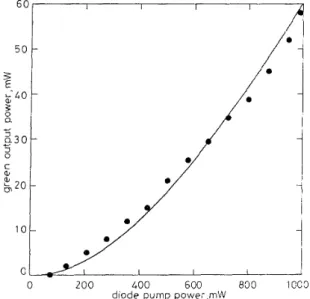
Neodymium yttrium alunlinum borate (NYAB) has a number of desirable features that make it an attractive material for a diode pumped compact green laser system. The self-frequency-.doubling CW NYAB laser end-pumped by a diode laser has been realised in several laboratories [ 1 - 41. However, the conversion #efficiency never exceeded 3% in these investigations. In this Letter we dem- onstrate a highly efficient fibre-coupled diode end-pumped NYAB laser. Under optimum pump conditions, 60mW of green laser out- put corresponding to a conversion efficiency 6% was obtained from
a
self-frequency-doubling NYAB crystal when pumped by a 1 W fibre-coupled laser diode.ELECTRONICS LETTERS
1stAugust
1996 Vol. 32
fibre - coupled
laser diode coupling
NYAB output optics crystal mirror
HR O6 pm AR 1 0 6 p m HR 1 0 6 p m 0 5 3 Irn 0 5 3 p m H R 0 5 3 p m
AR 0 808wm
a
Fig. 1 hire-coupled diode pumping expewnentul setup
The NYAB crystal, dimensions 3mm x 3mm x 2mm, was cut at the type
I
phase-matching angle for second harmonic generation at 1.063pm (On? = 32.9'). The experimental setup is s8hown in Fig. 1. The fibre-coupled laser diode used was an SDL-2:372-P2 (Spec- tra Diode Laser Labs),which hasa
2 1 3 0 p core fibre with a -36" half widi-h at ]/e2 of the peak intensity and a maximum CW out- put power of -1.2W. The emission wavelength of the diode laser was tuned by controlling the operating temperature control system to match the laser wavelength to the absorption peak of NYAB. The plarioconcave configuration of the resonator consisted of one planar crystal surface, high-reflection coated at I . 0 6 3 p and 0 . 5 3 2 ~ and high-transmission coated at 0 . 8 0 8 ~ for the pump light to enter the rod, and a spherical output mirror. The second surface of the crystal was antireflecion coated at 1 . 0 6 3 p and 0 . 5 3 2 ~ . An ouput mirror with a curvature of lOcm was used and the reflectivities of the mirror were 90.9% and < l o % for 1.063pn and 0 . 5 3 2 ~ , respectively. The mirror was mounted approxi- mately 5cm from the planar reflecting facet. This design yields a 0.13mm TEM", spot size.The brightness of a single fibre-coupled laser diode (several tens of kW/cm2.sr) is two orders of magnitude less than that of the source diode (several MW/cmz. sr) [5], Therefore, the characteristic of the pump-beam quality should be taken into acvount in deter- mining the optimum pump condition of the fibre-coupled laser- diode pumped lasers. Including the eiTect of the pump-beam qual- ity, the normalised spatial distribution of the pump 'enerjg can be described by
[6,
71On the basis of the paraxial approximation, w,,(z) := o,,,+O,,lz-z,l. Here
cop,>
is the radius at the waist, O,, and z,, are the far-field half- angle and focal plane of the pump beam in the active medium. The brightness theorem gives a relationship nO,,w,,<> = C, where C is a constant that is a characteristic of the beam quality and n is the refractive index for the pump beam. For a fibre-coupled diode, theI I 1 - 7 6o
I
5 0 - O l I I I I / 0 00 0 10 0 20 0 30 up0' m m 1 4 4Fig. 2 Culculated threshold pump powe aguinst pump bcam ,tuiyts
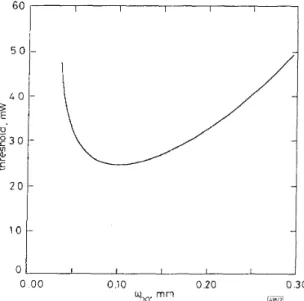
value of C can be easily calculated from its core radius and diver- gence angle. It can be seen that for small pump beam waists the propagation angles of the beams relative to the optic axis may be too large for good overlap with the resonator mode. Conversely. for small divergence angles the large pump spot sizes may 'cause a reduction in mode overlap. Optimum pump spot size for th.e mini- mum threshold and maximum slope efficiency is expected when these two effects are balanced.
By using the above parameters, an upper-state lifetime of 6 0 p , a cross-section of 10 x lW9cm2
,
an absorption coefficient of 9.2cm-I at the pump wavelength, an absorption coefficient of 1.4cm at the second harmonic beam wavelength, a nonlinear optical coefficient of 6.82 x l(f9 e.s.u, andan
internal loss of 2.8?4cm-', we have calculated the threshold pump power as a function of pump beam waists. As shown in Fig. 2, the threshold has a minimum of -25mW of pump power with the the pump beam waist around 0.12mm. To match this optimum pumping condition, the fibre output was focused into the NYAB crystal by using f = 6Smm focal length collecting lens ( N A = 0.615), a n d f = 8.0mm focal length focusing lens (NA = 0.5).0 200 400 6 00 800 'IO00
diode pump power,mW
Fig. 3 Experimental and theoretical results f o r output pon'er ugainst
opticul pump pow'er
theory, 0 experimental result
0 1 I I I I I
0 1 2 3 4 5 6
length of NYAB, rnm @g
Fig. 4 Dependence of green output power on internal losses and length
of N Y A B crystal (i)
a,
= 0.7%1cm-' (ii) CL, = 1.4%cm-' (iii) a, = 2.8Yocm-'The fibre-coupled diode end-pumped NYAB laser was operated using the pumping configuration discussed above. Experimental and theoretical results for output power against optical pump power are shown in Fig. 3. A CW green output power of -60mW was obtained at a pumping power 1 W corresponding to a conver- sion efficiency of -6%. To our knowledge, the present conversion efficiency is the highest reported so far for a self-fi-equency-dou- bling CW NYAB laser. Also, it can be seen that the predictions of the analysis agree very well with experimental data.
With NYAB crystals of good optical quality the efficiency and output power can be improved considerably. The dependence of green output power on the length of the NYAB crystal is shown in Fig. 4. It can be seen that the conversion efficiency can be higher than 10% for an NYAB with internal loss less than 1.4%0m-'. It can be seen that the optimum crystal length is -1.5-2.Omn, with almost total insensitivity to internal losses.
0 IEE 1996
Electronics Letters Online No: 19960977
Y.F. Chen. C.F. Kao and T.M. Huang (Precision Instrument Dei.elopiiieiit Center, Nutionul Science Council, Hsincliu, Taiwan, Republic of Cliiiia)
S.C. Wang (Institute of Electro-optical Engineering, National Chiuo Tung University. Nsinchu, Taiwan, Republic of China)
E-mail: [email protected],tw
22 Mu.y 1996
References
WANG. s.c . STONE. R E., and LIN. J T : 'Characteristics of neodymium yttrium aluminum borate as a diode pumped laser material'. Advanced Solid State Laser Tech. Dig., Salt Lake City UT, 1990, Paper TuB4
S T O M . R.E., SPITZER. R.C., and WANG. s c : 'A Q-switched diode- pumped neodymium yttrium aluminum borate laser', IEEE Photonics Technol. Lett., 1990, 2, (1 I), pp. 769-771
ZARRABI. J.H., GAVRILOVIC, P , and SINGH, s : 'Monolithic, self- frequency doubled, neodymium-doped yttrium aluminium borate green laser with low intensity noise', Electon. Lett., 1993, 29, (20). pp. 1769-1770
HEMMATI, H : 'Diode-pumped self-frequency-doubled neodymium yttrium aluminum borate (NYAB) laser', IEEE J. Quantum Electron., 1992, QE-28, (4), pp. 1169-1171
CHEN. w., ROYCHOUDHURI, c.s., and BANAS, c.M.: 'Design approaches for laser-diode material-processing systems using fibres and micro-optics', Opt. Eng., 1994, 33, (ll), pp. 3662-3669 LAPORTA. P . and BRUSSARD, M.: 'Design criteria for mode size optimization in diode-pumped solid-state lasers', IEEE J , Quantum Electmi., 1991. QE-27, (lo), pp. 2319-2326
FAY. T Y , and SANCHEZ, A : 'Pump source requirements for end- pumped lasers'. IEEE J. Quantum Electron., 1990, 26, (2), pp. 311- 316
High performance 660nm InGaP/AIGalnP
quantum well metal cladding ridge
waveguide laser diode
D. Sun. D.W. Treat
and
D.P. Bour
Indexing terms. Semiconductor junction lasers, Waveguide lusers A high perforniance 660 nm metal cladding ridge waveguide laser diode was fabricated from a compressively strained In, hGq ,Pi (Al,Gal-,)o jP single quantum well laser structure. The 4 p wide ndge waveguide diode had a threshold current of 3 1 mA with a differenfial quantum eficiency of 45Wfacet (slope efficiency of 0.85 W/A) under CW operation. The characteristic temperature was 120K from 20 to 75°C. The diode operated in a single transverse mode up to 22mWifacet.
Red laser diodes are being widely used in applications such as printing, bar code scanning and optical data storage [l]. In appli- cations which need stable single transverse mode beam at power level over tens of milliwatts, a buried ridge waveguide structure has been mostly used to in diode fabrication [2, 31. Although high