IEEE SIGNAL PROCESSING LETTERS, VOL. 11, NO. 4, APRIL 2004 431
A New Fuzzy Bandwidth Carrier Recovery System
in GPS for Robust Phase Tracking
Wei-Lung Mao, Hen-Wai Tsao, Member, IEEE, and Fan-Ren Chang, Member, IEEE
Abstract—Fast carrier recovery loops are essential in high-dynamic global positioning system receivers. A new dig-ital phase-locked loop (DPLL) system incorporating a fuzzy bandwidth controller (FBC) is presented in this letter. The FBC provides a time-varying bandwidth and adjusts the loop filter coefficients to improve DPLL tracking capability. When the phase error or phase difference error becomes large in the presence of significant accelerations, the loop bandwidth increases adaptively and performs rapid locking. Simulation results show that our receiver does achieve a superior performance over conventional tracking loops in terms of shorter settling time and wider fre-quency ramp range, while preventing the occurrence of cycle slipping.
Index Terms—Carrier phase tracking, cycle slipping, digital phase-locked loop (DPLL), fuzzy bandwidth controller (FBC), global positioning system (GPS) receiver.
I. INTRODUCTION
C
ARRIER PHASE observable is widely used in global sitioning systems (GPS) to obtain a centimeter-level po-sitioning accuracy with applications of aircraft precision ap-proaches, missile navigation, and etc. Unfortunately, high dy-namics and shadowing may lead to cycle slipping that seri-ously degrades the ranging accuracy and requires a time-con-suming ambiguity search algorithm for rinitialization. Previ-ously, a fuzzy estimation filter [1] has been proposed for mis-sile navigation. However, the model needed an a priori known specific trajectory to train the fuzzy phase-locked loop (PLL) and thus was unsuitable for practical receiver. Lee et al. [7] pre-sented an adaptive PLL capable of varying the loop bandwidth by increasing the amount of charge-pump current. An alterna-tive scheme operating by the control on the reference frequency and frequency division ratio was proposed for frequency syn-thesizer [8]. Thus, these adaptive bandwidth methods are only applicable for analog PLL architectures. In carrier loop design, a wider bandwidth is needed for rapid acquisition, whereas a smaller bandwidth is preferred for noise performance [2]. To enhance both carrier tracking and phase estimation accuracy simultaneously in GPS receivers, the digital bandwidth-adjust-ment scheme is indispensable to overcome this difficulty.In this letter, we propose a new carrier recovery system com-posed of a third-order digital phase-locked loop (DPLL) and a fuzzy bandwidth controller (FBC) to achieve robust carrier
Manuscript received May 26, 2003; revised August 5, 2003. The associate editor coordinating the review of this manuscript and approving it for publica-tion was Prof. Visa Koivunen.
The authors are with the Integrated System Laboratory, Department of Electrical Engineering, Graduate Institute of Electronics Engineering, National Taiwan University, Taipei, Taiwan, R.O.C. (e-mail: [email protected]; [email protected]; [email protected]).
Digital Object Identifier 10.1109/LSP.2004.824020
phase tracking. The FBC provides a means of converting a con-trol strategy comprised of a set of linguistic rules into a band-width-control operation and requires only moderate computa-tional complexity. Under realistic mobile conditions, the carrier phase signal is modeled as a sum of three components, these being 1) phase offset, 2) frequency offset, and 3) frequency ramp offset. When the phase error or phase difference error increases due to large dynamics, the FBC provides an adaptive bandwidth to the DPLL and results in fast acquisition. If both absolute phase and phase difference errors are small, the loop bandwidth will reduce and thus improves the positioning accuracy. This new adaptive-bandwidth method has been shown to shorten the pull-in process and widen the locking range in comparison with conventional loops under a variety of dynamic environments.
II. MOBILECARRIERPHASEMODEL
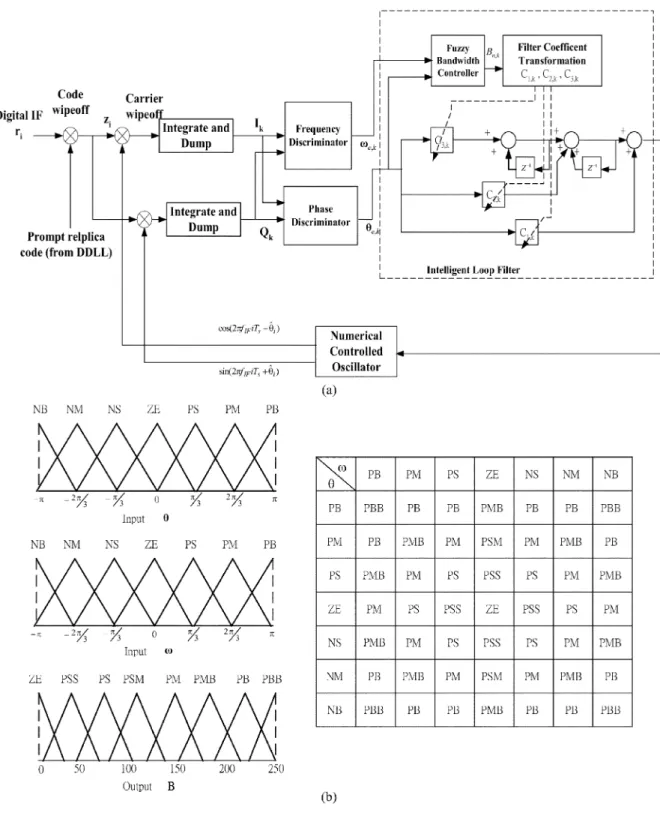
A detailed block diagram of the proposed GPS carrier loop is illustrated in Fig. 1(a). The received sample observation can be represented as
(1) where is the average power of the received signal, is the coarse/acquisition (C/A) code sequence, is the sample period, is the code transmission delay time, is the re-ceiver intermediate radian frequency, and is the unknown car-rier phase to be estimated. The noise component is modeled as sample of a zero-mean white Gaussian noise with two-sided power spectral density of W/Hz, and the jamming source is not considered in this letter. The mathematical model for the carrier phase can be represented as
(2) where (radians) is a constant phase offset, (hertz) is the amount of frequency offset due to the Doppler effect, and (hertz per second) is the frequency ramp offset of a high-dy-namic user. Since the frequency ramp caused by the satellite motion is usually small, we may consider only the motion of vehicles [4]. It is assumed that the user has an acceleration of m/s , and the equivalent Doppler frequency ramp becomes
Hz/s (3)
where is the speed of light and is the GPS L1 carrier frequency ( MHz). For a highly dy-namic condition with an acceleration of
gravitational acceleration with a value of m/s , the frequency ramp will be 515 Hz/s.
1070-9908/04$20.00 © 2004 IEEE
432 IEEE SIGNAL PROCESSING LETTERS, VOL. 11, NO. 4, APRIL 2004
Fig. 1. (a) Proposed fuzzy bandwidth carrier tracking loop. (b) Membership functions and rule table.
III. NEWFUZZYBANDWIDTHCARRIERTRACKINGLOOP
A. Fuzzy Bandwidth Controller (FBC)
The integration and dump filters sum up their input data in I- and Q-arms, and the outputs of the digital accumulators [6] become
(4.1)
(4.2) where is the autocorrelation function of C/A codes, is
the loop update time, , and
is the number of samples summed together to update the loop. and are the phases of the received signal and local carrier signal. and are I- and Q-phase noise components due to noise . The phase error and phase
MAO et al.: NEW FUZZY BANDWIDTH CARRIER RECOVERY SYSTEM 433
TABLE I
SETTLINGTIMES FOREACHDPLL SCHEME INDOPPLERFREQUENCYRAMPENVIRONMENTS
difference error are chosen as input variables of the FBC and given by
(5.1) (5.2) The output variable of the FBC, , is the desired loop bandwidth to vary the loop filter parameters accordingly. We choose triangular-shaped membership functions (MFs) for the input and output variables [shown in Fig. 1(b)]. The inference mechanism based on the Mamdani algorithm [5] is utilized. These control rules have the general form
IF is AND is THEN is (6)
where , , and are the linguistic variables, and , and are the corresponding linguistic labels characterized by MFs. The fuzzy output can be determined using the center-average defuzzification [5] formulated as follows:
(7)
where is the number of fuzzy output sets, is the numerical value of output MF, and represents its membership value at the th quantization level.
B. Filter Coefficient Transformation
The closed-loop transfer function of a third-order PLL [3] can be represented as
(8)
The single-sided noise bandwidth for this loop is
Hz (9)
where is the ratio of the
nat-ural frequency to the loop bandwidth . Since most GPS carrier loops are implemented as a digital structure, the bilinear transformation is used to map the continuous-time system into a discrete-time one. We consider the second-order loop filter with a transfer function
(10) where , , and are the digital filter coefficients. Inserting (10) into the carrier loop system, the discrete-time transfer func-tion becomes as shown in (11) at the bottom of page, where is the gain of phase discriminator, and is the gain of the numer-ically controlled oscillator. The loop filter parameters in terms of loop bandwidth can be derived as
(12.1)
(12.2)
(12.3)
(11)
434 IEEE SIGNAL PROCESSING LETTERS, VOL. 11, NO. 4, APRIL 2004
IV. SIMULATIONRESULTS
Computer simulations have been carried out to evaluate the performance of proposed scheme applied in high-dy-namic receivers. The relevant parameters are: the IF carrier MHz, IF sampling frequency MHz, and loop update time ms. The value of the third-order filter coefficients and are chosen as 1.1 and 2.4 [3], respectively. The new fuzzy bandwidth DPLL is compared to the conven-tional second-, third-, and fourth-order loops with Hz [3]. The desired dynamic limitations are set as a lock range of 100 Hz and a frequency ramp range of 515 Hz/s. The complete rule table for the FBC is shown in Fig. 1(b). Seven linguistic terms are used for each input variables, and 49 rules are developed in this controller. The dynamic tests are conducted at a lowest value of CNR 35 dB-Hz [2], and each result is obtained through 2000 independent Monte Carlo simulations.
Table I compares the simulated performances of our fuzzy loop with those of the conventional methods under the accel-eration conditions. The constant-bandwidth loops can only op-erate in smaller frequency ramp ranges (near 220 Hz/s). On the other hand, the FBC provides an adaptive loop bandwidth to the DPLL, and the corresponding tracking capability can be signif-icantly extended to 515 Hz/s with a shorter settling time of 28 ms (5% frequency ramp error specification).
Table II shows the acquisition limitation comparisons between each DPLL scheme. If no fuzzy algorithm is used, loss of locking will occur in conventional loops when the frequency offset is larger than 30 Hz. It is observed that the fuzzy bandwidth scheme can work very well to achieve wider lock range and pull-in range. The significant improvement by using our DPLL is that a robust transient behavior can be performed in kinematic environments.
V. CONCLUSION
This letter has presented a new architecture of an intelligent GPS receiver suitable for use under various dynamic conditions. Based on the bandwidth-adjustment criterion, the proposed
car-TABLE II
ACQUISITIONLIMITATIONS FOREACHDPLL SCHEME
rier loop does achieve three better acquisition performances: 1) larger frequency ramp range (515 Hz/s); 2) wider lock range (100.2 Hz) and pull-in range (134.6 Hz); and 3) shorter settling time for the L1 carrier signal. These results demonstrate that our receiver is capable of faster acquisition speed and broader fre-quency ramp range compared to those of the conventional con-stant-bandwidth loops in a variety of mobile circumstances.
REFERENCES
[1] D. Simon and H. El-Sherief, “Fuzzy logic digital phase-locked loop filter design,” IEEE Trans. Fuzzy Syst., vol. 3, pp. 211–218, May 1995. [2] M. S. Braasch and A. J. Van Dierendonck, “GPS receiver architectures
and measurements,” Proc. IEEE, vol. 87, pp. 48–64, Jan. 1999. [3] E. D. Kaplan, Understanding GPS: Principles and
Applica-tions. London, U.K.: Artech House, 1996.
[4] J. B. Y. Tsui, Fundamentals of Global Positioning System Receivers: A Software Approach. New York: Wiley, 2000.
[5] B. Kosko, Neural Networks and Fuzzy Systems: A Dynamical System Approach to Machine Intelligence. Upper Saddle River, NJ: Prentice-Hall, 1992.
[6] W. Zhuang, “Performance analysis of GPS carrier phase observable,” IEEE Trans. Aerosp. Electron. Syst., vol. 30, pp. 754–767, Apr. 1996. [7] J. Lee and B. Kim, “A low-noise fast-lock phase-locked loop with
adaptive bandwidth control,” IEEE J. Solid-State Circuits, vol. 35, pp. 1137–1145, Aug. 2000.
[8] Y. Tang, Y. Zhou, S. Bibykl, and M. Ismail, “A low-noise fast-settling PLL with extended loop bandwidth enhancement by new adaptation technique,” in Proc. 14th Annu. IEEE Int. C/SOC Conf., 2001, pp. 93–97.