科技部補助專題研究計畫成果報告
期末報告
新興科技創先採用策略之探討-以社群、適地、行動服務
創新為例
計 畫 類 別 : 個別型計畫 計 畫 編 號 : MOST 103-2410-H-004-109- 執 行 期 間 : 103 年 08 月 01 日至 104 年 07 月 31 日 執 行 單 位 : 國立政治大學資訊管理學系 計 畫 主 持 人 : 尚孝純 計畫參與人員: -兼任助理人員:吳君怡 報 告 附 件 : 出席國際會議研究心得報告及發表論文 處 理 方 式 : 1.公開資訊:本計畫涉及專利或其他智慧財產權,2 年後可公開查詢 2.「本研究」是否已有嚴重損及公共利益之發現:否 3.「本報告」是否建議提供政府單位施政參考:否中 華 民 國 104 年 10 月 19 日
中 文 摘 要 : 面對環境、技術、市場的轉變,企業無不積極運用新興科技 以創新服務吸引消費者、確保市場競爭優勢。雖然今日許多 新興科技(如社群、適地、行動技術)變得更容易被採用, 然而創先採用新興科技似乎反而無法再像過去般為先進者取 得、持續其先進優勢。本研究欲了解新興科技(以社群、適 地、行動技術為範疇)的先進者是否仍能像過去一樣成功地 從先進定位中佔有優勢,從實際案例之中我們發現今日的企 業創先採用新興科技確實存在成效不一的情況,作者為此進 而提問:策略性考量可能方為決定企業能否成功採用新興科 技的關鍵因素。為驗證此命題,本研究以策略理論為基礎對 企業採用科技成效設計一分析表,並且採用跨個案脈絡分析 法以驗證此命題,藉此了解企業在策略性考量下與戰術性考 量下採用新興科技所能延續的先進者優勢之差異。 中文關鍵詞: 先行者、商業策略、新興科技服務創新
英 文 摘 要 : As the environment, technology, and marketing
continue to change, businesses seek opportunities for leveraging technologies to build innovative services that attract customers and secure markets. Although emerging technologies such as social, local, mobile (SOLOMO) technologies have become widely adopted, not every first mover can achieve and maintain the
advantages of being the first adopter. Some
innovators have exhibited the advantages of being the first mover, whereas other first movers did not gain the advantages associated with the same emerging technologies. Because of the diverse results observed among the first SOLOMO service innovation adopters, the business performance of those first movers who adopted emergent service innovation technologies was examined in this study. Based on the findings from an initial content analysis on SOLOMO cases developed using a resource-based view, the researchers propose that business strategic thinking is one of the
driving factors affecting the success of sustained innovation adoption. To validate the proposition, an analytic list of business performance based on
strategy theories will be constructed and a cross-case content examination will be conducted to develop insight regarding how businesses sustain their first-mover advantages by using different strategic and
tactical intentions.
英文關鍵詞: First mover, business strategy, emerging technological service innovation
科技部補助專題研究計畫成果報告
(□期中進度報告/■期末報告)
新興科技的創先採用策略之探討-以社群、適地、行動服務創新為例
An Examination of First Mover Strategy with Emerging
Technologies – SOLOMO for Service Innovation
計畫類別:■個別型計畫 □整合型計畫
計畫編號:MOST 103 - 2410 - H - 004 - 109 -
執行期間:2014 年 8 月 1 日至 2015 年 7 月 31 日
執行機構及系所:國立政治大學資訊管理學系
計畫主持人:尚孝純
計畫參與人員:吳君怡
本計畫除繳交成果報告外,另含下列出國報告,共 1 份:
□執行國際合作與移地研究心得報告
■出席國際學術會議心得報告
期末報告處理方式:
1. 公開方式:
□非列管計畫亦不具下列情形,立即公開查詢
■涉及專利或其他智慧財產權,□一年■二年後可公開查詢
2.「本研究」是否已有嚴重損及公共利益之發現:■否 □是
3.「本報告」是否建議提供政府單位施政參考 ■否 □是, (請列舉提供
之單位;本部不經審議,依勾選逕予轉送)
中 華 民 國 104 年 10 月 15 日
目錄
目錄 ... I 中英文摘要及關鍵詞 ... II 報告內容... 1 INTRODUCTION ... 1 LITERATURE REVIEW... 2Comparison between traditional ICT and SOLOMO technology ... 2
First mover advantages ... 4
Business strategy thinking ... 5
RESEARCH METHODOLOGY ... 7
ANALYSIS RESULT ... 8
DISCUSSION ... 9
參考文獻... 10
中英文摘要及關鍵詞
面對環境、技術、市場的轉變,企業無不積極運用新興科技以創新服務吸引消費者、確保市場競爭優 勢。雖然今日許多新興科技(如社群、適地、行動技術)變得更容易被採用,然而創先採用新興科技 似乎反而無法再像過去般為先進者取得、持續其先進優勢。本研究欲了解新興科技(以社群、適地、 行動技術為範疇)的先進者是否仍能像過去一樣成功地從先進定位中佔有優勢,從實際案例之中我們 發現今日的企業創先採用新興科技確實存在成效不一的情況,作者為此進而提問:策略性考量可能方 為決定企業能否成功採用新興科技的關鍵因素。為驗證此命題,本研究以策略理論為基礎對企業採用 科技成效設計一分析表,並且採用跨個案脈絡分析法以驗證此命題,藉此了解企業在策略性考量下與 戰術性考量下採用新興科技所能延續的先進者優勢之差異。 關鍵字:先行者、商業策略、新興科技服務創新As the environment, technology, and marketing continue to change, businesses seek opportunities for leveraging technologies to build innovative services that attract customers and secure markets. Although emerging technologies such as social, local, mobile (SOLOMO) technologies have become widely adopted, not every first mover can achieve and maintain the advantages of being the first adopter. Some innovators have exhibited the advantages of being the first mover, whereas other first movers did not gain the advantages associated with the same emerging technologies. Because of the diverse results observed among the first SOLOMO service innovation adopters, the business performance of those first movers who adopted emergent service innovation technologies was examined in this study. Based on the findings from an initial content analysis on SOLOMO cases developed using a resource-based view, the researchers propose that business strategic thinking is one of the driving factors affecting the success of sustained innovation adoption. To validate the proposition, an analytic list of business performance based on strategy theories will be constructed and a cross-case content examination will be conducted to develop insight regarding how businesses sustain their first-mover advantages by using different strategic and tactical intentions.
報告內容
INTRODUCTION
Because emergent technological service innovations are increasing, businesses can now easily adopt these innovations. Among those potential innovations, social, local, mobile (SOLOMO) is the most influential trend that will rapidly and completely change the world’s economy, consumers’ behavior, and industry rules in the coming decades (Husson & Ask, 2011; Murphy & Meeker, 2011). Referring to social networking and social media, social-related innovations enable the formation of various types of relationship through which businesses can connect with customers. Referring to location-based services and navigation applications, location-related innovations enable unique ways for companies to reach customers. Referring to mobile devices and applications, mobile innovations affect the time required to spread messages and the message formats. Combining these technologies as SOLOMO can facilitate considerable innovation in business.
Experts suggest that businesses adopt those innovations as early as possible (Schmalensee, 1982; Robinson & Fornell, 1985; Urban et al. 1986). Studies have indicated that first movers leverage their advanced position to achieve competitive advantages and withstand the threat of later movers (Lieberman and Montgomery, 1988; Piccoli & Ives, 2005). However, concerns regarding the differences in characteristics between emerging and traditional technologies may challenge businesses and cause them to hesitate. Because of the improvement of network access and the pervasion of mobile devices, most businesses view mobile applications as a means for broadening connections with customers. As one of the most popular applications, Line is attractive to every marketing department in Taiwanese companies because Line enables businesses to efficiently reach new customers. Two types of business adopting the same innovation, Line, exhibited different results occurred. A government department case exhibited the advantages being the first mover; however, a convenience store case did not show the same advantages associated with being a first mover to adopt the same emerging technology.
Because of the changing industrial rules and diverse characteristics of technologies, it is unclear whether the first mover advantages exist when emerging technological service innovations are adopted. This study will examine cases of SOLOMO-enabled service innovation to thoroughly understand first mover advantages and to answer the following question: Does the first mover that adopts emerging technological service innovations achieve the same advantages as businesses that adopt traditional technologies do? Regarding first and late movers and emerging technologies, this study will explore the following question: Are there principle drivers that businesses should cautiously consider when adopting innovations?
To comprehensively understand the specific characteristics of emerging technologies, traditional technological innovations and emerging technological innovations will be compared. Although it has been recognized that emerging technological innovations are greatly beneficial, few businesses have adopted these innovations and successfully gained advantages. By initially investigating emerging technological innovation cases, this study proposes that business strategic thinking may be one of the driving factors affecting success in sustaining innovation adoption.
tactically. The differences between strategic and tactical adoption may result in a different position toward the value of innovations. To validate this proposition, a set of measurements based on a resource-based view (Kathleen & Claudia, 1996), business model (Osterwalder, 2004), and strategy theory (Porter, 1996) will be constructed and a cross-case content examination will be conducted to develop insight regarding the
proposition. The findings regarding the strategy of being a first mover can be used to improve the understanding of emerging technologies used for service innovation and help businesses thoroughly understand strategic moves that involve using technology.
LITERATURE REVIEW
The concept of pioneering an innovation to achieve competitive advantages has been studied extensively, but the rapidly changing environment and technology make the issue of being a first mover complicated. Furthermore, the new and important trend, SOLOMO, is totally divergent from traditional ICT. To extend the study of first movers into emerging technological service innovation, this section provides a review of the characteristics of SOLOMO and constructs the research framework based on the extant literatures.
Comparison between traditional ICT and SOLOMO technology
In their research on ICT adoption, Clemons and Kimbrough (1986) identified emerging ICT as ―the strategic necessities,‖ by which they meant that ICT would rapidly vary the cost structure and relative bargaining power of companies and consequently would expose them to new sources of competition. In addition, with regard to ICT being a catalyst of business innovation (Hertog 2000; James et al. 2008), embracing the trend to achieve forward-looking advantages has been considered critical for increasing revenue. SOLOMO, the emerging concept of ―social, location, and mobile technology,‖ has taken a long time to evolve. With the perspective of environment and technologies, SOLOMO not only will be a new channel but also will change the ways in which companies reach customers, the types of message provided to customers, and the time of message spreading.
The trend of social networking began with the diversified services of Web 2.0 applications. With the emergence of Blogger (initiating in 1999), Wikipedia (in 2001), MySpace (in 2003), and Flickr (in 2004), the initial Web 2.0 allowed people to communicate and participate in various highly interactive applications. Although the initial stage of Web 2.0 applications attracted many people involved in creating information, the follow stage of Web 2.0 provided people with communication instantly with each other. Representative of this stage, Facebook (in 2004) and Twitter (in 2006) claimed one billion and 140 million active users in 2012.
The trend of mobile applications has relied on the effective combination of the Internet and wireless networks, which has also been driven by the improvement in mobile Internet devices, with their various functions and processing efficiency. With the success of EeePC (launching in 2007) and Kindle (in 2007), Intel first identified the concept of mobile Internet devices (MID) in 2007. These kinds of devices were sized between cellphones and netbooks (which are different from heavy devices such as mainframes, personal computers, and laptops) and had the feature of ―always on‖ with the Internet, which is totally different from the waiting
time of computers. Among the early MIDs, the iPhone (in 2008) may not have been the first smartphone, but it has been the most successful one. Accompanying its friendly and intuitive finger-touch screen and its varied and ever-growing service platform (i.e., App Store and iOS), the most important factor of iPhone’s success is the ecosystem created by Apple. Apple provides developer an arena to develop and sell mobile application (i.e., Apps), in this place every components have been ready, such as the operational function of devices, the spotlighting shelf of displays, and even the customers. This ecosystem revealed the business model of Apps in a smartphone, which is very significant because it broke the rule of traditional software developing and charging methods. While the new service operating system attracted many customers and the robust service-development mechanism attracted many developers, the coordinating ecosystem made the concept of MID (and its services) pervasive in people’s lives and in the business world. How well did it succeed? There were just 500 Apps in the App Store (which provides Apps to customers) in July 2008 when the iPhone was launched, but the number rapidly increased until there were more than 775,000 Apps in January 2013.
Another trend is location-based services (LBSs), which are rooted in the technology of global positioning systems (GPSs), speed/direction sensors, micro-electro-mechanical systems (MIMS), road databases, etc. The early usages were vehicle navigation services. While mobile applications and other emerging ICT became more popular, new kinds of LBSs sprouted up, such as Gowalla (initiating in 2007), Foursquare (in 2009), and Layar (in 2009). Related to the traditional provider-center service (which means customers can only take the services the provider has provided), new LBSs will be closer to the customers because they can directly access their real lives.
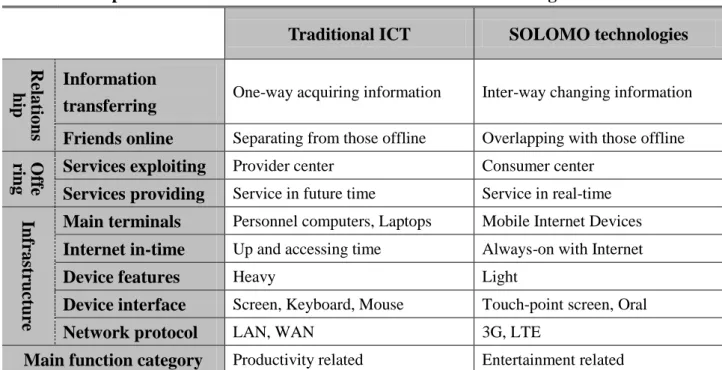
The trend of SOLOMO is spreading everywhere today, such as in people’s daily lives, office productivity tools, and industry’s business models, and companies are facing dynamic and asymmetric competition with regard to distribution, connectivity, and service itself. However, emerging technology is equivocal and is marked by information that is incomplete, exaggerated, or highly ambiguous. This research shows how SOLOMO technology diverges from the related traditional ICT by comparing several criteria as shown in Table 1.
Table 1. Comparison between traditional ICT and SOLOMO technologies
Traditional ICT SOLOMO technologies
Re lation s h ip Information
transferring One-way acquiring information Inter-way changing information Friends online Separating from those offline Overlapping with those offline
Off
e
rin
g Services exploiting Provider center Consumer center
Services providing Service in future time Service in real-time
In fr a str u ctur e
Main terminals Personnel computers, Laptops Mobile Internet Devices
Internet in-time Up and accessing time Always-on with Internet
Device features Heavy Light
Device interface Screen, Keyboard, Mouse Touch-point screen, Oral
Network protocol LAN, WAN 3G, LTE
In essence, SOLOMO reveals three kinds of change: (1) how information is distributed (transferred) and what its impact and contribution are, (2) how people access information (or service) through networks and devices, and (3) how close information (or service) is to the customer’s real world. Consequently, the relationship, offering, and infrastructure of service innovation provide by businesses change into a different way.
Osterwalder (2004) provided a business model that contained four components—infrastructure, value proposition, customer value, and financial structure. Depending upon the unique characteristics shown above, while traditional ICT mostly focuses on the infrastructure and financial structure, SOLOMO is focused on value propositions and customer value.
Summarizing these discussions, the trend of SOLOMO, with the popularizing of mobile devices, the accessibility of the Internet, and the increasing usage of social services, is that people now can connect with anyone and access any services at any time or place. This, in turn, reveals a new way of doing social media, public relations, and business marketing. Facing such huge changes, companies need to reconfigure resources and strategies in a fundamentally different way. Otherwise, they will not be able to satisfy a continuously changing and growing range of customer requirements.
First mover advantages
Service activities have considered potential for revenue nowadays. During the past decades, firms have changed their focuses from production-related activities to customer-centric services because the margins with service activities are about twice the margins of products sold (Weissenberger-Eibl and Koch, 2007). To survive in the intensively competitive market, the demand for better service and service innovations is going to grow significantly.
Service innovation is both easy and tough. While emerging technologies are such accessible and creative for service innovation, it is hard to obtain a real success for most business. Honestly, although some businesses overcome the basic problem of implementation, service innovation may hard to achieve profit because it may be easily duplicated by competitors or it may not touch the core of value this business provides. So how to achieve a success when business innovate? Literatures have identified the position of first move is important because there is a strong relationship between the order business adopting innovation and the profit earning (Schmalensee 1982; Robinson & Fornell, 1985; Urban et al. 1986). In other words, first movers leverage their current positions to obtain advantages by some isolating mechanisms such as asset accumulating, path dependency, and organizational learning (Kerin et al., 1992; Lieberman & Montgomery, 1988; Mueller, 1997; Piccoli & Ives, 2005).
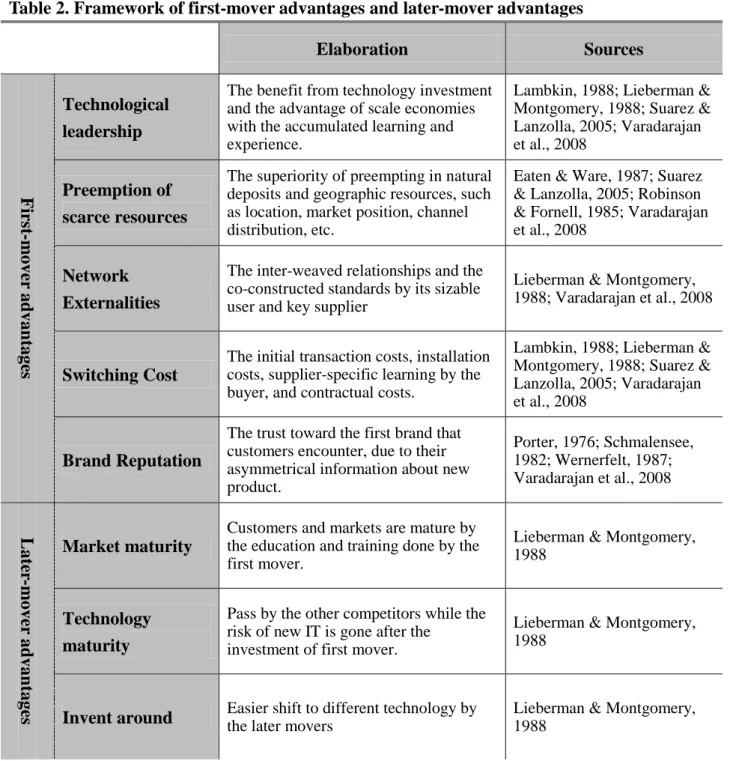
According to the extant literature, the advantages of being a first mover may be classified into technological leadership, preemption of scarce resources, network externalities, switching cost, and brand reputation, while at the same time there are several advantages achieved by later mover such as market maturity (free-rider effects), technology maturity, and invent around (shift in technology) (Kerin et al., 1992; Lieberman & Montgomery, 1988; Varadarajan et al. 2008; Shang & Wu, 2012). Table 2 elaborates the framework of first mover advantages.
Table 2. Framework of first-mover advantages and later-mover advantages Elaboration Sources F irst -m ove r ad van tage s Technological leadership
The benefit from technology investment and the advantage of scale economies with the accumulated learning and experience.
Lambkin, 1988; Lieberman & Montgomery, 1988; Suarez & Lanzolla, 2005; Varadarajan et al., 2008
Preemption of scarce resources
The superiority of preempting in natural deposits and geographic resources, such as location, market position, channel distribution, etc.
Eaten & Ware, 1987; Suarez & Lanzolla, 2005; Robinson & Fornell, 1985; Varadarajan et al., 2008
Network Externalities
The inter-weaved relationships and the co-constructed standards by its sizable user and key supplier
Lieberman & Montgomery, 1988; Varadarajan et al., 2008
Switching Cost
The initial transaction costs, installation costs, supplier-specific learning by the buyer, and contractual costs.
Lambkin, 1988; Lieberman & Montgomery, 1988; Suarez & Lanzolla, 2005; Varadarajan et al., 2008
Brand Reputation
The trust toward the first brand that customers encounter, due to their asymmetrical information about new product. Porter, 1976; Schmalensee, 1982; Wernerfelt, 1987; Varadarajan et al., 2008 L ate r-m ove r ad van tage s Market maturity
Customers and markets are mature by the education and training done by the first mover.
Lieberman & Montgomery, 1988
Technology maturity
Pass by the other competitors while the risk of new IT is gone after the
investment of first mover.
Lieberman & Montgomery, 1988
Invent around Easier shift to different technology by the later movers Lieberman & Montgomery, 1988
Although both academic and empirical studies have shown variance at times, the strategy of the first mover is still regarded as the main source of key competitiveness by most managers. Also, later research has further identified some factors that powerfully influence the fate of first movers, including the pace of new-product diffusion in the market and the pace of emerging technology evolving in the industry (Suarez & Lanzolla, 2005). However, facing a totally divergent from traditional ICT, SOLOMO make the issue of being a first mover complicated and worthy a further research. To find out a rule to improve the service qualities and continue service innovations, a systematic approach is needed for the design and production/delivery of services (Tien and Berg, 2003).
Business strategy thinking
After trying to answer the question ―do first movers with emerging technological service innovations achieve
movers succeed while adopting emerging technological service innovations?‖ The research tries to answer the
second question by reviewing the literatures of business strategy field.
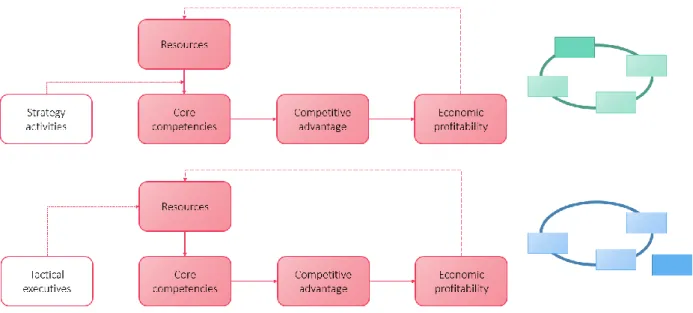
Business strategy refers to the position managers set to achieve the vision and the goal of a business. To increase competitive advantages, businesses deploy and integrate all resources and activities that enable the strategy to be achieved. Kathleen & Claudia (1996) indicated that a firm gains a competitive advantage through the integration of all of its resources. Porter (1996) indicated the importance of alignment between activities (resources) and business strategy, and displayed the relationship according to the strategic activities. However, managers may confuse the difference between a strategic activity and a tactical executive.
Figure 1. The comparison between the strategy activities and the tactical executive
Figure 1 shows that the comparative concept between strategy and tactics mainly focuses on the synergic effect of innovation activities on current activities. Regarding the factors affecting the result of adopting SOLOMO innovations, research has indicated that strategic thinking rather than tactical thinking may be critical for successfully adopting SOLOMO service innovations. After the implementation of an innovation, the synergic effect of the innovative activities is reflected in the output factors such as core competencies, competitive advantages, and economic profitability (Porter, 1996).
The proposed study will involve designing an analysis list based on the concepts of business models. Osterwalder (2004) provided a business model that contained four components: infrastructure, value proposition, customer value, and financial structure. New activities initiated by a business based on a strategic consideration are reflected in the performance of the entire business model. For example, ―infrastructure‖ includes the competencies of distribution, logistics, and warehouse. ―Value proposition‖ product, function, price, and the core value of the business. ―Customer value‖ refers to customer-related indexes such as customer reaching and customer relationships. ―Financial structure‖ refers to cash-flow related issues. Because these items reflect the resources possessed by an adopter of innovation, the items will be used to construct a set of measures that will be applied in the proposed study.
RESEARCH METHODOLOGY
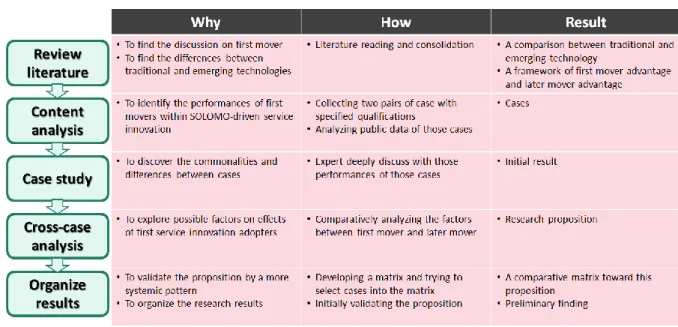
Businesses are facing the changing environment and technology, and the research objectives are to identify the differences between traditional and emerging technologies (such as SOLOMO) and to provide a more suitable pattern for successfully adopting SOMOLO technological service innovation. Figure 2 shows the research process.
Figure 2. Research process
We recognize that SOLOMO is different from traditional ICT; therefore, we will answer the first research question: ―Does a first mover to adopt emerging technological service innovation achieve the same advantages as a business that adopts traditional technologies does?‖ To understand the performance of first movers using SOLOMO-driven service innovation, the analysis framework shown in Table 2 was developed based on the literature review. To investigate the first movers to adopt SOLOMO, we selected cases based on three qualifications: (1) The firm is the first mover in their industry; (2) the first mover adopts SOLOMO technology or applications to provide customers with innovative services; and (3) the firm may have a high market share or may have been reported frequently.
Based on the above qualifications and the research goal, the research finally selected two pairs of cases. The descriptions of those cases are show in Table 3. After collecting a sufficient number of public data, we will conduct a content analysis with those cases.
Table 3. List of tow pair of cases SOMOLO technological
service innovations First mover Later mover
Instant messaging app Tainan Gov (TN) Taoyuan Gov (TY)
Mobile Payment Starbucks (S) Blue bottle (B)
Virtual store via QR code Homeplus (H) Jumbo Mobile (J)
ANALYSIS RESULT
With an initial analysis toward those two pair of cases, the result showed below. Essentially, with the framework which taken from the extant literature, first mover advantages are not very significant. However, we can at least identify the more successful one from another one.
Table 4. Results of initial cases analysis
TN TY S B H J F C F irst -m ove r ad van tage s Technological leadership Preemption of scarce resources O Network Externalities Switching Cost O Brand Reputation O O L ate r-m ove r ad van tage s Market maturity O Technology maturity O O O Invent around
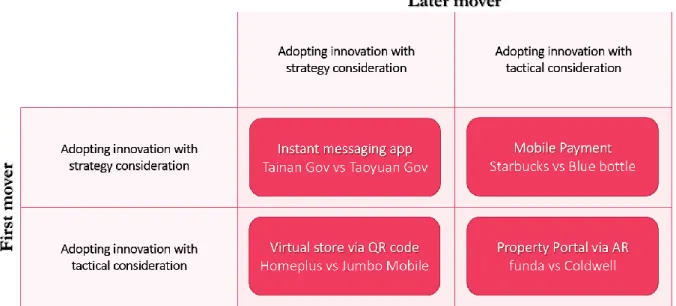
To explore the possible factors affecting the diverse performances of first adopters of service innovation, the study will comparatively analyzing the contexts of the cases and proposes that business strategic thinking is one of the driving factors affecting success in sustaining innovation adoption. Figure 3 shows the matrix of SOLOMO technological innovators which indicates the differences between strategic and tactical intention.
DISCUSSION
Because of the changing industrial rules and diverse characteristics of technologies, it is unclear whether the first mover advantages exist when emerging technological service innovations are adopted. This study tries to examine cases of SOLOMO-enabled service innovation to thoroughly understand first mover advantages and to answer the following question: Does the first mover that adopts emerging technological service innovations achieve the same advantages as businesses that adopt traditional technologies do? Regarding first and late movers and emerging technologies, this study will explore the following question: Are there principle drivers that businesses should cautiously consider when adopting innovations?
To understand performances of emerging technological innovations, the research reviewed extant literatures and provided a framework. However, with initial analysis of selected cases, the result shows that first mover advantages are not very significant. In the future research, there should be other measurement to identify the first mover advantages.
The study consequently tries to understand how companies successfully use SOLOMO to promote innovation by a different perspective. Many cases fail to embrace innovative opportunities may result from the business intention. On the other words, companies with strategy consideration will deal the innovation program with a more integrated and synergic operation. Based on the cross-case study, the research found that business
strategic thinking may be one of the driving factors affecting success in sustaining innovation adoption.
Businesses face strong competition and must embrace future opportunities, and the expected findings will benefit the current service industry. Recommendations will be provided to enable managers to make appropriate decisions when adopting SOLOMO-enabled service innovation. Instead of adopting emerging innovations strategically, some business may adopt these innovations purely tactically. The differences between strategic and tactical adoption may result in a different position toward the value of innovations. To validate this proposition, a set of measurements based on a resource-based view (Kathleen & Claudia, 1996), business model (Osterwalder, 2004), and strategy theory (Porter, 1996) will be constructed and a cross-case content examination will be conducted to develop insight regarding the proposition. The findings regarding the strategy of being a first mover can be used to improve the understanding of emerging technologies used for service innovation and help businesses thoroughly understand strategic moves that involve using technology.
參考文獻
Clemons, E. K., & Kimbrough, S. O. (1986). Information systems, telecommunications, and their effects on industrial organization, Proceedings of the Seventh International Conference on InformationS ystems, San Diego, CA, December 1986, pp. 99–108.
Eaten, B. C., & Ware, R. (1987) A theory of market structure with sequential entry, Rand Journal of Economics, 18, 1–16.
Hertog, P. D. (2000) Knowledge-intensive business services as co-producers of innovation, International Journal of Innovation Management, 4, 4, 491–528.
Husson, T., & Ask, J. A. (2011) 2011 Mobile trends—A social computing report, Forrester, for Consumer product strategy professionals. Retrieved Mach 15, 2013, from http://www.forrester.com/2011+Mobile+Trends/fulltext/-/E-RES571d83.
James, I. C. J., Michael, J. E. and Robert, M. 2008. ―Teaming Up to Crack Innovation and Enterprise Integration,‖ Harvard Business Review (86:11), pp. 90-100.
Kathleen, M. E. and Claudia B. S. (1996), ―Resource-based View of Strategic Alliance Formation: Strategic and Social Explanations in Entrepreneurial Firms.‖ Organization Science 7(2), 136–150.
Kerin, R.A., Varadarajan, P.R., & Peterson, R. A. ―First-mover advantage: A synthesis, conceptual framework, and research propositions,‖ Journal of Marketing, 56, 33-52.
Lambkin, M. (1988) Order of entry and performance in new markets, Strategic Management Journal, 9, 127–240.
Lieberman, M. B., & Montgomery D. B. (1988) First-mover advantages, Strategic Management Journal, 9, 41–58.
Mueller, Dennis C. "First-Mover Advantage and Path Dependence." International Journal of Industrial Organization 15, no. 6 (1997): 827–850.
Murphy, M., & Meeker, M. (2011) Top mobile Internet trends, KPCB. Retrieved Mach 15, 2013, from http://www.slideshare.net/kleinerperkins/kpcb-top-10-mobile-trends-feb-2011.
Osterwalder, A. (2004) The business model ontology a proposition in a design science approach, Universite de Lausanne.
Piccoli, G. & Ives, B. (2005) Review: IT-dependent strategic initiatives and sustained competitive advantage: A review and synthesis of the literature, MIS Quarterly, 29, 4, 747–776.
Porter, M. E. (1976) Interbrand Choice, Strategy and Bilateral Market Power, Harvard University Press, Cambridge, MA.
Porter, M. E. (1985) Competitive Advantage: Creating and Sustaining Superior Performance, The Free Press, New York.
Porter, M. E. (1996) What is Strategy, Harvard University Press, Cambridge, MA.
Robinson, W. T., & Fornell, C. (1985) The sources of market pioneer: Advantages in the consumer goods industries, Journal of Marketing Research, 22, 3, 297–304.
Schmalensee, R. (1982) Product differentiation advantages of pioneering brands, American Economic Review, 72, 3, 349–365.
Shang, S. S. C., and Wu, A. J. Y. (2012) An examination of first-mover (dis)advantages of ICT-driven innovation in the service industry, Proceedings of the Eighteenth Americas Conference on Information Systems, Seattle, Washington, August 9–12, 2012.
Solon, O. (2011) Tesco brings the supermarket to time-poor commuters in South Korea, Wired, Business.
Retrieved Mach 15, 2013, from
http://www.wired.co.uk/news/archive/2011-06/30/tesco-home-plus-billboard-store
Suarez, F., & Lanzolla, G. (2005) The half-truth of first-mover advantage, Harvard Business Review, 83, 4, 121–127.
Tien, J. M. and Berg, D. (2003) A case for service systems engineering, Journal of Systems Science and Systems Engineering, 12, 1, 13-38.
Wernerfelt, B. (1987) Umbrella branding as a signal of new product quality: An example of signalling by posting a bond, Unpublished, Kellogg Graduate School of Management, Northwestern University.
Weissenberger-Eibl, M. and Koch, D. (2007) The importance of industrial service and service innovations, Journal of Management and Organization, 13, 2, p. 88-101.
Urban, G. L., Carter T., Gaskin S., & Mucha Z. (1986) Market share rewards to pioneering brands: An empirical analysis and strategic implications, Management Science, 32, 6, 645–659.
Varadarajan, R., Yadav, M. S., & Shankar, V. (2008) First-mover advantage in an Internet-enabled market environment: Conceptual framework and propositions, Journal of the Academy of Marketing Science, 36, 3, 293–308.
科技部補助專題研究計畫成果報告自評表
請就研究內容與原計畫相符程度、達成預期目標情況、研究成果之學術或應用價
值(簡要敘述成果所代表之意義、價值、影響或進一步發展之可能性)
、是否適
合在學術期刊發表或申請專利、主要發現(簡要敘述成果是否有嚴重損及公共利
益之發現)或其他有關價值等,作一綜合評估。
1. 請就研究內容與原計畫相符程度、達成預期目標情況作一綜合評估
■ 達成目標
□ 未達成目標(請說明,以 100 字為限)
□ 實驗失敗
□ 因故實驗中斷
□ 其他原因
說明:
2. 研究成果在學術期刊發表或申請專利等情形:
論文:□已發表 ■未發表之文稿 □撰寫中 □無
專利:□已獲得 □申請中 ■無
技轉:□已技轉 □洽談中 ■無
其他:
(以 100 字為限)
3. 請依學術成就、技術創新、社會影響等方面,評估研究成果之學術或應用價
值(簡要敘述成果所代表之意義、價值、影響或進一步發展之可能性)
,如已
有嚴重損及公共利益之發現,請簡述可能損及之相關程度(以 500 字為限)
本研究針對新興科技的服務創新採用進行探討,除了運用既有文獻所提供之
理論脈絡,同時也網羅四則實際案例,並深入剖析成功案例之重要概念。本
研究除了所整理資料能作為下一階段研究之研究基礎,也可作為台灣產業界
實際導入創新服務時的參考依據。
1
科技部補助專題研究計畫出席國際學術會議心得報告
日期: 104 年 7 月 31 日研討會分成兩天舉行,第一天總共有八個議程,分兩間教室同時舉行〃第二天總共有十二的議程,分 三間教室同時舉行〃每個議程都一個半小時,參與人數大概五至六人,甚至到十人的都有〃主辦單位 是 ATISR 組織,由臺北大學協辦〃一開始入場要先去櫃檯報到簽名,那時候會給予一份參與證明,議程 表,而且還贈送一個袋子和 USB.之後走進自己分配到的教室後把檔案放進研討會提供的電腦裡,可以 進行調整來看格式正確與否〃接著就坐等議程開始〃我這場由以色列 bar Ilan 大學的老師揭開序幕, 他針對維基百科的書目計量學做探討〃雖然因為研究領域不同有點難懂,但老師都儘量用簡單的英文 解釋,所以大致上還算沒問題〃每個人報告時間為 15 分鐘,台下主持人會提前三分鐘提醒時間快到了, 會留三分鐘讓台下人問問題〃由於我的研究跟台灣選舉有關,所以他們好像不是很懂,但有針對我的 研究方法請我再解釋一下〃大致上整體氣氛輕鬆和樂,就是一場學術的交流不用太緊張〃 我的論文題目是“選舉中線上口碑風暴之研究”.會想做這份研究的動機是因為在這網路發達的世 界,電子口碑(electronic word of mouth)一直以來都是學術界研究的重點。電子口碑分成正面跟負 面,尤其以負面電子口碑備受關注,因為這會帶給企業難以估計的傷害。而在 2014 年,開始有學者提 出了網路風暴(online firestorm)的新名詞,描述在現代社群網路下,負面口碑在網路上突然大量流 傳的現象。 雖然網路風暴的文獻相當少,但在台灣 2014 年舉辦的九合一選舉中,可以看出網路風暴對選情的影響 之大,我們觀察到某些候選人可以藉由應對來有效控制情勢,但有些回應卻會讓負面口碑風暴越趨惡 化,因此我們想要探究這之間的問題所在。所以本研究首先透過文獻了解口碑風暴的定義,從而利用 文獻推斷出口碑風暴形成過程。並以 Google Trend 設計出衡量口碑風暴的方式,以此找出選舉中符合
計畫編號
MOST103-2410-H-004-109-
計畫名稱
新興科技創先採用策略之探討-以社群、適地、行動服務創新為例
出國人員
姓名
陳怡臻
服務機構
及職稱
政治大學資管系
會議時間
104 年 7 月 18 日
至 104 年 7 月 19
日
會議地點
日本東京
會議名稱
(中文)國際網路研究研討會
(英文)
International Conference on Internet Studies (NETs 2015)發表題目
(中文)選舉中線上口碑風暴之研究
(英文)An Examination of Online Firestorm in Election
附件五2 口碑風暴標準的負面口碑案例。之後把案例分成三種情境,每種情境以兩個不同候選人的個案為例, 把從 Opview 收集到的負面口碑資料套用在設計出的公式裡來判斷選舉人的應對有效與否。選舉人的應 對則會利用 Benoit 印象修復理論來做進一步說明。最後,由於此篇研究是以選舉中的口碑風暴為主, 因此我會把選舉中的口碑風暴與傳統商業中的口碑風暴做比較,來看兩者間有何不同或相同之處。 報告完後有位台灣的教授跑來問我的研究,說他覺得這主題非常新穎有創意,順便打聽了一下我未來 的動向,聽到我沒有要讀博士表情愉快地表示這是個好決定〃會後大家也很熱絡的拍照聊天,覺得與 會的人都相當好,就算是外國人也很熱情的參與拍照並大聲讚美大家的研究〃中途有提供午餐卷,是 西式的套餐可與與會者一起在 toshiba 大樓餐廳裡吃飯,但難得到日本我想體驗日本食物就自行到外 面覓食了沒有參與〃但聽同學說很不錯〃據說明年是辦在大阪,這場研討會雖然報命費不低,但還有 提供不錯的午餐能與世界各國學者交流,跟我聽到其他的研討會比起來算是相當好的福利,所以建議 以後參加的同學們可以留下來一起吃飯〃 研討會網誌:http://www.internet-studies.org/ 研研討會 FB: https://www.facebook.com/NETs2015 https://www.facebook.com/atisr.org
科技部補助計畫衍生研發成果推廣資料表
日期:2015/10/19科技部補助計畫
計畫名稱: 新興科技創先採用策略之探討-以社群、適地、行動服務創新為例 計畫主持人: 尚孝純 計畫編號: 103-2410-H-004-109- 學門領域: 資訊管理無研發成果推廣資料
103 年度專題研究計畫研究成果彙整表
計畫主持人:尚孝純 計畫編號:103-2410-H-004-109-計畫名稱:新興科技創先採用策略之探討-以社群、適地、行動服務創新為例 量化 成果項目 實際已達成 數(被接受 或已發表) 預期總達成 數(含實際已 達成數) 本計畫實 際貢獻百 分比 單位 備 註 ( 質 化 說 明:如 數 個 計 畫 共 同 成 果、成 果 列 為 該 期 刊 之 封 面 故 事 ... 等) 期刊論文 0 0 100% 研究報告/技術報告 0 0 100% 研討會論文 0 0 100% 篇 論文著作 專書 0 0 100% 申請中件數 0 0 100% 專利 已獲得件數 0 0 100% 件 件數 0 0 100% 件 技術移轉 權利金 0 0 100% 千元 碩士生 0 0 100% 博士生 1 0 100% 博士後研究員 0 0 100% 國內 參與計畫人力 (本國籍) 專任助理 0 0 100% 人次 期刊論文 0 0 100% 研究報告/技術報告 0 0 100% 研討會論文 0 0 100% 篇 論文著作 專書 0 0 100% 章/本 申請中件數 0 0 100% 專利 已獲得件數 0 0 100% 件 件數 0 0 100% 件 技術移轉 權利金 0 0 100% 千元 碩士生 0 0 100% 博士生 0 0 100% 博士後研究員 0 0 100% 國外 參與計畫人力 (外國籍) 專任助理 0 0 100% 人次其他成果