27
WORKING HOUR CHANGES AND LEISURE TIME
INSTITUTIONALIZATION PROCESS IN TAIWAN
SHU-TZU CHUANG*
Department of Kinesiology, Health, and Leisure Studies, National University of Kaohsiung
MING-JANG WENG
Department of Applied Economics, National University of Kaohsiung
YA-YEN SUN
Department of Transportation & Communication Management Science, National Cheng Kung University
ABSTRACT
The purpose of this paper is to analyze the changes in working hours in Taiwanese society that have been a result of different processes as compared to the West and to discuss the social meanings that might be a result, especially the relationship between work and leisure. This paper presents the changing process in Taiwanese society as it has moved from a traditional agricultural society to a new capitalism in recent decades while the society has experienced shifts in working hours that exhibit value-transfer and time-redistribution phenomenon. The value of work and leisure and work hour changes are also discussed in this paper.
Keywords: working hours, leisure time, work value, Taiwan
(Received: December, 2009; 1st revised: July, 2011; 2nd revised: October, 2012; 3rd revised: December, 2012; accepted: December, 2012)
* Corresponding author: SHU-TZU CHUANG, Department of Kinesiology, Health, and Leisure Studies, National University of Kaohsiung, No. 700, Kaohsiung University Road, Nan-Tzu District, Kaohsiung 811, Taiwan, R.O.C.; Tel: +886-7-3697077; E-mail: [email protected].
INTRODUCTION
Taiwanese society has undergone rapid changes in the last half century. The economy has developed as a result of US assistance and the adoption of economic planning that has occurred since World War II, which resulted in Taiwan being recognized as one of the “Four Little Dragons” in Asia. While impacts from the 1997 Asian Economic Crisis and economic globalization have caused a serious recession in the last two decades, political progress, on the other hand, has resulted in democratic freedom and the lifting of prohibitions that have unlocked the society after a long period of restraints. Peaceful transference of the reins of government is recognized as a sign of a democratic and liberal society. Changes in the political and economic environment and in values have shaped a new relationship between work and leisure. In this paper, there is first a review of these relationship changes in the West, and then a discussion of the economic and political development and the establishment of working values in Taiwan. There is also a discussion regarding changes in working hours in Taiwan. Finally, we discuss the social meaning underlying the processes related to changes in work hours and leisure time institutionalization in Taiwan.
THE CHANGING PROCESS OF THE RELATIONSHIP BETWEEN
WORK AND LEISURE IN THE WEST
The Industrial Revolution caused the Western world to change its developmental direction during the late 18th century, and the characteristics of labor patterns changed from agricultural intensive to industrial labor intensive. The 19th century was the first generation of the industrial era, and the industrial labor pattern left just enough time for rest and recovery (Marx, 1887). Increases in production made working more and more important, since in order to create the capital necessary for economic development, working and accumulation were considered to be the best methods. Thus, working has been viewed as moral behavior, and this perception has shaped the work ethic (Weber, 1958; Kelly & Freysinger, 2000). People who focused on leisure were blamed for causing squandering of both spirit and time on non-work related matters. Leisure and free time were seen as immoral behavior both in the society and in relationship to
the economy (Kelly & Freysinger, 2000). From an economic perspective, leisure activities are viewed as non-productive, but on the other hand, such activities stimulate personal consumption, and their existence is on the opposite track of a society focused on economic accumulation (Veblen, 1899). The consciousness of leisure is in direct conflict with productiveness and accumulation, thereby placing a lot of pressure on those who wish to partake in leisure activities (Cross, 1990). From a moral perspective, work is a restrictive discipline that makes people compliant and is contrary to leisure, which makes people accustomed to languidness and indulgence and is a behavior that can bring harm to a society. Hence, leisure has been rebuked both from a moral and an economic perspective (Parker, 1983).
According to Marxism, residual time for the proletariat and laborer class is necessary for their recovery from labor. It was thought that reducing laborers’ work hours would be a good way for the bourgeois to deprive the proletariat because the additional time for allotted for the proletariat would increase their productivity (Marx, 1887). Nevertheless, to the proletariat, regardless of time spent at work or residual time, both are transformation of the deprivation from capitalists (Deem, 1988). As time passed, the society changed and so did the relationship between work and leisure. In the past, leisure was the privilege of class. Mass leisure (Kelly & Godbey, 1992; Kelly & Freysinger, 2000; Jara-Diaz, Munizaga, Greeven, Guerra, & Axhausen, 2008) became a common social phenomenon, and it became the responsibility of the government to offer suitable conditions and opportunities with the intention of improving people's leisure activities, such as restriction of work hours and construction of mass recreational facilities. Working enabled people to have the ability and resources by which to enjoy leisure time (Marimon & Zilibott, 2000).
In a consumption society, leisure turns out to be a very important, since people have to work to possess the capacity for leisure (Cuvillier, 1984). The relationship between work and leisure achieves a new concomitant relationship. Leisure is an important objective for many people, as is having the ability to choose how they spend their leisure time, and people work to pay for the expenses related to leisure. There are no more conflicts between work and leisure; instead, work is one of the conditions for a
creating leisure lifestyle (Kelly & Godey, 1992; Butsch, 1990). Leisure will liberate people from heavy social burdens (Iso-Ahola, 1997). For individuals, longer periods of rest and leisure time can reduce or avert work burnout (Iso-Ahola & Park, 1996). On the other hand, it could be seen as a compensation because through leisure people can enjoy a sense of autonomy that they cannot get from their work (Iso-Ahola & Park, 1996), which allows them to rediscover themselves and express potential that has been repressed at work (Glyptis, 1989; Mannel & Kleiber, 1997).
The Industrial Revolution changed the pattern of production and labor in western countries. This change in labor patterns resulted in labor alienation. Sociologists’ attention toward the class antagonisms that have existed between capitalists and laborers has been an important process contributing to both the rise of leisure rights and the establishment of labor hour restrictions in western society.
ECONOMIC AND POLITICAL DEVELOPMENT AND THE
ESTABLISHMENT OF WORK VALUES IN TAIWAN
Values and changes related to work and leisure are deeply influenced by social structures, living patterns, and economic development. The changing process of work and leisure values in western societies mentioned in the previous discussion also appeared in the capitalizing Taiwanese society. Taiwan is a society that has faced fast changes and restructuring, and it is a mixture of Japanese, traditional Chinese and western modern culture. Thus, individuals are also influenced by multi-cultures (Cheng, 2001; Manrai, 1995). The special political situation in Taiwan in the international arena has caused Taiwan’s development to be complex. The establishment of values in work and leisure has also been influenced by these factors.
Before World War II
Economic patterns are closely related to lifestyle. Taiwan was ceded to Japan in 1895, and at that time Taiwan was heavily reliant on agricultural production and was under the Japanese imperial policy of “An Agricultural Taiwan and Industrial Japan." Since then, Taiwan has moved from sustainable agricultural production towards
commodity production. The initial multi-production pattern has since switched to high-value commercial agriculture. Season and climate are the main factors governing time allocation in an agricultural society. People’s lifestyle generally depends on the production of major crops and changes in the weather. Farmers devote themselves to cultivation in the busy season and participate in leisure activities during the off seasons. Leisure is recognized as residual time because normal production is restricted by inclement weather. In order to acquire more resource supplies, the Japanese government tried to create a working value whereby production and leisure were treated as both time and energy consuming that have no righteousness in moral and social value.
After World War II
After WWII in 1945, the Kuomintang (KMT) ruled Taiwan as a one-party autocracy, and in 1947 enforced Martial Law, which was not lifted until 1987. At the same time, US aid and the Land Reform Program stabilized the situation and laid the foundation for a future economic take off. The political situation and structure in Taiwan during this period was high-pressured and intensive with strict regulations. From 1951 to1965, large amounts of economic and military aid came from the US as part of its Cold War efforts to preserve this valuable ally in Asia. Much of the aid was used in the infrastructure and in the agricultural sectors. This invaluable military and economic support continued through the 1960’s and 1970s, preventing Taiwan from becoming Communist. US advisors stationed in Taiwan, as well as Taiwanese sent abroad for education, were all directed at rebuilding the economy and the capitalistic development ideology.
Land reform was executed by Taiwan’s central government in 1949 and was completed in 1953. This policy included reduced land rents, distributed public land, and land purchased and resold from landlords. This policy changed the basic social structure, resulting in influences on all social classes, systems of ownership, and on the basic structure of the entire society. The KMT government shifted the national development emphasis to economic development, and these factors made the Taiwanese population pay much more attention to economics while ignoring other aspects of
society, shaping the value of working as a priority.
Taiwan was at the height of functionalism, which emphasized economic development in the 1960’s and shaped the status of work in the society (Calagione, 1998). The highly pressured nation oppressed its population’s appeals to uphold human rights. National policies treated people as the carriers rather than the objects of development. Laborers' rights were ignored, and no one dared to oppose a state under martial law. This resulted in capitalistic domination, and Taiwanese society was replete with social inequalities. Despite this, following the footsteps of the human rights movement and the rise of democracy in the West, the relationship restructuring process began between work and leisure in Taiwanese society. By the 1970s, Taiwan’s industrial environment was still dominated by agriculture. Labor consciousness and labor working hours issues were not considered seriously even though the population started to move from rural to urban areas and was gradually converted to an industrial labor force. Therefore, there were no clear legislative regulations related to working hours, and labor hours in various industries just followed habits as usual. Labor hours were not clearly regulated until 1974 when Taiwan set the Labor Standards Law.
The change in the political and economic environment and the evolution of labor hour restrictions
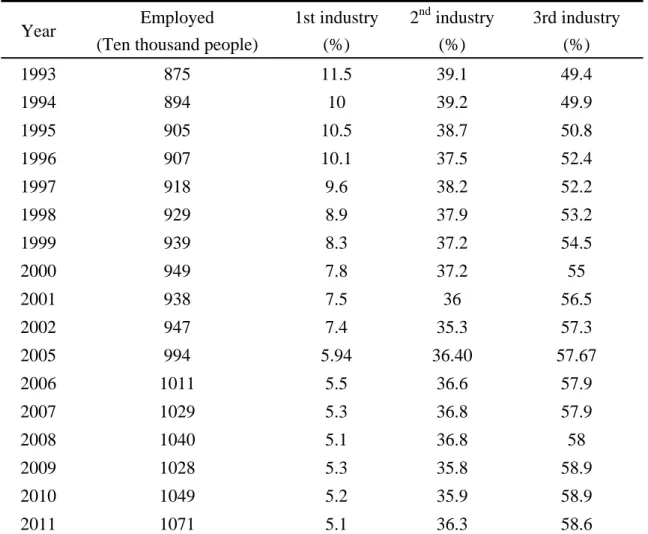
Between 1962 and 1985, Taiwan's economy witnessed the most rapid growth in its history: an average annual rate of nearly 10%, over twice the average economic growth rate of industrialized countries during this period. The economic structure of the nation shifted from reliance on agricultural exports in the 1950’s to light manufacturing in the 1960’s and 1970’s, and on to high technology and chemical product exports in the 1980’s and 1990’s. Economic development is the foundation of social diversity and also the initiator of the leisure industry. The employment rate gradually rose from 875 persons per ten thousand in 1993 to 949 persons per ten thousand in 2000, and then to 1,071 persons per ten thousand in 2011.(Table 1). The industrial structure also began moving towards mainly tertiary industry. In 1993, 11.5% of Taiwan’s population was involved in agriculture, 39.1% of the population was engaged in secondary industries,
and 49.4% population in tertiary industries. From then on, the structure continued to move towards tertiary industry, so that by 2011, only 5.1% of the population remained in agriculture, while the percent of the population involved in secondary and tertiary industry shifted to 36.3% and 58.6%, respectively. This showed that Taiwan’s population and economic structures were moving towards that of a fully economically developed country.
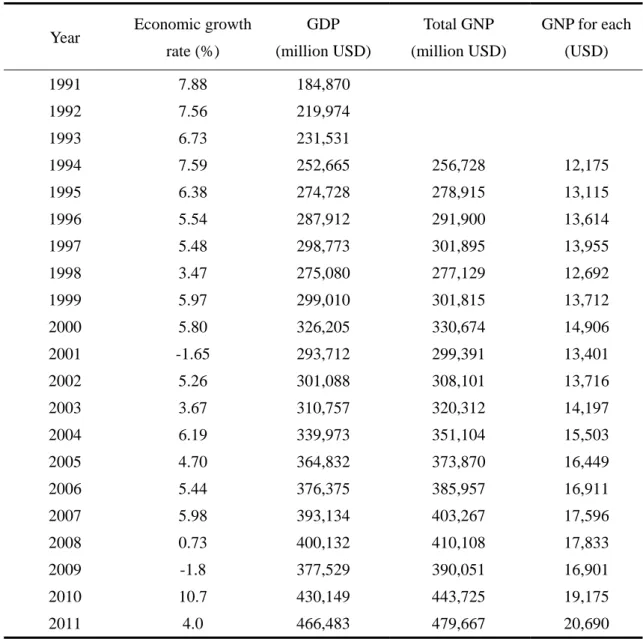
The economic take-off, reflected by the growth in GDP from 184,870 million USD in1991 to 466,483 million USD in 2011 (Table 2), and incomes all served to meet the needs necessary for basic living and consumption, and further enabled available capital to flow towards leisure expenditures.
TABLE 1 Change in Taiwan’s economic structure, 1993-2011
Year Employed (Ten thousand people)
1st industry (%) 2nd industry (%) 3rd industry (%) 1993 875 11.5 39.1 49.4 1994 894 10 39.2 49.9 1995 905 10.5 38.7 50.8 1996 907 10.1 37.5 52.4 1997 918 9.6 38.2 52.2 1998 929 8.9 37.9 53.2 1999 939 8.3 37.2 54.5 2000 949 7.8 37.2 55 2001 938 7.5 36 56.5 2002 947 7.4 35.3 57.3 2005 994 5.94 36.40 57.67 2006 1011 5.5 36.6 57.9 2007 1029 5.3 36.8 57.9 2008 1040 5.1 36.8 58 2009 1028 5.3 35.8 58.9 2010 1049 5.2 35.9 58.9 2011 1071 5.1 36.3 58.6
Data source: http://www.stat.gov.tw/ct.asp?xItem=11978&CtNode=493&mp=4, http://www.dgbas.gov.tw/ct.asp?xItem=30866&ctNode=3247&mp=1
TABLE 2 Taiwan’s economic growth rate and GDP, 1991-2011
Year Economic growth rate (%) GDP (million USD) Total GNP (million USD) GNP for each (USD) 1991 7.88 184,870 1992 7.56 219,974 1993 6.73 231,531 1994 7.59 252,665 256,728 12,175 1995 6.38 274,728 278,915 13,115 1996 5.54 287,912 291,900 13,614 1997 5.48 298,773 301,895 13,955 1998 3.47 275,080 277,129 12,692 1999 5.97 299,010 301,815 13,712 2000 5.80 326,205 330,674 14,906 2001 -1.65 293,712 299,391 13,401 2002 5.26 301,088 308,101 13,716 2003 3.67 310,757 320,312 14,197 2004 6.19 339,973 351,104 15,503 2005 4.70 364,832 373,870 16,449 2006 5.44 376,375 385,957 16,911 2007 5.98 393,134 403,267 17,596 2008 0.73 400,132 410,108 17,833 2009 -1.8 377,529 390,051 16,901 2010 10.7 430,149 443,725 19,175 2011 4.0 466,483 479,667 20,690 Updated: 10/16/2012
Data source: http://www.dgbas.gov.tw/ct.asp?xItem=28862&ctNode=3099&mp=1
Under pressure from international organizations to do so, the Legislative Yuan ratified the Labor Standards Law in 1974. Article 30 of the Law states that “a worker shall not regularly work in excess of 8 hours a day and 48 hours a week." That was the working hours established for laborers, while the government and its related agencies worked 5.5 days a week, namely, 44 hours for officials or white-collar workers. The work-hour system was therefore unequal between white-collar workers and laborers. Taiwan's economy kept growing from 1993 to 2000 (Table 2), but the laborers’ work hours did not change (Wang, 2000).
The welfare of Taiwanese laborers had been ignored for a long time, and the people had grown accustomed to the repressed political climate and dared not fight for leisure time by popular voice. However, economic growth had revealed their need for leisure. Even though leisure had not been recognized by institutions, nor was it endorsed because work was still the main consideration with regard to the distribution of time. However, in people’s practical social life, leisure time had taken on greater importance, especially in the middle class (Urry, 2002). The relationship between work and leisure had begun to restructure. The changing industry structures and urbanization along with the penetration of the Western life style all contributed to the emerging of the value of recreation in Taiwan.
Modern Taiwan experienced changes in its political environment and industrial structure as it moved from an agricultural society into an industrial and business society, resulting in changes in people's lifestyle, as well as trade-offs between the value of work and leisure.
THE CONFLICT OF WORKING HOURS IDEOLOGIES IN TAIWAN
The gradual opening up of the political climate
In the early 1980’s, members of the non-ruling political party were engaged in a democratic social movement calling for the KMT to lift martial law. Subsequently, a series of political reforms emerged that reshaped ideology and contributed to the vision of the social movement. Social power began to exert guidance on social progression. The social maladies caused by the correlation of politics and the economy in the past had resulted in an awareness of "anti-monopoly, anti-privilege, anti-speculation." In the meantime, social problems that had been hidden or ignored were now in the open, and the newly generated social power was demonstrated in waves of local protests and some organized social movements. The first major opposition party, the Democratic Progressive Party (DPP) was formally established in 1986, and it appealed for Taiwan's identity, the welfare of laborers, and entitlement for the underprivileged, marking the beginning of multiparty democracy in Taiwan.
Until 1987, Taiwan remained under martial law, during which over a forty-year period, opposition political parties were banned, publishing and the media were restricted, and relations with the mainland were forbidden. Martial law was lifted in 1987, and the bans on political parties and publishing were exempted over time. Therefore, the political ecology became more open, with all kinds of social movements rising. People could march on the street to appeal for their rights and privileges. People began to understand political participation was not the privilege and benefit of any specific class, and they began to appeal for their civil rights through legal channels or illegal approaches such as mass demonstrations. These types of appeals were a strong influencing factor on the shift in basic social structure and ways of accumulating and allocating social resources (Chuang, 2000; Chuang, 2001).
The debate and results of labor hours policy
Complying with economic development and globalization, workers having “two days off per week” became the inevitable tendency for Taiwanese workers (Cheng, 1996). In Asia, only Japan implemented “two-days off”, and its GDP was higher than that of Taiwan before 2000. (Hou, 2010). In order to avoid huge economic impacts, the Taiwanese government decided to implement the “two days off per week” in phases. In 1988, the first phase was implemented, which offered laborers "two days off biweekly," namely, every month there were two weeks with 2 days off, and 1.5 days off for the other weeks. This course of action endorsed the importance of leisure, and provided a sense of normalcy with regard to the idea of leisure time. However, withstanding opposition from capitalistic entities, this implementation was not suited for all businesses, and what resulted was a strange situation of "one nation with two systems,” meaning that officials and white-collars worked 40 hours each week, but laborers still had to work 48 hours each week before the year 2001 (Table 3). This also showed that laborers were still treated unequally.
Even though the Labor Standard Law was legislated in 1984, work hours for laborers were not reduced for almost another 30 years. Before the DPP won the presidential election, workers appealed for labor welfare and debated on behalf of better
work hours. In 2000, DPP presidential candidate Chen advocated a labor policy establishing a reduction in work hours to 44 hours a week, and abided by the reduction in 2002 when weekly work hours were reduced to 40 hours. However, the policy could not be implemented completely because of economic shrinkage and pressure from capitalists after the DPP won the election. The results of this election completed the first political party turnover in Taiwan’s history, ended the KMT’s one-party autocracy in Taiwan for more than fifty years, and instated Taiwan as a mature democracy. However after it became the ruling party, the DPP, which had always shown leftist tendencies, was forced to turn right because of economic factors. On the other hand, even though the KMT, which had ruled Taiwan for over half a century, lost the presidential election in 2000, it switched its platform to pursue labor welfare. Having the majority advantage in the Legislative Yuan, the KMT enforced the amendment to work hours in the Labor Law and pressed to amend the reduction of weekly work hours to 84 hours every two weeks, which was even lower than the standard appealed by the DPP for 44 hours each week.
Taiwan implemented the “2-days off a week” policy entirely in 2000, and work hours were reduced in 2001. The government pushed ahead with all kinds of cultural and leisure-related fundamental structural developments. What emerged was that leisure time became a human right in Taiwan both institutionally and in people's practical lives. The changes in the social structure resulted in a shift in social morals and values, from placing importance on work to achieving equilibrium between work and leisure. People paid more and more attention to leisure, both in terms of value and concept. Leisure behavior began receiving social and institutional recognition as well as economic support. The social time have redistributed by leisure time, it proclaims Taiwan’s mass leisure era is coming.
TABLE 3 The institutional change of work hours in Taiwan
1949 -1966 Official and public offices get “one day off per week” and “work 48 hours each week.”
1966 Official and public offices get “1.5 days off per week” and “work 44 hours each week.”
1984 The Labor standard Law was established. Article 30 states that “a worker shall not work in excess of 8 hours a day and 48 hours every week.”
1998 Official and public offices implement “2 days off per week” in phases. The first phase entitles “2 days off every 2 weeks,” but this implementation was not adopted by all businesses.
2000 Official and public offices get “2 days off per week,” but this was not adopted by all businesses.
2001 The Labor Standards Law was amended, which reduced laborer work hours to not exceed 8 hours each day, and 84 hours every two weeks.
(still ongoing at the time of this paper ) Data source: written by authors.
Along with the economic take-off and the gradual opening up of the political climate in Taiwan, laborers’ work and leisure rights became important social issues. Institutionalized labor hours became an important symbol marking social and human rights. The implementation of the “2-days off a week” policy further represented people’s reconsideration and specific requests towards the relationship between labor and leisure in Taiwanese society.
THE PARADOXICAL INTERACTION BETWEEN WORK
AND LEISURE
The redistribution of work and leisure time was the most disputed topic in 2000. Taiwan's GDP ranked third amongst the Four Little Dragons of Asia, but the first nation executed '2-days off a week.' The establishment of this policy then endowed partly institutional righteousness for leisure. The policy was implemented in phases, and businesses did not initially comply with the policy (Cheng, 1998). In order to avoid remonstrations from businesses and the creation of negative impacts on the economy, laborers still had to work 48 hours each week. The businesses influenced the policy
setting through their economic power, but the welfare of laborers welfare was ignored, and laborers were still treated unfairly in Taiwan. This state of affairs did not change until the 2000 presidential election. The work hours for laborers turned out to be the candidates' most important issue for debate since the majority of votes would come from the laborers. The Democratic Progressive Party (DPP), candidate Chen, proposed a labor policy for reducing weekly work hours to 44 hours in 2000, which would be later further reduced to 40 hours in 2002. When Chen finally won the election, he began to push these amendments to the Labor Standards Law. The ideal work week was 44 hours each week, but what emerged was a dramatic change in the law amendment process, and the work hours were reduced to 84 hours every two weeks due to Taiwan's particular political environment.
In fact it was the result of competition between political parties. It was done without concerns for benefits to the laborers themselves, but rather was only addressing the advantages of the political parties involved. This led to unhealthy interaction and competition between the political parties concerned. (Huang, 2006; Lee, 2011)
Before 2000, according to Chao (2000), amongst Asian countries, Japan had 40 working hours per week, Singapore had 42 hours, Korea had 44 hours, and Malaysia, Thailand, Hong Kong, and the Philippines each had 48 hours. Each country’s national holidays were added on to this basic standard.
While the new law was formally implemented, Taiwanese laborers’ work time was reduced to 245 work days in one year, which would be lower than Japan's 248 work days and any other Asian country (Table 4)(Chen, 2011).
This resulted in industry out-migration to other countries and increased the unemployment rate. Compared with Japan, where working hours were reduced in phases over ten years, and work hours were reduced every three years and were associated with a flexible work hour system completed in 1997 (Shiu & Song, 1989; Shiu, 1997; Kuroda, 2010), the process of Taiwan’s work hour reductions was sure to influence the enterprise-laborer relationship and labor laws in the future.
TABLE 4 Comparison of Asian Countries' GDP and Work Time
Nation or area GDP (USD) Work days in one year (Approximate)
Work hours every week (Hours)
Taiwan 13,248 245 day 42(84 hrs biweekly)
Japan 29,925 248 day 40 Singapore 28,502 278 day 42 Korea 8,581 297 day 44 Malaysia 3,208 290 day 48 Thailand 1,819 300 day 48 Hong-Kong 23,235 301 day 48 Philippine 907.99 301 day 48 Data source: Chao (2000: 39), rewritten by authors.
Paradoxically, after the amended law was completed in the legislature, President Chen considered the economic shrinkage during the next few years and the pressure from businesses. He then organized the Economic Development Advisory Conference (EDAC) for the purpose of advising him on national economic planning. Furthermore, he tried to reverse the new work hours by the conclusion of the EDAC. In the end, the DPP did not achieve its goal because of the KMT’s persistence and as a result of opposition from some labor groups. Since the DPP is a left-wing party, they appealed for laborer's rights. On the contrary, KMT is a conservative party. After the 2000 presidential election, DPP President Chen was expected to promote laborer privileges, but after he got into the saddle, he seemed to care more about the benefits to businesses than he did about the laborers, and moved along with the economic development to the right. By contrast, the KMT changed by ignoring the businesses’ resistance in regard to reducing laborer work hours. The work hour policy should have gone through the autonomy mechanism that was negotiated by both laborers and businesses (Kauo, 1996; Cheng, 1996; Owen, 1989; Huang, 2006 ). Instead, the labor issues turned into a social field for political competition (Liu, 2001; Shiao, 2011 ).
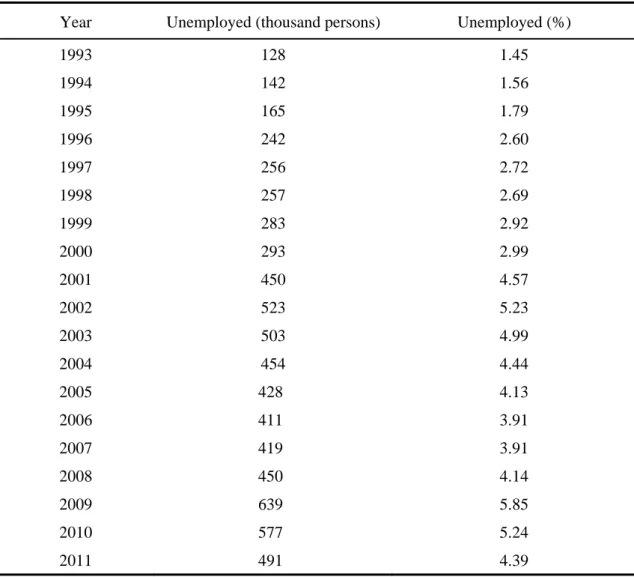
TABLE 5 Unemployment in Taiwan, 1993-2011
Year Unemployed (thousand persons) Unemployed (%)
1993 128 1.45 1994 142 1.56 1995 165 1.79 1996 242 2.60 1997 256 2.72 1998 257 2.69 1999 283 2.92 2000 293 2.99 2001 450 4.57 2002 523 5.23 2003 503 4.99 2004 454 4.44 2005 428 4.13 2006 411 3.91 2007 419 3.91 2008 450 4.14 2009 639 5.85 2010 577 5.24 2011 491 4.39
Data source: http://www.stat.gov.tw/ct.asp?xItem=17166&ctNode=517; rewritten by authors.
In addition to the political parties that were involved in this issue, the support for laborers was also different from the perspective of groups having different viewpoints from those of the laborers. One group supported reducing the work hours to 84 hours every two weeks, while another group was against this policy. The representatives supported the new policy because in the long term, laborers had been treated with injustice as compared with other working groups. Business owners even proposed that the proper time for reducing work hours and entirely implementing 2-days off per week should be considered only after the GDP had reached US$20,000. So in a sense, the new policy was just due in 2011. Those against the new policy took the viewpoint that under the economic influence of globalization, Taiwan’s traditional manufacturing industry was losing the advantage of low labor costs. Taiwan’s economic growth rate
fell from 7.59 in 1994 to -1.8 in 2009, while unemployment rate rose from 1.45% in 1993 to 5.85% in 2009 (Table 5). With this type of pressure, most laborers were forced to stay with their current jobs just to maintain a basic livelihood and were discouraged from trying to fight for lower work hours. They were concerned that if the new policy was to be implemented, then the cost to businesses would rapidly increase and force them out of their jobs, allowing foreign investors to enter the country and leading to a rise in the unemployment rate (Gorz, 1999), resulting in the laborers becoming the ultimate victims.
In most countries, the actual work hour of laborers is lower than the regulated hours. In Taiwan, the actual work hours are higher than those stipulated by regulations. This could be a phenomenon peculiar to Taiwan (Chu, 2000). In other developed countries, the laborers can typically march in the streets for their hard-won privileges, and so can Taiwan. The diversity in labor groups resulting from different viewpoints has also been revealed in the development of western countries (Sue, 1980).
With a capitalist ideology and a tendency toward globalization, the economy is treated as the most important concern in Taiwan. Labor groups did not get together to fight against the bourgeois as Marx had predicted. On the contrary, in accepting the capitalistic ideology, they gave up their rights to exchange living conditions and enhance economic development. They volunteered or were forced to be the element responsible for producing capitalism.
In the process of the alternation of political parties in Taiwan, labor hours on one hand were an issue by which to fight for labor leisure rights, and on the other hand they have also become a tool by which to obtain political support for a specific party. The discussion and reduction of labor hours wasn’t presented simply for the purpose of acquiring labor rights and labor interests in Taiwan, but rather it served political parties’ multi considerations and power struggles as well. However, for society as a whole, the reduction in labor hours specifically reflected people’s value shifts between labor and leisure.
CONCLUSIONS
The relationship between work and leisure in Taiwan has experienced a structural change. Pre-capitalized imperial Japan brought the agricultural production in Taiwan from being sustainable to a commodity-based industry before World War II. By the end of the war, Taiwan received US aid as well as the ideology of Capitalism. The value of work first has been reshaped in Taiwan under political considerations related to economic development. The status of work and leisure was significantly different during that period. Along with economic development and the development of social consciousness, the relationship of work and leisure has been restructured, and leisure has become more and more important. The fast development of the leisure industry has placed leisure into an important role in middle-class life in Taiwan. The importance of leisure time was institutionally recognized in 2000, and an era of mass-leisure is now emerging. The relationship between work and leisure in Taiwan, a new capitalistic society, is a result of interactions amongst political, economic and social powers. However, labor consciousness and leisure rights have never been sufficiently recognized in Taiwan. The relationship between work and leisure is constantly changing, and leisure rights will become more emphasized in the future in Taiwan. Also, leisure will become an agenda worthy of research, as to whether it should be treated as a basic human right or as a field for political competition.
REFERENCES
Butsch, R. 1990. For fun and profit: The transformation of leisure into consumption. Philadelphia: Temple University Press.
Calagione, J., Francis, D., & Nugent D. 1992. Workers’ expression. State University of New York Press.
Chao, C. S. 2000. International work hour system and business management. Journal of
Electrical Industry, 115: 32-39.
Cheng, J. J. 1996. The suggestion of Taiwan work hour system for international laborer organization contract. Journal of Capitalist-Laborer Relationship, 14(9): 519-526. Chen, Y. F. 2011. A brief discussion and comparision on working hours among
Taiwan and international. Quarterly Taiwan Labors, 26:74-81.
Cheng, Y. J. 1998. The change of living pattern and industry management after a week 2-days holiday. Chinese Laborer, 977: 6-9.
Cheng, Y. M. 2001. The formation and transformation of work value. Social Education
Dual-Journal, 104:15-21.
Chu, R. R. 2000. The comparison of work hour system in advanced countries. Journal
of Capitalist-Laborer Relationship, 19(3):134-148.
Chuang, S. T. 2000. The restructuring of rurality- analysis in sociological concept and action. Agricultural Extension Anthology, 45: 209-216.
Chuang, S. T. 2001. The typology of rural development in Taiwan. Unpublished doctoral dissertation, National Taiwan University, Taiwan.
Cross, G. S. 1990. A society history of leisure since 1600. College Park, PA: Venture Publishing .
Cuvillier, R. 1984. The reduction of working time. Geneva: International Labour Office. Deem, R. 1988. Work, unemployment and leisure. London: Routledge.
Glyptis, S. 1989. Leisure and unemployment. Milton Keynes, Philadelphia: Open University Press.
Gorz, A. 1999. Reclaiming work: Beyond the wage-based society. Cambridge, UK: Polity Press.
Hou, Y. H. 2010. The development and inspiration of determining working time and stand-by time in Japan, Taipei University Law Review, 75: 175-209.
Huang, K. M. 2006. Decision-making in the public sector: Taiwanese work-hours case study. The Chinese Public Administration Review, 15(4):81-118.
Iso-Ahola, S. E. 1997. A psychological analysis of leisure and health. In. J. T. Haworth (Ed.), Work, leisure and well-being. London: Routledge.
Iso-Ahola, S. E. & Park. C. J. 1996. Leisure-related social support and
self-determination as buffers of stress-illness relationship. Journal of Leisure
Jara-Diaz, S. R., Munizaga, M. A., Greeven, P., Guerra, R., & Axhausen, K. 2008. Estimating the value of leisure from a time allocation model. Transportation
Research Part B, 42: 946-957.
Kaou, L. H. 1996. The introduce of Germany work hour system and debate of Taiwan work hour system. Journal of Capitalist-Laborer Relationship, 14(9): 538-552. Kelly, J. R. & Godbey, G. 1992. Sociology of leisure. State College, PA: Venture
Publishing, Inc.
Kelly, J. R. & Freysinger, V. J. 2000. 21st century leisure: current issue. Boston: Allyn & Bacon.
Koo, A. Y. C. 1966. Economic consequences of land reform in Taiwan. Asian Survey, 6(3): 150-157.
Kuroda, S. 2010. Do Japanese work shorter hours than before? Measuring trends in market work and leisure using 1976–2006 Japanese time-use survey. Journal of
The Japanese and International Economies, 24: 481–502.
Lee. Y. C. 2011. Perspective of legal mechanism of working hours in Taiwan: View point of experience in Japan and South Korea. Shih Hsin Law Review, 4(2): 73-113.
Liu, M. C. 2001. Working time struggle: A critique from political economy. Bulletin of
Labour Research, 10: 23-54.
Mannell, R. C. & Kleiber, D. A. 1997. A social psychology of leisure. State College, PA: Venture Publishing.
Manrai, L. A. & Manran, A. K. 1995. Effects of cultural-context, gender, and
acculturation on perceptions of work verse social/leisure time usage. Journal of
business Research, 32: 115-128.
Marimon, R. & Zilibotti, F. 2000. Employment and distributional effects of restriction working time. European Economic Reviews, 44: 1291-1326.
Marx, K. 1887. "The working-day" from capital, volume one. In Robert G. Tucket (Ed.), The Marx-Engels reader (2nd ed.): 361-84. W.W. Norton & Gompany.
Owen, J. D. 1989. Reduced working hours: Cure for unemployment or economic burden? Baltimore and London: The John Hopkins University Press.
Parker, S. 1983. Leisure and work. London: George Allen & Unwin Ltd.
Shiao, Y. C. 2011. A brief history of the struggle for standard work hours legislation in Hong Kong. Hong Kong Journal of Social Science, 41: 17-39.
Shiu, M. Y. 1997. Japan's a week 2-days off institution experience for Taiwan. Journal
of Taiwan Economic Research, 20(22): 38-41.
Shiu, C. K. & Song, W. L. 1989. The factors analysis of Taiwan uprising social
movement. Taipei: Chu-liou Co. Ltd..
Urry, J. 2002. The tourists gaze. London: Sage Publications.
Veblen,T. 1899. The theory of the leisure class. Boston: Houghton Mifflin. Wang, I. C. 2000. The planning, prospect and impacts of 'a week 2-days holiday'
institution of official. Official Journal, 31(5): 52-55.
Biographical Sketch
Dr. Shu-Tzu Chuang is an assistant professor at the National University of Kaohsiung, Taiwan. Her research area is on the tourism impacts and ecotourism development on the Taiwan rural areas using the quantity and quality methods. The empirical cases that she has worked with included ecotourism constructed in Taiwan, the residents’ perspective of rural tourism and agri-tourism, the relationship of emotional labor and leisure coping strategy. In addition to empirical works, her research has involved with theoretical perspectives of the post-structuralism, the methodology of ecotourism research, and the characteristics of tourism industries. Dr. Chuang also received the best paper award in the Asia-Pacific Tourism Association 17th Annual Conference in 2011.
Dr. Ming-Jang Weng is an associate professor at the National University of Kaohsiung (NUK), Taiwan. Dr. Weng's research area is on the international finance, financial economics and exchange rate dynamics using data provided by IMF and other data banks. His empirical studies mainly concern interactions among financial markets in Asian countries and emerging countries against the US so as to design financial portfolio for global investment. He is also in charge of EMBA program as the chair at NUK currently.
Dr. Ya-Yen Sun is an assistant professor at the National Cheng Kung University, Taiwan. Her reach area is on the economic impact evaluation associated with tourism development using the Input-Output Model. The empirical cases that she has worked with included economic impact studies of US. National Park Service visitor consumption, Taiwan National Tourism Policy e Doubling Tourists Arrivals Plans, 2009 World Games, and Chinese visitors to Taiwan by cross-strait ferry services. In addition to empirical works, her research has involved with theoretical perspectives of the standard Input-Output model, the methodology of visitor expenditure studies, and the characteristics of tourism industries.