Transitions of domain ordering and domain size in a spherical-forming
polystyrene-block-poly(ethylene oxide) copolymer and its composites
with colloidal cadmium sulfide quantum dots
Ya-Sen Sun
a, U-Ser Jeng
a,*, Keng S. Liang
a, Siao-Wei Yeh
b, Kung-Hwa Wei
b aNational Synchrotron Radiation Research Center, 101 Hsin-Ann Road, Science Industrial Park, Hsinchu 30076, Taiwan, ROC b
Department of materials Science and Engineering, National Chiao Tung University, Hsinchu 30049, Taiwan, ROC
Received 10 June 2005; received in revised form 4 November 2005; accepted 11 December 2005
Abstract
With specific annealing schemes applied to a neat polystyrene-block-poly(ethylene oxide) (SE) and its composites with cadmium sulfide quantum dots (CdS QD), we have observed microdomain structures and phase transitions in the system using temperature-resolved small-angle X-ray scattering (SAXS) and transmission electron microscopy (TEM). Both TEM images and SAXS results show clearly that incorporation of surfactant-tethered CdS QD preferentially into PEO blocks leads to increases in thermal stabilities of both bcc-packed lattice (referred as long-range order) and microdomains themselves in the sphere-forming SE/CdS composites. The bcc-packed lattice in the SE/CdS composites sustains better than that in the neat SE, during a temperature elevation to w160 8C, at which the bcc-packed SE/CdS spheres start to transform into micelles with a short-range liquid-like order. Quantitative model analysis shows that the PEO/CdS micelles can retain their size in the SE/CdS composites up to 200 8C, whereas the PEO micelles shrink after the softening of the PS matrix around 100 8C, and disassociate largely into the PS matrix of the neat SE at 160 8C.
q2005 Elsevier Ltd. All rights reserved.
Keywords: Copolymer-nanoparticle composite; Microdomain; Phase transition
1. Introduction
Mixtures of solid nanoparticles and block copolymers have received considerable attention because the incorporation of nanoparticles into block copolymers produces novel and unique electronic, optical and magnetic properties [1–7]. Achieving such novel properties generally requires the fabrication of both nanoparticles and block copolymers in a nanometer scale. Copolymer–nanoparticle composites possess various complicated morphologies that offer diverse and versatile benefits, such as templates for lithography [8–10]
and fabrication of metallized nanowire/nanodots [11–13]. Nevertheless, the addition of nanoparticles into block copolymers entangles the ordering phase of the neat block copolymers, due to additional interactions between the particles and copolymers.
Effects of nanoparticles on the morphological structure of copolymer–nanoparticle composites have been widely explored [14–21]. Basing on theoretical models, Balazs and coworkers predicted that copolymer–nanoparticle composites possess rich morphologies [14–17]; they concluded that interactive particles added into block copolymers are not passive but can affect significantly the overall morphology of the composite in both the strong and intermediate segregation limits of the diblock melt [17]. Experimentally, Yeh et al. found that morphological modification was induced upon incorporation of surfactant-modified CdS, of a preferential binding to the minor PEO block, into a SE copolymer [18]. Many theoretical predictions and experimental observations for ordered morphologies of copolymer–nanoparticle compo-sites focus on the strong and intermediate segregation limits of the diblock melt[14–19]. Yet, much remains unknown about plausible transitions upon annealing copolymer–nanoparticle composites to high temperatures.
Very recently, we have reported phenomenologically the enhanced thermal stability of nanoparticle/copolymer compo-sites over the neat copolymer, due to the formation of PEO/CdS microdomains[21]. In this contribution, we focus on the form
www.elsevier.com/locate/polymer
0032-3861/$ - see front matter q 2005 Elsevier Ltd. All rights reserved. doi:10.1016/j.polymer.2005.12.055
* Corresponding author. Tel.: C886 3 578 0281x7108; fax: C886 3 578 3813.
factor evolution of the microdomains of PEO/CdS and PEO in the composites and neat copolymer, respectively, during a heating process from an ordered phase to a disordered structure. The evolutions of the form factor of the micro-domains and domain ordering are closely traced by tempera-ture-resolved SAXS measurements. With a model analysis that takes into account the polydispersity of the scattering form factor P(q) of the microdomains, we compare quantitatively the order–disorder transitional behaviors of the PEO/CdS and pure PEO microdomains during the heating process.
2. Experiments
2.1. Material and sample preparation
An asymmetric SE diblock copolymer with a molar-mass ratio 125 K/16.1 K was purchased from Polymersource Inc., with a volume fraction of the minor PEO block 0.11 ðfv
PEOZ 0:11Þ, and a polydispersity (PDI) 1.04. CdS quantum
dots (QD), characterized previously with a mean size of 3.8 nm and a polydispersity of w50%, were synthesized with mercaptoethanol as surfactant on reacting cadmium acetate dihydrate (Cd(Ac)2$2H2O), sodium sulfide (Na2S) and
mercaptoethanol (HSC2H4OH) in methanol, according to a
modification of the kinetics-trapping method [22,23]. After filtration, CdS QD were collected and then dissolved in N,N-dimethylformamide (DMF). The non-aggregate distribution of the CdS QD in both solutions and bulk samples were described in our previous papers[18,21].
CdS QD solutions of two concentrations, 1.8% v/v (CdS(1)) and 7.2% v/v (CdS(4)) with respect to the PEO block, were added, respectively, into the SE/DMF solutions under stirring. Two composites, designated as SE/CdS(1) and SE/CdS(4) depending on unsaturated and saturated CdS concentrations incorporated into SE copolymers, were cast from the DMF solutions. To avoid crystallization-induced metastable phases in the solution-cast SE and its composites, bulky specimens were cast from the DMF solutions and then annealed under DMF vapor at 60 8C for 12 h. After the development of thermal equilibrium with microphase-separated microdomains, residual solvent was further removed under vacuum at 60 8C for 1 week.
2.2. Apparatus
SAXS experiments were performed at the wiggler beamline BL17B1 at the National Synchrotron Radiation Research Center (NSRRC), Taiwan, with a monochrome beam of a wavelength of lZ1.6 A˚ . The distance from sample to detector was 975 mm and the beam stop was a molybdenum disk of a diameter 4 mm. SAXS data were collected using a one-dimensional position-sensitive detector, calibrated with a Fe55 source before the data collection. All the SAXS data were corrected, respectively, for sample transmission, background and detector sensitivity, and normalized to the absolute scattering scale I(q), namely, the differential scattering cross section ds/dU per unit sample volume. The absolute scattering
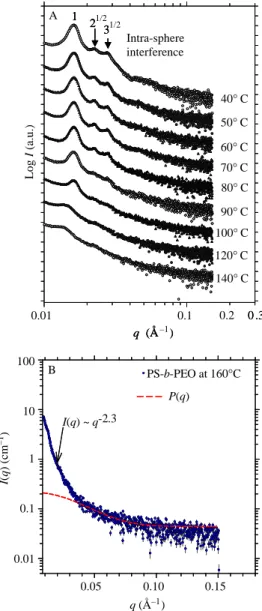
Fig. 1. SAXS data for the neat SE as cast from the DMF solution and the corresponding curve-fitted patterns for structure factor, S(q) and form factor, P(q). 0.01 0.1 40° C 60° C 80° C 100° C 140°C q (Å ) 50°C 70°C 90°C 120°C 2 3 1 Intra-sphere interference Log I (a.u.) A 0.2 0 .3 q (Å ) 21/231/2 1 0 .3 q (Å–1 2 3 1 1 PS-b-PEO at 160 o P(q) q (Å–1) P(q) PS-b-PEO at 160 oCPS-b-PEO at 160 o P(q) B 100 10 I( q ) (cm –1) 0.1 0.01 0.05 0.10 0.15 P(q) I(q) ~ q-2.3 PS-b-PEO at 160°C
Fig. 2. (A) Temperature-dependent SAXS profiles for the neat SE block copolymer subjected to heating in the temperature range 40–140 8C. (B) SAXS data (solid circles) and the corresponding curve-fitting pattern (short dotted curve) for the neat SE annealed at 160 8C.
intensity is critical in calculating the scattering invariant Qinv
for assessing quantitatively the degree of phase separation in the system[21]. The scattering wavevector transfer q is defined as qZ(4p/l)sin(q/2) in which q is the scattering angle. The specimens were placed in a sample cell sealed with two thin Kapton films, and heated to designated temperatures under a nitrogen environment for SAXS measurements. For each set of 10-min. SAXS data collection, 15 min. were awaited for thermal equilibrium after the sample reached the target temperature.
TEM experiments (Hitachi H-600) were performed with an accelerating voltage 120 kV. Thin slices were prepared using a microtome (Leica Ultracut Uct) on the diblock copolymer and composites. To increase the phase contrast of microdomains, we stained the neat SE diblock copolymer under RuO4vapor at
25 8C for 12 h. The stain was not necessary for the composites due to the high electron density of CdS QD. TEM images were taken for the as-cast SE/CdS composites and the composites annealed at 140 and 200 8C for 12 h, then followed by rapid quenching in liquid nitrogen.
3. Results and discussion
Fig. 1shows the SAXS pattern (open circles) for the as-cast SE copolymer measured at 30 8C, featuring with the relatively sharp diffraction peaks located at qZ0.0162, 0.0225 and 0.0280 A˚K1, respectively. These peaks with the q ratios of 1:21/2:31/2 are the characteristic diffractions of spherical domains, ordering with a body-cubic-center (bcc)-packed lattice. On the other hand, a broad scattering hump at q near 0.05 A˚K1reflects the form factor scattering of individual spherical domain[24]. Using a model of polydisperse spheres, with a mean radius of 10.4 nm and a polydispersity of 15% (dashed curve), we can reproduce the form factor scattering P(q) in the q region from intermediate to large q (Fig. 1), where the structure factor S(q) has a much less influence. The interference S(q) is, then, extracted from I(q)/P(q)[19,21]. An inter-domain spacing DZ47.6 nm can be estimated from the position of the principal peak, whereas the size of the long-range-order domain Lw350 nm can be extracted from the half-height-full-width 2s of the principal peak, using L fp/s.
For the as-cast SE copolymer, the impact of the crystal-lization of PEO blocks on the morphology of the SE copolymer is suppressed upon casting at 60 8C, a temperature above
the melting temperature of PEO (w45 8C). Thus, the morphology of spherical microdomains with the bcc-packed lattice in the neat SE is mainly driven by microphase separation. Note, with the intervening of the crystallization kinetics of PEO blocks upon casting the SE at 25 8C, a meta-stable phase of cylinder-like domains in a hexagonal array was obtained in our previous report[18].
Fig. 2shows the temperature-resolved SAXS profiles for the neat SE subjected to successive heating in a temperature range 40–140 8C. Before softening of the PS matrix (w98 8C), the structural factor S(q) maintains relatively stable in the temperatures of 40–80 8C. Nevertheless, the total scattering intensity decreases quickly as temperature increases and approaches the melting temperature of PEO (w45 8C), due to the smaller contrast between the PS matrix and the amorphous PEO domains. Starting from 90 8C, the PS matrix softens. The depressed and broadened ordering peaks indicate an occur-rence of lattice disordering. Upon heating to 120 and 140 8C, S(q) for the pure PEO domains is largely diminished, and the SAXS patterns show a nearly monotonic scattering with little discernible characteristics of diffraction peaks. Upon further heating the SE sample at 160 8C, a SAXS pattern shows a diffuse scattering with absence of characteristic diffraction
Table 1
Structural parameters for the SE, SE/CdS(1), and SE/CdS(4) samples
T (8C) d (nm) p D (nm) L (nm) Nor. Qinv SE 30 20.8 0.15 47.6 350 1 100 13.8 0.33 Lattice disorder 0.41 160 7.0 0.4 Melt/disorder micelles 0.4 SE/CdS(1) 30 21.4 0.15 67.0 224 1 200a 27.0 0.26 Disorder micelles 0.55 SE/CdS(4) 30 27.4 0.2 69.8 332 1 200a 28.0 0.26 Disorder micelles 1
The normalized Qinvis the normalized scattering power with respect to the Qinvvalue at 30 8C. a
The data of the composites at 200 8C are adopted from our previous study[21].
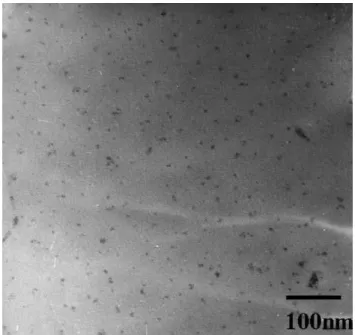
Fig. 3. TEM image of the SE block copolymer after isothermal annealing at 140 8C followed by rapid quenching in liquid nitrogen.
peaks, as shown inFig. 2(B), where the data in the q region from intermediate to high q can be fitted with a model of spherical domains of a mean radius of 3.5 nm and a polydispersity of 40%. On the other hand, the data in the low-q region can be characterized by I(q)–qK2.3, revealing a sign of thermal composition fluctuations. This result indicates that upon annealing at 160 8C the PEO micellar size becomes small. When the micellar size is smaller than a critical size for achieving stable microphase-separated domains, the PEO micelles dissociate largely into the PS matrix. Similar phenomena have been found in highly asymmetric poly-styrene-block-polyisoprene and polystyrene-block-polyiso-prene-block-polystyrene copolymers [25,26]. The structural parameters extracted for the PEO domains at each temperature using the same model stated previously are tabulated in
Table 1.
Fig. 3reveals a TEM image for a thin section of this neat SE sample after having been subjected to extended annealing at 140 8C for 12 h followed by rapid quenching in liquid nitrogen.
0 25 50 75 100 125 150 0.0 0.2 0.4 0.6 0.8 1.0 1.2 1.4 1.6 SAXS Qinv T (°C) Normalized Qinv , dnor & V bcc
Nor. ordered domain volumeVbcc
Nor. domain size dnor
Fig. 4. Normalized Qinv, dnor, and ordered phase volume Vbccas a function of temperature for the neat SE block copolymer.
0.01 0.1 40 C 60 C 80 C 100 C 120 C 140 C 160 C 180 C 200 C q (Å–1) 21/2 31/2 1 61/2 Intra-sphere interference Log I (a.u.) Log I (a.u.) 0.2 0.3 0.01 0.1 q (Å–1) 0.2 0.01 0.1 q (Å–1) 0.2 0.01 0.1 q (Å–1) 0.2 0.3 A B 40° C 60° C 80° C 100° C 120° C 140° C 160° C 180° C 200° C 40 C 60 C 80 C 100 C 120 C 140 C 160 C 180 C 200 C 40° C 60° C 80° C 100° C 120° C 140° C 160° C 180° C 200° C 21/2 31/2 1 61/2 Intra-sphere interference 21/2 31/2 61/2Intra-sphere interference 21/2 31/2 61/2Intra-sphere interference as-cast SE/CdS(1) S(q) P(q) 21/2 1 31/2 2 As-cast SE/CdS(1) P(q) 0.01 0.1 1 10 100 1000 as-cast SE/CdS(1) S(q) P(q) I( q ) (cm – 1) 0.01 0.1 1 10 100 1000 I( q ) (cm – 1) 21/2 1 31/2 2σ As-cast SE/CdS(1) P(q) as-cast SE/CdS(4) S(q) P(q) 21/2 1 31/2 2 As-cast SE/CdS(4) P(q) as-cast SE/CdS(4) S(q) P(q) 21/2 1 31/2 2σ As-cast SE/CdS(4) P(q) C D
Fig. 5. Temperature-dependent SAXS profiles for (A) SE/CdS(1) and (B) SE/CdS(4) composites. The curves in (C) and (D) show, respectively the SAXS data and the corresponding simulations for the as-cast composites.
The TEM image clearly shows small micelles (w8 nm in diameter) randomly dispersed in the PS matrix.
For clearly identifying the morphological change as a function of annealing temperature, the temperature dependence of the normalized invariant Qinv(T)/Qinv(T0) and volume
Vbcc(T)/Vbcc(T0) of the long-range-order domains are shown
inFig. 4, where T0is a reference temperature. Here we use Qinv
(30 8C) and Vbcc (30 8C) for the as-cast SE at 30 8C as the
reference quantities. From 30 to 80 8C, Vbcc persists well,
indicating that the bcc-packed order maintains well in the solid PS matrix. On the other hand, the w65% drop in Qinvin this
temperature range can be quantitatively explained by the reduced electron contrast due to the smaller density differences between PEO and PS blocks for the SE at 80 8C[27]. In the temperature range 80–100 8C (approaching the glass-transition temperature ðTgPSÞ of the PS matrix and order–disorder
transition temperature (TODT) of the neat SE), Vbccdepresses
significantly as the bcc-packed spheres gradually transform into disorder micelles with a short-range liquid-like order. At temperatures above 120 8C, the disorder micelles become less stable with rising temperature and successively dissociate to homogeneous melt with thermal fluctuations, leading to a vanishing Vbcc value. Nevertheless, these residual PEO
micelles together with the density fluctuations of the neat SE contribute to the Qinvvalues measured above 120 8C, as shown
inFig. 4.
Fig. 5presents temperature-resolved SAXS profiles for (A) SE/CdS(1) and (B) SE/CdS(4) composites subjected to a series of temperature increase in steps of 20 8C from 40 to 200 8C. For both the as-cast SE/CdS composites, SAXS profiles show several broad diffraction features, which are characteristics of bcc-packed spheres, as illustrated inFig. 5(C) and (D). Using the same model of polydisperse spheres as that for the neat SE, structural parameters for the two as-cast composites, such as PEO/CdS domains size d, polydispersity p, domain spacing D, order length L and normalized Qinv, are extracted and tabulated
inTable 1.
Upon increase of temperature from 40 to 140 8C, these diffraction peaks retain the same positions and intensities. For the SE/CdS composites annealed at 160 8C, the intensity of the principal peak was depressed, accompanied by disappearance of the higher-order diffracted peaks. This SAXS result indicates that the long-range order was destroyed upon heating the SE composites at temperatures between 140 and 160 8C. However, disordered micelles exist in these SE/CdS compo-sites, as a trace of a transformation from ordered bcc-packed spheres into disordered micelles. At 180–200 8C, the SAXS curves reveal the depressed intensities of the principal peaks, indicative of disordered micelles in SE/CdS composites.
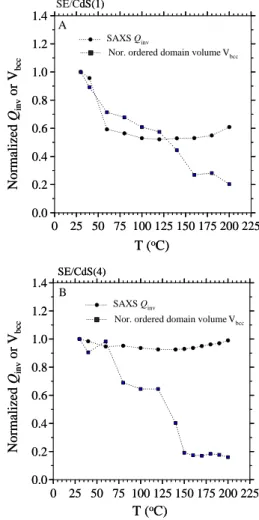
Fig. 6(A)and (B) shows the temperature dependence of normalized Qinv and normalized volume (Vbcc) of the
long-range-order domains for the SE/CdS(1) and SE/CdS(4) composites. For both SE/CdS composites, a discontinuous change of the Vbcc can be observed when the ordered
bcc-packed spheres transform into disordered micelles. Further-more, Qinvchanges slightly or remains nearly constant for the
SE/CdS composites annealed at temperatures ranging from 60
to 200 8C. Presumably, due to the incorporation of the CdS QD within PEO blocks, the PEO chains have to stretch to get around the dispersed nanoparticles and thus are stiffened with a reduced molecular mobility owing to the binding to the nanoparticles. Nevertheless, there is a 40% drop in Qinvfor the
SE/CdS(1) composite in the temperature range of 30–60 8C. Since the PEO chains are not saturated with CdS QD (1.8% v/v CdS nanoparticles in the PEO domains) in the SE/CdS(1) composite, the PEO domains may crystallize when the temperatures are below the melting of the PEO crystallites
[18,21]. The 40% drop in Qinv for the SE/CdS(1) composite
annealed in the temperature range can be explained by the reduced electron contrast due to the smaller density differences between CdS/PEO and PS blocks in the absence of the PEO crystallites. In fact, if the PEO blocks are saturated with CdS QD (for example, 7.2% v/v CdS nanoparticles in the case of SE/CdS(4)[21]), the crystallization of the PEO blocks can be completely inhibited. The SE/CdS(4) composite did not crystallize even after storage at the lowest annealed tempera-ture of K20 8C [18]. As the PEO chains in the SE/CdS composites are comparatively less flexible (more sluggish) than those in the neat SE, the electron contrast between the PEO/CdS spheres and the PS matrix can be relatively insensitive to temperature changes. In contrast, the PEO
0 25 50 75 100 125 150 175 200 225 0.0 0.2 0.4 0.6 0.8 1.0 1.2 1.4 SAXS Qinv
Nor. ordered domain volume (A) T (oC) Vbcc SE/CdS(1) 0 25 50 75 100 125 150 175 200 225 0.0 0.2 0.4 0.6 0.8 1.0 1.2 1.4 SAXS Qinv
Nor. ordered domain volume A T (oC) Vbcc dS(1) 0 25 50 75 100 125 150 175 200 225 0.0 0.2 0.4 0.6 0.8 1.0 1.2 1.4 SAXS Qinv
Nor. ordered domain volume (B) T (oC) Vbcc SE/CdS(4) N o rm alize d Qin v or V bc c 0 25 50 75 100 125 150 175 200 225 0.0 0.2 0.4 0.6 0.8 1.0 1.2 1.4 SAXS Qinv
Nor. ordered domain volume B T (oC) Vbcc SE/CdS(4) N o rm alize d Qin v or V bc c N o rm alize d Qin v or V bc c N o rm alize d Qin v or V bc c
Fig. 6. Normalized Qinv and ordered phase volume Vbcc as a function of temperature for (A) SE/CdS(1) and (B) SE/CdS(4) composites.
spherical domains in the neat SE start to dissociate after softening of the PS matrix at temperatures higher than TgPSand
TODT(Table 1), where TODTis close to TgPSin the case of no
CdS QD particles in the SE[21].
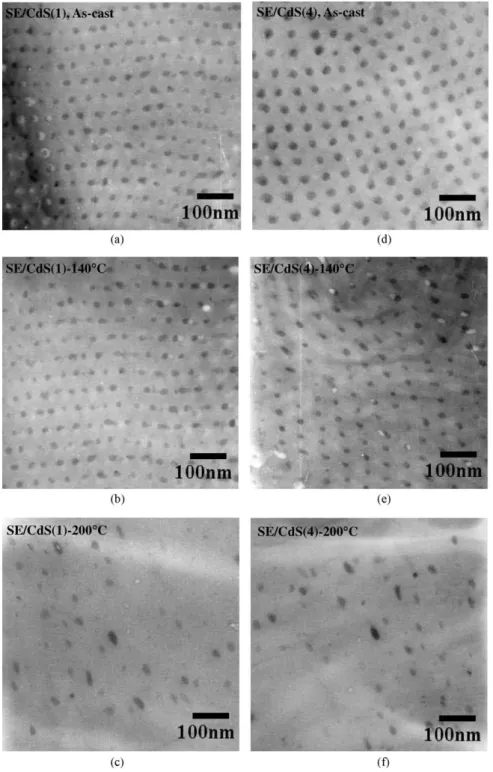
To provide further evidence, we have employed TEM characterization to investigate the morphological evolution of the SE/CdS composites subjected to several thermal treatments. Fig. 7 presents TEM images for SE/CdS(1) and SE/CdS(4) composites. After scrutiny of these TEM images, we describe pertinent phenomena as follows. Through incorporation of surfactant-modified CdS QD into PEO blocks,
the PEO block selectively stained with CdS QD appears dark, whereas PS appears white. Before further annealing, both as-cast SE/CdS(1) (Fig. 7(a)) and SE/CdS(4) (Fig. 7(d)) compo-sites reveal bcc-packed PEO/CdS spheres in the PS matrix. At 140 8C certain spherical domains deform slightly although the bcc-packed lattice of these spheres persists largely (Fig. 7(b) and (e)). At 200 8C, disordered spheres (micelles) with a short-range liquid-like order can be observed (Fig. 7(c) and (f)).
With the SAXS evidence combined with TEM observation, we proceed to interpret the experimentally observed increase of thermal stability of bcc-packed spheres for SE composites
Fig. 7. TEM images of (a) SE/CdS(1) and (d) SE/CdS(4) composites taken at the as-cast form and after annealed at (b) and (e)140 and (c) and (f) 200 8C for 12 h. Image (d) is adopted from our previous paper[18].
incorporating CdS QD in various proportions. The reason is that hydrogen bonding, between hydroxyl groups of the surfactant attached on CdS QD and ethylene oxide in the PEO domain, increases the repulsive segment–segment interaction between PS and PEO. The repulsive interaction plays a crucial role in order–disorder phase transition[28,29]. It has been proposed that the order–disorder transition temperature of microdomain structures is inversely related to this segment–segment interaction [30,31]. Thus, the order-disorder phase transition for SE/CdS composites is expected to occur at a temperature higher than that for neat SE. Furthermore, after transformation from bcc-packed spheres to disordered ones, the binding of the surfactant on the surface of CdS QD may preserve the disordered micelles of PEO/CdS from micelle dissociation into the PS matrix[21].
In summary, we have shown that the surfactant-modified CdS QD can be used to finely manipulate the thermal stability and domain sizes of microphase-separated microdomains in a diblock copolymer. In light of the spin-coated diblock copolymer–nanoparticle thin films with well-ordered micro-domains being used as templates [32–34], the effective nanoparticles’ binding can be extended to raise the service temperature for diblock copolymer lithography processes and control the density of periodical domains within self-assembled copolymer-based templates.
4. Conclusion
The bcc-packed PEO spheres in the neat SE block copolymer possess a relatively vulnerable thermal stability. At temperatures above 100 8C, the bcc-packed lattice of the SE is largely destroyed. And the spherical PEO domains, lacking the support from the PS matrix, disassociate gradually and transform into disorder melt largely with residual micelles of smaller size. In contrast, the incorporation of CdS QD into PEO blocks results in the same bcc-packed spherical microdomains as the neat SE, but with a greater thermal stability in the SE/CdS composites. The bcc-packed lattice of the SE/CdS composites survives up to w160 8C. After the loss of the bcc-packed lattice, the PEO/CdS micellar domains, however, maintain their size up to the highest temperature 200 8C studied.
Acknowledgements
We thank Dr Chia-Hung Hsu, Dr Hsin-Yi Lee and Mr Chih-Mou Huang for assistance with SAXS set-up and assembly at wiggler beamline BL17B1.
References
[1] Fo¨rster S, Antonietti M. Adv Mater 1998;10:195.
[2] Simon PFW, Ulrich R, Spiess HW, Wiesner U. Chem Mater 2001;13: 3464.
[3] Lopes WA, Jaeger HM. Nature 2001;414:735.
[4] Fogg DE, Radzilowski LH, Blanski R, Schrock RR, Thomas EL. Macromolecules 1997;30:417.
[5] Bockstaller M, Kolb R, Thomas EL. Adv Mater 2001;13:1783. [6] Fink Y, Urbas AM, Bawendi MG, Joannopoulos JD, Thomas EL.
J Lightwave Tech 1999;17:1963.
[7] Thurn-Albrecht T, Schotter J, Ka¨stle GA, Emley N, Shibauchi T, Krusin-Elbaum L, et al. Science 2000;290:2126.
[8] Park M, Harrison C, Chaikin PM, Register RA, Adamson DH. Science 1997;276:1401.
[9] Park M, Chaikin PM, Register RA, Adamson D. Appl Phys Lett 2001; 79:257.
[10] Cheng JY, Ross CA, Chan VZH, Thomas EL, Lammertink RGH, Vancso GJ. Adv Mater 2001;13:1174.
[11] Fahmi AW, Braun HG, Stamm M. Adv Mater 2003;15:1201.
[12] Haupt M, Miller S, Glass R, Arnold M, Sauer R, Thonke K, et al. Adv Mater 2003;15:829.
[13] Kim HC, Jia X, Stafford CM, Kim DH, McCarthy TJ, Tuominen M, et al. Adv Mater 2001;13:795.
[14] Huh J, Ginzburg VV, Balazs AC. Macromolecules 2000;33:8085. [15] Thompson RB, Ginzburg VV, Matsen MW, Balazs AC. Science 2001;
292:2469.
[16] Thompson RB, Ginzburg VV, Matsen MW, Balazs AC. Macromolecules 2002;35:1060.
[17] Lee JY, Thompson RB, Jasnow D, Balazs AC. Macromolecules 2002; 35:4855.
[18] Yeh SW, Wei KH, Sun YS, Jeng U, Liang KS. Macromolecules 2003; 36:7903.
[19] Yeh SW, Wei KH, Sun YS, Jeng U, Liang KS. Macromolecules 2005; 38:6559.
[20] Sohn BH, Choi JM, Yoo II S, Yun SH, Zin WC, Jung JC, et al. J Am Chem Soc 2003;125:6368.
[21] Jeng U, Sun YS, Lee HY, Hsu CH, Liang KS, Yeh SW, et al. Macromolecules 2004;37:4617.
[22] Herron N, Wang Y, Eckert H. J Am Chem Soc 1990;112:1322. [23] Veinot JGC, Ginzburg M, Pietro WJ. Chem Mater 1997;9:2117. [24] Sakamoto N, Hashimoto T. Macromolecules 1998;31:8493.
[25] Han CD, Vaidya NY, Kim D, Shin G, Yamaguchi D, Hashimoto T. Macromolecules 2000;33:3767.
[26] Choi S, Vaidya NY, Han CD, Sota N, Hashimoto T. Macromolecules 2003;36:7707.
[27] Zhu L, Cheng SZD, Calhoun BH, Ge Q, Quirk RP, Thomas EL, et al. Polymer 2001;42:5829.
[28] Lee KM, Han CD. Macromolecules 2003;36:804.
[29] Epps III TH, Bailey TS, Pham HD, Bates FS. Chem Mater 2002;4:1706. [30] Leibler L. Macromolecules 1980;13:1602.
[31] Hamley IW. The physics of block copolymer. New York: Oxford University Press; 1998 [chapter 2].
[32] Lin Y, Bo¨ker A, He J, Sill K, Xiang H, Abetz C, et al. Nature 2005; 434:55.
[33] Yeh SW, Chang YT, Chou CH, Wei KH. Macromol Rapid Commun 2004;25:1679.