國
立
交
通
大
學
資訊科學與工程研究所
博
士
論
文
使用資訊科技方法研究虛擬世界 –
探勘多人線上遊戲中的玩家活動資訊
Using an Information Technology Approach to Investigate Virtual Worlds:
Mining Demographic Data in MMOGS
研 究 生:謝吉隆
指導教授:孫春在 教授
使用資訊科技方法研究虛擬世界–
探勘多人線上遊戲中的玩家活動資訊
Using an Information Technology Approach to Investigate Virtual Worlds:
Mining Demographic Data in MMOGS
研 究 生:謝吉隆 Student:Ji-Lung Hsieh
指導教授:孫春在 Advisor:Chuen-Tsai Sun
國 立 交 通 大 學
資 訊 科 學 與 工 程 研 究 所
博 士 論 文
A DissertationSubmitted to Department of Computer Science College of Computer Science
National Chiao Tung University in partial Fulfillment of the Requirements
for the Degree of Doctor of Philosophy
in
Computer Science
June 2008
使用資訊科技方法研究虛擬世界–
探勘多人線上遊戲中的玩家活動資訊
學生 : 謝吉隆 指導教授 : 孫春在 國立交通大學資訊科學與工程研究所博士班 [email protected]摘要
本論文的主旨在於提出一套資訊科技的方法,以觀察並分析虛擬世界(線上遊戲) 中玩家所產生出來的社會、群體與個人行為。虛擬世界是相對於實體世界而言,通常是 指電腦中介或網路中介的環境,也因其環境的關係,使得想觀察在虛擬世界中使用者活 動的研究者難以在其中進行研究。隨著個人電腦的普及、網路的發展與便利、以及線上 遊戲的盛行,線上遊戲世界幾乎成了虛擬世界的代名詞。在一開始,線上遊戲沈迷甚至 被認為是青少年在教育上與行為偏差上的重要因素;然而,隨著線上遊戲內容的發展, 國內外學者或遊戲開發者均意識到線上遊戲內容包含了人際交往、交易、合作、組織、 學習等可能性,因此線上遊戲成為除了家庭與工作場所外最重要的第三場所(The Third Space)[1]。然而,由於線上遊戲世界為網路與電腦中介的環境,並且使用者是透過自 己所創立角色,在一個遊戲公司所設計的遊戲主題下與其他使用者進行互動。因此,過 去的「線下」(或者說「遊戲外」)的研究方法,例如質化的訪談或量化的問卷法,難以 觀察並分析這些玩家在遊戲中的行為動態。而本論文的主要目的,則是利用現在線上服務的 Web 2.0 趨勢,以資訊科學資訊擷取的取徑,直接取得玩家在線上遊戲世界的活動,
以克服在虛擬世界的環境下進行研究的困難。
Web 2.0 其中一個主要的現象為服務提供者除了在提供服務本身之外,尚提供一套
程式語言,讓電腦終端的使用者能自行開發片段程式以取得服務的內容,或依照使用者
自己本身的喜好來寫作、修改、下載、掛載其所需的插件。這些特色可以從以下目前在
網路上十分流行的 Web 2.0 服務中發現,例如 igoogle, Firefox Extention, 與 Yahoo!
Widget 等。這些現象符合了 Web 2.0 創建與分享的特徵。而在數位遊戲的開發上也有如
此的特徵,例如世記帝國(Age of Empires)與魔獸爭霸三(Warcraft III)等區域網路連
線性質的即時戰略遊戲均提供地圖編輯器給使用者自行設計地圖並與其他使用者分
享;而線上遊戲第二人生(Second Life)則自行開發一套腳本語言(Script Language)
提供使用者設計虛擬環境中的場景、建築、物品、和角色的衣著與動作;線上遊戲魔獸
世界(World of Warcraft)也允許使用者修改、寫作與載入遊戲的使用者操控介面。
以魔獸世界的使用者自製介面來說,其功能不僅能夠改變玩家操控介面的外觀,尚
能夠和 Web 2.0 服務的特徵一樣,透過服務提供者所開放的應用程式介面(Application
Programming Interface: API)來擷取在服務背後使用者在線上所產生的活動紀錄。而本
論文則利用這樣的特色來長期不間斷地紀錄玩家在線上遊戲中的活動以觀察玩家在遊
戲中的互動、成長與動態。和過去遊戲外或線下的方法比較上,以資訊方法進行玩家的
線上環境而難以研究的議題,例如玩家的分工、合作與溝通、玩家在遊戲內經驗的成長、 線上遊戲中組織的成長與消退、玩家參與遊戲內玩家自組組織的趨勢與行為、乃至於大 範圍跨文化的比較(例如在本論文中會提到的台灣與美國的玩家動機行為推論比較) 等。以線上遊戲資料擷取為方法,本論文內容包含了博士生涯的數項成果,主要為 1) 和 過去在社會學的組織區位學的研究成果相較下,以資訊蒐集進行量化研究更能夠掌握到 在遊戲中的組織變化與動態;2) 遊戲中的玩家會因為遊戲內容的影響與來自其他玩家 的壓力而決定加入或離開遊戲內的組織;3) 和台灣的玩家相較之下,美國的玩家更重 視在線上遊戲中與人互動的娛樂性。 關鍵字:人工智慧、資料探勘、線上遊戲、虛擬世界、數位遊戲、虛擬社群、虛擬組織
U
SING ANI
NFORMATIONT
ECHNOLOGYA
PPROACH TOI
NVESTIGATEV
IRTUALW
ORLDS:
M
ININGD
EMOGRAPHICD
ATA INMMOG
SStudent : Ji-Lung Hsieh Advisor : Chuen-Tsai Sun Department of Computer Science
National Chiao Tung University [email protected]
Abstract
A growing number of researchers are looking into ways that online virtual and game
environments are affecting human activities, including communication, interpersonal
relationships, and community interactions. Whereas the first game researchers focused on the
potential for virtual world “addictions,” they are currently accepting the premise that virtual
space and online games are evolving into a collective “third space” in competition with family,
work, and school [1]. However, those researchers must deal with significant barriers based on
the nature of network environments, online games, and cyberspace. For example, the large
majority of users interact via their avatars and from divergent computer terminals, therefore
dynamic online and in-game behaviors are difficult to observe and analyze by conventional
off-game approaches (e.g., surveys or interviews) [2]. This dissertation will describe a method
As network services have evolved over the past two decades, a growing number of service
providers have started using easy-to-understand programming languages such as markup
language XML and script language Lua, and are now providing application programming
interfaces (APIs) to give users the power to refine and develop their own user interfaces (UIs).
These user-designed UIs are often executed as add-ons or plug-ins attached to main
applications. Examples include the Mac OS Dashboard, Yahoo! Widget, and Google Desktop
Sidebar. This flexible feature has also been adopted by the designers of World of Warcraft
(WoW), currently the world’s most popular Massive Multi-player Online Game (MMOG).
WoW players can design or modify their own UI add-ons to supplement in-game controls,
create guides and maps for solving missions, and collect in-game information on other players
or game environments. The third use will be the focus of this dissertation—specifically, taking
advantage of the UI feature to collect analyzable data on human behaviors in virtual space. The
resulting data can be used to perform quantitative longitudinal analyses, as opposed to
restricted qualitative analyses of data gathered via interviews and surveys aimed at specific
groups. In this dissertation I will highlight the advantages of the personalized UI feature for
investigating virtual worlds and give three examples of potential investigative uses: how
in-game communities grow and decline, how players join and leave guilds, and how Taiwanese
and American gaming cultures differ. As background I will discuss the characteristics of Web
between content providers and users as well as between game designers and players. My results
indicate that (a) compared with conventional research on organization ecology, the proposed
method is capable of capturing in-game guild evolution dynamics; (b) players usually leave
guilds or quit group play due to group mission pressure; and (c) compared with Taiwanese
players, American players put more emphasis on recreation.
Keywords: Artificial Intelligence, Data Mining, Massively Multiplayer Online
Acknowledgement
“Wow!” With the support from so many beloved people around me, my doctor
dissertation was finally born! Firstly, I would like to express my most sincere gratitude to Prof.
Chuen-Tsai Sun, my respectable advisor. He always respects my research interests and
provides possible directions for me while I am wandering. He provided me a lot of opportunity
to travel around the world for publishing my paper, shared many life experiences with me
beside my research, and trained me to know how to be a good teacher and leader.
I would also like to thank my friends in my Learning Sciences and Technology laboratory.
Chung-Yuan Huang always unselfishly provided his help and encourages me to do research
and publish my idea. Chia-Yin Cheng always helped me overcoming any problems as possible
as his can when I stayed in our laboratory. Finally, I would like to thank my parent, Lien-Fen
Kang and Chuen-Zong Hsieh, for your love and encouragement, I can express only an
inadequate acknowledgement of my appreciation. I dedicate this dissertation to you. And,
Jen-Yi, my sweetheart, I thank that you always accompanies with me, supports and warms
INDEX
摘要 ... III ABSTRACT ... VI ACKNOWLEDGEMENT ... IX INDEX ... X FIGURES ... XII TABLES ... XIV 1. INTRODUCTION ... - 1 -1.1. MASSIVE MULTIPLAYER ONLINE GAMES—VIRTUAL WORLDS ... -1-
1.2. APPROACHES TO INVESTIGATING VIRTUAL WORLDS ... -6-
2. BACKGROUND ... - 9 -
2.1. PLAYER ... -9-
2.1.1. Player modeling ... - 9 -
2.1.2. Power Leveling ... - 10 -
2.2. MMOGCOMMUNITIES ... -11-
2.2.1. Informal and Formal Groups ... - 14 -
2.2.2. Game Element for Forming Groups—Guild ... - 16 -
2.2.3. Game Content for Promoting Group Play—Raiding Missions ... - 20 -
2.3. WOW(WORLD OF WARCRAFT) AND CLIENT-DESIGNED USER INTERFACE ... -22-
2.3.1. WoW Success ... - 22 -
2.3.2. WoW Game World ... - 23 -
3. ENVIRONMENTS AND APPROACHES ... - 25 -
3.1. NEW TRENDS FOR PEER DESIGNERS TO INVESTIGATE DIGITAL WORLDS ... -25-
3.1.1. Open-Data Trends ... - 25 -
3.1.2. Client-designed User Interface ... - 27 -
3.2. WEB 2.0TRENDS IN GAME COMMUNITY ... -30-
3.3. INVESTIGATING WOWUSING THE CLIENT-DESIGNED UIFEATURE ... -33-
4. RESULTS ... - 36 -
4.1. DATA COVERAGE ... -36-
4.2. DYNAMICS AND EVOLUTION OF MMOGGUILDS AND OTHER ORGANIZATIONS ... -38-
4.2.1. Introduction ... - 38 -
4.3. DYNAMICS OF PLAYER LEAVING AND JOINING GUILDS ... -47-
4.3.1. Experiment and Results ... - 48 -
4.4. COMPARING PLAYER BEHAVIORS IN DIFFERENT CULTURES ... -52-
4.4.1. Introduction ... - 53 -
4.4.2. Experiment and Results ... - 57 -
4.4.3. Level Upgrading Efficiency ... - 60 -
4.4.4. Faithful Participation in Guild Missions ... - 62 -
5. PC GAME EXPERIENCE: EVALUATING PLAYER EXPERIENCE IN STARCRAFT BY REPLAY ANALYSIS ... - 65 -
5.1. INTRODUCTION ... -65-
5.2. REPLAY ANALYSIS ... -70-
5.3. LEARNING PLAYER STRATEGIES BY CASE-BASED REASONING ... -73-
5.3.1. Results – Calculating the percentage of strategies accurately predicted by the trained decision system - 79 - 6. CONCLUSION AND DISCUSSION ... - 82 -
7. RELATED PUBLICATION LIST ... - 86 -
FIGURES
Figure 1. Second Life screenshots. All objects are user-created. Two buildings at the top of the screenshot are embassies, one for the Maldives and one for Sweden. Avatars in central section are involved in an online meeting. Second Life players have the power to design game actions, including sexual behavior. ... - 3 - Figure 2. World of Warcraft Screenshot. Similar to most other MMOGs, WoW avatars use weapons to win experience points and to earn gold. ... - 4 - Figure 3. Relationships and interactions among service providers, web services (virtual worlds or MMOGs), and researchers. ... - 27 - Figure 4. Yahoo! Widgets. Users can design their own add-ons or insert add-ons made by third-party service providers and designers. ... - 29 - Figure 5. iGoogle. Users have the power to add gadgets to the iGoogle panel. Since it is a webpage, it requires a browser. ... - 29 - Figure 6. An original player-controlled UI provided by WoW. ... - 30 - Figure 7. Modified UI created by third-party source. Client-designed UIs can be found and downloaded from player-sharing community websites. ... - 30 - Figure 8. Screenshots of Warcraft III mods including two types of gameplay: tower defense and two-team combat. ... - 31 - Figure 9. Screenshot of a WoW player-designed UI called AltasLoot, which provides
probability of loot dropping. ... - 32 - Figure 10. Structure and hierarchy comparisons between physical and virtual worlds. ... - 35 - Figure 11. Avatar level distribution for World of Warcraft in Taiwan. Data were collected on 02/10/2006 for 641,805 avatars on 60 servers. More than half of all avatars between levels 16 and 20 were guild members. ... - 41 - Figure 12. Differences between new and mature servers. A mix of growth and decline is noted in 2b. ... - 42 - Figure 13. Guild scale transformation. Array thickness represents transformation probability potential. Data were collected four times per day on average between February and April, 2006 from an average of 40 PvE and 20 PvP servers. ... - 43 - Figure 14. Life cycles for six basic guild types. ... - 45 - Figure 15. Guild life cycle after Blizzard Entertainment launched its official expansion pack in Taiwan (September-December, 2007). ... - 47 - Figure 16. Player changing guild behaviors. The thickness of arrow stands for amount of players changing behaviors. ... - 51 - Figure 17. Dynamics of player staying at original guild and following with their guild growth. ... - 51 -
Figure 18. Dynamics of player leaving and joining guilds. ... - 52 - Figure 19. Data collecting on avatars who leave original guilds but don’t join other guilds. ... - 52 -
Figure 20. Average playing time for players on the Taiwanese and American WoW servers used in the study. ... - 58 - Figure 21. Size distributions of the Taiwanese and American guilds used in the study. .... - 59 - Figure 22. Distribution of level upgrading efficiency for players on both servers. Only avatars with levels 11 or higher were considered. ... - 62 - Figure 23. Average weekly raiding time distribution for guilds on both WoW servers (single avatar guilds deleted). ... - 64 - Figure 24. Example of possible building sequence in StarCraft. ... - 74 - Figure 25. Building sequence representing 100 combat incidents between a “Terran” species player and a “Zerg” species player. Link thickness indicates number of times the same
strategy was used. Node ID number indicates building status. ... - 80 - Figure 26. Predictive accuracy of the first 100 rounds for player using Terran, Zerg, and
Protoss species. After 20 rounds of training, predictive accuracy was generally higher than 50
percent. Graph indicates large variation in predictive accuracy for player using Zerg species due to large variation in player strategies. ... - 82 -
TABLES
Table 1. Categories of WoW communities according to definitions from Bartle (2003) and Taylor (2006). ... - 16 - Table 2. Example of WoW avatar behavior data collected using the game’s player-designed user interface. ... - 34 - Table 3. Datasets. Different dataset recording frequencies, periods, and scales were used for different purposes. ... - 38 - Table 4. Data collected from Taiwanese WoW servers between February 10 and April 10, 2006, including total numbers of avatars, average avatar levels, percentages of level-60 avatars among all avatars on individual servers, total numbers of guilds, average guild size, and Alliance/Horde ratio for PvP and PvE servers. Data were collected four times per day from an average of 40 PvE and 20 PvP servers. ... - 39 - Table 5. Descriptive comparison of Taiwanese and American WoW servers. ... - 58 - Table 6. Comparison of guild-related characteristics for the Taiwanese and American WoW servers. ... - 59 - Table 7. Data on level upgrading efficiency and playing time per day for players on the Taiwanese and American WoW servers used in the study. ... - 61 - Table 8. Selected actions and corresponding descriptions. To preserve anonymity, players are named “Player1” and “Player2” ... - 72 - Table 9. Example of current case and equivalent pass cases. The best choice should be case 1. ... - 78 - Table 10. Number of building states and construction strategies for three species. Statistics were obtained before and after100 rounds of training from each species ... - 80 - Table 11. System predictive accuracy. Statistics were obtained after training 100, 200, and 300 rounds of play for each species (Replays of each species belong to only one player). - 81 -
1. I
NTRODUCTION1.1. Massive Multiplayer Online Games—Virtual Worlds
Virtual worlds are computer-based simulation environments that allow users to interact
via avatars. They are often described as persistent, shared, and computer-moderated
environments in which multiple users interact with each other and make changes via individual
representations and movements in real time [3]. Due to increased time spent online and greater
complexity in online behaviors affecting physical world communication, interpersonal
relationships, and communities, virtual worlds are now recognized as real but not concrete [4].
Virtual worlds visually mimic complex physical spaces in which people can interact using
self-created avatars as alter egos [5]. Although they have other non-entertainment applications
(e.g., education, public policy making, business trades, advertising simulations) [6, 7], most
virtual worlds that are the targets of research are game-based [3], mostly text-based Multi-User
Dungeons (MUDs) and graph-based Massive Multiplayer Online Games (MMOGs). The
immense popularity of MMOGs is reflected in the number of subscribers in 2006: 14,000,000
and growing [8].
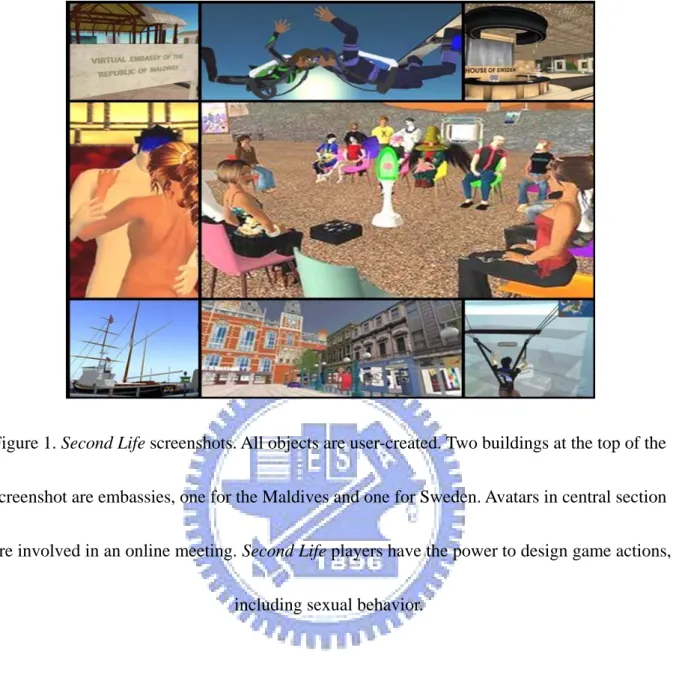
Launched in 2003, Second Life is a typical web-based virtual world (Figure 1). Since 2003
(http://secondlife.com/whatis/economystats.php). Compared to other MMOGs, Second Life
has no clear goals, missions, experience levels, or victories. The main activities are social
communication, participation in group activities, and producing/selling virtual objects and
services (e.g., virtual building construction, giving music lessons). This and similar games (e.g.,
ActiveWorlds, Kaneva, and Entropia Universe) blur the boundaries between virtual and
physical worlds—for example, the virtual “Linden Dollar” currency in Second Life can be
exchanged for real world currencies (265 Linden Dollars = $1US when this report was being
written), virtual Second Life objects have been sold on ebay, and at least one country (Sweden)
has created a virtual Second Life embassy to introduce its culture and to canvass visitors.
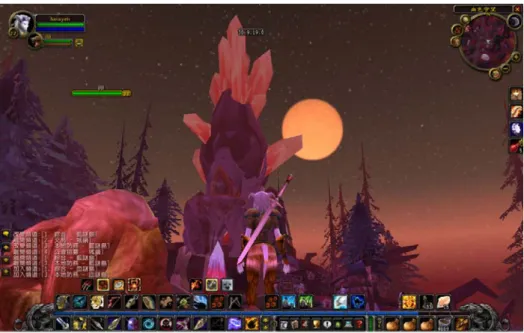
Another remarkable example of a virtual world is World of Warcraft (WoW) created by
Blizzard Entertainment (Figure 2). WoW is currently the world’s most successful MMOG, with
over 10 million players as of January 2008. WoW crosses regional and cultural boundaries,
providing services in North America, Europe, and East Asia. Main WoW activities include
visiting virtual “zones,” accepting and executing missions, upgrading avatar levels, buying,
selling and trading treasure and equipment, and joining guilds. Blizzard continues to develop
and distribute expansion packs and game content updates (especially high-end group missions)
as part of its major effort to retain players. It is also attracting considerable research attention in
Figure 1. Second Life screenshots. All objects are user-created. Two buildings at the top of the
screenshot are embassies, one for the Maldives and one for Sweden. Avatars in central section
are involved in an online meeting. Second Life players have the power to design game actions,
Figure 2. World of Warcraft Screenshot. Similar to most other MMOGs, WoW avatars use weapons to win experience points and to earn gold.
The dramatic increase in the number and quality of MMOGs since 1997 has impacted not
only the game market, but also multiple aspects of gaming society and culture [9]. The
popularity of gaming and the formation of MMOG online/offline communities have resulted in
the breaking down of boundaries formed by age, sex, race, and national origin. The rapid
increase in the number of online games has resulted in a steady stream of new products
developed by a growing number of commercial companies. Designers have increasingly
focused on detailed aspects of game societies consisting of player avatars, and the growing
number of increasingly sophisticated games is attracting exceptionally high numbers of new
players. The average age at which children begin to play video games has fallen at the same
As MMOG popularity has grown, players have become more immersed in virtual worlds
consisting of game situations and player communities. Individual players spend considerable
time, money, ideas, and emotional energy creating avatars and maintaining relationships with
each other. Avatars often evolve into identities that players adopt when trading game-based
equipment, knowledge, and virtual capital and property. In some cases game capital and
property take on value in the physical world, and game achievements, friendships, and
appearances take on emotional or personal value. Game-related transactions create second
lives for many players [12], leading to a description of online games as a collective “third
place” whose status competes with family, work, and school [1]. Compared to other types of
virtual worlds, MMOGs attract greater research attention because they cross boundaries
between countries and cultures, yet the location of servers in different countries allows for the
expression of unique cultural characteristics during play. Accordingly, they allow for studies of
hierarchies, societies, organizations, and individuals in both virtual and physical worlds.
MMOGs and online/offline social interactions are drawing considerable attention from
players, game developers, and researchers in the computer and social sciences [13]. Topics
attracting the greatest research interest include the effects of a player’s social context on
choosing games to play, common online and offline resources used to solve problems during
processes that form social norms in virtual societies, how players gain experience and expand
their social networks inside and outside the games they play [14], how players form informal
communities and highly structured organizations [15], and how players create or design new
game content [16]. Today’s players not only come together in the same virtual space to play,
but also form offline player communities. Today’s players frequent game websites and
discussion boards to share their experiences and to discuss game-related issues.
1.2. Approaches to Investigating Virtual Worlds
The large majority of users enter virtual worlds from divergent computer terminals,
thereby posing several considerable challenges to online game research. Most efforts to date
have entailed qualitative approaches (e.g., individual and group interviews, secondary data
study [17], participation in games by researchers who then reflect and report on their
experiences) and a handful of quantitative efforts (e.g., surveys[2]) to investigating player
motivations and activities. However, statistical analyses and experiments with small numbers
of research subjects generally fail to detect trends or the strong effects of variables [5].
Combined, these challenges and factors have resulted in deficiencies in understanding
individual player behaviors and the nature of interactions within online communities.
Furthermore, long-term MMOG trends in such areas as in-game organizational change and
increases in one avatar’s level, even when using longitudinal surveys and interviews. Choosing
survey samples that represent certain population segments is also difficult due to the potential
for respondents to misrepresent their age, gender, and other demographic characteristics.
In summary, the online virtual world properties of persistence, closed communities, being
based on the Internet, and multiple user properties pose five important challenges to
conventional quantitative or qualitative approaches to investigating player behaviors: (a)
interview and survey samples can be biased in terms of representability and generality; (b)
players find it difficult to describe what they are doing when they are immersed in games, with
different players offering different descriptions of the same avatar behaviors; (c) conventional
approaches are ineffective in providing cross-sectional and longitudinal observations at the
same time; (d) researchers currently cannot obtain in-game data without the permission of and
support from game companies; and (e) cross-cultural studies are particularly difficult to design
and execute for virtual worlds.
With the help of computer science and information technology, some researchers are
using digital video recorders [13] and computer monitor recording software to collect data on
in-game activities. In some cases, they are using computer monitor recording software to
record the online behaviors of avatars and digital video recorders to collect data on how players
monitor recording software to assess human-computer interface efficiency. These methods
demands long hours of replay viewing and analysis, and results are highly dependent on the
ability of researchers to observe consistent behaviors and to analyze motivations behind them.
Some researchers are beginning to design their own programs to collect online
information from such sources as Bulletin Board Systems (BBS) and transaction logs for
online auction websites such as Yahoo! Auction and ebay. Recent developments in markup
languages are allowing researchers to retrieve and integrate information from web pages,
although such efforts are limited to text-based online resources. For closed, non-text based
MMOG environments, users and researchers are limited to filtering network packets to retrieve
in-game information—for example, designing a “bot”1 that automatically kills monsters,
upgrades avatar level, and earns money. This method is somewhat inconvenient because it is
best done when the target network address can be obtained; it is less effective when a user’s
long-term behaviors are monitored by an onlooker. Another challenge to using bots is that
game designers are increasingly concerned about transactions involving virtual goods on ebay
and other auction websites, with most (as well as many players) arguing that the use of bots is
unfair to the spirit of online game playing. Accordingly, some game companies are starting to
encrypt network packets in an effort to block bot applications. While this may satisfy the
1
A “bot” is a third-party intelligent agent capable of automatically controlling avatars to slaughter monsters or non-player characters. Bots are capable of upgrading avatar experience levels when players are away from their computers. Most designers and players complain that bots ruin the fairness of game, and some game designers encrypt network packets to block bot activity.
desires of players, it serves as another challenge to researchers.
Due to recent developments in computer science, especially in the concept of open source
programming, more and more online service providers are releasing application programming
interfaces (APIs) that allow users to create applications or plug-ins to access and record online
information and activities; examples include Google desktop, MSN Messenger, and
Yahoo!Widget API development kits. Furthermore, some service providers are giving their
virtual world users access to online information. For example, several real time strategy (RTS)
games are now providing access to text-based user activity logs, which allow users to analyze
and understand their own playing strategies. Two games that offer this feature are Starcraft2
and World of Warcraft; WoW allows users to access and record information and activity logs for
their own and others’ avatars.
2. B
ACKGROUND2.1. Player
2.1.1. Player modeling
Bartle [3] notes that player demographic data are important to game companies wanting
to investigate what kinds of players like specific MMOGs (in order to know where to look to
increase membership) and how MMOGs might be altered to attract new players and to retain
existing players. Academic researchers can take advantage of the same data to learn how
players control avatar behaviors, as well as to organize their analyses in terms of player type
(e.g., newbies, casual, hardcore) [18, 19] and motivation (e.g., seeking personal achievement
or social interaction) [20]. Data on avatar behavior can also be used to identify gold farmers
(players interested in earning real-world currency) and white-eyes (players who purposefully
try to disrupt games or otherwise break gameplay rules) [21]. Bartle [22] used motivation to
categorize MMOG players as achievers, socializers, explorers, and killers; these categories
have been the bases for a large number of discussions by other researchers. Note that Bartle
used online surveys aimed at gaming communities to gather the data for his categories. For
my research I used avatar demographic data for similar analytical purposes.
2.1.2. Power Leveling
Potential level upgrade speed is recognized by players as an important factor influencing
the popularity of online games, especially MMOGs. Game design complexity affects level
upgrade speed, which in turn influences how long a player continues visiting the same game.
WoW designers clearly focused on this important aspect of their product when creating a game
that allows players to learn the game environment and gain a sense of control very quickly.
player’s experience growth or flow status to adjust mission difficulty. For example, WoW
contains missions that allow newbies to reach level 10 in less than 5 hours. Players at
subsequent levels can take part in more complex actions such as small-group raids (for up to 20
avatars), joining guilds, or riding horses. A major difference between WoW and its predecessors
is the speed at which players can reach the highest avatar level (70)—an average of two months,
but possibly as fast as one week. At one time, players had to spend at least one year to reach the
top level, and many never succeeded. Upgrade speed is strongly influenced by player behaviors:
since players in groups are required to share experience points with other avatars, guild
membership and cooperation can slow down player advancement [1]. Players gain experience
points much more quickly by repeatedly killing the same monster at a fixed location without
guild support; those interested in rapidly advancing their avatar levels can take advantage of
this tactic.
2.2. MMOG Communities
The characteristics of communities formed by online game players is a sociological issue
receiving considerable attention from virtual world researchers [3]. Designers of the most
popular MMOGs recognize that a sense of community is an important factor for player
retention, and therefore often create several community levels, from casual teams and
its members organize themselves to obtain achievement or to simply have fun. Recognizing the
range of possibilities, developers have designed (a) multi-avatar missions promoting group
play, (b) friend lists for players to maintain private in-game connections, and (c) structured
guilds and group (raid) missions to promote formal communities. For their part, players are
usually creating independent web sites for discussing online game community issues and
sharing information.
In-game communities are recognized as centrally important to retaining players. The
ways in which players organize themselves and make decisions to join or leave game world
organizations are drawing attention from real-world sociologists and enterprise managers.
Good guild leaders in an MMOG are recognized as having potential for becoming good team
managers in the physical world [23]. For this reason, game communities are also receiving
attention from researchers of organization ecology [24, 25]. Whereas real world organizations
have clear goals that resist change due to members joining and leaving, virtual world
organizations have no clear initial goals and therefore suffer from frequent member
movement. McPherson [24] has proposed an ecological model of competition among social
organizations for members, defining ecological niches in a manner that brings together
organizational geography, time, member characteristics, and social composition. Successful
organizations grow and unsuccessful organizations either disappear or are absorbed into other
members, and their growth and disappearance may be viewed as compact examples of change
in real-world organizations.
In organizational ecology terms, a competitive relationship exists between organizations
that overlap temporally or geographically. The criterion used to measure or evaluate an
organization is called a niche, with every organization having its own niche dimensions (e.g.,
employee education level, age, occupational prestige, type of service). Since MMOGs cross
geographic, age, gender, education, and occupation boundaries, synchronicity defined as
in-game time overlap between different players is considered an important niche dimension.
In most MMOGs, an avatar can only join one guild, which adds to the competition among
guilds to recruit new members. From the player perspective, avatars join guilds to achieve
social, personal, and/or game goals. However, MMOG player motivations are more likely to
change over a short period of time compared to real-world member motivations, making
guild dynamics much more complex. Since surveys and interviews only capture single
moments, they are less likely to identify why players join and leave guilds and less efficient
in obtaining detailed data on guild categories frequently mentioned by players (e.g., elite,
leisure, and family guilds). In contrast, avatar demographic data can be used to investigate
niche dimensions such as organizational structure, synchronicity, and social network
2.2.1. Informal and Formal Groups
Due to the high-end content design found in recent MMOGs, players are showing a
growing tendency to form social structures and to play together to gain experience points by
completing complex missions [17, 26]. According to some researchers, it is not uncommon for
players to spend eight or more hours in one session playing with other members of their
communities [26]. Using WoW missions as an example, many are designed for small group
activities involving avatars at level 30. To complete these missions, players form temporary
groups, visit a few dungeons together, and coordinate their activities to defeat monsters. These
informal groups and casual missions often lead to larger groups consisting of both online and
offline friends, then to guilds marked by explicit rules and management structure, then to
temporary hybrid groups formed to solve the largest and most difficult missions [17]. To
support these groups, game developers are providing private communication channels for guild
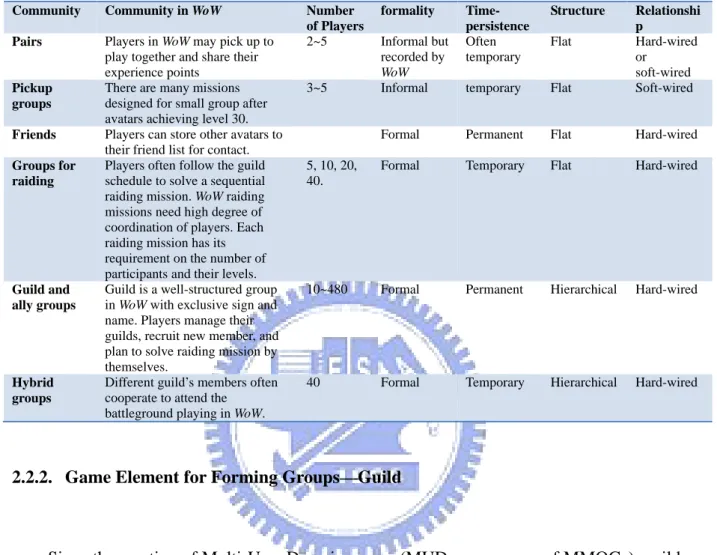
Table 1 presents WoW community and/or group categories in terms of Bartle’s (2003) and
Taylor’s (2006) definitions and categories: formal or informal, temporary or permanent, flat or
Table 1. Categories of WoW communities according to definitions from Bartle (2003) and Taylor (2006).
Community Community in WoW Number of Players
formality Time- persistence
Structure Relationshi p
Pairs Players in WoW may pick up to play together and share their experience points 2~5 Informal but recorded by WoW Often temporary Flat Hard-wired or soft-wired Pickup groups
There are many missions designed for small group after avatars achieving level 30.
3~5 Informal temporary Flat Soft-wired
Friends Players can store other avatars to their friend list for contact.
Formal Permanent Flat Hard-wired
Groups for raiding
Players often follow the guild schedule to solve a sequential raiding mission. WoW raiding missions need high degree of coordination of players. Each raiding mission has its requirement on the number of participants and their levels.
5, 10, 20, 40.
Formal Temporary Flat Hard-wired
Guild and ally groups
Guild is a well-structured group in WoW with exclusive sign and name. Players manage their guilds, recruit new member, and plan to solve raiding mission by themselves.
10~480 Formal Permanent Hierarchical Hard-wired
Hybrid groups
Different guild’s members often cooperate to attend the
battleground playing in WoW.
40 Formal Temporary Hierarchical Hard-wired
2.2.2. Game Element for Forming Groups—Guild
Since the creation of Multi-User Domain games (MUDs, precursors of MMOGs), guilds
have attracted considerable attention from players, game developers, and researchers.
Originally viewed as self-emerging organizations formed among avatars belonging to different
players, guilds have evolved to become an important factor in game design following the
successful implementation of guild mechanisms in Ultima Online, EverQuest, and Lineage.
These mechanisms (which continue to be refined and improved) are now viewed as important
equipment. The high percentage of players joining guilds also attests to their essential position
in game worlds, as well as their suitability as a focus for research on MMOG development, the
behaviors of players who join guilds, and social tendencies in game playing. For long-term
users and power gamers, the importance of guilds can approach that of the game itself [14, 27].
Guild member avatars have exclusive guild names and flags, and game systems often set
aside conversation channels for intra-guild communications. Taking into account system and
design variation, guild functionality and capability tend to be MMOG-specific. For example,
guilds in Final Fantasy XI have special conversation channels, Lineage guilds have access to
treasuries for storing guild-owned equipment and gold, and WOW and EverQuest guilds are
given special roles that encourage long-term cooperation and coordination among members.
Different levels of purposefully designed tasks explicitly and implicitly guide players to
various self-organizing activities [28].
Initially, the decision to join a guild and the process of doing so were considered the most
important criteria for player categorization. As guilds and data collection techniques evolved,
researchers broadened their investigations to include player experiences, the sharing of those
experiences, searches for friendship, cooperation for performing missions, and the formation of
virtual social norms [14, 21]. Guild structure and activity are now viewed as representative of
player needs, especially since guilds now tend to satisfy the social needs of players in virtual
worlds and serve as centers for interaction in the physical world.
Due to the growing complexity of MMOGs, newbies are increasingly choosing to play the
same games and to join the same guilds as their friends in the physical world; this allows them
to rely on each other for help in elevating skill levels. Veteran players report asking friends and
acquaintances in the physical world to join their guilds as a means of reducing the risks
involved in dealing with strangers. Such actions are the result of different perceptions
regarding risk and trust for different guild functions [29]—for instance, socializing, seeking
help to solve problems or to build skills and experience, and organizing unified attacks and
defenses. A simple example is the exchange of tips, gifts, or favors between players with
distinctly different skill levels or experience. Those who act as the givers in these scenarios are
often generous, placing less value than the receivers on their gifts or favors [30]. Givers often
have enough time to evaluate the capabilities of the receivers, thus reducing the sense of risk.
However, perceived risks involved in exchanging equipment and other resources increase
rapidly when players form large groups to attack cities or camps; in these situations, exchanges
among players are more likely to be controlled by a trust mechanism. Game guilds consisting
of real-world friends help reduce the sense of risk [28].
spans (and profits), they have strong motivation to incorporate guild-based activities into their
products. However, companies also know that different players have different motivations for
playing, and therefore they must address those motivations while providing various incentives
associated with guilds. For example, guild members must belong to the same faction, and
certain virtual classes and occupations (e.g., priests) are considered more valuable to guilds
than others.
Bartle’s [22] proposed player categories include achievers, explorers, socializers, and
killers, each with characteristics and powers considered essential to establishing successful
guilds. The expanding variety in guild functions has significantly increased the complexity of
game social interaction mechanisms—for instance, guild management tasks attract players
with specific interests in organizing. Bartle [3] has identified two player types—politicians and
planners—who are more likely to participate in establishing and building guilds as a means of
achieving their personal game goals. Game mechanisms such as information sharing, learning,
cooperation, and dragon killing points (DKPs) also encourage communication and cooperation
within guilds in order to set goals, establish trust and reputation, and show responsibility [14,
31, 32]. Still, variety in individual player motivation and purpose translates into multiple
reasons for creating or participating in guilds as well as distinct differences in guild style and
game-focused guilds generally consist of players with little interest in spending time chatting
with other players.
2.2.3. Game Content for Promoting Group Play—Raiding Missions
“Raids” (also referred to as “raid missions” and “guild missions”) are high-end activities
suitable for groups of 20 to 40 avatars. Raids often consist of a series of missions requiring up
to one week to complete. The serial structure of these missions means that players must
collaborate more than once for planning and execution purposes. WoW designers have also
incorporated raiding missions suitable for groups consisting of 40 avatars whose levels go as
high as 60 or 25 avatars whose levels go as high as 70. One game feature that encourages
guild membership is the fact that players can obtain rare equipment and treasure only by
participating in raid missions. However, a successful raid produces only one copy of a coveted
piece of equipment or treasure, therefore a guild must perform the same raid mission many
times in order to make sure that all members have their own copies. This design feature
requires a sense of trust [31]; the perception of being a valued member of a team may explain
why mission execution is a very popular aspect of WoW’s high-end content. Furthermore,
different raids require different combinations of avatar abilities; inappropriate combinations
usually result in failure.
“large-scale cooperative problem-solving endeavors [1].” One of their more interesting
observations is the willingness of individual players to collaborate according to their avatar
capabilities. Thus, WoW avatars that serve as “tanks” during raids must be willing to withstand
attacks from powerful monsters; “healers” accept responsibility for restoring the lives of other
avatars; and the sole purpose of “DDers” is to inflict harm on monsters. To manage these tasks,
guild members organize themselves into hierarchies that include such positions as “raid
leaders” skilled at planning and execution and “DKP” managers who reward guild members in
accordance with their level of participation in a mission.
Methods for executing missions can be used to categorize guild type, since intra-guild
communication and mission and member management are considered important factors in an
individual’s decision to join or leave a guild. Researchers of games such as EverQuest have
described guild mission play as “work-like play.”[1, 33] Whether mission execution is
considered work or play, it has become a very popular aspect of WoW’s high-end content. Over
one-third (35%) of all Taiwanese WoW guilds that I collected data on were raid guilds. This
phenomenon shows that WoW game design has impacted the virtual world game community; in
turn, it is inspiring researchers to place special analytical emphasis on how high-end activities
influence player society.
researchers to date have used a combination of goals, motives, and size to categorize them [17,
34]. However, it is very difficult to infer guild organizing behaviors that affect player
communities from data on initial player motives, since they include such complex behaviors
and factors as stability, equilibrium, dismissal, breakdown, and conflict over participating in
missions and sharing rewards—issues that often develop based on interactions between player
and game environments. Another barrier to understanding these phenomena is the
above-mentioned difficulty of gathering in-game data to record the dynamics of guild
evolution, type, collective behavior, and movement between guilds.
2.3. WoW (World of Warcraft) and Client-Designed User Interface
2.3.1. WoW Success
Between its November 2004 release and January 2007 (the most recent data available),
WoW has attracted more than 8 million subscribers in North America, Europe, Korea, China,
Australia, and Taiwan. The previous record of 3.5 million subscribers was held by Lineage. It is
currently believed that one-half of the world’s MMORPG subscribers are WoW players [8]. In
North America, 220 game servers are used by 2 million subscribers—roughly ten times the
200,000 Taiwanese players who have used that country’s 46 WoW servers since its release date
[35]. Players and analysts generally agree that WoW has created completely new styles of play
same manner as its popular predecessors, Lineage and EverQuest.
2.3.2. WoW Game World
At the beginning of play, WoW players are allowed to choose a specific server to play on.
The three options for server type are player-versus-environment (PvE), player-versus-player
(PvP), and role-playing (RP). Players who choose the most popular servers (PvE) cannot kill
other player-controlled avatars, but players who choose PvP servers can participate in player
killing (PK) combat. The RP server type is for players who prefer fantasy storylines. Players
also select one of two faction types (alliance or horde) that differ greatly in terms of appearance,
capabilities, and storylines. Based on faction choice, players must choose from four “races”
(e.g., human members of an alliance or orc members of a horde). The final player decision
concerns avatar class, with examples being warlock, warrior, and priest. These four choices
affect player decisions and processes in joining guilds. Note that since the first two decisions
(server type and faction) are not commonly found in MMOGs, they serve as examples of how
game design can influence player communities.
Blizzard Entertainment’s response to the server choice issue has been to provide PvP and
PvE game situations simultaneously on separate servers. Once an avatar is placed on one server,
behavior in advance, or PK must be scheduled for a specific time in a specific arena.
Conversation, trading, group formation, giving assistance, and all other interactions between
avatars from different factions are forbidden. As a result, many view PvE servers as supporting
more leisurely play compared to competitive and violent PvP environments. The two settings
are strong reflections of conflicting player styles and preferences.
Another strong example of how design influences player interaction and game
environment is choice of avatar race. Players have eight choices divided equally between two
factions: night elves, gnomes, humans, and dwarves belong to the alliance faction, and orcs,
trolls, the undead, and taurens belong to the horde faction. Older fantasy MMOGs (e.g., The
Ring and Dragonlance) gave similar choices to players, but not as many. Experienced players
are well aware of how their selections affect play. Most players know that alliance avatars tend
to be brighter, more civilized, and attractive and that horde avatars tend to look evil, savage,
and cold. Previous studies have shown that avatar appearance and ability are important factors
that influence player choice [36, 37], therefore design differences among WoW factions and
3. E
NVIRONMENTS AND APPROACHES3.1. New Trends for Peer Designers to Investigate Digital Worlds
Five characteristics of online virtual worlds mentioned in section 1.2 limit research
methods for investigating them. Computer monitor recording and network packet filtering are
two alternative methods for data collection; the shortcomings of each are discussed in section
1.2. In this section I will look at two current web 2.0 service trends: client-designed user
interfaces and open user-created data trends, both serving as examples of how providers
welcome user participation in certain aspects of service design for purposes of sharing and
personalization. Combined, the two trends allow services to meet the needs of different
populations and to integrate online information access. For example, Google Desktop API
allows users to read e-mail, check on the weather, and monitor sports scores and stock prices on
a single browser screen.
3.1.1. Open-Data Trends
With the development of the World Wide Web, the amount of information available online
is growing exponentially. Digital tools are making it easier to record activities and exchange
information than their counterparts in the physical world. Without digital tools, player
kinds of online information still require cooperation from service providers—for example,
non-text-based services (e.g., MMOG avatar information and online maps) and author
information placed in the deepest levels of webpage hierarchies. Virtual world researchers also
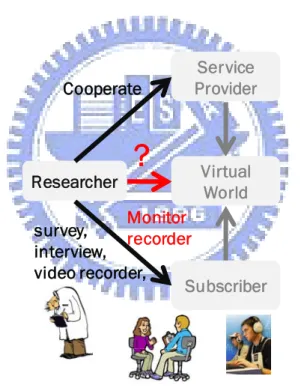
find it necessary to cooperate with game companies to obtain network traffic statistics and
subscriber information to analyze MMOG connection quality and gamer populations (
Figure 3).
Open data provided by service providers have the following properties: (a) third-party
users can only access data through an API; (b) interested users often need to apply for
authentication keys to access data; (c) some private data fields are restricted to prevent
improper access; and (d) open data have fixed fields and meanings that make analysis easier.
Using Google series service APIs as an example, Gdata (“Google data API protocol”) allows
users to query syndication format data using an authentication mechanism to access
user-created data. Other Google services support the Gdata protocol for developing APIs:
Google Apps, blogger, calendar, web album, YouTube, and social network API. Other examples
include e-commerce or citation service websites such as the non-commercial flickr service API
(http://www.flickr.com/services/). Many third party applications have been developed based on
this API, including flickrball3 (which gives access to a six-degrees-of-separation experiment
3
using flickr picture tags) and retrievr4 (which allows users to draw sketches or upload images
to find similar photos on flickr). MMOGs also provide accessible data for client-side
developers; a good example is Blizzard Entertainments’ decision to give WoW users access to
basic avatar demographic and auction information. The central point of this dissertation is that
this feature can be modified and used to investigate in-game player activities. Warhammer
Online is also adopting this feature, and other games and game designers are expected to follow
suit.
Figure 3. Relationships and interactions among service providers, web services (virtual worlds or MMOGs), and researchers.
3.1.2. Client-designed User Interface
Most UIs used with network services or PC software are fixed, single-user interfaces that
Service Provider Virtual World Subscriber Researcher Cooperate survey, interview, video recorder,
?
Monitor recorderprovide functions defined by the service provider; users cannot alter them or add new
components. As designers put greater emphasis on UI usability, a growing number are giving
users the ability to design their own components for attachment to main service applications. A
popular means of delivering this feature is providing a main engine and several default
components called add-ons (Figure 4 and Figure 5). APIs for UI design differ from the data
APIs mentioned above—for example, Yahoo Widgets API (http://widgets.yahoo.com/tools/)
and Google Gadget API (http://code.google.com/apis/gadgets/). Users can also add third-party
components. Common add-on functionalities include writing memos, reading E-mail and RSS
news, and checking personal calendars.
Based on this trend, several add-ons are automatically downloaded and attached on the
main screen the first time that players connect to WoW; they can later download additional
add-ons written in WoW UI API from third-party websites. UI design is an important issue for
game companies, who are acknowledging (a) player desires to quickly become familiar with
game controls and content, and (b) the shortcomings of single fixed UIs to meet the various
needs of complex MMOG game content (e.g., completing initial missions, joining guilds,
participating in raids, and executing combat). Compared with the original WoW UI shown in
Figure 6, the third-party product in Figure 7 is more suitable for group missions. The WoW UI
is created using the Lua script language for functionalities and xml for appearance. Since 2004,
strategy games, role-playing games, and MMOGs: Supreme Commander, Ragnarok Online,
World of Warcraft, and Warhammer Online.
Figure 4. Yahoo! Widgets. Users can design their own add-ons or insert add-ons made by third-party service providers and designers.
Figure 5. iGoogle. Users have the power to add gadgets to the iGoogle panel. Since it is a
10
Calendar
My ebay
Clock New York Times
Weather
11
Gmail
To-Do List
RSS Feeding
Figure 6. An original player-controlled UI provided by WoW.
Figure 7. Modified UI created by third-party source. Client-designed UIs can be found and downloaded from player-sharing community websites.
3.2. Web 2.0 Trends in Game Community
Web 2.0 characteristics found in digital games include player involvement in game design,
shared playing logs, and client-designed UIs. Some early examples are MUDs that allowed
players to design rooms and room functions (Bartle, 2003). Today, in addition to MMOGs, •Status
•Map
•Skills & tools •Chatting
Channel
•Status •Map
•Skills & tools •Chatting
Real-Time Strategy (RTS) and First-Person Shooter (FPS) games also give users tools for
designing their own maps, missions, and combat scenarios. Player-designed games that utilize
combinations of map editors or APIs with main game programs are called mods; they are
generally available for downloading from game-related websites. One of the most famous
mods is Counter Strike, which uses the FPS game Half Life’s engine and structure. Another
example is Warcraft III World Editor, which is similar to StarCraft’s level editor but allows
users to create and edit their own maps and scenarios. Many Asian players have designed
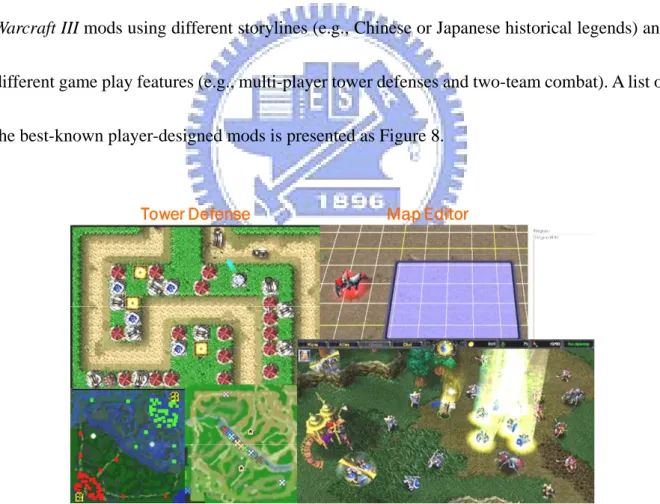
Warcraft III mods using different storylines (e.g., Chinese or Japanese historical legends) and
different game play features (e.g., multi-player tower defenses and two-team combat). A list of
the best-known player-designed mods is presented as Figure 8.
Figure 8. Screenshots of Warcraft III mods including two types of gameplay: tower defense and two-team combat.
Blizzard Entertainment is the most successful example of a MMOG company encouraging its
players to create, share, and download player-designed user interfaces. The three main UI
functions are (a) assisting with in-game control, (b) creating hints, maps, and libraries for
solving missions, and (c) collecting in-game information on avatar status. Whereas the most
basic function of user interfaces is to provide the outward appearances of game or website
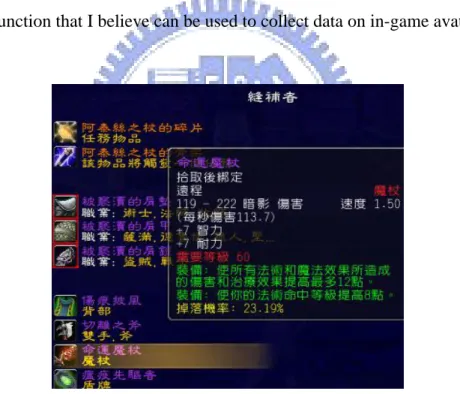
services, my objective emphasizes the third function. Using WoW’s “AltasLoot” function as an
example, its main use is to provide data on the probability of “loot dropping”5 when a monster
is killed (Figure 9). Dropping probabilities are calculated based on information collected from
peer users—a function that I believe can be used to collect data on in-game avatar status.
Figure 9. Screenshot of a WoW player-designed UI called AltasLoot, which provides
probability of loot dropping.
5
When a player kills a monster, it drops “loot” and gold as rewards. However, loot for two monsters of the same type aren’t always identical, therefore AltasLoot has been designed to calculate the probability of loot being dropped from individual monsters. The AltasLoot UI only records loot dropping events for the player who attaches it as an add-on.
3.3. Investigating WoW Using the Client-designed UI Feature
WoW is attracting considerable research attention, similar to its popular predecessor,
EverQuest. EverQuest researchers felt that they had no choice but to spend long periods
playing the game they were studying, browsing discussion boards, and participating in or
observing game design workgroups to build their knowledge of game situations, backgrounds,
and cultures. It is now generally accepted that time-slice approaches are insufficient for
investigating progressive guild development and life cycles (i.e., creation, development,
splitting, and disbanding); such topics require data collected over time periods ranging from
several weeks to six months. For the most part, these time-consuming methods have been
passed over in favor of online/offline surveys and interviews aimed at understanding player
motives and behaviors [8, 22, 34]. Another major challenge for researchers is the
above-mentioned need to gain support from game companies for data collection.
In order to attract and retain players, many companies are creating mechanisms that allow
players to modify avatar appearances, characteristics, skills, and abilities to organize and join
guilds. As mentioned earlier, Blizzard Entertainment has made one of the most dramatic moves
in this regard by giving WoW players the ability to create and modify their personal interfaces
by means of an API. This feature allows users to collect progressive data on grouping,
changes in avatar participation in specific guilds over time and to use guilds as game agents for
the purpose of analyzing their distribution, differences, and life cycles. Specifically, I have
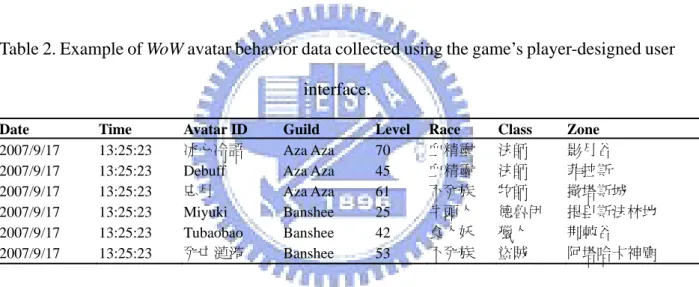
designed a WoW add-on that I call census++ to automatically record data on time, camp
(alliance or horde), avatar name, guild membership, level, race, class, and zone. A log sample is
shown as Table 2. Data that are returned from individual queries reflect information for all
avatars on one server. The time interval between successive queries depends on the number of
avatars on the server; average data recording frequency is once per 15 minutes.
Table 2. Example of WoW avatar behavior data collected using the game’s player-designed user interface.
Date Time Avatar ID Guild Level Race Class Zone
2007/9/17 13:25:23 冰心冷語 Aza Aza 70 血精靈 法師 影月谷 2007/9/17 13:25:23 Debuff Aza Aza 45 血精靈 法師 菲拉斯 2007/9/17 13:25:23 忘月 Aza Aza 61 不死族 牧師 撒塔斯城 2007/9/17 13:25:23 Miyuki Banshee 25 牛頭人 德魯伊 提里斯法林地 2007/9/17 13:25:23 Tubaobao Banshee 42 食人妖 獵人 荊棘谷 2007/9/17 13:25:23 死亡漣漪 Banshee 53 不死族 盜賊 阿塔哈卡神廟
WoW currently operates 32 servers in Taiwan. There are two server types, player vs. player
(PvP) and player vs. environment (PvE); avatars on one server cannot interact with avatars on
another. Players using a PvE server cannot fight with player-controlled avatars in opposing
camps unless both players agree ahead of time. These restrictions allow servers to be viewed as
unique societies. Note also that individual avatars can only join one guild, although guilds can
recruit new members and try to convince players to switch guilds. These exclusive server and
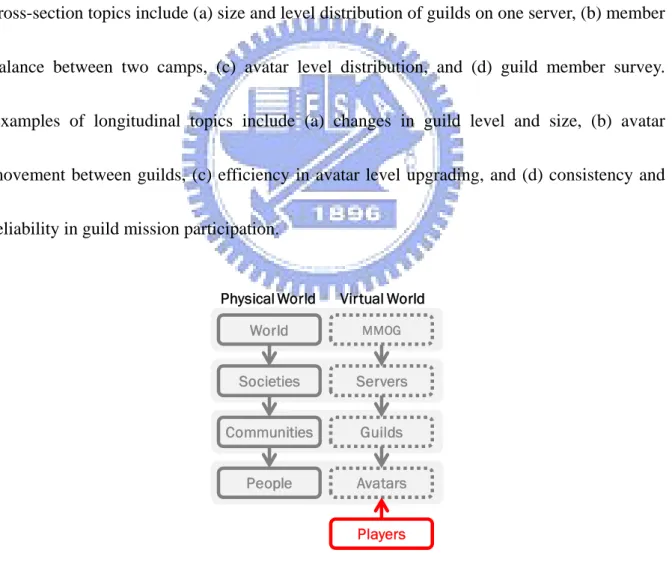
Figure 10. Each hierarchy level requires a separate analysis of recorded log data. For
example, at server-level researchers can compare differences in guild growth and decline in
PvP and PvE servers, and in-game community guild-level researchers can categorize guild
types according to player level and size and observe changes in those parameters.
Since census++ runs as a background program in WoW and records player status over time,
interested researchers can perform both cross-sectional and longitudinal analyses. Examples of
cross-section topics include (a) size and level distribution of guilds on one server, (b) member
balance between two camps, (c) avatar level distribution, and (d) guild member survey.
Examples of longitudinal topics include (a) changes in guild level and size, (b) avatar
movement between guilds, (c) efficiency in avatar level upgrading, and (d) consistency and
reliability in guild mission participation.
Figure 10. Structure and hierarchy comparisons between physical and virtual worlds.
World Societies Communities People MMOG Servers Guilds Avatars Players
4. R
ESULTS4.1. Data Coverage
Different datasets were established for specific topics and WoW update events. Data on
period, frequency, server type, and total numbers of avatars and guilds in each dataset are listed
Table 3. The first set, consisting of data from 62 Taiwanese servers between January and April
of 2006, were used to analyze WoW guild dynamics. Since in-game guilds change slowly,
collecting frequency was adjusted to once every 6 hours. Since Taiwan WoW service began in
November of 2005, the dataset is considered young enough to capture early guild dynamics.
Three datasets from American and Taiwanese servers created between the end of 2006 and
early 2007 were used to determine differences between the two player cultures in terms of
behaviors aimed at game achievement. A shorter collection frequency allowed for monitoring
all changes in avatar level upgrading and guild activities. The fifth dataset was established to
address the topic of why players leave their original guilds and join other ones. This topic
Table 3. Datasets. Different dataset recording frequencies, periods, and scales were used for different purposes.
File Collection Time Frequency Server Type Total Avatars Total Guilds Taiwan 1/6~4/6(2006) 6 hours All 62 Taiwanese servers 641,805 285 per server US 9/1~9/25(2006) 12mins 1 PvP + 1PvE servers 40,038+50,703 1437+1456 Taiwan 12/1~12/25(2006) 15mins 1 PvP server 8,394 156 US 1/3~1/18(2007) 18mins 1 PvP server 41,097 1312 Taiwan 9/15~12/15(2007) 40mins Selected 5 servers, 2 PvE+3
PvP 98248
4.2. Dynamics and Evolution of MMOG Guilds and Other Organizations
4.2.1. Introduction
Online game guilds have a hierarchical leadership structure that allows players to act as
unified groups to solve joint missions. Whereas guilds used to be viewed as informal and
unplanned organizations, some recently released online games have incorporated guild
formation into their structure, adding mechanisms for establishing guilds and designing goals
and missions that require coordinated actions by members of well-organized teams [3, 38, 39].
Since online players frequently change their personal gaming goals, they often leave active
guilds to join others. Accordingly, online guilds are now experiencing cyclical lives that entail
creation, development, member suspension, splitting, merging, and disbanding, thereby
becoming perhaps the most representative social organization in online game societies.