
英語歌曲融入教學對國中生文法學習效益的研究 - 政大學術集成
112
0
0
全文
(2) 立. 政 治 大. ‧. ‧ 國. 學. n. er. io. sit. y. Nat. al. Ch. engchi. i n U. v.
(3) TABLE OF CONTENTS Chinese Abstract……………………………………………………………………x English Abstract .......................................................................................................xii Chapter One: Introduction .....................................................................................1 Background and Motivation .............................................................................1 Purpose of the Study .........................................................................................3. 政 治 大. Research Questions...........................................................................................3. 立. Significance of the Study ...................................................................................4. ‧ 國. 學. Definition of Terms ............................................................................................5 Grammar Practice through Drills5...........................................................5. ‧. English Songs...........................................................................................5. y. Nat. sit. Chapter Two: Literature Review............................................................................7. n. al. er. io. Arguments against Grammar Teaching..............................................................7. i n U. v. Arguments in Support of Grammar Teaching....................................................8. Ch. engchi. Empirical Evidence for and against Teaching Grammar ................................... 9 Grammar with Communicative Language Teaching ....................................... 10 Drills ................................................................................................................12 Types of Pattern Practices ........................................................................12 Drills in Language Classrooms................................................................13 Songs and Language Teaching.........................................................................14 Studies of English Song Instruction in Taiwan ................................................16 Chapter Three: Methodology................................................................................21 Participants....................................................................................................... 21 iii.
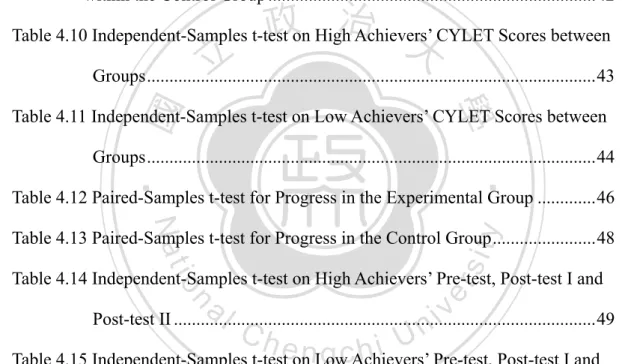
(4) Instruments....................................................................................................... 23 English Grammar Test (EGT) .................................................................. 24 The Design of English Grammar Test.............................................. 24 The Scoring of EGT......................................................................... 24 The Validity and Reliability of EGT ................................................ 24 Cambridge Young Learners English Test (CYLET): Flyers .................. 25. 政 治 大. A Pre-test and Two Post-tests................................................................. 26. 立. Teaching Materials................................................................................. 27. ‧ 國. 學. iEnglish 1 ..................................................................................... 28 Ten Songs with Lyrics.................................................................. 29. ‧. Procedure of the Study........................................................................... 30. y. Nat. io. sit. Data Analysis ......................................................................................... 31. n. al. er. Chapter Four: Results ........................................................................................... 35. i n U. v. The Results of Pre-test, Post-test I and Post-test II for the. Ch. engchi. Experimental Group......................................................................................... 35 The Results of Pre-test, Post-test I and Post-test II for the Control Group .................................................................................................. 36 Comparisons of the Results of Pre-test and Post-test I between the Two Groups ................................................................................................38 Comparisons of the Results of Post-test II between the Two Groups.............. 39 Effects of Grammar Practice on Students with Different Proficiency Levels . 39 The Results of Statistics of the CYLET Scores for High and Low Achievers ...............................................................................................40 iv.
(5) Comparisons of Progress between the Experimental and Control Groups......44 Progress of High and Low Achievers in the Experimental Group......... 44 Progress of High and Low Achievers in the Control Group.................. 46 Comparisons of Progress between High and Low English Achievers............. 48 High English Achievers between the Two Groups ................................ 48 Low English Achievers between the Two Groups ................................. 49. 政 治 大. Summary .......................................................................................................... 50. 立. Chapter Five: Discussion and Conclusion ........................................................... 53. ‧ 國. 學. Answers to the Research Questions................................................................. 53 Results of the Present Studies versus Results of the Previous Studies ............ 56. ‧. Pedagogical Implications of the Study............................................................. 60. y. Nat. sit. Limitations of the Study................................................................................... 62. n. al. er. io. Recommendations for Further Research.......................................................... 63. i n U. v. Conclusion ....................................................................................................... 64. Ch. engchi. References................................................................................................................ 65 Appendix A: Cambridge Young Learners English Test (CYLET): Flyers............... 74 Appendix B: English Grammar Test (EGT) ............................................................ 82 Appendix C: Two-way Specification Table of Grammar Points from Starter to Unit5 .............................................................................................. 86 Appendix D: Item Reliability of EGT ..................................................................... 87 Appendix E: Diana lyrics......................................................................................... 88 Appendix F: Are You Lonesome Tonight lyrics ...................................................... 89 Appendix G: Dancing Queen lyrics......................................................................... 90 v.
(6) Appendix H: Yellow Bird lyrics............................................................................... 91 Appendix I: Downtown lyrics.................................................................................. 92 Appendix J: All Kinds of Everything lyrics............................................................. 93 Appendix K: Eleanor Rigby lyrics........................................................................... 94 Appendix L: I Left My Heart in San Francisco lyrics ............................................. 95 Appendix M: Somewhere over the Rainbow lyrics................................................. 96. 政 治 大. Appendix N: Hero lyrics.......................................................................................... 97. 立. Appendix O: A Sample Lesson Plan of English Song Instruction........................... 98. ‧. ‧ 國. 學. n. er. io. sit. y. Nat. al. Ch. engchi. vi. i n U. v.
(7) LIST OF TABLES. Table 2.1 Related Studies on English Song Instruction in Taiwan ..........................19 Table 2.2 Related Studies of Different Participants on English Song Instruction in Taiwan......................................................................................................20 Table 3.1 Statistics of Participants’ CYLET Scores.................................................22. 政 治 大. Table 3.2 Independent-Samples t-test on Participants’ English Proficiency Test ....23. 立. Table 3.3 Statistics of the CYLET Scores for High and Low Achievers within Each. ‧ 國. 學. Group .......................................................................................................23 Table 3.4 Reliability Statistics .................................................................................25. ‧. Table 3.5 The Function of the Tests in the Study.....................................................27. y. Nat. sit. Table 3.6 Ten Songs Used in the Study....................................................................28. n. al. er. io. Table 3.7 Teaching Materials Used in the Study......................................................28. i n U. v. Table 3.8 Songs Taught in Each Unit.......................................................................29. Ch. engchi. Table 3.9 The Similarities and Differences in Treatments. between the Two Groups..........................................................................33 Table 4.1 Paired-Samples t-test on the Experimental Group’s Pre-and Post-test I..36 Table 4.2 Paired-Samples t-test on the Experimental Group’s Pre-test and Post-test II ................................................................................................36 Table 4.3 Paired-Samples t-test on the Control Group’s Pre-testand Post-test I......37 Table 4.4 Paired-Samples t-test on the Control Group’s Pre-test and Post-test II ...37 Table 4.5 Independent-Samples t-test on Participants’ Pre-test and Post-test I .......38 Table 4.6 Independent-Samples t-test on Participants’ Post-test II..........................39 vii.
(8) Table 4.7 Statistics of the CYLET Scores for High and Low Achievers within Each Group .......................................................................................................41 Table 4.8 Independent-Samples t-test on High and Low Achievers’ CYLET Scores within the Experimental Group................................................................42 Table 4.9 Independent-Samples t-test on High and Low Achievers’ CYLET Scores within the Control Group .........................................................................42. 政 治 大. Table 4.10 Independent-Samples t-test on High Achievers’ CYLET Scores between. 立. Groups....................................................................................................43. ‧ 國. 學. Table 4.11 Independent-Samples t-test on Low Achievers’ CYLET Scores between Groups....................................................................................................44. ‧. Table 4.12 Paired-Samples t-test for Progress in the Experimental Group .............46. y. Nat. sit. Table 4.13 Paired-Samples t-test for Progress in the Control Group.......................48. n. al. er. io. Table 4.14 Independent-Samples t-test on High Achievers’ Pre-test, Post-test I and. i n U. v. Post-test II ..............................................................................................49. Ch. engchi. Table 4.15 Independent-Samples t-test on Low Achievers’ Pre-test, Post-test I and Post-test II ..............................................................................................50. viii.
(9) LIST OF FIGURES. Figure 3.1 Overall Procedure of the Study ..............................................................32. 立. 政 治 大. ‧. ‧ 國. 學. n. er. io. sit. y. Nat. al. Ch. engchi. ix. i n U. v.
(10) 國立政治大學英國語文學系碩士在職專班 碩士論文提要 論文名稱:英語歌曲融入文法教學對國中生文法學習效益的研究. 指導教授:葉潔宇博士. 立. 政 治 大. ‧ 國. 學. 研究生:林淑娟. ‧. 論文提要內容:. y. Nat. sit. 本研究旨在探討英語歌曲練習文法和機械式練習文法對學生文法學習和記. n. al. er. io. 憶保留的成效。主要目標欲探究(1)兩種文法練習方法對於文法學習的成效;(2). i n U. v. 兩種文法練習方法對記憶保留的成效;以及(3)兩種文法練習方法對於高、低成. Ch. engchi. 就學習者在文法學習和記憶保留的影響。. 研究對象為台灣中部一所公立國中兩班七年級的學生。此均質的兩個班被 隨機指定為實驗組與控制組。實驗組於教授文法後施予英語歌曲練習文法,而 控制組則施予傳統機械式練習文法。歷時十一週的文法教學後,兩組受試者接 受文法測驗(EGT),以得知兩組受試者文法學習情況。一個月後,兩組受試者再 次接受相同文法測驗,以進一步得知其文法的記憶保留情形。本研究主要發現 如下:(1)在文法學習成效方面,接受英語歌曲練習文法的實驗組學生表現顯著 優於接受機械式文法練習的控制組學生。(2)在記憶保留方面,接受英語歌曲練 x.
(11) 習文法的實驗組學生表現顯著優於接受機械式文法練習的控制組學生。(3)利用 英語歌曲練習文法對於高、低英語學習成就者而言,在文法學習和記憶保留上 皆有正面影響。 (4)透過機械式文法練習亦有助於提升高、低英語學習成就者, 在文法學習和記憶保留的成效。(5)對於高英語學習成就者而言,利用英語歌曲 練習文法和透過機械式練習文法兩者對於其文法學習和記憶保留成效相同。(6) 對於低英語高學習成就者而言,利用英語歌曲練習文法在文法學習和記憶保留. 政 治 大. 的成效皆優於透過機械式文法練習。. 立. ‧ 國. 學. 最後,研究者對於英語歌曲在文法教學上之應用提供建議以作為教育學者們的 參考。. ‧. n. Ch. engchi. xi. er. io. al. sit. y. Nat 關鍵字:文法練習、練習、英語歌曲、記憶保留. i n U. v.
(12) ABSTRACT The study investigated the effects of “grammar practice through drills plus English songs” versus the effects of “grammar practice through drills” on students’ grammar learning and retention of grammar points. The study aims to (1) investigate the effects of these two kinds of grammar practices on grammar learning; (2) explore. 政 治 大 and (3) evaluate the effects of these two kinds of grammar practices on grammar 立 the effects of these two kinds of grammar practices on retention of grammar points;. learning and retention of grammar points for high and low English achievers.. ‧ 國. 學 ‧. Participants were two intact classes of seventh-grade students in a public junior. y. Nat. high school in central Taiwan. With the homogeneity of English proficiency, the two. er. io. sit. classes were randomly assigned as the experimental and control groups. The former received “grammar practice through drills plus English songs”, while the latter. n. al. received “grammar practice. v i n C through drills.” After h e n g c h i U receiving. an eleven-week. instruction, both groups received English Grammar Test (EGT), to assess their grammar learning. One month after EGT, the same grammar test—EGT were conducted to both groups to assess their retention of grammar points. The major findings are summarized as follows. (1) In terms of grammar learning, students receiving “grammar practice through drills plus English songs” outperformed those receiving “grammar practice through drills.” (2) In terms of retention of grammar points, “grammar practice through drills plus English songs” had a more positive influence than “grammar practice through drills.” (3) “Grammar practice through drills plus English songs” possessed a facilitative effect for both high and low xii.
(13) English achievers with regard to grammar learning and retention of grammar points. (4) “Grammar practice through drills” benefited both high and low English achievers. (5) “Grammar practice through drills plus English songs” and “grammar practice through drills ” could enhance high English achievers’ grammar learning and retention of grammar points. (6) “Grammar practice through drills plus English songs” exerted a superior effectiveness on low English achievers’ grammar learning. 政 治 大. and retention of grammar points. Pedagogical implications based on the findings. 立. were also provided.. ‧. ‧ 國. 學. Keywords: grammar practice, drills, English songs, retention. n. er. io. sit. y. Nat. al. Ch. engchi. xiii. i n U. v.
(14) 立. 政 治 大. ‧. ‧ 國. 學. n. er. io. sit. y. Nat. al. Ch. engchi. xiv. i n U. v.
(15) CHAPTER 1 INTRODUCTION Background and Motivation In the field of second or foreign language acquisition, the role of grammar has undergone a series of changes in language teaching. In the mid to late 19th century, Grammar-Translation Method (GTM) dominated language teaching, where grammar was taught deductively; that is, learners are given grammatical rules and examples, and are told to memorize them. In GTM, it is important for learners to learn about. 政 治 大 GTM does not seem to be very effective regarding learners’ ability to communicate 立 the form of the target language and be conscious of the grammatical rules. Since. of which is Communicative Language Teaching (CLT).. 學. ‧ 國. in the target language, some approaches have developed as a reaction to GTM, one. ‧. Communicative Language Teaching (CLT) is the application of theoretical. y. Nat. perspective of Communicative approach (Larsen-Freeman, 2000). The goal of CLT. er. io. sit. is in preparing students to use the target language to communicate effortlessly; hence, language is for communication. In CLT, language function is emphasized. al. n. v i n C hthere raised concerns over language forms. However, that learners achieve fluency at engchi U. the expense of accuracy since the role of grammar is not particularly emphasized in CLT. In spite of the popularity and prevalence of CLT approach, high school English teachers in Taiwan in general think it is necessary to incorporate grammar teaching in class. But in terms of teaching practice, most teachers still adhere to the traditional way of teaching grammar; that is, teaching grammar deductively and explicitly (Lai, 2004). To date, a more popular idea about grammar teaching would be that incorporating grammar teaching under communicative situation helps learners learn better. This notion is supported by many researchers (Ellis, R., 1994; Lightbown, P., 1.
(16) & Spada, 1997; Pienemann, 1989). In addition, Larsen-Freeman suggests that grammar should be taught as “the fifth skill,” which conveys the idea that it enables students to use grammatical structures accurately, meaningfully, and appropriately when they are engaged in activities (Pérez-Llantada Auría, 2007). Given the findings from immersion programs, Harley (1989) that emphasized the need of grammar teaching cannot be discarded even under the context of French immersion classes where a large amount of input is given. Swain & Lapkin (1989) learned from the immersion experience, stating that grammar should be taught in. 政 治 大 illustrate a “grammar in context.” More specifically, songs “give context to grammar 立. context. As Diamond & Minicz (1994, p.112-115) point out, songs can be used to. and syntax.”. ‧ 國. 學. In fact, Medina (1990) noticed that the use of songs in second language. ‧. acquisition is a very common practice in language classrooms. She further proposed. y. Nat. that to promote second language acquisition, songs should be utilized more often in. the classroom to support language acquisition.. al. er. io. sit. the curriculum. Therefore, teachers should increase the frequency of using songs in. n. v i n According to Stansell (2005),C the use of songs for U h e n g c h i grammar instruction is an. area which is seldom taken into consideration and should be focused on. Although some empirical studies on songs and language learning have been conducted, very little research in Taiwan has been done in the domain of teaching grammar through English songs. Many previous studies in Taiwan showed the effectiveness of using English songs on junior high school students’ listening comprehension (e.g., Lin, 2009), and overall English proficiency (Lee, 2011; Yang, 2002) but only Kao’s study (2007) focuses on the effects of grammar learning through English songs. He indicated that due to the limitation of the short time in the experiment, no significant differences were shown between the two groups though the experimental group 2.
(17) scored higher than the control group on the grammar test. He suggests that a longer period of time of conducting the experiment may be taken into consideration for future studies. As a result, there is a need for further research on what effects English songs have on junior high school students’ grammar learning. What’s more, many studies have pointed out the strong link between music and language, which is quite important in language learning. Wallace’s (1994) study, for instance, concluded that music contributes to text recall. Therefore, a closer investigation of how grammar teaching through English songs affects students’ retention of grammar points is worthy of attention.. 立. 政 治 大 Purpose of the Study. ‧ 國. 學. What is of particular interest to this study is that little research has been. ‧. conducted in discovering the effects of teaching grammar by using English songs in. y. Nat. class. Hence, the purpose of the study is to investigate whether the use of English. er. io. sit. songs will be beneficial for learners on learning grammar. The researcher intends to find out whether learners who receive “grammar practice through drills plus English. al. n. v i n C h than those who receive songs” can learn grammar better “grammar practice through engchi U drills.” Moreover, the researcher is especially interested in whether those who receive “grammar practice through drills plus English songs” can aid memory and facilitate grammar proficiency of low proficiency level learners by means of English songs which are believed to provide low affective filter.. Research Questions To investigate the effectiveness of “grammar practice through drills plus English songs” and “grammar practice through drills,” five research questions are addressed as follows. 3.
(18) 1. What is the effect of “grammar practice through drills plus English songs” on students’ grammar learning and retention of grammar points? 2. What is the effect of “grammar practice through drills” on students’ grammar learning and retention of grammar points? 3. Do students who receive “grammar practice through drills plus English songs” perform better in grammar learning than those who receive “grammar practice through drills”? 4. Do students who receive “grammar practice through drills plus English. 政 治 大 receive “grammar practice through drills”? 立. songs” perform better on their retention of grammar points than those who. 5. Is there any difference between “grammar practice through drills plus. ‧ 國. 學. English songs” and “grammar practice through drills” for high and low. ‧. proficiency level students respectively in terms of their grammar learning. io. y. sit. Significance of the Study. er. Nat. and retention of grammar points?. It is hoped that the study will be useful in the following aspects. First, the. al. n. v i n results of the study may provide C teachers with an alternative way for teaching hengchi U. grammar, a field which was often deemed difficult and boring by many learners in Taiwan. Second, by using songs in the classroom, it is believed that students’ development of grammatical competence could be fostered by means of the repetitive and melodic feature of songs. Third, it is expected that textbook writers should take into consideration the inclusion of more songs related to grammatical structures in the textbooks. In sum, the present study is conducted to discover the effects of grammar practice through English songs on junior high school students’ grammar learning and retention of grammar points. It is strongly hoped that the results of the study will be 4.
(19) beneficial for teachers, students and textbook writers as well.. Definition of Terms Some important terms used frequently in the study are provided as follows.. Grammar practice through drills In the present study, grammar was first introduced deductively. Then, learners practice grammar through drills. Drills in the present study refer to activities, such as. 政 治 大 the experimental and control groups receive grammar practice through drills, while 立 substitution drills, transformation drills, done either individually or in groups. Both. the experimental group also practices grammar through English songs.. ‧ 國. 學 ‧. English songs. y. Nat. In this study, English songs refer to the ones the researcher chose as teaching. er. io. sit. materials used in the experiment. Ten songs were selected since they meet Abbott’s (2002) two principles—the age and proficiency level of learners and the level of. al. n. v i n difficulty of the song shouldCbe suitable to participants. h e n g c h i U With regard to the age and proficiency level of learners, each song was chosen because of its salient grammatical feature of the lyrics. In other words, each song was chosen in accordance with the structure emphasized in each unit of iEnglish 1, a set of approved English textbook by Ministry of Education used in the present study.. 5.
(20) 立. 政 治 大. ‧. ‧ 國. 學. n. er. io. sit. y. Nat. al. Ch. engchi. 6. i n U. v.
(21) CHAPTER 2 LITERATURE REVIEW Six major sections are presented to review literature on grammar teaching through English songs. The first section is about arguments against and in support of grammar teaching. The second section provides empirical evidence for and against teaching grammar. The third section introduces grammar with Communicative Language Teaching. The fourth section describes drills in language classrooms. The fifth section elaborates on the relationship between songs and language teaching.. 政 治 大. Finally, the last section is about the studies on the effects of English song instruction in Taiwan.. 立. ‧ 國. 學. Arguments against Grammar Teaching. The role of grammar is perhaps one of the most hotly debated issues in. ‧. language teaching (Richards & Renandya, 2003). It has long been argued that. y. Nat. sit. whether grammar teaching is necessary in language teaching. Krashen (1981), for. n. al. er. io. example, proposed the Input Hypothesis, claiming that learners will acquire a. i n U. v. language as long as enough comprehensible input is provided. In addition, he made. Ch. engchi. a distinction between learning and acquisition and argued that grammar teaching only has a “perpherial effect” because language should be acquired naturally, not learned through formal instruction (Krashen, 1999, p. 245). It was claimed that learning does not transform into acquisition (Krashen, 1982), so grammar teaching is of little value. A similar claim to Krashen’s comprehensible input was also made by Hatch (1978), who believed that no instruction in grammar was needed for language, proposing that grammar would “emerge as a result of interaction and commnuication”(cited in Celce-Murica, M, 1990, p. 204).. 7.
(22) Truscott (1998), suggested that grammar instruction only led to learners’ success on metalinguistic knowledge but had little relation to authentic use of language. What’s more, explicit grammar instruction does not necessarily guarantee a long-term benefit on language learning since most studies conducted their tests right after the instruction.. Arguments in Support of Grammar Teaching Although there are a lot of studies (Krashen, 1981; Richards & Renandya, 2003; Truscott, 1998) questioning the effectiveness of teaching grammar, a lot of. 政 治 大. researchers, on the other hand, agree that there is a need to reconsider the role of. 立. grammar teaching in the L2 classroom (Nassaji, H. & Fotos., S, 2004). Schmidt. ‧ 國. 學. (1990), Rutherford and Sharwood (1985) have argued that noticing or. ‧. consciousness-raising facilitates learners’ language learning. According to Schmidt (1990), conscious attention to form is a necessary condition to convert input into. y. Nat. io. sit. intake. In addition, given the findings from immersion programs, Harley (1989). n. al. er. emphasized the need of grammar teaching cannot be discarded even under the. i n U. v. context of French immersion classes where a large amount of input is given. He. Ch. engchi. points out the problem of early French immersion programs was that even after years of learning, learners’ grammatical competence still differed from that of native French speakers. Thus, he suggested that the proper use of grammatically arranged teaching materials can facilitate leaners’ grammatical development. Lightbown and Spada’s (1990) study of Canadian immersion programs adds further support to the beneficial effects of formal instruction. The results showed that if learners are to achieve high level of accuracy in target language, form-focused instruction should be provided.. 8.
(23) Celce-Murcia. (1990). advocated. that. for. the. purpose. of. effective. communication, grammar is an important part of language teaching. That is, grammar, along with two other aspects, meaning and function should interact with each other. Pienemann’s (1989) Teachability Hypothesis suggests that instruction is beneficial and can promote language acquisition if it is close to learners’ development of structure. Terrell (1991, p. 62) noticed that grammar instruction can be served as an aid by making “grammatical forms more salient” to learners.. Empirical Evidence for and against Teaching Grammar. 政 治 大. A growing body of research has explored the effectiveness of grammar. 立. instruction in language class through empirical studies. Pica (1985) conducted a. ‧ 國. 學. study to compare how 18 adult Spanish speakers’ production of English grammatical morphology differed under 3 situations: (1) through classroom instruction, (2) in. ‧. natural environment and (3) mixed (a combination of 1and 2) and found out that the. y. Nat. sit. instruction group showed high accuracy of the production of plural -s. Pavesi’s. n. al. er. io. (1985) study of relative clause formulation on 48 Italian learners also supports the. i n U. v. view that learners displayed greater improvement in acquisition. In Weslander and. Ch. engchi. Stephany’s study (1983), 577 Southeast Asian students in Grade 2 through 10 were evaluated after receiving English instruction, or grammar instruction and the results revealed that instruction helped during the first year but the effect decreased during the second and the third year. The conclusion confirmed the findings of Long’s (1982), which stated that instruction appeared to be more beneficial in the early stages.. Though some of the studies have found grammar instruction beneficial, others have failed to do so. Schumann (1976), for example, did a one-to-one instruction on 9.
(24) an adult learner—Alberto, but found out that after a ten-month instruction, Alberto did not improve accuracy in spontaneous speech. Ellis (1984) conducted a study to investigate the effects of grammar instruction in WH questions on 13 children’s ability to see if they could have accurate oral production. Again, he found out that the instruction did not help learners produce structures accurately. In addition, Felix (1981) also provided evidence that instruction may sometimes cause errors not seen in naturalistic acquisition when conducting a study of 34 German children learning negative structures of English.. 政 治 大 From the inconsistent findings such as the ones mentioned above, it has been 立. suggested that grammar teaching is no longer an issue which can be neglected. As. ‧ 國. 學. Garrett points out: “To teach grammar without understanding how it functions in. ‧. communication is a waste of everyone’s time, but not to teach it may jeopardize the. er. io. sit. y. Nat. whole endeavor” (Garrett, 1986, p. 134).. al. n. v i n Ch Grammar with Communicative Language Teaching engchi U. Communicative Language Teaching (CLT) has been the dominant approach in English teaching for more than two decades (Beale, 2002). In Taiwan; however, not until the 1990s did Taiwan start to switch from the traditional structural approach to CLT (Chung, 2006). In a weak and a strong version of CLT proposed by Howatt (1984), the former emphasized the needs of incorporating drills or controlled practices with communicative activities, which is close to the PPP (presentation, practice, production) method (Beale, 2002). In contrast, the latter believes that learners can acquire language naturally through the process of interaction in the target language. It is the belief of the strong version in CLT that led to the emergence 10.
(25) of immersion programs in Canada and the task-based instruction (TBI). As we have seen in arguments in support of grammar teaching, the main problem of the immersion programs, also regarded as a form of content-based instruction(CBI), is that learners fail to develop high level of accuracy in the target language even after several years of learning (Harley, 1989). TBI sees language learning as an “organic process,” in which learners subconsciously acquire language form by doing tasks (cited in Willis & Leaver, 2004, p. 17 ). Through the process of meaning negotiation, learners can acquire the language forms naturally (Herusatoto, 2005).. 政 治 大 In sum, the primary focus of CLT, CBI and TBI is on meaning rather than on 立. form (Herusatoto, 2005). However, the rejection of explicit teaching of grammar. ‧ 國. 學. raises concerns among some researchers. Schmidt (1990), in particular, argued the. ‧. importance of conscious attention to form on the cognitive process of language. y. Nat. development. Swain (1988) suggested even though in immersion programs, learners. er. io. sit. were fluent in French, more direct formal instruction is needed.. al. n. v i n CCLT In the strong version of communicative proficiency is emphasized U h ewhen i h ngc. over the learning of structures, many high school English teachers in Taiwan still hold the thought that grammar teaching is necessary and that only when students are taught grammar can they express themselves correctly in the target language (Lai,. 2004). If our goal is to equip learners with communicative competence (Canale and Swain, 1980), it is unarguable that grammatical competence, being one of the four components of the communicative competence, should be emphasized in language teaching. As Richards & Renandya (2003) stated, there is no one best way of teaching grammar, but we need to consider how to teach grammar effectively. Therefore, how to create a stress-free learning environment to facilitate learning has 11.
(26) aroused many interests among researchers. One of the most widely used pedagogical tools is music, or songs in classrooms.. Drills Drills, or sometimes called pattern practices, were popular in the 1940s. Deeply rooted in the theory of Structuralism and Behaviorism, drills were seen vital in Audiolingual Method (Richards & Rodgers, 2001). Due to the popularity of Audiolingual Method, learning was a regarded as a process of habit formation and. 政 治 大 linguistics argued that speech is the primary focus of language. Therefore, a lot of 立. through exposure to large amount of drills would learning occur. Structural. oral drills should be presented to learners in learning a language. In behaviorists’. ‧ 國. 學. point of view, if appropriate reinforcement is provided during the stimulus-response. Types of Pattern Practices. n. al. Paulston (1971) divided. er. io. sit. y. Nat. (Skinner, 1957).. ‧. chains, learning behavior is likely to occur. And finally, it may become a habit. ni C h activities into Uthree grammar engchi. v. types: mechanical,. meaningful and communicative drills. And she stated that grammar practice should begin with mechanical, then move on to meaningful drills and then communicative drills follow. Other researchers (e.g. Paulston & Bruder, 1976; Rivers & Temperley, 1978) shared the same view with Paulston that grammar practice should follow the sequence. Mechanical drills were defined as those which a controlled response or one correct answer is expected from the learners. For example, substitution and transformation drills fit into this category. Learners may not need to know the exact meaning of the sentence to complete this kind of drill successfully. Like mechanical 12.
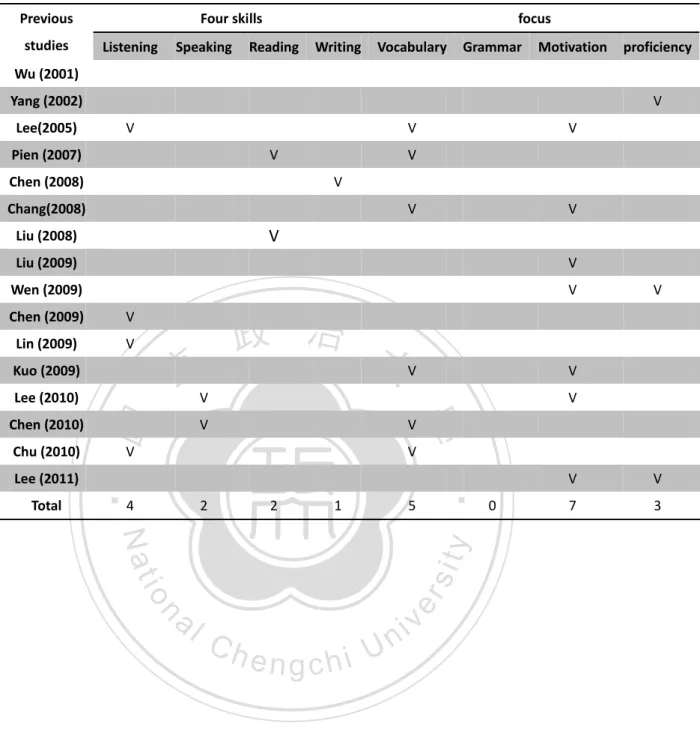
(27) drills, only one right or wrong answer is elicited during meaningful drills. Unlike mechanical drills, however, leaners have to comprehend the meaning of the sentence in order to complete the drills. For example, when practicing prepositions, a teacher might hold up a picture and ask students “where is John’s cat?” All the learners can see the cat in the picture under the sofa, so the answer “it is under the sofa” is a very controlled response. But it is only when learners understand the meaning of the question can they answer it. As for communicative drills, there is no right or wrong answer involved in the drills but they acquire learners to exchange information in. 政 治 大 questions that need learners to express their opinions, such as “what are your 立 order to communicate. For example, information gap activities are one of them or. hobbies?” or “what is your advice to Mary?”. ‧. ‧ 國. 學 Drills in Language Classrooms. y. Nat. Though the notion that learning is likely to occur through repetition of drills is. er. io. sit. advocated by structuralists and behaviorists, some researchers (Lightbown, 1983; Savignon, 1972; Wong & VanPatten, 2003) are strongly against the use of drills in. al. n. v i n C h (1972) empiricalU study indicated that L2 French language classrooms. Savignon‘s engchi leaners in the drill group did not develop communicative competence after engaging. in drill practices. Another group, however, which received communicative training performed significantly better than the drill group. Lightbown’s (1983) study also lent support to this view that drills are unnecessary and may be harmful to their learning. In her longitudinal study of French-speaking ESL learners, she found out that learners tended to overuse the grammatical morphemes in English, which may result from learners’ memorization and repetitive practice.. Even though the use of drills caused strong attack from some researchers 13.
(28) (Lightbown, 1983; Savignon, 1972; Wong & VanPatten, 2003), other scholars (Ellis, 2006; Hammerly, 1991; Hedge, 2000; Nunan, 1999; Politzer, 1968; Stevick, 1996; Ur, 1996; Vilson, 2007) hold the view that drills are necessary in language classrooms. Ur (1996) contended that after presenting and explaining grammar, grammar activities should be followed. Another researcher, Hedge (2000) indicated that grammar teaching consisted of presenting and practicing grammatical structures. Ellis (2006) also argued that grammar teaching involved drawing learners’ attention to focus on certain grammatical structures before they could internalize language.. 政 治 大 Based on Lai’s (2004) survey on high school teachers’ belief of grammar 立. teaching, she found out that most high school teachers hold a positive view about the. ‧ 國. 學. incorporation of pattern practices in grammar teaching. That is to say, the use of. Nat. y. ‧. drills still has its place in language learning.. er. io. sit. As Vilson (2007, p9) argued, “there is no such thing as language learning without drills.” In addition, several researchers (Hatch, 1978; Savigonon, 1972;. al. n. v i n Spada, 1987) argued that learnersCwill need to engageUin both meaningful and hengchi communicative drills to achieve higher level of language proficiency. Therefore, drills cannot be totally discarded in language classrooms.. Songs and Language Teaching The study of music and language has drawn a lot of attention from researchers (Patel, 2003). Even though music is perceived as an important aspect at school, its role in second language learning is still at a beginning stage (Huy, 2000). Some studies tried to discover the relationship between music and language learning. Medina (1990), for example, conducted a study to investigate the effects of music 14.
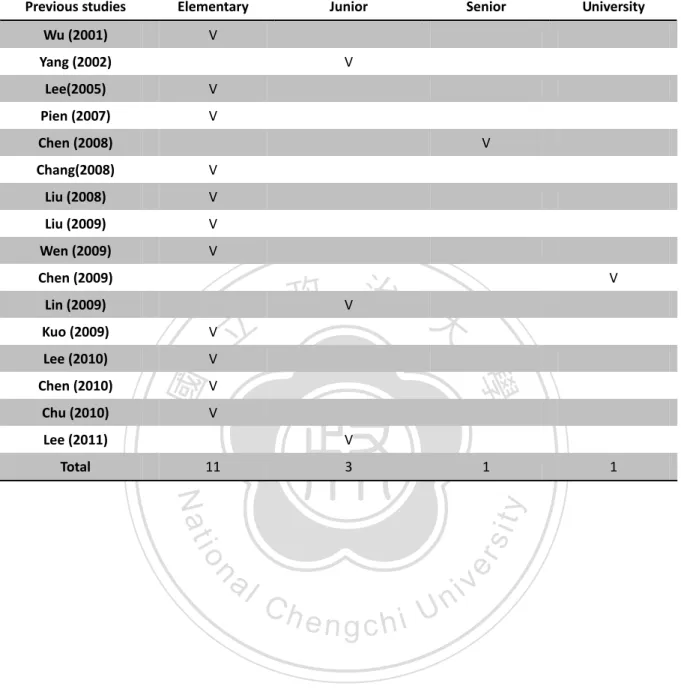
(29) and picture illustrations on second language vocabulary acquisition. All 48 second-graders of limited English proficiency listened to the same story and were divided into four groups: 1. Sung story version, i.e. the story is presented in the form of singing; 2. Oral story version, i.e. the story is read; 3. Sung story version plus picture illustrations, i.e. the story is presented in the form of singing accompanied with pictures of the target words; 4. Oral story version plus picture illustrations, i.e. the story is read and accompanied with pictures of the target words. The results showed that the group with either songs or picture illustrations used scored higher in. 政 治 大 heard the sung version story and saw illustrations at the same time showed the 立. vocabulary gains than the other two groups without. Learners in the third group who. highest vocabulary gains among the four groups, which is consistent with previous. ‧ 國. 學. studies regarding the effects of music on language acquisition.. ‧. y. Nat. In a more recent study conducted by Rafiee, M.; Kassaian, Z., & Dastjerdi, H.. er. io. sit. (2010), they examined the effects of humorous songs on the listening comprehension of 30 Iranian’s EFL learners. The experimental group listened to. al. n. v i n humorous songs before theyCdid the exercises onU h e n g c h i the coursebook, while the control. group did the same exercises without listening to songs beforehand. After 17 sessions of treatment, the two groups took the TOEFL listening test, also used as pre-test again. It is surprising to find out that the experimental group outperformed the control group in the listening test. It is concluded that using humorous songs in EFL classroom could lower learners’ “psychological barrier” and therefore enhanced learners’ listening comprehension.. Beaton (as cited in Whittaker, 2005) described the importance of music in the early childhood language curriculum and mentioned a study of how children 15.
(30) learning French benefited from grammar learning through songs. Apparently, those who were taught a grammatical structure could remember the rule more clearly than those who were taught by using traditional method because they seemed to recall better due to the repetition of the song lyrics. Stokes (2008, p. 25) also supports the view that the combination of music and language can create many connections, as “language is primarily processed in the brain’s left hemisphere and music is in its right hemisphere.” It is believed that the use of music in language class can aid memory (Stokes, 2008). Wallace (1994) demonstrated in his study that music can. 政 治 大. contribute to text recall. That is, the interaction between music and language facilitates memory.. 立. ‧ 國. 學. Studies of English Song Instruction in Taiwan. ‧. A lot of empirical studies in Taiwan have proven the usefulness of using songs in language teaching (see Table 2.1). Pien (2007) examined the effects of using. y. Nat. io. sit. pictures in English song instruction on 63 third graders in elementary school in. n. al. er. Kaohsiung. The results show that students’ vocabulary and reading comprehension. i n U. v. ability were strengthened after the instruction. Chen (2008) investigated the effects. Ch. engchi. of using English songs on writing proficiency of 44 second-grade senior high school students. She indicated that students had significant improvement in writing after the English song instruction. Liu (2008) incorporated song teaching with reading instruction to foster reading proficiency of 55 students who received 40-minute instruction once a week. After 15 weeks of instruction, the experimental group made significant progress in reading proficiency than the control group. In Wen’s (2009) action research, he found out that using English pop songs as a teaching material improved sixth-grade students’ four skills.. 16.
(31) A study by Lin (2010) indicates that the 72 seventh-grade students’ listening comprehension improved as a result of English song instruction. Similar results were also found in Chu’s study (2010) of sixth-grade students. Chen (2010) concluded that pop songs can be a powerful tool to improve EFL young learners’ sight vocabulary acquisition and reading fluency. Lee (2011) compared the performance of the experimental group who received lessons of English songs integrated with lecturing and the control group who was taught mainly through lecturing. She found out that the experimental group outperformed the control group in English. 政 治 大. achievement test after an eight-week treatment.. 立. In conclusion, the application of English songs in language classrooms is. ‧ 國. 學. beneficial for both elementary and junior high school students in their development. ‧. of four skills, vocabulary proficiency and grammar learning. This view is also. y. Nat. supported by Whittaker (1981), who asserts that songs can be useful tools in. er. io. sit. developing learners’ listening, speaking, reading and writing. As Schoepp (2001) stated, songs can be used to increase opportunities for learners in the development of. n. al. cognitive process.. Ch. engchi. i n U. v. Moreover, in terms of affective domain, a number of studies (Chang, 2008; Kuo, 2010; Lee, 2003; Lee, 2010; Lee, 2011; Liu, 2009; Wen, 2009) point out learners’ motivation was greatly enhanced after the English song instruction. For instance, Wen’s (2009) study indicated that most students are more active to learn more and believe that English pop songs can help their English learning after Wen used English pop songs as teaching materials. Similar results were found in Kuo’s (2010) study. Kuo’s (2010) study examined 22 low achievers of fifth-graders’ attitude after English song instruction and the results revealed that participants 17.
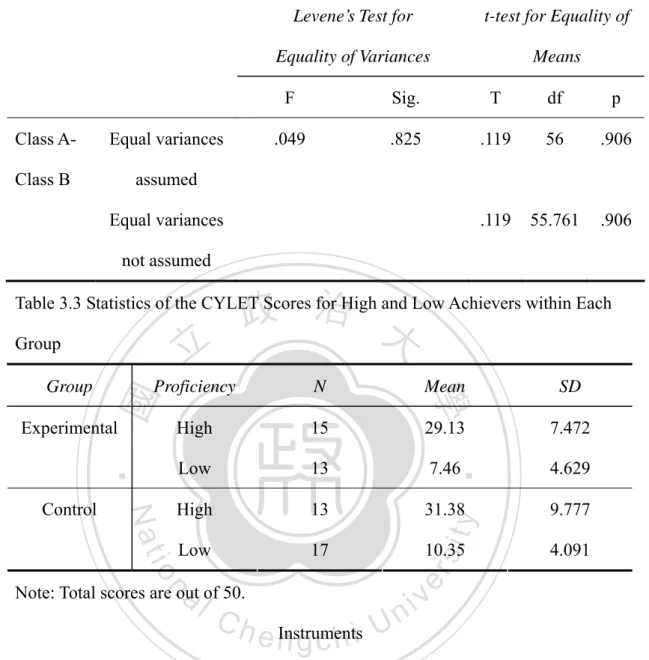
(32) showed a very positive attitude towards the 16-week of English song instruction. In addition, Lee’s (2010) study investigated the effects of English songs and rhymes on the motivation of two classes of second graders, showing that the experiment group demonstrated higher motivation than the control group after the treatment.. When it comes to the age of the participants, most of the studies (Chang, 2008; Chen, 2010; Chu, 2010; Kuo, 2010; Lee, 2005; Lee, 2010; Liu, 2008; Liu, 2009; Pien, 2007; Wen, 2009) focus on the effects of English song instruction on. 政 治 大 2011; Lin, 2010; Yang, 2002) conducted in the environment of junior high schools, 立. elementary school students (see Table 2.2). Among the four studies (Kao, 2008; Lee,. Lin’s (2010) study concentrated on the effects of songs on learners’ listening. ‧ 國. 學. comprehension, while Lee (2011) and Yang (2002) focused on the effects of songs. ‧. on learners’ overall English proficiency. However, few, if any were conducted to. y. Nat. investigate what effects English songs have on junior high school students.. er. io. sit. Therefore, it is worthwhile investigating the effects of English songs on grammar learning and retention of grammar points of junior high school students.. n. al. Ch. engchi. 18. i n U. v.
(33) Table 2.1 Related Studies on English Song Instruction in Taiwan Previous studies . Four skills Listening Speaking. focus . Reading. Writing. Vocabulary. Grammar Motivation. proficiency. Wu (2001) . . . . . . . . . Yang (2002) . . . . . . . . V . Lee(2005) . V . . . . V . . V . . Pien (2007) . . . V . . V . . . . Chen (2008) . . . . V . . . . . Chang(2008) . . . . . V . . V . . Liu (2008) . . . V . . . . . . Liu (2009) . . . . . . . V . . Wen (2009) . . . . . . . V . V . Chen (2009) . V . . . . . Lin (2009) . V . . . . . Kuo (2009) . . 治 政 大 V . . V . . Lee (2010) . . . V . . . . . V . . . V . . . . V . . . . V . . . . . . . . . . V . V . 4 . 2 . 2 . 1 . 5 . 0 . 7 . 3 . io. sit. y. Nat. n. al. er. Total . . ‧. Lee (2011) . ‧ 國. Chu (2010) . 立V . 學. Chen (2010) . . Ch. engchi. 19. i n U. v.
(34) Table 2.2 Related Studies of Different Participants on English Song Instruction in Taiwan Elementary . Junior . Senior . University . Wu (2001) . V . . . . Yang (2002) . . V . . . Lee(2005) . V . . . . Pien (2007) . V . . . . Chen (2008) . . . V . . Chang(2008) . V . . . . Liu (2008) . V . . . . Liu (2009) . V . . . . Wen (2009) . V . . . . Chen (2009) . . . V . Lin (2009) . . . . . . . . . V . . . V . . 學. . . . . V . . . 11 . 3 . 1 . 立 V . Kuo (2009) . V . Total . Nat. y. Lee (2011) . io. sit. Chu (2010) . n. al. er. Chen (2010) . ‧ 國. Lee (2010) . 政 V 治 大 . ‧. Previous studies . Ch. engchi. 20. i n U. v. 1 .
(35) CHAPTER 3 METHODOLOGY This is an empirical study which aims to investigate the effects of English songs on junior high school students’ grammar learning and retention of grammar points. Four sections are included in this part. The first section describes the background information of the participants. The second section is about the introduction and application of the instruments. The third section explains the procedure of the experiment. Finally, the last section illustrates how data analysis is carried out.. 立. 政 治 大 Participants. ‧ 國. 學. Two classes of the seventh graders in a public junior high school in central. ‧. Taiwan participated in the study. They were chosen because they were considered. y. Nat. homogeneous for the following reasons. First, they had similar English proficiency. er. io. sit. based on a standardized English proficiency test, Cambridge Young Learners English Test (CYLET): Flyers (see Appendix A) conducted before the study. The. al. n. v i n twoCclasses were compared h e n g c h i U and. mean scores of the. analyzed through an. independent-samples t-test. As shown in Table 3.1, the mean score of Class A was 19.07 (n=28) with a standard deviation of 12.63, and that of Class B was 19.47 (n=30) with a standard deviation of 12.69. According to the statistics in Table 3.2, these two classes passed the Levene’s test (F=.049, P=.825>.05), indicating that the two classes were homogeneous. The t-test for equality of means also revealed that no significant difference was found between the two classes (t=.119, p=.906>.05).. Second, they were all native speakers of Mandarin Chinese with an average age of 14. Third, they have studied English for at least four years through formal English 21.
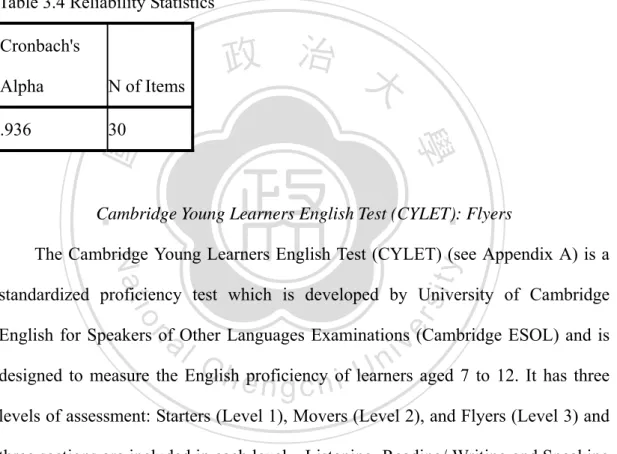
(36) instruction provided in the elementary school prior to this classroom-based experiment. In addition to the homogeneity, they were selected for the reason that they were the researcher’s own classes, so the experimental research was able to be conveniently conducted in practice. Afterwards, one of the classes was randomly assigned as the experimental group, and the other as the control group.. Moreover, in order to investigate what effects” grammar practice through drills plus English songs” and “grammar practice through drills” have on high and low. 政 治 大 levels based on their CYLET scores. The cut-off point was the mean of the CYLET 立. proficiency level students, the participants in each group were divided into two. scores in each group (see Table 3.1). As indicated in Table 3.3, participants (n=28) in. ‧ 國. 學. the experimental group, whose CYLET scores were above the mean of the. ‧. experimental group’s CYLET scores (m=19) were designated as high English. y. Nat. achievers (n=15), while those with the scores under the mean were designated as. er. io. sit. low English achievers (n=13). Similarly, participants (n=30) in the control group, whose CYLET scores were above the mean of the control group’s CYLET scores. al. n. v i n C h achievers (n=13), (m=19) were designated as high English while those with the engchi U scores under the mean were designated as low English achievers (n=17).. Table 3.1 Statistics of Participants’ CYLET Scores Test CYLET. Group. N. Male. Female. Mean. SD. Class A. 28. 14. 14. 19.07. 12.63. Class B. 30. 16. 14. 19.47. 12.69. Note: Total scores are out of 50.. 22.
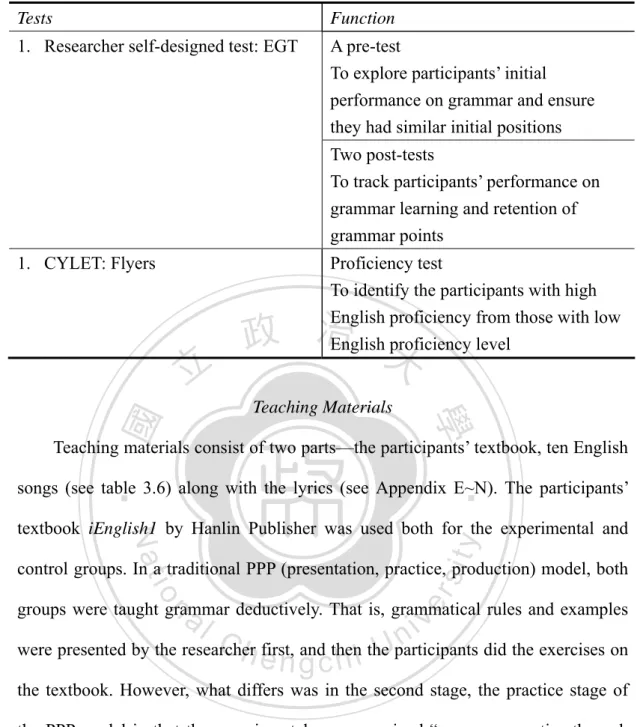
(37) Table 3.2 Independent-Samples t-test on Participants’ English Proficiency Test. Class A-. Equal variances. Class B. assumed. Levene’s Test for. t-test for Equality of. Equality of Variances. Means. F. Sig.. T. df. p. .049. .825. .119. 56. .906. .119. 55.761. .906. Equal variances not assumed. 政 治 大. Table 3.3 Statistics of the CYLET Scores for High and Low Achievers within Each. 立 Proficiency. N. High. 15. Low. 13. 7.46. 4.629. High. 13. 31.38. y. 9.777. Low. 17. 10.35. sit. 4.091. io. al. n. Note: Total scores are out of 50.. Ch. 29.13. 7.472. ‧. Nat. Control. SD. er. Experimental. Mean. 學. Group. ‧ 國. Group. e nInstruments gchi. i n U. v. The following instruments were employed in the present study: (1) English Grammar Test (EGT) as pre-test and post-tests; (2) Cambridge Young Learners English Test (CYLET): Flyers as the test to divide participants into high and low proficiency level; (3) teaching materials, including a) iEnglish 1 by Hanlin (翰林) Publisher and b) ten English songs along with the lyrics.. 23.
(38) English Grammar Test (EGT) The Design of English Grammar Test English Grammar Test (EGT) (see Appendix B) is a researcher self-designed grammar test and it was administered before the formal instruction as a pre-test to both classes so as to ensure they had similar initial performance on grammar. EGT contains 30 multiple choice questions. The use of multiple choices is preferred because the scoring is “reliable, rapid and economical” (Hughes, 2003, p76). All the 30 questions were constructed on the basis of the grammar points covered from. 政 治 大 content validity, a two-way specification table of the grammar points (see Appendix 立 Starter to Unit 5 in participants’ textbook, iEnglish 1. To make sure the test has. C) would be used. Given that EGT is a test of grammar points of 6 units, 30 multiple. ‧ 國. 學. choices were evenly distributed, i.e. five questions for each unit. Each item was. ‧. constructed in a context that was able to offer enough contextual information for. y. Nat. testees to choose one correct answer among the four options. That is to say, each. n. al. er. io. options, the distractors.. sit. multiple choice item consists of one correct answer, the key and three incorrect. The Scoring of EGT. Ch. engchi. i n U. v. As for the scoring of EGT, the participants get 3 points for answering one item correctly. In other words, the total score ranges from 0 to 90. As mentioned above, it was used as a pre-test applied to both seventh-grade classes to ensure that there is no significant difference between the experimental and the control group before the formal instruction which focuses on particular grammar points.. The Validity and Reliability of EGT EGT was validated by my advisor, a professor specializing in testing and two 24.
(39) experienced English teachers, who have more than fifteen years of teaching experience and their suggestions and comments were used to modify the test accordingly. As for the reliability, EGT was administered to a seventh-grade class who did not join the main study. After the test, Cronbach’s alpha coefficient was used to examine the internal consistency reliability of EGT. As the results indicated (see Table 3.4), Cronbach’s alpha for EGT was .936, which was considered as high reliability. As for the reliability of each item, please see Appendix D. Table 3.4 Reliability Statistics Cronbach's Alpha. N of Items. .936. 30. 立. 政 治 大. ‧. ‧ 國. 學. Cambridge Young Learners English Test (CYLET): Flyers. sit. y. Nat. The Cambridge Young Learners English Test (CYLET) (see Appendix A) is a. io. er. standardized proficiency test which is developed by University of Cambridge. al. English for Speakers of Other Languages Examinations (Cambridge ESOL) and is. n. v i n C h proficiency of learners designed to measure the English e n g c h i U aged 7 to 12. It has three. levels of assessment: Starters (Level 1), Movers (Level 2), and Flyers (Level 3) and three sections are included in each level—Listening, Reading/ Writing and Speaking. CYLET: Flyers was chosen because its level of difficulty was considered suitable to assess the proficiency of the seventh-graders by consulting with two other experienced English teachers. Only the reading/ writing section was used because speaking and listening were not the primary focus of the present study.. The Cambridge Young Learners English Test (CYLET): Flyers was used as a 25.
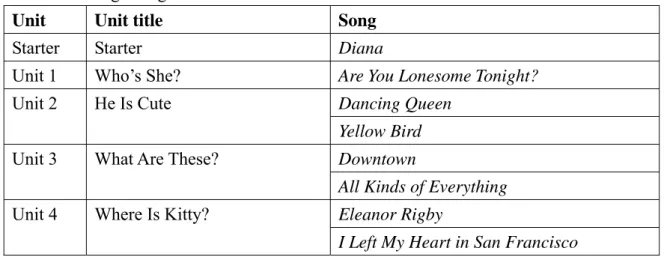
(40) general proficiency test and applied to both seventh-grade classes to assess participants’ English proficiency level before the formal instruction. It was administered to distinguish the participants with high English proficiency level from those with low English proficiency level. In order to compare the effects of “grammar practice through drills plus English songs” and “grammar practice through drills” on high and low proficiency level students, the participants in the experimental and the control group were stratified into two levels, i.e., high and low proficiency level based on their CYLET scores. The cut-off point was the mean of. 政 治 大. all the participants’ CYLET scores (m=19).. 立. A Pre-test and Two Post-tests. ‧ 國. 學. The researcher self-designed English Grammar Test (EGT) was used as pre-test,. ‧. post-test I and post-test II. It was administered before the formal instruction as. y. Nat. pre-test to both classes so as to ensure they have similar initial performance on. er. io. sit. grammar. After the eleven-week instruction, namely right after the participants received 6 units of grammar teaching, the identical EGT was administered again as. al. n. v i n C hof the experimental effects group, engchi U. post-test I to investigate the. which received. “grammar practice through drills plus English songs” and those of the control group, which received “grammar practice through drills” on their performance of grammar learning. Then a month later, EGT was administered to both groups as post-test II to track their retention of grammar points. According to Ebbinghau’s (1964) theory “Curve of Forgetting”, people may only retain only about 2~ 3% of the information they have learned a month later. Therefore, the interval between post-test I and post-test II was one month. The function of the tests used in the study is summarized in Table 3.5. 26.
(41) Table 3.5 The Function of the Tests in the Study Tests. Function. 1. Researcher self-designed test: EGT. A pre-test To explore participants’ initial performance on grammar and ensure they had similar initial positions Two post-tests To track participants’ performance on grammar learning and retention of grammar points. 1. CYLET: Flyers. Proficiency test To identify the participants with high English proficiency from those with low English proficiency level. 立. 政 治 大. ‧ 國. 學. Teaching Materials. Teaching materials consist of two parts—the participants’ textbook, ten English. ‧. songs (see table 3.6) along with the lyrics (see Appendix E~N). The participants’. sit. y. Nat. textbook iEnglish1 by Hanlin Publisher was used both for the experimental and. io. er. control groups. In a traditional PPP (presentation, practice, production) model, both. al. groups were taught grammar deductively. That is, grammatical rules and examples. n. v i n C h first, and then theUparticipants did the exercises on were presented by the researcher engchi the textbook. However, what differs was in the second stage, the practice stage of the PPP model in that the experimental group received “grammar practice through drills plus ten songs” for the treatment, while the control group only did drills in a conventional way, such as oral substitution practices in class. See Appendix O for a sample lesson plan for the experimental group. Table 3.7 summarizes the teaching materials used in the study.. 27.
(42) Table 3.6 Ten Songs Used in the Study No. Songs. Grammar points. 1. Diana. Personal pronouns (I , you, he, she, it) possessive determiners (my, your, his, her, its). 2. Are You Lonesome Tonight?. Question form of the linking verb (be). 3. Dancing Queen. 4. Yellow Bird. Wh-question (how old…?) Adjectives (happy, sad, beautiful, ugly, young, old, full, hungty). 5. Downtown. Plurals (-s, -es, ies). 6. All Kinds of Everything. 7. Eleanor Rigby. 8. I Left My Heart in San Francisco. 9. Somewhere over the Rainbow. 10. Hero. 政 治 大 There is…/there are…. Table 3.7 Teaching Materials Used in the Study. Grammar practice through drills +songs. n. al. Control Group . . er. Grammar practice through drills. io. Practice Practice. y. Nat. Presentation Textbook + grammar instruction. sit. Materials. Experimental Group . ‧. Group. 學. ‧ 國. 立. Wh-question (where…?) prepositions (in, on, under, behind, in front of). i n C Note: Shaded areas are h the different treatments. engchi U. v. iEnglish 1 The participants’ textbook iEnglish1 by Hanlin Publisher was designed based on the Nine-Year Integrated English Curriculum Guidelines of Elementary and Junior High Schools (Ministry of Education, Republic of China, 2004) and was chosen as the textbook used for all seventh-grade classes at the researcher’s school. There are a total of nine units in the textbook, starting from Starter to Unit 8. There is at least one sentence pattern served as the grammar point to be covered in each unit. The sentence pattern is usually presented with examples first, then some 28.
(43) exercises, such as fill-in-the blanks or sentence writing in the following page.. Ten Songs with Lyrics Abbott (2002) argued that the criteria of choosing songs should be based upon two principles-- the age and proficiency level of learners and the level of difficulty of the song and the lyrics. Therefore, ten songs used in the study were selected to meet the two principles mentioned above. As far as participants’ age and proficiency level were concerned, each song was chosen because of its salient grammatical feature of the lyrics. That is, each song was chosen in accordance with the structure. 政 治 大. emphasized in each unit of iEnglish 1, which is a set of approved English textbook. 立. by Ministry of Education. In so doing, the level of the song and lyrics should be. ‧ 國. 學. suitable for the participants. For instance, the song Diana and Are You Lonesome Tonight were used to teach Starter and Unit 1 respectively. As for the rest of four. ‧. units, i.e., Unit 2 to Unit 5, two songs were taught in each unit to familiarize the. y. Nat. sit. participants with the structure. Table 3.8 shows the unit title along with songs to be. n. al. er. io. taught in each unit. In order to draw students’ attention to focus on salient grammar. i n U. v. points, key words which were underlined in the lyrics were deleted as cloze texts to. Ch. engchi. further highlight the grammar points related in each unit. Table 3.8 Songs Taught in Each Unit Unit. Unit title. Song. Starter. Starter. Diana. Unit 1. Who’s She?. Are You Lonesome Tonight?. Unit 2. He Is Cute. Dancing Queen Yellow Bird. Unit 3. What Are These?. Downtown All Kinds of Everything. Unit 4. Where Is Kitty?. Eleanor Rigby I Left My Heart in San Francisco 29.
(44) Unit 5. Are There Any Koalas Here?. Somewhere over the Rainbow Hero. Procedure of the Study The present study took place in the first term of the 2011-2012 academic year. The researcher conducted the study for approximately 3 months, from September to November in 2011. In other words, it was conducted through four stages: pre-test, treatment, post-test I and post-test II (see Figure 3.1). In the 2nd week of the semester, both groups received a researcher self-designed test on grammar points, English. 政 治 大 During the following 11 weeks, each group meet five times a week and 45 minutes 立. Grammar Test (EGT) and Cambridge Young Learners Test (CYLET): Flyers in class.. ‧ 國. 學. per meeting during normal English class time and 6 units were instructed based on the school’s schedule.. ‧. During the treatment stage, i.e., from 3rd to 13th week, both the experimental. sit. y. Nat. and control group were engaged in grammar teaching in the textbook and completed. io. er. exercises in each unit. However, only the experimental group was instructed by learning grammar through drills plus ten English songs during class. That is, during. al. v i n to 13Cweek, the experimental and control group U h e nboth i h gc. n rd. the first four periods from 3. th. had the same treatment. But in the last, or the 5th period of each week, the. experimental and the control group received “grammar practice through drills plus English songs” and “grammar practice through drills” respectively for 15 minutes once a week. After an eleven-week instruction, i.e., in the 14th week, a post-test, EGT was employed to compare the performance of grammar learning of the two groups. A month later, in the 18th week, the same identical EGT was administered as post-test II to track both groups’ retention of grammar points. The procedure of the two groups in the study is presented in Table 3.9. 30.
(45) Data Analysis In the study, the statistical package SPSS (19.0) was used to compute the data collected from the pre-and post-tests. To answer the first and the second research questions, paired-samples t-test were conducted to compare the results of pre and post-test I for the experimental and control groups. To answer the third research question, an independent-samples t-test was applied to compare the mean scores of the experimental and control groups. To answer the fourth research question, an independent-samples t-test was implemented for the mean scores of post-test II of. 政 治 大. the experimental and control groups. As for the fifth research question, which. 立. focuses on the effects of “grammar practice through drills plus English songs” and. ‧ 國. 學. “grammar practice through drills” on high and low proficiency level students, a paired-samples t-test and an independent-samples t-test was used respectively.. ‧. n. er. io. sit. y. Nat. al. Ch. engchi. 31. i n U. v.
(46) Pre-test: A researcher self-designed test on grammar points (EGT). A general proficiency test: Cambridge Young Learners English Test (CYLET): Flyers. The Experimental Group: Drills +English Songs. 立. The Control Group: Drills. 政 治 大. ‧. ‧ 國. 學. Eleven weeks. Post-test I: A researcher self-designed test on grammar points (EGT). er. io. al. sit. y. Nat. One month later. n. v i n C h designed test on U Post-test II: A researcher-self e n g c h i grammar points (EGT) Data Analysis. Figure 3.1 Overall Procedure of the Study. 32.
(47) Table 3.9 The Similarities and Differences in Treatments between the Two Groups Week. Lesson. Class period The Experimental Group. 2 3. The Control Group. Administer the pre-test and proficiency test (45 min). Starter. 1st to 4th 5. th. Grammar instruction, pattern exercises English song *(1) Drills (15 min) +drills (15 min). 1st to 4th th. Unit 2. 5. English song (2) + drills (15 min). 1st to 4th. Grammar instruction, pattern exercises. th. 5. 1st to 4th. 6. 8. Unit 3. 1st to 4th th. Drills (15 min). Grammar instruction, pattern exercises. Grammar instruction, pattern exercises. th. n. al. 1st to 4th 5th. Drills (15 min). ‧. 1st to 4th. io Unit 4. English song (4)+drills (15 min). 治 政 Grammar instruction, 大 pattern exercises. English song (5)+drills (15 min). 5. 10. Drills (15 min). 5. Nat. 9. 立. English song (3) +drills (15 min). 學. 7. ‧ 國. 5th. Drills (15 min). y. 5. Grammar instruction, pattern exercises. English song (6)+drills (15 min). sit. Unit 1. Drills (15 min). er. 4. v i n C h English song (7)+drills engchi U. Grammar instruction, pattern exercises Drills (15 min). (15 min). 1st to 4th. 11. 5. th. 12. Unit 5. 1st to 4th th. 13. Grammar instruction, pattern exercises English song (8) +drills (15 min). Drills (15 min). Grammar instruction, pattern exercises. 5. English song (9) +drills (15 min). 1st to 4th. Grammar instruction, pattern exercises. 5. th. English song (10) +drills (15 min). Drills (15 min). Drills (15 min). 14. 1st. Administer the post-test I (25 min).. 18. 1st. Administer the post-test II (25 min).. Note: Shaded areas are the different treatments. 33.
(48) *The number refers to the song in accordance with sequence taught in Table 3.6.. 立. 政 治 大. ‧. ‧ 國. 學. n. er. io. sit. y. Nat. al. Ch. engchi. 34. i n U. v.
(49) CHAPTER 4 RESULTS. In this chapter, the results of the study are presented and examined. This chapter consists of six sections. The first section presents answers to Research Question 1—What is the effect of “grammar practice through drills plus English songs” on students’ grammar learning and retention of grammar points? The second section gives answers to Research Question 2— What is the effect of “grammar practice through drills” on students’ grammar learning and retention of grammar. 政 治 大. points? The third section reports on the results to answer Research Question 3—Do. 立. students who receive “grammar practice through drills plus English songs” perform. ‧ 國. 學. better in grammar learning than those who receive “grammar practice through drills”? The fourth section shows the findings to answer Research Question 4—Do students. ‧. who receive “grammar practice through drills plus English songs” perform better on. y. Nat. sit. their retention of grammar points than those who receive “grammar practice through. n. al. er. io. drills”? The fifth section provides the results to answer Research Question 5—Is. i n U. v. there any difference between “grammar practice through drills plus English songs”. Ch. engchi. and “grammar practice through drills” for high and low proficiency level students respectively in terms of their grammar learning and retention of grammar points? The final section summarizes all of the findings in the study. The Results of Pre-test, Post-test I and Post-test II for the Experimental Group The results of pre-test and post-test I for the experimental group were shown in Table 4.1. After the experimental group received an eleven-week instruction, post-test I was administered to examine their performance of grammar learning. As seen in Table 4.1, the results indicated that the mean score of post-test I (m=79.10) was significantly greater than that of pre-test (m=57.00). The table shows that 35.
(50) p=.000 < .05, demonstrating that students could benefit from “grammar practice through drills plus English songs” in terms of grammar learning. Post-test II was administered one month after the eleven-week instruction to explore the effects of “grammar practice through drills plus English songs” on students’ retention. The results of pre-test and post-test II for the experimental group were shown in Table 4.2. As shown in Table 4.2, the results indicated that the mean score of post-test II (m=78.64) was significantly greater than that of pre-test (m=57.00). The table shows that p=.000 < .05, indicating that “grammar practice through drills plus English. 政 治 大 Table 4.1 Paired-Samples t-test on the Experimental Group’s Pre-test and Post-test I 立 songs” appears to have positive influence on students’ retention of grammar points.. Group. Test. Experimental. Pre-test. 57.00. group. Post-test I. 79.10. t. df. p. 學. ‧ 國. M. -6.400. 27. .000***. ‧ er. io. sit. y. Nat. * p < .05, ** p < .01, *** p < .001. Table 4.2 Paired-Samples t-test on the Experimental Group’s Pre-test and Post-test II. n. al. CM h. Group. Test. Experimental. Pre-test. 57.00. group. Post-test II. 78.64. e n g cth i -5.215. i n U. v. df. p. 27. .000***. * p < .05, ** p < .01, *** p < .001 The Results of Pre-test, Post-test I and Post-test II for the Control Group The results of pre-test and post-test I for the control group were shown in Table 4.3. Post-test I was conducted to the control group which received “grammar practice through drills” after the eleven-week instruction to investigate the effects of grammar learning. As shown in Table 4.3, the results indicated that the mean score 36.
數據

+7


Outline
相關文件
1. Students will be able to deliver oral presentations, sing songs, poems and read passages fluently. Students will practice reading texts through choral reading,
1-1. Students will be able to deliver oral presentations, sing songs, poems and read passages fluently. Students will practice reading texts through choral reading,
• To enhance teachers’ knowledge and understanding about the learning and teaching of grammar in context through the use of various e-learning resources in the primary
As with all poetry, is-poems are a little more complicated than it looks. You need to write down all your associations and ideas and then just select a few, adding the
vs Functional grammar (i.e. organising grammar items according to the communicative functions) at the discourse level2. “…a bridge between
NETs can contribute to the continuing discussion in Hong Kong about the teaching and learning of English by joining local teachers in inter-school staff development initiatives..
• Teaching grammar through texts enables students to see how the choice of language items is?. affected by the context and how it shapes the tone, style and register of
• The practice aspect refers to “the leadership practice arisen through the interaction of leaders, followers and context” (Spillane, 2004:10–11;
