國 立 交 通 大 學
管 理 學 院
企業管理碩士學位學程
碩 士 論 文
分析公關行業的商業模式和競爭策略 - 愛德曼公關個案Analyzing the business model and competitive strategy in public relations industry
– benchmarking Edelman Public Relations
研 究 生:黃泇菱
指導教授:唐瓔璋
中華民國 102 年 7 月
Analyzing the business model and competitive strategy in public relations industry
– benchmarking Edelman Public Relations
研 究 生:黃泇菱
指導教授:唐瓔璋
Student: Ooi Car Len
Advisor: Prof. Edwin Tang
國 立 交 通 大 學
管理學院
企業管理碩士學位學程
碩 士 論 文
A Thesis Submitted to Master Degree Program of Global Business Administration College of Management National Chiao Tung University In partial Fulfillment of the Requirements For the Degree of Master in Business Administration July 2013 Hsinchu, Taiwan, Republic of China 中華民國 102 年 7 月i
Abstract
Public Relations an umbrella term, with a wide range of functions from investor relations to lobbying has started as powerful political weaponry back in nineteenth century. Through modernization and liberalization, public relations function is shifting from the role of being just a function towards the symmetrical communication. James E. Grunig’s study of public relations as a strategic management has led public relations to a brighter future. If public relations can involve in organizational decision making, it creates value to organizations. In reality, pure public relations firms cannot be survived in the highly competitive public relations industry, especially when they are facing competition and threats from the conglomerates and consequently being acquired as their subsidiary companies. But sadly, they lost the core value of public relations because they became public relations of someone’s advertising agency. However, Daniel Edelman’s adhere to his core believe in public relations has never stop for the past six decades and still moving forwards to become the first public relations centered holding company and the world’s biggest public relations firms. Due to the difference cultural background, the practice of public relations is founded with a gap in Western and Asian countries. Most importantly, we notice that the symmetrical communication will complement with the growth of public relations in the future.
ii
Chinese Abstract
公共關係,一個總稱,從投資者關係至遊說,其功能非常廣泛。早在十九世紀開始,公共 關係被視為強大的政治武器。隨後經過現代化和自由化的演變,公共關係從只是功能演化成為一 個對稱通信功能。詹姆斯.格魯尼格 (James E. Grunig) 在過去四十年對公共關係議題的研究,他指 出公共關係應作為一種戰略管理。如果公共關係可以涉及組織的決策,它也許會創造更高的價值。 在現實中,純公關公司很難存活在競爭激烈的公關行業,尤其是當他們面對的競爭對手是龐大的 企業集團,結果就是被收購成為他們旗下的附屬公司。可悲的是,這些公關公司一旦被收購了就 會失去其公共關係的核心價值,因為他們成為了其他廣告代理公司的公關。然而,丹尼爾·愛德曼 (Daniel Edelman) 堅持了他對於公關的信仰,經過了六十年也從來沒有改變,繼續往目標前進, 因而成為了第一家以公關為核心的控股公司,也成為了全世界最大的公關公司。基於文化背景的 差異,公共關係在西方和亞洲國家的實踐上有一些差距上的不同。但是最重要的是,我們發現對 稱通信與公共關係在未來的增長將有互補的作用。iii
Acknowledgement
I would like to express my deep appreciation to my thesis advisor, Professor Edwin Tang for your patient guidance in advising and inspiring me to complete my master thesis. Besides that, I also wanted to take this opportunity to thank Professor Huang and Professor Liou for being my oral defense committee and your recommendations. Through your valuable advices, I would have improved my thesis. Personally, I am so grateful to my parents and siblings, they are so supportive and encouraging me for pursuing my master study.
It is also important for me to send my thankfulness to Mr. Cédric Alviani, the founder and director of Infine Art & Cultural Exchange. I had been inspiring when I worked in his company during my summer internship and motivated me in doing this research. Finally, I want to take this opportunity to acknowledge all GMBA’s faculty, professors and classmates for helping me to achieve my master degree and complete my thesis.
iv
Table of Contents
Abstract ... i Chinese Abstract ... ii Acknowledgement ... iii List of Tables ... viList of Figures ... vii
1. Introduction ... 1
Part I: Exploring the Importance of Public Relations ... 3
2. Chapter 1: Concept Definitions ... 3
2.1 Public Relations ... 3
2.2 Public ... 4
2.3 Communication ... 5
2.4 Relationships ... 5
2.5 Stakeholders ... 5
2.6 Public Relations Functions... 6
3. Chapter 2: Literature Review ... 9
3.1 Public Relations as a Strategic Management ... 9
3.1.1 The “Edifice” ... 9
3.1.2 Strategic Management of Communication ... 11
3.2 Public Relations Strategy ... 13
3.2.1 Perspective of Strategy ... 13
3.2.2 Levels of Strategy ... 14
3.2.3 Competitive Strategy ... 15
3.2.4 Corporate public relations and marketing public relations ... 16
4. Chapter 3: Public Relations Models ... 17
4.1 “Communication” in the conceptual framework of PR ... 17
4.2 Research Process ... 17
4.3 The Rise of Public Relations ... 18
4.4 Development of PR models ... 21
4.4.1 Press Agentry/ Publicity Model ... 21
4.4.2 Public Information Model ... 22
v
4.4.4 Two-way Symmetric Model ... 22
4.5 Asymmetrical versus Symmetrical Models ... 23
Part II: The Effect of Public Relations Theory and Practice ... 25
5. Chapter 4: Public Relations Industry Overview ... 25
5.1 Background... 25
5.2 Trends in Public Relations Industry ... 26
5.2.1 Fast Growing Industry ... 26
5.3 Industry and Market Forces ... 27
5.3.1 Global Market Players ... 27
5.3.2 Market Forces ... 33
5.4 Public Relations in Taiwan ... 34
5.4.1 The Geo-political Context ... 35
5.4.2 The Economic and Media Context ... 36
5.4.3 Societal Culture ... 36
5.4.4 Market Players in Taiwan ... 37
5.5 Differences in Global PR and Taiwan’s PR practice ... 40
6. Chapter 5: Edelman Public Relations ... 42
6.1 Company Background ... 42 6.1.1 Edelman’s Culture ... 42 6.1.2 Company Evaluation... 43 6.2 Competitors ... 44 6.3 Competitive strategy ... 46 6.3.1 Intellectual property... 47
6.4 Implications for Public Relations ... 48
6.4.1 Organization Structure ... 48
6.4.2 PR industry ecosystem ... 50
6.4.3 Collaboration ... 52
6.4.4 Symmetrical Communication ... 53
7. Conclusion and Limitations ... 55
vi
List of Tables
Table 1: History of PR and Development of PR Models ... 19
Table 2: Presuppositions between Asymmetrical and Symmetrical Worldviews ... 24
Table 3: Industries with the highest levels of employment in occupation ... 27
Table 4: The top ten global PR firms in 2012 ... 29
Table 5: Comparison between Global PR industry and Taiwan’s PR industry ... 41
vii
List of Figures
Figure 1: The role of public relations as strategic management of communication ... 12
Figure 2: Research process ... 18
Figure 3: Percentage change in employment, projected 2010-2020 ... 26
Figure 4: Median annual wages, May 2010 ... 26
Figure 5: Phenomenon in PR industry ... 40
Figure 6: Edelman's growth rate over the 5 years ... 43
Figure 7: Edelman's revenue by practice (2012) ... 44
Figure 8: Edelman's revenue by region (2012) ... 44
1
1. Introduction
There is great influence of public relations in our daily life. Ranging from daily mass media influences to government lobbying is related to public relations. The term public relations carried a wide range of definitions and functions. A lot of scholars have studied about public relations for the past decades and the most influential public relations scholar is James E. Grunig. He had developed the main framework for public relations studies and theories in his over 45 years of research and studies in public relations. Thus, I am keen to explore the public relations industry and its business model.
Unlike the public relations in the United States, public relations in Taiwan is perceived as lower status industry compare to advertising and marketing industry. Therefore, PR professionals are considered as labor intensive rather than professional intensive because I have met a lot of people who had worked as PR practitioners but never want to go back to PR industry again because they were found with low salaries if compared to the time contributed for executing projects.
For my study, I begin my thesis with literature review. Chapter one is composed of the main concept of public relations and definitions. Then, we will review the literature used to analyze the role of public relations as strategic management and public relations strategy. Chapter three will focus on public relations models that developed by James E. Grunig, the well-known public relations scholar and researcher. With more than 40 years in observing public relations practice around the world, he classified public relations models into asymmetrical model (press agentry, public information and two-way asymmetrical models) and symmetrical model. From his early research and ongoing research on excellent public relations which emphasized on public relations as strategic management is crucial to organization effectiveness. By understanding the fundamental and development of these four business models, it will be helpful for the industry analysis in the following chapter.
Furthermore, we will find out the effect or difference of public relations practice by comparing the global public relations practice with local practice (targeted Taiwan as local). In this part, my audience will have an overview of the history and evolution of public relations industry. The history of public relations can be traced back from the nineteenth century where it started in United States and spread to United Kingdom in the 1920’s. Most of the public relations
2 companies in the United States were owned by postwar communication veterans. The leading public relations companies like Hill & Knowlton and the postwar start-up agencies like Burson-Marsteller and Edelman, still successfully operating their business in the intense competitive public relations industry. These public relations firms were ranked on top ten in the Holmes Reports 2012.
Finally, in Chapter five, to have a better case study of a successful public relations firm, we have chosen Edelman (top ranking company in the Holmes Report for two years, consecutively) as the benchmarking PR firm to analyze its business model as well as the competitive strategy. Using these implications, we shall be able to give some propositions for the public relations practitioners in Taiwan.
3
Part I: Exploring the Importance of Public Relations
2. Chapter 1: Concept Definitions
2.1 Public RelationsWhen we mentioned the term of public relations (PR), it carries a lot of definitions because PR is actually an umbrella term. Most of the people have misconception for the term as people always confused between PR and marketing. For example, Paul Holmes, the president and editor of Holmes Group with more than 15 years in writing about PR business has come up with the explanation in PR Week, “Someone once told me he was changing his firm’s name from XYZ Public Relations to XYZ Marketing Communications because we have broadened our portfolio of services.”1
Based on his experience, he thought marketing has much narrow aspect than PR because marketing is building the relationship between an organization with its customers, on the other hand, PR is building the relationship between an organization with all the stakeholders. 2
According to Public Relations Society of America (PRSA), the earliest definitions of PR were focused on publicity or press agentry but the modern definitions of PR move towards the concepts of “engagement” and “relationship building”. In 2011, PRSA came up with a new modern concept of PR by defining PR as “a strategic communication process that builds mutually beneficial relationships between organizations and their publics.” Most importantly, the word “process” is refers to “management function” which can raise the ideas of control and top-down, one-way communications.3
James Grunig and Hunt (1984) also characterized PR as the management of communication between an organization and its publics. The definition from Public Relations News “Public relations is the management function which evaluates public attitudes, identifies the policies and procedures of an individual or an organization with the public interest, and plans and executes a program of action to earn public understanding and acceptance . 4
1
http://www.prweekus.com/paul-holmes-to-overcome-its-identity-crisis-the-industry-has-to-define-and-defend-public-relations/article/46697/
2
Effective Public Relations, p.7
3 http://www.prsa.org/AboutPRSA/PublicRelationsDefined/ 4 Effective Public Relations, p.4
4 Institute of Public Relations (IPR), the leading professional public relations organization in UK defined PR (1987) as the planned and sustained effort to establish and maintain goodwill and understanding between an organization and its publics. The word ‘planned’ and ‘maintain’ were emphasized that the relationships are not form automatically or without effort. Thus, they have to be ‘established’ and ‘maintained’. Public relations work exists in time and they focus on goodwill and mutual understanding between organization and the publics.5
2.2 Public
Public is the target audience in the communication relationships. According to James E. Grunig and Hunt (1984), public can be segmented. They pointed out that a crucial distinction for segmenting a population of people into publics is the extent to which they passively or actively communicate about an issue and the extent to which they behave in a way that supports or constrains the organization’s pursuit of its mission. They identified three types of publics:
(1) Active publics have detected a problem regarding the organization or an issue important to the organization. Members of an active public have communicated about the problem or issue and are organizing to do something about it.
(2) Aware publics have detected a problem, but have not communicated with each other nor have they organized for action.
(3) Latent publics are people affected by consequences of organizational actions, and therefore are linked to the organization. However, latent publics are unaware of these consequences; such publics have not detected a problem.
J. Grunig’s (1978) theory of publics underscores the dynamic nature of defining publics according to concepts of open-systems theory. Following J. Grunig’s theory, publics are not viewed as fixed or constant. Moreover, publics are defined by the consequences of organizations’ actions and issues. They are monitored as they pass from non-publics status to latent, aware, and active publics. Action and communication strategies are implemented to change publics and adapt the organization to those publics.6
5 The Handbook of PR, p.5
5 2.3 Communication
Windahl and Signitzer (1992) point out that there are two main traditions in defining communication, the one-way transmission model and the two-way exchange concept. In contrast, Rogers and Kincaid define communications as ‘a process in which the participants create and share information with one another in order to reach a mutual understanding’.
Moreover, Berger (1995) identifies four levels of communication: intrapersonal (thoughts), interpersonal (conversations), small group communication (like a lecture) and mass communication. He points out that talking to another or others uses the airwaves to carry the verbal message, as well as non-verbal communication, like body language, facial expression and so on. Mass media communication uses print, broadcast or phone wires to communicate with a wide range of geographically scattered people.
2.4 Relationships
According to Grunig, relationships is a way to evaluating the contribution of public relations programs and the overall function to organizational effectiveness in the long-term and short-term. Huang (1997) and Grunig and Huang (2000) began to identify trust, control mutuality, satisfaction, and commitment as key components of high-quality relationships that can be measured for both planning and evaluation of public relations (Grunig 2006).
Hon and J.E. Grunig (1999) also identified two types of relationships, exchange and communal relationships. They argued that public relations makes a unique contribution to strategy when it helps organizations develop communal relationships with the publics, where the relationships that benefit publics but not necessarily the organization. However, Hung (2002, 2005) founded six types of relationships after the study of the relationships of multinational companies in China. They were mutual communal, covenantal, contractual, symbiotic, manipulative, and exploitive relationships. As a result, she found that covenantal relationships helped reach a win-win situation while mutual communal relationships benefitted multinational companies the most.
2.5 Stakeholders
In his book, Grunig mentioned that the terms stakeholders and publics are used synonymously. However, they are still difference by definition. People are included in stakeholders because they will be affected by organizational decisions or vice versa. If
6 stakeholders are more aware and active can be described as publics. Furthermore, J.E. Grunig identified the eight most common categories of stakeholders in his Excellence Study, they are employees, media, investors, community, customers, government, members of associations, an donors. (Austin and Pinkleton 2006)
2.6 Public Relations Functions
As mentioned in previous section, public relations (PR) is an umbrella term. Now, we would like to look at the PR functions to have a clear concept about PR activity. Questions like “What is PR”, “When is PR being used”, “Who is PR practitioners”, “Why PR is needed” and “How can PR functioning” can be answered from this section by explaining the activities and techniques of PR. The practice of public relations includes publicity, lobbying, internal relations, advertising, press agentry, public affairs, issues management, and investor relations. These public relations functions act differently in every organization because it depends on the need or situation occurs. (Cutlip, Center et al. 2000)
Internal Relations
Before any relationship can be maintained with customers, consumers, neighbors, investors, and others outside the organization, management must attend to those who do the work, which are the employees. Hence, employees should be treated as “the organization’s most important asset”, and organization culture plays an important role. Organizations will need to plan and implement programs of internal communication to keep employees informed and motivated, and to promote the organization’s culture.7
Publicity
The earliest definition of PR is focused on publicity. Publicity is information provided by an outside source that is used by the media because the information has news value. Back in the old times, publicity is an uncontrolled method on information being used because the source does not pay the media for placement. Therefore, a lot of misused by the media.8
Advertising
Unlike the publicity model, advertisers control content, placement, and timing by paying for media advertising time and space. Both publicity and advertising are mediated
7 Effective Public Relations, p.9 8 Effective Public Relations, p.10-11
7 communication, but advertising is using a controlled method over the source and information that being advertised.9
Press Agentry
Press agenty is creating newsworthy stories and events to attract media attention and to gain public notice. They focus on gaining attention more than to build public understanding and most of the time they use publicity as their major strategy. Commonly, press agentry plays a major role in the music recording industry, professional sports, tourist attractions, motion picture studios, television, concert and theater performances and companies headed by celebrities.10 Public Affairs
“Public Affairs” is commonly used in the military services, many governmental agencies, and some corporations as a substitute for public relations. Public affairs is a specialized part of public relations, which refers to build and maintain governmental and local community relations in order to influence public policy. Corporate public affairs specialists serve as liaisons with governmental units, implement community improvement programs, encourage political activism, campaign contributions and voting, and volunteer their services in charitable and community development organizations.11
Lobbying
Lobbying carries the meaning of public affairs, but refers to an even more specialized and criticized part of public affairs because lobbying attempts to influence legislative and regulatory decisions in government. Lobbying involves much more than persuading legislators.12
Issues Management
Issues management is the proactive process of anticipating, identifying, evaluating, and responding to public policy issues that affect organizations’ relationships with their publics. There are two points to capture the essence of issues management: (1) early identification of
9
Effective Public Relations, p.12
10
Effective Public Relations, p.14
11 Effective Public Relations, p.15-16 12 Effective Public Relations, p.16-19
8 issues with potential impact on an organization, and (2) a strategic response designed to mitigate or capitalize on their consequences.13
Investor Relations
Investor relations are very important to corporate public relations because it helps to build and maintain mutually beneficial relationships with shareholders and others in the financial community to maximize the market value. The specialists work to enhance the value of a company’s stock. This reduces the cost of capital by increasing shareholder confidence and by making the stock attractive to individual investors, financial analysts, and institutional investors.14
13 Effective Public Relations, p.19-20 14 Effective Public Relations, p.20-21
9
3. Chapter 2: Literature Review
3.1 Public Relations as a Strategic Management
3.1.1 The “Edifice”
In James E. Grunig research article, Furnishing the Edifice: Ongoing Research on Public Relations as a Strategic Management Function, conceptualizes public relations as strategic management rather than just acting as publicity function. As publicity function is information provided by an outside source that is used by the media for the news value.15 He had spent over 40 years in public relations and developed an “edifice”, which provides a framework for public relations practice and have become the important role in the development of public relations theory and research.
The first part of the edifice was the situational theory of public that renamed by James E. Grunig from the cognitive dissonance theory which focus on information seeking. According to the theory, it explains the communication behavior points out that people were likely to selectively expose themselves to messages that supported their attitudes. In other words, people are more likely to be subjective and bias to such information. With the early intention of wanted to know the reason of why people seeking information and explain why messages have effects, James E. Grunig had brought in the critical element in theory of public relations and strategic management for today’s practice. He then found out that the situational theory can become a tool to segment stakeholders into publics, to isolate the strategic publics with whom it is most important for organizations to develop relationships to be effective, and to plan different strategies for communicating with publics whose communication behavior ranged from active to passive.
From the situational theory to the organizational theory, James E. Grunig did his study of communication behavior of organizations and found that most of them were likely to give information rather than to seek information from the publics. This means organizations also using the same types of communication behavior identified by the situational theory. This is so called the one-way communication. By his later extended research to many organizations that doing
10 public relations in the United States, he followed Thayer (1968) idea of synchronic and diachronic communication to explain one-way and two-way communications. Later, he revised these two concepts into the major four models of public relations, (1) press agentry/publicity, (2) public information, (3) two-way asymmetrical and (4) two-way symmetrical (J.E. Grunig, 1984). The research suggested that the relationship among the models of public relations and these organizational variables (organizational structure, environment, technology, size, age, culture, worldview, and power structure) was normative rather than positive. He thinks the knowledge of public relations practitioners had a major effect on practicing the two-way symmetrical public relations model.
When the International Association of Business Communications (IABC) Research Foundation issued a request for proposals in 1984 for research on “How, Why, and to What Extent Communication Contributes to the Achievement of Organizational Objectives”, James E. Grunig considered it was a good opportunity for him to move further from the program level of AT&T research back in the late 1970s. Therefore, through the Excellence study he gained the possibility of building a grand theory to explain the value of public relations. For the IABC’s research, the most important part was to explain the value of public relations. From Grunig’s literatures review on organizational effectiveness, first it showed that public relations has value when it helps the organization achieve its goals. However, to reach those goals need to go through the interaction with strategic constituencies, which are the stakeholders and publics. Secondly, public relations can add value when using the symmetrical communication to build and maintain the relationships with strategic publics.
However, for today’s public relations practitioners, they pay much more attention on showing the positive financial return on investment (ROI) in public relations. The Excellence study did a great job in explaining the value of public relations in a more logically and satisfying way. Although J. E. Grunig concluded that it is difficult to measure the relationships with public in monetary value, refers to measure ROI. But, the interviews done with CEOs and senior public relations practitioners gave them some useful examples of how good relationships had help to reduce the costs of litigation, regulation, legislation, reduced the risk of making decisions that affect different stakeholders, negative publicity was caused by poor relationships and so on, all
11 these turned out to be the powerful evidence to show the value of good relationships with strategic publics.
More importantly, the Excellence study provided solid theory and empirical evidence of how the public relations function should be organized to maximize its value. J. E. Grunig (1984) indicated that public relations must be organized in a way that makes it possible to identify strategic publics as part of the strategic management process and to build quality long-term relationships with them through symmetrical communication programs. Firstly, the involvement in strategic management was the critical characteristic of excellent public relations and public relations must be empowered, if not public relations will have little effect on organization decisions making. Secondly, the adoption of horizontal public relations function in an organizational structure will be better than vertical structure because it allows them worked with other management functions such as marketing will collaborate more than just competed for resources and this will turn out to be an excellent public relations function. Therefore, he concluded that if the role of public relations in strategic management is to bring the voices of publics into the decision-making process, public relations should be able to improve the ethics and social responsibility of organizational behaviors.
3.1.2 Strategic Management of Communication
The term ‘strategic management’ is included the concepts of issue management and corporate communications where the word ‘strategic’ is means to achieve goals and solve problems. Therefore, strategic public relations starts when PR practitioners identify potential problems that might happen in the relationships between organization and stakeholders (Plowman 2005).
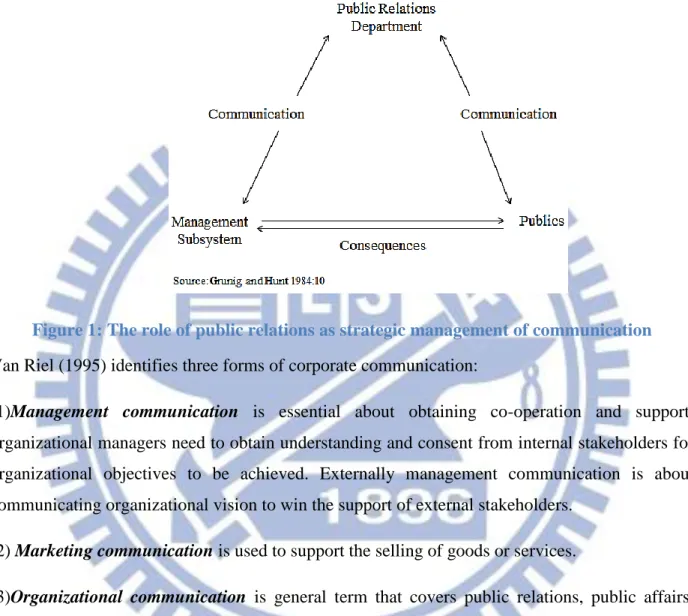
Grunig and Hunt (1984) propose that organizations typically develop a formal communication function ‘when the organization or its publics behave in a way that has consequences upon the other’. If these consequences are adverse, then a public relations problem or issue is created. Grunig and Hunt’s depiction of the role of the public relations department is shown in the figure below. This relationship holds good for both internal and external publics. The contribution of public relations in the strategy-making process is helping to collect and
12 interpret information from the social environment so that strategic decision can be made. Next, PR involves in the communication of the strategic vision (Theaker 2004). 16
Figure 1: The role of public relations as strategic management of communication Van Riel (1995) identifies three forms of corporate communication:
(1)Management communication is essential about obtaining co-operation and support; organizational managers need to obtain understanding and consent from internal stakeholders for organizational objectives to be achieved. Externally management communication is about communicating organizational vision to win the support of external stakeholders.
(2) Marketing communication is used to support the selling of goods or services.
(3)Organizational communication is general term that covers public relations, public affairs, investor relations, internal communication and corporate advertising. Most of these activities Van Riel states to be within the remit of public relations.
However, Varey and White (2000) narrow this down to two inter-related communication systems.
Internal systems aim to enable the organization to meet its goals by gathering and interpreting
data on expectations, attitudes and conditions from the external environment via external communication channels.
13
External systems aim to present information about the internal processes of the organization to
the external environment in an attempt to influence the behavior of various publics.17 3.2 Public Relations Strategy
3.2.1 Perspective of Strategy
(Grunig 2006) had mentioned that the relationship perspective on public relations suggests that the purpose is to manage relationships with publics. However, the logic suggests that it is not really possible to ‘manage’ relationships, or reputation, images, or brands. The possible way we can do is influence outcomes by managing the processes. Therefore, J.E. Grunig had chosen the term “cultivation” for the strategies used in ongoing relationship processes.
Hon and J.E. Grunig (1999) identified several of these cultivation strategies in the literature on interpersonal communication and conflict resolution and classified them as symmetrical and asymmetrical strategies and he believed that the concept of relationship cultivation strategies is the heir to models of public relations and the two-way symmetrical model because the cultivation strategies identify specific ways in which symmetrical communication can be used to cultivate relationships. As an example, the strategy of “sharing of tasks” is a kind of symmetrical strategy. It is used in organizations to solve problems of concern to stakeholders as well as problems it is concerned with.
According to Austin and Pinkleton (2006), strategic decision making is goal directed and guided by an organization’s larger purpose. According to Fred Nickols (2000), “strategy is the bridge between policy or high-order goals on the one hand and tactics or concrete actions on the other.” Tactical decision making on the other hand, focuses more day-to-day actions and therefore tends to be more response oriented in nature. When practitioners respond to problems and challenges strategically instead of tactically, they have a much greater likelihood of helping organizations meet their challenges, solve or avoid protracted problems, and adjust to the expectations of key stakeholders in mutually beneficial ways (Austin and Pinkleton 2006). 18
The concept of strategy is defined as a broad consensus exists within the management literature that strategy is essentially concerned with a process of managing the interaction
17 The PR Handbook, p.59 18 Strategic PR Management, p.4
14 between an organization and its external environment so as to ensure the best ‘fit’ between the two. From this perspective, it can be argued that the public relations function has the potential to make an important contribution to strategic management through its role at the interface between an organization and its environment. For example, Grunig and Repper (1992) argue that public relations is able to contribute to organizational strategy by helping ‘to manage potential conflict and assisting in building relationships with those strategic publics who may limit the autonomy of the organization ‘to attain its goals’. Hambrick (1983) suggests two main reasons for this lack of consensus: first, strategy is a multidimensional concept; and secondly, strategy is inherently situational and will, as a consequence, tend to vary by industry (Kitchen 1997). 19
3.2.2 Levels of Strategy
Conceptually, strategy has been considered in terms of a hierarchically organized structure in which the essential layers of any formal strategic planning process are seen to comprise the corporate, business and functional levels of strategy (Hax and Majluf, 1991). Johnson and Scholes (1993) draw the following distinctions between corporate, business and operational or functional strategies.20
Corporate strategy is concerned with what type of business a company as a whole should be
in and is therefore concerned with decisions of scope. It may also be concerned with decisions regarding the acquisition or divestment of businesses or with the allocation of resources between a company’s different businesses. Corporate strategy is also likely to be concerned with questions about the financial structure and organizational structure of a company as a whole. In other words, corporate strategy addresses issues which by their very nature affect the totality of the organization.
Business or competitive strategy is concerned with determining how a company should
compete in particular markets. Thus, while corporate strategy is concerned with decisions about the organization as a whole, competitive strategy is more likely to be concerned with various business units within the organization. Here, decisions may focus on such issues as whether to compete across a market as a whole or whether to focus on particular segments of the market.
19 A Strategic Perspective for PR, p.45
15 Competitive strategy decisions may also be concerned with how best to enter new markets, or how best to combat the threat from competitors in the markets in which the organization operates.
Operational or functional strategy is concerned with how the various functions of an
organization – marketing, finance, personnel, manufacturing, and so on – contribute to the success of other levels of strategy. As Johnson and Scholes (1993:11-12) point out ‘in most businesses, successful business strategies depend to a large extent on decisions which are taken, or activities which occur, at the operational level. The integration of operations and strategy is therefore of great importance’.
Overall, it is generally recognized that all three levels of strategy need to be integrated closely together in order to ensure that an organization is able to make optimum use of its resources and is able to compete effectively in its markets.
3.2.3 Competitive Strategy
Competitive strategy has been described as ‘the core level of strategy’ because it is at this level that most competitive interaction occurs and where competitive advantage is ultimately won or lost (Montgomery and Porter, 1991:xiv).21
Perhaps the most important and influential contribution to thinking about competitive strategy in recent years has been that of Harvard Business School Professor, Michael Porter, whose texts Competitive Strategy: Techniques for Analyzing Industries and Competitors (1980) and Competitive Advantage: Creating and Sustaining Superior Performance (1985) have undoubtedly had a pervasive influence on thinking in this field. For Porter (1985:1), the emphasis on competition is all important:
Competition is at the core of the success or failure of firms. Competition determines the appropriateness of a firm’s activities that can contribute to its performance, such as innovations, a cohesive culture, or good implementation. Competitive strategy is the search for a favorable competitive position in an industry, the fundamental arena in which competition occurs.
16 Competitive strategy aims to establish a profitable and sustainable position against the forces that determine industry competition.22
Therefore, competitive advantage lies on ‘upstream’ of product markets and depends on firm’s characteristic and most importantly the firm’s resources are difficult to imitate by competitors (Teece, Pisano et al. 1997).
3.2.4 Corporate public relations and marketing public relations
When defining marketing, McCarthy (1960) argued that its basic task was to combine the four main elements into a marketing program to facilitate the market exchange, known as the marketing mix or 4P’s (product, price, place, and promotion). Likewise, promotion was traditionally divided into four elements, known as the promotional mix: advertising, sales promotion, personal selling and public relations. In recent times, this promotional mix has been extended to include direct mail, sponsorship and the Internet (Dibb et al., 2001). In this context, public relations is seen as a communication tool that will be coordinated with the others (e.g. advertising) to achieve a previously defined marketing objective. Therefore, when seen in relation with marketing, public relations is incorporated within its aims. According to Goldman (1984) “while all public relations is concerned with strategy, marketing-oriented PR is concerned with marketing strategy” (Lages and Simkin 2003).
Public relations academics trying to build a specific theoretical framework for the discipline reject marketing PR as a limited and misleading view of the practice. Public relations academics consider that when deployed solely as a marketing tool, public relations is reduced to a short-term, non-strategic technical task, far from its managerial potential (Grunig, 1992). Most underline that marketing and public relations are completely different managerial function (Cutlip et al., 1999). Additions to the theoretical discipline of PR, may well encourage marketers to reconsider and acknowledge the longer-term strategic input possible from public relations.
17
4. Chapter 3: Public Relations Models
4.1 “Communication” in the conceptual framework of PR
From previous literature reviews, we could say that “communication” is the key of public relations. Scholars used a lot of communication theories to developed approaches to public relations. Before J. Grunig developed the PR models during his first study of PR relations behavior, He used Thayer’s (1968) concepts of synchronic and diachronic communications as the idea of one-way and two-way models of communication. In Thayer’s concepts, he pointed out that the purpose of synchronic communication is to “synchronize” the behavior of a public without changing organization behavior so that the organization can continue to behave in the ways they want. On the other hand, diachronic communication is to negotiate a state of affairs that benefits both the organization and the public.
Later, J. Grunig (1984) concluded that the term synchronic and diachronic literally means “at one time” and “at two times”, cannot point out the difference in purpose. As an ongoing process, he elaborated the idea of one-way and two-way models of communication by including the purpose of communication as well as the direction. He replaced the terms with the terms asymmetrical and symmetrical to describe the purpose of PR as balanced and unbalanced communication and the effects.23
4.2 Research Process
We will begin the research process by understanding the four models of public relations developed by James E. Grunig. Using the fundamental of these four models, we will then start to look at the global public relations industry and Taiwan’s PR industry. By studying the two different markets, we will be able to review the differences between them and find out the implications. Next, we will narrow down our scope of study to Edelman Public Relations as a case study. We benchmarked Edelman PR because it is the biggest PR firm in the world and we hope that we could study the uniqueness of the company, at the same time to reveal its competitive strategy. Finally, we should be able to come up with some propositions after the long process of study.
18 Figure 2: Research process
4.3 The Rise of Public Relations
To have a better understanding with the models of public relations, we will begin with the rise of public relations. Basically, the growth of public relations can be traced back in seven major periods of development since the nineteenth century.24 In table 1, it shows the summary of the history and development of public relations models. Although the development of PR models is not clearly defined by historical year, these models were developed to fit into the purpose during the seven periods. The purpose or usage of each PR models is important because it represents the growth and evolution in public relations industry. Still, the process of developing PR theories and models still ongoing and we can only distinguish by using the literature reviews from scholars.
19 Table 1: History of PR and Development of PR Models
History of PR (7 periods) Development of PR models
Seedbed Era (1900-1916) World War I (1917-1918) Booming Twenties (1919-1929) World War II (1930-1945) Postwar Era (1946-1964)
Period of Protest & Empowerment (1965-1985)
Digital Age and Globalization (1986-present)
Many PR firms came in during this period: - Edelman (1952)
- Burson-Marsteller (1953)
Two-way Symmetrical Model Press Agentry / Publicity
- P.T. Barnum
Public Information Model - Ivy Lee
Model
Two-way Asymmetrical Model - Edward L. Bernays
20 Seedbed Era (1900-1916)
During this period, PR was about muckraking. The muckraking journalists effectively exploited the newly developed national forums by popular magazines, national wire services and feature syndicates.25 According to Regier, muckraking was the inevitable result of decades of indifference to the illegalities and immoralities attendant upon the industrial development of America (Regier 1932). To overcome this issue, big companies hired former reporters to deal with the muckrakers using whitewashing press agentry. The historical key person at that time was Ivy Lee. He was the one started to use the term publicity to describe public relations.
World War I Period (1917-1918)
Before World War I, the contemporary practice of public relations emerged as a defensive measure, but during this period PR became a great offensive motive power.
Booming Twenties Era (1919-1929)
After World War I, the booming era began. During this period, PR specialty was widely spread due to the wartime developments and the used of PR advertising as a tool started to increase. It is used in government, business, education and others. The most influential figure appeared in the twentieth century, Edward L. Bernays, people also called him the “father of public relations”. He was a propagandist during that period.
World War II (1930-1945)
World War II created a lot of dramatic changes in the environment and hence brought up the development of public relations. Furthermore, the paid advertising appeared to be a major tool for public relations.
Postwar Era (1946-1964)
A lot of new opportunities and new demonstrations of the utility of PR was driven by World War II. For example, using PR in motivating war production, military morale, and civilian support, also brought in new techniques and channels of communication. Furthermore, those
21 major PR firms that dominate the market today were established back in this postwar era, such as Edelman Public Relations (1952) and Burson-Marsteller (1953).
Period of Protest and Empowerment (1965-1985)
This era put “consumerism”, “environmentalism”, “peace”, “racism”, “sexism” at the top of the public agenda. A new breed of investigative muckrakers and powerful new advocacy groups pushed for social change, new social safety nets, and increased government oversight of business and industry. During this period, organizations became more responsive to public concerns and values. 26
Digital Age and Globalization (1986-present)
The digital age and globalization period is the last but still ongoing period because it still has great influence on every business industry nowadays, not to mention only public relations industry. With the causes like accelerating technology or increasing in global competition, a lot of businesses need to change the way of operating business.
4.4 Development of PR models
In early section, we have gone through the history of public relations. We have also mentioned that the development of PR models was complementary to the history. The evolution of history has brought up the increasing needs of public relations in modern society. According to James E. Grunig, he classified PR models into four types: (1) press agentry/publicity model, (2) public information model, (3) two-way asymmetrical model, and (4) two-way symmetrical model.
4.4.1 Press Agentry/ Publicity Model
This is the first model among the four and probably the kind of activity that most people associate with public relations. A press agent or publicist aims to secure coverage for a client, and truth is not an absolute requirement. This type of PR is most common in show business like celebrity PR, where individuals are promoted through media coverage. Grunig and Hunt point out that ‘practitioners in these organizations concern themselves most with getting attention in the
22 media for their clients’. Understanding is not necessary for this kind of PR, which is likely to measure success.27
4.4.2 Public Information Model
Public information model is the second model being developed after publicity model. The key person for this model was Ivy Lee, who is This model provides information to people, where accuracy is now important, indeed essential. It does not seek to persuade the audience or change attitudes because its role is similar to that of in-house journalists, releasing relevant information to those who need it. This practitioner may not know much about the audience, and tends to rely on one-way communication, from sender to receiver.28
4.4.3 Two-way Asymmetric Model
The third model is called two-way asymmetric model. This model introduces the idea of feedback or two-way communication. However, it is asymmetric or imbalanced because the intended change is in the audience’s attitudes or behavior rather than in the organization’s practices. It is also described as persuasive communication and can be demonstrated in health campaign, for example. Persuasion communication relies on an understanding of the attitudes and behavior of the targeted publics, so planning and research are important to this kind of public relations.29
4.4.4 Two-way Symmetric Model
Two-way symmetric model is the fourth model, it is sometimes described as the ‘ideal’ of public relations. It describes a level of equality of communication not often found in real life, where each party is willing to alter their behavior to accommodate the needs of the other. While the other models are characterized by monologue-type communication, the symmetric model involves ideas of dialogue. It could lead an organization’s management to exchange views with other groups, possibly leading to both management and publics being influenced and adjusting their attitudes and behaviors. Communication in this model is fully reciprocal and power
27
The Handbook of Public Relations, p.12
28 The Handbook of Public Relations, p.13 29 The Handbook of Public Relations, p.14
23 relationships are balanced. The terms ‘sender’ and ‘receiver’ are not applicable in such a communication process, where the goal is mutual understanding.30
4.5 Asymmetrical versus Symmetrical Models
The four PR models can be categorized into asymmetrical model and symmetrical model. Press agentry, publicity and two-way asymmetrical are considered asymmetrical models because these models carry the intention to change the behavior of public without changing the behavior of the organization. In contrast, symmetrical model will influence both organization and publics to change their behavior. For example, symmetrical model may adopt by organizations to deal with conflict, enhance better understanding, and build good relationships with publics.31
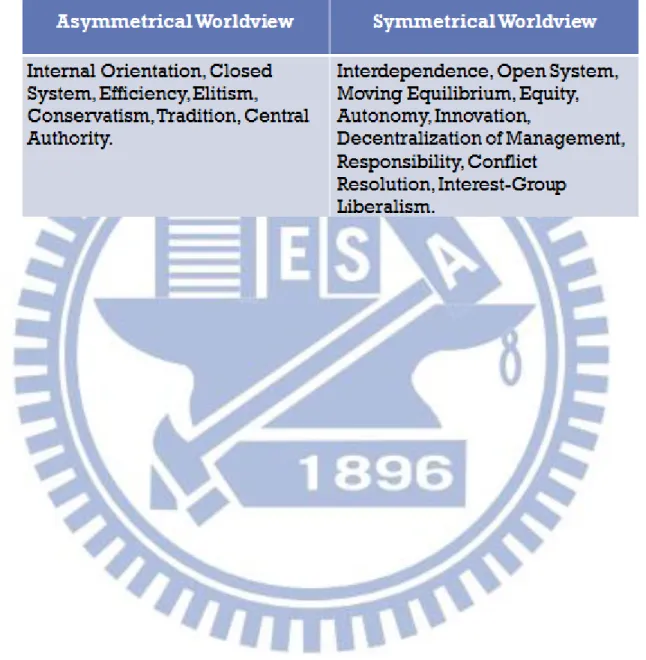
The difference between symmetrical and asymmetrical communication was highlighted in papers presented by J. Grunig (1989b) and Miller (1989) and the debate that ensued at the conference on public relations theory at Illinois State University. At the conference, J. Grunig argued that the asymmetrical worldview steers public relations practitioners toward actions that are unethical, socially irresponsible, and ineffective. He argued that practitioners with an asymmetrical worldview presuppose that the organization knows best and publics benefit from “cooperating” with it.32
In reality, public relations units cannot be isolated in organizations, the presuppositions guiding their activities are a part of the social structure and culture that integrates the organization. No one public relations practitioner or even a single public relations department is accountable for the approach that an organization takes to communication. Thus, to develop excellence in public relations, one must look at the cultural presuppositions of the organization as well as the presuppositions of public relations. J. Grunig (1989b) came up with several presuppositions that he believes explain the asymmetrical and symmetrical worldviews. By looking at Table 2, we will be able to distinguish organizations that fall in the characteristic of being asymmetrical or symmetrical worldviews because these presuppositions will appear in their organization culture. From the table, we can see that the symmetrical worldview’s presuppositions of autonomy,
30
The Handbook of Public Relations, p.16
31 Excellence Public Relations and Communication Management, p.39 32 Excellence Public Relations and Communication Management, p.40
24 innovation, decentralization of management and others are so important to public relations businesses.
25
Part II: The Effect of Public Relations Theory and Practice
5. Chapter 4: Public Relations Industry Overview
5.1 BackgroundIn Chapter four, we will have a global PR overview since PR originated from the United States back in the nineteenth century. By looking the evolution and development of PR in United States then spread to other countries, we will compare the impact of PR in organization level as the insight of PR industry. At the very beginning, Public relations appeared in the American Revolution’s struggle for power between the patriots’ grassroots movement and the commercial, propertied Tories. In the PR history, the tools and techniques of public relations have long been used as an important part of political weaponry. Thus, the developments in public relations are strictly tied to the power struggles evoked by political reform movements. Later on, public relations grew at that time when there was a need to gain public acceptance and utilization of swiftly advancing technology (e.g. the Bell Telephone System switched to all-number telephone dialing). Followed by the first corporate public relations department, it was established in 1889 by George Westinghouse for his new electric corporation for the purpose of promoting his revolutionary alternating current system of electricity.33
Up to now, the utility of PR is being widely used by most of the corporations, government or even non-profit organizations in the United States. Especially for government, PR is the most powerful weapon to get the popularity among the publics during the presidential campaign. The historic victory happened in 2008 when the first African-American, Barak Obama being elected as the 44th president of the United States.34 Obama’s slogan “We want change” and “Yes, we can” urged the public desire for change and improvement in issues like economic crisis, unemployment. On May 2009, President Obama launched office of public engagement that will serve as the front door to the White House, the purpose is to give information and let Americans to participate in the work of the President.35
33
Effective Public Relations, p.88-93
34 http://www.usnews.com/news/campaign-2008/articles/2008/11/04/barack-obama-elected-president 35 http://www.veteranstoday.com/2009/05/12/president-obama-launches-office-of-public-engagement/
26 5.2 Trends in Public Relations Industry
5.2.1 Fast Growing Industry
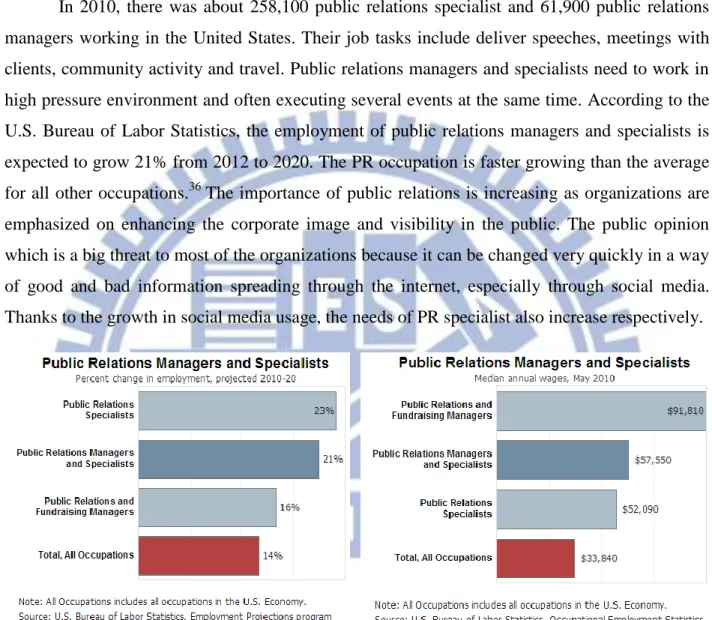
In 2010, there was about 258,100 public relations specialist and 61,900 public relations managers working in the United States. Their job tasks include deliver speeches, meetings with clients, community activity and travel. Public relations managers and specialists need to work in high pressure environment and often executing several events at the same time. According to the U.S. Bureau of Labor Statistics, the employment of public relations managers and specialists is expected to grow 21% from 2012 to 2020. The PR occupation is faster growing than the average for all other occupations.36 The importance of public relations is increasing as organizations are emphasized on enhancing the corporate image and visibility in the public. The public opinion which is a big threat to most of the organizations because it can be changed very quickly in a way of good and bad information spreading through the internet, especially through social media. Thanks to the growth in social media usage, the needs of PR specialist also increase respectively.
Figure 3: Percentage change in employment, projected 2010-2020
Figure 4: Median annual wages, May 2010
27 Table 3: Industries with the highest levels of employment in occupation
The above figure is the research findings about the pay for public relations professions in the United States. In order to collect more accurate data and distinguish the difference, the U.S. Bureau of Labor Statistics categorized PR professions into three categories as it includes all the standard occupational classification (SOC) code related to public relations. If we look at the salary of public relations managers, the median annual salary was $91,810 in May 2010. The median salary shows that fifty percent of the PR managers earned more than $91,810 while another fifty percent earned less. The top ten percent was capable to earn more than $166,400 but the lowest ten percent earned less than $49,720. If we look at the category of Public relations specialists, the annual median pay was $52,090 much lower than PR managers with a gap of $39,720.37
Nonetheless, the pay is depend on which city or which company you work for. As shown in the table above, the hourly mean wages in advertising, public relations industry was $61.56 higher than people working in College, University or Management Company.38 However, the bad part of working in public relations industry is overwork. According to the findings, almost one-third of public relations managers and specialist worked more than 40 hours per week in 2010.
5.3 Industry and Market Forces
5.3.1 Global Market Players
There are several market players within the public relations industry, in-house PR departments, big PR firms, the “Big Four” conglomerates, and PR Associations. These market
37 http://www.bls.gov/ooh/management/public-relations-managers-and-specialists.htm#tab-5 38 http://www.bls.gov/oes/current/oes112031.htm
28 players have their own role in the market and the interestingly part is to see the relationships between them and the impact on the PR market.
In-house PR departments
Almost every organization from big companies to small companies, even for university will have their in-house PR departments. Sometimes it is not named public relations but public affairs. For example, for most of the university will set up a department like foreign students affair as a way to deal and manage the issues related to foreign students. As for most of the company, the in-house PR department is being set up for the purpose of internal communication and also taking responsibility of filtering the incoming and outgoing information within the company.
Big PR firms
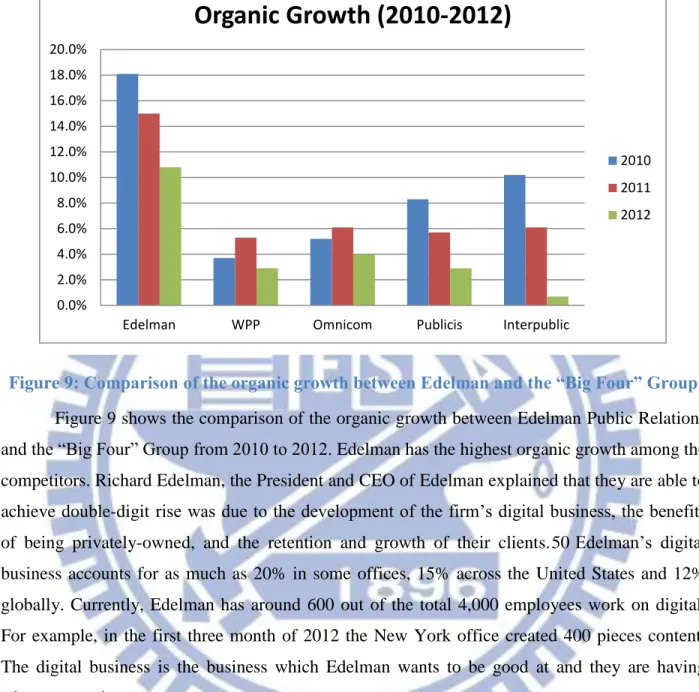
The top 10 global PR firms 2012 were ranked by the Holmes reports according to the fee income from 2011 and company growth. Among these ten big PR firms, Edelman is placed at the top with the annual fee income of $614 million and about 16% in revenue growth. Others big PR firms includes Weber Shandwick, Fleishman-Hillard, MSL Group and others. Interestingly, we can see that the ranking for these ten firms in 2011 was the same as 2012. These could be applied to top ten always remain on place where these ten companies have their own sustainable advantage to stay the best at the marketplace. However, most of these top ten companies are not independent PR firms except Edelman. Most of them are tied to the conglomerates in PR industry.
29 Table 4: The top ten global PR firms in 2012
Conglomerates
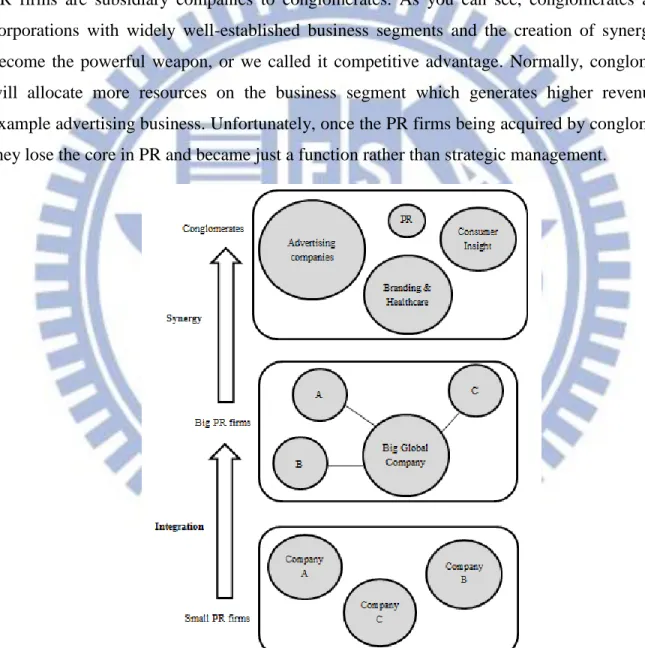
WPP began in 1985 as a UK based manufacturer, Wire and Plastic Products. The company shortened its name to WPP Group and began to acquired companies to expand their global network. Now, WPP owns 30 PR companies including three of the top ten big PR firms, Burson-Marsteller, Hill+Knowlton Strategies and Ogilvy Public Relations Worldwide. With this large network, WPP becomes the world leader in communication services, with more than 150 companies within the Group. The revenue of WPP in 2012 was £10 million. With their tailor-made range of integrated communications services provided to their clients, they are capable in serving those client companies that came from 350 of the Fortune Global 500, 30 of the Dow Jones 30, 63 of the NASDAQ 100 and so on. Their core strategy is to focus on the fast growing markets like Asia-Pacific regions, also to achieve “horizontality” where a large number of employees can work together primarily under two integrators (clients leaders and country managers).
Omnicom Group, the second largest communication service conglomerate. Omnicom owns two of the top 10 big PR firms, Fleishman-Hillard and Ketchum. Omnicom is a leading global advertising and marketing communications services company. They have 175 companies within the Group and more than 63,000 employees. Omnicom is a leading global advertising and marketing communications services company. They are serving more than 5,000 clients from 100 countries in different industries. The major business segments are advertising, CRM, public relations and specialty communications. According to Omnicom CEO, John D. Wren, their core
30 strategy came from the excellence practice in all aspect of business management. With more than a decade invested in formalizing and disseminating their collective business knowledge through advanced education programs, seminars and conferences.39
Publicis Groupe, a France-based company and the third largest communications group worldwide. Publicis owns MSL Group, ranked number 4 at the top ten lists. Also, Publicis is the leader in digital and interactive communication, which accounted 33% of total revenue in 2012. They have offices operate in more than 220 cities and 108 countries with 58,000 employees. In 2012, there were 11 acquisitions in emerging countries, particularly India, China, Brazil and others. They segmented the business into three categories, advertisng, specialized agencies and marketing services (SAMS), media advice and purchasing. However, pure digital operations have become Publicis’ most important segment. Publicis has formed global partnerships with Microsoft for development of digital media and IBM to enhance their utility in e-commerce. With the collaborations, Publicis has developed the capacity to anticipate the market changes and for continuous growth.
Interpublic Group (IPG) was first formed in 1930 under the name McCann-Erickson Incorporated but later using the name IPG since 1961. IPG has 95 companies with the Group and around 43,300 employees work in offices in more than 100 countries. IPG is the holding company for Weber Shandwick, second largest PR firms worldwide. They are actively developing offices in the BRICs and other fast growing economies like Africa, Southeast Asia and others. In 2012, IPG reached the record of 12 acquisitions in critical business including digital, healthcare, social and mobile marketing. IPG enhance their businesses through merger and strategic alliance, and develop relationships with technology and emerging media companies. One of their current strategy is re-organized the media operations into a single management structure.
31 Du Pont Analysis of the Top Four Conglomerates in Public Relations Industry
Source: The Author
These conglomerates are so huge in terms of the company size, communication networks, service provided, and others. However, by looking at the return on investment (ROE) of the Du Pont analysis, these “Big Four” groups show different perspectives. For example, Omnicom Group has the highest and increasing ROE of 23% in 2010 to 29% in 2012. While, WPP has the lowest ROE of 10% in 2010 and 13% in 2012. Besides that, Omnicom also has the highest total asset turnover (TA TO) while WPP Group has the lowest total asset turnover. Publicis has the lowest in leverage factor but still the average of leverage factor is about 4, although is the lowest compared to others but is considered risky. However, Publicis has the highest profit margin
0% 2% 4% 6% 8% 10% 12% 14% 16% 0 0.5 1 1.5 2 2.5 3 3.5 4 2010 2011 2012
WPP
TA TO (left) TA/E (left) PM (right) ROE (right)
0% 5% 10% 15% 20% 25% 30% 35% 0 1 2 3 4 5 6 7 2010 2011 2012
Omnicom
TA TO (left) TA/E (left) PM (right) ROE (right)
0% 5% 10% 15% 20% 25% 0 1 2 3 4 5 6 7 2010 2011 2012
Interpublic
TA TO (left) TA/E (left) PM (right) ROE (right)
0% 2% 4% 6% 8% 10% 12% 14% 16% 18% 0 0.5 1 1.5 2 2.5 3 3.5 4 4.5 5 2010 2011 2012
Publicis
TA TO (left) TA/E (left) PM (right) ROE (right)
32 among these conglomerates. In other words, we can conclude that Omnicom Group has good return on investment because the assets was being used efficiently but Omnicom need to watch out its leverage factor because is too high and risky, 5.4 in 2010 and 6.4 in 2012.
From the Du Pont analysis, we can see that Publicis has the highest profit margin (PM) among others followed by WPP Group. The profit margin is calculated from net income divided by revenue. In other words, these two conglomerates have high and increasing revenue although they were actively involved in M&A activity. WPP’s increasing revenue growth was impacted by the strength of pound against the Euro and good performance in regions like Asia Pacific, Latin America, Africa. On the other hand, Publicis successfully launched Vivaki, an innovation platform in 2008 has strengthen its business. Vivaki was created to accelerate the digital transformation of Publicis and its agents, and initiated the partnerships with Google, Facebook, Microsoft and other players by providing innovative products and services such as The Pool and Audience on Demand (AOD).40
PR Associations
Public Relations Society of America (PRSA). The PSRA was formed in 1947, New York City.
PRSA is a community of more than 21,000 public relations professionals across the United States, from recent college graduates to the leaders of leading PR firms. Their mission is to promote greater understanding and adoption of public relations services, provide professional development, set standards of excellence and upholds principles of ethics for its members or even for global public relations practitioners.41
International Public Relations Association (IPRA). IPRA, London was founded in 1955 with
the objective of raising standard of public relations practice. Currently, IPRA has 700 members from 0 countries worldwide.
Public Relations Consultants Association (PRCA). PRCA began in 1969, represents many of the
major consultancies in UK. Currently, PRCA has over 317 agency members around the world, including the majority of the top 100 leading consultancies in UK.
40
http://www.prnewswire.com/news-releases/publicis-groupe-transforms-vivaki-a-new-step-for-growth-177658821.html