行政院國家科學委員會專題研究計畫 成果報告
台灣網際網路產業發展的政治經濟分析--後續研究計畫
計畫類別: 個別型計畫 計畫編號: NSC92-2414-H-004-022- 執行期間: 92 年 08 月 01 日至 93 年 07 月 31 日 執行單位: 國立政治大學國際關係研究中心 計畫主持人: 彭慧鸞 共同主持人: 郭承天,徐斯勤,劉鴻暉 計畫參與人員: 王文岳 報告類型: 精簡報告 處理方式: 本計畫可公開查詢中 華 民 國 93 年 11 月 3 日
行政院國家科學委員會專題研究計畫 成果報告
台灣網際網路產業發展的政治經濟分析--後續研究計畫
計畫類別: 個別型計畫 計畫編號: NSC 92-2414-H-004-022 執行期間: 92 年 08 月 01 日 至 93 年 07 月 31 日 執行單位: 國立政治大學國際關係研究中心 計畫主持 人: 彭慧鸞 共同主持 人: 劉鴻暉,郭承天,徐斯勤 計畫參與 人: 王文岳 報告類型: 精簡報告 處理方式: 本計畫可公開查詢目錄:
中文摘要 ……… 2
英文摘要 ……… 3
報告內容 (論文) ……… 4
中文摘要:
本研究嘗試提出台灣產業政策的新決策模式。有鑑於政治與經濟環境的變 遷,網路治理成為一個新的發展趨勢。本論文首先提出「蕈狀分佈政策網絡」 (Fungus Policy Networks,FPN)的概念,作為解釋網際網路產業決策模式的分析架 構。在FPN的架構中,具備了四種制度性特性:有限的國家自主性(limited state autonomy)、彈性的國家職能(flexible state capacity)、資訊透明度(transparency)及 問責性(accountability)。這四種特性將使得處於政策網路中的各分子皆能透過資 訊的共享與快速流通之特性,更彈性的協調行為者彼此之間的集體行動。 依據FPN之分析模式,獲得以下之研究發現,(一)在全球化發展的過程中, 國家機關並未退出市場,反而透過網路治理模式,將國際競爭壓力與技術的變遷 轉化成為產業轉型的動力;(二)在網路治理模式之下政府與企業關係保持高度的 靈活度;(三)透過網路治理的制度創新可以減輕部門本位主義與組織僵化的困 擾;(四)透過網路治理,也為政府與企業之間的非正式制度關係提供了更佳的溝 通協調機制。從不同的電子化整備度的指數分析中發現,台灣的表現已經獲得普 遍的肯定。而關係電子化整備度整體表現的FPN的決策模式或許可以提供東亞政 經研究一個新的視角。 關鍵詞:網際網路;新制度主義;蕈狀分佈的網路關係;數位台灣;國家資訊通 信工作小組;台北市電腦公會;財團法人資訊工業策進會
英文摘要:
This paper presents a preliminary effort to achieve a new theory to interpret policymaking in Taiwan. As the conventional wisdom withers in the face of new condition, the network governance becomes a new guideline to understand economic policy. We also engineer Fungus Policy Networks (FPN) to explain the policymaking process of the Internet industry. The network attributes, autonomy, capacity,
transparency, and accountability, should be the main scale to gauge the viability of policy networks.
By applying FPN analysis, several reflections are inspired from this paper. Firstly, the state-business relations do not disintegrate or retreat the state from the market in the age of globalization. Contrary to the passive adjustment driven by the market dynamic, the autonomy and capacity of network governance perform as the filter to translate international pressure and technological change as progressive momentum for the domestic industry. Secondly, as analyzed in this paper, the state-business relations should be flexible, and adaptable according to the business reality. The transitional process is hence dynamic, not static. Thirdly, institutions are creatable. Suited institutional innovation helps the state to intervene in volatile sectors. In the case of Taiwan’s Internet industry, the innovative establishment of NICI substantially cures departmentalism and avoid organizational rigidity. It is instructive that the state may achieve better outcomes by communication and coordination with informal organizations, rather formal state organs. Indeed, We are shy away to provide a comprehensive explanation to the development of Taiwan’s Internet industry so far, though Taiwan is ranked at the leading spot regarding e-readiness. But the
development of FPN of Taiwan’s Internet industry should cast new light to the East Asian political economy.
關鍵詞:Internet; Neo-Institutionalism; Fungus policy network; e-Taiwan; National Information and Communication initiative (NICI); Taipei Computer Association; Institute for Information Industry
Networking governance of e-Taiwan policy
1Paper delivered for “The 33rd Sino-American Conference on Contemporary China: New International Order in East-Asia in the 21st Century: Implications for Taiwan-U.S.-China Relations”, hosted by Institute of International Relations,
National Chengchi University
Chengtian Kuo [email protected] Dept of Political Science National ChengChi University
Hwei-luan Poong [email protected] Institute of International Relations
National ChengChi University Hung-Hwei Liu
Dept of Public Affairs Management Hsuan-Chuang University
Szue-Chin Philip Hsu [email protected], Institute of International Relations
National ChengChi University James W.Y. Wang
[email protected] Dept of Political Science National Taiwan University
Taipei, Taiwan Oct 5, 2004
1 研究成果已發表於第三十三屆中美「當代中國」學術研討會,並將於 2004 年 12 月以會議論文
Introduction
Since the second half of the twentieth century, transcontinental regimes of trade, money, and transportation emerged through gyration of various course of politico-economic clash in the international arena.2 The rise of economic integration incrementally transforms the social and economic relations lasting post the War. Mainstream debate in the political economy also shifts accordingly to reflect the temporal metamorphosis of concerns. No doubt, national economies behind boundaries based on national territories are aware of intensified constraints over autonomy that exercises macroeconomic leverages to affect the market outcome substitute becomes a inevitable trend. While national governments lose grounds to protect domestic peasants from foreign competition, the parallel development of convergent direction toward free trade, foreign direct investment and capital mobility explicitly demonstrate that intensified interconnection of national economies and enactment of supranational economic governance will make national states to brace political issues at a prescribed framework they never experienced.3
Obviously, the political inquiry of greater economic integration on
nation-states alludes to tension between the global and the national. For those who recognize skyrocketing magnitudes of trade, fdi, and short-term capital flows across national boundaries as catalytic to the single world market, the power for
national-states to control economic outcomes is diminishing.4 As Glyn & Sutcliff, Ohmae, Friedman, and Castells contend, the main determinants of income and employment should be analyzed under a global scale.5 But dissent over global agreement of universal trade rules and convergent market mechanism questions plausibility to alter analytic units of economic activities, even national territory of the business world is changing.6 Further, Hirst & Thompson, Krugman, and Rodrik contend a global economy should rather be interpreted as a process of
internationalization and regionalization, in which stress lasting salience of national economies.7
The presence of the Internet industry comprises a perfect case to verify national salience in the global age. Conventionally, as argued by Castells, the
communication mode dominated the civil world after the Renaissance is named as the Gutenberg Galaxy to present a communicative system that function through printing, voice, and alphabets.8 However, the advent of computer-mediated communication
2
For the review of debate over globalization and politics, cf. Berger, Suzanne. “Globalization and Politics,” Annu. Rev. Poli. Sci.2000, 3:43-62.
3 Gourevitch, Peter and Michael Hawes, “Political Institutions and National Production Systems in the
Globalized Economy,” mimeo, paper given at APSA.
4 Summers, Lawrence, "Reflections on Managing Global Integration," Journal of Economic Perspectives, vol. 13, no. 2 (Spring 1999), pp.3-18.
5 Cf. Ohmae, K. The Boundless World (New York: Harper Collins, 1990). Friedman, T. The Lexus
and the Oliver Tree (NY: Farrar Strauss Giroax, 1999). Glyn & Sutcliff. “Global but Leaderless: The
New Capitalist Order,” in The Socialist Register, ed. R. Miliband (London: Merlin), pp.76–95. Castells, M. The Rise of the Network Society (London: Blackwell).
6
Hirst and Thompson. Globalization in Question (Cambridge, MA: Blackwell, 1996). Krugman, P. “Growing World Trade,” in Brookings Pap. Econ. Act. 1: 327-77. Rodrik, Dani, "Sense and Nonsense in the Globalization Debate," Foreign Policy, (Summer 1997), pp. 19-37.
7 Whereas the share of trade in
GDP for countries in the OECD in the 1970s and 1980s were just comparable to levels in 1913, it is still noticeable that most economic activities are still underway within national boundaries.
post wide spread of electronic communication in the second half of last century constructs an unprecedented environment made of super-text and meta-language. The first time in history people are connected interactively by multimedia channels, especially the Internet. As McLuhan argues, medium is the message.9 This means the wide use of the Internet should poise a driving force to build a new space for politico-economic operation. If information and communication technology presented by the Internet has revolutionary effects at the global scale, in what extent how/what can nation-states manage the challenge by asserting national distinction? And in what direction may the business and the state cooperate to craft national competitiveness? This paper aims to resolve the puzzle through probing the Internet industry in Taiwan. As precedent researches of high-tech industrialization of East Asia in the era of new economy, politico-economists found that the developmental paths of East Asian countries to succeed in the high-tech industry do not coincide with what the globalists asserts a one-size-fit-all strategy.10 Either by vertical integration or horizontal division of labor, South Korea and Taiwan both leverage national business-government arrangements to integrate into the global production network. But the strategy to develop the semiconductor industry may not apply to the case of e-business, given different industrial endowments on demand.11
To date e-business has evolved by three generations.12 Each generation indicates a novel redefinition that substantially metabolizes our understanding of the marriage of business and technology. The first, the emergence of electronic business is a process of synchronicity. One feature of the Internet is extensive penetration and exchange of electronic information transcending national borders. Multinationals, the advocate of the globalized economy, demands each element embedded in the global value chain to expedite responsive velocity and to elasticized the production
9
McLuhan, Marshall. The Gutenberg Galaxy: The Making of Typographic Man (Toronto: University of Toronto Press).
10 Regarding the conception of new economy, cf. Thurow, Lester C. 1996. The Future of Capitalism:
How Today's Economic Forces Shape Tomorrow's World (New York: William Morrow & Co). For
delicate analysis of East Asian high-tech industrialization, ref. Hong, Sung Gul. 1997. The Political
Economy of Industrial Policy in East Asia: the Semiconductor Industry in Taiwan and South Korea
(Northampton: Edward Elgar). Okimoto, Daniel I. 1989. Between MITI and the Market: Japanese
Industrial Policy for High Technology (CA: Stanford University Press); Simon, Denis Fred. 1992.
“Taiwan’s Emerging Technological Trajectory: Creating New Form of Competitive Advantage,” in Denis Fred Simon and Michael Y. Kau ed., Taiwan: Beyond the Economic Miracle. New York: An East Gate Book, pp. 123-150; Mathews, J. A. 1995. High-Technology Industrialization in East Asia:
The case of the Semiconductor Industry in Taiwan and Korea (Taipei: Chung-Hua Institution for
Economic Research); Evans, Peter. Embedded Autonomy (Princeton: Princeton University Press, 1995).
11 Kohli, Atul, Chung-in Moon, and George Sørensen. 2003. States, markets, and just growth :
development in the twenty-first century (New York : United Nations University Press). Mahoney, Paul G. 1999. “The Common Law and Economic Growth: Hayek might be right,” in Transition 10: 28-9. Woo-Cumings, Meredith (ed.) 1999. The Developmental State (Ithaca, NY: Cornell Univ. Press).
12 The first generation is lead by the widely use of ERP systems to improve productivities and EDI for
transactions efficiency between enterprises. The emergence of Internet starts the second generation, represented by the web-presence (including using internal web-based productivity tools, and external web-based catalogs) and e-commerce exchange (B2C or B2B). Recently, Virtual Enterprise, a more innovative conception that creates a virtual intermediary to leverage the Internet to coordinate all members in the business process with shared information and values. Cf. Chen, Longun, and CHEN Liqin, “The 3rd Wave of E-Business: Collaborative Virtual Enterprise,” a paper delivered at
capability to adapt to diversified flexible production system.13 The seamless information exchange among production segments globally is prerequisite to create efficiency. Hence, the wide separation of ICT may redefine the division of labor of production partners located in national border other than oblivious
upstream-downstream relationship. The second, the decentralized business structure of e-business also invalidates industrial policy effective in the manufacturing industry. The dirigisté approach argues a centralized industrial governance structure with vision may surmount market failure and blueprint the sensible system to develop new
production modes. The theoretical deficit of ignoring good sectoral match of governance structure may make centralized policymaking models in manufacturing industry less capable in decentralization-asserted knowledge-base industry. Prominent cases come from sluggish adaptation of Japan and Germany in the era of new
economy. The lean economic performance of the two economic powerhouses in the past decade implicates restructuring state-business relations might be the hotbed to ignite new economic growth. The emergence of e-business also gives a blow to
neo-Unitarians. The harsh price competition in the early phase of e-business generated less constructive accumulation than devastative sabotage. Great amounts of capital input, dubbed as net gold rush, did not create torrent of business opportunity
automatically. Instead, the failure of the dotcom economy might drag down the real economy. A burgeoning consensus to curb market failure is related institutional arrangement as sine qua non to ready the legal and transaction framework for
e-business. The political will committed to the Internet industry may be more capable to harness the society with technological, social infrastructure, specific legal
regulation, and supporting e-service.
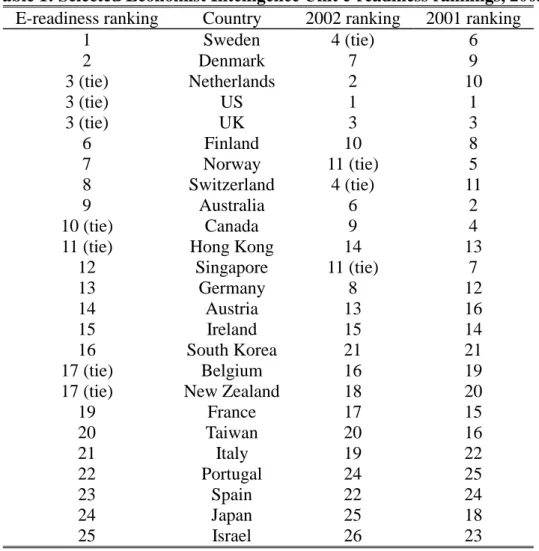
Since 2001, the Economist Intelligence Unit cooperated with IBM to investigate the world’s 60 largest markets in order to establish a benchmark to identify countries with Internet potential.14 The measured term, “e-readiness”, is shorthand for the extent to which a country’s business environment is conducive to Internet-based opportunities. The e-readiness rankings reveal several noticeable messages. The first, Internet is an irreversible trend.15 Even under economic downturn, the e-business environment is improved through infrastructure projects, telecomm liberation, Internet lawmaking, and e-education. For most countries with visions, Internet is only a chic gadget for e-generation. Rather, Internet is used as a platform to improve governance and national competitively. The second, small countries have an edge.16 Among top e-readiness leaders, small and nimble economies stand at better position to implement nationwide policies. Extensive infrastructure and the spread Internet knowledge have to reach most population in order to achieve economic scale. Close contact and deep penetration of small countries facilitate diffusion of information. The third, government policy makes difference. Countries may give the market positive signals through deliberate
initiatives. This is no contention that an interventionist state is more capable to excel a laisser-faire state at information management. Contrarily, freedom of speech is the crux to have sizable online population. But proper extent coordination and policy
13
Felker, Greg and Jomo, K. S. 1999. “New Approaches to Investment Policy in the ASEAN-4,” paper presented at the Asian Development Bank Institute Second Anniversary Workshop on Development Paradigms, Tokyo, 4 December.
14 Economist Intelligence Unit. The 2002 E-Readiness Rankings (UK: London, 2002). 15
Economist Intelligence Unit. The 2003 E-Readiness Rankings (UK: London, 2002), p. 3.
output conducted by the state may accelerate the progress of a networked society, the Internet access to people, and reliability of e-business.
Taiwan used to be praised by statists as an example of the developmental state.17 The pilot agency heavy-handedly guided the route of industrial coordination and had specialty to figure out vision for future development. Nonetheless, since democratization in the early nineties, extensive research conducted by scholars offered an alternative option to understand Taiwan’s niche competence to evolve industries.18 The most prominent model is institutional perspective of the policy network. Of various policy networks, differentiated by the nature of industries, concerned interests interact through policy coordination mechanisms, to incubate “joint projects”, a concept evolved by Evans to mitigate interest conflicts.19
Consequently, status quo is reached through compromise and eclectic communication between institutional actors, rather than unilateral takeover of the state will.
In EIU’s e-readiness rankings Taiwan is deemed as a leading force. However, the advance of e-readiness requires totality consisting of connectivity, legal
framework, social and cultural capital, and the policy environment.20 This
implicates that, while Internet emerges as a new platform to flow information, human beings are not ready to launch a new way of governance. We argue that multiple coordination between the state and the society through policy networks can contribute most to build an electronized county. In this paper, we take the Internet industry as a symbol for the coming of a service-oriented society. As old wisdom is outmoded, we will propose Fungus Policy Networks to explain development of the Internet industry in Taiwan.
{Table 1 about here}
Governance, Production, and Economic Performance
As the global economy keeps rolling and markets integration mounts, few countries are kept away at the limbo from the expansion of capitalism. However, as technology diffusion, over capacity, surge of the buyer’s market, national economies have to compete head to head in different levels of embedded global value chains.21 Therefore politics involves to aiding economic development. The states, responsible to economic constituents, will identify economic issues into political agendas and engineer coordination mechanisms to incorporate concerned interests to formulate new momentum for the next wave industrialization. Here comes the question: how to engineer sustainable economic governance? Economic governance is a set of politico-institutional regulations and coordination mechanisms to deal with economic transactions. For coordinate economic activities, institutional arrangements of
economic units and apparatus create public goods to moderate interests conflicts and to form agreements in order to increase production efficiency.
17 Refer to Haggard, Stephan. Pathways from the Periphery: The Politics of Growth in the Newly
Industrializing Countries (Ithaca: Cornell University Press, 1990); Wade, Robert. Governing the Market: Economic Theory and the Role of Government in East Asian Industrialization (Princeton:
Princeton University Press, 1990); Gold, T. “Entrepreneurs, Multinationals, and the State,” in Winckler and Greenhalgh, eds. Contending Approaches to the Political Economy of Taiwan (Armonk: M.E. Sharpe, 1988).
18 Waldner, David. 1999. State Building and Late Development (Ithaca, NY: Cornell Univ. Press). 19 Evans, Peter. Embedded Autonomy (Princeton: Princeton University Press, 1995).
20 EIU, The 2002 E-Readiness Rankings. 21
Rasiah, Rajah, "FDI, Technological Capabilities and Export Performance in Indonesia, Malaysia, Philippines and Thailand," Development Engineering 9(1), 2003, pp. 21-44.
As a coordination mechanism, economic governance has economic
implications as well as political.22 Concerned interests embedded in policymaking process engage in bargaining based on comparative politico-economic configuration. For long runs, distinctive socio-contextual relations, embedded in history, and geography, will shape and constrain transaction process between concerned interests in such a way to formulate production systems. We should also notice that even the most delicately-engineered mechanisms of economic governance are not destined to deliver success. However, it is not possible to see a robust economy rolling without proper coordination mechanisms.
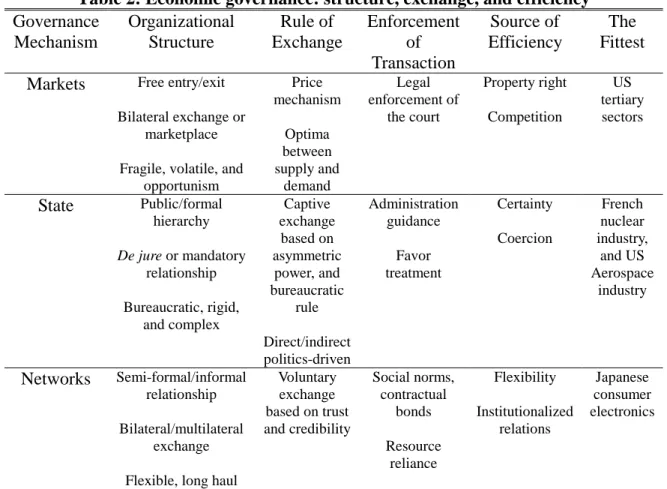
Generally, three essential types of economic governance in the human history prevail to coordinate economic activities: markets, the state, and networks.23 Concerned interests, or say institutional actors, embedded in different governance institutions will form unique relationship in ways to benefit specific segments of production process. Therefore, institutional bias will derive comparative advantage of production efficiency that will assist economic units within national boarders to outperform rivals who are embedded in less efficient governance mechanisms. Consequently, governance institutions are conducive to advanced states positions in the division of labor in the global value chains. Getting governance institutions right may not be the panacea to cure all economic slumps. But inextricability between governance institutions and economic performance implicates absence of institutional underpinnings is conducive poor governmental intervention that makes things worse. It is also noticeable that no single mysterious institutional formula guarantees
prosperity. Economic coordination mechanisms function effectively only when they fit in the social context.
Since the inception of Ricardian conception of comparative advantage of national market, most economic research tends to view economic growth in East Asia as the result of factor endowment utilization. Econmonists might not deny prematurity of East Asian markets might hinder economic develop in this area. However, they should not agree the state to play an interventionist role. Classical works contributed by economists take the state as the supporter and provider of market factor, rather than the creator of market signals.24 Once the state performs its role “correctly“, the capital will flow to proper location and utilize local resources to accrue profits automatically. In this sense, the core to economic miracles in East Asia are attributed to perfect market factors, eg. high saving rate, educated work force, and preferrential tax rate. Firms and deligent entrepreurs are rational individals in markets
knowledgeable of information in order to maximize their interests.25 It is by no means to say economists are naive to ignore relevant factors of uniqe accumulation model in East Asia. Subtle economic research may cover institutional perpective to economic operation. However, the mainstream research in the economic camp still prefer to adopt functional explanation to interpret the location fit of East Asian NICs as the result of international division of labor in accorance to their comparative advantage. All states contribute are infrastructure, public goods, marcroeconomic
22 Deyo, Frederic C., and Richard F. Doner. “Introduction: Economic Governance and Flexible
Production in East Asia,” in Deyo, Doner, and Hershberg, eds. Economic Governance and the
Challenge of Flexibility in East Asia (UK: London, Rowman & Littlefield Pub, 2001), p. 5.
23
Idid., pp. 6-8.
24 Cf. Krueger (1978), Kuznets (1977), Fei et al. (1979), Little (1979), Balassa (1981), and Kuo
(1981).
25 Ranis, G. (1981) “Employment, Income Distribution and Growth in the East Asia Context: A
Comparative Analysis.” Paper Presented at the Conference on Experiences and Lessons of Small Open Economies (Santiago, Chile).
stability, eliminating price distoration, and developmental istitutions. As of known by most researchers, the shortcoming of the neo-liberalism of economic development firstly comes from methodological individualism. The methodological individualism puts emphasis on rational entities. However, the market instituions in East Asia is most structured by the state due to varied political consideration.26 Thus the economic development in East Asia can only be correctly understood by including relevant social and political institutions. Secondly, the neo-liberalism also takes the state-business relations as given or constant, ignoring sectoral and temporal
discrepancy. Atkinson and Coleman’s survey over sectoral differences of policy networks implicate the state-business relations may be varied by industrial dynamics and, even, national diversities.27 The third, the market will evolve by time and location. As Nobel Laureate North argues, the market development is substantially embedded in the historical path rather than rational competition that reward most efficient survivals.28
The statist approach is widely applied to investigate state-instituional factors of economic activities.29 Unitile the classic work contributed by Johnson on Japan’s economy-cognizant Ministry of International Trade and Industry, the statist approach then ascends as the mainstream approach to analyze economic development of East Asian countries. Following Johnson, East Asian states are analyzed in terms of natinal regimes, historical structure of state power, and the developmental goal. The
enterprises of investigation over East Asian states generally conclude that the
developmental state is the core to economic development in East Asia. The state as a coordinating mechanism functions quite opposite to markets. As economic historians argue, the state performs its duty in a specific time and space based on the unique social and international context where it is situated. Hence, by tracing institutional configuration of mandatory hierarchies of economic units, political leadership in economic activities is always a key force to shape national economies. The rational that states involve in economic coordination rests on the grounds that scatter economic units may be better incorporated into the economic process through authoritative governmental interventions.30 In this situation, most transactional institutions, such as property rights, monetary policy, and markets regulation, are heavy-handedly drafted by the state apparatus. Hierarchical coordination may be a fashion of economic governance superior to markets by underwriting long-term collaboration and developmental investments.31 However, equally influential is that the state may impede economic growth as well. In most countries stressed national economies, organizational problems derived from collaborative problems inside hierarchies, such as formalism, verticality, and rigidity, may offset merit from the
26 In additioon, as Chang correctly points, in the early stage of capitalism, the state has to socialize
investment risk and create the market for sake to keep away from the market failure. Ha-Joon Chang. “Explaining ‘flexible rigidities’ in East Asia,” in Tony Killick, ed. The Flexible Economy: Causes and
Consequences of the Adaptability of National Economies (London: Routeledge, 1995): pp. 203-07, and
“The hazard of moral hazard: untangling the Asian crisis.” World development, Vol. 28, no. 4 (2000): 775-788.
27
Atkinson, Michael M., and William D. Coleman. 1989. "Strong States and Weak States: Sect oral Policy Networks in Advanced Capitalist Economics," in British Journal of Political Science 19.
28 North, D. (1990) Institutions, Institutional Change and Economic Performance. Cambridge:
Cambridge University Press.
29
Cf. Ikenberry (1988), Cohen (1987), Zysman (1983).
30 Chang, Ha-Joon. The Political Economy of Industrial Policy (London: MacMillan Press, 1996).
31
Chang, Ha-Joon. “The hazard of Moral hazard: untangling the Asian crisis.” in World development, Vol. 28, no. 4 (2000), pp. 775-788.
reliable hierarchy.32 The economic bureaucrats may have organizational interests as long as they involve in economic activities. Once this happens, the economic
bureaucracy may discourage business innovation, which may challenge their authorities. On the other hand, the business may take advantage of the
vertical-integration nature of industrial coordination by lobbying or paying off to seek the rent. This is why authoritarian states might favor few conglomerates and cause power and wealth inequality in the society. For convenience of rule, the state is not enthusiastic to support a strong civil society. However, as most political scientists recognize, the robust civil society has been seen as the key force to monitor
policymaking process, to resist bureaucratic abuse, and to quick respond to external turmoil. The state may fail to build a knowledge-based society, if a lively civil society is in void.
{Table 2 here}
In a foreseeable future, current discussions of globalization should be deepened and broadened. International movements of environmentalism, human rights, and labor actively remind the world the radical force will not surrender quietly. The spatiality of conventional perfection is substantially altered and international division of labor should be redefined. As a serious inquiry, we should recognize two seemly parallel but co-evolution trend spawned from globalization. The first,
penetration of international forces and institutionalization of international economic regime prescribe clearer limit of independent state autonomy over time. Rather than Westphalian sovereignty enjoys absolutely independence over issue inside national boundaries, various evidences indicate national states have to join trade blocks, honor international norms, and build up credibility in order to be concluded in the
international economy. Tighter economic integration is most telling by membership surge in free trade agreements in the wake of the socialist block. The second, state capacity turns more significant to economic development. Other than infrastructure construction, market open often remarks greater demands of social protection, including social security, occupational training, and family policy. Extensive
prevailing of left governments in Europe demonstrates the left ideas that stress proper state-society arrangements and tripartite negotiation compromise a new institutional fix, which has function of vice-into-virtue.33
Based on our preliminary inquiry, the Internet industry in Taiwan is engaged in a network governance mechanism of economic coordination. However, network relations among involved parties are not purely strategic. Rather, socio-economic context of Taiwan’s knowledge-oriented industries evolves unique geographical and social significances for the policymaking process. Whereas existing theories do not capture the core dynamics of the Internet industry, here we present Fungus policy networks to interpret the economic coordination mechanism.
The Fungus Policy Network and Its Attributes
Over the past two decades, free trade rules, economic liberalization, collapse of the Soviet bloc, free capital flight, and technology progress all make FDI and
32 Deyo, Frederic C., and Richard F. Doner. Op. cit., p. 8. 33
Garrett, J. “Global Market and National Policies: Collision Course or Virtuous Cycle?”
global logistics far much tenable than any time in the history. Conventional analyses confined in national borders need to be redesigned. As Piore and Sabel contend that firms embedded in dense ties of formal or informal networks share a sense of community, interdependence and trust may produce in synergy for high-quality, innovative products.34 Especially in markets stress response speed and volatile change of production, flexible governance of networks hold the edge against other more rigid governance mechanisms. Network governance differs from markets and the state in terms of state-business relations. Conventional theories portray the state and the society as incompatible institutional actors in adversary. The state and the society engage in iterant fights to grab ultimate control of the sovereign. But, quite oppositely, network governance deal interactions between the public and the private sectors in an alternative way by establishing an issue zone compatible for involved parties. As Evans argues, “joint projects” formed by the network governance,
coordinate the state and the society through multilateral cooperation.35 Joint projects are non-zero-sum games that involved parties can all benefit. Whereas institutional actors embedded in multiple formal or informal social frameworks of constraints, incentives, sanctions, and mutual obligations, network members incline to engage in production activities with partnership based on long-term credibility, against
opportunism, deceit, and transactional hazards. Network governance would also encourage horizontal and multiple coordination, development of committed group goals, and exchange of information by sharing information. Therefore networks are more adaptive to organize strategic relations in response to volatile markets.
Therefore, network governance is advantageous to provide necessary latitude for flexible systems of production.
Network governance has its weakness as well. Network governance may crash as negative performance implications of power and collusion within networks
occurs.36 For the former, networks function efficiently when institutional actors are placed equal to flow information. But when inter-firm dependency exacerbates power asymmetry, or transform network equals to vertically integrated hierarchies, network governance may become particularism, and formalism. Under this condition, the roles of third parties will mediate natural inequality derived from technology and resources accessibility between network members.37 For the second concern, networks can involve more collusion than collaboration. In relational networks, based on kinship, ethnicity, and clans, tight connections of network members fuel cronyism in the policymaking process. Even firms with turnkey value to production chains can be excluded to partake in external economic activities.38
As noted by Kitschelt, high-tech sectors demand more flexible coupling of production elements.39 Rather than concentrate on policy coordination between the state, the labor, and the capital in manufacturing sectors, policy-network analysis in high-tech industry demands theoretical innovation as new elements, including R&D-oriented production and market volatility exist systematically.40 To better describe a creative development of policy coordination in the Internet industry, we
34 Piore, Michael J., and Chrles F. Sabel. The Second Industrial Divide: Possibilities for Prosperity
(New York: Basic, 1984).
35 Evans, op. cit. 36
Deyo, Frederic C., and Richard F. Doner. Op. cit., pp. 10-11.
37 Hollingsworth, J. R. and R. Boyer. Op.cit., p. 17.
38 Berger, Suzanne, Timothy Sturgeon, Constanze Kurz, Ulrich Voskamp, and Volker Wittke. Op.cit.,
p. 6.
39
Kitschelt, Herbert (1991) op. cit.
need to construct a more sophisticate framework to incorporate diverse actors of interest. For instance, in the case of Taiwan, we find that traditional policy-network analysis has hard time to explain economic coordination by virtue of complex sectoral participation and organizational innovation underway. Therefore, we call the new policymaking model as “Fungus Policy Network” to portray the decisionmaking process in Taiwan.
The Structure of FPNs
FPNs are beneficial to industrial development. At the center of a FPN is the state, or more precisely, the key bureaucracies that make and implement economic policies. The relationships among economic bureaucracies can take the form of either pyramid or flat, as described by organization theories. The pyramid structure has a powerful and centralized agency that makes industrial development plans and sends orders to other economic bureaucracies to execute these plans. In a FPN, however, the structure is more likely to be flat with a core agency serving as a coordinator. This core agency also initiates industrial development plans, but these plans are often results of
meticulous communications and negotiations among economic bureaucracies. As in the real world fungus, a single spore (the state’s core economic agency) develops a small policy network among economic bureaucracies.
Then, the core fungus cells branch out either through underground extension or through surfacing above the ground and releasing spores. Spores are carried away by wind and produce the next generation of fungi elsewhere, but the original fungus continues to extends its roots underground. Important in the fungus analogy is its nutrition system. The original cells of the fungus serve as a coordination center among all its branches. Nutrition comes from the branches and goes through the coordination center to be redistributed to other branches. When a branch reaches too far from the original cells, it becomes a local coordinator center to re-allocate nutrition at the local level. When a branch encounters hostile environment, it may receive nutrition from other branches for a while. But over the long run, it may wither and saves nutrition for other more productive branches.
Similarly, a FPN branches out from the state economic bureaucracies and make connections with other semi-state and social economic agents. Semi-state economic agents may include public enterprises, state-owned research institutions, and
state-private joint ventures. Social economic agents may include domestic and foreign firms, business associations, labor unions, and universities. When these semi-state or social economic agents grow stronger, they become local coordination centers. Those that do not perform well, wither away.
Attributes of FPNs
We argue that although FPNs can take different forms in different contexts, they generally reveal the attributes of limited state autonomy, flexible state capacity, transparency, and accountability.
Limited State Autonomy
In a FPN, the state does not have absolute autonomy from social agents because it continues to receive policy inputs from social agents. The state, however, retains relative autonomy by its authority to make final decisions among different policy inputs. In fact, a FPN encourages the state to use its relatively autonomy prudentially in order to re-allocate resources according to correct market signals sent
by various social agents. A FPN also enables the state to increase its relative autonomy against protectionist legislators by appealing to the common interests of various social agents.
A highly autonomous state, as described by the developmental state theory, may lead to its own demise. Powerful social agents become more motivated to capture the state, which is not influenced by other social agents. A FPN, by contrast, is
difficult for any social agent to capture the state alone.
The degree of state autonomy is not related to the maturity of FPN or product cycles. Granted that at the early stage of development of a particular industrial sector, the state may have better knowledge and resources than other non-state actors to formulate correct development policies. But the state still needs critical information from non-state actors about the applicability and effectiveness of state policies.
Relative autonomy may exist at the state level as well as at the middle-level bureaucracy. This happens when specialization develops beyond the comprehension of top-level economic bureaucrats or legislators. Classical studies on the collusion between regulators and regulates are anecdotal to the relative autonomy of
middle-level bureaucracies. However, because of the existence of wider policy networks, the collusive behavior of regulators and regulates can be kept at bay.
Flexible State Capacity
The state in a FPN needs to develop various capacities to maintain a functional market, such as macroeconomic controls, tax collection, infrastructure, and law and order. The FPN needs to develop further capacities if it intends to promote particular industries, such as the construction of industrial parks, incentive financial policies, and technology transfer. Above all, the state in a FPN has to be equipped with enough capacity to coordinate, monitor, and discipline the behavior of both state and non-state actors.
The degree of state capacity in a FPN is likely to vary according to the maturity of FPN and product cycles. At the initial stage of industrial development, the state needs to assume most of the sunk costs, e.g., infrastructure, coordination, capital, and technology. As the FPN and products mature, the state’s intervention in the
development is no longer needed, and, in fact, can be counter-productive. But when the product reaches its final stage of development, the state needs to resumes its role as market creator.
A FPN may increase the state’s capacity by providing correct information for policymaking and implementation, by monitoring the cheating behavior of corrupt officials, and by recruiting talent entrepreneurs to the state.
Transparency
Critical to the quality of policymaking and implementation are the amount and quality of information. But the sheer amount of information may turn out to be an impediment to effective policies when few state agencies have enough capacity to organize the information. A laissez faire state may choose to ignore the information, but it does not solve the problem. A clientelistic state chooses to receive the
information provided by particular social agents.
A FPN reduces the problem of information flow in two ways. First, as a FPN extends like a fungus, the number of information received increases geometrically. Second, local coordination centers help to reduce the amount of information cramping into the state by performing the first stage of information filtering. Individual
of the state is to cross-check the information provided by various local coordination centers, which may be tainted by their local needs and environments.
A highly centralized state as described by the developmental state cannot benefit from the amount and quality of information that a FPN enjoys.
Accountability
A FPN can make economic agents more accountable than in a developmental state. First, cheating behavior of economic agents is more likely to be exposed. Second, the structure of multiple coordination centers makes cheating behavior more difficult to perform. In a FPN, decisionmaking and implementation are performed collectively in a checks-and-balanced manner.
The error in the proposal of establishing a new anti-corruption agency to fight corruption is the question that who, then, guards the guardian? Many developing countries continue to establish new anti-corruption agencies to replace the old ones of no vail. Instead of centralizing the anti-corruption function in one agency, the FPN would propose to maintain checks-and-balances among a few anti-corruption agencies, such the court, the prosecution office, the investigation bureau, the ombudsmen, the accounting office, and the legislature.
Those who favor centralization argue so in the name of efficiency. But without accountability, efficiency means faster and more rampant corruption.
Through collective discussion and information sharing, a FPN has a built-in mechanism to hold economic agents accountable. Those unsuccessful agents or rule-breakers will wither away in the long run. The FPN is heuristic to understand Taiwan’s economic coordination as tradition state-business relations broke in the wake of democratization. Further, the bottom-up decisionmaking model also indicate the state is getting coordinative, rather than developmental.
FPN and Industrial Development
In research of economic development in East Asia, the networked production relations, which incorporated the state, the business, and related institutions, become a more conspicuous approach.41 The seminal work of Pempel and Tsunekawa to
portray the Japanese economic coordination as “the corporatism without labor” vividly marks the symbiotic relations between the state and the business conducive to trust building, information floating, interests reconciliation, benefits sharing, and policy formulation.42 As Samuels argues the Japanese state-business relations are discrepant from the developmental state thesis that puts emphasis on the unilateral coercive order from the state to lead the market.43 Rather than omnipotent, the policy efficiency of the Japanese state came from its leverage through superior policy
networks constituted by various clans, clubs, associations, and shingikais (審議会) that facilitate extensive communication between the public and the private sector before the policy goal is making. Thus the policymaking process in Japan is distinctive from the Westminsterian pluralism or the French dirigisté policy formulation.44 Instead, the Japanese industrial policy is feasible on the basis of
41 Biddle, Jesse and Milor, Verdat. 1999. Consultative Mechanisms and Economic Governance in
Malaysia, Occasional Paper No. 38, Private Sector Development Department: World Bank.
42 Pempel, T. J., and Keiichi Tsunekawa. 1979. "Corporatism Without Labor?" in Philippe C.
Schmitter and Gerhard Lehmbruch eds. Trends Toward Corporatist Intermediation. CA: Sage.
43 Samuels, Richard J. (1987) The Business of the Japanese State (Ithaca: Cornell Univ. Press). 44
Noble, Gregory. 1998. Collective Action in East Asia: How Ruling Parties Shape Industrial Policy (Ithaca, NY: Cornell Univ. Press).
“reciprocal consent” that encompasses the private interests in the public agendas. Samuels’ research framework over the Japanese energy industry is further refined by the research in the high-tech industry in Japan and South Korea by Okimoto and Yeom, respectively.45 Oppositely from the speculation of economists or technocrats, who often take the short product cycle of the high-tech industry and volatile business practice as hurdles for the public intervention, the high-tech industrialization in Japan is actually the result of networked coordination between the MITI, the research labs, the alumna clubs, and the long-term reined Liberal Democratic Party (自民党). The state intervenes into the high-tech industrialization in a coordinated style to form sectoral consensus among major players in the industry. In this way, the state transforms its role from single-handed administrator to lead the industrial
development to a public counselor that coordinates R&D, work force cultivating, market maturization, and business competition.
The existence of FPN does not guarantee the success of industrial
development in the short run. After all, exogenous factors such as international market fluctuations and domestic recessions may undercut the effect of FPN. However, the FPN does provide a policy milieu that will contribute the long-term development of industries.
Can FPN fail? Yes, it can. When a single actor or an economic agent (domestic or international) becomes too powerful and dominates the FPN, the FPN becomes vulnerable to environmental change due to lack of alternative information and effective checks and balances among agents. This is likely to happen when the civil society is weak or when the market power of a particular economic agent is
overwhelming (e.g., a multinational comes in and wipes out local competitors). The FPN may also fail when the state abandons the FPN. The state may opt for individual actors for policy inputs. The state may lose interests in a particular industrial sector. And the state may put political considerations above economic goals. If the state cannot help industrial development, it can certainly hurt it. Finally, as globalization proceeds, the membership of FPN should also include foreign actors to avoid the problems of “captive networks” or “relational networks” as Berger et al. mentioned.46
The FPN of Taiwan’s Internet Industry
Instead of scale demands of capital and labor required in the conventional industry, the Internet industry presents a new model of capital accumulation which concocts the value chain through knowledge generating, knowledge marketing, and knowledge management via conduit of the Internet network by information and communication technology (ICT). Whereas the Internet-related business is hard to find an official definition in Taiwan, for research expediency, we define the Internet industry in a more narrow scope to concentrate on business and derivative service pertaining to e-business. The business process, named as e-Business, including manufacturing, procurement, negotiation, resources management, electronic data interchange and payment, are collaborated, regulated, and monitored through the electric network. As highlighted in the e-Taiwan project, five categories are currently delineated as Taiwan’s prior goal to build the e-business friendly environment: Infrastructure, e-Industry, e-Government, e-Transportation, and e-Society. The core
45 Okimoto, op. cit. Yeom, Jaeho (1989). A Bureaucratic Organization in a Network Setting: MITI and
Japanese Industrial Policy for High Technology. Stanford University PHD Diss. mimeo..
value of the Internet industry concentrates on producing, processing, and managing information. Hence the e-Taiwan project, latter being integrated into 2008 National Development Program, should be viewed as Taiwan’s another attempt to locate national competitive advantage.
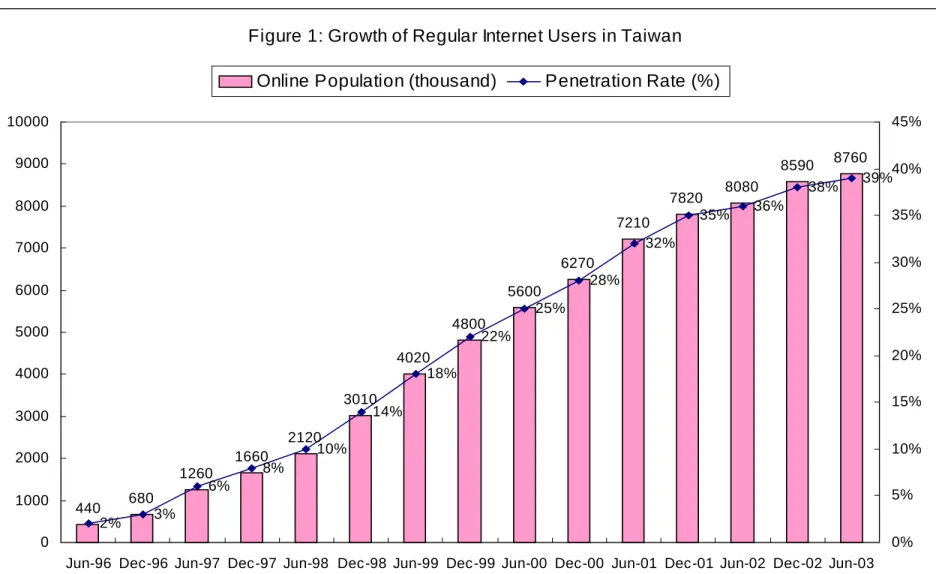
{Figure 1 here}
In the wake of dotcom bust, the murky aspect of the Internet industry might be a good time to return to basics. Attention to the real value of Internet has been
assessed as new ways for enterprises to take advantage of virtual communities. However, the business should also recognize a more positive role the state may perform to build an e-business community. Some analysts argue a resurgence of Taiwan’s Internet industry is only a matter of time. Positive facts, such as that over 8 millions regular Internet users, over one third of total population, more than 8 millions Internet subscribers, and increasing e-business behaviors, convince economic
predictors that Internet is still the mainstream for future transaction. If this is the case, a most positive role the state can perform should improve e-readiness and create proper regulatory environment awaiting next wave of e-business boom. For instance, the telecomm industry has to be further liberalized. Compared with its counterparts in the East Asia, Taiwan still keeps a semi-state-control telecomm market. China
Telecomm, the former SOE, was under the state hand sparing from global
telecommunication industrial competitiveness until few years later. Without wonder, Taiwanese telecomm consumers have to pay for less quality service at higher
expenses. Indeed, telecomm liberalization has been accelerated after the DPP came to power. However, partially because of frequent national elections, the telecomm market liberation and deregulation in Taiwan are hinged on short-term consideration, rather than long-term vision, especially compared with Hong Kong and Singapore. A prominent case, the semi-public Chunghwa Telecomm did not respond to public grievance over its highly questioned rate policy until after the presidential election of 2004.47
The Internet laws and related regulation have to be followed and respected as well. All tenable policy for a more lucrative Internet industry could not be reached without cooperation between concerned interests. Music products counterfeiting and software pirating are prevalent through the island. The past few years, under strong USTR pressure of the Special 301 Clause, Taiwan incrementally bettered the laws of intellectual property right, and related education. However, this cannot be seen as satisfied consequence. According to local research reports, the most profitable ISP service is still network connection. In fact, most Internet content providers still struggles to survive in the brink of bankruptcy. Some ICPs also provide e-solution or consultancy service to small-and-middle size enterprises. According empirical interviews, the government initiatives to push electronizing SMEs do create a sizable market for local business. Quite a few Internet / software companies gain subsidies from the MOEA’s projects. To support the development of Taiwan’s e-business, the state can perform a more sensible role.
Obviously, what Taiwan really needs is a more capable framework to
coordinate interests between the state, the semi-public organization, the social actors, and the industry in order to output a more effective and prospective Internet policy.
Polycentric Policy Initiative
Based on our preliminary inquiry, three roles the state may entrench and perform for the future Internet industry:
• The Demiurge of the connectivity environment: technically, connective velocity is still a main factor to determine electronic data transmission. Comprehensive broadband deployment does not meet the business standard, and also offers a reliable platform for multimedia service. Broadband deployment needs political will, not only a matter of territorial size. The Singaporean and Korean states have arranged to deploy quality broadband infrastructure better than the U.S. Therefore, the Taiwanese state can be more active in this regard.
• The Propagator of Internet development: the state had introduced quite a few electronic solutions into the policy agenda for years. Information and knowledge spread, inspired, and managed based on Internet are still the main element for a successful industry. In the package of Digital Taiwan, the state pushed initiatives, including e-government, e-industry, and e-society.
• The Partnership for the Internet Industry: the state is no more a pilot agency, as described by the theory of the developmental state, to guide and safeguard the business to create a new industry. Rather, the vivid industry has more say in the policymaking process due to its expertise. The state needs an intermediary to communicate and mitigate conflicts and differences. Apparently, a new coordination mechanism is needed. It is not proper to construe the state perform the three roles following a
specific timetable. Instead, if we recognize electronization as an agenda to upgrade local industries, it is not hard to understand why state agencies do not synchronize the e-policy due to diverse policy scope.
Another aspect worth to know is the power to initiate the policy. Volumed work dedicated to industrial policy research in East Asia praised single-minded, intelligent bureaucracy the locomotive of rapid economic growth. Japan’s legendary MITI, now restructured as METI, and its Taiwanese and South Korean counterparts, say CEPD and EPB, had hegemonic power inside the state to streamline
decisionmaking and implementation.48 This line of research is greatly invalidated in e-Taiwan project. Contrary to traditional industrial policy, Taiwan’s e-policy is essentially led by the business. In the late 90s, wide spread application of multimedia communication push Taiwanese firms to gear up with quality enterprise resource management solution on demand of foreign buyers. This outside-in pressure soon request local business to have superior capacity to couple production elements of the value chain.
The organized interests thus represented local business to bridge the gap between the government and the private sector to work on sensible policy. During the policymaking process, the executive enjoys high degrees of autonomy from
particularism during the policymaking process due to its expertise. But we should know the organized interests, the Taipei Computer Association, play an important role as the government’s main advisor. TCA was established in 1974 and evolved as a
48 Woo-Cumings, Meredith (ed.) 1999. The Developmental State (Ithaca, NY: Cornell Univ. Press).
Woo, Jung-en. 1991. Race to the Swift: State and Finance in Korea Industrialization (NY: Columbia Univ. Press).
national representative for Information industry owning more than five thousand memberships. TCA frequently reviews the related industrial policy and participates in deliberation councils held by governmental agencies. During the development of the Internet industry, TCA was both the consultant for the government and the counselor to introduce new technology to its members. In the past decade, TCA also expanded its service scope to Mainland China as numerous Taiwanese business invested in China. Indeed, TCA plays a strong role for the computer-related industry; it also experienced some problem from the extended coverage of membership. The Internet industry is an emerging industry and need more specific attention. For example, in the U.S. the USIIA performs as a chartered representative for the Internet industry.49 In the national Internet agenda, USIIA can play a more customized and active role to represent the Internet industry. In Taiwan, similar role is performed by TCA. But we also find evidence that enterprise leaders somehow have their personal channel to engage in lobbying. This is indicative in Taiwan after democratization. Personal politico-business networks are parallel to institutional organizations to influence the policy.50
Another actor to initiate e-policy is Institute of Information Industry. The III is a critical force to push the information industry. The same as ITRI, III is also built by the Economic ministry as a quasi-public non-profit institution (QPNPI) to take responsibility to assimilate, diffuse, and re-engineer information knowledge to the industrial sector. The beauty of QPNPI comes from its institutional property to work as an interface communicating the state and the society. QPNPI’s seminal effect to introduce new technology is apparently a more efficient way for the state to involve in the economy. Three respects can be observed of III’s activities: the first, the software industry has different property from the semiconductor industry. The new package can immediately have its market value without a commercialization stage.51 Therefore, it is questionable that what kind of function III should perform for the Internet industry. On the other hand, as the state asked QPNPIs to finance half of the operational cost, III needs to incrementally acquire financial security y itself.
Therefore, in time, the business criticizes III as a competitor in the market. Especially, III lobbies badly for more technological budgets in competition with other high-tech companies. The rent-seeking issue is thus on the table awaited to review. Finally, non-profit institutions used to be a major source for public goods. However, after
49
http://www.usiia.org/ (Sep, 03).
50 The legislature kept a low-profile posture to participate in the policymaking process, as most
lawmakers were lack of required expertise, only few lawmakers pay attention to the Internet laws, thanks to constituency interests. In the U.S. the Congressional Internet Caucus coordinated congressmen to represent interests of the Internet industry and educated the Congress essential knowledge of the Internet [ref. http://www.netcaucus.org/about/ (Sep, 2003)]. However, in Taiwan, the Internet constituency is basically represented by few lawmakers. In addition, only few junior lawmakers has involved in policymaking on the floor. During the policy review process, only a DPP heavyweight lawmakers from Hsinchu county, the location of Taiwan’s main scientific community, plays an active role. Hence a strong representative and organized force for the Internet constituent is still waited to build. One tentative explanation to legislative apathy of Internet laws comes from frequent elections. Most lawmakers prefer to speak for short-term policy than long-term project in order to increase personal credit in election.
51
Cf. James W.Y. Wang (王文岳). Taiwan Bandaoti Chanye de Zhengzhijingji Fenxi (台灣半導體產 業的政治經濟分析, The State-Business Institutions of Taiwan’s Semiconductor Industry) (Taipei: NCCU. Masters Thesis. Mimeo.).
democratization, the society gains more leverage access to financial and technology source. QPNPI incrementally turned into a liability to the state.52
As stated above, the state did not directly intervene manufacturing and innovation activities of the Internet industry. Policy initiatives are made mostly after consulted with the private sectors. A new economic coordination model is apparently under evolution to incorporate involved interests in the Internet industry.
The organizational innovation of NICI
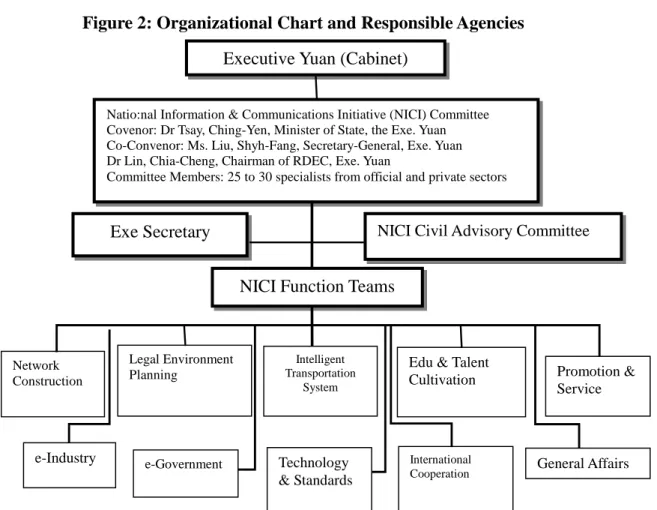
In addition to the private sector, policymaking process is also an evolutionary process, rather than visionary. If we take National Information and Communication Initiative Committee as a consolidated force to push e-policy, we should also identify the private sectors have more say in the policymaking process. Therefore we prefer to see NICI as organizational innovation of the Taiwan state. Five features could be identified in the organizational development process.
{Figure 2 here}
The first, the executive pluralism prevails in the emerging stage. The state did not have a clear vision from the beginning of the Internet industry. A fluid model to share responsibility between related agencies applied. What could be seen was the executive pluralism as the state planned to push electronization. Quite different from the textile or electronics industries that only few agencies took charge, no single agency dominated the electronization agenda inside the state. The second, routinizing the policy coordination between the state agencies after regular work meeting had been held. The state recognized the tendency of electronization after most countries see e-business as the next wave industrialization. Even though Taiwan might not have comparative advantage in e-business, the state, however, had no option but put more resources to electronization. In this stage, deputy ministers had monthly joint
committee to discuss visions and policy execution. The third, establishing
coordination mechanism to integrate electronization policy. The state established several agencies, such as National Information Infrastructure, the Information Industry Development Program and industry Automation and Electronic Business (iAeB), to promote the Internet industry. NII was commenced in 1994 to consolidate public and private resources to command construction work on basic information infrastructure, and popular Internet application software. The IDP had been set up in January 1982 designated as policy initiator to nurture information technology and facilitate economic transformation. The iAeB was launched in July 1999 with special attention to promote Taiwan’s IT policy. Partially learning lessons from the IDP and NII initiatives, the iAeB located its mission on supportive role as to automatize and electronize industrial operation to forge global competitiveness.53 Obviously the policy scope of e-Taiwan policy was previously headed simultaneously by three state
52
For details, refer to Poong, Hwei-luan. Sep 27, 2004. “Networking Role of Quasi-State Instituion in Taiwan’s Industrial Transformation: A Case Study of III”, pp. 3-5, paper delivered at the seminar on Political Economy: The Dialogue between Philosophy, Institutions, and Policy at National ChengChi University.
53
The formulation of NICI is based on previous work contributed by Kuo, C, and James W.Y. Wang, Sep. 27, 2003. “The Fungus Policy Network of Taiwan’s Internet Industry”, pp. 15-6, paper delivered at the seminar on Political Economy: The Dialogue between Philosophy, Institutions, and Policy at National ChengChi University. Also refer to another two articles in the same conference: Hsu, Szue-Chin. Philip, “Steering Economic Growth in the Information Age: State Bureaucracy and the e-Business Policy in Taiwan”, p. 7; Liu, Hung-Hwei, “The Political Economy of e-Taiwan Policy”.
organs without central coordination. Before inception of NICI, decisionmaking of Taiwan e-policy was highly decentralized, and departmental. But the growing demand to realign policy resources and actions in selected areas propel formation of a stronger coordination center. In Mar 2001, the state established National Information
Communication Initiative (NICI) to integrate functions of the three responsible agencies. While NICI is in charged of policy coordination, NICI also supervised a division to implement the e-Taiwan plan. The fourth, the Science and Technology Advisory Group of the Executive Yuan becomes the main agency to coordinate policy implementing. STAG has a special advantage to coordinate different agencies from various departments due to its superior standing. The institutional feature gives STAG sufficient leeway to coordinate policy implementing and to solicit specialists to work together. However, STAG is constrained by the budget limit, as it is only an initiative under the Secretariat of the Executive Yuan. Hence, the organization limits of STAG do catch with rapid-expanding electronization plans. The fifth, the budget constrains of electronization policy influence the scope. Apart from limited technological budgets, most financial source of electronization policy comes from the economic development projects. However, the Council for economic planning and development (CEPD) is the supervised organization of economic development projects. Therefore, CEPD also integrated the e-Taiwan plan into the Challenge 2008 National
Development Plan. For some extent, CEPD becomes a critical player to evaluate the e-Taiwan plan, as it controls most financial resources.
Policymaking and Implementation of e-Taiwan Policy
The state, because of insufficient expertise of industrial electronization, took a reactive posture to evolve the coordination mechanism for the Internet industry. Currently, the state plays a counselor to introduce the framework of e-business to the general public. Major policies, including information electronization aid,
electronizing value chains, establishing the demonstration system, and e-learning, are aiming at establish a e-business environment.
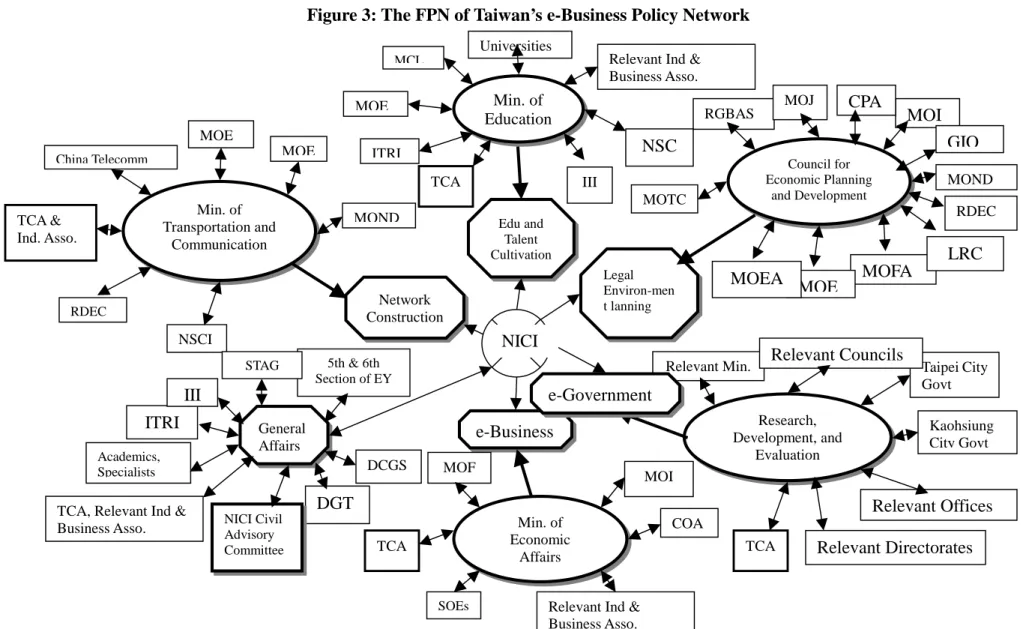
Generally speaking, the FPN of Taiwan’s e-business policymaking network represents a new development of economic governing model. Divergent from the statist and marketian theses, the emergence of FPN is a dedicate evolution of state governance in response to the business dynamics. Contrary to dirigisté wisdom enamoring state capacity to direct industrial development, FPN acknowledges relative business capacity of novel technology and preferred to sustains a moderate
coordination relationship between the state and relevant business / industrial
associations. This is a policy innovation of NICI to outsource policy implementation. From figure 3, associations appear in the scope of the deliberation process of multiple policy centers. The blurring of the state / business boundaries may spawns superb conduits to flow information regarding vision of future industrial development and contributes to good policymaking. Consequently, NICI as the core of the FPN is not comparable to paramount economic apparatus we used to know in the East Asia. Constrained by budgets and human resources, NICI could not assume power from related state organs discretionarily and unilaterally. Therefore, NICI that is embedded in FPN has limited autonomy and flexible capability regarding decisionmaking and policy execution.
The FPN also make the Internet industrial governance more transparent. The best mission NICI can carry is information exchange and aggregate center that expedites policymaking efficiency, and reconciles position different in order to reach policy equilibrium. Since most initiatives are contributed in bottom-up way, the initiative-motivators, whether the state managers or the societal actors, have full understanding of the policy. The communication process in FPN prevents general asymmetrical informational exchange between principal and agents.
The most prominent innovation of FPN comes from accountability. NICI is the central organ in charge of policy coordination. But the budget of sub-projects and implementation are operated by independent departments. In the case of getting budget from the source of technology development, it is certainly under the control and evaluation of NICI/STAG. For those sub-projects getting budget from the source of economic development or public construction, CEPD is in charge of supervision. While most initiatives come from the bottom, the executive organ, either the public or the private, could direct supervise sub-projects. The supervision mechanism
substantially makes policymaking and implementation accountable to principles. As figure 3 shows, extension of multiple policy centers are leading
recognizant organs that are responsible to sub-coordinate relevant agents during the policy making process. In times, policy center may compete with each other in specific policy turf. However, thanks to the horizontal structure of the FPN, most interests conflicts can be resolved through rational compromise and deliberation. Stark ministerial rivalry, which occurs frequently in hierarchical coordination, is substituted by horizontal cooperation. In addition, as the development potential of the FPN is vivid, opportunities to absorb external resource to support initiatives proposed by policy centers may make the FPN more extended than currently plotted.
Conclusion
This paper presents a preliminary effort to achieve a new theory to interpret policymaking in Taiwan. As the conventional wisdom withers in the face of new condition, the network governance becomes a new guideline to understand economic policy. We also engineer Fungus Policy Networks to explain the policymaking process of the Internet industry. The network attributes, autonomy, capacity, transparency, and accountability, should be the main scale to gauge the viability of policy networks.
By applying FPN analysis, we illustrate the developmental trajectory of the Internet industry with five features. The story indicates proper-networked
arrangements of state-business relations are innovative as well as conducive to industrial development. We should notice that a factor, not less important than any actor analyzed in this article, might help the advent of FPNs in Taiwan is democracy. Since the early 90s, the persistent process of democratization substantially dismantled hegemonic control of the state and drew more civil groups into the policymaking process. Especially in high-tech sectors, emergence of professionalism of industrial community becomes influential source for policy initiation. For some extent, professionalism can explain why most respondents implicated politics is not a
significant factor when plotting the Internet policy. Even after the first power turnover occurred in 2000 after DPP won the presidential election, the relationship between technocrats and the industry did not veer as shown in some sectors.