
An Improved Transaction Scheduling Policy for Mixed Real-Time Nested Transaction Models
5
0
0
全文
(2) RT-group CPU1. Ready Queue Priority Assignement Policy. Real-Time Transactions. CPU2 CPUi. END. CPUi+1. Ready Queue Non Real-Time Transactions. Concurrency Control Strategies. Tranditional Scheduling Policy. CPUi+2. Statistical Feedback Adjuster Information. CPUn NRT-group. Figure 1. Diagram of FAP [10, 11] priority assignment policy or a traditional scheduler for utilizing the CPUs. The number of CPUs allocated to RT-group or NRT-group is adjusted dynamically based on the real-time ratio for overload adjustment measured statistically by MissRatio. Namely, while at most RA percentage of the total CPUs are allocated to the real-time transactions. For instance, suppose the total number of CPUs in the system is 10 and RA is 70%. The number of CPUs for RT-group and NRT-group should get 7 and 3, respectively. FAP works by the request rule, release rule and adjust rule [16]. The detail functions are described as follows: Request Rule: For a real-time (sub)transaction Ti arriving at the sytem, it requests the processors for execution. If there are free processors, the FAP randomly allocates one processor to Ti. In case no free processor exists, the priority of Ti is compared with those transactions in the RT-group to check the possibility of preemption. Release Rule: Whenever a processor is released by a (sub)transaction, FAP picks up the (sub)transaction with highest priority in the ready queue of the group to execute on the released processor based on the priority assignment policy or traditional scheduling policy of the corresponding group. Adjust Rule: Whenever a number of transactions in an observed period are completed, MissRatio during this period, MRc, is compared with that of setting for overload adjustment, MRs.. reward ratio of scheduling a transaction and provides an adjustable policy for various system load conditions. Using the concept of the distributed slack time given by Kao and Garcia-Molina [12, 13], and the influence of the shape characteristic for nested transactions [14, 15], FHRN policy is proposed. It considers the reward ratio, reflection of the shape characteristic, distributed slack time and degree of urgency [12]. 2.2. Traditional Scheduling Policy SJF associates with each process the length of the latter’s next CPU burst [15]. When the CPU is available, it is assigned to the processes that have the smallest next CPU burst. This paper focuses the minimizing the number of missed real-time transactions, and reducing the impact on the performance of non-real-time transactions. It’s only considered in our experiments because its performance.. 3. FAP Attempting to minimize the number of missed real-time transactions and reducing the impact on the performance of non-real-time transactions, FAP is shown in Figure 1 dynamically allocates the processors to both of real-time transactions and non-real-time transactions based on the status of a system. The total CPUs in the system are partitioned into the RT-group that executes the real-time transactions and the NRT-groups that executes the non-real-time transactions by the feedback adjuster. Real-time or non-real-time transactions arriving at the system enter the separate ready queues, and wait to be scheduled by a 2.
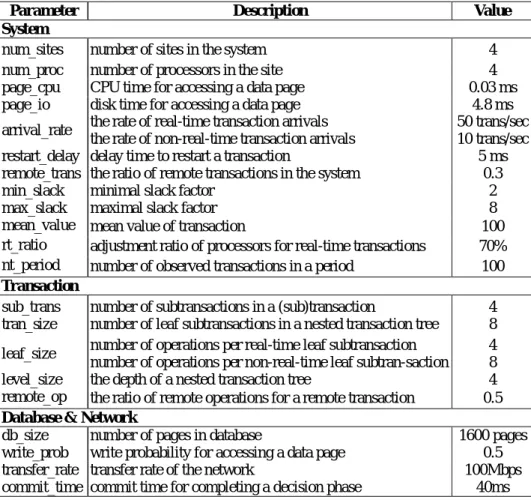
(3) The comparing real-time scheduling policies are ED, HV, HRU, and FHRN+FAP (denoted as FFAP) underlying various conditions. We also concern the variety of response time for non-real-time transactions. SJF and SJF+FAP (denoted as SFAP) were included in this experiment. The concurrency control protocol used is two-phase locking with high priority for nested transactions (2PL-HPN) as shown in [12] because it is a simple and effective protocol for most real-time database researches. 4.2. Basic model In this experiment, we varied the arrival rate from 20 real-time transactions/second (abbreviated as real-time trans/sec) to 120 real-time trans/sec in increasing steps of 20 to model different system loads. The parameters are set as in Table1 based on the previous studies [1-2, 12, 16, 18]. As shown in Figure 2, the performance order from the best to the worst based on the metrics of MissRatio and LossRatio is FFAP > HRU > HV > ED (i.e., FAP performs the best and ED performs the worst). The excellent performance of FFAP is due to its dynamic allocation of processors to both of real-time transactions and non-real-time transactions based on the system load. Meanwhile, we observe the impact of arrival rate of real-time transactions on response time of non-real-time transaction. Figure 3 that the performance of non-real-time transactions under SFAP is slightly affected and its response time keeps the small value at heavy load of real-time transactions. The effective utilization of rt_ratio makes more real-time transactions meet the deadlines and gets a lower MissRatio.. If MRc<=MRs, i.e. the status of system is at normal load, no action must be token. Basically, a system is considered as overload if MissRatio exceeds 20% [2]. If MRc>MRs, it presents the system is under an overload. Let RA = RA + (MRc – MRs), which indicates RA is increased by the difference between MRc and MRs. On the other hand, the number of processors in RT-group will be increased to get better performance.. 4. Performance Evaluation 4.1. Workload Model This section describes the simulation model was developed by using SIMPACK packages to evaluate the performance of FAP [17]. Table 1 lists the workload model parameters and their base values. The parameters page_cpu and page_io determine the CPU and disk time needed to access a data page, respectively. The parameter used to model the load of the system is arrival_rate, which specifies the mean rate of transaction arrivals and has a Poisson distribution. In other words, the inter-arrival time of nested transaction is in exponential distributed with mean 1/arrival_rate. Restart_delay gives the delay time caused by restarting a transaction. Write_prob determines the probability of updating data pages after a transaction has read the data pages. Sub_trans signifies the number of subtransactions varying randomly in a (sub)transaction tree. Tran_size represents the number of leaf subtransactions in a nested transaction, which is the mean of a uniform distribution varying range between 0.5*tran_size and 1.5*tran_size. The parameter leaf_size determines the number of operations per leaf subtransaction varying uniformly between 0.25*leaf_size and 1.75*leaf_size. The parameter level_size represents the depth of a nested transaction tree varying uniformly from 0.25*level_size to 1.75*level_size. The main performance metric is the MissRatio as given in [2, 4, 12] and are restated below: MissRatio =. 5. Conclusion In the past decades, real-time transaction scheduling has been an active research topic. Many previous approaches for scheduling transactions in a RTDBS often assume that all transactions with real-time constraints and having the single level structure. However, the DMRTDBS is an advanced database system in a multiprocessor enviro-. number of transactions missing the deadline *100% total number of submitted transactions. 3.
(4) Parameter System num_sites num_proc page_cpu page_io. Description. Value. number of sites in the system 4 number of processors in the site 4 CPU time for accessing a data page 0.03 ms disk time for accessing a data page 4.8 ms the rate of real-time transaction arrivals 50 trans/sec arrival_rate 10 trans/sec the rate of non-real-time transaction arrivals restart_delay delay time to restart a transaction 5 ms remote_trans the ratio of remote transactions in the system 0.3 min_slack minimal slack factor 2 max_slack maximal slack factor 8 mean_value mean value of transaction 100 rt_ratio adjustment ratio of processors for real-time transactions 70% nt_period number of observed transactions in a period 100 Transaction sub_trans number of subtransactions in a (sub)transaction 4 tran_size number of leaf subtransactions in a nested transaction tree 8 number of operations per real-time leaf subtransaction 4 leaf_size number of operations per non-real-time leaf subtran-saction 8 level_size the depth of a nested transaction tree 4 remote_op the ratio of remote operations for a remote transaction 0.5 Database & Network db_size number of pages in database 1600 pages write_prob write probability for accessing a data page 0.5 transfer_rate transfer rate of the network 100Mbps commit_time commit time for completing a decision phase 40ms. Table 1. Workload parameters and base values. ment consisting of both real-time and non-real-time transactions, and its structure is flat or nested type. The techniques proposed for real-time scheduling policies may not be suitable to DMRTDBS due to the existence of non-real-time transactions. This paper proposes feedback adjustment policy (FAP) to attempt minimizing the number of missed real-time transactions, and reducing the impact on the performance of non-real-time transactions. The main concept of FAP is utilizing the information recording system load status to allocate processors dynamically to the both of real-time transactions and non-real-time transactions. From simulation results, the performance order from the best to the worst based on the metrics of MissRatio and LossRatio is FFAP > HRU > HV > ED (i.e., FFAP performs the best). The performance of non-real-time transactions under SFAP is slightly affected and its response time keeps the small value at heavy load of real-time transactions.. 100 90 80 MissRatio (%). 70 ED HV HRU FFAP. 60 50 40 30 20 10 0 20. 40. 60. 80. 100. 120. Arrival Rate (real-time trans/sec). Figure 2. MissRatio for basic model. 3000. Response Time (ms). 2500 2000 SJF 1500. SFAP. 1000 500 0 20. 40. 60. 80. 100. 120. Arrival Rate (non-real-time trans/sec). Figure 3. Response time for basic model. 4.
(5) References 1.. 2.. 3.. 4.. 5.. 6.. 7.. 8.. 9.. 10.. 11.. Abbott, R., Garcia-Molina, H.: Scheduling Real-Time Transactions: a Performance Evaluation. ACM Trans. Data. Sys, vol. 17, pp. 513-560, 1992. Haritsa, J.R., Carey, M.J., Livny, M.: Value-Based Scheduling in Real-Time Database Systems. VLDB J., vol 2, no. 2, pp. 117-152, 1993. Ulusoy, Ö., Belford, G.G.: Real-Time Transaction Scheduling in Database Systems. Info. Sys., vol. 18, no. 8, pp. 559-580, 1993. Tseng, S.M.: Design and Analysis of Value-Base Scheduling Policies for Real-Time Database Systems. PhD. Thesis, National Chiao Tung University, Taiwan, 1997. Lee, V.C.S, Lam, K.Y., Kao, B.: Priority Scheduling of Transactions in Distributed Real-Time Databases. Real-Time Sys., vol. 15, no. 1, pp. 31-61, 1998. Chen, H.R., Chin, Y.H., Tseng, S.M.: Scheduling Value-Based Transactions in Distributed Real-Time Database Systems. Proc. Int. IEEE Symp. Para. and Dist. Proc, San Francisco, pp. 978-984, 2001. Chen, H.R., Chin, Y.H.: An Adaptive Scheduler for Distributed Real-Time Database Systems. Info. Scie.: an Intl. J., vol. 153, pp. 55-83, 2003. Cram, C.M.:E-Commerce Concepts: Illustrated Introductory. Course Technology, Boston, 2001. Lam, K.Y., Kuo, T.W., Kao, B., Lee, S.H., Cheng, R.: Evaluation of Concurrency Control Strategies for Mixed Soft Real-Time Database Systems. Info. Sys., vol. 27, pp. 123-149, 2003. Ulusoy, Ö.: Processing real-time transactions in a replicated database system. Dist. and Para. Data., vol. 2, no. 2, pp.405-436, 1994. Lee, V.C.S., Lam, K.Y., Hung, S.L.: Impact of High Speed Network on Performance of Real-Time Concurrency Control Protocol. J. Sys.. 12.. 13.. 14.. 15.. 16.. 17.. 18.. 5. Arch., vol. 42, no. 6-7, pp.531-546, 1996. Chen, H.R., Chin, Y.H. Scheduling Value-Based Nested Transactions in Distributed Real-Time Database Systems. Real-Time Sys., vol. 27, pp. 237-269, 2004. Kao, B., Garcia-Molina, H.: Deadline Assignment in a Distributed Soft Real-Time System. IEEE Trans. Para. and Dist. Sys., vol. 8, no. 12, pp. 1268-1274, 1997. El-Sayed, A.A., Hassanein, H.S., El-Sharkawi, M.E.: Effect of Shaping Characteristics on the Performance of Nested Transactions. Info. and Soft. Tech., vol. 43, no. 10, pp. 579-590, 2001. Silberschatz, A., Galvin, P.B.,Grgne, G. Operating System Concepts, 6rd edn. John Wiley & Sons, 2003. Tseng, S.M., Chin, Y.H., Yang, W.P.: Value-Based Scheduling for Multiprocessor Real-Time Database Systems. IEICE Trans. Info. and Sys. E81-D, no. 1, pp. 137-143, 1998. Fishwick, P.A.: SIMPACK: C-Based Simulation Tool Package Version 2. University of Florida, 1992. Agrawal, R., Carey, M.J., Livny, M. 1987. Concurrency Control Performance Modeling: Alternative and Implications. ACM Trans. Data. Sys., vol. 12, no. 4, pp. 609-654, 1987..
(6)
數據
![Figure 1. Diagram of FAP [10, 11]](https://thumb-ap.123doks.com/thumbv2/9libinfo/8913178.260656/2.892.165.730.106.314/figure-diagram-of-fap.webp)
相關文件
The performance guarantees of real-time garbage collectors and the free-page replenishment mechanism are based on a constant α, i.e., a lower-bound on the number of free pages that
The schedulability of periodic real-time tasks using the Rate Monotonic (RM) fixed priority scheduling algorithm can be checked by summing the utilization factors of all tasks
Reading: Stankovic, et al., “Implications of Classical Scheduling Results for Real-Time Systems,” IEEE Computer, June 1995, pp.. Copyright: All rights reserved, Prof. Stankovic,
(In Section 7.5 we will be able to use Newton's Law of Cooling to find an equation for T as a function of time.) By measuring the slope of the tangent, estimate the rate of change
Since we use the Fourier transform in time to reduce our inverse source problem to identification of the initial data in the time-dependent Maxwell equations by data on the
Breu and Kirk- patrick [35] (see [4]) improved this by giving O(nm 2 )-time algorithms for the domination and the total domination problems and an O(n 2.376 )-time algorithm for
0 allow students sufficient time to gain confidence and the skills of studying in English, allow time for students to get through the language barrier, by going through
If the skyrmion number changes at some point of time.... there must be a singular point
