行政院國家科學委員會專題研究計畫 成果報告
矽智財設計智庫之市場策略與模式–跨國比較研究
計畫類別: 個別型計畫 計畫編號: NSC94-2416-H-009-004- 執行期間: 94 年 08 月 01 日至 95 年 07 月 31 日 執行單位: 國立交通大學管理科學系(所) 計畫主持人: 張力元 報告類型: 精簡報告 報告附件: 出席國際會議研究心得報告及發表論文 處理方式: 本計畫可公開查詢中 華 民 國 95 年 8 月 7 日
行政院國家科學委員會專題研究成果報告 矽智財設計智庫之市場策略與模式 – 跨國比較研究 計畫編號:NSC94-2416-H-009-004 執行期限:94 年 8 月 1 日至 95 年 7 月 31 日 計畫主持人:張力元 交通大學管理科學系 教授 Abstract
A survey of Taiwan Hsinchu Science Park and Sweden Kista Technology Center System on Chip (SoC) companies compares opinions of managers and engineers toward design libraries, global standards, and Intellectual Property (IP) licensing. The results show respondents do not hold strong opinions and are ambivalent about design libraries providing patent analysis services. Since the added value of services gives electronic libraries market advantage over other IP trade business models, emphasis should be placed on service expansion, knowledge management, and relationship building. Nationality does not play a
significant role with the trade of SoC IP and the Taiwanese and the Swedes are
interpreting the market issues with the same level of enthusiasm – positive, but not strong. The implication is that unless libraries build confidence and enthusiasm, their global trade model leadership can be lost. The research developed a library framework to build legal knowledge and customer relationship management services.
Keywords: Electronic design libraries,
intellectual property licensing, IP trade business models, system on chip
1. Introduction
The global integrated circuit (IC) industry is changing its focus from the design of electronic components to the design of hardware and software integrated systems. These integrated chip systems, or Systems on Chips (SoC) combine the functions of multiple chips into a single reduced size chip. The reduction is size and the reduced power demand of SoC has created new business opportunities with companies designing and building a wider range of consumer electronics,
communications devices, and industrial applications. The complexity of SoC designs and the increased pace of technology
development in the IC industry are creating a greater need for the marketing and reuse of designs. The current environment is driving companies to better understand the
technology and the risks, to establish risk management methodologies and to develop business models to increase the trade of intellectual property [Fowler, 2002].
The Internet is playing a critical role as firms explore electronic based business models to find and trade SoC designs. As more enterprises trade designs electronically (also referred to as trading Intellectual Property or virtual components), issues concerning the development of uniform
standards, the creation of electronic libraries, the protection of intellectual property, and the use of generally accepted trade practices are being identified. The purpose of this research is to evaluate the opinions of system on chip design engineers towards uniform intellectual property standards and the use of IP design libraries. A survey of Taiwanese and Swedish SoC companies in the Hsinchu Science Park in Taiwan and the Kista Technology Center in Sweden was conducted to evaluate and compare the opinions of managers and engineers toward design libraries, global standards, and IP licensing. The research is conducted in three steps beginning with a literature review covering the IP trade terminology, IP trade issues, and prevailing e-commerce based IP trade models. The second step develops the methodology used to survey engineers working in
science-based industrial parks in Taiwan and Sweden to measure the similarities and differences in their opinions towards characteristics of the emerging IP trade marketplace. Finally, the results are discussed and recommendations for improving IP marketing are provided.
2. Literature Review 2.1. IP Trade Terminology
The legal framework regarding intellectual property is quite new and somewhat difficult to apply [Fowler, 2002], particularly for smaller electronic firms that have limited capital. A patent is the most favorable form of ownership for intellectual property.
Since core IP in the SoC industry can yield significant market advantage and profits, and since the cost of developing the technology are high, the damage caused by patent infringement, trade secret leakage, and licensing disputes can also be quite high. Thus, SoC designers frequently study whether or not to secure their IP as patents, process patents, or to protect their IP processes as trade secrets.
When a company holds patents or trade secrets, it may generate additional revenues by licensing others to use their intellectual property. A license is an agreement between the licensor and the licensee who is given the right to use the property under certain conditions stated in the agreement. The license agreement can be seen as the beginning of an ongoing business
relationship between the agreed parties and as a step increasing trust and flexibility [Narayanan, 2001].
2.2. IP Trade Concerns
The trade concerns related to IP libraries are concentrated in the areas of emerging standards, protecting IP, and developing fair trade models. There are several obstacles to be overcome before the trade of IP can be widely implemented across companies. First, there is no simple method for
protecting IP that is easily and inexpensively implemented. Second, there is a need to protect IP without revealing its core technology prior to contract or sale.
Hammermesh, Marshall, and
Pirmohamed [2003] define a business model as a summation of the core business
decisions and trade offs employed by a company to earn profit. Due to the rapid development of SoC in the last decade and the shrinking time to market, the traditional ways of doing business have changed [Ratford, 2002].
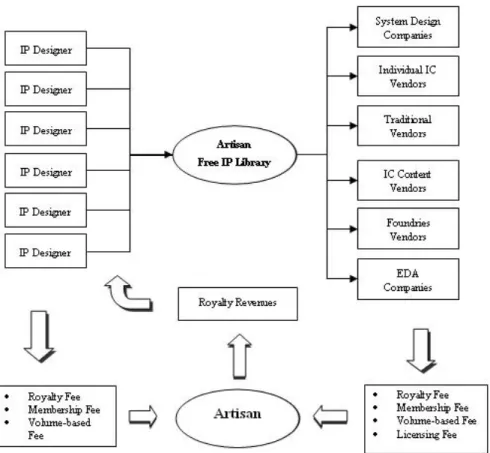
The common business practice for using IP libraries is based on the license driven business model. However, Artisan introduced a new and fundamentally different business model to the industry by moving away from the upfront-fee approach to a royalty driven system called Free IP (Figure 1). The contents of the libraries are distributed to the chip designer members at no charge. The members in Artisan’s library pay a membership fee and a royalty or volume based fee, depending on the agreement [Artisan, 2004].
Figure 2 describes IBM’s internal business model and demonstrates the strategy by which they manage and market IP. The business model provides well defined steps to manage IP, to assure
quality, and to create new IP from developed products and services. IBM’s goal is not only to obtain licensing revenues but to use IP as barter for closing deals and as a patenting strategy to protect future markets in the area [IBM, 2003].
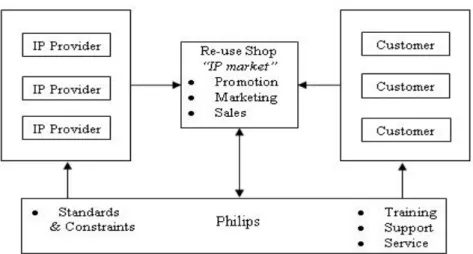
In Figure 3, the business model for marketing Philip’s IP for design and re-use is introduced. The design houses provide the IP and Philips agrees to manage the
electronic library and its content, identify customers, negotiate deals with customers,
and provide customer service. Philips works with its existing client base (that contract Philips to manufacture their SoC designs) and helps them to identify the most appropriate IP [Have, 2000].
3. Hypotheses
The research questions of interest are whether or not aspects of the emerging electronic libraries, design standards, and design licensing are equivalently perceived by international trading partners. A
comparison of companies in Sweden and Taiwan will therefore help to understand the prevailing views in the emerging SoC market.
3.1. Sweden and Taiwan IC Industry
The development of the Taiwan’s IC industry has grown to be global scale within a few decades and now covers
manufacturing as well as the design of IC components. Sweden has experienced a similar growth pattern but with the
integrated circuit industry being built on top of a global industrial economy and over a longer period of time. These two countries have comparable SoC design capabilities, particularly for the wireless application areas [Vasquez, 2003].
3.2. Hypotheses
The emerging SoC market is shifting the roles between the key players and the
biggest challenge will be to understand the technology and business risks [Ratford, 2002]. The following hypotheses test whether or not licensing is viewed as the best business model for global IP trade.
H1: IP licensing is the best business model at present in the SoC market.
H2: The perception that IP licensing is the best business model in the SoC market is similar for design engineers and managers in Sweden and Taiwan.
H3: Increased SoC design standards will increase IP licensing.
H4: The perception that SoC design standards will increase IP licensing is similar for design engineers and managers in Sweden and Taiwan.
H5: SoC design libraries increase the usage of IP licensing in the global SoC market. H6: The perception that SoC design libraries increase SoC IP licensing are similar for design engineers and managers in Sweden and Taiwan.
H7: Too many different design standards in the SoC market are a drawback for licensing SoC IP.
H8: The perception that too many different design standardizations in the SoC market are a drawback for licensing SoC IP are similar for design engineers and managers in Sweden and Taiwan.
H9: SoC design libraries increase cross licensing of IP.
H10: The perception that SoC design libraries increase cross licensing of IP are similar for design engineers and managers in Sweden and Taiwan.
H11: Acquiring IP from a SoC design library demands less detailed patent analysis.
H12: The perception that IP from a SoC design library will demand less detailed patent analysis is similar for design
engineers and managers in Sweden and Taiwan.
H13: A less detailed patent analysis should be performed when using IP from a SoC design library.
H14: Design engineers and managers in Sweden and Taiwan hold similar views that a less detailed patent analysis should be performed when using IP from a SoC design library.
H15: The Virtual Socket Interface Alliance Standards will increase opportunities to trade, to increase the customer base, and to use design libraries.
H16: Design engineers and managers in Sweden and Taiwan hold similar views that the Virtual Socket Interface Alliance
Standards will increase opportunities to trade, to increase the customer base, and to use design libraries.
4. Research Methodology
The targets of the surveys were managers and senior engineers working in the Hsinchu Science Park and at the Kista Technology Centre. The survey distributed consisted of 16 questions. The survey covered the topics of IP licensing (question 1 and 3), design standards (questions 2, 4, 8 and 10), SoC design libraries (questions 5) and
demographic information covering sex, age, position, and company name. Questions 1 through 8 were constructed as bi-polar 5-point opinion scales measuring the respondent’s agreement or disagreement with the proposition. Finally, the hypotheses consist of two sets. The analysis to test the hypotheses includes a two-way univariate
test for difference between country and between questions.
5. Statistical Results
Forty Swedish companies were sent surveys by e-mail and 34 responded (85% response rate) whereas 60 Taiwan
companies were sent surveys by e-mail and 34 responded (57% response rate). The demographics of the respondents are shown in Table 1. Table 2 presents the mean response values for each survey question by country as well as the overall mean for each question.
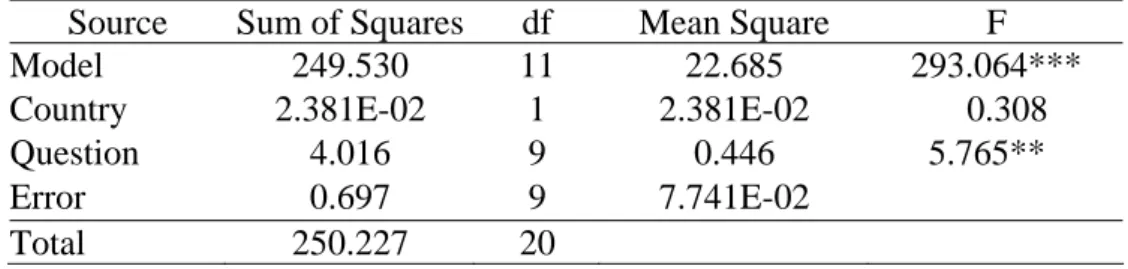
A two way univariate analysis by country (Taiwan and Sweden) and by question (survey questions 1 through 8) was conducted (Table 3). The results show that there is no evidence of differences between the respondents from Taiwan and Sweden. That is, there is no evidence to disagree with any of the odd numbered hypotheses.
However, there is reason to believe that there is a difference between questions (p = 0.008).
A one-way Anova confirmed that there are differences between the questions (p = 0.004) so the Tukey method was used. Overall, the respondents express positive opinions toward IP libraries and the related market issues.
6. Conclusion
The research results show that the respondents are mostly supportive of the IP marketing issues. Design houses in Taiwan and Sweden do not hold strong opinions and appear to be taking a wait and see approach and are ambivalent about trusting design
libraries with tasks that can jeopardize the core value of the firm.
This research leads to an important question: why do design companies disagree with outsourcing critical services like patent analysis to the libraries? Figure 4 depicts a framework that integrates Legal Knowledge Management (LKM) services and Customer Relation Management (CRM) systems with the library trade functions. The extensions of service include the addition of links into databases of design and patent knowledge that can be synchronized with design house knowledge management systems [Hsu, Trappey, et al, 2004].
References
[1] Artisan [2004] "Artisan Components: The IP Partner of Choice, " (Available: http://media.corporate-ir.net/media_file s/irol/11/112233/reports/Artisan_Annua l_Report.pdf).
[2] Fowler, T.B., [2002] “Technology’s Changing Role in Intellectual Property Rights,” IEEE IT Pro, pp. 39-44. [3] Hammermesh, Richard G., Paul. W.
Marshall and Taz Pirmohamed [2003] "Note on Business Model Analysis for the Entrepreneur,” Harvard Business
School Case Library, pp.1-14.
[4] Have, M. Ten [2000] "IP Reuse in the European Industry," Mirco-Electronics Development for European
Applications (MEDEA) Conference 2000 on Embedded System Design (Available: http://medea.it.uc3m.es/). [5] IBM [2003] "IBM’s IP Trade Business
the IBM Taipei, Taiwan office from an unpublished internal document.
[6] Lippe, Paul [1998] "An Emerging Soc Business Model. Electronic Business, " (Available:
http://www.reed-electronics.com/eb-ma g/article/CA6).
[7] Narayanan, V. K. [2001] "Managing Technology and Innovation for
Competitive Advantage,” New Jersey, Prentice-Hall.
[8] Ratford, Vincent [2002] "Make Your SoC Design a Winner: Select the Right Memory IP," IEEE Computer Society, pp. 15.
[9] Seepold, R., Martinez N. Madrid, A. Vörg, W. Rosenstiel, M. Radetzki, P. Neumann and J. Haase [2002] "A Qualification Platform for Design Reuse, " Proceedings of IEEE Quality
Electronic Design, pp. 75-80.
[10] Hsu, F.-C., Trappey, A.J.C., Hou, J.-L., Trappey, C.V., and Liu, S.-J. [2004] “Develop a multi-channel legal knowledge service center with knowledge mining capability,”
International Journal of E-Business Management, Vol. 2, No. 2, pp. 92-99.
(INSPEC).
[11] Vasquez, Ciro [2003] "Sweden is a Leading ICT Country," (Available:
http://www.isa.se).
本研究之期刊發表成果:
1. Trappey, A.J.C, Trappey, C.V., Lin, F.T.L. [2006] “Automated Silicon Intellectual Property Trade Using Mobile Agent Technology,” Robotics
and CIM, Vol. 22 (2006), pp. 189-202
(SCI).
2. Hsu, F.C., Trappey, A.J.C., Hou, J.L., Trappey, C.V., and Liu, S.J. [2006] “Technology and Knowledge Document Clustering Analysis for Enterprise R&D Strategic Planning, International Journal
of Technology Management, Vol. 36,
No. 4, pp. 336-353 (SCI/SSCI).
3. Trappey, C.V., Shih, T.-Y., and Hoang, T. [2006] Marketing Intellectual
Property using Electronic Libraries: A Survey of System on Chip Engineers and Managers in Sweden and Taiwan,
International Journal of Technology Management, Vol. 36, No. 4, pp.
Figure 1. Artisan’s free IP business model
Figure 3. The Philips IP re-use shop organisation
Figure 4. Design library with legal knowledge and customer relationship management service extensions R&D Team R&D KM R&D Team Fax E-mail Phone PDA Web Data Synchronization Contract Management Patent Analysis Patent Map Analysis Law Suite Services
LKM
CRM
On-line Chat
Technology Law
Experts Design Library Service Extension
Call Center Agents
Call Center
Legal Services
Knowledge Document Search Knowledge Document Management Metadata Management
Technology Analysis
Library Service Center
SoC Design Houses
Design Team With Internal KM System
Design Team Without Internal KM System R&D Team R&D KM R&D Team Fax E-mail Phone PDA PDA Web Data Synchronization Contract Management Patent Analysis Patent Map Analysis Law Suite Services
LKM
CRM
On-line Chat
Technology Law
Experts Design Library Service Extension
Call Center Agents
Call Center
Legal Services
Knowledge Document Search Knowledge Document Management Metadata Management
Technology Analysis
Library Service Center
SoC Design Houses
Design Team With Internal KM System
Design Team Without Internal KM System
Table 1. Demographics of respondents Country Demographics Sweden Taiwan Male 32(94.1%) 30(88.2%) Female 2(5.9%) 4(11.8%) Sex Total 34(100%) 34(100%) 25-35 10(29.4%) 13(38.2%) 36-45 16(47.1) 16(47.1%) 46- 8(23.5) 5(14.7%) Age Total 34(100%) 34(100%) Mangers 21(61.8%) 27(79.4%) CEO 13(38.2%) 0(0%) System Engineer 0(0%) 7(20.6%) Position Total 34(100%) 34(100%)
Table 2. Mean response by country and survey question
Mean Survey Question
Sweden Taiwan Question 1. IP licensing is the best business model for SoC trade. (H1) 3.21 3.79 3.49 2. Uniform design standards increase the use of IP licensing. (H3) 3.68 4.00 3.84 3. SoC design libraries increase the use of IP licensing. (H5) 3.97 3.76 3.87 4. The number of different design standards in the SoC market is a
drawback for IP licensing. (H7)
3.15 3.82 3.48
5. SoC design libraries increase cross licensing of IP. (H9) 3.68 4.12 3.90 6. Patent analysis is less important to carry out when using IP from
a SoC design library. (H11)
2.68 2.30 2.49
7. Engineers should perform a less detailed analysis when using IP from a SoC design library (H13)
2.94 2.73 2.84
8a. Virtual Socket Interface Alliance (VSIA) standards will increase opportunities to trade. (H15)
3.68 3.58 3.63
8b. Virtual Socket Interface Alliance (VSIA) standards will increase opportunities to sell, purchase, and license to different customers. (H15)
3.91 3.58 3.75
8c. Virtual Socket Interface Alliance (VSIA) standards will increase opportunities to use design libraries (H15)
3.79 3.70 3.75
Note: The total mean for all questions is 3.51 on an opinion scale of 1 (agree not at all) to 5 (agree very much).
Table 3 Two-way univariate analysis of variance by country and question: Tests of Between-Subjects Effects
Source Sum of Squares df Mean Square F
Model 249.530 11 22.685 293.064***
Country 2.381E-02 1 2.381E-02 0.308
Question 4.016 9 0.446 5.765**
Error 0.697 9 7.741E-02
Total 250.227 20