
行政院國家科學委員會補助專題研究計畫
■ 成 果 報 告
□期中進度報告
新穎三元及四元含硫、硒、碲之金屬固態化合物之合成與鑑定
Systematic Investigations of Ternary and Quaternary Metal
Chalcogenides
計畫類別:■ 個別型計畫 □ 整合型計畫
計畫編號:NSC 94 - 2113 - M - 009 - 012 -
執行期間:
94 年 8 月 1 日至 95 年 12 月 31 日
計畫主持人:李積琛
共同主持人:
計畫參與人員:王明芳,陳奎伯,黃文亨,楊朝翔,翁聖豐,顏詠哲,
鍾明諺,鄭乃倫
成果報告類型(依經費核定清單規定繳交):□精簡報告 ■完整報告
本成果報告包括以下應繳交之附件:
□赴國外出差或研習心得報告一份
□赴大陸地區出差或研習心得報告一份
■出席國際學術會議心得報告及發表之論文各一份
□國際合作研究計畫國外研究報告書一份
處理方式:除產學合作研究計畫、提升產業技術及人才培育研究計畫、
列管計畫及下列情形者外,得立即公開查詢
□涉及專利或其他智慧財產權,□一年■二年後可公開查詢
執行單位:國立交通大學應用化學系
中 華 民 國 96 年 6 月 8 日
行政院國家科學委員會補助專題研究計畫
結案報告
新穎三元及四元含硫、硒、碲之金屬固態化合物之合成與鑑定
Systematic Investigations of Ternary and Quaternary Metal
Chalcogenides
計畫類別:■ 個別型計畫 □ 整合型計畫
計畫編號:NSC 94 - 2113 - M - 009 - 012 -
執行期間:94 年 8 月 1 日至 95 年 12 月 31 日
計畫主持人:李積琛 交通大學應用化學系
(一)中英文摘要 中文摘要 本計畫是95 年國科會個別型計畫之結果摘要。這一年主要的工作在進行新穎固態化合物之 合成、結構與物理性質測量。主要的研究工作為合成具有已知構造單元之新固態化合物。 主要的研究成果為成功的合成並結構鑑定數個新穎固態化合物Sr3GeSb2Se8,MPb4In8X17 (M
= Cr, Mn, Fe, Cu, Ag, Au; X = S, Se),與 Sn3-xBi2+xSe6 (0<x<0.62)。物理性質的測量顯示這些
化合物均為半導體。
關鍵字: 固態化學,晶體結構,含第六族元素之固態化合物
Abstract
A new quaternary alkaline-earth selenide Sr3GeSb2Se8 has been synthesized at 750 °C from pure
elements in a stoichiometric ratio under vacuum. The product as synthesized is characterized by single-crystal X-ray diffraction, diffuse reflectance spectroscopy, and thermoanalysis. The title compound crystallizes in the orthorhombic space group Pnma with a = 12.633(4) Å, b = 4.301(1) Å, c =28.693(7) Å, V = 1558.8(8) Å3, Z = 4, R1 /wR2 = 0.0582/0.1221, GOF = 1.077. The
structure of Sr3GeSb2Se8 features a novel structural type that consists of one-dimensional chains
of vertex-sharing tetrahedra 1
[
3]
MSe
∞ (M=Ge/Sb) and fused-double chains of edge-shared
square pyramids 1
[
2 5]
Se M
∞ , which are held together by Sr
2+ ions. A band gap 0.75 eV for
Sr3GeSb2Se8 was derived from its diffuse reflectance spectrum.
(二)計畫緣由與目的
Multinary chalcogenides exhibit varied structural types that have attracted intensive research for their prospective thermoelectric applications 1-6. Much attention has been devoted to the synthesis of metal chalcogenides, such as CsBi4Te67 and AgPbmSbTe2+m8,9, that might produce compounds
with a narrow band gap for a large figure of merit (ZT = σ S2 / κ ; Z = figure of merit; T =
temperature; S = Seebeck coefficient; σ = electrical conductivity; κ = thermal conductivity). For the reported chalcogenides, almost all main-group metals cooperate with elements of group 16 (S, Se, Te) and alkali, alkaline-earth metals or rare-earth elements to form multinary chalcogenides.
10 Among these compounds, only a few ternary selenides Sr-Ge-X and Sr-Sb-X (X = S, Se, Te)
have been structurally characterized, such as Sr2Ge2Se5 11, Sr2Ge2X4 (X = S, Se) 12,13, Sr3Sb4S9 14,
and Sr6Sb6S17 15. Only one multinary clalcogenide Ba4LaGe3SbSe13 16 containing Ge, Sb and Se,
appears to have been reported. Our exploratory research has focused on chalcogenides of the form Ae-M1-M2-X (alkaline-earth element Ae; M1 = Ge, Sn; M2 = Sb, Bi; X = S, Se, Te) system.
On extending the project to the Sr-Ge-Sb-Se system, we synthesized a new quaternary chalcogenide Sr3GeSb2Se8 having one-dimensional chains of corner-sharing tetrahedra and fused
square-pyramidal double chains. Here we report the synthesis, structure and characterization of Sr3GeSb2Se8.
(三)現階段進度與結果
A) Experimental
Synthesis
Sr3GeSb2Se8 was synthesized by a solid-state method. The initial reagents were strontium (Sr,
99.0%, Alfa Aesar), germanium (Ge, 99.999%, Alfa Aesar), antimony (Sb, 99.5%, Alfa Aesar), and selenium (Se, 99.999%, Alfa Aesar). In a typical reaction, these pure elements in
stoichiometric proportions were mixed in an Ar-filled glove box (total mass ~ 0.5 g), placed in a silica tube, sealed under dynamic vacuum, and heated slowly to 750 °C within 72 h. This
temperature was maintained for three days, followed by slow cooling to 550 °C over seven days, and finally to about 23 °C on simply terminating the power. Initial reactions were intended to synthesize ‘Sr3Ge2Sb2X9’ (X = S, Se, Te). Based on the powder X-ray diffraction experiment, the
S and Te reactions yield mixtures of Sr2GeS4, SrS for ‘Sr3Ge2Sb2X9’ and SrTe, Sb2Te3, Te for
‘Sr3Ge2Sb2Te9’ reactions. From the ‘Sr3Ge2Sb2Se9’ reaction, the products contain a dark brown
product with irregularly shaped crystals. As confirmed by single-crystal diffraction, we succeeded in preparing Sr3GeSb2Se8 in quantitative yields using the elements in a stoichiometric ratio and
the same heating profile as described above. Analysis of Sr3Ge2Sb2Se9 crystals with
energy-dispersive spectra (SEM/EDX, Hitachi H-7500 Scanning Electron Microscope) showed the presence of Sr, Ge, Sb and Se. Sr3GeSb2Se8 is sensitive to air and moisture such that it
gradually decomposes to form a red amorphous powder in air in seven days. Single-crystal X-ray diffraction (XRD)
A single crystal of compound Sr3GeSb2Se8 (0.1 x 0.1 x 0.1 mm3) was mounted on a glass fiber
with graphite-monochromated Mo–Kα radiation, λ = 0.71073 Å) at 25(2) °C. The distance from the crystal to the detector was 5.0 cm. Data were collected in scans 0.3° in ϖ within groups of 600 frames each at φ settings 0° and 60°. The duration of exposure was 60 s/frame. The values of 2θ varied between 3.50° and 56.58°. Diffraction signals obtained from all frames of
reciprocal-space images were used to determine the unit-cell parameters. The data were integrated using the Siemens SAINT program and were corrected for Lorentz and polarization effects. 17 Absorption corrections were based on fitting a function to the empirical transmission surface as sampled by multiple equivalent measurements of numerous reflections. The structural model was obtained with the direct method and refined with full-matrix least-square refinement based on F2 using the SHELXTL package. 18
Structure Determination
A dark brown crystal of Sr3GeSb2Se8 revealed an orthorhomic unit cell (a = 12.633(4) Å, b =
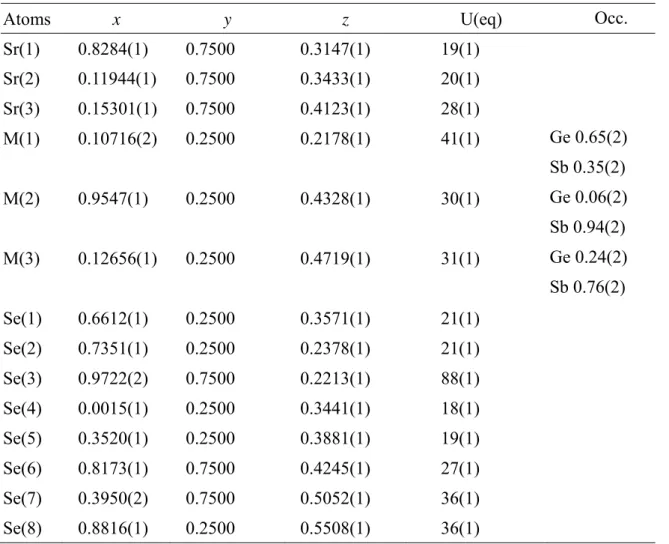
4.301(1) Å, c =28.693(7) Å, V = 1558.8(8) Å3), and systematic absences indicated space group Pnma (No. 62). Using direct methods, a structural model was built with six unique sites for metal atoms (Sr, Ge and Sb) and eight unique sites for Se atoms. The crystal structure was initially refined in a model of Sr3GeSb2Se8 with fully occupied sites of Sr (Sr(1)-Sr(3)), Ge (M(1)), Sb
(M(2), M(3)) and Se (Se(1)-Se(8)). The isotropic displacement parameters (Uiso) of M(1)-M(3)
sites exhibited unreasonable values, which indicated that M(1)-M(3) sites had partial or mixed occupancy by Ge or Sb cations. A subsequent refinement indicated that the M(1) site is occupied 65%/35% by Ge/Sb, whereas the M(2) and M(3) sites contain 6%/94% and 24%/76% of Ge/Sb, respectively. This result yielded a charge-balanced formula Sr3GeSb2Se8. Final structural
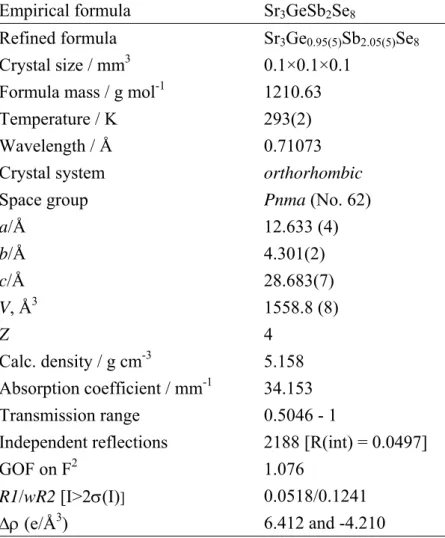
refinements yielded R1/wR2 to be 0.0582/0.1221. All atomic positions were refined with anisotropic displacement parameters. Tables 1-3 summarize the crystallographic data, atomic coordinates and interatomic distances of Sr3GeSb2Se8. Further details of the crystal-structure
investigation can be obtained from the the Fachinformationszentrum Karlsruhe,
Eggenstein-Leopoldshafen, Germany (Fax: +49 7247 808 666; E-mail: [email protected]) on quoting the depository number CSD-XXXXXX.
Characterization
X-ray powder-diffraction data of the products were measured about 23 °C on a Bragg–Brentano-type powder diffractometer (Bruker D8 Advance, operated at 40 kV and 40 mA, Cu Kα, λ = 1.5418 Å). For phase identification, XRD data were collected in a 2θ range from 5° to 60° with a step interval 0.02°. Diffuse reflectance measurements were performed near 25 °C with a UV-visible spectrophotometer (Jasco V-570); an integrating sphere was used to measure the diffuse reflectance spectra over the range 200-2000 nm. Samples as ground powder were pressed onto a thin glass slide holder; a BaSO4 plate served as reference. Thermogravimetric
(TGA) analyses were performed on a thermogravimetric analyzer (Perkin-Elmer pyres). The sample was heated to 920 °C under a constant flow of N2 with a heating rate 5 °C min-1.
Measurements of electrical resistivity were performed with the standard four-probe method on cold pressed bars (1x1x5 mm3). The sample was annealed at 500 °C for 6 h before the measurement. For several samples, the electrical conductivity was so poor that the electrical resistance exceeded the limit (~ 103 MΩ) of the instrument.
B) Results and Discussion:
Structure Description
Sr3GeSb2Se8 crystallizes in a new structural type with orthorhombic space group Pnma, with
fourteen independent positions, three for Sr, three for mixed occupancy of Sb and Ge, and eight for Se atoms. The crystal structure of Sr3GeSb2Se8 viewed along [0 1 0] is shown in
Fig. 1. The major structural feature of this compound is the presence of alternative stacks of corner-shared tetrahedra and chains of edge-shared square pyramids, which are separated by Sr2+ ions. The Sr atoms are connected to seven or eight selenium atoms in a polyhedron close to a monocapped (Sr(2)) or bicapped (Sr(1), Sr(3)) trigonal prism with Sr–Se distances ranging between 3.1421(17) and 3.645(3) Å. The coordination environment of Sr2+ atoms is common in similar chalcogenides containing the Sr2+ cation, such as Sr2Ge2Se4 12, Sr3Sb4S9 14,
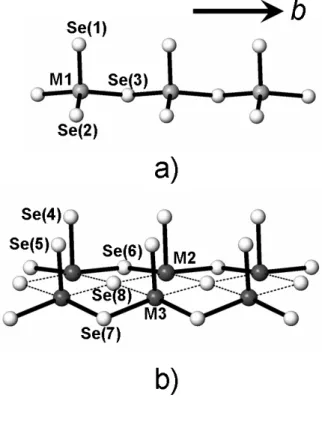
and Sr6Sb6S17 15. The M(1)-M(3) sites form a one-dimensional structure composed of
corner-sharing tetrahedral chains 1
[
MSe3]
∞ (M(1)) and chains of edge-sharing double
square-pyramids 1
[
M2Se5]
∞ (M(2), M(3)), which are shown in Figure 2. For a
[
3]
1 MSe
∞ unit,
each central metal atom forms severely distorted tetrahedral units (bond angles between 93.89(9)° and 119.26(12)°) with four M-Se bonds of length 2.429(3), 2.427(2) and 2.492(2) (x2) Å, which share corners to form an infinite chain parallel to the b axis (Fig. 2a). These Se(3) atoms are shared between two MSe4 tetrahedra. The M–Se distance is greater than for
regular Ge-Se (~2.35 Å) but smaller than for Sb-Se (~2.6-2.8 Å) distances, indicating that the M(1) site has a mixed occupancy. The 1
[
MSe3]
∞ chain is rare in antimony chalcogenides, but
similar corner-sharing GeSe4 one-dimensional chains are found in A2GeX3 (A = Na, K, Rb,
Cs; X = S, Se) 19-22. Regarding the 1
[
M2Se5]
∞ unit, the M(2) and M(3) sites form distorted
square-pyramidal units with four selenium atoms that share edges to form a ribbon shape with fused square-pyramidal units parallel to the b axis (Fig. 2b). The distortion of the square-pyramidal unit is caused mainly by three short and two long M–Se bonds in each polyhedron. The M(2) atoms comprise three short bonds to Se between 2.611(2) and 2.774(1) Å and two longer ones at 3.020(2) Å, whereas M(3) exhibits three short M-Se bonds at 2.642(2)-2.864(2) and two longer ones at 2.917(2) Å. As M(2) and M(3) sites are rich (> 75%) in Sb, these M-Se bonds compare satisfactorily with the Sb-Se distances in Sb2Se3. The
chains of fused double square pyramids form a pair that are related to each other via an a-glide plane parallel to the a-axis. Similar edge-sharing double chains were found in some multinary chalcogenides, such as K2Pr2-xSb4+xSe12 23, and La7Sb9S24 24. Combining the Sr2+,
Ge-Se and Sb-Se anionic units, we express the charge-balanced formula as [Sr2+]3[Ge4+][Sb3+]2[Se2-]8, which is consistent with the refined formula Sr3Ge0.95Sb2.05Se8.
Characterization
To determine the optical bandgap, the UV-vis diffuse reflectance spectrum of ground crystals of Sr3GeSb2Se8 was measured between 200 and 2000 nm (6.2-0.62 eV); cf. Fig. 3.
Sr3GeSb2Se8 is expected to be a semiconductor because the charge of cations and anions is
balanced. Those measurements of optical diffuse reflectance reveal that the band gap is near 0.75 eV. Thermogravimetric (TGA) measurements obtained on heating polycrystalline samples reveal a distinct decrease of mass near 700°C, attributed to decomposition of Sr3GeSb2Se8 about that temperature (Fig. 4). Powder X-ray experiments indicate that the
residues contain SrSe and an amorphous phase.
C) Conclusions
We have synthesized a new quaternary selenide Sr3GeSb2Se8 that exhibits unique
one-dimensional chains of vertex-sharing tetrahedra 1
[
MSe3]
∞ (M=Ge/Sb) and fused double
chains of edge-sharing square pyramids1
[
M2Se5]
∞ . Sr3GeSb2Se8 is an electron-precise compound
Fig. 1. a) Polyhedral representation of
Sr3GeSb2Se8 viewed along the
crystallographic b-axis [010], showing 1D chains of 1
[
3]
MSe
∞ (gray polyhedra) and
[
2 5]
1
Se M
∞ (dark gray polyhedra). Big black
and small white circles denote Sr2+ and Se 2-atoms, respectively.
Fig. 2. (a) and (b) show ∞1
[
MSe3]
and[
2 5]
1
Se M
∞ chains along the [010] direction.
Solid and dashed lines indicate M-Se distances < 2.87 and < 3.02 Å, respectively.
Fig. 3. TGA curve of Sr3GeSb2Se8 (N2 flow,
heating rate = 5 °C/min).
Fig. 4. Diffuse reflectance spectrum of
Table 1. Crystallographic Data for Sr3GeSb2Se8
Empirical formula Sr3GeSb2Se8
Refined formula Sr3Ge0.95(5)Sb2.05(5)Se8
Crystal size / mm3 0.1×0.1×0.1
Formula mass / g mol-1 1210.63
Temperature / K 293(2)
Wavelength / Å 0.71073
Crystal system orthorhombic
Space group Pnma (No. 62)
a/Å 12.633 (4) b/Å 4.301(2) c/Å 28.683(7) V, Å3 1558.8 (8) Z 4 Calc. density / g cm-3 5.158 Absorption coefficient / mm-1 34.153 Transmission range 0.5046 - 1
Independent reflections 2188 [R(int) = 0.0497]
GOF on F2 1.076
R1/wR2 [I>2σ(I)] 0.0518/0.1241
Δρ (e/Å3) 6.412 and -4.210
Table 2. Atomic Positional Coordinates, Isotropic Displacement Parameters / 10-3 Å2, and Site
Occupancies for Sr3GeSb2Se8.
Atoms x y z U(eq) Occ.
Sr(1) 0.8284(1) 0.7500 0.3147(1) 19(1) Sr(2) 0.11944(1) 0.7500 0.3433(1) 20(1) Sr(3) 0.15301(1) 0.7500 0.4123(1) 28(1) M(1) 0.10716(2) 0.2500 0.2178(1) 41(1) Ge 0.65(2) Sb 0.35(2) M(2) 0.9547(1) 0.2500 0.4328(1) 30(1) Ge 0.06(2) Sb 0.94(2) M(3) 0.12656(1) 0.2500 0.4719(1) 31(1) Ge 0.24(2) Sb 0.76(2) Se(1) 0.6612(1) 0.2500 0.3571(1) 21(1) Se(2) 0.7351(1) 0.2500 0.2378(1) 21(1) Se(3) 0.9722(2) 0.7500 0.2213(1) 88(1) Se(4) 0.0015(1) 0.2500 0.3441(1) 18(1) Se(5) 0.3520(1) 0.2500 0.3881(1) 19(1) Se(6) 0.8173(1) 0.7500 0.4245(1) 27(1) Se(7) 0.3950(2) 0.7500 0.5052(1) 36(1) Se(8) 0.8816(1) 0.2500 0.5508(1) 36(1)
Table 3. Selected Interatomic Distances / Å for Sr3GeSb2Se8.
Sr(1)-Se(1) x 2 3.250(2) M(1)-Se(1) 2.429(3) Sr(1)-Se(2) x 2 3.298(2) M(1)-Se(2) 2.427(2) Sr(1)-Se(3) 3.236(3) M(1)-Se(3) x 2 2.492(2) Sr(1)-Se(4) x 2 3.182(2) Sr(1)-Se(6) 3.154(2) M(2)-Se(4) 2.611(2) Sr(2)-Se(2) x 2 3.208(2) M(2)-Se(6) x 2 2.774(1) Sr(2)-Se(4) x 2 3.250(2) M(2)-Se(8) x 2 3.020(2) Sr(2)-Se(5) x 2 3.200(2) Sr(2)-Se(8) 3.187(2) M(3)-Se(5) 2.642(2) M(3)-Se(7) x 2 2.864(2) Sr(3)-Se(1) x 2 3.142(2) M(3)-Se(8) x 2 2.917(2) Sr(3)-Se(5) x 2 3.188(2) Sr(3)-Se(6) 3.645(3) Sr(3)-Se(7) x 2 3.337(2) Sr(3)-Se(7) 3.166(3)
(四)計畫成果自評
This project was focused on the synthesis of new chalcogenides and a manuscript for Sr3GeSb2Se8 was prepared. In addition, two series of chalcogenide compounds were synthesized
and their preliminary results are summarized below. (1) The Effect of Transition Metal on the Synthesis of Quaternary Sulfides MPb4In8X17 (M = Cr, Mn, Fe, Cu, Ag, Au; X = S, Se, Figure
5)25: The first representing compound is TPb4In8S17 (T = Cu-Au). their structures are built from
slabs of 2
∞[InS2] and ∞2[MPb2In3S6]. The transition metal is essential to the synthesis of these
quaternary compounds. The EDS analysis on a single crystal has also confirmed the existence of transition metal. The compound crystallized in the monoclinic system, space group P21/m .
Measurements on the title compounds as single crystals clearly show that the transition metals atoms occupy preferentially on different distorted octahedral sites depending on the d electron configuration. We propose that a transition metal with filled d orbitals would occupy preferentially a position with little M-S contact to avoid M-S antibonding interactions: the off-center octahedral sites fulfill this requirement (see M9 and M11 sites in Figure 5). On the other hand, early transition metals prefer to occupy other octahedral sites; theoretical investigation is underway to understand the site preference of transition-metal and In atoms. Analogues with varied transition metals were also been synthesized and characterized. These compounds are semiconductors with electrical conductivity in the range 10-6–10-5 Ω-1cm-1 at
room temperature. Measurements of optical diffuse reflectance on sulfide compounds revealed band gaps near 1.3 eV. (2) Experimental and Theoretical Investigation of the Ternary Chalcogenide Sn3-xBi2+xSe6 (0<x<0.62, Figure 6.)26, 27: A series of new ternary chalcogenides
Sn3-xBi2+xSe6 (0<x<0.62) were synthesized and the crystal structure crystallizes in the
orthorhombic space group Pnma (No.62). Sn3-xBi2+xSe6 is isostructure to the mineral of Pb3Bi2S6.
The structure is made up by slabs of the galena structure, which are juxtaposed and related to each other by (100) mirrors plane. The structure can be described as a polysynthetic twinning of the galena structure. The crystal structure exhibits Sn/Bi mixed occupancied sites, and experiments indicated phase width in Sn3-xBi2+xSe6 (0<x<0.62). The average thermopower of
Sn2.38Bi2.62Se6 and Sn3Bi2Se6 over temperature range between 300 and 500K are -53(8)μV/K and
87(9)μV/K, respectively , which showed n-type and p-type semiconducting properties,. The relative Mulliken population analyses revealed positively and negatively polarized sites for Sn/Bi and Se sites and the proposed phase width from the calculations is in consistent with the experimental data. Detail characterizations including the purification of these phases, physical property measurement and detail theoretical studies could be done soon. During this project year, two posters were presented by graduate students in the 2005 annual Chinese Chemical Society meeting and the 2006 Meeting of the American Crystallographic Association. The manuscripts for these results are in progress.
Figure 5. Three-dimensional structure of
CuPb8In17S34 projected along [010]; big gray
circles: Pb; small gray circles: S; black circles inside the gray octahedral: In; small black circles inside the dark gray octahedral: 75% In/25% Cu. b) Coordination environment of the M9 site.
Figure 6. Perspect representation of
Sn3-xBi2+xSe6 and viewed along b axis. Yellow:
(五)參考文獻
(1) Kanatzidis, M. G. Semicond. Semimetals 2001, 69, 51-100.
(2) Slack, G. A. CRC Handbook of thermoelectrics; Boca Raton, 1995.
(3) Venkatasubramanian, R.; Siivola, E.; Colpitts, T.; O'Quinn, B. Nature 2001, 413, 597-602.
(4) Tritt, T. M. Thermoelectric materials, 1998 -- the next generation materials for small-scale refrigeration and power generation applications: symposium held November 30-December 3, 1998, Boston, Massachusetts, U.S.A; Materials Research Society: Warrendale, Pa., 1999.
(5) Nolas, G. S.; Sharp, J.; Goldsmid, H. J. Thermoelectrics: basic principles and new materials developments; Springer: Berlin; New York, 2001.
(6) Kanatzidis, M. G.; Mahanti, S. D.; Hogan, T. P. Chemistry, physics, and materials science of thermoelectric materials:beyond bismuth telluride; Kluwer Academic / Plenum Publishers: New York, 2003.
(7) Chung, D.-Y.; Hogan, T.; Brazis, P.; Rocci-Lane, M.; Kannewurf, C.; Bastea, M.; Uher, C.; Kanatzidis, M. G. Science 2000, 287, 1024-1027.
(8) Quarez, E.; Hsu, K.-F.; Pcionek, R.; Frangis, N.; Polychroniadis, E. K.; Kanatzidis, M. G. J. Am. Chem. Soc. 2005, 127, 9177-9190.
(9) Hsu, K. F.; Loo, S.; Guo, F.; Chen, W.; Dyck, J. S.; Uher, C.; Hogan, T.; Polychroniadis, E. K.; Kanatzidis, M. G. Science 2004, 303, 818-821.
(10) Inorganic Crystal Structure Database; FIZ Karlsruhe and the Gmelin Institute, 2006. (11) Johrendt, D.; Tampier, M. Chem. Eur. J. 2000, 6, 994-998.
(12) Pocha, R.; Tampier, M.; Hoffmann, R. D.; Mosel, B. D.; Poettgen, R.; Johrendt, D. Z. Anorg. Allg. Chem. 2003, 629, 1379-1384.
(13) Philippot, E.; Ribes, M.; Maurin, M. Rev. Chim. Miner. 1971, 8, 99-109.
(14) Cordier, G.; Schwidetzky, C.; Schaefer, H. Rev. Chim. Miner. 1982, 19, 179-186. (15) Choi, K. S.; Kanatzidis, M. G. Inorg. Chem. 2000, 39, 5655-5662.
(16) Assoud, A.; Soheilnia, N.; Kleinke, H. J. Solid State Chem. 2004, 177, 2249-2254. (17) SAINT Version 6.22; Version 4 ed.; Siemens Analytical X-ray Instruments Inc.: Madison, WI., 2001.
(18) SHELXTL Version 6.10; Reference Manual, Siemens Analytical X-Ray Systems, Inc, Madison, WI, 1996.: Madison, WI., 2000.
(19) Olivier-Fourcade, J.; Philippot, E.; Ribes, M.; Maurin, M. C. R. Seances Acad. Sci., Ser. C 1972, 274, 1185-1187.
(20) Eisenmann, B.; Hansa, J.; Schaefer, H. Z. Naturforsch., B: Chem. Sci. 1985, 40, 450-457.
(21) Eisenmann, B.; Hansa, J. Z. Kristallogr. 1993, 203, 301-302. (22) Klepp, K. O.; Fabian, F. Z. Kristallogr. 1997, 212, 302-302. (23) Chen, J. H.; Dorhout, P. K. J. Alloy. Compd. 1997, 249, 199-205.
(24) Assoud, A.; Kleinke, K. M.; Kleinke, H. Chem. Mater. 2006, 18, 1041-1046. (25) K.-C. Wang, C.-S. Lee, 2007, Manuscript in preparation.
(26) K.-B. Chen, C.-S. Lee, in 10th Int. Chem. Conf., Tsing Hua University, Hsinchu, Taiwan., 2005.
![Figure 5. Three-dimensional structure of CuPb 8 In 17 S 34 projected along [010]; big gray circles: Pb; small gray circles: S; black circles inside the gray octahedral: In; small black circles inside the dark gray octahedral:](https://thumb-ap.123doks.com/thumbv2/9libinfo/8511336.185895/11.892.91.811.49.529/figure-dimensional-structure-projected-circles-octahedral-circles-octahedral.webp)
