Preparation and characterization of nanosized lithium cobalt oxide
powders for lithium-ion batteries
Chung-Hsin Lu
∗, Hsuan-Hao Chang, Yu-Kai Lin
Electronic and Electro-optical Ceramics Laboratory, Department of Chemical Engineering, National Taiwan University, Taipei, Taiwan, ROC Received 29 November 2003; received in revised form 10 December 2003; accepted 22 December 2003
Available online 10 June 2004
Abstract
Lithium cobalt oxide powders have been synthesized by a developed microemulsion process in this study. The cationic concentration of the aqueous phase significantly affects the sizes of micelles and obtained powders. Increasing the cationic concentration of the aqueous phase leads the size of the micelles to increase. Nanosized and well dispersed LiCoO2 powders are obtained in this study. The electrochemical
analysis reveals that the discharge capacity of LiCoO2significantly depends on the particle size and agglomeration state of the synthesized
powders.
© 2004 Elsevier Ltd and Techna Group S.r.l. All rights reserved.
Keywords: LiCoO2; Microemulsion; Nanoparticles; Lithium-ion batteries
1. Introduction
Lithium cobalt oxide (LiCoO2) is one of the most im-portant cathode materials used in lithium-ion secondary batteries. LiCoO2can be prepared by various methods using different lithium and cobalt sources [1–3]. As all lithium ions are extracted from the host structure of LiCoO2, irre-versible phase transformation will occur to result in inferior cycleability. When only 50% of the lithium ions are ex-tracted during cycling, LiCoO2 can maintain good cyclic stability[4].
In recent years, synthesis of nanoparticles has been intensively investigated [5–7]. Powders prepared by the traditional solid-state reaction have large particle size and broad size distribution. On the other hand, solution method can reduce the particle size to nanometer range and control the particle size distribution. Different kinds of solution methods such as the sol–gel process [8], the hydrothermal process [9], and the emulsion process [10–12] have been utilized to synthesize the nanoparticles.
In lithium-ion batteries, cathode materials have great in-fluence on the electrochemical performance. In this study, a newly developed microemulsion process is utilized to
syn-∗Corresponding author. Tel.:+886-2-23635230;
fax:+886-2-23623040.
E-mail address: [email protected] (C.-H. Lu).
thesize LiCoO2 powders. The effects of the salinity in the aqueous phase and the heating conditions on the properties of synthesized powders are discussed. The electrochemical characteristics of LiCoO2powders are also examined.
2. Experimental
Stoichiometric LiNO3 and Co(NO3)2·6H2O were dis-solved in water to form the aqueous phase. The salinity of the aqueous phase was varied from 0.5 to 2 M. The oil phase was comprised of analytical grade cyclohexane as the pri-mary component. 1-Hexanol and OP-10 were chosen as the surfactant and co-surfactant, respectively. The well mixed water phase was added to the oil phase with a volume ratio maintained at 1:10. After thorough stirring, a thermody-namically stable microemulsion system was obtained. The prepared microemulsion was added dropwise to hot oil at 200◦C via a peristaltic pump. The obtained precursors were further dried at 400◦C to remove organic phase. The dried powders were calcined at elevated temperatures for 2 h to obtain LiCoO2powders. The microstructure of the calcined powders were examined by XRD and TEM, respectively. The size of microemulsion droplets was measured by an acoustic spectrometer. The electrochemical behavior of the obtained powders was examined in coin cells. The cathode composites were comprised of 87 wt.% LiCoO2 powders,
0272-8842/$30.00 © 2004 Elsevier Ltd and Techna Group S.r.l. All rights reserved. doi:10.1016/j.ceramint.2003.12.163
8 wt.% super-S carbon black, and 5 wt.% binder (polyvinyli-dene fluoride (PVdF)). n-Methyl pyrrolidone (NMP) was used as the solvent. Lithium foil was utilized as the anode, and the electrolyte solution was composed of 1 M LiPF6 dissolved in ethylene carbonate (EC)–dimethyl carbonate (DMC) (at a volume ratio of 1:1). The cells were charged and discharged at 0.2 mA/cm2within a potential range of 3 to 4.3 V.
3. Results and discussion
3.1. Formation of LiCoO2powders
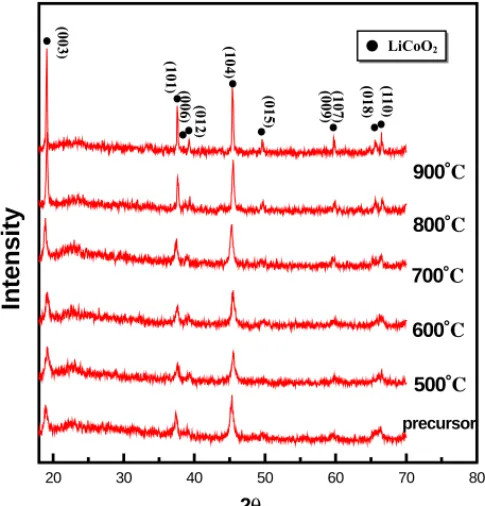
Fig. 1 illustrates the variation of the X-ray diffraction patterns of the microemulsion-derived precursors quenched at temperature ranging from 500 to 900◦C. The salinity of the aqueous phase in the precursors is 1 M. As shown in Fig. 1, LiCoO2 is formed in 400◦C dried precursors. Once the temperature increases, the crystallinity of LiCoO2 is improved. During all heating processes, only LiCoO2is obtained. The XRD pattern shows great consistency with that reported in JCPDS No. 44-151[13], and the diffrac-tion peaks in the XRD pattern have been indexed to the hexagonal form (high-temperature polymorph). Therefore, it confirms that the obtained LiCoO2exhibits aR¯3m struc-ture, and the pure phase of LiCoO2is successfully obtained via the microemulsion process. In comparison with the con-ventional solid-state reaction[14], the required temperature for preparing LiCoO2 powders is significantly reduced in the microemulsion process. It is considered to result from
20 30 40 50 60 70 80 900˚C 800˚C 700˚C 600˚C 500˚C precursor
In
te
n
s
ity
2θ (018 ) (1 10 ) (107 ) (009 ) (015 ) (104 ) (101 ) (006 ) (012 ) (003 ) LiCoO2Fig. 1. XRD patterns of the microemulsion-derived LiCoO2 powders
heated at elevated temperatures.
0. 0. 0. 0. 10 05 10 15 0.20 25 [Li+]= 0.5M dm=55 nm [Li+]= 0.1M dm=75 nm [Li+]= 2 M dm=95 nm 100 PSD weight basis diameter (nm) , , ,
Fig. 2. Size distribution of micelles containing various concentrations of cations.
the improved homogeneity of constituents and the enhanced reactivity of the microemulsion-derived precursors.
3.2. Effects of the concentration of cations in the aqueous phase on the microstructures of LiCoO2powders
The size distribution of micelles with different concentra-tions of caconcentra-tions in the aqueous phase is illustrated inFig. 2. In all prepared systems, the size distribution of micelles is narrow. However, the average size of micelles varies with the concentration of cations in the aqueous phase. When the concentration of cations in the aqueous phase increases from 0.5 to 1 M, the mean diameter of micelles increases from 55 to 95 nm. The above three kinds of aqueous phase were used to prepare the precursors of LiCoO2via the mi-croemulsion process. The obtained precursors were dried at 400◦C, and were investigated via TEM. According to the TEM analysis, when the concentration of the aqueous phase increases from 0.5 to 1 M, the average particle size of pow-ders increases from 25 to 52 nm. It is found that the size of obtained powders reflects the size of micelles. When the size of micelles increases, the size of powders will also increases correspondingly.
The TEM images of 800◦C-calcined LiCoO2 powders prepared from different concentrations of cations in the aqueous phase are shown in Fig. 3. As seen in this figure, the particle size increases correspondingly with a rise in the concentration of cations in the aqueous phase. As the concentration of the aqueous phase increases from 0.5 to 1 M, the average particle size of LiCoO2powders increases from 100 to 270 nm. It is evident that nanosized LiCoO2 powders are synthesized via the microemulsion process. The dependence of the particle size of LiCoO2powders on
Fig. 3. TEM images of 800◦C calcined LiCoO2 powders: (a) [Li+]= 2 M, (b) [Li+]= 1 M, and (c) [Li+]= 0.5 M.
the concentration of cations in the aqueous phase and the heating temperature is illustrated inFig. 4. For all systems, the particle size of LiCoO2powders increases rapidly with a rise in the heating temperature. At the same heating tem-perature, raising the concentration of cations in the aqueous phase effectively increases the particle size of LiCoO2 pow-ders. As seen inFig. 4(c), LiCoO2particles prepared from the concentration of cations equal to 0.5 M agglomerate seriously. The agglomeration state as well as the particle size of the prepared powders will affect the electrochemical properties of cathode powders.
3.3. Electrochemical properties of microemulsion-derived LiCoO2powders
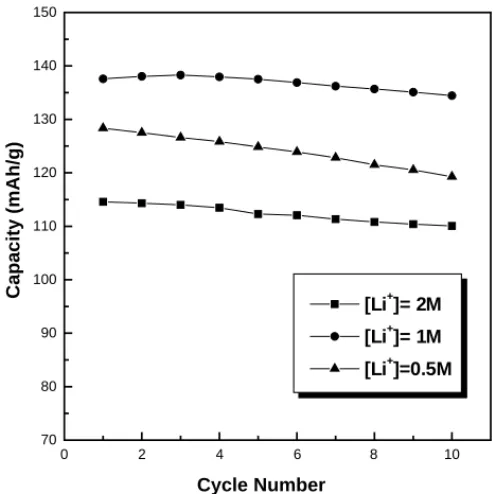
Fig. 5 illustrates the charge–discharge curves of 800◦C calcined LiCoO2 powders prepared from different con-centrations of cations in the aqueous phase. All obtained powders clearly display a plateau at 3.9 V, which represents the typical electrochemical characteristic of LiCoO2. The discharge capacities in the first cycle of LiCoO2 powders prepared from the concentration of cations in the aqueous phase equal to 0.5, 1, and 2 M are 114, 137, and 128 mAh/g, respectively. It reveals that both the particle size and agglom-eration state of LiCoO2powders will influence the discharge
400 500 600 700 800 900 (a) (b) (c) 0 50 100 150 200 250 300
[Li
+] = 2 M
[Li
+] = 1 M
[Li
+] = 0.5M
Particle Size (nm)
Temperature (˚
C
)
Fig. 4. Relation of the particle size of LiCoO2 powders and the
3.2 3.6 4.0 4.4 114 mAh/g [Li+]=[Co+2]=2M 3.2 3.6 4.0 4.4 Capacity (mAh/g) 137 mAh/g [Li+]=[Co+2]=1M 3.2 3.6 4.0 4.4 128 mAh/g [Li+]=[Co+2]=0.5M 0 20 40 60 80 100 120 140 Vol tage (V) (b) (a) (c)
Fig. 5. Charge and discharge curves of the microemulsion-derived LiCoO2
powder obtained at various cationic concentrations: (a) 0.5 M, (b) 1.0 M, and (c) 2 M.
capacities during the electrochemical reactions. When the concentration of cations in the aqueous phase is equal to 1 M, the particle size of the prepared LiCoO2powders is small, and the powders are well dispersed as seen in Fig. 4(b); therefore a high discharge capacity is achieved. When the
0 2 4 6 8 10 70 80 90 100 110 120 130 140 150 [Li+]= 2M [Li+]= 1M [Li+]=0.5M Capacity (mAh/g) Cycle Number
Fig. 6. Discharge capacity vs. cycle number for the microemulsion-derived LiCoO2 powders.
concentration of cations in the aqueous phase is equal to 0.5 M, agglomerated powders are formed. It is considered that the carbon black and binder cannot be well mixed with cathode materials, thereby reducing the discharge capacity. The relation between specific capacity and cycle number is plotted inFig. 6. It reveals that good cycleability can be obtained in the microemulsion-derived LiCoO2 powders. The developed method can also be applied to other kinds of cathode materials for controlling their particles size and morphology.
4. Conclusions
LiCoO2powders have been synthesized via a developed microemulsion process in this study. Monophasic powders with a layered (R¯3m) structure are obtained. The concentra-tion of caconcentra-tions in microemulsion not only affects the size of micelles but also the particle size of LiCoO2powders. An increase in the cationic concentration of the aqueous phase results in an increase in the size of the micelles. Nanosized and well dispersed LiCoO2 powders are formed. The elec-trochemical analysis indicates that the discharge capacity of LiCoO2depends on the particle size and agglomeration state of the synthesized powders.
References
[1] M.G.S.C. Thomas, P.G. Bruce, J.B. Goodenough, AC impedance analysis of polycrystalline insertion electrodes: application to Li1−xCoO2, J. Electrochem. Soc. 132 (1985) 1521–1528.
[2] G.G. Amatucci, J.M. Taraacon, D. Larcher, L.C. Klein, Synthesis of electrochemically active LiCoO2 and LiNiO2 at 100 degrees C,
Solid State Ionics 84 (1996) 169–180.
[3] Y.M. Chang, Y.I. Jang, H. Wang, B. Huang, D.R. Sadoway, P. Ye, Synthesis of LiCoO2 by decomposition and intercalation of
hydroxides, J. Electrochem. Soc. 145 (1998) 887–891.
[4] E. Plichta, M. Salomon, S. Slane, M. Uchiyama, D. Chua, W.B. Ebner, H.W. Lin, An improved Li/LixCoO2 rechargeable cell, J.
Electrochem. Soc. 136 (1989) 1865–1869.
[5] S. Wada, T. Suzuki, T. Noma, The effect of the particle sizes and the correlational sizes of dipoles introduced by the lattice-deffects on the crystal-structure of barium-titanate fine particles, J. Ceram. Soc. Jpn. 103 (1995) 5368–5379.
[6] G.H. Maher, C.E. Hutchins, S.D. Ross, Preparation and characteri-zation of ceramics fine powders produced by the emulsion process, Am. Ceram. Soc. Bull. 72 (1993) 72–76.
[7] W. Liu, G.C. Farrington, F. Chaput, B. Dunn, Synthesis and electro-chemical studies of spinel phase LiMn2O4cathode materials prepared
by the Pechini process, J. Electrochem. Soc. 143 (1996) 879–884. [8] X. Qiu, X. Sun, W. Shen, N. Chen, Spinel Li1+xMn2O4synthesized
by coprecipitation as cathodes for lithium-ion batteries, Solid State Ionics 93 (1997) 335–339.
[9] V. Jayaraman, T. Gnanasekaran, G. Periaswami, Low-temperature synthesis of beta-aluminas by a sol–gel technique, Mater. Lett. 30 (1997) 157–162.
[10] C.H. Lu, Y.P. Yeh, Microstructural development and electrochemi-cal characteristics of lithium cobalt oxide powders prepared by the water-in-oil emulsion process, J. Eur. Ceram. Soc. 22 (2002) 673– 679.
[11] C.H. Lu, Y. Lin, Influence of the emulsification conditions on the microstructures and electrochemical characteristics of spinel lithium manganese oxide powders, J. Mater. Res. 18 (2003) 552–559. [12] C.H. Lu, H.C. Wang, Synthesis of nano-sized LiNi0.8Co0.2O2 via a
reverse-microemulsion route, J. Mater. Chem. 13 (2003) 428–431.
[13] Powder Diffraction File, Card No. 44-145, Joint Committee on Pow-der Diffraction Standards, Swarthmore, PA.
[14] K. Mizushima, P.C. Jones, P.J. Wiseman, J.B. Goodenough, Mater. Res. Bull. 15 (1980) 783.
![Fig. 3. TEM images of 800 ◦ C calcined LiCoO 2 powders: (a) [Li + ] = 2 M, (b) [Li + ] = 1 M, and (c) [Li + ] = 0.5 M.](https://thumb-ap.123doks.com/thumbv2/9libinfo/8851472.242394/3.1263.218.1025.145.816/fig-tem-images-calcined-licoo-powders-li-li.webp)