Abstract—A mounting base integrated with disk-shaped
miniature heat pipe (DMHP) is designed for laser diode TO can package in the present study. The heat spreading performance of the disk-shaped miniature heat pipe is also presented. The present mounting base is made of aluminum (6061 T6) other than the conventional TO can package with oxygen free copper. The mounting base shows different thermal resistance with different working fluid charge volume. By optimizing the working fluid charge volume, the thermal resistance of the present mounting base will become lower than the conventional base with an oxygen free copper disk for TO can package. Moreover, this novel design can be manufactured on a massive scale and the fabrication cost can thus be effectively reduced.
Index Terms—Heat spreader, micro groove heat pipe, TO can
laser diode packaging.
I. INTRODUCTION
L
ASER DIODES, known as semiconductor lasers, have been popularly used as light source in many applications such as laser pointer, CD ROM drive, laser printer, optical communication system, and bar code scanner. Laser diodes provide stable coherent light beam and are usually packaged in very compact forms. Therefore, high heat flux will be generated while emitting light in such compact volumes. Consequently, the temperature of laser diode might rise rapidly without proper application of cooling device that can effectively dissipate heat from the laser diode to the surrounding atmosphere.Temperature rise in the active region of a semiconductor laser diode can cause a significant impact on the laser beam character-istics. The wavelength tolerance of optical communication de-vice can be deeply affected by the large temperature change. If a laser diode is operated under a constant current condition, a tem-perature rise will cause a peak shift in the emitting wavelength of an approximate value of 0.2 nm/K and a decrease in output laser power of approximately 0.2 mw/K. The wavelength drift of the emitted light results in the mode-hopping phenomenon. Therefore, it is critical to control the laser diode’s temperature to assure the standard operation. The control on the laser diode’s temperature can be achieved by coupling an effective cooling device to the laser diode packages. The heat generation in a laser
Manuscript received September 1, 2002; revised February 8, 2003. This work was recommended for publication by Associate Editor T. Lee upon evaluation of the reviewers’ comments.
The authors are with the Mechanical Engineering Department, National Taiwan University, Taipei, Taiwan 10617, R.O.C. (e-mail: [email protected]).
Digital Object Identifier 10.1109/TCAPT.2003.817648
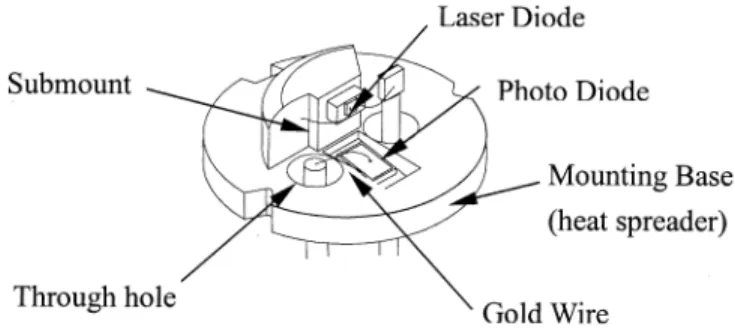
Fig. 1. TO can package of a laser diode.
diode is highly related with the material used, the ohmic contact, the confinement layer, laser stripe morphology, and packaging technology[1]. Various cooling devices such as heat spreader and heat sink have been proposed to control the laser diode’s temperature [2]. For a conventional TO can package of laser diode shown in Fig. 1, a copper disk is attached to the laser diode as a heat spreader due to its high thermal conductivity of 401 W/m-K. To avoid the oxidation of copper plate, the purity of copper disk for a TO can package is 99.999%.
Miniature heat pipe (MHP) has become one of the best choices to dissipate heat generated by the chips in electronic equipments because of its low cost, compact size, passive operation, packaging flexibility, large thermal conductance, and high reliability. The application of MHP in improving heat dissipation rate on electronic devices can be dated to 1984 [3]. Many attempts have so far been proposed, especially on the wick structure of heat pipe, to obtain a greater capillary force to drive the flow of condensed coolant to evaporator in order to improve the thermal performance. Nevertheless, the cost of manufacturing these proposed wick structure should be considerably inexpensive and the reliability should be lies above an acceptable level for practical application in electronic devices. Hammel et al. [4] proposed a silicon heat spreader with microwhisker structure, which was proved to have a heat dissi-pation rate of 6 . Ponnappan [5] presented a miniature heat pipe with groove-wick structure. The evaporator heat flux of the design can be up to 115 with a thermal resistance of 0.16 K/W. Zuo et al. [6] developed a heat pipe with a closed serpentine loop in which the pulsating flow is thermally driven. The prediction showed that the cooling capacity could rise to 250 with a thermal resistance of 0.16 K/W. Both Take et al. [7] and Take and Webb [8] conducted measurements on the thermal performance of integrated roll bond heat pipe 1521-3331/03$17.00 © 2003 IEEE
(a)
(b)
Fig. 2. Design of DMHP: (a) a prototype and (b) three-dimensional view.
with an aluminum plate. The measured results showed that a heat flux of 14.5 could be dissipated with a thermal resistance of 0.59 K/W.
In this study, a novel packaging base for the TO can package of laser diode is proposed to replace the conventional copper base. A configuration with multiple micro-grooves that radiate from the center of the base is designed. Besides, few studies has so far been conducted to investigate the thermal performance of DMHP and to study the ptential of DMHP as heat spreader of laser diodes. Therefore, the thermal resistance of DMHP is measured. In addition, the effect of charge volume on thermal performance of DMHP is also reported. A comparison is also made between thermal performance of DMHP and the conven-tional pure copper disk used in the TO can packages.
II. DESIGN OF DMHP AND ESTIMATE HEAT TRANSFERLIMITATION
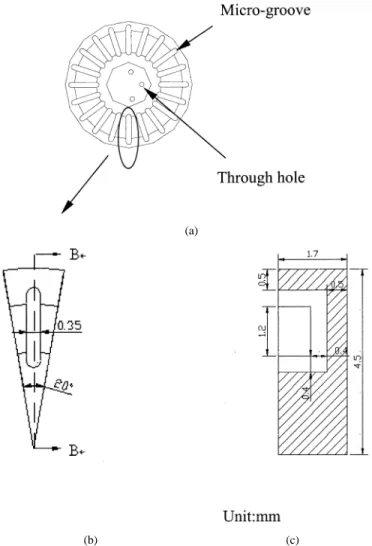
A. Design of Disk-Shaped Miniature Heat Pipe (DMHP) Fig. 2(a) and (b), respectively, show the prototype and a three dimensional view of the present DMHP. Micro-grooves were fabricated on aluminum base by a precise metal forming process. The micro-grooves can provide capillary pumping force to drive the flow of liquid from condenser to evaporator. A same diameter and shape as conventional copper base are used for the proposed packaging base. The diameter and thickness of aluminum base are 9 mm and 2 mm, respectively. The base material is aluminum alloy (6061 T6). Although thermal conductivity of aluminum alloy is lower than pure copper, the aluminum alloy is chosen as the base material for its low price and easier to be machined.
A total number of 20 micro-grooves were evenly distributed on the aluminum base, as shown in Fig. 3. The depth and width of micro-grooves are 0.4 mm and 0.35 mm, respectively. The main features of the DMHP can be summarized as:
1) metal forming process of micro-grooves is easily ex-tended for mass production;
(a)
(b) (c)
Fig. 3. (a) Eighteen micro-grooves on aluminum base plate, (b) top view of a single groove, and (c) cross-sectional view of B-B plane.
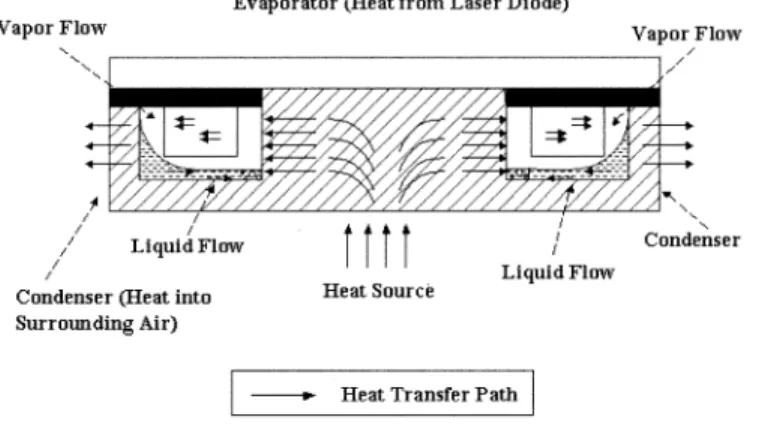
2) rectangular micro-groove provides enough capillary force for carrying condensed working fluid back to evaporator; 3) micro-grooves are radially distributed such that heat gen-erated by the laser diode vaporizes the returned liquid flow at the inner end of micro-groove, and heat dissipates into atmosphere by condensing the vapor flow at the outer end.
Since heat transfer coefficient of boiling is much higher than the convective heat transfer coefficient of vapor flow, the heat pipe requires much larger heat exchange area at the condenser end than that at evaporator end. The difference in the design of heat exchange area is needed to avoid the dry-out phenomenon. There, additional fins are usually attached to the condenser for the dissipation of heat into the atmosphere. In this study, the present design of the radiating micro-grooves arrangement can provide enough heat exchange area between vapor flow and at-mosphere for condensation of the vapor flow.
Fig. 4 shows the schematic view of heat flow and vapor-liquid flow in a DMHP micro-groove. A silicone rubber was sealed on the top of the aluminum base with vacuum grease, and the en-closed micro-grooves were charged with working fluid. Deion-ized (DI) water was used as the working fluid of DMHP due to its high merit number [9] and environmental concern of other
re-Fig. 4. Heat flow and liquid-vapor flow in a DMHP micro-groove.
TABLE I
MAXIMUMHEATTRANSFERRATE OFTHREEMAINLIMITATIONS IN THEDMHP
frigerants. For the present study, water charge volumes with 18, 37, 55, 74, and 92% of the total void volume respectively were used in the measurement. For practical application, an upper aluminum disk will be welded with the aluminum base by a high-power laser. To test for leakage, a tested DMHP was vacu-umed to a level of about 1 torr and held for 3 h. The test shows no obvious increase in the pressure reading.
B. Estimation on the Heat Transfer Limitations of DMHP Although heat pipes are very efficient heat transfer devices, they are subject to a number of heat transfer limitations. Limita-tions to heat transfer arise mainly from the ability of the wick to return condensate to evaporator, and from thermodynamic bar-riers encountered in the flow of the vapor. These limitations de-termine the maximum heat transfer rate that a specific heat pipe can achieve under certain working conditions, and can be pre-dicted by Faghri’s models. [10]. As most heat pipe applications [9]–[11], there are three main limitations in the DMHP, namely the capillary limitation, boiling limitation and entrainment lim-itation. The calculated limitations for the present DMHP are listed in Table I. As listed in Table I, the boiling limit will be the dominant effect that limits the transport capacity of the present heat pipe.
Fig. 5. Measuring systems.
Fig. 6. Thermal performance of tested DMHP at various fluid charge volumes.
III. EXPERIMENTALMEASUREMENT
A schematic view of the measuring system for the thermal performance of DMHP is shown in Fig. 5. The tested DMHP was fixed on the through hole of a holder. The plexiglas holder was positioned horizontally and had a through hole with a diam-eter of 8.5 mm. The local temperatures on the DMHP were, re-spectively, measured by five thermocouples of type-T. Two ther-mocouples were attached at the center of aluminum base plate to measure the evaporator’s temperature, and three were evenly distributed at the circumference to measure the condenser’s tem-perature. All thermocouples were calibrated against a quartz thermometer. The uncertainty in temperature measurement is
.
To ensure the practical heat dissipation ability of the present DMHP on the application of laser diode, a laser diode was em-ployed as the applied heat source in the measurement. The laser diode has an emission power of 0.68 W, and the heating power
(a)
(b)
Fig. 7. Effects of heat transfer rate on thermal resistance of DMHP with charge volume of: (a) 18% and (b) 37%.
was measured by an optical power meter (Vector H410, Scien-tech) with a resolution of 0.001W. The laser beam was focused on the center of aluminum base where was painted with black paint of 0.95 absorptivity.
Once both the heating load and the temperature
differ-ence were measured, the
thermal resistance could then be evaluated from the
equa-tion, . The evaporator temperature, ,
de-notes the average temperature obtained at the focused spot of laser irradiation on the aluminum base; while de-notes the average temperature obtained on the periphery of the DMHP.
Fig. 8. Effect of fluid charge volume on thermal resistance of DMHP.
Fig. 9. Thermal performance of conventional pure copper base.
IV. RESULTS ANDDISCUSSION
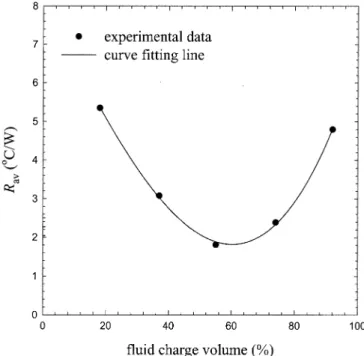
Fig. 6 shows the measured results at different fluid charge volumes. Note that the thermal resistance of each fluid charge volume can be evaluated from the best fit of measured data. The corresponding values of thermal resistance are found as 5.35, 3.08, 1.81, 2.39, 4.80 for fluid charge volume of 18, 37, 55, 74, and 92%, respectively. As listed in Table I, the es-timated heat transfer limitation of the present DMHP is 0.6 W. For all tested fluid charge volumes, no dry-out phenomenon has
ficient degree to allow nucleation. The nucleation occurs at the heating surface within 0.2–0.3 W in Fig. 7. At low heat fluxes, the vapor structure changes by starting at a few individual sites. Finally, the bubbles coalesce. The vapor patches and columns are formed close to the surface at high heat fluxes. After the nu-cleation boiling, the two-phase forced convection reach within 0.3–0.4 W in the experiment. The growth bubbles escape from the surface on the channels rapidly and a higher degree of tur-bulence will be produced [12]. The heat transfer coefficient in forced convective boiling may be strongly dependent upon ei-ther the heat flux or the mass quality. Because extremely high heat transfer coefficients are possible in this forced convective boiling regime, the temperature drop will be flatter. As a result, the thermal resistance is lower under 0.3–0.4 W in Figs. 6 and 7. The experimental data shows that a low charge volume of 18% and 37% can apparently reduce the thermal resistance within 0.3–0.4 W. It is obvious that the two-phase convective boiling phenomenon will not easily occur with a higher charge volume. The effect of fluid charge volume on the thermal performance of tested DMHP is shown in Fig. 8. It is found that the optimal fluid charge volume is about 55% for the present tested DMHP. Fig. 9 shows the thermal performance of pure copper base used in conventional laser diode package. The thermal resistance is found to be 2.97 . Consequently, the present measured data verify that the proposed DMHP have a lower thermal resis-tance as compared with the pure copper base under the optimal fluid charge volume (55%).
V. CONCLUSION
A novel packaging base for the TO can package of laser diode, the disk-shaped miniature heat pipe (DMHP), is pro-posed as substitute for the conventional copper base in the present study. An aluminum base with multiple micro-grooves that radiate from the center was prototyped to verify the thermal performance of DMHP and the potential of using DMHP as heat spreader of laser diodes. For the present tested DMHP, the optimal working fluid filling volume is found to be 15–16 . Meanwhile, an average decrease of 40% in the thermal resistance is also achieved as compared with traditional copper base. Therefore, the mounting base integrated with DMHP tolerates the high output power of laser diode, and also decreases the operation temperature of laser diode. As a result, the low fabrication cost and high heat spreading features of the present design have proved the potential as a substitute for the conventional oxygen free copper base.
[5] R. Ponnappan, “A novel micro-capillary groove-wick miniature heat pipe,” in Proc. AIAA’00, 2000, Paper 2000-2947, pp. 818–826. [6] Z. J. Zuo, M. T. North, and K. L. Wert, “High heat flux heat pipe
mech-anism for cooling of electronics,” IEEE Trans. Comp. Packag. Technol., vol. 24, pp. 220–225, June 2001.
[7] K. Take, Y. Furukawa, and S. Ushioda, “Fundamental investigation of roll bond heat pipe as heat spreader plate for notebook computers,” IEEE
Trans. Comp. Packag. Technol., vol. 23, pp. 80–85, Mar. 2000.
[8] K. Take and R. L. Webb, “Thermal performance of integrated plate heat pipe with a heat spreader,” ASME J. Electron. Packag., vol. 123, pp. 189–195, 2001.
[9] G. P. Peterson, An Introduction to Heat Pipes-Modeling, Testing, and
Applications. NewYork: Wiley, 1994.
[10] A. Faghri, Heat Pipe Science and Technology. London, U.K.: Taylor & Francis, 1995.
[11] G. P. Peterson and J. M. Ha, “Capillary performance of evaporating flow in micro grooves: An approximate analytical approach and experimental investigation,” ASME J. Heat Transfer, vol. 120, pp. 743–751, 1998. [12] J. G. Collier and J. R. Thome, Convective Boiling and
Condensa-tion. Oxford, U.K.: Clarendon Press, 1996.
Hsin-Tang Chien received the B.S. degree in mechanical engineering from the National Central University, Taiwan, R.O.C., in 1998 and is currently pursuing the Ph.D. degree at National Taiwan University, Taipei, Taiwan.
His main research interests include MEMS fabrication, packaging, thermal management, and nanofluid.
Da-Sheng Lee received the M.S. degree in mechan-ical engineering from National Taiwan University, Taipei, Taiwan R.O.C., in 1996 where he is currently pursuing the Ph.D. degree.
Since he has joined ITRI, Hsinchu, Taiwan, R.O.C., in 1996, he has been serving as a Vice Researcher of ERL and Laboratory Leader of the Sound and Vibration Laboratory. His current re-search interests include the Lab on a chip for biology and real time PCR system for DNA quantitative sequencing.
Pei-Pei Ding received the B.S. degree in mechanical engineering from National Taiwan Ocean University, Taiwan, R.O.C., in 1997 and the Ph.D. degree in me-chanical engineering from National Taiwan Univer-sity, Taipei, Taiwan, R.O.C., in 2003.
Her main research interests include MEMS design and LIGA fabrication. Afterwards, she joined the Asia Vital Components Co., Ltd., Taipei, where she is a Researcher in the Input Device Division.
Shiu-Lin Chiu received the B.S. degree in agricul-ture mechanical engineering from National Chung Hsing University, Taiwan, R.O.C., in 1996 and the M.S. degree from National Taiwan University, Taipei, Taiwan, R.O.C., in 2002.
She is a Lecturer at the Da-An Vocational School.
Ping-Hei Chen received the B.S. degree from Na-tional Taiwan University, Taipei, Taiwan, R.O.C., in 1980 and the Ph.D. degree from the University of Minnesota, Minneapolis, in 1988.
Afterwards, he joined the Department of Mechan-ical Engineering, National Taiwan University, Taipei, as an Associate Professor. He was promoted to Full Professor in 1996. He had served as the Chairman of the Department of Mechanical Engineering, National Taiwan University, from 1998 to 2001. His research areas include micro-thermal-fluid systems, lab-on-a-chip for DNA detections, nanofluid, MEMS fabrication technology, and cooling devices for electronic equipments.