TECHNICAL REPORTS
Ground water and aquifer samples from a site contaminated by hexachlorocyclohexanes (HCHs; C6H6Cl6) were exposed to nanoscale iron particles to evaluate the technology as a potential remediation method. Th e summed concentration of the HCH isomers in ground water was approximately 5.16 μmol L−1 (1500 μg L–1). Batch experiments with 2.2 to 27.0 g L–1 iron nanoparticles showed that more than 95% of the HCHs were removed from solution within 48 h. Using a pseudo fi rst-order kinetics model, the HCH isomers were removed in accordance with the trend γ ≅ α > β > δ. Th is seems to be correlated with the orientation (axial vs. equatorial) of the chlorine atoms lost in the dihaloelimination steps. Although the reactivity of the HCH isomers has been investigated in the classical organic chemistry literature, the present study was the fi rst in the environmental remediation arena. Th e rate of removal is directly correlated to the number of axial chlorines. Th e observed rate constant varied from 0.04 to 0.65 h–1, and the rate constant normalized to the iron surface area concentration ranged from 5.4 × 10⁻⁴ to 8.8 × 10⁻⁴ L m–2 h–1. Post-test extractions of the reactor contents detected little HCH remaining in solution or on the iron surfaces, reinforcing the contention that reaction rather than sorption was the operative mechanism for the HCH removal. Together with previously published work on a wide variety of chlorinated organic solvents, this work further demonstrates the potential of zerovalent iron nanoparticles for treatment and remediation of persistent organic pollutants.
Zerovalent Iron Nanoparticles for Treatment of Ground Water Contaminated
by Hexachlorocyclohexanes
Daniel W. Elliott
Geosyntec ConsultantsHsing-Lung Lien
National University of KaohsiungWei-xian Zhang*
Lehigh UniversityT
he hexachlorocyclohexanes (HCHs) are a well known group of persistent organic pollutants (POPs) and a widely studied class of organochlorine pesticides. First synthesized by Michael Faraday in 1825, the HCHs have garnered considerable research and regulatory attention over the years because of their toxicity, extensive global usage, and relative persistence in the environment (Kolpin et al., 1998; Willett et al., 1998; Walker et al., 1999). Th e highly toxic gamma isomer of HCH, better known as lindane, is regulated under the U.S. National Primary Drinking Water Standards with a maximum contaminant level of 0.2 μg L–1 (USEPA, 2002). Although the HCHs are not generallyregarded as major threats to surface and ground waters, past improper handling, storage, and disposal practices have resulted in contaminant plumes at some sites that exceed the maximum contaminant level by two or three orders of magnitude (Law et al., 2004). Considering that approximately 10 million tons of HCHs were consumed globally between 1948 and 1997, it is reasonable to assume that many HCH-contaminated sites exist throughout the world (Willett et al., 1998).
Th e synthesis of HCHs typically results in a mixture of isomers with an approximate composition as follows: 60 to 70% α-HCH, 10 to 12% γ-HCH, 5 to 12% β-HCH, 6 to 10% δ-HCH, and 3 to 4% ε-HCH (Slade, 1945; Willett et al., 1998). Of this mixture, generally referred to as technical grade HCH, all except the latter isomer are of major environmental signifi cance. Th ese isomers are depicted in Fig. 1. Th e principal diff erence among the HCH isomers concerns the orientation (e.g., axial vs. equatorial) of the chlorine substituents around the cyclohexane ring. Th e HCH isomers contain from three (γ) to six equatorial (β) chlorines and from zero (β) to three (γ) axial chlorines (Fig. 1 and Table 1). In general, it is energetically more favorable for bulky substituents like chlorine to be located in the more spacious equatorial posi-tion (Morrison and Boyd, 1987). Stated another way, equatorial chlorine substituents contribute toward lower overall energy than their axial counterparts and therefore have greater stability (i.e., lower reactivity). Th us, isomers with the largest ratio of axial to
Abbreviations: HCH, hexachlorocyclohexane; kSA, surface area normalized rate constant; nZVI, nanoscale iron; PCB, polychlorinated biphenyl; POP, persistent organic pollutant; ZVI, zero valent iron.
D.W. Elliott, Geosyntec Consultants, Lawrenceville, NJ 08648. H.-L. Lien, Dep. of Civil & Environmental Engineering, National Univ. of Kaohsiung, 811 Kaohsiung, Taiwan ROC. W.-X. Zhang, Dep. of Civil & Environmental Engineering, Lehigh Univ., Bethlehem, PA 18015.
Copyright © 2008 by the American Society of Agronomy, Crop Science Society of America, and Soil Science Society of America. All rights reserved. No part of this periodical may be reproduced or transmitted in any form or by any means, electronic or mechanical, including pho-tocopying, recording, or any information storage and retrieval system, without permission in writing from the publisher.
Published in J. Environ. Qual. 37:2192–2201 (2008). doi:10.2134/jeq2007.0545
Received 12 Oct. 2007.
*Corresponding author ([email protected]). © ASA, CSSA, SSSA
677 S. Segoe Rd., Madison, WI 53711 USA
equatorial chlorines are expected to be more reactive toward iron nanoparticles. Th eoretically, one would expect to observe progressively increasing reactivity along the series β < δ < α < γ. Although the classical organic chemistry literature includes studies of the role of HCH structure on reactivity, the present work is, to our knowledge, the fi rst such investigation in the environmental remediation arena (Cristol, 1947; Cristol et al., 1951). Moreover, it is the fi rst assessment of the amenability of iron nanoparticles to degrade the HCHs. Th ese structural dif-ferences contribute to the varying physical and chemical prop-erties of the HCH isomers, which are summarized in Table 1.
Zero valent iron (ZVI) has been the subject of intense research interest over the past decade for its potential to reme-diate a wide variety of environmental contaminants in surface and ground water. Th e majority of the ZVI research has fo-cused on the degradation of relatively simple one- and two-carbon chlorinated hydrotwo-carbons using primarily granular or microscale iron (Gillham and O’Hannesin, 1994; Matheson and Tratnyek, 1994; Johnson et al., 1996; Arnold and Rob-erts, 2000). In recent years, the focus has expanded to include other potentially amenable contaminants and contaminant classes, including nitrate, pesticides, radionuclides, and toxic Fig. 1. Structures of the environmentally signifi cant hexachlorocyclohexane (HCH) isomers, including the two α-HCH enantiomers (Willett et
al., 1998).
Table 1. Selected physical and chemical properties of the hexachlorocyclohexanes (HCHs) at 25°C (Mackay et al., 1997).
Isomer Solubility Vapor pressure† Henry’s law constant (KH) log Kow‡ Axial vs. equatorial chlorine positions
mg L–1 Pa Pa m3 mol–1
γ-HCH 6–10 3.5 × 10⁻³ 0.149 2.81–3.89 3 axial, 3 equatorial
α-HCH 6–10 4.4 × 10⁻² 0.872 3.80–4.44 2 axial, 2 equatorial
β-HCH <1 4.3 × 10⁻⁵ 0.116 3.78–4.15 0 axial, 6 equatorial
δ-HCH 6–10 2.0 × 10⁻³ 0.0825 4.14 1 axial, 5 equatorial
† The data represent an average of the range of values reported. ‡ The logarithm of the octanol-water partition coeffi cient (Kow).
metals (Cheng et al., 1997; Sayles et al., 1997; Gu et al., 1998; Blowes et al., 2000; Alowitz and Scherer, 2002).
Since 1996, we have actively investigated the ability of iron and bimetallic (e.g., Fe/Pd and Fe/Ag) nanoparticles to treat a wide variety of contaminants, including chlorinated solvents (Zhang et al., 1998; Lien and Zhang, 1999, 2001, 2005; Zhang, 2003), polychlorinated biphenyls (PCBs) (Wang and Zhang, 1997), chlorinated benzenes (Xu and Zhang, 2000), perchlorate (Cao et al., 2005), and heavy metals (Cao and Zhang, 2006; Li and Zhang, 2006, 2007) in laboratory studies and fi eld ap-plications. In these studies, the average particle diameter of the nanoscale iron was generally two orders of magnitude smaller than the commercially available iron powder (i.e., microscale iron) used in ZVI remediation studies. Th e much larger specifi c surface area of the nanoparticles translates into potentially signifi -cantly enhanced reactivity because the zero valent metal degrada-tion reacdegrada-tions are surface mediated. Surface area normalized rate constants (kSA) from experiments with nanoscale palladized iron are typically one to two orders of magnitude larger than those for microscale iron under similar conditions (Lien and Zhang, 2001). Lowry and Johnson (2004) indicated the capability of iron nanoparticles for degrading PCBs. Th e nanoparticle technol-ogy is considered well suited for in situ treatment of contaminant hot-spots given its high reactivity, portability, and fl exible deploy-ment in the fi eld (Elliott and Zhang, 2001; Li et al., 2006b).
In this research, slurries of nanoscale iron (nZVI) were added to batch reactors containing HCH-contaminated ground water to evaluate its potential utility as a remediation tool. Process ef-fectiveness was evaluated in terms of the extent of contaminant loss from solution and the rate (e.g., kinetics) of removal. Other key factors were the role of varying iron dose and the presence of indigenous aquifer solids on the contaminant removal process.
Materials and Methods
Site Overview and Ground Water Quality
Th e contaminated ground water and aquifer solids samples used in this study were obtained from an active pesticides man-ufacturing and formulating site in Jacksonville, Florida. Th e samples were collected within a contaminant source area
af-fected by past waste disposal activities. Uncontaminated ground water from the area is of near-neutral pH, with calcium and bicarbonate being the dominant cation and anion, respectively.
Major ground water contaminants in site ground wa-ter include the four HCH isomers, benzene, and xylenes (Table 2). Using the gas chromatographic method described herein, the average initial concentration of the isomers was as follows: α-HCH = 520 μg L–1, β-HCH = 138 μg L–1,
γ-HCH = 475 μg L–1, and δ-HCH = 390 μg L–1. Th e pH of the
source area ground water was approximately 2.4 standard units, resulting from the historic disposal of sulfuric acid and other waste materials (Law et al., 2004). Th e low pH in this source area likely contributed to the persistence and extent of the HCH plume given the relative stability of the isomers under acidic conditions (Law et al., 2004). Dissolved oxygen levels were less than 1 mg L–1. Measured values of the reduction potential relative
to the standard hydrogen electrode were typically on the order of +50 to +150 mV, indicating mildly reducing conditions. Th e source area ground water also contains elevated levels of total dis-solved solids, sulfate, chloride, and iron. In accordance with the prevailing standard hydrogen electrode, the vast majority of the total iron observed exists as ferrous (Fe2+) iron.
Nanoparticle Synthesis
Th e nZVI particles were synthesized by mixing equal vol-umes of 0.50 mol L−1 sodium borohydride (98.5%) (Finnish Chemicals OY, Aetsa, Finland) and 0.28 mol L−1 ferrous sul-fate heptahydrate (VWR Scientifi c, West Chester, PA) solu-tions. Th e borohydride solution was metered into the ferrous sulfate solution at approximately 0.15 L min–1, forming
nano-scale zerovalent iron according to the following stoichiometry:
2 - 0
-(aq) 4(aq) 2 (l) (s) 2 3(aq) (aq) 2(g)
2Fe+ +BH +3H O →2Fe +H BO +4H+ +2H [1] Th e synthesis was conducted in a fume hood in 5-gallon polyethylene containers fi tted with variable-speed, explosion-resistant mixers (Heindorf ) set at 700 ± 50 rpm. No attempt was made to exclude air from the reaction mixture. After 1 h of settling, the jet-black nanoparticle aggregates were recovered by vacuum fi ltration. Th e fi nished nanoparticles Table 2. Representative snapshot of site ground water quality.†
Parameter Recent value Type Comments
α-HCH, μg L–1 520 pesticide no enantiomeric distinction
β-HCH, μg L–1 138 pesticide
γ-HCH, μg L–1 475 pesticide
δ-HCH, μg L–1 390 pesticide
ε-HCHs, μg L–1 1523 pesticide summation of HCH‡ isomers
Benzene, μg L–1 75 volatile organic
Xylenes, μg L–1 75 volatile organic
pH 2.4 conventional HCHs are reasonably acid stable
Dissolved O2, mg L–1 <1 conventional near anaerobic conditions
Oxygen-reduction potential, mV +50 ~ +150 conventional moderately reducing conditions
Total dissolved solid, mg L–1 2800 conventional
Sulfate, mg L–1 2650 conventional
Chloride, mg L–1 50 conventional
Iron, mg L–1 239 conventional total, unfi ltered; exists as Fe2+
† The data refl ect relatively recent site conditions and are representative of the ground water samples tested in this research. ‡ HCH, hexachlorocyclohexane.
were then washed with ethanol, purged with nitrogen, and refrigerated in a sealed polyethylene container under ethanol until use. Th e residual moisture content of the nanoparticles as used typically varied between 45 and 55%. Th e moisture content refers to the percent of water and ethanol remaining in the iron nanoparticle slurry relative to its dry weight and is found by dividing the weight of water/ethanol in the slurry by the weight of dry particles. Figure 2 shows an image of iron nanoparticles comprised of spherical particles assembled in chains taken with a Philips EM 400T transmission
electron microscope (Philips Electronics Co., Eindhoven, Th e Netherlands) operated at 100 kV. Detailed procedures for the imaging have been previously reported (Sun et al., 2006).
Although detailed surface characterizations were not performed as part of this research, many studies have confi rmed the presence of ZVI and crystalline iron oxide (FeO) phases on freshly synthe-sized nZVI by using the sodium borohydride method (Nurmi et al., 2005; Sun et al., 2006; Li et al., 2006a). Although the nitrogen gas–dried Brunauer–Emmett–Teller surface area for freshly syn-thesized nZVI has been determined to be 33.5 m2 g–1, it may not
be refl ective of conditions in aqueous solution given the strong aggregation potential and reactivity of nZVI (Wang and Zhang, 1997; Lowry et al., 2007). After aging for approximately 3 wk, the X-ray absorption near edge structure spectrum revealed the presence of 44% ZVI and 56% oxidized iron (Sun et al., 2006). Th us, the surface composition of the reactive nZVI changes over time. As is now widely reported, nZVI tends to form a core-shell structure wherein the reactive zero valent core (Fe0) is surrounded
by a passivating oxide shell (Nurmi et al., 2005; Sun et al., 2006; Li and Zhang, 2007). Th e precise composition and thickness de-pends on the specifi c environmental conditions (e.g., geochemical considerations), time of exposure, and other variables. In addition, X-ray photoelectron spectroscopy analysis indicated that impuri-ties, including boron (i.e., borate) and sodium, are introduced into the iron nanoparticles core-shell structure using the borohydride reduction method (Nurmi et al., 2005).
Batch Hexachlorocyclohexane Degradation Experiments
Pre-fi ltered (0.45 μm) HCH-contaminated ground water (100 mL) was added to 120-mL glass amber bottles fi tted with screw caps containing Tefl on-lined septa. Approximately 50 mg L–1 of sodium azide (Fisher, Pittsburgh, PA) was added toinhibit possible biodegradation of the contaminants. Although the use of sodium azide is well known in the control of aerobic microorganisms, its eff ectiveness on anaerobic microbial consor-tia is not known with certainty (Forget and Fredette, 1962). Th e acidic ground water pH and the presence of other pesticidinal agents (e.g., HCHs and arsenic) were likely inhibitory to sig-nifi cant growth of microbes in the source area. Variable doses of nanoscale iron or microscale iron powder (<10 μm; Aldrich, St. Louis, MO), which was used without further treatment, were then added to the reactors. Early fi eld applications typically entailed the use of iron loadings on the order of 1 g L–1 (Elliott
and Zhang, 2001). However, the nZVI loadings in more recent applications have been on the order of 15 to 20 g L–1, similar to
the higher end of concentrations in this study. Th e sealed reactors
were placed on a rotating platform shaker at 325 rpm and 30°C and sampled at regular intervals. Although the controls were used in duplicate, the reactors containing variable iron and fi ll concen-trations were not set up as replicates given limitations in the avail-ability of aquifer materials and ground water. Hence, error bars are shown only for the control reactors. However, quantifi cation was based on triplicate injections of sample into the GC.
At each interval, 2 mL of sample withdrawn by a gastight syringe was passed through a 0.20-μm syringe fi lter and added to 2 mL of 2,2,4-trimethylpentane in a 5-mL vial (Wheaton, Mill-ville, NJ) fi tted with an aluminum crimp cap and Tefl on-lined septa. Th e samples were extracted for a minimum of 30 min before GC analysis. Resolution of the individual HCH isomers was ac-complished on the basis of gas chromatographic elution times. Quantifi cation was achieved by retention time comparison and a calibration curve over the anticipated concentration range. Th e detection limit for the HCH isomers was on the order of 1 to 5 μg L–1. Th e data reported for all analyses are the result of triplicate
injections from each reactor at the appropriate time interval. At the conclusion of the test, some reactors were extracted with 20 mL of TMP for 24 h to evaluate the role of sorption in the HCH removal process. Th ese “whole reactor” extractions aff orded a quali-tative means of identifying possible surface-associated degradation products. Moreover, it helped to ascertain whether the loss of HCHs from solution could be attributed exclusively to sorption or to some combination of sorptive- and reaction-based processes.
Analytical Procedures
A Hewlett-Packard 5890 gas chromatograph (Hewlett-Packard, Santa Clara, CA) equipped with an electron capture detector and an Econocap EC-5 (Alltech, Nicholasville, KY) low-polarity capillary column was used to quantify the aqueous concentra-tions of the HCH isomers and degradation products. Th e column specifi cations were 30 m length by 0.25 mm internal diameter by Fig. 2. Transmission electron microscopy image of iron nanoparticles.
0.25 μm fi lm thickness. Th e carrier gas was ultra pure nitrogen fl owing at 4.86 mL min–1. Injection was performed in splitless
mode. Th e injector port and detector temperatures were 200 and 250°C, respectively. A progressive, three-stage temperature ramp was used as follows: 90°C for 2 min, 90 to 150°C at 10°C min–1,
150 to 160°C at 3°C min–1, and 165 to 185°C at 10°C min–1.
Quantifi cation was facilitated by the use of calibration curves for a series of standard solutions of known concentration. Th e indi-vidual HCH isomers were chromatographically resolved using this GC temperature ramp and the average elution times as follows: α-HCH = 9.86 min, β-HCH = 10.80 min, γ-HCH = 10.91 min, and δ-HCH = 11.86 min. Peak areas were measured in triplicate with relative percent diff erences less than 15%.
Results and Discussion
Eff ectiveness of Nanoscale Iron in Removing
Hexachlorocyclohexanes from Ground Water
Th e HCHs were rapidly removed from the ground water in batch reactors containing the nanoscale iron (Fig. 3). Th e data in Fig. 3 are reported in normalized fashion, C/C0, in which the concentration at any time (t) is divided by the initial concentra-tion (C0). For the two higher dosages, 8.3 and 16.5 g L–1, more
than 95% of the summed HCHs initially present were removed within 24 h. Th e lowest nZVI dose, 2.2 g L–1, still removed
74% of the total HCHs from the aqueous phase after a reaction period of 24 h. After 100 h, all three doses performed equally well, having removed 98% or more of the HCHs. In addition, the solution pH increased from about 2.4 to 6.0–6.5 stan-dard units. In batch aqueous (distilled water) nZVI systems, the maximum pH observed tends to be in the range of 8.5 to 9.5 standard units, depending on the iron dose. As shown in Eq. [2], the increasing solution pH refl ects the generation of hydroxide resulting from the corrosion of iron by water under anaerobic conditions (Matheson and Tratnyek, 1994):
0 2
-(s) 2 (l) (aq) 2(g) (aq)
Fe +2H O →2Fe+ +H +2OH [2]
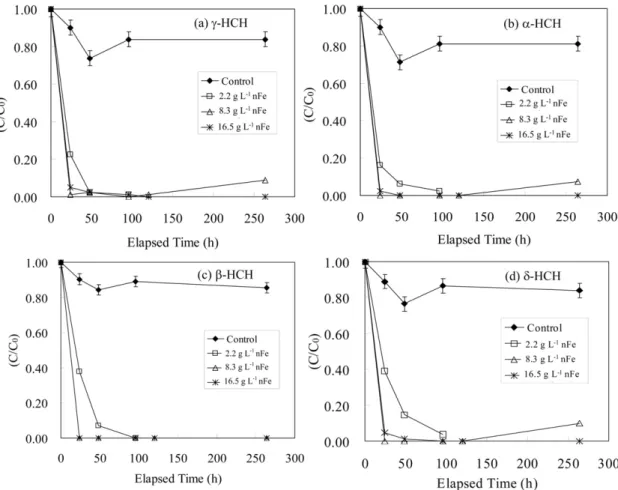
Figure 4 depicts the removal curves for the individual HCH isomers. Th e curves are similar to Fig. 3, indicating that all four isomers exhibit roughly equivalent reactivity toward nanoscale iron, particularly at the two higher dosage levels. At the lowest dosage (2.2 g L–1), some reactivity diff erentiation is evident because
the beta and delta isomers seem to be more recalcitrant than the gamma and delta isomers. After 24 h, an appreciable fraction of the beta and delta isomers (38 and 39%, respectively) remained apparently unreacted in the aqueous phase. In contrast, only 16 and 23% of the alpha and gamma isomers remained over the same period. Th us, when the iron dose is low enough, a reactivity diff erentiation is apparent in the data. δ- and β-HCH with fi ve and six equatorial chlorines, respectively, exhibited greater stability over the initial 24 to 48 h than gamma (three) and alpha (four) isomers. Th e control reactors showed a roughly 25% loss in the total HCH concentration over the initial 48 h of the experiment, al-though normalized concentrations (C/C0) were more than 0.80 thereafter. Th is may refl ect HCH partitioning to the headspace during the early stages of the experiment. α-HCH exhibits a surprisingly robust vapor pressure for an organochlorine pesti-cide (approximately 4.4 × 10⁻² Pa at 25°C), which is an order of
magnitude larger than the γ and δ isomers and three orders of magnitude larger than β-HCH (Table 1). Th e apparent losses of the alpha isomer were slightly larger given its vapor pressure. Given its relative stability and low vapor pressure, control losses for the beta isomer were lower than those for the other isomers. Th e 80% overall mass balance observed in the control reactors in this work was considered reasonable (Fig. 4a–4d).
In comparison to the modest initial concentrations of the HCH isomers (100–550 μg L–1), the substantial nZVI loadings
(i.e., 2.2–27.0 g L–1) likely contributed to the lack of signifi cant
levels of intermediates or degradation products observed dur-ing the experiment. Other factors included the greater volatility and loss tendencies of probable degradation products, including benzene. However, in other studies with comparable nZVI dos-ages and signifi cantly higher (e.g., 300–600 mg L−1) lindane (i.e., γ-HCH) concentrations in ethanol, gamma-tetrachlorocyclo-hexadiene (γ-TeCCH) was detected by GC/MS at concentrations of up to 5 to 15% of the initial HCH dosage (Elliott, 2005). Moreover, because of their hydrophobic nature, many POPs (e.g., PCBs) exhibit a high adsorption affi nity toward zerovalent iron (Lowry and Johnson, 2004). Reaction with the iron surface could result in some portion of the contaminant mass being lost from solution. Th ere is a need to develop better experimental procedures for further investigation of the reaction products and mass balance for HCHs degradation with iron nanoparticles.
Assessment of HCH Degradation Kinetics
In the literature, iron-mediated contaminant degradation is often characterized in terms of simplifi ed pseudo fi rst-order kinetics (e.g., Johnson et al., 1996; Lien and Zhang, 1999). As applied to HCH, the appropriate equation is as follows: Fig. 3. Eff ectiveness of nanoscale iron (nZVI) particles in removing
the hexachlorocyclohexanes (HCHs) from solution as a function of dosage. Error bars depict the SE from the duplicate control reactors (0 g L–1 nZVI).
d[HCH]
- [HCH]
dt = kobs [3]
where [HCH] is the concentration of HCH in μmol L−1, and
kobs is the observed pseudo fi rst-order rate constant (h–1). Th e
rate of contaminant transformation is directly proportional to the amount of available iron surface (Johnson et al., 1996). To achieve this, kobs can be expanded as follows:
kobs = kSA[Fe0]a
Fe [4]
where kSA is the rate constant normalized to the iron surface area concentration (L m–2 h–1), [Fe0] is the concentration of
iron (g L–1), and a
Fe is the specifi c surface area of the iron (m 2
g–1). A representative specifi c surface area of 33.5 m2 g–1 for dry
iron nanoparticles was used in this study. Although more complex kinetics approaches, such as the mixed order (e.g., combined zero and fi rst-order) model from Wüst et al. (1999), have been reported in the literature, the simple pseudo fi rst-order model described by Eq. [3] and [4] was used herein.
Table 3 summarizes the relevant rate constants from the experiments with the nZVI. All four HCH isomers exhibited similar reactivity toward the nZVI with the following trend observed: α ≅ γ > β > δ at the iron dosage of 2.2 g L–1. Th e
kobs values observed ranged from 0.065 to 0.04 h–1, and the
corresponding kSA values ranged from 8.8 × 10⁻⁴ to 5.4 ×
10–4 L m–2 h–1. Th e k
obs data are comparable to data observed
in the experiments with lindane (γ-HCH) at the relatively low nZVI dosage (0.015–0.39 g L–1) (Table 3). However,
the normalized rate constants are approximately one order of magnitude smaller. Th is can be partly explained in terms of the eff ect of iron dosages. Larger iron dosages may cause aggregation-related reductions in surface area, which has the eff ect of decreasing the observed rate constants. Because the
aFe value used in Eq. [4] is assumed to be constant, the calcu-lated values of kSA may be underestimated due to the eff ect of aggregation. Th e reactors were shaken during the experiments, but the eff ect of aggregation was not thoroughly investigated.
Eff ect of Aquifer Solids on HCH Degradation
In these experiments, the role of fi ll materials on the overall HCH removal process was investigated. Th e uncon-taminated fi ll samples were collected at a depth of between approximately 1.5 and 2.27 m below ground surface in the vicinity of the former waste disposal area. Th e fi ll was used “as is” without additional testing or characterization. Th e sole intent of this experiment was to preliminarily evaluate the eff ects of the fi ll in the nZVI-HCH system insofar as the rela-tive rates and extent of removal observed. Additional focused batch and column experiments, which were beyond the scope of this “fi rst-cut” assessment, are needed to examine the sorp-Fig. 4. Eff ectiveness of nanoscale iron (nZVI) particles in removing hexachlorocyclohexanes (HCHs): (a) γ-HCH, (b) α-HCH, (c) β-HCH, and (d) δ-HCH
tive potential of the HCHs on this material and the other major lithologic units at the site and to fully characterize their eff ects on the iron-mediated degradation reactions.
Th e HCHs are reasonably hydrophobic compounds, with log Kow values on the order of 2.81 to 4.14 (Mackay et al., 1997) (Table 1). Figure 5 depicts the eff ect of 100 g L–1 fi ll on HCH
loss in the aqueous phase in the presence of 0.0 to 27.0 g L–1
nZVI. Th e moderately hydrophobic HCHs exhibit an affi nity for the fi ll solids as the approximate half-life for the summed isomers is on the order of 125 h (Fig. 5). Although 77% of the summed HCHs remained in solution after 24 h in the reactor containing only fi ll (i.e., 0 g L–1 nZVI), only 2 and 27%,
respec-tively, remained in parallel reactors containing 27.0 and 8.3 g L–1
nZVI. Th e presence of such aquifer materials would reasonably be expected to deter or prolong the iron-mediated degradation process. Th is eff ect can be confi rmed by comparison with the HCH removal in the absence of fi ll materials shown in Fig. 3. For example, without fi ll materials, over 99% of HCHs were removed by 8.3 g L–1 nZVI within 24 h. By comparison, it took
96 h to remove 99% of HCHs in the presence of fi ll materials at the same iron dose. However, to the extent that the sorption of HCHs onto aquifer materials is reversible, nanoscale iron in the system can function as a reactive sink for these and other redox-amenable contaminants as they partition into the aqueous phase.
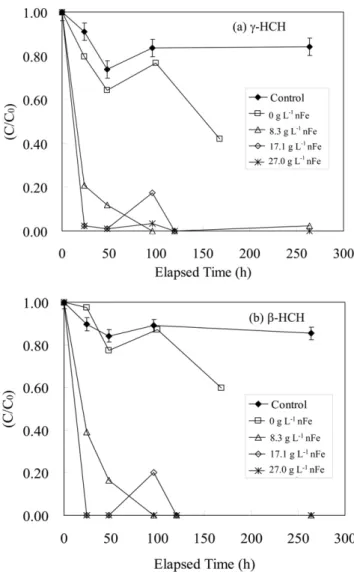
Th e eff ect depicted for the summed HCHs was also ob-served for the individual isomers but to varying degrees. Figures 6a and 6b show the plots for the gamma and beta isomers, respectively. Th e diff erences are most obvious for the reactors
containing 0 g L–1 and 8.3 g L–1 nZVI. With respect to the
former, only slightly more than 60% of the gamma isomer remained in solution after 48 h, and about 40% remained after 175 h. By comparison, 77 and 60% of the beta isomer remained in solution at 48 and 175 h, respectively, for the reac-tor containing no nZVI. Although these data may suggest that the observed sorption potential of β-HCH was slightly less than that of γ-HCH, they may refl ect the greater degradability of the gamma isomer to other reactive components of the fi ll. Regard-ing the 8.3 g L–1 nZVI dose, only 21 and 12% of the gamma
isomer remained in solution after 24 and 48 h of reaction, respectively. Th e fraction of the beta isomer remaining at these two time intervals was observed to be 40 and 17%. Th is refl ects their diff ering reactivity toward the nanoscale iron particularly during the early period of the experiments. At the higher nZVI doses, virtually no beta isomer remained in solution, while trace levels (<5%) of γ-HCH were observed. Post-test extraction re-vealed low levels of all isomers except β-HCH (Fig. 7).
Comparison of Microscale vs. Nanoscale Iron
As we have previously reported, the particle size of the iron strongly infl uences observed reactivity in the iron-mediated degradation process (Zhang, 2003). Th e 8.8 g L–1 nanoscale
iron dose performed considerably better than the 49.0 g L−1 microscale iron dose (Fig. 8). After 24 h, approximately 47% of the summed HCHs remained in solution in the reactor containing microscale iron, whereas only 1% remained in the nanoscale iron reactor. Th e kobs value of microscale iron was about 0.013 h–1, whereas the limited dataset precluded
determi-nation of the rate constant for the nanoscale iron reactor. Th e
kSA value of microscale iron was 2.65 × 10⁻⁴ L m–2 h–1, which
is one to two orders of magnitude lower than that of nanoscale iron (Table 3). Th e larger available surface area associated with the nanoscale iron would be expected to translate into a faster reaction and greater adsorption potential with respect to the contaminants. However, the specifi c surface area of the nZVI is not a static property and varies over time. All other factors being equal, the specifi c surface area would be expected to de-crease over time as a result of nanoparticle aggregation and loss of reactivity. Although the data for the individual isomers is not shown here, the eff ect of iron type and the general reactivity trends observed were similar to that depicted in Fig. 8.
Alternative HCH Degradation Pathways
Th e disappearance of the HCHs from solution observed in these experiments strongly suggests the occurrence of iron-mediated degradation as opposed to other processes. Th e HCHs Table 3. Comparison of rate constants for all four hexachlorocyclohexane (HCH) isomers and lindane.
Iron dose kobs† kSA α-HCH γ-HCH β-HCH δ-HCH α-HCH γ-HCH β-HCH δ-HCH g L–1 ––––––––––––––––––––h−1–––––––––––––––––––– –––––––––––––––––L m–2 h−1––––––––––––––––– 0.015 3.62 × 10⁻² 7.20 × 10⁻² 0.10 1.49 × 10⁻¹ 4.46 × 10⁻² 0.39 1.38 × 10⁻¹ 1.05 × 10⁻² 2.2 6.5 × 10⁻² 6.5 × 10⁻² 5.0 × 10⁻² 4.0 × 10⁻² 8.8 × 10⁻⁴ 8.8 × 10⁻⁴ 6.8 × 10⁻⁴ 5.4 × 10⁻⁴
† kobs, observed pseudo fi rst-order rate constant; kSA, surface area normalized rate constant.
Fig. 5. Eff ect of 100 g L–1 fi ll on the disappearance of
hexachlorocyclohexanes (HCHs) from solution in the presence of 0.0 to 27.0 g L–1 nanoscale iron (nZVI) particles. Error bars depict
are known to be susceptible to attack by anaerobic microorgan-isms that exist in sewage sludge, in river or lake sediments, or in the soil of fl ooded fi elds (Hill and McCarty, 1967; Tsukano and Kobayashi, 1972; Jagnow et al., 1977; Ohisa et al., 1980; Middledorp et al., 1996). Hill and McCarty (1967) measured the half-life of lindane, under anaerobic conditions, to be approx-imately 1 d in reactors containing non-acclimated sewage sludge. Buser and Müller (1995) found that the anaerobic degradation rates by sewage sludge microorganisms followed the sequence γ > α > δ > β, with half-lives between 20 and 178 h for gamma and beta, respectively. Th e conditions existent in our reactors were suffi ciently anaerobic because typical redox potential values at 24 h were between −40 and −160 mV. However, the presence of sodium azide (50 mg L–1) should prevent the growth of
micro-organisms, and the observed HCH removal is far faster than that which would occur through biodegradative pathways.
Th e HCHs can also be abiotically degraded under alkaline conditions to yield a mixture of trichlorobenzenes, particularly the 1,2,4 isomer (Cristol, 1947; Cristol et al., 1951; Ngabe et al., 1993). Th ese abiotic dehydrodehalogenations (e.g., loss of HCl)
progress through pentachlorocyclohexene and tetrachlorocyclo-hexadiene intermediates before forming the stable aromatic ring. Th e reactivity trend for these reactions mirrors that observed for anaerobic biodegradation: γ > α > γ > β. Unlike the previous case, however, the beta isomer exhibited virtually no reaction even after 3 d at a pH of 12.6, which is considerably more basic than the conditions in our reactors (e.g., maximum pH reached approximately 9.5). Ngabe et al. (1993) determined that the half-life of lindane in aqueous solution at pH 9.0 and 30°C is approximately 3 to 4 d. Th e observed disappearance rates in our experiments were much faster than could be accounted for by base-catalyzed dehydrohalogenation. Although very low levels of pentachlorocyclohexene (e.g., 20 μg L–1 or less) were frequently
observed in the t = 0 samples before addition of the nanoscale iron slurry, none was generally detected in the t = 24 h samples and beyond. Th ese considerations and the fact that none of the terminal products (i.e., the trichlorobenzenes) was detected in any of our reactors suggest that the dehydrohalogenation path-way did not play a major role in our experiments.
Fig. 6. Eff ect of 100 g L–1 fi ll on the disappearance of (a) γ-HCH and (b)
β-HCH in the presence of 0.0 to 27.0 g L–1 nanoscale iron (nZVI)
particles. Error bars depict the SE from the duplicate control reactors (0 g L–1 nZVI, 0 g L–1 fi ll).
Fig. 7. Post-extraction rebound of hexachlorocyclohexane for 27.0 g L–1 nanoiron in the presence of 100 g L–1 fi ll.
Fig. 8. Eff ect of iron type on the loss of hexachlorocyclohexanes (HCHs) in the presence of 50 g L–1 fi ll. Error bars depict the SE
from the duplicate control reactors (0 g L–1 nZVI, 0 g L–1 fi ll). The
Th e HCHs have been reported to be relatively stable under acidic conditions (Law et al., 2004). In the present work, the pH of the control reactors was as low as 2.4 standard units, and the relative loss of the HCHs was generally less than 25% over timescales in excess of 250 h. Th is suggested that acid-catalyzed hydrolyzation of HCHs should be negligible in this study.
Conclusions
In this work, reactors containing HCH-contaminated ground water and fi ll materials were treated by varying dos-ages of nZVI. In fi ltered ground water containing 2.2 to 27.0 g L–1 nZVI, typically greater than 95% of the HCHs
were removed from solution within 48 h. Th e presence of fi ll materials signifi cantly retarded the HCH removal process. Th e time required to remove 99% of the HCHs in the pres-ence of 8.3 g L–1 nZVI increased from 24 to 96 h for the
reac-tors containing 0 and 100 g L–1 fi ll, respectively.
Th e trend γ ≅ α > β > δ was observed in terms of the rate of disappearance from solution. Th is trend seems to be correlated with the orientation (axial vs. equatorial) of the chlorine atoms lost in the dihaloelimination steps. Rate constants obtained from this work were comparable to previously determined val-ues for lindane (γ-HCH). Little HCH remained in solution or was detected on the solid surfaces after the reaction, indicating that sorption was the principal removal mechanism.
Acknowledgments
Th e work was supported by a grant from the Pennsylvania Infrastructure Technology Alliance (PITA) and by USEPA STAR grants R829624 and GR832225. We thank a
confi dential colleague for supplying the contaminated ground water and aquifer materials used in this study. Mr. Stephen T. Spear also provided valuable assistance in the laboratory and design of the experiments.
References
Alowitz, M.J., and M.M. Scherer. 2002. Kinetics of nitrate, nitrite, and Cr(VI) reduction by iron metal. Environ. Sci. Technol. 36:299–306. Arnold, W.A., and A.L. Roberts. 2000. Pathways and kinetics of chlorinated
ethylene and chlorinated acetylene reaction with Fe(0) particles. Environ. Sci. Technol. 34:1794–1805.
Blowes, D.W., C.J. Ptacek, S.G. Benner, C.W.T. McRae, T.A. Bennett, and R.W. Puls. 2000. Treatment of inorganic contaminants using permeable reactive barriers. J. Contam. Hydrol. 45:123–137.
Buser, H.R., and M.D. Müller. 1995. Isomer and enantioselective degradation of hexchlorocyclohexane isomers in sewage sludge under anaerobic conditions. Environ. Sci. Technol. 29:664–672.
Cao, J., D.W. Elliott, and W.X. Zhang. 2005. Perchlorate reduction by nanoscale iron particle. J. Nanoparticle Res. 7:499–506.
Cao, J., and W.X. Zhang. 2006. Stabilization of chromium ore processing residue (COPR) with nanoscale iron particles. J. Hazard. Mater. 132:213–219. Cheng, I.F., R. Muftikian, Q. Fernando, and N. Korte. 1997. Reduction of
nitrate to ammonia by zero-valent iron. Chemosphere 35:2689–2695. Cristol, S.J. 1947. Alkaline treatment of the HCHs. J. Am. Chem. Soc.
69:338–342.
Cristol, S.J., N.L. Hause, and J.S. Meek. 1951. Mechanisms of elimination reactions: III. Th e kinetics of the alkaline dehydrochlorination of the benzene hexachloride isomers. J. Am. Chem. Soc. 73:674–679. Elliott, D.W., and W.X. Zhang. 2001. Field assessment of nanoscale bimetallic
particles for groundwater treatment. Environ. Sci. Technol. 35:4922–4926.
Elliott, D.W. 2005. Iron nanoparticles: Reactions with lindane and the hexachlorocyclohexanes. Ph.D. diss. Lehigh Univ., Bethlehem, PA. Forget, A., and V. Fredette. 1962. Sodium azide selective medium for the
primary isolation of anaerobic bacteria. J. Bacteriol. 83:1217–1223. Gillham, R.W., and S.F. O’Hannesin. 1994. Enhanced degradation of
halogenated aliphtics by zero-valent iron. Ground Water 32:958–967. Gu, B., L. Liang, M.J. Dickey, X. Yin, and S. Dai. 1998. Reductive precipitation
of uranium(VI) by zero-valent iron. Environ. Sci. Technol. 32:3366–3373. Hill, D.W., and P.L. McCarty. 1967. Anaerobic degradation of selected chlorinated
hydrocarbon pesticides. J. Water Pollut. Control Fed. 39:1259–1277. Jagnow, G., K. Haider, and P.C. Ellwardt. 1977. Anaerobic dechlorination
and degradation of hexachlorocyclohexane isomers by anaerobic and facultative anaerobic bacteria. Arch. Microbiol. 115:285–292. Johnson, T.L., M.M. Scherer, and P.G. Tratnyek. 1996. Kinetics of
halogenated organic compound degradation by iron metal. Environ. Sci. Technol. 30:2634–2640.
Kolpin, D.W., J.E. Barbash, and R.J. Gilliom. 1998. Occurrence of pesticides in shallow groundwater of the United States. Environ. Sci. Technol. 32:558–566.
Law, S.A., T.F. Bidleman, M.J. Martin, and M.V. Ruby. 2004. Evidence of enantioselective degradation of α-Hexachlorocyclohexane in ground water. Environ. Sci. Technol. 38:1633–1638.
Li, X.Q., D.W. Elliott, and W.X. Zhang. 2006a. Zero-valent iron
nanoparticles for abatement of environmental pollutants: Materials and engineering aspects. Crit. Rev. Solid State Mater. Sci. 31:111–122. Li, L., M. Fan, R.C. Brown, J. Van Leeuwen, J. Wang, W. Wang, Y. Song,
and P. Zhang. 2006b. Synthesis, properties, and environmental applications of nanoscale iron-based materials: A review. Crit. Rev. Environ. Sci. Technol. 36:405–431.
Li, X.Q., and W.X. Zhang. 2006. Iron nanoparticles: Th e core-shell structure and unique properties for Ni(II) sequestration. Langmuir 22:4638–4642. Li, X.Q., and W.X. Zhang. 2007. Sequestration of metal cations with zerovalent
iron nanoparticles: A study with high resolution X-ray photoelectron spectroscopy (HR-XPS). J. Phys. Chem. C. 111:6939–6946.
Lien, H.L., and W.X. Zhang. 1999. Transformation of chlorinated methanes by nanoscale iron particles. J. Environ. Eng. 125:1042–1047. Lien, H.L., and W.X. Zhang. 2001. Nanoscale iron particles for complete
reduction of chlorinated ethenes. Colloids Surf. A. 191:97–105. Lien, H.L., and W.X. Zhang. 2005. Hydrodechlorination of chlorinated ethanes
by nanoscale Pd/Fe bimetallic particles. J. Environ. Eng. 131:4–10. Lowry, G.V., T. Phenrat, N. Saleh, K. Sirk, and R. Tilton. 2007. Aggregation
and sedimentation of aqueous nanoscale zerovalent iron dispersions. Environ. Sci. Technol. 41:284–290.
Lowry, G.V., and K.M. Johnson. 2004. Congener-specifi c dechlorination of dissolved PCBs by microscale and nanoscale zerovalent iron in a water/ methanol solution. Environ. Sci. Technol. 38:5208–5216.
Mackay, D., W.X. Shiu, and K.C. Ma. 1997. Illustrated handbook of physical-chemical properties and environmental fate for organic chemicals. Vol. V. Lewis Publishers, New York.
Matheson, L.J., and P.G. Tratnyek. 1994. Reductive dehalogenation of chlorinated methanes by iron metal. Environ. Sci. Technol. 28:2045–2053. Middledorp, P.J., M. Jaspers, A.J.B. Zehnder, and G. Schraa. 1996.
Biotransformation of α-, β-, γ-, and δ-hexachlorocyclohexane under methanogenic conditions. Environ. Sci. Technol. 30:2345–2349. Morrison, R.T., and R.N. Boyd. 1987. Organic chemistry, 5rd ed. Allyn and
Bacon, Inc., Boston, MA.
Ngabe, B., T.F. Bidleman, and R.L. Falconer. 1993. Base hydrolysis of γ- and β-hexachlorocylohexanes. Environ. Sci. Technol. 27:1930–1933. Nurmi, J.T., P.G. Tratnyek, V. Sarathy, D.R. Baer, J.E. Amonette, K. Pecher, C.
Wang, J.C. Linehan, D.W. Matson, R.L. Penn, and M.D. Driessen. 2005. Characterization and properties of metallic iron nanoparticles: Spectroscopy, electrochemistry, and kinetics. Environ. Sci. Technol. 39:1221–1230. Ohisa, N., M. Yamaguchi, and N. Kurihara. 1980. Lindane degradation by
cell-free extracts of chlostridium rectum. Arch. Microbiol. 125:221–225. Sayles, G.D., G. You, M. Wang, and M.J. Kupferle. 1997. DDT, DDD,
and DDE dechlorination by zero-valent iron. Environ. Sci. Technol. 31:3448–3454.
Slade, R.E. 1945. Th e γ-isomer of hexachlorocyclohexane (gammexane): An insecticide with outstanding properties. Chem. Ind. (London) 40:314–319. Sun, Y.P., X. Li, J. Cao, W.X. Zhang, and H.P. Wang. 2006. Characterization of
Tsukano, Y., and A. Kobayashi. 1972. Formation of γ-BTC in fl ooded rice fi eld soils treated with γ-BHC. Agric. Biol. Chem. 36:166–167. USEPA. 2002. List of drinking water contaminants & MCLs. National
primary drinking water regulations. EPA 816-F-02-013. USEPA, Washington, DC.
Walker, K., D.A. Vallero, and R.G. Lewis. 1999. Factors infl uencing the distribution of lindane and other hexachlorocyclohexanes in the environment. Environ. Sci. Technol. 33:4373–4378.
Wang, C.B., and W.X. Zhang. 1997. Synthesizing nanoscale iron particles for rapid and complete dechlorination of TCE and PCBs. Environ. Sci. Technol. 31:2154–2156.
Willett, K.L., E.M. Ulrich, and R.A. Hites. 1998. Diff erential toxicity and environmental fates of hexachlorocyclohexane isomers. Environ. Sci.
Technol. 32:2197–2207.
Wüst, W.F., O. Schlicker, and A. Dahmke. 1999. Combined zero- and fi rst-order kinetic model of the degradation of TCE and cis-DCE with commercial iron. Environ. Sci. Technol. 33:4304–4309.
Xu, Y., and W.X. Zhang. 2000. Subcolloidal Fe/Ag particles for reductive dehalogenation of chlorinated benzenes. Ind. Eng. Chem. Res. 39:2238–2244.
Zhang, W.X. 2003. Nanoscale iron particles for environmental remediation: An overview. J. Nanoparticle Res. 5:323–332.
Zhang, W.X., C.B. Wang, and H.L. Lien. 1998. Treatment of chlorinated organic contaminants with nanoscale bimetallic particles. Catal. Today 40:387–395.