行政院國家科學委員會專題研究計畫 成果報告
以固相微萃取發展環氧乙烷的採樣分析技術 (II)
計畫類別: 個別型計畫 計畫編號: NSC91-2320-B-039-022- 執行期間: 91 年 08 月 01 日至 92 年 07 月 31 日 執行單位: 中國醫藥大學職業安全與衛生系 計畫主持人: 蔡詩偉 計畫參與人員: 蔡詩婷 報告類型: 精簡報告 處理方式: 本計畫可公開查詢中 華 民 國 92 年 10 月 21 日
行政院國家科學委員會補助專題研究計畫成果
報告
※※※※※※※※※※※※※※※※※※※※※※※
※※
※
※
※
以固相微萃取發展環氧乙烷的採樣分析技術(II)
※
※
※
※※※※※※※※※※※※※※※※※※※※※※※
※※
計畫類別:
;個別型計畫 □整合型計畫
計畫編號:NSC 91-2320-B-039-022-
執行期間:91.08.01 至 92.07.31
計畫主持人:蔡詩偉
共同主持人:
本成果報告包括以下應繳交之附件:
□赴國外出差或研習心得報告一份
□赴大陸地區出差或研習心得報告一份
□出席國際學術會議心得報告及發表之論文各一份
□國際合作研究計畫國外研究報告書一份
執行單位:中國醫藥大學職業安全與衛生學系
中 華 民 國 92 年 10 月 20 日
行政院國家科學委員會專題研究計畫成果報告
計畫編號:NSC 91-2320-B-039-022-
執行期限:91 年 08 月 01 日至 92 年 07 月 31 日
主持人:蔡詩偉 中國醫藥大學職業安全與衛生學
系
計畫參與人員:蔡詩婷 中國醫藥大學環境醫學研究所
一、中文摘要 本研究首先以 Carboxen/Polydimethyl-siloxane (CAR/PDMS)纖維經 30 秒 的頂空萃取裹附溴化氫後,組裝成被動式採樣器,然後利用動態標準氣體製造 系統於實驗室中模擬暴露狀況並進行相關驗證,以獲得採樣器之實驗採樣率。 此外,研究中也將 3M #3551 採樣器一併置於暴露腔內中進行平行比對。樣本 收集完畢後則以氣相層析質譜儀(GC/MS)進行分析。 本研究所設計之被動式採樣器的實驗採樣率為(2.96±0.09)×10-2 cm3/min﹔ 本研究所使用之 3M #3551 環氧乙烷被動式採樣器的脫附效率為 103±1%﹔本研 究所設計之採樣器的壽命試驗顯示經貯存於 4℃冰箱中 7 天後,樣本之採集回 收率可達 93%;樣本儲存穩定性試驗顯示,置於 4℃冰箱中保存 7 天後,回收 率可達 97﹪﹔本研究所設計之採樣器與 3M #3551 採樣器之平行比對顯示有良 好之相關(R2 =0.9723)。 本研究所設計之環氧乙烷採樣分析方法具有免溶劑脫附、萃取時間短、組 合簡單、攜帶方便並可重複使用等優點,同時也具有可接受之採樣器壽命與樣 本穩定性,與經美國職業安全衛生署(OSHA)所認可之 3M #3551 採樣結果比對 亦有良好之相關。 關鍵詞:固相微萃取、溴化氫、環氧乙烷、被動式採樣、氣相層析 AbstractHydrogen bromide was first loaded onto the Carboxen/Polydimethylsiloxane (CAR/PDMS) fiber through 30 sec of headspace extraction. The diffusive sampler was then assembled and a dynamic standard gas generation system was used to validate the performance of the sampler. After sampling, the sampler was inserted into the injection port of gas chromatography/mass spectrometry (GC-MS) for thermal desorption and sample analysis. Besides, 3M #3551 monitor which was a commercially available sampler for ethylene oxide, was side-by-side compared with
the designed sampler in the lab exposure chamber.
The experimental sampling rate of the designed sampler was found to be (2.96±0.09)×10-2 cm3/min; the desorption efficiency of the 3M #3551 monitor used was found to be 103±1%; the shelf life test of the designed SPME sampling device showed the recovery was around 93% after 7 days storage at 4℃; the sample stability test of the SPME device showed the recovery was around 97% after 7 days storage at 4℃; the side-by-side comparison with 3M #3551 monitor also showed linear relationship (R2=0.9723).
The sampler designed in this study showed the advantages of solvent-free, short extraction time and high reproducibility. The results showed that shelf life and sample stability were acceptable. While compared with the OSHA approved 3M #3551 method, the designed sampler showed linear relationship as well.
Keywords: SPME、HBr、Eethylene Oxide、passive sampler、Gas Chromatography
二、緣由與目的
Ethylene oxide (EtO; C2H4O; epoxyethane; oxirane) is a colorless gas at room
temperature with an ether-like odor at concentrations above 895 to 1253 mg/m3 [1]. According to the US Environmental Protection Agency (US EPA), EtO is among the top 3% of high-volume chemicals produced in the United States [2]. Ethylene oxide is processed in various applications, for example, in the production of ethylene glycol, or as the starting material for the manufacturing of acrylonitrile and nonionic surfactants [3]. The US National Institute for Occupational Safety and Health (NIOSH) estimated that 270000 US workers are potentially exposed to ethylene oxide, with the largest concentration being in the health care industry [4]. Exposure to EtO has been reported predominantly on workers occupied in sterilization units [5]. EtO irritates the eyes and skin; it may also cause allergies, adverse reproductive effects, and possibly asthma [1]. EtO is also a known human carcinogen and a potential reproductive hazard [6]. The US Occupational Safety and Health Administration (OSHA) promulgated ethylene oxide health standard with a work-shift 1.79 mg/m3 permissible exposure limit and 0.895 mg/m3 action level in 1984 [7] and revised in 1988 to add a 8.95 mg/m3 short-term excursion limit [8] while the American Conference for Governmental Industrial Hygienists (ACGIH) has set up a threshold limit value (TLV) of 1.79 mg/m3 EtO for workplace air [9].
For the exposure assessment of ethylene oxide, many air sampling and analysis methods have been developed. For example, charcoal tube was used for sampling and carbon disulfide was used for desorbing EtO [10], acid bubbler filled with ethylene glycol was used for sampling and followed by colorimetric analysis [11], and Ambersorb XE347 coated hydrobromic acid (HBr) was used to collect EtO as 2-bromoethanol [12]. Besides, hydrobromic acid-coated charcoal tube method was
recommended by both OSHA and the US National Institute for Occupational Safety and Health (NIOSH) where the reaction of EtO with HBr to produce 2-bromoethanol was utilized [13,14]. Commercially available 3M 3551 passive monitor which was recommended by OSHA as organic method No. 49 also utilized the reaction of EtO with HBr [15].
However, all the methods mentioned above involve complex procedures for sample preparations (solvent desorption, for example) and therefore very time-consuming. In recent years, a new extraction technique called solid-phase microextraction (SPME) has been developed by Pawliszyn and co-workers [16,17].
SPME presents many advantages over conventional analytical methods by combining sampling, preconcentration, and direct transfer of the analytes into a standard gas chromatograph (GC) [18]. The air sampling and analysis methods with SPME have been applied to time-weighted average sampling. It is superior to currently available diffusive sampling methods in overall analytical sensitivity because all of the sorbed analytes are introduced into the analytical instrument for quantitation rather than a small fraction of the extract [19,20]. A user-friendly SPME diffusive sampling device has recently also been reported for the analysis of ethylene oxide where HBr was first loaded onto the SPME fiber and direct 2-bromoethanol analysis was performed to determine the amounts of EtO collected [21]. Methodical optimizations with respect to the fiber material used, the HBr coating time, and the desorption time for 2-bromoethanol were all determined [21]. However, more studies were still required, such as measurements in the real environments. The research shown here detailed the information regarding the validations of the new designed SPME diffusive sampler [21] where the side-by-side comparisons between the SPME device and the OSHA approved 3M 3551 passive monitor were performed in the laboratory as well as in the fields.
三、結果與討論
To validate a diffusive sampler, several parameters including face velocity, relative humidity, temperature, shelf life, and sample stability were recommended to be evaluated in the NIOSH protocol [24]. Previous study has shown that face velocity (0-0.25 m/s) and RHs (10-80%) were not expected to have effects on the designed SPME diffusive sampler [21]. The recoveries for both shelf life and sample stability were around 100±7% after 7 days storage at 4°C [21]. In this research, effects of different temperatures were further investigated and Figure 1 shows the results. By doing simple linear regression, the slopes of these regression lines were (2.37±0.14)×10-2, (3.11±0.08)×10-2, and (2.94±0.12)×10-2 cm3/min, for 4°C, 25°C,
and 35°C, respectively, which actually stand for the experimental sampling rates of the sampler. Statistical analysis showed no difference between the sampling constants at 25°C and 35°C (P≅0.45) while significant differences were observed for the slopes at 4°C versus 25°C and 35°C (P≅0.007 and 0.008, respectively).
The following equation for the estimation of diffusion coefficient might be used to explain why the sampling constant was lower at 4°C [25].
D T PM AB AB V A V B = × +
∑
∑
0 00143 1 75 1 2 1 3 1 3 2 . [( ) ( ) ] . / / / (2)where: DAB is the binary diffusion coefficient of analyte in air in cm2/s at T;
T is temperature, K; MA and MB are molecular weight, g/mol; MAB =
2[(1/MA)+(1/MB)]-1; P is the external pressure, bar; Σv is the summation of atomic
diffusion volumes, unitless; i is all the contributing species; A is air; B is the analyte. From the estimation, the theoretical diffusion coefficient at 4°C was 0.136 cm2/sec (around 87% of the diffusion coefficient at 25°C) while it was 0.165 cm2/sec at 35°C (around 105% compared to 25°C). The experimental sampling constant of the SPME device reported previously was (2.96±0.09)×10-2 cm3/min at 25°C [21]. If the variation of diffusion coefficients at different temperatures were considered, the experimental sampling constant at 4°C was estimated to be (2.57±0.08)×10-2 cm3/min (around 87% compared to 25°C) which showed no statistical difference with what was found in this research (P≅0.11). On the other hand, the experimental sampling constant at 35°C was estimated to be (3.10±0.09)×10-2 cm3/min which also showed no statistical difference with what was found in this research (P≅0.14).
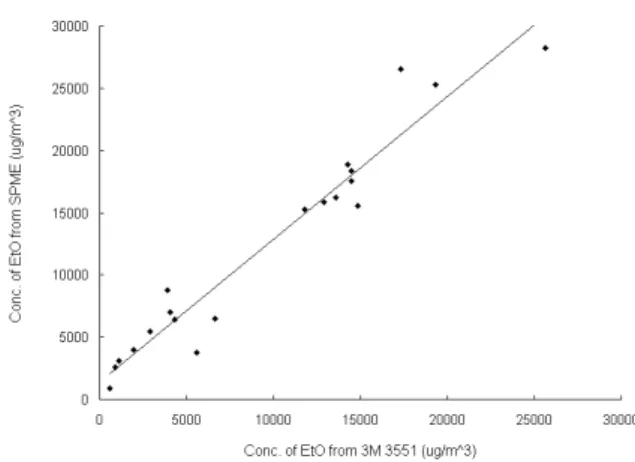
Figure 2, 3, 4 and 5 show the results of side-by-side comparisons between the SPME device and the 3M 3551 passive monitor. To calculate the concentrations of EtO that were sampled, (2.96±0.09)×10-2 cm3/min was used as the experimental sampling constant of the SPME device [21] while 49.3 cm3/min was used for the 3M monitor [23]. For the side-by-side comparisons in the laboratory, Figure 2 shows that the correlation between the results from the SPME devices and the 3M 3551 passive monitors was linear with r= 0.9861. The slope is 1.05±0.05 which further suggested that the results from both methods were consistent.
The temperatures and relative humidities during the field validations were 22.9°C -26.0°C and 71%-80%, respectively. The wind velocities of area samplings were also monitored which showed that the minimum air velocities required for the 3M 3551 passive monitor (0.076 m/s) [15] and the SPME device (wind velocity had no effects) [21] were both met. Figure 3 shows that the correlation between the results of 3 days’ sampling from the SPME devices and the 3M 3551 passive monitors was linear with r=0.9718 for area sampling. The slope is 1.16±0.07 which also suggested
that the results from both methods were consistent.
However, as shown in Figure 5, when the results of personal and area sampling from the first two days were merged together, the correlation (r=0.8742) and consistency (slope=2.18±0.28) changed. As shown in Figure 6, the SPME device was originally clipped on the wearer’s clothes and was placed in front of the chest. The open-face of the sampler was found very easily to be blocked if the wearer kept moving. This might explain why big variations were observed from the side-by-side personal sampling of the first two days. Therefore, the SPME device was placed on the wearer’s shoulder at the same side of the 3M 3551 passive monitor to avoid further blocking of the open-face on the third day. When all the data from field validations were merged, except the personal sampling of the first two days, Figure 5 shows that the results from both methods were linear (r=0.9699) and consistent (slope=1.14±0.07).
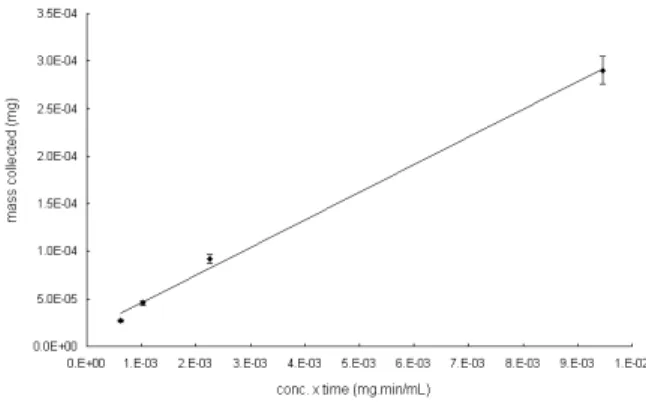
Previous laboratory validations found that the SPME device could be applied to 1 - 8 hours sampling at concentrations equaled 0.5 - 2 times TLV-TWA as well as only 10 - 90 min sampling at concentration equaled 8 times TLV-TWA [21]. In this study, EtO of 0.89, 1.79, 3.58 and 17.9 mg/m3 (equivalent to 0.5, 1, 2 and 10 times TLV-TWA) were prepared by the dynamic system and the SPME devices were exposed for 6 hours at each concentration. As shown in Figure 7, the slope was (2.91±0.13)×10-2 cm3/min which was not statistically different from (2.96±0.09)×10-2 cm3/min, the experimental sampling constant reported previously [21]. This suggested that the designed method could also be applied to higher concentration (10 times TLV-TWA) for longer sampling time (6 hours).
四、計畫成果自評
The research shown here validated the newly designed user-friendly SPME device for the determination of EtO [21]. Both laboratory and filed evaluations of the side-by-side comparisons for the SPME device and the 3M 3551 passive monitors were performed. It was shown that the results between the SPME device and the OSHA approved 3M 3551 were linear and consistent.
The diffusive sampling with the SPME device has an advantage over other methods because no pumps and solvents are required which reduces the sampling costs and the time for sample analysis. Compared with 3M 3551 passive monitor where 30 min of desorption with 1.5 mL of 10% (v/v) methylene chloride in methanol was needed, the sample from SPME device was analyzed simply by inserting the
needle of the SPME into the injector of GC/MS. The cumbersome procedure was omitted obviously. However, special cares must be taken to avoid the possible blocking of the open-face when the tube-type SPME diffusive sampler is going to be used.
Derivatization technique which increased the sample stability and analytical sensitivity was used in this research where simultaneous derivatization and extraction were performed directly on the fiber coating. The current method could be applied to 1 - 8 hours sampling at concentration equaled 0.5~2 times TLV-TWA as well as 6 hours sampling at 10 times TLV-TWA. Face velocities (0 - 0.25 m/s) and RHs (10 - 80%) were not expected to have effects on the sampler while temperatures did influence the results. However, the concentration of EtO can be measured correctly once the variation of diffusion coefficients from different temperatures was considered and the experimental sampling constant was adjusted.
五、參考文獻
[1] Preventing Worker Injuries and Deaths from Explosions in Industrial Ethylene Oxide Sterilization Facilities, US Department of Health and Human Services, DHHS (NIOSH) Publication No. 2000–119, 2000.
[2] High Production Volume (HPV) Voluntary Challenge Chemical List, EPA, Office of Pollution Prevention and Toxics, 2001.
[3] S. Budavari (Ed.), The Merck Index, 12th ed., Merck, Whitehouse Station, NJ, 1996.
[4] K. Steenland, L. Stayner, A. Greife, W. Halperin, R. Hayes, R. Hornung, S. Nowlin, New Engl. J. Med. 324 (1991) 1402
[5] Environmental Health Criteria 55 - Ethylene Oxide, World Health Organization, Geneva, 1985.
[6] Ethylene Oxide in IARC Monographs on the Evaluation of Carcinogenic Risks to Humans, Volume 60 Some Industrial Compounds, International Agency for Research on Cancer, World Health Organization, 1994, p. 73.
[7] Occupational Exposure to Ethylene Oxide, Final Standard Federal Register, OSHA, 1984, p. 25734.
[8] Occupational Exposure to Ethylene Oxide, Final Standard Federal Register, OSHA, 1988, p. 11414.
[9] Threshold Limit Values for Chemical Substances and Physical Agents and Biological Exposure Indices, American Conference of Governmental Industrial Hygienists, Cincinnati, OH, 2000.
[10] A.H. Qazi, N.H. Ketchum, Am. Ind. Hyg. Assoc. J. 38 (1977) 635. [11] S.J. Romano, J.A. Renner, Am. Ind. Hyg. Assoc. J. 40 (1979) 742.
[12] G.G. Esposito, K. Williams, R. Bongiovanni, Anal. Chem. 56 (1984) 1950. [13] Organic Method No. 50, OSHA Analytical Laboratory, OSHA, Utah, 1985. [14] Manual of Analytical Methods (NMAM), Method 1614, 4th ed., NIOSH, 1994. [15] Organic Method No. 49, OSHA Analytical Laboratory, OSHA, Utah, 1984. [16] J. Pawliszyn, Solid-Phase Microextraction- Theory and Practice, Wiley-VCH,
New York, 1997.
[17] J. Pawliszyn (Ed.), Applications of Solid Phase Microextraction, Royal Society of Chemistry, Cambridge, 1999.
[18] J.A. Koziel, J. Pawliszyn, J. Air Waste Manage. Assoc. 51 (2001) 173. [19] P.A. Martos, J. Pawliszyn, Anal. Chem. 71 (1999) 1513.
[20] S.W. Tsai, T.A. Chang, J. Chromatogr. A 954 (2002) 191. [21] S.W. Tsai, K.K. Wu, J. Chromatogr. A 991 (2003) 1. [22] A. Khaled, J. Pawliszyn, J. Chromatogr. A 892 (2000) 455.
[23] Determination of Ethylene Oxide in Air Using 3M 3550/3551 Ethylene Oxide Monitors, Occupational Health & Environmental Safety Division, 3M Company, St. Paul, Minne, 1997.
[24] M.E. Cassinelli, R.D. Hull, J.V. Crable, in: Diffusive Sampling: An Alternative Approach to Workplace Air Sampling, Royal Society of Chemistry, London, 1987, p. 190.
[25] R.C. Reid, J.M. Prausnitz, B.E. Poling (Eds.), The Properties of Gases and Liquids, 4th ed., McGraw-Hill, New York, 1988, p. 586.
Fig. 1. Vapor exposures from gas bag with conc.=14.38 mg/m3 at different temperatures
Fig. 2. Correlation of EtO concentrations measured in the laboratory with SPME device and 3M 3551 passive monitor side-by-side placed in the exposure
chamber
Fig. 3. Correlation of EtO concentrations measured from area sampling for 3 successive days with SPME
device and 3M 3551 passive monitor side-by-side placed in the fields
Fig 4. Correlation of EtO concentrations measured from personal and area sampling for the first 2 days
with SPME device and 3M 3551 passive monitor side-by-side placed in the fields
Figure 5. Correlation of EtO concentrations measured from area sampling for 3 successive days and from personal sampling of the third day with SPME device
and 3M 3551 passive monitor side-by-side placed in the fields
Fig. 6. Side-by-side validations from personal sampling in the fields
Fig. 7. Vapor exposures from dynamic system with conc.=0.89, 1.79, 3.58 and 17.9 mg/m3 for 6 hours