
兒童與電腦間之社會互動-探討互動性、語音、與表情符號的影響
142
0
0
全文
(2) ආᄃཝม̝ۤົ̢જ.ଣ̢જّăᄬࢰăᄃܑଐཱི۞ᇆᜩ! Social Interaction between Children and Computers- Effects of Interactivity, Speech, and the Emoticon. ࡁ!տ!ϠĈ!!!!!!!!!!!!!!!!!!!!!!!!!!!!!!!!!!!!!!ڠ!۾ ጱିĈዒِ౾̀. Student: Fang-Wu Tung! Advisor: Dr. Yi-Shin Deng. ઼ϲϹ఼̂ጯᑕϡᘹఙࡁտٙ! ౾̀ኢ͛!. A Dissertation Submitted to Institute of Applied Arts College of Humanities and Social Sciences National Chiao Tung University In Fulfillment of the Requirements For the Degree of Doctor of Philosophy. June 2007 Hsinchu, Taiwan, Republic of China. ̚රϔ઼˝Ȉ̱ѐ̱͡!.
(3)
(4) 國. 立. 交. 通. 大. 學. 博碩士論文全文電子檔著作權授權書 本授權書所授權之學位論文,為本人於國立交通大學 應用藝術研究所 工業設計_組, 95 學年度第 2 學期取得博士學位之論文。 論文題目: 兒童與電腦間之社會互動-探討互動性、語音、與表情符號的影響 指導教授:鄧 怡 莘 博士. ■ 同意 □不同意 本人茲將本著作,以非專屬、無償授權國立交通大學與台灣聯合大學系 統圖書館:基於推動讀者間「資源共享、互惠合作」之理念,與回饋社 會與學術研究之目的,國立交通大學及台灣聯合大學系統圖書館得不限 地域、時間與次數,以紙本、光碟或數位化等各種方法收錄、重製與利 用;於著作權法合理使用範圍內,讀者得進行線上檢索、閱覽、下載或 列印。 論文全文上載網路公開之範圍及時間: 本校及台灣聯合大學系統區域網路. ■ 中華民國 98 年 8 月 1 日公開. 校外網際網路. ■ 中華民國 98 年 8 月 1 日公開. 授 權 人:董芳武 親筆簽名: 中華民國: 96 年 6 月 30 日.
(5) 國. 立. 交. 通. 大. 學. 博碩士紙本論文著作權授權書 (提供授權人裝訂於全文電子檔授權書之次頁用). 本授權書所授權之學位論文,為本人於國立交通大學 應用藝術 研究所 工業設計 組, 95. 學年度第 2 學期取得博士學位之論文。. 論文題目: 兒童與電腦間之社會互動-探討互動性、語音、與表情符號的影響 指導教授: 鄧 怡 莘 博士. ■ 同意 本人茲將本著作,以非專屬、無償授權國立交通大學,基於推動讀者間 「資源共享、互惠合作」之理念,與回饋社會與學術研究之目的,國立 交通大學圖書館得以紙本收錄、重製與利用;於著作權法合理使用範圍 內,讀者得進行閱覽或列印。. 授 權 人:董芳武 親筆簽名: 中華民國 96 年 6 月 30 日.
(6) 國家圖書館博碩士論文電子檔案上網授權書 ID:GT009142808 本授權書所授權之論文為授權人在國立交通大學 人文社會. 學院. 應用藝術研究 所 工業設計 組 95 學年度第 2 學期取得博士學 位之論文。 論文題目: 兒童與電腦間之社會互動-探討互動性、語音、與表情符號的影響. 指導教授:鄧 怡 莘 博士. 茲同意將授權人擁有著作權之上列論文全文(含摘要) ,非專屬、無償 授權國家圖書館,不限地域、時間與次數,以微縮、光碟或其他各種數 位化方式將上列論文重製,並得將數位化之上列論文及論文電子檔以上 載網路方式,提供讀者基於個人非營利性質之線上檢索、閱覽、下載或 列印。 ※ 讀者基於非營利性質之線上檢索、閱覽、下載或列印上列論文,應依著作權法相關 規定辦理。. 授權人:董芳武 親筆簽名:. 民國 96 年 6 月 30 日.
(7) ආᄃཝม̝ۤົ̢જ.ଣ̢જّăᄬࢰăᄃܑଐཱི۞ᇆᜩ!. ࡁտϠĈ!!!!!!!!!!!!!!!!!!!!!!!!!!!!!!!!!!!!!!!!!!!!!!!ڠ!۾ጱିĈዒِ౾̀!. ઼ϲϹ఼̂ጯ! ᑕϡᘹఙࡁտٙ౾̀!. ၡࢋ! ధкࡁտᙋ၁ۤົቢ৶ཉˢֹϡ۰̬ࢬΞኬ̟ཝώ̝֗ۤົᓜಞຏĂѣӄٺ೩̿ˠࣇ၆ཝ ۞ᄮТ҃யϠ႕ຍ۞̢જགྷរĄཝӈۤົјࣶቑˠࣇົ၆ཝࢉϠۤົّ۞аᑕĂдٺᆧ ซˠࣇ၆ཝ۞ણᄃજ፟೩˞ѣሕ˧۞ᑕϡّĄ҃ᙷࡁտ̂кͽјˠࠎࡁտ၆෪ĂЯѩĂώ ࡁտᑢͽආࠎࡁտ၆෪Ăଣۤົቢ৶дᇴҜጯ௫ᒖဩ۞ᑕϡĂᑭෛ̢જّăᄬࢰᄃᓚొܑଐઇࠎ ۤົቢ৶۞ᑕϡĂಶආ၆ཝ۞ၗޘᄃણᄃጯ௫જ፟۞ᇆᜩĄ! ώࡁտўдଣ৶тңචϡˠᅫ఼̢̚જّăᄬࢰăܑଐཱི۞ۤົপኳүࠎۤົቢ৶ᑕϡдᇴҜ ጯ௫ᒖဩ̚Ăдආણᄃጯ௫߿જॡ၆ཝ۞ၗޘᄃጯ௫જ̝፟ᇆᜩĄࢋ۞ࡁտᛉᗟт˭Ĉ2/!ࢵАĂ дˠ̢፟જ̚Ă̢જّăᄬࢰăܑଐཱིүࠎۤົቢ৶۞ᑕϡߏӎ֖ͽ೩̿ආ̝ۤົᓜಞຏצć3/!Г ۰Ă࿅ֱۤົቢ৶۞೩ֻĂߏӎਕᇆᜩආ၆ཝࢉϠۤົӛ͔ć4/!ޢĂۤົቢ৶ཉˢٺᇴҜጯ ௫ᒖဩ̚ߏӎਕ೩̿ආ۞ጯ௫જ፟Ą!! ώࡁտેҖˬ࣎ࡁտͽᑭෛ˯ٙ೩̝ᛉᗟĄࢵАซҖࡁտ)˘*ଣˠᅫ఼̢̚જّᄬࢰᖼ ೱֹٺϡ۰̬ࢬ̢̝જనࢍĂߏӎਕឰආវរྵૻ۞ۤົᓜಞຏᄃۤົӛ͔ຏצĂ֭೩̿ࣇણᄃጯ ௫۞જ፟Ăࡁտඕڍពϯۤົቢ৶ቁ၁ਕ೩̿ආᄃཝ۞̢જགྷរᄃણᄃᇴҜጯ௫̝જ፟Ąૄࡁٺտ )˘*۞јڍĂ͘ેҖࡁտ)˟*ͧྵᄬࢰܑଐཱིүࠎۤົቢ৶۞ᑕϡĂ֭ീ۰ѣ࠹༊۞ᇆᜩ ˧ĂҭࡁտඕڍܑଐཱིϏਕ྿זᄬࢰٙயϠ۞ᇆᜩޘĂѩࡁտඕࡁֹܳڍտ۰ซ˘Վኢᓚొ ܑଐдˠᅫ఼̚۞ώኳĄॲፂࡁտ)˟*۞ඕڍᄃኢĂࡁտ)ˬ*۞ેҖϫ۞дٺᑭෛᄬࢰજၗܑଐ ཱིүࠎۤົቢ৶ᑕϡٺᇴҜጯ௫ᒖဩ̚Ăಶආ၆ཝ۞ၗޘᄃጯ௫જ̝፟ᇆᜩĄࡁտඕڍᙋ၁ᄬࢰ જၗܑଐཱི۞ᇆᜩ֭ޘ՟ѣព۞मளĂѩγĂඕ̚ژ̶ڍ൴னّҾमளᇆᜩආ၆ᄬࢰજၗ I.
(8) ܑଐཱི۞ତצᄃઐрĄ! གྷϤώࡁտેҖĂΞវ྿јͽ˭ϫ۞Ĉ2/ᒔۢтңˠᅫ఼̚۞̢જăᄬࢰăᓚొܑଐᖼೱ ࠎۤົቢ৶ᑕϡࢬ̬ٺనࢍć3/நྋཝӈۤົјࣶቑдͽආࠎ၆෪۞ᑕϡّć4/˞ྋ̢જّăᄬ ࢰăܑଐཱི̝ۤົቢ৶၆ආᄃཝ̢જۤ̚ົᓜಞຏᄃۤົӛ͔۞ᇆᜩć!5/˞ྋ̢જّăᄬࢰă ܑଐཱིᑕϡٺᇴҜጯ௫ᒖဩ̚Ă၆ආણᄃጯ௫જ፟۞ᇆᜩć!6/!ͽࡁտࠎૄϮĂ೩൴णۤົ̼ ᄃ፬ᐽّ̝̬ࢬనࢍඉரĄώࡁտሀё่̙Ξᑕϡ࠹ٺᙯயຽĂТॡ೩˘࣎ͽආࠎֹϡ۰۞ࡁ տ͞ڱଣۤົᓜಞຏ̢̝જనࢍ၆ֹϡ۰۞ણᄃຏצᄃጯ௫જ̝፟ᇆᜩĄ! ! ᙯᔣෟĈ̢જనࢍă̢જّăᄬࢰăܑଐཱིăආăۤົᓜಞຏ. II.
(9) Social Interaction between Children and Computers- Effects of Interactivity, Speech, and the Emoticon. Student: Fang-Wu Tung. Advisor: Dr. Yi-Shin Deng. Institute of Applied Art National Chiao Tung University. Abstract Researchers have shown that incorporating social cues into a user-interface enables a computer to create a social presence, which helps people better identify with the computer and results in more sociable experiences. The CASA (Computers Are Social Actors) paradigm asserts that human to computer interactions are fundamentally social responses. engagement and motivation.. It shows potential for improving. Much of this research has been focused on adult subjects. This. research discussed the effects of the management of social cues in children’s e-learning environment development. Specifically, it examined the roles that interactivity, speech and the emoticon play in an e-learning environment in the development of children attitudes toward computers and their intrinsic motivation. The research aimed at exploring how to utilize the social attributes of interactivity, speech, and the emoticon as social cues, as well as obtaining an insight in what effects these social cues have on children’s attitudes toward computers and learning as employed in e-learning environments. It intended to focus on the following issues raised in the research. 1) The first issue of concern was whether the manipulation of such social cues as interactivity, speech, and the emoticon can be effective enough to generate strong feelings of social presence in child-computer interaction; 2) The second issue of concern was whether social cues provided by computers have an impact on children’s perception of social attraction; 3) the third issue concerned whether computers with social interfaces could foster children’s intrinsic motivation for learning. III.
(10) Three studies were conducted to investigate the impact of interactivity, speech, and the emoticon on the issues addressed above. The first study tested whether modeling the computer to user interaction after the two factors in interpersonal communication could allow children to experience stronger feelings of social presence and social attraction, as well as sustain their intrinsic motivation with learning. The preliminary results gave us an idea that children’s attitudes toward computers can be influenced significantly and positively by the social cues rendered by a computer interface. Based on the results obtained from study I, the research then conducted the second study to compare the effects of using speech and the emoticon as social cues in e-learning environments on children. The results of study II showed that the effects of emoticon do not reach the same level as the effects of speech, and as such were not consistent with the predictions. As a result, the nature of facial expressions in interpersonal communication was reviewed further. According to the results and discussion of study II, the study III was conducted to test the effects of the use of speech and dynamic emoticons as social cues on children’s attitudes toward computers, as well as their motivation within learning. Similar effects of the two social cues on children’s attitudes and motivation were observed. It was found that gender differences influence children’s perception and preference of speech and dynamic emoticon. The following goals were attained through the research: 1) to acquire the knowledge of how to employ interactivity, speech, and facial expressions of interpersonal communication as social cues in application to interface design; 2) to comprehend the implementation of the CASA paradigm to target children; 3) to understand effects of social cues of interactivity, speech and the emoticon on children’s feelings of social presence and social attraction; 4) to comprehend the impacts of interactivity, speech and the emoticon in e-learning environments on children’s motivation for learning; 5) to propose a set of principles for the design of more sociable and motivating interfaces. The results of the research are useful not only to relevant industries, but also to those interested in exploring how children react to the feelings of social presence and motivation created by an interactive system. Keywords: Interaction design, Interactivity, Speech, Emoticon, Children, Social presence IV.
(11) ᄫ!ᔁ! ᆷ˭ѩࢱĂ͕̚·႕ຏ፬Ą! ࢵАĂԧࢋຏᔁԧ۞ጱҁरዒِ౾̀Ăᔁᔁҁर۞ଉ͕ጱĂ͔ᅳԧ႙႙ԱזຏᎸ۞ ᛉᗟᄃࡁտ͞ШĂҁर၆ۢᙊܲฟ۞ٸତצၗޘᄃ̙ጻ۞ՐۢჟৠĂϺᇆᜩԧ၆ࡁտ۞ၗ ޘĄТॡĂຏᔁ˾ྏ؎ࣶćͳကᅛିăڒၷିăڒᅛିăధإරିăఄځॎି )ͽ˯ֶͩؖඊထଵԔ*Ăдኢ͛೩९ᄃ˾ྏॡĂ೩ధкᚗෳ֍ྋᄃϒĂឰώኢ͛ͽ ՀΐԆ౯ĄѩγĂຏᔁٙ˯ౘ˘πି೩ֻેҖ၁រ͞ޙ۞ڱᛉĂૺްӖିᄃᏥาି ᓁߏ̙ӊග̟ԧခᐽᄃޙᛉĄ! Րጯ࿅̚ĂضᏥధк۞̓ڈჟৠ͚Ăࠤٕ၁ኳםӄĂԧ̖ਕึӀԆјጯຽĂপ Ҿߏරᇕᄃछј˘ྮ˯۞࠹̷̢ሿᄃኢĂٺᑙᄃЇᅈםӄ၁រಫՄ۞ёᇤᆷĂ൞ाᄃ Dave םӄࡻ͛७ቇĂд઼࡚۞ᩕ˘ᄃ Steven ೩ֻԧд઼̰࠹۞פڱᙯࡁտྤफ़Ăͽ ̈́ᚊৌă⟳খăVicăăࡻࣖă઼ࠡă̄⚻ăΞᖤă̈າ…ඈ˘дϹ̂ᑕᘹٙ˘ጯ ௫۞Тጯࣇᄃӄି˼۞ခᐽᄃםӄĄԧ˵ࢋᔁᔁ၁ኹ̂ጯ̍ຽயݡనࢍጯր߆ءਕٙܜă ̗ؤਭЇᄃր˯Т̥۞͚Ăឰԧਕѣ࣎፟ົГаזጯ७ซ࣒ĄੵѩĂຏᔁѻΔ઼̈ᆒ ڧᐴҁर۞ሤ͕םӄᄃాඛĂֹԧਕѣ፟ົତᛈזధк̈ጯጯϠĂᔁᔁֱણᄃώࡁտ۞ ̈ࣇ̓ڈĄ! ޢĂਾ͕ຏᔁԧ۞ͭϓ၆ԧ۞ᜪᄃॺૈĂ̳̳۞םӄĂγ̄ᕃអ۞͚ᄃΒटĂౖ ҡԧޘ࿅ӧॡഇĂͽ̈́Ξຑߌ̄ჯĂд۞ආ֏༴ᄬ̚Ăឰԧ၆ώࡁտᛉᗟѣՀஎˢ۞ நྋĄ! ຏᔁҁ͇ග̟ԧ֖ૉ۞֭ྻضឰԧ࿃זтѩкҜᙯຑԧ۞Ꮠڈр̓Ăྕᇞຏᔁ"!. ! ڠ۾ᖰᄫ! Ϲ఼̂ጯᑕϡᘹఙࡁտٙ! ܐआ!2007. V.
(12) Table of Contents I. 摘要. III. Abstract. V. 誌謝. VI. Table of Contents. X. List of Tables. XII. List of Figures. 01. Chapter 1 Introduction. 01. 1-1 Background. 01. 1-1.1 The coming trend in Human-Computer Interaction and social interfaces. 04. 1-1.2 Extending the employment of CASA to children’s e-learning environments. 05. 1-1.3 Studying effects of interactivity, speech, and the emoticon. 07. 1-2 Objectives. 09. 1-3 Framework of dissertation. 10. Chapter 2 Interactions and Relationship between Humans and Computers. 11. 1-1 Social presence. 13. 2-2 Computers Are Social Actors. 13. 2-2.1 Social responses to computers. 16. 2-2.2 Explanations for social responses to computers. 17. 2-3 Social presence and e-learning environments. 19. 2-4 Children’s attitudes toward objects and computers. 19. 2-4.1 Childhood Animism. 21. 2-4.2 Children’s concepts of objects change with the coming digital objects. 22. 2-4.3 Granting psychological status to computational objects. 24. 2-5 Summary. 26. Chapter 3 Interactivity, Speech, and the Emoticon. 26. 3-1 Interactivity. 27. 3-2 Speech. 29. 3-3 Facial expressions and emoticons. 29. 3-3.1 Facial expressions. 31. 3-3.2 Emoticons. VI.
(13) 34. 3-4 Speech and the emoticon. 35. 3-5 Gender differences in perception of facial expressions. 36. 3-6 Summary. 38. Chapter 4 Research Issues and Method. 38. 4-1 Research issues. 40. 4-2 Experimental Method. 43. Chapter 5 Study I: Effects of interactivity and speech. 43. 5-1 Hypotheses and research questions. 44. 5-2 Participants. 45. 5-3 Experiment Design. 45. 5-4 Materials. 45. 5-5 Four experimental conditions. 49. 5-6 Measurement Tools. 50. 5-7 Procedure. 50. 5-8 Results. 50. 5-8.1 Validity and reliability. 51. 5-8.2 Social presence. 52. 5-8.3 Social attraction. 53. 5-8.4 Intrinsic motivation. 54. 5-8.5 Correlation between social presence and intrinsic motivation. 56. 5-8.6 Children’s views of computer as a social actor. 57. 5-8.7 Summary of results for hypotheses. 58 59. 5-9 Discussion 5-9.1 Speech intensifies the sense of social presence in e-learning environments. 60. 5-9.2 Interactivity entails rich social traits. 61. 5-9.3 Effects of Interactivity and speech in social roles of computers. 64. Chapter 6 Study II: Speech versus the Emoticon. 64. 6-1 Hypotheses. 65. 6-2 Participants. 65. 6-3 Experiment Design. 65. 6-4 Materials. 68. 6-5 Experimental conditions. 70. 6-6 Measurement Tools. 71. 6-7 Procedure. VII.
(14) 71. 6-8 Results. 71. 6-8.1 Validity and reliability. 72. 6-8.2 Social presence. 73. 6-8.3 Social attraction. 73. 6-8.4 Intrinsic motivation. 74. 6-8.5 Performance. 75. 6-8.6 Summary of results for hypotheses. 76. 6-9 Discussion. 76. 6-9.1 Speech versus the emoticon. 77. 6-9.2 Dynamic emoticons versus static emoticons. 79. Chapter 7 Study III: Speech versus the Dynamic Emoticon. 79. 7-1 Hypotheses and research questions. 80. 7-2 Participants. 80. 7-3 Experiment Design. 82. 7-4 Measurement tools. 82. 7-5 Procedure. 82. 7-6 Results. 82. 7-6.1 Reliability. 83. 7-6.2 Social presence. 84. 7-6.3 Social attraction. 85. 7-6.4 Intrinsic motivation. 86. 7-6.5 Performance. 87. 7-6.6 Research questions. 90. 7-6.7 Summary of results for hypotheses. 91. 7-7 Discussion. 91. 7-7.1 The dynamic emoticon as a social cue. 93. 7-7.2 Effects of speech and dynamic emoticons on children’s motivation. 94. 7-7.3 Gender differences in children’s perception of speech and dynamic emoticons. 95. 7-8 Limitations. 96. Chapter 8 General Conclusion. 96. 8-1 Contributions. 96. 8-1.1 Contribution to the CASA paradigm. 97. 8-1.2 Contribution to children’s e-learning. 98. 8-1.3 Contribution to the field of Human-Computer Interaction. 99 100. 8-2 Future research 8-2.1 Breadth and depth in researching effects of the social cues VIII.
(15) 101. 8-2.2 Longitudinal studies on children’s social responses to computers. 102. References. 111. Appendix A Experimental questionnaire for study I. 120. B. Questionnaire for selecting emotions. C. Experimental questionnaire for study II and study III. Vita. IX.
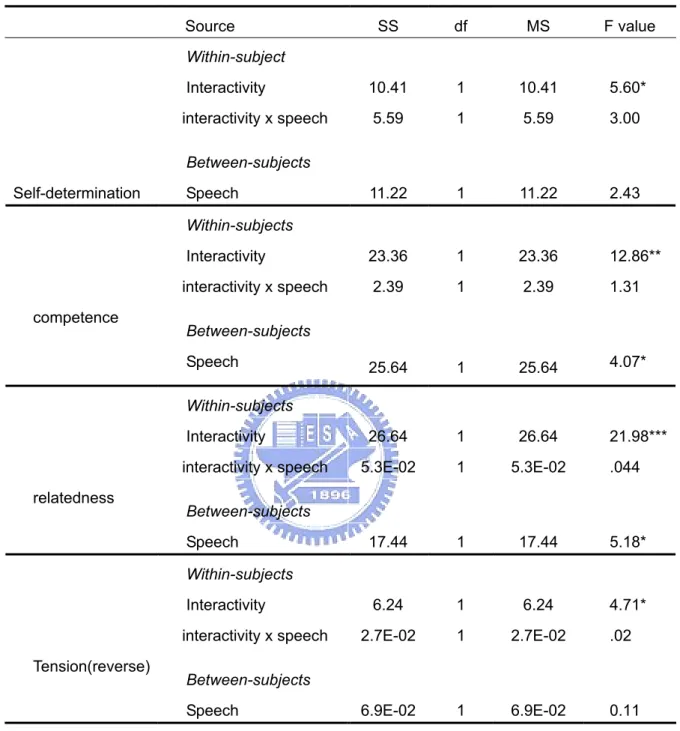
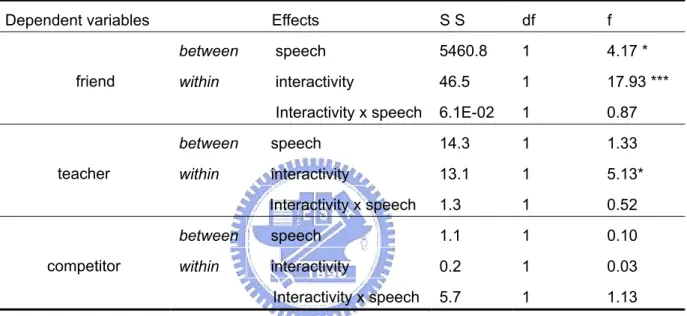
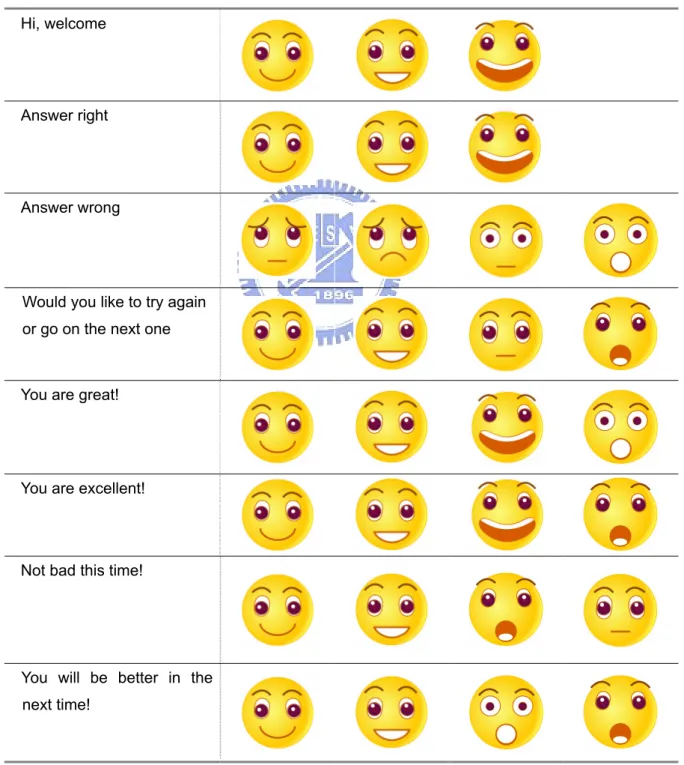
(16) List of Tables Table 5-1 A two by two mixed factorial design. 47. Table 5.2 Descriptive statistics of social presence. 51. Table 5.3 Summarized results of the analysis of variance. 52. Table 5.4 Descriptive statistics of social attraction. 52. Table 5.5 Summarized results of the analysis of variance. 53. Table 5.6 Descriptive statistics of intrinsic motivation. 53. Table 5.7 Summarized results of the analysis of variance. 54. Table 5.8 Effects of interactivity ad speech on self-determination, competence, relatedness, and tension. 55. Table 5.9 Descriptive statistics of computers as friends, teachers, and competitors. 56. Table 5.10 Effects of speech and interactivity on Children’s perception of computer as a social role. 57. Table 5.11 Summary of results for hypotheses. 57. Table 6.1 Voice settings of emotion for each speech output. 66. Table 6.2 Selected emoticons for each feedback. 67. Table 6.3 Paired Samples Statistics of social presence. 72. Table 6.4 Paired Samples Test of social presence. 72. Table 6.5 Paired Samples Statistics of social attraction. 73. Table 6.6 Paired Samples Test of social attraction. 73. Table 6.7 Paired Samples Statistics of intrinsic motivation. 74. Table 6.8 Paired Samples Test of intrinsic motivation. 74. Table 6.9 Paired Samples Statistics of performance. 74. Table 6.10 Paired Samples Test of performance. 75. Table 6.11 Summary of results for hypotheses. 75. Table 7.1 The transition from the neutral emoticon to the intended emoticon for a greeting. 81. X.
(17) Table 7.2 The transition from the neutral emoticon to the intended emoticon for a correct-answer feedback. 81. Table 7.3 The transition from the neutral emoticon to the intended emoticon for a wrong-answer feedback. 81. Table 7.4 The transition from the neutral emoticon to the intended emoticon for a prompt. 81. Table 7.5 The transition from the neutral emoticon to the intended emoticon for a comment on performance. 82. Table 7.6 Paired Samples Statistics of social presence. 83. Table 7.7 Paired Samples Test of social presence. 84. Table 7.8 Paired Samples Statistics of social attraction. 84. Table 7.9 Paired Samples Test of social attraction. 85. Table 7.10 Paired Samples Statistics of intrinsic motivation. 85. Table 7.11 Paired Samples Test of intrinsic motivation. 86. Table 7.12 Paired Samples Statistics of performance. 87. Table 7.13 Paired Samples Test of performance. 87. Table 7.14 Results of boys’ feeling of elf-determination, competence, relatedness, and tension. 88. Table 7.15 Result of girls’ feeling of elf-determination, competence, relatedness, and tension 89 Table 7.16 Descriptive Statistics of intrinsic motivation of boy subjects at three levels of performance. 89. Table 7.17 Tests of Between-Subjects effect. 90. Table 7.18Descriptive Statistics of intrinsic motivation of girls at three levels of performance. 90. Table 7.19 Tests of Between-Subjects effect. 90. Table 7.20 Summary of results for hypotheses. 91. XI.
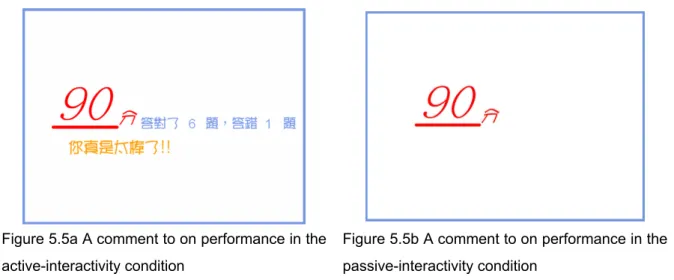
(18) List of Figures Figure 1-1 Interactivity, speech and facial expressions in interpersonal communication as social cues. 6. Figure 3-1 Emoticons composed of punctuation marks. 31. Figure 3-2 Concrete images of Emoticons. 32. Figure 4-1 Children’s attitudes and motivation to e-learning environments with social cues. 38. Figure 5-1 The start screen. 46. Figure 5.2.a Feedback with greeting. 47. Figure 5.2.b A math problem presented on screen. 47. Figure 5.3a Feedback to a correct answer in the active-interactivity condition. 47. Figure 5.3.b Feedback to a correct answer in the passive-interactivity condition. 47. Figure 5.4a Feedback to a wrong answer in the active-interactivity condition. 48. Figure 5.4b Feedback to a wrong answer in the passive-interactivity condition. 48. Figure 5.5a A comment on performance in the active-interactivity condition. 49. Figure 5.5b A comment on performance in the passive-interactivity condition. 49. Figure 5.6 A significant positive correlation between social presence and intrinsic motivation 56 Figure 5.7 Children’s perceptions of computers as social roles in the four conditions. 63. Figure 6.1a Greeting in the speech condition. 68. Figure 6.1b Greeting in the emoticon condition. 68. Figure 6.2b Feedback to a correct answer in the emoticon condition. 69. Figure 6.3a Feedback to a wrong answer in the speech condition. 69. Figure 6.3b Feedback to a wrong answer in the emoticon condition. 69. Figure 6.4a Prompt in the speech condition. 70. Figure 6.4b Prompt in the emoticon condition. 70. Figure 6.5a Comment on performance in the speech condition. 70. Figure 6.5b Comment on performance in the emoticon condition. 70. XII.
(19) Figure 7.1 Results of boy and girl subjects’ feeling of social presence in the two conditions. 83. Figure 7.2 Results of boy and girl subjects’ feeling of social attraction in the two conditions. 85. Figure 7.3 Results of boy and girl subjects’ intrinsic motivation in the two conditions. 86. Figure 7.4 Results of boy and girl subjects’ performance in the two conditions. 87. XIII.
(20) Chapter 1 Introduction. 1 1-1. . Introduction. Background. 1-1.1 The coming trend in Human-Computer Interaction and social interfaces Norman (2004) has suggested that people are emotional and social creatures and has mentioned the role of human emotions as an influencing factor in the way people deal with and relate to objects and artifacts. Thus, in addition to usability issues, design of products has to take human emotional needs and social desires into consideration. A similar trend appears in the field of Human-Computer Interaction. Many researchers have revealed that human-computer interaction is on both a social and emotional level. In light of their findings, researchers have started to explore new theories that enable or augment socio-emotional interaction between people and computers (Picard, Wexelblat, & Nass, 2002; Muller, 2004). "The coming revolution in computing is social" Microsoft chairman Bill Gates declared in a speech at the Consumer Electronics Show in Las Vegas. He pointed out social interface as something that has immense depth, and can be used to make the machine fun and more predictable (Harmon, 1995). Indeed, technologists have aspired to make computer interfaces more human-like and sociable since it was suggested that more humanized interfaces convey a sense of comfort and ease to the user. (Laurel, 1990; Sproull et al, 1996). Shneiderman (1998) suggested that people seem to have a primitive urge to anthropomorphize objects. According to familiarity and comfort theses (Guthrie, 1997), it may come from human beings’ primarily cognitive motivation to understand the world in the way people are most familiar with or from an emotional motivation to reduce the discomfort of relating to that which is different by making things be more human. It could be said that the interaction between people and the objects in their surroundings is filled with complicated feelings.. 1.
(21) Chapter 1 Introduction. The demand for more human computer features reflects the aspiration for social interactivity as derived from the features of interpersonal social activities, together with the dependent attachment to familiar feelings and intimate relations. As mentioned by Norman (2004), people have evolved to interpret even the most subtle of indicators and are predisposed to anthropomorphize, and so to project human emotions into everything.. From the perspective of the human tendency to interpret. and anthropomorphize things, anthropomorphic responses can bring great delight and pleasure to the user of a product. Besides the use of sophisticated computing technology or artificial intelligence, utilizing social cues in user interface may offer an uncomplicated and inexpensive way to achieve a humanized interface. Moving beyond theory, several experimental studies have demonstrated that people do not respond to a computer merely as a tool. Instead, individuals bring to bear a wide range of social rules and learned behaviors that guide their interactions with and attitudes toward computers (Picard, 1997; Picard, Wexelblat, & Nass, 2002; Reeves & Nass, 1996). The finding that people appear to have social relationships with computers raised attention for its potential to promote the interaction between humans and computers. Computers could act as social partners of humans. From this perspective, Nass et al. (Nass, Steuer, & Tauber, 1994)have empirically proven that people socially interact with computers and claim that “Computers are social actors (CASA)”, which is widely regarded as one of the foremost developments in the theory of socio-emotional interaction with computer interfaces. CASA claims that computers that exhibit social cues can convey a sense of sociability and intimacy and thereby induce social responses from people, which leads people to treat computers in the way as they treat other people. Research on the CASA paradigm has received a great deal of attention in the recent past and has been recognized as a direction for interface design in the future (Picard, et al., 2002). IT-related businesses, such as web design, application design, and software design, have managed to explore the potential application of CASA. This effort has been devoted to creating sociability in human-computer interaction to increase the use and. 2.
(22) Chapter 1 Introduction. acceptance of computers. The CASA paradigm is based on a concept of social presence, and involves the social responses of people not to other entities within a medium, but to cues provided by the medium itself (Lombard & Ditton, 1997). This paradigm has been shown to have a significant affect on human to computer interactions. It shows a potential strategy for interface design which uses interaction to improve engagement and motivation in a computer-mediated learning environment. CASA studies suggest that if a computer exhibits even minimal social cues it can induce people to treat the computer as a social actor rather than as an inanimate tool. This social response from the user can facilitate a more intimate human-computer interaction. This in turn improves user attitudes toward computers and fosters a more beneficial relationship between users and computers. One conclusion that can be drawn from these studies is that people tend to feel that computers are friendlier, more attractive, and more helpful if they exhibit social cues. These studies of the user’s social interaction with computers have come to be noticed in the field of human-computer interaction. In addition to triggering the interest of numerous scholars, there have also been several business organizations which have adopted the research on the subject of “Computers Are Social Actors” to create many successful business applications. These include Bob, the product made through the collaborating effort of Microsoft and Nass et al. Their effort attempted to make computers that featured much more humanity and also numerous applications in websites, service systems and education media. Both education-related departments from University of Florida and Michigan State University collaborated to research different ways of applying the concept of “Computers Are Social Actors”. Through this effort, learning media was allowed to demonstrate the presence of sociability (Ferdig & Mishra, 2004).. They suggested that designers of education technology should. emphasize the possibility of social interactivity among interpersonal relations. From the view of creating social interactivity between learners and learning media, an inactive design attracting people's learning motives can be created. 3.
(23) Chapter 1 Introduction. 1.1-2 Extending the employment of CASA to children’s e-learning environments The CASA paradigm is an important issue and should compel more interface designers to consider its employment to improve human-computer relationships. Numerous experiments have been conducted with adults and considerable evidence has been delivered. Few experiments however have focused on children or tested whether children respond similarly to computer social cues (Bracken & Lombard, 2004). Thus, this study tries to extend the concepts of CASA to the e-learning environment for children. Turkle (1984) has conducted a long-term observation of juvenile computer users, considering their interrelationship from the discipline of psychoanalysis. She has found that the boundary between computer interactions and live interactions is blurred in children. Children tend to anthropomorphize computers and endow them with human intelligence. This notable finding may provide powerful evidence to support the idea that children respond socially to computers in ways similar to adults, and may in fact respond to an even greater degree. This finding also raises the question of whether children are fundamentally social with computers regardless of social cues. This area should be explored in more detail as the authors hope to extend the employment of CASA to children. Computers have expanded the available learning channels for children and provided them with a potential way to learn by themselves. The focus on design of computers for children’s learning is different from those for task-oriented purposes. In addition to the issue of usability, the design of computers needs to improve engagement and motivation for younger users (Chiasson & Gutwin, 2005; Druin & Inkpen, 2001). Admittedly, computer-mediated learning initially appeals to many learners because of the novelty of the experience, the variety of features offered, and the cumulative effects that graphics and animation have on the learning experience (Brown, 1986). However, Keller (1997) pointed out that the component of motivation which is attributed to novelty tends to wane as computers become more widely used in the student’s environment. As the excitement associated with these novel features diminishes, it becomes more challenging to 4.
(24) Chapter 1 Introduction. stimulate and sustain learners’ motivation while they engage in computer learning activities. One common strategy is to offer an entertainment-oriented interactive experience with the goal of enhancing a learner’s motivation by making learning fun (Malone, 1981; Malouf, 1988). While this is a valid approach, entertainment is not appropriate for all learning modes and applications. It is, therefore, important to explore other possibilities and methods by which to increase and sustain learners’ motivation and involvement in the e-learning environment. Another approach that may be effective would be the “computers are social actors (CASA)” paradigm (Nass, Steuer, &, Tauber, 1994). With this as background, the research attempts to extend the concepts of CASA to e-learning environments for children.. 1.1-3 Study effects of interactivity, speech, and the emoticon The research aims to extend the employment of the CASA concepts to children and to study their attitudes toward computers and motivation with learning within e-learning environments augmented with social cues. Specifically, it attempts to investigate the effects of such social cues as interactivity, speech, and emoticons on children by understanding the nature of the way people communicate and how the roles of speech and facial expressions in interpersonal communication function as social cues in human-computer interaction. As long as social groups continue to be an integral part of human life, human sensitivity to voice and language cues has a critical role to play in the interactions among people. That is to say speech is social and plays a dominant role in interpersonal communication; and interactivity is an inherent property of the communication process. Interactivity does not mean verbal and nonverbal codes per se but offers potentially valuable insights into their interrelationships. Comparing speech with interactivity during interchange, the former is sensible and explicit while the latter is latent and implicit. Hence, it is interesting to explore how to utilize those features as cues being incorporated into interface design to enhance the social attributes of computers, as well as to investigate whether social cues could positively impact on the social interaction between children and 5.
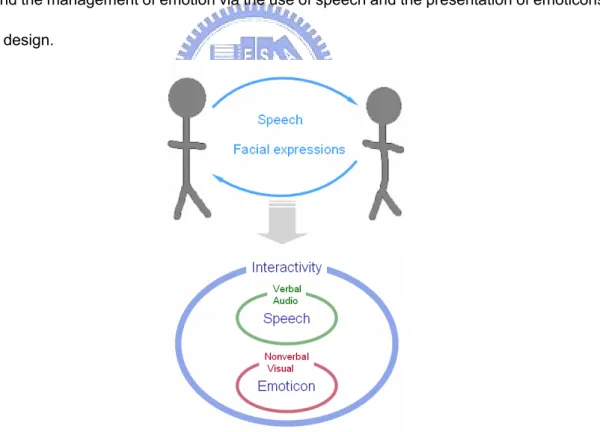
(25) Chapter 1 Introduction. computers. Facial expression in addition to speech plays a crucial role in interpersonal communication. It can nonverbally express emotions to others and serves as the most powerful external representation of emotion. Besides this, people process faces differently than all other objects just as they process voices differently than all other sounds. If we compare speech with facial expression, the former is a channel of verbal communication and an audio modality while the latter is one of nonverbal communication and a visual modality. The emoticon, a blend of "emotion" and "icon", is intended to represent a human facial expression and convey an emotion. Thus, the comparison of speech and the emoticon relates to a further issue, that of verbal communication versus nonverbal communication as well as audio modality versus visual modality. The study also attempts to better understand the management of emotion via the use of speech and the presentation of emoticons in interface design.. Figure 1-1 Employing Interactivity, speech and facial expressions in interpersonal communication as social cues In sum, the research explores whether modeling the human-computer interaction after interpersonal communication can indeed endow a computer with the attribute of social presence. 6.
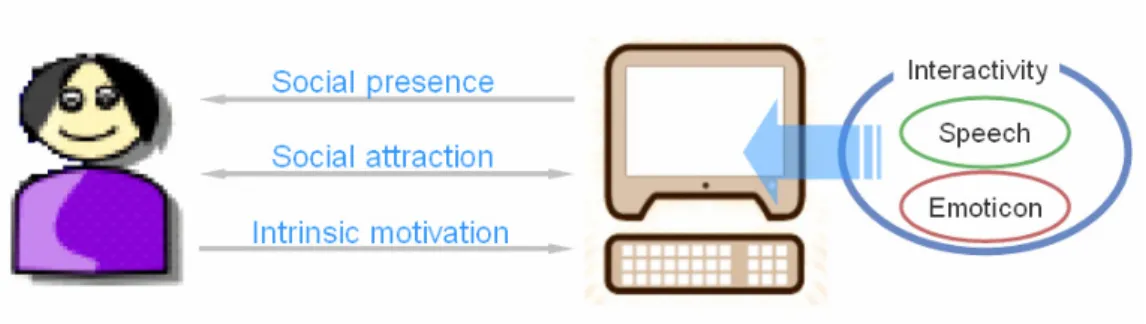
(26) Chapter 1 Introduction. and thereby become socially attractive to children. It goes further to test how this treatment would affect children’s intrinsic motivation. Results of the research could provide designers with evidence-based design principles founded on research when they are developing relevant products targeting children and considering interactivity, speech and the emoticon.. 1-2. Objectives. This research attempted to use social cues of interactivity, speech, and the emoticon in e-learning environments and test whether children respond socially to computers providing social cues. It aimed at investigating whether social interaction exists between children and computers and testing if the social interaction contributes to e-learning. The objectives of the research are as follows:. 1. To explore how to employ interactivity, speech, and facial expressions of interpersonal communication as social cues and to apply them to interface design. Interactivity, speech, and facial expressions play important roles in communication, human-to-human interaction and perception. The research intends to study the nature of the aforementioned three elements of interpersonal communication and how they function as social cues in computer interfaces.. 2. To extend the implementation of the CASA paradigm to target children The CASA paradigm suggests that people respond to computers and other forms of media in the same way that they respond to real people.. One benefit of this work is that computers. exhibiting sociability make users’ experiences more positive during interaction, leading to increasing the use and acceptance of computers. However very little CASA-related research has been done with children to examine the effects of social cues provided by computers on children’s attitudes toward computers and on the way they interact with computers. This study therefore manages to extend the employment of the CASA concept to children and to more clearly understand their attitudes toward a computer’s social attributes. 7.
(27) Chapter 1 Introduction. 3. To compare the effect of the social cues of interactivity and speech on children’s feelings of social presence and social attraction as well as the comparison between the effect of the social cues of speech and the emoticon. Interactivity, speech, and the emoticon (representation of facial expression) are essential elements in communication. Each one entails various aspects of social attributes. To obtain an insight of how the three elements function as social cues to make computers more humanized and sociable, the research first compares the effects of interactivity and speech on children’s feelings of social presence and social attraction toward computers, and then the effects of speech and the emoticon were compared as well.. 4. To investigate the effect of interactivity and speech in e-learning environments on children’s motivation with learning, and the effect of speech and the emoticon is investigated as well. The research also explores the effects of social cues of interactivity, speech, and the emoticon used in e-learning environments on children’s motivation for learning. Numerous studies claim that social presence within e-learning environments serves as a positive factor in motivating learners. The social presence in the said studies involves learners and instructors in an online environment. The research focuses on the possibility that the social presence of the computer itself can play an effective role in engaging an individual in learning, especially in the form of individual self-paced learning. Computers may be perceived as learning partners to improve motivation while a single learner participates in computer learning activity with no instructor involved.. 5. To propose a set of principles for the design of more sociable and motivating interfaces The research manages to leverage the social attributes of interactivity, speech, and the emoticon for interface design to make computers more humanized and sociable and then 8.
(28) Chapter 1 Introduction. investigate the possibility of social interaction and relationships between children and computers. This effort aims at supporting children’s social needs and sustaining their motivation in learning during interaction with computers. Results of the research can be used for the practical development of learning software, educational products and systems, or interactive toys which target children.. 1-3 Framework of dissertation In the following chapter outlines the literature relevant to social presence, Computers are Social Actors, social presence and e-learning environments, and children’s reactions to computers. In the chapter 3 interactivity, speech, and the emoticon will be defined and the way they function as social cues will be detailed. The research issues and the methodology adopted will be described in chapter 4. The method and the results of study I, study II, and study III will be discussed in detailed in chapter 5, 6, and 7, respectively. The three studies were linked by the theme of exploring how interactivity, speech, and facial expressions function as social cues and what effects these social cues employed in e-learning environments have on children. Finally, chapter 8 will provide the general conclusion and future research.. 9.
(29) Chapter 2 Interactions and relationships between humans and computers. 2. . Interactions and Relationships between Humans and Computers. Technology drives social change. Mcluhan (1964) proposed that the main technology and medium used in a society has a determining effect on culture. The introduction of new technology will make an impact on society and culture. The dominant medium will influence the way human experiences are interpreted. Generally, a technology determines or dictates how individuals in a society will react to and with different media and the world (Bracken, 2000). Mcluhan (1964) argued that media and technologies affect the human mind and senses, and proposed that media and technologies are extensions of man. Any extension, whether of skin, hand or foot, affects the whole psychic and social complex. The personal and social consequences of any medium–that is, of any extension of ourselves–result from the new scale that is introduced into our affairs by each extension of ourselves, or by any new technology (p.7). Any medium or technology is seen in terms of the change of scales pace or pattern that it introduces into human affairs. Thus, computers, being the dominant technology and medium of the age, play an influential role in reshaping the interplay between media, people, and their surroundings. As asserted by Bolter (1984), the computer is the latest and most radical defining technology as it has become the dominant metaphor for the human mind in popular culture. Bolter argues that throughout history, technology has transformed human thought on two levels: self-conception and relation to nature. Bolter uses the term ‘defining technologies’ to describe technical innovations which have defined or redefined humanity and its relationship to the natural world. Society is more than just people; it includes the interrelationships among them. Likewise,. 10.
(30) Chapter 2 Interactions and relationships between humans and computers. computing technology is not just about computers and processing of data but it is also worthy to note the relationships among its use and its users (Marakas, et al., 2000). Obviously, the computer appears to have made a remarkable impact on the experiences of humans and their relationship to their surroundings since it came into the world. Being extensions of the human body and senses, the computer insinuates itself into people’s lives in various ways. The way the computer affects how people interpret and think about themselves has manifested itself in language. It is common that CPU or RAM specification could be used to describe human capabilities or a metaphor of the computer could be used to symbolize the human brain. as a. computer. Turkle (1984) said that language like this carries an implicit psychology that equates the processes that take place in people to those that take place in machines. Besides this, the computer also brings unprecedented experiences to people, such as social presence, in various ways.. 2-1. Social presence. The term, presence, was coined by Minsky (1980) who used “telepresence” to refer to teleoperation systems for remote manipulation of physical objects and a physical sense of “being there” in a remote, mediated location. Since then, media scholars use the term “presence” to refer to the generic perception of being in an artificial or remote environment and are interested in how people are influenced by media presentations (Sheridan, 1992). Lombard and Ditton (1997) have defined presence as “illusion of nonmediation”. It is available to create the connection between consciousness and experience only when people's perception towards external experience can be operated by mediation. Mediation acts as the communication mechanism. When mediation and personal perception are combined, the feeling of presence to materialize objective knowledge or the external world immediately occurs (Tung, 2006). The dimensions of presence are generally categorized into two types: physical and social of presence. Physical presence refers to the sense of physically being in or near a mediated 11.
(31) Chapter 2 Interactions and relationships between humans and computers. environment. This can be achieved by providing people with, for example, virtual reality systems . Social presence is defined as the degree of awareness of another person in an interaction and the consequent appreciation of an interpersonal relationship (Walther, 1992). Biocca (1997) declared that social presence occurs when users feel that a form, behavior, or sensory experience indicates the presence of. Social presence in a computer-mediated communication environment refers to the user’s degree of feeling, perception, or reaction being connected to another intellectual entity, which involves a subjective quality of the communication medium related to the psychological concepts of social intimacy and immediacy (Short, Williams, & Christie, 1976; Tu & McIsasc, 2002). In other words, intimate or immediate responses provided by a medium contribute an appreciable degree of social presence. Lombard and Ditton (1997) outlined six conceptualizations of presence, among which four refer to social presence. 1.. Presence as social richness- It occurs that medium is perceived as sociable, warm and personal when it is used to interact with other people. A medium high in presence of social richness allows interactants to adjust more of voice quality, facial expressions, gestures, and so on.. 2.. Presence as Transportation- This involves the idea of transportation consisting of three different types:: “You are here”, in which the user is transported to another place; “It is here”, in which another place and objects within it are transported to the user; and “We are together”, in which two (or more) communicators are transported together to a place that they share.. 3.. Presence as Social Actors within Medium- This may be called para-social interaction which refers to the relationship between a television personality and a television viewer. In a parasocial interaction media users respond to social cues presented by persons they encounter within in a medium.. 4.. Presence as Medium as Social Actor- It involves social responses of media users not to. 12.
(32) Chapter 2 Interactions and relationships between humans and computers. entities (people or computer characters) within a medium, but to cues provided by the medium itself. From the four conceptualizations of presence mentioned above, people could discern different amounts of social presence in various types of media. Studies of social presence not only focus on the feeling of being together (and communicating) with a mediated person, but also explore the perceived social presence created by the medium itself.. The “Presence as medium as. social actor” occurs when an individual feels a sense of social presence from the medium itself and then perceives it or interacts with it as if it is a veritable social actor. It involves social responses of people not to other entities within a medium, but to cues provided by the medium itself. Studies claim that if computers exhibit social cues, people will treat the computers as social actors rather than as inanimate tools. Several empirical studies have demonstrated that people do not respond to a computer merely as a tool. Instead, individuals bring to bear a wide range of social rules and behaviors that change their interactions with and attitudes towards computers. The most studied type of social presence is represented by CASA research. The concept of CASA (Nass, et al., 1994) points that social cues exhibited by the computer lead users to treat the computer as a social entity.. 2-2. Computers Are Social Actors. 2-2.1 Social responses to computers Reeves and Nass (1996) have gathered their empirical evidence into the book, “The Media Equation: Media equate real life to argue that people tend to equate media and real life.” The book claims that people treat media socially as they treat other people in real world experience. People unconsciously apply social behaviors such as politeness and reciprocity to media. Based on the surprising findings, Nass et al (1994) have proposed the “Computers are Social Actors” paradigm to highlight the way in which people attribute social or human characteristics to. 13.
(33) Chapter 2 Interactions and relationships between humans and computers. computers when those computers demonstrate sufficient social cues. Several studies provided evidence that people are influenced by a computer’s social attributes and subsequently treat the computer the way they would treat humans. The findings reveal the phenomenon that the way people interact with computers is potentially social; moreover, they provide a new perspective on social psychology to fulfill the goal of humanizing interfaces. Employing social cues derived from social psychology and sociology to interface design can enable users to sense a high degree of social presence from the medium itself and a sense of intimacy accordingly. Such perceptions may elevate the human-to-computer relationship to the level similar to human-to-human relationship. The CASA paradigm seeks to incorporate a set of contextual cues into user interface design by replicating human-human interaction in the context of human-computer interaction. The general structure of CASA paradigm begins with picking a social science finding (usually social psychology or sociology) concerning behavior or attitude toward humans, and then substituting ‘computer’ for ‘human’ in the statement of the theory and replicating the methodology of the social science study but replacing humans with computers, and finally determining whether or not social rules still apply. CASA-related research draws on literature which can be grouped into the following four categories: (1) Exploring human attitudes toward computers exhibiting human traits: Research conducted by Nass et al. (Moon, 1996; Nass, & Lee, 2001) supported the existence of similarity attraction between humans and computers. The Computer can exhibit either extroverted or introverted traits by manipulating its voice, or presenting either submissive or dominant personalities by manipulating its text feedback. Isbister and Nass (2000) demonstrated that people sense and interact with a character’s personalities via verbal and non-verbal cues and prefer a character that is complementary to them. The results described above suggest that humans are influenced by the traits of the computer that are exhibited during interaction, and the computer’s personality can be created by using minimal psychological cues (e.g., verbal style, voice, and postures). 14.
(34) Chapter 2 Interactions and relationships between humans and computers. (2) Exploring whether people apply social rules and norms to computers: It is found that humans react to praise or flattery from a computer in the same way as they react to these messages from humans. Studies also showed that people will act according to the norm of reciprocity or apply politeness norms when interacting with computers (Fogg, & Nass, 1997; Morkes, Kernal, & Nass, 1999).Tzeng’s (2004) study suggests that a computer offered apologetic feedback triggered people’s social schema and made them behave in a civilized way. (3) Exploring whether and under what conditions people would affiliate with a computer: Nass and his associates have demonstrated that people affiliate with computers in a team relationships via minimal cues of social identity in a controlled interaction (Nass, Fogg, & Moon, 1996) The ethnicity of a computer agent will affect the attitudes and behaviors of a user in line with social identity theory. (4) Investigating the effect of the way computers interact with users: The study conducted by Klein, Moon, and Picard (1999) revealed that social-affective feedback with text-only interaction was able to alleviate users’ feeling of frustration. They then suggested that designers should consider the user's emotional state as an interactive factor during design processes. In view that people tend to like and be more willing to cooperate with a humorous person, Morkes et al. (1999) studied effects of humor in human-computer interaction and computer mediated communication. It was found that people respond to humans and computers in identical ways; participants responded to computers that provided humorous comments in a more social manner, joke back more often, and reported greater cooperation. Brave et al., (2005) demonstrated that computers which are programmed with the capacity for empathic emotion have major positive effects on both liking and trust, as well as on perceived caring and felt support. Clearly, computer embedded social cues could act more sociable and humanlike and change people’s attitudes and behaviors. These findings show an insight into users’ social interaction with a single computer. It implies that designers could create a more sociable and intimate 15.
(35) Chapter 2 Interactions and relationships between humans and computers. user-interface by utilizing social cues properly. The developers need not rely on sophisticated computing technology or artificial intelligence to achieve a humanized interface.. 2-2.2 Explanations for social responses to computers The CASA paradigm states that the interaction between people and computers is social. The phenomenon of social interaction does not derive from a mistaken belief that computers are human, but from a natural human psychological tendency. Nass and Moon (2000) argued that mindlessness is the main cause of humans unconsciously applying social rules and expectations to computers. As stated by Langer (1989), mindlessness is likely to go along with behavior that is influenced primarily by routines and rules regardless of the particulars of current circumstances. That is, when acting in a mindless manner, one is relying on distinctions and categories drawn from past experiences. Langer (1992) indicated the cause of mindlessness is conscious attention to a subset of contextual cues. The cues trigger expectations that focus attention towards certain information and away from other information. Computers nowadays offer a variety of cues that suggest ‘humanness’; they use words for output, they offer interactivity (responses based on multiple prior inputs), and they fill roles traditionally filled by humans (Nass & Moon, 2000; Nass, Steuer, Henriksen et al., 1994). From the perspective of mindlessness, these cues are enough to trigger categorization of computers as social actors. This categorization, in turn, often leads people to respond to computers in a social and natural way. Nass and Moon (2000) outlined the following three human tendencies that cause people to treat computers as social actors. First, people tend to overuse human social categories. People would carry over uniquely human social categories to the computer realm, such as gender and ethnicity, by applying them to computers. Second, people engage in overlearned social behaviors, such as politeness and reciprocity, toward computers. Third, people easily exhibit premature cognitive commitments with respect to computers. 16.
(36) Chapter 2 Interactions and relationships between humans and computers. Turkle (1980) described the computer as Rorschach to present the computer as a relatively neutral screen onto which people were able to project their thoughts and feelings. Nevertheless, Turkle (2003) has pointed out that the computational object is no longer affectively neutral. People may perceive computers on a social dimension and attribute personality, intelligence, and emotion to them. She argues that sociable technology can encourage humans to view the computer as a companion not a tool, and further can enhance human performance. Marakas et al. (Marakas, Johnson, & Palmer, 2000), shared a similar view, which they suggested that sociable technology may provide opportunities to enhance human-computer interaction, to improve training and educational activities, and to improve satisfaction with the system. Marakas et al. have extended the CASA paradigm and proposed that four elements serve as inputs to an attribution process which results in an attribution of the computing technology as a social actor. The four elements that influence the attribution toward computing technology are: the social character of the computing technology; the individual’s core self-evaluations; the nature of the interaction with the technology; and the presence or absence of certain attributions which relate to the characteristics of the technology, an individual difference, individual experience, and the relationship between an individual and the technology with the social context. Given this, the social characteristics of the technology are regarded as an important input to the attribution process.. 2-3. Social presence and e-learning environments. Learning is a social activity that requires a close connection to achieve better quality. Thus, the e-learning environments should take into consideration the learner’s desire for social interaction while participating in learning activities. Gunawardena (1995) agues that social presence is necessary to enhance and improve effective instruction in both traditional and technology-based classroom. A lack of social presence may lead to a high level of frustration and a lower level of effective learning (Rifkind, 1992). Aragon (2003) also pointed social presence is important in an online environment due to the isolated nature of the instructional settings. Studies have 17.
(37) Chapter 2 Interactions and relationships between humans and computers. suggested that enhancing social presence in an e-learning environment can instill the learner with an impression of a quality learning experience. One benefit is to induce and sustain the learners’ motivation (Newberry, 2001; Tu, 2001;Walther,1992). As stated above, a high degree of social presence could create a learning environment that is perceived as warm and approachable for all involved (Rourke et al., 1999), which benefits supporting and sustaining learning objectives by making group interactions engaging, appealing and rewarding. The research, however, mainly focuses on the enhancement of the computer’s social presence necessary to create a successful learning experience involving learners and instructors in an online environment. By comparison, the possibility that a learner perceives the social presence created by the computer itself via the interaction and the interface design is seldom explored. In addition to supporting collaborative learning environments, computers used as learning technology can function as tutor, tool, and tutee (Bruckman, & Bandlow, 2003; Taylor, 1980). The latter three genres can be widely seen in a variety of instructional media and educational tools which deliver the ways of individual self-paced learning.. When learning in. this way the sense of social presence is required even more because the learner is cut off from other peers and tutors. This kind of perception may reduce the learner’s feeling of isolation and achieve the instructional goal despite the absence of a human instructor (Tung, & Deng, 2006). Social presence in a computer-mediated communication environment refers to the user’s degree of feeling, perception, or reaction being connected to another intellectual entity. Such experiences could enable an individual to perceive that another social being exists and is interacting with them. Thus, computers may be perceived as a social actor to improve motivation while a single learner participates in a computer learning activity with no instructor involved. This research focuses on the social presence and specifically the dimension of presence in which people perceive media technology as social actors. As stated previously, the CASA paradigm, a concept of social presence, involves social responses 18.
(38) Chapter 2 Interactions and relationships between humans and computers. by people not to other entities through a medium, but to cues provided by the medium itself (Lombard, & Ditton, 1997). The paradigm suggests that if a computer can be perceived as a social entity that this may improve user’s motivation when a child participates in a computerized learning activity with no instructor involved. Thus, a computer mediated learning experience especially designed for individual self-paced learning should afford the learner the feeling of social presence of a partner to facilitate learning. Mishra (2006) also argues that the findings of the CASA approach have the potential to reconfigure the domain of educational technology by forcing designers to evaluate the conception of computer and the other forms of media as being mere tools. Mishra’s research (2006) demonstrated that failure to recognize the existence of people's social responses towards media can thwart the pedagogical goals of educational technology and emphasize the importance of the social relationship that can develop between a computer and the learner. As suggested by Fogg (2002), the author of Persuasive Technology, the fact that people respond socially to computer products has significant implications for persuasion. When perceived as social actors, computer products can leverage these principles of social influence to motivate and persuade. The CASA paradigm shows a potential strategy to provide social support and model a target behavior or attitude just right for creating a sociable and motivating e-learning environment (Tung & Deng, 2006a; 2006b).. 2-4. Children’s attitudes toward objects and computers. 2-4.1 Childhood animism Piaget (1929) contended children's knowledge about world was based on the interaction between them and surroundings. To make sense of the world around them children apply strict rules to new objects (Turkle, 1984). To understand children's attitude toward general objects should be helpful to understand their conception about computers.. Accordingly, it is required. for us to understand the way children treat and perceive objects. Furthermore, we must understand their perception about computers. 19.
(39) Chapter 2 Interactions and relationships between humans and computers. As the research concerns children’s attitudes toward computers, the phenomenon of childhood animism should also be considered. Animism was first used by Piaget (1929) to describe children’s tendency to endow inanimate things with life and consciousness. He outlined four stages of animism through which children normally go. In the first stage (age of 4-6): a child attributes consciousness and life to anything that is in any way active, undamaged, or useful. A whole dish is alive; a broken dish is not alive. In stage two (6-7) only things that move are given life-like qualities. A ball is alive when it is rolling; otherwise it is not alive. In the third stage (8-10) consciousness is attributed only to things that move spontaneously. The sun and river are alive; a bike is not alive, even when moving. In the final stage (older than age of 11) restricts consciousness and life to plants and animals only. Humans and animals are alive, and many children in this stage state that plants are alive. Piaget (1962) especially pointed out that self-moving is an important criterion used by children to judge the aliveness of objects. Children attribute life to objects which appear to move by themselves,. Inspired by Piaget’s finding on childhood animism, Dolgin and Behrend (1984) expanded on the research to test children across a wide age range from age 3 to 9. The children were asked twenty questions about stimuli reflecting the basic differences between animates and inanimates, and comparing their answers with those of adults. These stimuli were presented as photographs including animate beings and inanimate objects: human adults, preschool-age children, infants, mammals, birds, fish, insects, cooked, obviously dead animals, plants, dead plants, naturally occurring immobile objects, man-made immobile objects, naturally occurring mobile objects, objects commonly made by young children, and dolls. The questions were as follows: Which of these grow? Can die? Have a brain? Eat? Get thirsty? Are sometimes happy? Can hurt and feel pain? Can drink? Have dreams? Sleep? Might want to do something or to have something? Have a mom and dad? Might understand you if you talk to it? Can move all by itself? Are sometimes naughty? Can do things on purpose? Might be a boy or a girl? Can see? Might like. 20.
(40) Chapter 2 Interactions and relationships between humans and computers. you? Are alive? It was found that apparently self-moving or animate-appearing objects yielded more errors in children, especially in 5-year-old children. 3- and 4-year-olds were less likely to respond animistically than 5-year-olds.. Interestingly, the finding revealed that animism does. not appear to be the most primitive mode of conceptualization. Animism probably demonstrates incomplete knowledge and understanding of the world, but it is also a reflection of children's rich imagination (Bullock, 1985). Dolgin and Behrend argued that certain properties associated with animates (e.g. physical appearance, self-moving) are so potent to 5-year-olds that they presume other animistic properties must be present as well.. 2-4.2 Children’s concepts of objects change with the coming digital objects When Piaget proposed the phenomenon of childhood animism, most objects on the world could be easily understood. According to the research conducted by Piaget and Dolgin, attributes like inanimates linking motion or physical appearance association in mind, could be recognized. This recognition would make children view them as living individuals. All the said attributes were all visible and tangible in physic nature.. However, since the late 70s' we have seen the. continuous occurrence of electronic games and toys,. These digital products could actually affect children's knowledge about the natures of objects and the ways to understand them. In Turkle (1984) study children were asked to sort pictures of objects into "alive" and "not alive" categories and explain choices. The stimuli include natural entities (like the sun, a cloud), animals (like a dog, an insect), plants (like a tree), products (like an alarm clock, an airplane, a telephone) as well as computer toys (like Merlin, speak and spell). It was observed that objects which manifest human qualities like intelligence and speaking as well as motion lead children at age 4-6 to conclude that those objects are alive. With the capabilities of speaking and thinking, the computer seems to act more human than other objects.. As a result of this, the way children. categorize humans, machines, and animals may change further. Turkle (1984) also argued that children view traditional objects as living/dead individuals in physical terms. As for digital objects, 21.
(41) Chapter 2 Interactions and relationships between humans and computers. the physical characteristics are opaque or even dismissed. Children turn to a psychological way to understand them because of their human behaviors, such as talking or thinking. Scaife and Duuren (1995, 1996) compared children’s and adults’ judgments of brain and brain-related behavior of entities with differential anthropomorphic similarity (person, robot, computer, doll and book-objects). Subjects were asked questions of whether each of the entities had a brain and heart, where the brain was located and what the brain was made of. It was found that 5-year-olds tended to attribute a brain to the person only, while older children and adults commonly attributed a brain to the person, robot and computer. Compared with young children, older children’s conception of the brain seems to be more flexible in that they appeared to indicate that there are different types of brains. Older children were found to associate cognitive and mental acts with the brain, whereas younger children were found to be limited in their brain understanding and brain-related attributions. The finding reveals that children’s conceptualization of the brain or intelligence evolves with age. The criteria children used to attribute intelligence to inanimate objects vary from being based on perceptual cues (i.e., physical similarity to humans) to being based on cognitive capabilities (i.e., apparent intelligence of the artifact).. 2-4.3 Granting psychological status to computational objects Brown’s (1988) study investigated how children distinguish between humans and machines and explored how children make sense of advanced mechanical media in the form of life-like, programmable talking toys. The results showed that children’s perceptions of media toys are influenced both by motion and speech characteristics of the toys. Children tend to develop parasocial relationships with those toys which have human qualities like motion or speech. Turkle (1984) used an ethnographical approach to study how children believe and feel about computers and their experiences with computers as well. Turkle stated children’s relationships. 22.
(42) Chapter 2 Interactions and relationships between humans and computers. with computers go through three stages. In the first stage, metaphysical, very young children are concerned with whether the computers think, feel, and are alive. The more contact children have with computational objects, the more they tend to believe those objects are alive. The reasons children think computers are alive involve the ability of computers to provide speech feedback and present emotion.. For example, a four-year-old child explained why she thinks the. computer is alive because it has a talking voice in it (p. 48). Another eight-year-old stated “Things that talk are alive” (p. 48). Children also believe computers in possession of emotions and used the showing of emotion as a justification for counting a computer as alive.. A. seven-year-old child, for example, said “You see; it is happy now. It made a happy sound (p. 50).”. In the second stage, mastery, children are all involved with the question of their own. competence and effectiveness. They do not want to philosophize, but want to win while working with computers. In the third stage, identity, children are interested in what they can do with computers. By using computers, they can keep a diary, program computers, and do other self reflexive activities. The activities of children working with computers express something of who they are, giving them a chance to understand themselves. In this way, the computer functions as a constructive as well as a projective medium. Turkle's research revealed that the evolution of children's relationship with computers was a process of natural development and the development could keep pace with children’s recognition growth equally. The younger children could much easier hold opinions that computers were featured with real life than older children. In keeping with the study of children and computers, Turkle (1995) has indicated today’s children know the computer is not alive and the issue of aliveness has moved into the background. The notion of the computer has been expanded to include having a psychology. Children are willing to grant psychological status to computational objects, and endow them with properties, such as having intentions and personalities, previously reversed for living beings. It means that computational objects in the. 23.
(43) Chapter 2 Interactions and relationships between humans and computers. category “machine”, like objects in the categories “pets” and “people”, can play the role of partners to humans. Children are increasingly likely to project human qualities on computational objects, which are blurring the people/machine distinction. Turkle (1995) concluded two reasons lead children to attribute psychological properties to the computer. First, the computer is responsive; it acts like it had a mind. Second, the machine’s opacity keeps children from explaining its behavior by referring to physical or mechanical properties. Being responsive and opaque, the computer is associated by children with other objects with the same properties: the human mind. Interestingly, the tendency to connect the computer with human qualities does not fade with age, so that the CASA paradigm suggests that adults socially respond to computers and treat them not simply as tools but as a social actors, too.. 2-5. Summary. The computer, being a dominant medium of the age, has not only made an impact on society and culture, but also influenced how people interpret and think about themselves. Moreover, the computer also brings unprecedented experiences to people such as social presence in various new ways. “Presence as Medium as Social Actor” reveals that the interaction between people and computers could be social. The CASA paradigm has empirically proved that people treat computers exhibiting social cues as social actors. Such perception does not derive from a mistaken belief that computers are human, but from a natural human psychological tendency. Humans mindlessly apply social rules and expectation to computers. These responses are mainly as a result of those individuals’ previous social experiences and the accumulation of learned social behaviors toward computers. The fact that social responses to computers are easy to be induced by minimal social cues provides a means to empower computers to be more friendly, human, and sociable.. 24.
(44) Chapter 2 Interactions and relationships between humans and computers. Numerous experiments have been conducted with adults and considerable evidence has been delivered. Few experiments have paid the same attention to children or tested whether children similarly respond to computer’s social cues. The research intends to extend the research focus and application of the CASA paradigm to children. When approaching this issue, the possibility that childhood animism may lead children to unconditionally endow computers with mental and human qualities should not be ignored. The features that computers have of responsiveness and opacity lead children to intuitively associate the computer with human brain. Children’s tendency to animate objects may provide powerful evidence to support the idea that children respond socially to computers in similar ways as adults or even to a greater degree. At the same time the tendency may raise the question of whether children are fundamentally social with computers regardless of social cues. Moreover, if children can perceive the sense of social presence via social cues of a computer itself and generate social attraction toward the computer, it may provide a strategy where interaction is specifically designed to engage children within the e-learning environment. This question warrants further exploration in more detail as the authors seek to extend the employment of CASA to children. The research tries to leverage the attributes of interactivity, speech, and the emoticon to empower computers to be more humanized and sociable, which will be discussed in the next chapter.. 25.
數據
+7


相關文件
Reading Task 6: Genre Structure and Language Features. • Now let’s look at how language features (e.g. sentence patterns) are connected to the structure
• To introduce the use of the LPF as a tool for planning the school English Language curriculum; and
Understanding and inferring information, ideas, feelings and opinions in a range of texts with some degree of complexity, using and integrating a small range of reading
Promote project learning, mathematical modeling, and problem-based learning to strengthen the ability to integrate and apply knowledge and skills, and make. calculated
The A-Level Biology Curriculum aims to provide learning experiences through which students will acquire or develop the necessary biological knowledge and
Internal assessment refers to the assessment practices that teachers and schools employ as part of the ongoing learning and teaching process during the three years
Wang, Solving pseudomonotone variational inequalities and pseudocon- vex optimization problems using the projection neural network, IEEE Transactions on Neural Networks 17
volume suppressed mass: (TeV) 2 /M P ∼ 10 −4 eV → mm range can be experimentally tested for any number of extra dimensions - Light U(1) gauge bosons: no derivative couplings. =>
Define instead the imaginary.. potential, magnetic field, lattice…) Dirac-BdG Hamiltonian:. with small, and matrix
