
遠距母職: 旅台菲籍勞工使用網路溝通履行母職的分析 - 政大學術集成
84
0
0
全文
(2) i . TABLE OF CONTENTS 1. Chapter 1: Introduction 1.1 Overview..........................................................................................................................................................1 1.2 Significance of the Study...........................................................................................................................2 2. Chapter 2: Review of Related Literature 2.1 Migrant Labor in the Philippines..........................................................................................................4 2.2 Feminization of Filipino Migrant Labor.............................................................................................6 . 政 治 大. 2.3 Defining Filipino Transnational Motherhood..................................................................................9 . 立. 2.4 Transnational Mothering through CMC...........................................................................................13 . • 國. ㈻㊫學. 2.4.1 Synchronicity...................................................................................................................................15 . •. Nat. y. 2.4.2 Interactivity......................................................................................................................................16 . er. io. sit. 2.4.3 Recordability....................................................................................................................................18 2.4.4 Transmission of Cues...................................................................................................................18 a. n. iv l C n hengchi U 2.5 Conclusion....................................................................................................................................................20 2.6 Research Questions..................................................................................................................................22 3. Chapter 3: Methodology 3.1 Research Method.......................................................................................................................................23 3.2 Participants..................................................................................................................................................27 3.3 Building Rapport and Trust..................................................................................................................29 . .
(3) . . ii . 4. Chapter 4: Analysis and Discussion 4.1 Conveying the Pains and Joys of Mothering in CMC...................................................................29 4.2 When Fathers Become Mothers..........................................................................................................39 4.3 Long-‐Distance Mothers and Computers..........................................................................................44 4.4 Long-‐Distance Mothering in Context................................................................................................48 4.4.1. On Coordinating Calls..............................................................................................................49 . 4.4.2. On Negotiating Social Spaces...............................................................................................50 . 4.4.3. On Dealing with Technical Barriers..................................................................................53 . 4.5 Tulay Program: Bridging Long-‐Distance Mothers and Children...........................................55 4.6 The Deviant Case of the Undocumented Long-‐Distance Mothers........................................58 5.. 政 治 大 Chapter 5: Conclusion..................................................................................................................................69 立 5.1 Concluding Statements............................................................................................................................69 . . 5.2 Limitations and Future Research........................................................................................................71 . • 國. •. sit. y. Nat. . ㈻㊫學. . n. al. er. io. 6. Works Cited.......................................................................................................................................................73 . . Ch. n e n g c h i U . iv.
(4) iii . ABSTRACT . Long-‐Distance Mothering: An Analysis of Filipino Migrant Workers’ Use of Computer-‐Mediated Communication in Taiwan By Jacqueline Uy . . In 2009, the Philippine Overseas Employment Administration reported that 75 percent of the estimated one million documented Filipino migrant workers who were deployed are women. Many of these women are mothers who leave their children to work in the care and domestic labor sector. This phenomenon called transnational mothering denies . 治or to bring their children along. This 政 overseas women workers the right to be mothers 大. 立transnational mothers who work as caregivers and qualitative research focuses on the • 國. ㈻㊫學. domestic helpers in Taipei, Taiwan and their use of computer-‐mediated communication . •. (CMC), more particularly Instant Messaging, Facebook, and Video Calling, to carry out their role as a mother. The emergence of CMC has revolutionized the way in which . y. Nat. sit. mothers nurture, care, and express love from afar. Data from the intensive interviews . n. al. er. io. conducted show that their utilization of CMC does not necessarily imply the utter . iv. displacement of other communication Cmheans like long U ndistance phone calls or mobile . engchi. phone communication, but rather complements these aforementioned modes. Moreover, since physical access to computers, daily routines and employee-‐employer relationship define mothers’ use of such medium, this paper also examines the way in which mothers integrate the use of this technology in their daily working and living conditions. Field observations from this research also allowed further exploration on the benefits and barriers posed by this mediated communication technology in mothering. Consequently, because migrant mother workers are most often considered as part of the marginalized sector, we acknowledge in this paper the differences between their consumption of computer-‐mediated communication with other members of society, in the goal of fulfilling their maternal responsibilities despite the hindrance of distance. . Keywords: transnational mothering, computer-‐mediated communication .
(5) 1 Chapter 1 Introduction 1.1 Overview . A critically acclaimed Filipino film entitled "Anak" or "The Child" was produced and . shown in the Philippines in the year 2000. Anak is the story of a female overseas Filipino worker who left her family to give them a better life. Her husband died during her stay in Hong Kong, living their three children behind in the care of her mother. Being the sole breadwinner, she comes home after ten years only to realize that her own children do not even acknowledge her as their mother. The long separation between her children caused a gap too difficult and perhaps too late to bridge. This movie resembles the overseas Filipino mothers’ plight of putting back together the broken pieces of their shattered families after returning home from abroad. . This is but a usual scenario in the Philippines. 9 million children or 27 percent of the . 政 治 大 youth population in the country are growing up physically apart from their mothers, fathers, or 立 • 國. ㈻㊫學. even both (KAKAMMPI, 2004 as cited in Parreñas, 2008). There are almost a million . •. documented migrant workers who left the Philippines in year 2009, of which 75 percent are . sit. y. Nat. women (POEA, 2009). Working overseas as caregivers and domestic helpers, these women leave . a. er. io. their children behind and pass on the caring role to the husband and their own mothers or . n. v sometimes to the extended members olf the family. They journey n i through a phenomenon called . Ch. engchi U. transnational mothering, where they strive to maintain their relationships with their children and continue to fulfill their maternal duties despite being away from home (Hondagneu-‐Sotelo and Avila, 1997). Transnational mothering involves emotion work that often contradicts with a mother-‐ worker's everyday life. While they are caring for someone else's children and looking after someone else's home, they cannot care for their children nor look after their own household. Hence, transnational mothering challenges migrant mothers to perform their mothering duties through nurturing alternatives. Regular communication is done by overseas mothers to overcome the hindrance caused by geographical distance. They take advantage of the recent . .
(6) 2 developments in communication technology to carry out their role as a mother and to prevent the formidable gap between mothers and children. This thesis begins with a brief discussion on the significance and objectives of the study. After which, I explain the basic concepts associated with this ongoing social phenomenon through the review of related literature in the second chapter. To understand transnational mothering in a broader context, I lay out an overview of the labor migration in the Philippines and its feminization. I provide a definition of mothering and examine how migration alters this socially constructed role. I will go into detail by describing how Filipino transnational mothering is done through computer-‐mediated communication, and how this medium is adapted into their everyday lives as a migrant worker and a mother. I show the different features of this mode of communication and study how they serve as benefits or barriers in their utilization. I will then . 政 治 大 present my research questions that w立 ill lead the direction of this project. In the third chapter, I • 國. ㈻㊫學. elaborate the methodology that was employed in the entire course of the research. Analysis and . •. discussion of the findings and narratives are examined in the fourth chapter. The last chapter . y. sit. er. io. 1.2 Significance of the Study . Nat. presents the conclusion, limitations of the study and the opportunities for future research. . a. n. . v. l Cone absent member There are so many ways in which n i of the family can make themselves . hengchi U. present (Christensen, 2009; Licoppe 2003). The resources used to support absent presence is in fact growing rapidly with the advent of information communication technology. From the interview data gathered prior to writing this proposal, letter writing was the most widely used form of communication during the early ‘90s when migrant mothers first set foot to other country to earn a decent income for their families. They write letters everyday and spend NT$13 for each letter, compared to the costly long-‐distance phone call. . Fast forward to year 2000, mobile phone usage among migrant mothers became . extensive albeit the monthly expenses incurred from buying prepaid cell phone cards. A decade later, Internet came in full swing and some employers gave their domestic helpers the benefit of using a computer with Internet connection to contact their families. Hence, long-‐distance . .
(7) 3 mothering has evolved from letter writing to mobile communication, and now to various forms of Computer-‐Mediated Communication (CMC) like e-‐mails, chats, video calls or video conferencing. With these technological advancements, there is a seemingly endless possibility a mother can keep in touch with her children from any part of the world. . This study on the relationship of migrant mothers and their use of mediated . communication in maintaining and sustaining familial ties is seemingly noteworthy because of the recent feminization of labor migration in the Philippines. The feminization of labor migration challenges the traditional gender ideology, which claims that the man of the household must be the breadwinner of the family. As breadwinners and mothers away from home, the constant predicament of earning, along with fulfilling maternal roles, has ruptured the gender implication and social definition ascribed to motherhood. Migrant mothers juggle two . 政 治 大 worlds apart and cope with separation 立using all possible means of communication to maintain • 國. This research aims to study the migrant mothers’ consumption of computer-‐mediated . •. . ㈻㊫學. their presence in the lives of their children. . sit. y. Nat. communication to mother their children, how it becomes a part of their daily domestic worker-‐. er. io. mother life, and to further understand its efficiency on instilling values to children despite the . n. a. v. l C hindrance of distance. It can also be motivating as it explores n iand examines how communication . hengchi U. technology provides an avenue for migrant mothers to fulfill their parenting duties to their children left at home. This study also intends to analyze the emotional consequences brought about by geographical distance in transnational mothering and to examine the ways transnational mothers cope with these issues. It seeks to explore the overseas mothers’ use of communication technology to mother their children and how they integrate or adapt various media like computer-‐mediated communication into their daily lives, considering their working condition. Lastly, this research will provide a lead in determining whether this mode of communication help fulfill the needs of transnational mothers as they are designed. . .
(8) 4 Chapter 2 Review of Related Literature 2.1 Migrant Labor in the Philippines . The Philippines is not only known for exporting goods. Several decades have passed and . the country became equally known for exporting laborers. Once a leading economy in Asia, the Philippines has suffered from political upheavals and economic crises and has eventually become the largest source of migrant labor in the world (Lan, 2006). The rate of Filipino migration has surpassed all other Asian ethnic groups since 1970 when the Philippines launched its “manpower exchange program” (Parreñas, 2001). The labor exportation program, which served as an economic development strategy during the term of President Ferdinand Marcos in the 1970s, aimed to help workers generate foreign currency and acquire technical knowledge unavailable to them in the domestic labor market (Chant and Mcllwaine, 1985). . 政 治 大 In 2009, the Philippine Overseas 立 Employment Administration (POEA) recorded 1.4 • 國. ㈻㊫學. million overseas Filipino workers (OFWs) being deployed, which amounts to a 15.1 percent . •. increase in OFW presence in more than 190 countries of destination (POEA Annual Report, . sit. y. Nat. 2009). POEA (2009) also reports that OFWs remitted a total of US$ 17.3 billion for the year, an . er. io. unexpected increase from the preceding year, which accounts for 10.8 percent of the country's . n. a. v. l C notes that remittances Gross Domestic Product (GDP). Kelly (2008) have been a mainstay in the ni. hengchi U. Philippine economy and are linked to the increase of GDP. As Filipino families use the remittances to purchase goods, the economy reflects steady growth. Mission (1998) also mentions that 34 to 54 percent of the country’s total population is dependent on the remittances sent by migrant workers. . It is assumed that OFWs go abroad to give their families basic necessities, since wages . abroad can provide them with better quality food, education, and health care. Parreñas (2006) writes that good education, stable employment and quality health care are the benefits many parents can achieve only by labor migration. Moreover, quality education is not offered in public schools in the Philippines so parents choose private education, which they can only afford with higher salaries offered in other countries. Hence, the desire of providing children with quality . .
(9) 5 education, in the hope that they would someday land a good profession that could support them, drives labor migration among Filipinos (Parreñas, 2006). . Most labor migration from the Philippines to overseas is made possible by private . recruitment agencies. Migrant workers pay a corresponding placement fee to these agencies and in return, help them process passports, visas, work permits and provide them with orientation and training prior to departure. The fees charged would depend on the destination of the migrant (Parreñas, 2001). Asian governments, like the Philippines, also have direct involvement in promoting international migration. Specific government agencies catering to the needs of migrant workers are established to regulate the processing, training, and to promote the workers to their destination (Lan, 2006). . In 1980s and 1990s, rapid development and industrialization by East Asia's "four tigers" . 政 治 大 namely Taiwan, Singapore, Hong Kong, 立and South Korea, became major destinations for migrant • 國. ㈻㊫學. labor from Southeast and South Asia (Skeldon, 1992, as cited in Lan, 2006). A report published . •. online by PinoyBusiness.Org (2010) shows that Taiwan ranked as the seventh country . sit. y. Nat. destination of OFWs. Lan (2006) adds that Taiwan has become a popular destination for Asian . n. al. er. io. migrant workers since the early 1990s, when Taiwanese households started to employ migrant domestic workers. . Ch. engchi. i Un. v. According to the latest Council of Labor Affairs report, the total number of migrant . workers in Taiwan by the end of September 2010 reached 372,785, the highest figure since 1995. Lan (2006) reports that there were already a total of 300,000 documented migrant workers in Taiwan in the year 2006, making up 2.5 percent of the national workforce. The figures imply that from 2006 to 2010, the number of migrant workers in Taiwan increased by 24 percent. Among the 300,000 migrant workers, 3 percent are involved in the agriculture and construction services, 48 percent in the manufacturing services, while the largest number, 49 percent, are in the care and domestic services. Majority or 78 percent of the domestic helpers or caregivers in Taiwan are women from the Philippines and Indonesia, 18 percent from Vietnam, and the remaining 4 percent is from Malaysia, Thailand and Mongolia (CLA, 2010). . .
(10) 6 . In the research conducted by Lan (2006), she mentions that it was in 1992 when the . Taiwan government has officially granted work permits to "domestic caretakers" to care for the ill or disabled. After which the government gave quotas for the employment of "domestic helpers" for households with children under the age of 12 and elderly above the age of 70 (p.8). She adds that since it became difficult to find local middle-‐aged domestic worker, migrant labor is a solution for housework, childcare, and care for the ill and elderly. The Taiwanese employers comprise predominantly of the first generation career women. They are the younger generations of middle-‐class women who are willing to employ domestic worker, to outsource housework and to do familial duties like childcare and serving the parents-‐in-‐law (Lan, 2006). . It is indeed ironic that while "care" is the largest export product in the Philippines . (Parreñas, 2005), caring for one's own family is sacrificed (Uy-‐Tioco, 2007). This scenario poses . 政 治 大 a threat to the country because with t立 he proliferation of the domestic service and care industry • 國. ㈻㊫學. all over the world, Filipino women have been outnumbering men in the labor migration sector. . •. This socio-‐economic phenomenon known as the feminization of the labor migration, has . sit. y. Nat. received pressing concerns among scholars. In the Philippines, sociologists claim that the . er. io. situation has caused alarm and anxieties about the future of the Filipino family and Filipino . n. a. v. l C the feminization noif migrant labor and the stability of society in general. Hence, the link between . hengchi U. the Filipino family is held significant because the migration of women, specifically mothers, endangers the whole concept of a solid family being tantamount to a solid and stable country. Thus, migration and its feminization are seen as a destabilizing factor, something that contests the idea of Filipino families as closely knit units (Asis, 2006, p.46). 2.2 Feminization of Filipino Migrant Labor . Feminization of the labor force had its peak after the Second World War when . immigration became a project sponsored by the state to address the labor shortage in the developing and industrializing countries. This labor shortage was then supplied by the Third World countries. As a result, women migrated to work in the export processing zones in the Asian region, working in the entertainment and sex industries, and as domestic laborers . .
(11) 7 (Thapan, 2006). From 1965 to 1990, the number of female migrants across the world increased by 63 percent, from 35 million to 57 million, 8 percent higher than male migrants (Zlotnick 1998, as cited in Oishi 2002). Moreover, data from the International Labor Organization (ILO) shows that a large number of women who move out to Asian countries like Japan, Singapore and Hong Kong, or to other European and Western countries, are from Indonesia, Sri Lanka, and the Philippines (Arya and Roy, 2006; Oishi, 2002). . According to Ogaya (2006), the feminization of the labor migration in the Philippines . started in the 1980s. Since the mid ‘80s, female OFWs make up the 60 percent of newly hired workers. The leading occupational categories of women OFWs are domestic workers or care takers and overseas performing artists (OPAs) or entertainers. Figures in Ogaya's (2006) study indicate that in 1998, 52.3 percent of the female OFWs were hired as domestic workers or . 政 治 大 caretakers, while only 25.1 percent w立 ere entertainers. Male OFWs on the other hand were • 國. ㈻㊫學. mainly working under different categories like production, transportation, and manual labor. . •. Hence, this suggests that the overseas employment in the Philippines is gendered (Ogaya, 2006; . y. sit. er. Gender has certainly shaped labor migration because most of the available jobs overseas . io. . Nat. Parreñas, 2006; Kelly, 2008; Fresnoza-‐Flot, 2009). . n. a. v. l C biological function cater to the domestic sector. Since women's n i of childbearing is seen as better . hengchi U. suited for childcare and homemaking (Go, 1993; Medina, 2001), they are delegated to the tasks of domestic work. Domestic work is defined by Schwartz (1983) as a "series of processes, of tasks that are inextricably linked, often operating at the same time” (as cited in Anderson 2000, p. 11). Domestic work, traditionally perceived as unpaid housework done by wives, sisters, aunts, mothers and grandmothers, ranked second in the dollar earner job in the Philippines (Pagaduan, 2006). With women making up the majority of migrant workers (Parreñas, 2008), Filipina domestic helpers have been growing in demand in Southeast Asia and Europe, boasting of their high education level, English ability, and their nurturing characteristics (Oishi, 2002). . Domestic work is the work that brings the country economic gains, and has hailed . overseas domestic helpers as new-‐day heroes (Pagaduan, 2006). Philippine government . .
(12) 8 recognizes OFWs as new-‐day heroes because of the remittances they bring in to the country. These remittances help boost the growth of the domestic economy primarily by fueling the household consumption. The World Bank estimates that the said remittances are equivalent to about 12 percent of the country's gross domestic product (Remo, 2010). Given the importance OFWs being personified by the amount of remittances sent, the year 2000 was proclaimed by the Philippine government as the 'Year of Overseas Filipino Workers' and the year 2002 as the 'Year of Service Providers' (Pagaduan, 2006). Nevertheless, the situation of OFWs leaving the country to work as domestic helpers abroad is not without consequences. Pagaduan (2006) writes that overseas domestic work now threatens many families with disunity and insecurity. She also emphasizes that marital separations, child delinquencies and dysfunctional families, the psycho-‐social stresses on the families left behind as well as the migrant worker herself, are still . 政 治 大 the unvalued and neglected costs of o立 verseas work (p.81). . In working overseas, women are denied the right to be mothers or bring their children . • 國. ㈻㊫學. . •. along with them (Arya and Roy, 2006). Concerns have been raised in the disharmony and break-‐. sit. y. Nat. up of families and questions persist regarding what happens when wives and mothers leave . er. io. (Pagaduan, 2006). Upon returning home, they are confronted with problems like disruption of . n. a. v. l C with their children, family relationships, indifference or alienation marital separation, or having ni. hengchi U. a dysfunctional family in general (Arya and Roy, 2006; Kottegoda, 2006; Ogaya, 2006). . There is a pervasive criticism on women's migration for curtailing their role as mothers . (Kottegoda, 2006). Parreñas (2008) confirms that there are no reliable government statistics on the number of mothers leaving their children behind in the Philippines, but nongovernmental organizations like KAKAMMPI (Kapisanan ng Kamag-‐anakan ng Manggagawang Pilipino or Association of Relatives of Filipino Migrant Workers, 2004) estimates that there are 9 million children in the country who are growing up physically apart from a migrant father, migrant mother, or both migrant parents (as cited in Parreñas, 2008). This raises questions about mothers’ fulfillment of duties, performing motherhood across vast geographic distance. . .
(13) 9 2.3 Defining Filipino Transnational Motherhood . A mother is a woman involved in the practice of mothering. Mothering, as defined by . scholars Glenn, Brown, and Forcey (Forcey, 1994, p.357) is "a socially constructed set of activities and relationships involved in nurturing and caring for people". Mothering is connected with women because as a universal fact and a basic notion of femininity, it is the women who do the mothering work (Arendell, 2000). Researchers find it vital to study not only women's capacity to conceive, give birth and lactate, but also the demanding activities of motherhood that involve child rearing and nurturing (Arendell, 2000). Studies devote time in determining what mothers do and the activities that mothers engage in. Ruddick (1989) calls it "maternal practice" wherein mothers do the nurturing, protecting and training of their children (p.34). . Mothering also consists of heavy emotional work (Chodorow, 1989). It can provide . 政 治 大 personal fulfillment, growth and joy, 立 but it can also cause distress, depression, and anxiety, • 國. ㈻㊫學. depending on her space, time, desires and frustrations (Ruddick, 1989). In this regard, a number . •. of factors (i.e. distance) take part in defining motherhood and may even result to variations in . sit. y. Nat. this definition (Arendell, 2000). Filipino women who work as domestic workers and reside in . er. io. Southeast Asian countries like Taiwan, while their children stay behind in their countries of . n. a. v. l C and definition of nmiotherhood. Hondagneu-‐Sotelo and origin is just one variation in the practices . hengchi U. Avila (1997) refers to this phenomenon as "transnational motherhood" or in layman's terminology, "long-‐distance mothering". . In a traditional Filipino family setting, the father is referred to as the "haligi ng tahanan" or . the pillar of the home whereas the mother is the "ilaw ng tahanan" or the light of the home. The pillar serves as a foundation, thus representing the breadwinning role of the father. The light symbolizes guidance, somewhat akin to housework and childcare, which are mainly considered as a mother's duties in a Filipino household (Go, 1993). To understand the characteristics ascribed to the Filipino family, Porio, Lynch and Hollnsteinen (1978) look at several dimensions on how families in the Philippines perceive decision making, shared activities, child-‐rearing and maternal employment. . .
(14) 10 . Factors considered in the decision-‐making aspect include disciplining of children, choice . of school and course of the child, and family investments. Overall, the pattern is bimodal, with a joint father-‐mother deliberation in terms of discipline, education and investments. Mother-‐alone decision is dominant in the area of household budgeting. Shared activities among families are recreational in nature. They attend gatherings together like weddings, baptisms, parties and town fiestas (or town feasts in honor of saints). Also a common shared activity among Filipino families is going to church services on Sundays. . As the ultimate breadwinners, Filipino fathers leave the house early for work and return . home for dinner with the family. He is the disciplinarian and decides for necessary punishment for every wrong action that his child has made. He has the final say when children ask for permission to be with friends on a Saturday night or to attend school trips. They hand the . 政 治 大 monthly household allowance to their 立wives-‐ the mothers, who are in charge of budgeting. Childrearing is done by mothers. From preparing the school uniform to lunch boxes, . • 國. ㈻㊫學. . •. mothers attend to their children's needs in school and everyday life. One family matter is the . sit. y. Nat. question of the working mother. Filipino mothers work only if there is a financial need, or if her . er. io. household duties will permit it. Only a small number would express uneasiness at the thought of . n. a. v. l C a professionally trained mother wasting her talent and years n oi f study by being unemployed (Porio, Lynch and Hollnsteinen, 1978). . hengchi U. In 1978, the survey data gathered by Porio, Lynch and Hollnsteinen state that many men . in the Philippines considered the working mother an affront to their own ability to fulfill the husband's primary family role of breadwinner. The data also show that the most likely to approve of the working mothers are those who readily admit they need the added income. On the contrary, in 2001, Morada et al.’s (2001) findings reflect that Filipino females have been recognized as potential household heads. In cases wherein women, especially mothers, leave home to work for their families, the Filipino ideal that the father is the pillar of the home and the mother is the guiding light, goes through a redefinition. . . Transnational mothers expand the definition of motherhood by developing the idea that .
(15) 11 they can fulfill their mothering responsibilities through being a breadwinner overseas (Hondagneu-‐Sotelo and Avila, 1997). But regardless of the breadwinning function transferred to women, and even despite their earnings being greater than men, Parreñas (2005) notes that fathers left in the Philippines have a preconceived notion that migrant mothers should still continue to nurture their children even from a distance. Fathers oftentimes forgo the physical caring responsibilities that migrant mothers surely cannot perform due to their geographical distance by passing this work on to other women in the family (for example, daughters, domestic workers, or extended kin). However, Parreñas (2005) adds that not all fathers refuse to acknowledge the needs of the children. Some would even clean and cook but very few do housework. They think of this work as temporary because the person-‐in-‐charge of the housework-‐ the mother, would come back. . 政 治 大 This social construction of long-‐distance motherhood, be it in the context of the 立. • 國. ㈻㊫學. Philippines or other nationalities, incur a lot of pain for the female migrant worker. In the . •. studies conducted by Parreñas (2001, 2005, 2008), Filipino migrant working mothers suffer . sit. y. Nat. from the emotional strains of transnational parenting which is even intensified by the . er. io. contradiction of caring for someone else's children while not caring for her own. Their only . n. a. v. i children despite feeling pangs l ork motivational force for doing domestic w C is their love for ntheir . hengchi U. of guilt for missing the growing years of their children (Parreñas, 2001). . Migrant mothers maintain intimate relations with their children by adopting several . nurturing alternatives to mother away from home (Fresnoza-‐Flot, 2009). Parreñas (2001) and Fresnoza-‐Flot (2009) name four main strategies used by overseas Filipino mothers to cope with long-‐distance mothering: sending of remittances, visits, commodification of love, and lastly, transnational communication. Sending of remittances is a common strategy for rekindling intimacy and maintaining a mother's presence (Yeates, 2009). Their physical absence from home is compensated by the money they regularly send to their families, which is used to meet the basic needs of the children. Depending upon the overseas worker's contract, migrant mothers are allowed to go for home visits every two or three years (Fresnoza-‐Flot, 2009). They . .
(16) 12 stay in the Philippines for a maximum period of one month, where they catch up and reunite with their children and other members of the family. . In a situation where home visits are not possible, mostly within the first two or three . years, migrant mothers maintain their presence in the daily lives of their children by sending gifts. Parreñas (2001) used the term "commodification of love" because mothers use gifts to express maternal love and to reaffirm their presence in the family (Yeates, 2009). Mothers give whatever their children ask from them and these are sent through a balikbayan box (Balikbayan is a Filipino term for a person returning home from overseas.), a huge box filled with goods, clothes, toys, books, and groceries (Sobritchea, 2007). . Migrant mothers adopt transnational communication strategy to reconstitute familial . intimacy and foster motherhood. Transnational communication is used by overseas mothers to . 政 治 大 monitor the condition of their children, 立their health, school performance and activities • 國. ㈻㊫學. (Sobritchea, 2007). There are several modes of communication available for migrant mothers . •. and their children to communicate: letter writing (Parreñas, 2001), mobile phones (Uy-‐Tioco, . sit. y. Nat. 2007), and just recently, computer-‐mediated communication (Bakardjieva, 2003; Dare, 2008) . er. io. through emails, instant messaging, video calls and social networking websites like Facebook. . a. n. . v. l Cin Asia during the neiarly 1990s, migrant mothers took Since the heyday of labor migration . hengchi U. comfort in daily letter writing as opposed to the scheduled long-‐distance phone calls. However, developments in communication technologies have enabled greater frequency and immediacy of communication with family members among migrant workers (Levitt, 2001). For instance, Uy-‐ Tioco (2007) has studied long-‐distance mothering through mobile communication and claims that mobile call and text messaging maintain and enhance existing relationships, especially intimate ones like of the mother and child. Through phone calls, migrant mothers constantly remind their children to study well, take vitamins, and to be good children (Hondagneu-‐Sotelo & Avila, 1997). They reinforce their love for their children with cell phone calls and text messaging, maintaining still their presence in their own homes despite the geographical distance (Thomas, 2008). Given these maternal roles that need to be fulfilled, Uy-‐Tioco (2007) states that . .
(17) 13 the advent of cell phone technology “reinvents the notion of transnational mothering, allowing for real-‐time and constant communication between mothers and children separated by time and space” (p.6). Maintaining mobile communication does not come cheap for Filipino migrant mothers. Since phone calls are considered as the responsibility of the migrant alone (Baldassar et al., 2007), in this case, the migrant mother, the cost of the calls and text messages made through mobile communication is another of their concern. Other female OFWs would spend more than their allotted money for prepaid cell phone cards to load credits and talk to their children. Most of them would maintain two cell phones, one that carries their Philippine number which they have registered with international roaming service, and another one that carries their local lines. Their family back home would send a message to the migrant mother's Philippine line while the . 政 治 大 mother responds using her local line. 立 This is being done to save both parties from spending too • 國. ㈻㊫學. much. It costs Php 1.00 to text to a Philippine number as compared to Php 15.00 (NT$ 10) when . On the other hand, rapid advancements in technology provided new means for . sit. y. Nat. . •. texting an international number. . er. io. transnational communication to take place through the use of the computer and Internet . n. a. v. l C technology (Baldassar et al., 2007). Bakardjieva (2003) claims n i that since the use of computer is . hengchi U. more interactive as compared to mobile phones, computer-‐mediated communication is preferred by many because of the unlimited amount of messages one can send and receive, and the sense of being together albeit virtually is greatly experienced. 2.4 Transnational Mothering Through Computer Mediated Communication . Computer-‐mediated communication (CMC) consists of text, audio, and video exchanges . that people can control using computers. CMC tools comprise of text-‐based emails, instant messaging, bulletin boards, chatrooms, voice-‐based teleconferencing and voice-‐mail systems, desktop videoconferencing and video mail, hypertext and multimedia systems (Haythornthwaite et al., 1998, p.199). The earliest form of CMC and the first text-‐based social interaction tool developed in the Internet is the e-‐mail (Ramirez et al., 2008). E-‐mail is the Internet's original . .
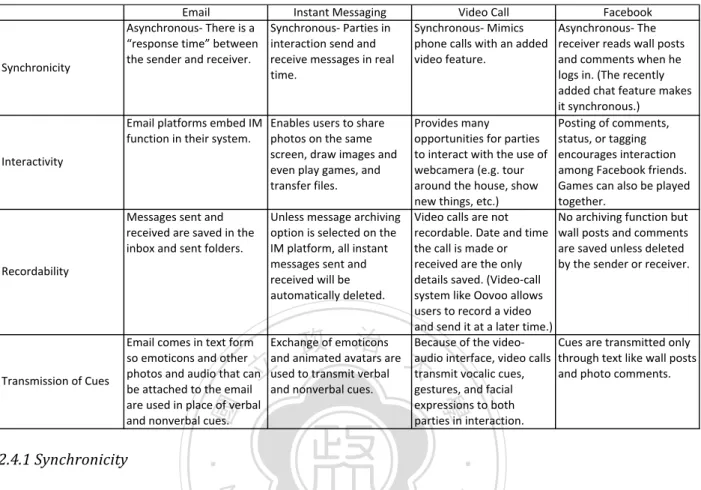
(18) 14 prime use, where individuals can manage their own address books and send messages, one-‐to-‐ one, or one-‐to-‐many (Wellman, 2001). Another form of CMC is instant messaging or IM. Ramirez et al. (2008) defined IM as a medium which provides geographically distributed relational people with the opportunity to engage in real-‐time interaction. It combines the typewritten form of communication, commonly associated with e-‐mail, only with the synchronicity of message exchange that characterizes telephone conversation. IM and telephone require users to exchange messages in real time, whereas e-‐mail does not (Ramirez et al., 2008). . The wide use of IM nowadays and its similarity to a more established media (e.g. e-‐mail, . telephone) suggests that the newer medium should compete with and perhaps displace the use if these technologies for some social purposes (Ramirez et. al., 2008). Hence, IM have been . 政 治 大 emerging to fulfill the function of sustaining 立 social ties (Ramirez & Broneck, 2009) by integrating • 國. ㈻㊫學. the function of telephone and video through video call or videoconferencing. Videoconferencing . •. or video calls are technically known as Voice over Internet Protocol (VoIP) (Fernando, 2006). . sit. y. Nat. Video communication allows users who want to share space and time, to communicate through . er. io. telecommunication technology while being at different locations. . a. n. . v. i networking has become a part l C CMC also gave birth to social networking sites (SNS). Snocial . hengchi U. of everyday life that enables people to plan and cultivate businesses, social contacts, and personal relationships (Anderson & Emmers-‐Sommer, 2006). With over 10 million users worldwide, Facebook (FB) is one of the latest trends in social networking (Facebook.com). Most SNS supports the maintenance of pre-‐existing social networks. Boyd and Ellison (2008) claim that FB is in fact used to maintain existing offline relationships or solidify offline connections, as opposed to meeting new people (p.221). . The defining features of the different forms of CMC were studied in the previous . scholarships on the Internet and computer-‐mediated communication (Ames et al. 2010; Kirk, Sellen and Cao, 2010). These features such as synchronicity, interactivity, recordability and transmission of cues are considered in this research to study how they benefit or become a . .
數據
Outline
Feminization
of
Filipino
Migrant
Labor
Defining
Filipino
Transnational
Motherhood
Building
Rapport
and
Trust
When
Fathers
Become
Mothers
Long-‐Distance
Mothers
and
Computers
On
Negotiating
Social
Spaces
On
Dealing
with
Technical
Barriers
The
Deviant
Case
of
the
Undocumented
Long-‐Distance
Mothers
Limitations
and
Future
Research
相關文件
01 綜合機械 3 陳俊嘉 行政院勞工委員會職業訓練局中區職業訓練 中心.. 01 綜合機械 4 王仲丞
一、 本職類檢定規範制定係依據行政院勞工委員會八十七年八月十一日台(八十 七)勞職檢字第 033372 號函辦理。.
(二) 民國 84 年爰經勞動部(前行政院勞工委員會《職業訓練局》
03 集體創作 洪慶桐 建國科技大學 / 勞動部勞動力發展署中彰投分署, 彰化縣私立達德高級商工職業學校.. 03 集體創作 張建雄
12 建築舖面 施浚澤 明道學校財團法人明道大學 勞動部勞動力發展署中彰投分署 國立秀水高級工業職業學校 12 建築舖面 陳武鑫 國立土庫高級商工職業學校
15 配管與暖氣 賴相儒 1 嘉義縣私立萬能高級工商職業學校、行政院勞工委員會職 業訓練局臺南職業訓練中心. 15 配管與暖氣 林昌宏
37-1 造園景觀(成人組) 黃泰源 5 行政院勞工委員會職業訓練局中區職業訓練中心. 37-1 造園景觀(成人組) 巫宗雨
系統(粉刷) 5 陳唯瑄 行政院勞工委員會職業訓練局臺南職業訓練中心 24 家具木工 1 黃俊翔 行政院勞工委員會職業訓練局臺南職業訓練中心.
