Raman spectroscopy study of Zn 1 x Mn x Se thin films under high-pressure
Chih-Ming Lin and Der-San Chuu
Citation: Journal of Applied Physics 101, 103535 (2007); doi: 10.1063/1.2735679 View online: http://dx.doi.org/10.1063/1.2735679
View Table of Contents: http://scitation.aip.org/content/aip/journal/jap/101/10?ver=pdfcov Published by the AIP Publishing
Articles you may be interested in
Temperature dependent transport properties of p -Pb 1 x Mn x Se films J. Appl. Phys. 108, 043709 (2010); 10.1063/1.3478708
Measurement of anharmonicity of phonons in the negative thermal expansion compound Zn ( CN ) 2 by high pressure inelastic neutron scattering
Appl. Phys. Lett. 95, 201901 (2009); 10.1063/1.3264963
The effect of Ni doping on the magnetic and transport properties in Pr 0.5 Ca 0.5 Mn 1 x Ni x O 3 manganites J. Appl. Phys. 106, 013913 (2009); 10.1063/1.3168422
Evaluation of the strains in charge-ordered Pr 1 x Ca x MnO 3 thin films using Raman spectroscopy J. Appl. Phys. 104, 063508 (2008); 10.1063/1.2978207
Pressure-induced metallization and resonant Raman scattering in Zn 1 x Mn x Te J. Appl. Phys. 104, 013503 (2008); 10.1063/1.2949707
Raman spectroscopy study of Zn
1−xMn
xSe thin films under high-pressure
Chih-Ming Lina兲
Department of Applied Science, National Hsinchu University of Education, Hsinchu 30014, Taiwan
Der-San Chuu
Department of Electro-Physics, National Chiao Tung University, Hsinchu, 300, Taiwan
共Received 5 January 2007; accepted 22 March 2007; published online 31 May 2007兲
Raman spectroscopy was used to study phase transitions of substrate-free Zn1−xMnxSe thin films, x = 0.07, 0.17, and 0.29, under high pressure up around 20.0 GPa at ambient temperature. One Raman mode, transverse optical split mode, was observed before metallization at 2.9± 1.0, 2.4± 0.8, and 2.1± 0.6 GPa for Zn0.71Mn0.29Se, Zn0.83Mn0.17Se, and Zn0.93Mn0.07Se thin films, respectively.
The semiconductor-metallic transition pressure for Zn0.71Mn0.29Se, Zn0.83Mn0.17Se, and
Zn0.93Mn0.07Se thin films was observed at 9.4± 0.4, 10.9± 0.6, and 11.7± 0.2 GPa, respectively. It
was found that the relation of the ionicity and the reduction of the pressure in transition from semiconductor to metal phase for Zn1−xMnxSe thin films was not the same as that of bulk crystals. The percentage of the increasing of the Grüneison parameter of longitudinal optical mode for semiconductor to metal phase transition might be the important factor inherently related to the reduction of phase transition pressure for substrate-free Zn1−xMnxSe thin film systems. © 2007 American Institute of Physics.关DOI:10.1063/1.2735679兴
I. INTRODUCTION
Diluted magnetic semiconductors共DMS兲, especially for Zn1−xMnxSe, are the materials in which transition metal ele-ments are substituted by a fraction 共x兲 of one to several tenths of a percent of cations in host semiconductors. For the studies of high pressure structural transition, a number of experiments have been performed to directly measure the dependence of the semiconductor-metal transition pressure, Pt, on Mn concentration x. Ves et al.1investigated the varia-tion of Pt of Zn1−xMnxSe bulk crystals with the impurity concentration x of Mn. They concluded that the decreasing of the semiconductor-metal phase transition pressure was strongly dependent on the increasing of the Mn concentra-tion. Maheswaranathan et al.2 and Maheswaranathan and Sladek3indicated that the substitution of Mn makes the zinc blende or würtzite lattice less stable not only in CdMnTe and ZnMnSe, but also in all the other Zn- and Cd-based AIIMnBVI compounds. They found that Mn, but not Zn, weakens the zinc blende crystal structure and makes it less stable under the application of pressure. They suggested that in Mn, but not in Zn, 3d orbital hybridizes into the tetrahe-dral bonds because the 3d electrons are less tightly bound in Mn than in Zn. They also found that in Cd and Zn d levels do not hybrid with the sp3bonding orbital. Therefore, the cause of the reduction of the phase transition pressure was attrib-uted to the hybridization of the Mn d orbital into the tetra-hedral bonds in the Mn-ternary alloys and the tetratetra-hedral structures of zinc blende and würtzite are sustained by the sp3-hybridized with partially ionic covalent bonds. The
va-lence electrons depopulate the sp3bonding states of the
cat-ion to make the tetrahedral bonds more cat-ionic. Arora et al.4 investigated the relationship of Ptvs x in the ternary system
Zn1−xMnxSe. They observed that the transition pressure did not manifest a strong dependence on the Mn concentration. Lin et al.5suggested that the effect of increasing the percent-age of the reduction of volume change factor of ZnSe based ternary semiconductors with any kind of impurity ions may be the main reason to reduce the stability of the zinc blende phase under the application of pressure. However, no appar-ent effect of 3d electronic hybridization has been observed. On the other hand, the Raman scattering of the high pressure effects on transverse optical 共TO兲 and longitudinal optical 共LO兲 phonons studied by Arora et al.4
showed that in Zn1−xMnxSe an intermediate phase, whose structure was not yet identified, precedes the rock salt phase in a compara-tively low pressure range 2 − 4 GPa. To explore more deeply the reason of the reduction of the semiconductor-metal phase transition pressure of the ternary system Zn1−xMnxSe, a more detailed investigation of the high pressure effect on Zn1−xMnxSe system is necessary. Among the aforementioned Zn1−xMnxSe systems, the previous works have only concen-trated on the high pressure effects on the bulk matrices. There is an unavoidable creation of some level of micro-grains, disorder, defects, oxidation, and intergrain boundaries in thin film for Zn1−xMnxSe material. Since the aforemen-tioned effects are not able to be separated clearly, we thus consider a series of substrate-free Zn1−xMnxSe thin films.
In this work, we extend our previous study6to the inves-tigation of the lattice vibration of the substrate-free Zn1−xMnxSe thin films by Raman measurements under high pressure. Our data of phase transition pressures are the direct observation in substrate-free Zn1−xMnxSe thin film system.
II. EXPERIMENT
The thickness of Zn1−xMnxSe thin films with x = 0.07, 0.17, and 0.29, are around 7000 Å. They were grown by the EPI 620 molecular beam epitaxy system on GaAs共100兲 wa-a兲Author to whom correspondence should be addressed; electronic mail:
JOURNAL OF APPLIED PHYSICS 101, 103535共2007兲
0021-8979/2007/101共10兲/103535/6/$23.00 101, 103535-1 © 2007 American Institute of Physics
fer. The sample preparation and the control of parameters for Raman measurements follow our previous work.6The films and ruby chips were sealed with the pressure transmitting medium共methanol-ethanol 4:1 fluid兲 in the sample chamber which was a hole of 130m in diameter and 50m in thick-ness drilled on the stainless steel 301 gasket as the same as previous work.6 The pressure was calibrated by the fluores-cence scale method.7,8Ruby fluorescence and Raman scatter-ing measurements were performed in a TRIAX 550 micro-Raman system. The 5145 Å line with power of 0.6 W from the Spectra-Physics stabilite 2017 6.0 W argon ion laser was focused to about 5m on the sample surface. The backscat-tered signal was collected by a microscopic system and re-corded with a Jobin–Yvon Spex spectrum one liquid nitrogen cooled charge coupled device detector. The recording time for each ruby fluorescence is of the order of 1 s, and Raman spectrum, 600 s. After the experiments, the spectra were pro-cessed to calculate the position, intensity, and the width at the half maximum under a Jandel Scientific Peakfit computer program as previous work.6The precision in the frequency determination was in the range of 1 cm−1. The corresponding error of pressure values was within ±0.1− 0.2 GPa at the highest pressure obtained because the good signal-to-noise ratio could be achieved in the system even for broad peaks below around 20 GPa. Energy-dispersive x-ray-diffraction 共EDXD兲 measurement has been employed to characterize the structure phase of substrate-free Zn1−xMnxSe thin films at ambient pressure. The source of EDXD is the supercon-ductor wiggler synchrotron beam line X17C of the National Synchrotron Light Source of Brookhaven National Labora-tory, USA. The germanium energy dispersive detector was set in the position where the diffracted angle 共兲 was changed to 6° for substrate-free Zn0.83Mn0.17Se and 7° for
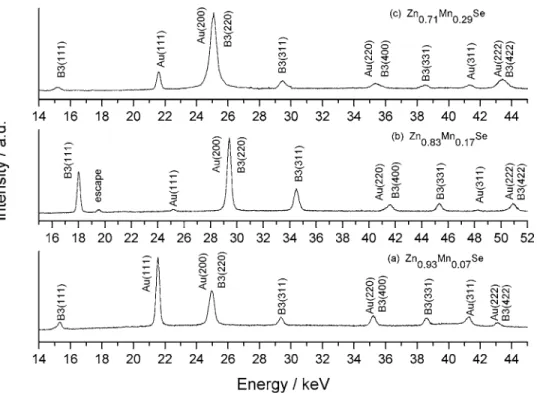
Zn0.93Mn0.07Se and Zn0.71Mn0.29Se, respectively. The relation of the energy of reflection, E, versus d spacings, d, was Ed = 59.317 and 50.866 keV Å for = 6° and 7°, respectively. Figure 1 shows the EDXD pattern of the substrate-free Zn1−xMnxSe thin films, 共a兲, 共b兲, and 共c兲 are for Zn0.93Mn0.07Se, Zn0.83Mn0.17Se, and Zn0.71Mn0.29Se,
respec-tively. One can note from Fig.1that the composition of the substrate-free Zn1−xMnxSe thin films is homogeneous. In Fig.
1, the B3共zinc blende兲 phase but not the wurtzite phase can be observed. Especially, no mixture of zinc blende and wurtzite structures can be found for x = 0.29 in our case not as those observed by Yoder-Short et al.9 and Arora et al.’s works.4
III. RESULTS AND DISCUSSION
The pressure dependence of Raman scattering spectros-copy at ambient temperature for substrate-free Zn1−xMnxSe thin films, x = 0.07 and 0.29, is shown in Figs. 2 and3, re-spectively. Similar results of Raman works of substrate-free Zn0.83Mn0.17Se thin film were reported in the previous work.6 At ambient pressure, two peaks identified as LO and TO phonons were observed at 254.8 and 207.5 cm−1, 255.8 and
208.4 cm−1 for substrate-free Zn
0.93Mn0.07Se and
Zn0.71Mn0.29Se thin films, respectively. Between these two
peaks, a weak structure attributed to the Mn local共impurity兲 phonon mode can be labeled through the deconvolution process at 229.9 and 234.9 cm−1 for substrate-free
Zn0.93Mn0.07Se and Zn0.71Mn0.29Se, respectively. The labeled
Mn local phonon mode is arisen from the introducing of the local electric field resulting from the substitution of Zn atom by Mn atom as bulks. At around 1.3± 0.2 GPa, for x = 0.07 and 0.29, the Mn local mode becomes more intense at higher
FIG. 1. A series of spectra of substrate-free Zn1−xMnxSe thin films at ambient pressure. There is only a B3共zinc blende兲 phase, which also contains the
standard identified pressure lines of internal gold.
103535-2 C. M. Lin and D. S. Chuu J. Appl. Phys. 101, 103535共2007兲
pressure and the Raman shift energy is increased with the pressure. A split TO phonon mode starts to develop and it becomes very pronounced at 2.1± 0.6 and 2.9± 1.0 GPa for substrate-free Zn0.93Mn0.07Se and Zn0.71Mn0.29Se thin films,
respectively. The error bar of 0.4 and 0.8 GPa results from the difficulty of pressure tuning while the error of 0.2 GPa comes from the uncertainty of the pressure determination for substrate-free Zn0.93Mn0.07Se and Zn0.71Mn0.29Se thin films, respectively. Similar blueshift behavior as that of the Mn local phonon mode is exhibited in the pressure effect on the LO and TO phonon modes. One Raman mode, TO split mode, occurs before metallization at 2.1± 0.6 and 2.9± 1.0 GPa for substrate-free Zn0.93Mn0.07Se and
Zn0.71Mn0.29Se thin films, respectively. This is similar to the case of substrate-free Zn0.83Mn0.17Se film in which the TO split mode happens at 2.4± 0.8 GPa. In the case of Zn1−xMnxSe bulk crystal, one more mode, the Mn impurity mode, was also observed.10 Arora et al.10 reported that the splitting of the impurity mode at 4.0 GPa is caused by the lowering of the crystal symmetry. However, if one refers to the study of the similar cubic structure of CdTe共Ref.11兲 and
HgTe,12 one more phase 共cinnabar for CdTe and HgTe兲 is observed before they undergo the structure transformation from the B3 phase to the B1 phase and is similar to our previous work on the bulk crystal of ZnSe DMS.13 There-fore, it is reasonable to suspect that substrate-free Zn1−xMnxSe thin films might also undergo a similar structure transformation from the B3 phase to the cinnabar structure for x = 0.07, 0.17, and 0.29 at around 2.1± 0.6, 2.4± 1.0, and 2.9± 0.8 GPa, respectively. The TO split mode exhibits a red-shift and can be observed as the pressure is increased up to around 16.9± 0.2, 17.5± 0.2, and 22.5± 0.2 GPa, for substrate-free Zn0.93Mn0.07Se, Zn0.83Mn0.17Se, and
Zn0.71Mn0.29Se thin films, respectively. As the pressure was
increased further to 11.7± 0.2 and 9.4± 0.4 GPa for substrate-free Zn0.93Mn0.07Se and Zn0.71Mn0.29Se thin films,
respec-tively, which are the semiconductor-metal transition pres-sures for these two thin films, both LO and Mn local modes disappear.6,13 The disappearance of the LO phonon and Mn local phonon modes can be understood as a semiconductor-metallic transition from the high pressure Raman spectros-copy measurements on the ZnSe bulk.13Two phase transition pressures of substrate-free Zn1−xMnxSe are listed in TableI. One can find that with 600 mW laser power at 514.5 nm and 600 s collecting time, the final Raman spectroscopy are still not good enough in diamond anvil cell 共DAC兲 condition, especially compared with the results from other groups.4,10 For vibrations of a crystal lattice, the intensity of the TO and LO branches depend upon the magnitude of the dipole mo-ment created by the vibrational mode. The dimension of the
FIG. 2. Pressure dependence of phonon frequencies of substrate-free Zn0.93Mn0.07Se thin film. Note the lowest frequency component is softened
at high pressure and was continuous to 16.9± 0.2 GPa.
FIG. 3. Pressure dependence of phonon frequencies of substrate-free Zn0.71Mn0.29Se thin film. Note the lowest frequency component is softened
at high pressure and was continuous to 22.5± 0.2 GPa.
TABLE I. Phase transition presents 共including those of one phase兲 of substrate-free Zn1−xMnxSe thin films are listed and compared with ZnSe
bulk.
Sample One phase pressure
共GPa兲: redshift Metallization pressure 共GPa兲 ZnSe bulk 4.7± 0.3 14.4± 0.3 Zn0.93Mn0.07Se thin film 2.1± 0.6 11.7± 0.2 Zn0.83Mn0.17Se thin film 2.4± 1.0 10.9± 0.6 Zn0.71Mn0.29Se thin film 2.9± 0.8 9.4± 0.4
103535-3 C. M. Lin and D. S. Chuu J. Appl. Phys. 101, 103535共2007兲
polarizability constant 共␣兲 is charge⫻length/ 共charge/length2兲=length3. The unit turns out to be one of
volume. A thickness around 0.7m of our samples and the DAC condition can create the reducing of the Raman spec-troscopic quality.
The variations of mode energies as a function of the applying pressure are shown in Fig.4. In Fig.4, the pressure dependence of Raman peak positions for substrate-free Zn0.71Mn0.29Se 共solid symbols兲, Zn0.83Mn0.17Se 共half solid
symbols兲, Zn0.93Mn0.07Se thin films共opened with cross
sym-bols兲, and ZnSe powder 共opened symbols兲 is shown. The arrows at 9.4± 0.4, 10.9± 0.6, 11.7± 0.2, and 14.4± 0.3 GPa represent the semiconductor-metal phase transition pressures for substrate-free Zn0.71Mn0.29Se, Zn0.83Mn0.17Se,6
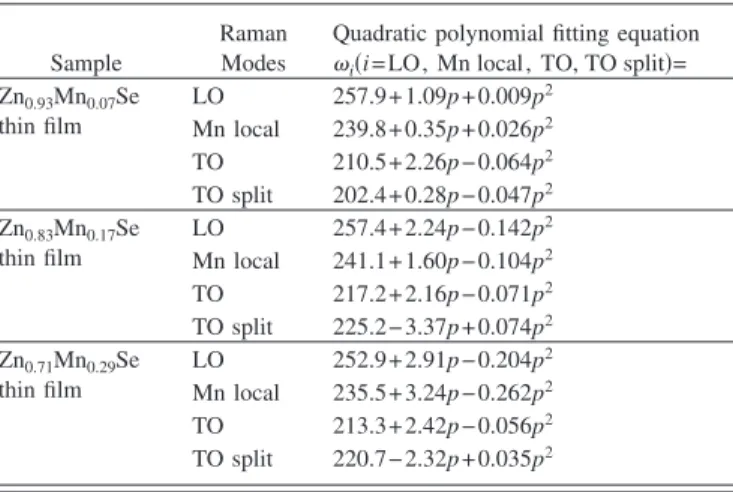
Zn0.93Mn0.07Se thin films, and ZnSe bulk,13respectively. The relationships of the mode frequencies versus pressure for substrate-free Zn0.71Mn0.29Se, Zn0.83Mn0.17Se, Zn0.93Mn0.07Se thin films were obtained by the quadratic polynomial fitting using the equations as listed in TableII, whereiis the wave number in cm−1 and p is the pressure in GPa. The effects of
pressure on the frequencies of various Raman vibrational modesi, pressure gradient ofi, and Grüneisen parameter
i of substrate-free Zn0.71Mn0.29Se, Zn0.83Mn0.17Se,
Zn0.93Mn0.07Se thin films at ambient temperature共298 K兲 are
listed in TableIII. The Grüneisen parameter共i兲 for a quasi-harmonic mode i of frequencyiwas defined by Cardona et al.9The ratio␥TO/␥LO, which relates to the property of
ion-icity, for substrate-free Zn0.71Mn0.29Se, Zn0.83Mn0.17Se, and
Zn0.93Mn0.07Se thin films is 0.986, 1.143, and 2.543,
respec-tively. This manifests that substrate-free Zn0.93Mn0.07Se thin
film has highest ionicity. Our result agrees with that obtained by the previous work in the investigation of bulk crystal.14 Lin et al.13 reported that the more the ionicity is, the more percentage of the reduction of the semiconductor to metal
transition pressure for ZnSe DMS doped with dilute Fe oc-curs. However, our result on substrate-free Zn1−xMnxSe thin films shows that the more the ionicity is, the less percentage of the reduction of the semiconductor to metal transition pressure happens. Therefore, the relationship of ionicity ver-sus the pressure reduction in the semiconductor to metal phase transition for substrate-free Zn1−xMnxSe thin films is different from that of ZnSe DMS doped with dilute Fe.
To explain the reason of the reduction of the phase tran-sition pressure of the impurity mixing substrate-free Zn1−xMnxSe semiconductor thin films, let us consider the Grüneison parameter of the LO mode in TableIII. The Grü-neison parameter,␥, is a convenient dimensionless parameter for detecting the effects of anharmonicity.15 The Grüneison parameter of the LO mode for substrate-free Zn0.71Mn0.29Se,
Zn0.83Mn0.17Se, and Zn0.93Mn0.07Se thin films is 0.265, 0.546,
FIG. 4. 共Color online兲 Pressure dependence of Raman peaks in the substrate-free Zn0.71Mn0.29Se共solid symbols兲, Zn0.83Mn0.17Se 共half solid symbols兲,
Zn0.93Mn0.07Se thin films共opened with cross symbols兲, and ZnSe powder 共opened symbols兲. The arrows at 9.4±0.4, 10.9±0.6, 11.7±0.2, and 14.4±0.3
represent the semiconductor-metal phase transition pressure of substrate-free Zn0.71Mn0.29Se, Zn0.83Mn0.17Se, Zn0.93Mn0.07Se thin films, and ZnSe, respectively.
TABLE II. The quadratic polynomial fitting equation of substrate-free Zn1−xMnxSe thin films.
Sample
Raman Modes
Quadratic polynomial fitting equation
i共i=LO, Mn local, TO, TO split兲=
Zn0.93Mn0.07Se thin film LO 257.9+ 1.09p + 0.009p2 Mn local 239.8+ 0.35p + 0.026p2 TO 210.5+ 2.26p − 0.064p2 TO split 202.4+ 0.28p − 0.047p2 Zn0.83Mn0.17Se thin film LO 257.4+ 2.24p − 0.142p2 Mn local 241.1+ 1.60p − 0.104p2 TO 217.2+ 2.16p − 0.071p2 TO split 225.2− 3.37p + 0.074p2 Zn0.71Mn0.29Se thin film LO 252.9+ 2.91p − 0.204p2 Mn local 235.5+ 3.24p − 0.262p2 TO 213.3+ 2.42p − 0.056p2 TO split 220.7− 2.32p + 0.035p2
103535-4 C. M. Lin and D. S. Chuu J. Appl. Phys. 101, 103535共2007兲
and 0.722, respectively. One can note that the increasing of the percentage of the impurity mixing, x, of substrate-free Zn1−xMnxSe thin film relates prominently with the increasing percentage of the effects of anharmonicity of the LO mode for our three thin film samples. We can estimate the magni-tude of the order of anharmonicity for our three samples. For nearest-neighbor interactions, the Grüneison parameter for a one-dimensional chain 共LO mode兲, with chain length L and lattice spacing a, is defined as ␥LO= −共L/LO兲共dLO/ dL兲.
Assume that the interaction potential energy has the form U共z兲=U0+共1/2兲LOz2+
LOz3, where z = d − a, d is the
dis-tance between the nearest-neighbors, and the parametersLO
共anharmonic term兲 and LO 共harmonic approximation兲 are
coefficients in a Taylor series for the potential U共z兲. Here we adopt the anharmonic potential model up to third-order term only because the high-order terms have been proved to be negligible in the present analysis. In a one-dimensional chain the frequency scale of the phonon dispersion curve共LO兲 is
determined by a frequency parameter LO=
冑
LO/ mLO,where mLO is the reduce mass of a one-dimensional chain.
Our goal is to resolve how this frequency depends on the length of the one-dimensional chain. To induce a small change in the length, from L to L
⬘
, we can apply an external force⌬F. Then we can calculate the second derivative of the potential energy around the equilibrium position, LO⬘
= dU2/ dz2for a quasiharmonic system. If a force共pressure兲is applied, the potential energy becomes U共z兲=U0
+共1/2兲LOz2+LOz3+⌬Fz. The equilibrium position can be
found by setting dU / dz = 0 which yields LO⌬z+3LO共⌬z兲2
+⌬F=0. For a small force, the second order of the displace-ment can be neglected and thus the solution is approximated to be ⌬z=−⌬F/LO. The lattice spacing is a
⬘
= a +⌬z; thechange in the length of the system is⌬L=N⌬z. The second derivative of the potential energy around the equilibrium po-sition共LO
⬘
= dU2/ dz2for the quasiharmonic system兲 is givenbyLO
⬘
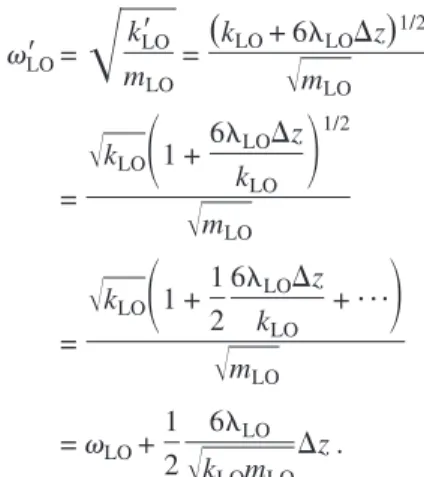
=LO+ 6LO⌬z and the frequency isLO
⬘
=冑
kLO⬘
mLO =共
kLO+ 6LO⌬z兲
1/2冑
mLO =冑
kLO冉
1 + 6LO⌬z kLO冊
1/2冑
mLO =冑
kLO冉
1 +1 2 6LO⌬z kLO +¯冊
冑
mLO =LO+1 2 6LO冑
kLOmLO ⌬z .Therefore, the Grüneison parameter for a one-dimensional chain can be obtained as
␥LO= − L LO ⌬LO ⌬L = − L LO
共
LO⬘
−LO兲
⌬L = − Na LON⌬z 3LO冑
LOmLO ⌬z = −3LOa LO .In dimensionless units, for nonsingular functions, these coefficients ␥LO are of the order of unity. For the case of
interaction potentials assumed in our samples, one finds LO⬍0 and ␥LO⬎0 similar to the Lennard–Jones potential
of the interaction of two atoms. Therefore, the increasing of the percentage of the impurity mixing, x, of substrate-free Zn1−xMnxSe thin films relates the increasing percentage of the effects of anharmonicity and Grüneison parameter of the LO mode. Our observation shows that decreasing in the phase transition pressure Pt for the phase transition from semiconductor to metal phase can be related to the increasing of the percentage of the impurity mixing, x, of substrate-free Zn1−xMnxSe thin films by the expression Pt=关14.1377 − 29.7673x + 47.7178x2兴 in GPa. Hence, one can conclude that the percentage of the increasing of the Grüneison param-eter of the LO mode for semiconductor to metal phase tran-sition might be the important factor for the reduction of phase transition from semiconductor to metal for substrate-free Zn1−xMnxSe thin film systems.
IV. CONCLUSIONS
We have carried out high-pressure micro-Raman scatter-ing experiment on substrate-free Zn1−xMnxSe thin films, x = 0.07, 0.17, 0.29, up to around 20.0 GPa at ambient tem-perature. The existence of the Grüneison parameter of the LO mode causes a reduction in the semiconductor-metal phase transition pressure that is very different from the be-havior of bulk crystals. The disappearance of the LO and Mn local phonons is attributed to the metallization of the substrate-free Zn1−xMnxSe thin films as same as the behavior of bulk. One component of the visible TO phonon splitting modes in substrate-free Zn1−xMnxSe thin film systems was observed up to around 20.0 GPa.
TABLE III. Effect of pressure on various Raman vibrational modes of substrate-free Zn0.71Mn0.29Se, Zn0.83Mn0.17Se, and Zn0.93Mn0.07Se thin films
and ZnSe bulk, respectively, at ambient temperature共298 K兲. The values of mode frequencies i, pressure dependence di/ dp, and mode Grüneisen
parameteriwere extrapolated at ambient conditions.
Sample Mode i 共cm−1兲 di/ dp 共cm−1GPa−1兲 i 关共K0/i兲共di/ dp兲兴 Zn0.93Mn0.07Se thin film LO 257.9 1.09+ 0.009p 0.265 Mn local 239.8 0.35+ 0.026p 0.092 TO 210.5 2.26− 0.064p 0.674 TO split 202.4 0.28− 0.047p 0.087 Zn0.83Mn0.17Se thin film LO 257.4 2.24− 0.142p 0.546 Mn local 241.1 1.68− 0.104p 0.437 TO 217.2 2.16− 0.071p 0.624 TO split 225.2 −3.37+ 0.074p −0.939 Zn0.71Mn0.29Se thin film LO 252.9 2.91− 0.204p 0.7223 Mn local 235.5 3.24− 0.262p 0.8636 TO 213.3 2.42− 0.056p 0.7122 TO split 220.7 −2.32+ 0.035p −0.6598
103535-5 C. M. Lin and D. S. Chuu J. Appl. Phys. 101, 103535共2007兲
ACKNOWLEDGMENTS
This work was supported by the National Science Coun-cil of Taiwan 共Contract Nos. NSC 89–2112-M-134–002, NSC 90–2112-M-134–002, NSC 91–2112-M-134–001, NSC 92–2112-M-134–001, NSC 94–2120-M-001–014, NSC 95– 2120-M-001–004, NSC 96–2120-M-001–003, NSC 94– 2120-M-009–002, NSC 94–2112-M-009–024, and NSC 95– 2119-M-009–030兲.
1S. Ves, K. Strössner, W. Gebhardt, and M. Cardona, Solid State Commun.
57, 335共1986兲.
2P. Maheswaranathan, R. J. Sladek, and U. Debska, Phys. Rev. B 31, 5212
共1985兲.
3P. Maheswaranathan and R. J. Sladek, Phys. Rev. B 41, 12076共1990兲. 4A. K. Arora and T. Sakuntala, Phys. Rev. B 52, 11052共1995兲.
5C. M. Lin, D. S. Chuu, J. A. Xu, E. Huang, W. C. Chou, J. Z. Hu, and
J.-H. Pei, Phys. Rev. B 58, 16共1998兲.
6C. M. Lin and D. S. Chuu, Phys. Lett. A 266, 435共2000兲.
7H. K. Mao, J. Xu, and P. M. Bell, J. Geophys. Res. 91, 4673共1986兲. 8J. Xu, H. K. Mao, and P. M. Bell, Acta Phys. Sin. 36, 500共1987兲. 9D. R. Yoder-Short, U. Debska, and J. K. Furdyna, J. Appl. Phys. 58, 4056
共1985兲.
10A. K. Arora, E. K. Suh, U. Debska, and A. K. Ramdas, Phys. Rev. B 37,
2927共1988兲.
11R. J. Nelmes, M. I. McMahon, N. G. Wright, and D. R. Allan, Phys. Rev.
B 51, 15723共1995兲.
12S. B. Qadri, E. F. Skelton, A. W. Webb, L. Colombo, and J. K. Furdyna,
Phys. Rev. B 40, 2432共1989兲.
13C. M. Lin, D. S. Chuu, T. J. Yang, W. C. Chou, J. A. Xu, and E. Huang,
Phys. Rev. B 55, 13641共1997兲.
14S. S. Mitra, O. Brafman, W. B. Daniels, and R. K. Crawford, Phys. Rev.
186, 942共1969兲.
15J. M. Ziman, Principles of the Theory of Solids 共Cambridge University
Press, Cambridge, 1984兲, Chap. 2.
103535-6 C. M. Lin and D. S. Chuu J. Appl. Phys. 101, 103535共2007兲