Quinone-based molecules doped poly(methyl methacrylate)
photopolymer for the holographic data storage
Shiuan-Huei Lin' and Ken Y. Hsu
Institute of Electro-Optical Engineering
'Department of Electrophysics
National Chiao Tung University
Hsin-Chu, Taiwan, R.O.C.
ABSTRACT
We present our studies on the photopolymer of poly(methyl methacrylate) (PMMA) doped with quinone-based molecules for holographic data storage. We discuss the recording mechanism involved with the photoreaction of the quinone and olefin bonds. Experimental characterizations, including sensitive wavelength, holographic recording and material M/# are also presented.
Keywords: Photopolymer material, Holographic data storage, M/#, PMMA
1. INTRODUCTION
Holographic dada storage has been considered as one of promising information storage technologies because of its distinct advantages of large storage capacity and fast data access rate. In recent years a lot of research efforts have been invested on this topic and a rapid progress has been obtained4. However, before this technology can be successful for practical applications there are several fundamental issues need to be resolved. One of the fundamental issues is the recording material.
To be a good holographic recording material, many characteristics are required, such as high optical sensitivity, simple development procedure, uniform spatial frequency response, large diffraction efficiency, high optical quality and long-term stability. For volume holographic storage using thick materials, good optical quality and dimensional stability are the most unique requirements. Among the practicable recording materials, the photopolymer materials are the most popular and suitable for the holographic Write-Once-Read-Only-Memory (WORM). Many experimental works have been demonstrated about the feasibility of using polymer-based materials for holographic data storage59. They can provide large refractive index change, and are easy to fabricate. But they also have some disadvantages. Among them the shrinkage effect after holographic recording is the most serious. It induces grating distortion on the recorded gratings such that the Bragg condition for volume holograms is lost and the recorded information cannot be readout completely10". The shrinkage effect is to some extent proportional to the material thickness. As a result, the thickness of photopolymer materials is limited to around lOOxm.
There are several different systems of photopolymers, such as photo-polymerizable, photo-crosslinkable, doped polymer and sol-gel systems. Previous researches found that the phenanthrenequinone (PQ) dye-doped poly(methyl methacrylate) (PMMA) photopolymer have very attractive optical quality and negligible photo-chemically induced shrinkage by using the pre-polymerization technique'213. The way to alleviate the shrinkage problem is to separate the photochemical reaction during holographic recording from the polymerization of the host monomer molecules during material preparation. This may be achieved, if the host polymer matrix is used only to support the binder matrix and only the doped molecules are the photosensitive elements responsible for forming the refractive index holograms. In making the PQIPMMA samples, the host polymer matrix PMMA is formed during the material preparation such that only a few percentage of un-reacted MMA monomer molecules are left for optical exposure usage during holographic recording. It is known that using thermal initiator azobisisobutyronitrile (AIBN) the most MMA monomer can transfer into polymer the polymer matrix PMMA. The main point is how to control the environmental parameters for material
preparation such that the most of the monomer molecules will be polymerized during the material preparation and only the necessary percentage of un-reacted monomer molecules will be left for optical recording.
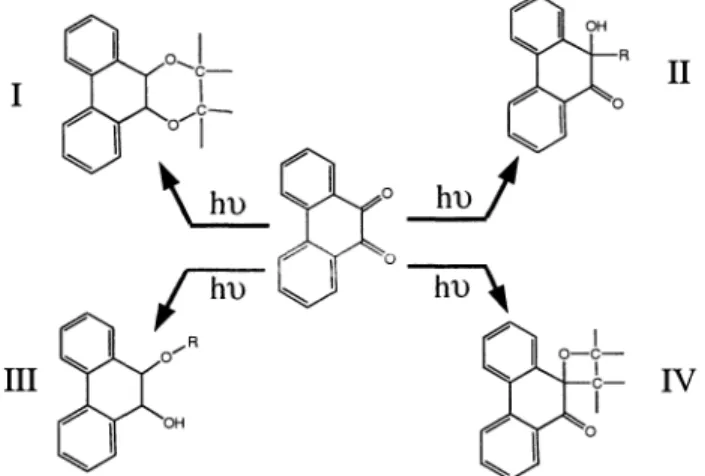
After a series of experiments, we found that a two-step procedure can be utilized to synthesize bulk samples with good optical quality'3. However, the environmental parameters have strong influence of photopolymer characteristics. A comparison of the recording mechanism has been made between the different photopolymers grown by diverse fabricated ways from viewpoint of optical recording behaviors'4. Studies of related photo- and thermo-reaction of PQ molecules with olefin-based molecules show that the o-quinones on the PQ molecules and olefins on the MMA molecules are mixed under light exposure15. This reaction carries out four different compounds based on one PQ molecule to one MMA molecule, as shown in the Figure 1 .However,there are still no strong and direct evidences to confirm the details of photochemical behavior in our bulk sample such that the optical recording mechanism of PQIPMMA photopolymer bulk is not clear enough. Hence, further development of this material for holography is obstructed.
In this paper, we report our investigations on chemical analyses of our PQ/PMMA samples under different conditions. In section two, we present the sample preparation method. In section three, we present chemical analyses for unexposed and exposed PQ doped PMMA solid and PQ solved MMA liquid samples. These results will give us strong and direct evidences to confirm the details of photochemical behavior related to the o-quinones on the PQ molecules and olefins on the MMA molecules in our bulk sample. The optical recording mechanism in our sample is then proposed. In section four, we first demonstrate holographic recording characteristics of our PQIPMMA samples. Then, some modifications of changing dye molecules in PMMA-based photopolymers will be made, and holographic recording characteristics of these modified samples will be investigated. Some conclusions will be given in section 5.
II
I
YL,ro
hv\
III
IV
Figure 1 Four different compounds based on one PQ molecule to one MMA molecule could be formed under light exposure.
2. PQ/PMMA SAMPLE PREPARATION
The major chemical components of PQ and methyl methacrylate (MMA) in our research were bought from Lancaster Company. We purified MMA by a vaporized approach under low pressure to remove the impurities such that the scattering center in bulk can be decreased. After the purification step, we solved PQ molecules the MMA with the PQ weight ratio of 0.7%, which is the dissolved saturated concentration. The azo-bis-isobutyrolnitrile (AIBN) molecules of 1% by weight are also added. It plays the role of thermal initiator that turns the MMA monomer into PMMA polymer. The compound solution was stirred about 24 hours under constant temperature and until the solute dispersed and mixed very well. We then used a filter with the hole size of 0.2 jim to further filter out impurities from the solvent. The filtered solution is ready for molding with different shapes. It is firstly stirred at 3000 for around 60 hours until the solution turns to higher viscosity. The solution is then poured into the glass cell and baked under 40°C for 3 days to make most of MMA molecules polymerized. This two-step procedure is found to obtain bulk samples with good optical quality. In
fact, by different processes, the samples will have different compositions when polymerization completed. Typically, the concentration of residual monomer MMA is varied and it depends on the temperature for polymerization. In our sample, it is usually around 10 % by weight. We believe that these surplus monomers play key rule for determining holographic properties of the samples.
3. CHEMICAL ANALYSIS
3.1. Measurement
In order to find the possible chemical paths between PQ and MMA, we make chemical analyses in both the PQ solved MMA liquid and the PQ doped PMMA bulk samples.
For the measurement of the photoproducts in PQ/MMA liquid sample, 0.7 weight % PQ is dissolved into MMA (without AIBN) solution and then the solution is illuminated by an argon laser beam with wavelength of 5 14 nm until the color of the solution is changed from yellow to colorless. After this prior step, we put the solution into a vacuum chamber at 4000 for 7 days such that the unreacted MMA were draw out from the solution. The sample is then ready for the chemical analyses.
For the measurement of the photoproducts in the PQIPMMA solid sample, all the measured samples are exposed to 5 l4nm argon ion laser beam after the two-step pre-polymerization procedure. The exposure continues until the colors of the samples are also changed from yellow to colorless. We dissolved three different samples, including photoproduct of PQ/MMA liquid sample, exposed PQ/PMMA sample, and unexposed PQ/PMMA sample, by proper solvents. We then make FT-IR spectra analysis for PQ/MMA sample and Mass spectra analysis for both PQ/MMA and PQIPMMA samples.
3.2. Results and Discussion
Fourier Transform Infrared Spectra : FT-JR analysis is utilized to analyze the functional groups of the structure. Figure 2 shows the FT-IR spectra of PQ, MMA and the photoproducts of liquid sample PQ/MMA. For the PQ, the absorption peak corresponding to C-H of aromatic spreads between wave-numbers of 3000 cm1 to 3 100 cm1. Over the wave number between 2800 cm1 to 3000 cm1, the
MMA has peak corresponding to the absorption of
C-H of aliphatic, and photoproduct of PQMMA also __________________________________________ has week signal from the same band. In results, there
is no peak more than 3100 cm1 observed in PQ-MMA product.
It can be explained that there is no OH
functional group exists on PQ-MM A molecule. The ________________________________________
peak of PQ at 1675 cnf' and 1593 cm1 are due to the
p
'''''' I
I
stretching of C=O and aromatic C=C. The C=O of MMA is located at 1746. As the photoproduct, we find its wave number of C=O belongs to the acrylate part,
.
111111' I
which shifts to 1757 cm1 and another C=O peak of <
PQMMA Photoproduct
1634 cm' belong to the unreacted part of aromatic
cm1 next to 1634 cm', which peak is the C=C of
rings. We can see that there exists one peak of 1600
aromatic rings of PQ. From the analysis and
''III I
comparison
of PQ, MMA, and photoproduct of
4O 3500 3000 2500 2000 1500 1000 500PQ-MMA,we also find that after exposed two strong Wavenumber(cm1)
peaksof 1337 cm1 and 1081 cni' appear. These two Figure 2 The FT-JR spectra of PQ, MMA and the exposed
peaks belong to the aromatic ether and it is one
PQ/MMA sample evidence to show that PQ and MMA will react in the
way to form one to one photoproduct by path IV in Figure1.
MASS
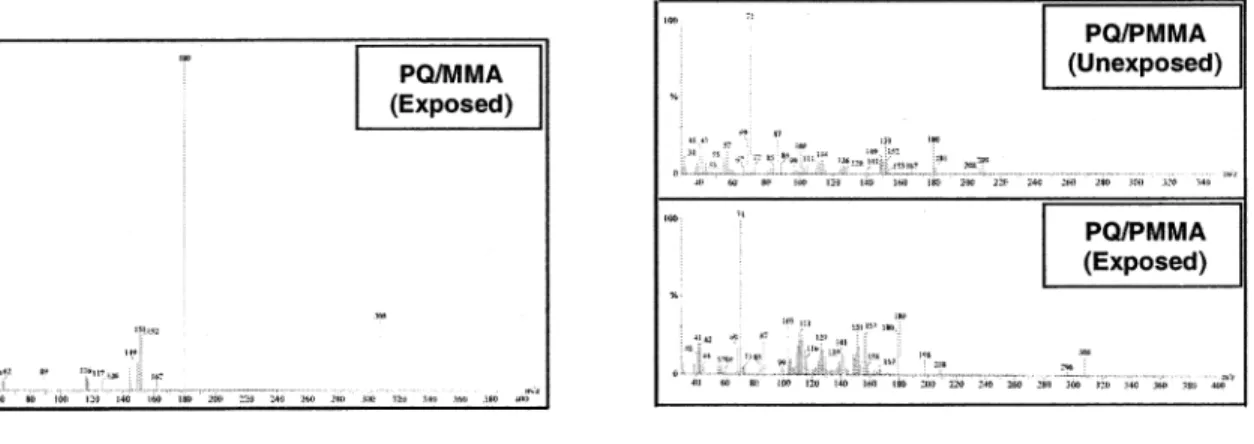
Spectra can provide information about the molecular weight of the compounds. Figure 3(a) shows the mass spectra of the exposed PQ-MMA liquid samples. The molecular weight of PQ and MMA are 208 and 100. From figure 3(a), we find the signal at 308 by molecular weight, which equals one MMA plus one PQ. We also find that the signal at1 80 by molecular weight. It seems to be the compound of 9-Fluorenone, which is formed by the broken PQ molecules with a carbon atom and an oxygen atom taken away from PQ. Mass spectra analysis is a method of destructive analysis, in which an electron beam is utilized as energy source to ionize the molecules. Under this procedure, the molecule compounds are often cracked into small fragments. Therefore, the existence of the peak signal at 308 by molecular weight gives direct evidence of the photo-reaction between one MMA molecule to one PQ molecule in our PQ/MMA liquid samples. Figure 3(b) shows the mass spectra of PQIPMMA (unexposed and exposed) bulk sample. It is observed that after optical exposure both liquid and solid samples show the same results. From this figure, we can consider that under light exposure, the compounds formed in the PQ/PMMA sample are the same as that in the PQ/MMA liquid sample. PQ/MMA (Exposed) ., PQ/PMMA (Unexposed) PQ/PMMA (Exposed)
Figure 3(a) The mass spectra of exposed PQ/MMA Figure 3(b) The mass spectra of unexposed and exposed
liquid sample PQIPMMA solid samples
From the above chemical analyses it is clear that under light exposure the PQ molecules and residual monomer MMA molecules take the number IV chemical path, shown in figure 1 ,toform a one to one photoproduct in our PQ/PMMA photopolymer samples. We then propose the recording mechanism of the optical exposure in our PQ/PIVIMA samples as following. During the holographic recording, the photosensitize PQ molecules absorb photons and they bond with those —10% residual monomer molecules to become radicals. The above chemical analyses show
that the bonding of PQ to MMA could be conducted to form a one
molecule to one molecule structure. This chemical reaction occurs in the bright region. Consequently, a difference between the refractive index in the dark region and that in the bright region is created, i.e. a phase grating is formed, since large refractive index change can be induced by the structure change of the PQ molecules. Since the residual monomers and photo-sensitizers involved in the formation of the hologram are only a
small fraction of the compositions, the host polymer matrix structure can be maintained during the optical recording. As a result, the dimensional shrinkage and the bulk refractive index change induced by the recording process are minimized. This concept can be extended to those similar molecules with o-quinones double bonds doped PMMA photopolymer materials. The holographic recording of these different photopolymer
materials will be characterized in next section.
4. HOLOGRAPHIC RECORDING
Our PQ/PMMA samples appear to be in clear yellow color, with good optical quality and uniform transmission. The samples show appropriate absorption at wavelength of 514nm. In the following experiments we used an argon laser of the wavelength 514.5 nm as the recording light source. The sample thickness is set as 1 mm. First, to study the image quality of the holographic recording, we recording a Fresnel hologram in our sample using the USAF resolution test
chart. Figure 4 shows the photograph of the reconstructed image, in which the sample is placed near the Fourier plane of the imaging lens. It can be seen that the image retains clear fidelity, which is down to the number 6 of the group 5. The distortion of the image and scattering background noise are not obvious. In our system, this resolution seems to be around 100 lps/mm, which is close to the limitation of our CCD. For the application of volume holographic storage, thousands of pages are superimposed on a single location of a thick recording material. As the number of recording pages becomes large, the diffraction efficiency of each hologram is very weak (typically less than 1O) and particular attentions must be taken to keep material scattering noise to be minimum. Thus it is very important to grow a material with high homogeneity in the refractive index. In this aspect, our technique of pre-polymerization during material fabrication seems to produce satisfactory uniformity of refractive index for holographic storage. We utilize similar procedures to fabricate doped PMMA photopolymer sample except it is doped by different molecules with o-quinones double bonds. Three commercialized molecules have been chosen, which are named as PQ1, PQ2 and PQ3. The chemical formula and structures of these three molecules are presented in Table 1. All our photopolymer samples appear to be clear yellow color, with good optical quality and uniform transmission.
Chemical formula Molecular structure M# Recordingsensitivity
(J/cm2) PQ phenanthrenequinone 0 0
IIIi
2.06 4.76 PQ1 lO-phenanthrenequinone1-isopropyl-7-methyl-9, 0 CH3H3C/H
2.13 2.07 PQ2 lO-phenanthrenequinone4,5-dinitro-9, NO2 NO2 0.74 21.17 PQ3 11,12-dihydrochrysene-11,12-dione 0.5 60.9Table 1 The chemical formula and structures of four different dye molecules, M# and recording sensitivity characteristic of our PMIYIA samples doped by these four molecules.
Next, we characterize those samples for volume holographic multiple storage. The dynamic range of a
holographic material is a commonly used criterion for describing its ability for multiple recording. For a given number of exposures, larger dynamic range of the material will give higher diffraction efficiency of each hologram. For a multiplexed holographic storage of equal diffraction efficiency, the diffraction efficiency of each hologram is inversely proportional to the number of holograms. If we define the proportional constant to be (M/#), i.e.Ti final =(M/#/N)2 , (1)
where N is the total number of hologram, the M/# is proportional to the total refractive-index change and thus is a representation of the dynamic range of material16. If the multiplexed holograms have different diffraction efficiencies, then the previous definition of MJ# can be expressed as17
M/#=1j
(2)where N' represents the largest number of hologram which can be recorded in the material until the material has been exhausted. In order to characterize the M/# of our samples, we have performed a hologram recording using the technique of peristrophical multiplexing'8. For PQ and PQ1 doped PMMA samples, three hundred plane wave
2 -C 1.5 1
0
0.5We have presented a method for synthesizing high-optical-quality thick photopolymer for volume holographic data storage. The chemical analyses for the PQ/MMA liquid samples and PQIPMMA samples under different optical exposure have been made to investigate the photo-induced chemical behavior. An optical recording mechanism of our PQIPMMA photopolymer has then been proposed. The concept of the doped photopolymer system has been extended to three similar doped PMMA photopolymer sample with o-quinones based molecules s. These samples show similar recording behaviors. The characteristics of the multiple holographic recording have been investigated, including analyzed the M# and the characteristic response energy for different samples.
7. ACKNOWLEDGEMENT
We gratefully acknowledge the support from the Ministry of Education under contract 89-E-FAO6-1-4, from the LEE-MTI Center with National Chiao Tung University and from the National Science Council, Taiwan, under contract NSC9O-2 1 12-M-009-032.
8. REFERENCES:
[1]. D. Psaltis and F H. Mok, "Holographic memories", Sci. Am., 273(5), pp. 70-76, 1995.
[2]. P. Yeh, A. E. Chiou, P. Beckwith, T. Chang and M. Khoshnevisan, "Photorefractive Nonlinear optics and optical computing", Opt. Eng., 28, pp.328-343, 1989.
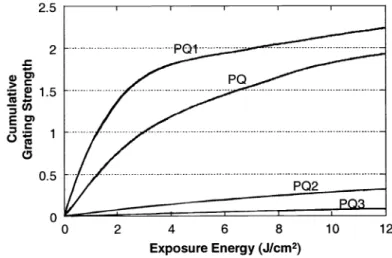
holograms, each with equal exposure energy (—4OmJ/cm2), have been recorded at a single location of the polymer samples. For PQ2 and PQ3 doped PMMA samples, one hundred plane wave holograms have been recorded. Each exposure uses the energy of 400mJ/cm2 and 800mJ/cm2, respectively. For all these cases, the diffraction efficiency of each hologram was measured, and then the square roots of the diffraction efficiencies were summed up to obtain a running curve of the cumulative grating strength (defined as C = N
is the total number of exposed
2.5
holograms) as a function of the cumulative
exposure energy. The running curves for
different polymer samples with the same
thickness of 1.0 mm are given in Figure 5. It can be seen that multiple holograms can be recorded well in all types of the samples. They have the similar recording behavior. After light
exposure, the color of all samples has been
changed from yellow to colorless. The running curves indicate the recording dynamics of our samples. According to Eq. (2), saturation value of the cumulative grating strength is equal tothe M/#. Thus, the M/#. Furthermore, the
characteristic response energy of our photopolymer samples can be estimated by curve fitting of the running curves in Fig. 5, as summarized in Table 1. It can be seen in the Table 1 that the PQ 1 doped PMMA samples has
the largest the M/# and the most sensitive
response. According to diffraction formula of avolume phase grating, this refractive index change of the photopolymer can be estimated to be 3.37 x i0. 0
0 2
4
6 8ExposureEnergy (J/cm2)
10 12
Figure 5 The running curves for different polymer samples.
t66I
'c66-66dd
'61i°A
'.flg,-T 1d0'upRd!1Inm
Diqdoijsud U!Sfl1JO1S
oqdiJojoq
ioj
poqiu
i,,
'snh1sdu
pu
d
v
'su.tn
9661'ç
V'd
M SUJ13P'
U 'Sflh1Sdatnsodx
inpis
ioj
uijdninw
swr,iOOq utJwiiodooqd
'saqij
'•u:1
[LI] 9661
'ggg9ggdd
'j
'•11-1dO
SWS/S
oiuu
znqdiiooq
ioj
ouiu
iuisis
y,,
'snjis
u
pui
'nn
j
'joj
Jouonwj
UIp1j
01 1oxo!U•mqj
'"°D
1°A'j
'69-g9dd
8961d/j
S
'P!"1
U
'SSH
D
'pUflJd N H'zjoqo
pui
ij
'UEJJ1 SUOt1DEaIOOq,, Jo SUOU!flO-O ql!M:suij1o
MN
[cIl
.100z'soi-:oi
dd'f61
"-"°3
dO
'SjJJtU
qim)jod
(jcioiqpm
jo
souuip
upJooai
jo
uosudwoj
'uiq
SOf iJflO'U1EWOO
'S!11Sd U3fl1j!H
'UV UN A 'flSHUf-Ij
'uq3
UozI
[vi]
.ooo
'cv-icv
dd'
''
IdO'JOS
p
orqdiojoq
UJfl1OA JOJjnq
A 'nsHp
j
'uiq
pu
w
z
'uq
jiqiui)i'jod
i
'uq
Hs
[i]
i'qiu)/od
(oipioiqu
oj
qdiu2ojoq
'JOiUTU
IdO'i'-I
'
dd £1-O1:1 'Z1 8661jo
'suh1sdj
pui
'noiz
'uu1uoIos
1'UE1DS
10
[zi]
6661 'SSJd:iim
'9LIT-cLTI '66 WQJd!f3Vd/O7J
't'
'1JO1SDdJOjOq
U! U!Ufl1PU!1J
JO1OJJ
'qA
d
U1
'A X [11] .100zqop
'i-ci
dd'(oflot'
'u:Ei
'siw/odooqd
utiomui
D!qdiJojoq uoiojp
uiunip
uuij
'nsH A Mpui
qLSHjj
[01] 6661jflf
£Z-81 'OpUOOJ'JAUU
'vL-99dd'jg
D0Jd1IdS
'A SUO!!jddVpui
'so!UdoJdio!dO
'SpJEW
:SO!AUtSD
p1113qH
AUD13JJJO1O UO UJfl!SOdIUiS I13UO1113UJ1UI ELIdS'iuijodoioqd
U!Sfl13JOS
13113oajd13iojo,,
'nsH Ai
[6] 9661 'LLOT -cLoudd'iz
'ni
ldO'siwijodoioqd
ui UOflI3UIJOJ UJ131 Zftjd13JOO,, 'SUDUf N1
U13 13110ZZ13!d S [8] v861'L6ZLZ
dd'z
H
'1U131d jl3fldO,, 8uipooai jo xpu!-Aflo13JJat suIfl13d Uipdop
/qu)-i4jod
(13iJo13qu
'swpj
iddy
'dO
[L] 1L61