國立交通大學
外國語文學系外國文學與語言學碩士班
碩士論文
無語法化之構式化:
論臺灣國語中「用」之新功能的形式與語意重組
Constructionalization without Grammaticalization:
The Form-meaning Reassociation in the Novel Use of YONG in
Taiwan Mandarin
研究生:徐睿良
指導教授:劉美君 教授
無語法化之構式化:
論臺灣國語中「用」之新功能的形式與語意重組
Constructionalization without Grammaticalization:
The Form-meaning Reassociation in the Novel Use of YONG in Taiwan Mandarin
研究生:徐睿良 Student: Rui-Liang Xu 指導教授:劉美君 Advisor: Mei-Chun Liu
國立交通大學
外國語文學系外國文學與語言學碩士班 碩士論文
A Thesis
Submitted to Department of Foreign Languages and Literatures College of Humanity and Social Science
National Chiao Tung University for the Degree of Master of Arts
July 2013
Hsinchu, Taiwan, Republic of China
無語法化之構式化:
論臺灣國語中「用」之新功能的形式與語意重組
研究生:徐睿良 指導教授:劉美君 國立交通大學外國語文學系外國文學與語言學碩士班摘 要
本文旨在藉由臺灣國語中「用」一詞的新功能之詞彙語意研究,探討其生成之緣起 與機制。近年來,臺灣國語中之「用」一詞出現二種新功能:代動詞與指事動詞,此二 新功能係源自臺灣閩南語移入,並已廣泛使用於國語非正式、口語語境中。代動詞「用」 之功能係取代語篇中已經前述之先行動詞詞組,以免同一動詞詞組於語篇中重複贅述。 指事動詞「用」之功能則為概略指稱以某種特定方式發生的事件類型,而非如同一般動 詞具體描述實際發生之事件。「用」的此二種功能雖然語法表現不同,語意卻非常相似, 因此,本文試圖藉由「構式語法」、「框架語意」及「屬性結構」等多項互補相成之理論 框架,系統性地解釋並呈現「用」之詞彙語意特徵。 國語中「用」之新功能的生成與語言接觸誘發之語言變遷息息相關。由於此一現象 涉及跨語言之對應詞項的功能整合,在此過程中,國語中舊有詞項「用」之語音形式被 賦予來自閩南語的新語意功能,進而產生「用」在國語中的新功能,因此,此一演化過 程或可視為「詞彙重整」機制。同時,此一演化過程係藉由重組舊有詞項之形式與語意 搭配關係以產生新構式,且並未涉及目標語國語中之內部語法化機制,由是,以歷時性 構式語法觀點而言,此一演化過程應屬「無語法化之構式化」機制之流變,亦即,此一 過程非如過往文獻所定義之「語言接觸誘發語法化」,而係經語言接觸所致之構式化。 本文最終希冀經由此一個案研究,能突顯台灣地區語言的特色與新興的變化,探究 生活中真實的語言使用狀況,使語言學研究貼近自然語料。在理論上則以構式語法作為 整合性的理論框架,連繫動詞詞彙語意與語法變遷之間互動關聯,使跨此二領域之研究 能依據同一理論背景解釋並呈現。 關鍵詞: 構式化、詞彙重整、語言接觸誘發語法化、框設動詞、指事動詞、代動詞、詞 彙語意、構式語法、框架語意、屬性結構、臺灣國語、臺灣閩南語Constructionalization without Grammaticalization:
The Form-meaning Reassociation in the Novel Use of YONG in Taiwan
Mandarin
Student: Rui-Liang Xu Advisor: Mei-Chun Liu
Graduate Institute of Foreign Literatures and Linguistics National Chiao Tung University
ABSTRACT
With an elaboration of its grammatical function and semantic properties, this thesis aims to explore the mechanisms by which the novel use of YONG came into being in Taiwan Mandarin. In recent years, the novel use of YONG as either an anaphoric pro-verb or a process-referring verb had got transferred from Taiwan Southern Min to Taiwan Mandarin and has been widely used in informal or colloquial registers. When being used as s a pro-verb,
YONG substitutes a forementioned antecedent VP to avoid redundant repetition in discourse.
When being used as a process-referring verb, YONG sketchily denotes a process fulfilled in certain manner rather than specifies the actual event undertaken as other ordinary verbs do. Though these two functions of YONG are syntactically different, they share plenty of semantic similarities. To deal with their lexical semantics, the multiple complementary approaches combining Construction Grammar, Frame Semantics and Qualia Structure are adopted. Thus, verbal semantics of these novel uses of YONG can be accounted for and presented effectively in a systematic way.
The core issue of this thesis concerns the contact-induced language change involved in the emergence of the novel use of YONG. In terms of grammatical convergence, the interlingual identification of YONG with a new form-meaning pairing can be viewed as a process of relexification (Lefebvre, 2009), since it is essentially a kind of “relabelling” of an existing form with a new meaning of a lexical item from another language. From the perspective of diachronic construction grammar (Bergs and Diewald, 2008; Traugott, 2011), the emergence of the novel function of YONG in Taiwan Mandarin demonstrates a process of construcionalization without grammaticalization, since it is the creation of a new construction by re-association of the existing form-meaning pairing, but without the internal grammaticalization in the target language, Taiwan Mandarin. In other words, the novel
functions of YONG do not resulted from contact-induced grammaticalization, as defined in the literature (Heine and Kuteva, 2003), but presents a case of constructionalization due to language contact.
Finally, by providing the case study on the emergence of the novel use of YONG in Taiwan Mandarin, this thesis reveals characteristics and the on-going novel change of Taiwan languages. Only by probing into the actual language use in the real daily life, linguistic studies will factually reflect natural language. Theoretically, this thesis attempts to link researches of verbal lexical semantics and grammatical change with an integrated theoretical framework, namely, the constructional approach. Consequently, a unified explanation to the interrelation between these two linguistic areas can be established.
Key words: constructionalization, relexification, contact-induced grammaticalization, frame-setting verb, process-referring verb, pro-verb, lexical semantics, Construction Grammar, Frame Semantics, Qualia Structure, Taiwan Mandarin, Taiwan Southern Min
謝 誌
匆匆之間,四載只在流光轉瞬,而今論文既成,畢業在即,回顧過往,學業苟有所 成,實乃得惠於各方諸君,在此謹致忱謝,以表感恩。 首先,感謝恩師劉美君教授,先生堪稱學術研究、為人處事之典範,受業期間,先 生引導學習、訓練思辨能力,平日又多所關照門生,提攜之恩永難忘懷,所謂大恩無以 言謝,言語難盡,莫過如是。其次,感謝口試委員連金發教授與鄭縈教授為本篇論文批 評指引,提供諸多寶貴意見,令論文增色,受益良多,能獲二位先生提點指教,實屬莫 大榮幸。再者,感謝交大外文所許慧娟、劉辰生、賴郁雯教授等諸位師長,以及師大華 教所蕭惠貞教授,傳授教誨語言學知識,啟蒙基礎研究能力,受用無窮。 交大四年,幸有良師,更得益友,能以切磋琢磨,長進學業。在此首要感謝 VerbNet 團隊研究伙伴,與大家合作共事,同心協力為目標而努力的革命情誼彌足珍貴,無論治 學研討,或者出遊同樂,相聚時光總令人懷念。團隊之中,特別感謝佳音學姊,在團隊 研究事務以及個人論文寫作等諸多方面為我指點迷津,親切和善且條理清明,每能從旁 點破困惑迷惘,令人豁然開朗,學姊亦師亦友,有幸結識學姊,可謂良師益友兼得。其 次,同窗三載,感謝碩班同學晉廷時時砥礪,相互討論學習,修業並進,是我碩班生涯 之中最難能可貴之諍友。此外,感謝摯友達維、佩蓉、仕達等人,在研究生涯中相互關 懷勉勵,共度歡樂與失意。 最後,感謝父母雙親手足和家族親戚的全力支持與包容,使我求學期間得無後顧之 憂,免於勞頓,尤其特別感謝姨母李華芸女士提供居所,多方照顧,使生活無虞,特此 忱謝。 碩班生涯中,儘管苦樂交織,憂歡起伏,幸得親善敬愛之諸君襄助,終能順利完成 學業,求學期間受惠多方,凡若以上列舉,不及一一備載,恐有疏漏。然則,受恩不忘, 銘感在心,本人在此謹致至忱之謝意與祝福,報以諸方,姑以微薄聊表無盡感恩。 求學生涯將告段落,人生新途伊始,滿載各方的期許與祝福,在未來的人生旅途, 我深自期許,能毋忝所得,不負所學,莫忘初衷。 一○二 夏 記於竹湖Table of Contents
Chinese Abstract ... i English Abstract ... ii Acknowledgement ... iv Table of Contents ... v List of Tables ... vi List of Figures ... viList of Abbreviations ... vii
Chapter 1 Introduction ... 1
1.1 The Issue ... 1
1.2 Scope and Goal ... 6
1.3 Theoretical Framework... 7
1.3.1 Construction Grammar ... 7
1.3.2 Frame Semantics ... 9
1.3.3 Qualia Structure ... 10
1.4 Database... 12
1.5 Organization of the Thesis ... 13
Chapter 2 Literature Review ... 14
2.1 English Pro-verb Do ... 14
2.2 Mandarin Verbs of Doing ... 17
2.3 Mandarin Frame-setting/evoking Verbs ... 18
2.4 Summary ... 22
Chapter 3 Lexical Semantics of PR-V YONG in TM ... 23
3.1 Findings ... 24
3.2 The Frame-based Analysis ... 34
3.3 The Construction-based Analysis ... 36
3.4 The Qualia Structure Analysis ... 39
4.5 Summary ... 43
Chapter 4 Lexical Semantics of Pro-V YONG in TM ... 44
4.1 Findings ... 44
4.2 Analysis ... 50
Chapter 5 Constructionalization of the Novel Use of YONG in TM ... 55
5.1 PR-V and pro-V YONG in Taiwan Southern Min ... 55
5.2 Contact-induced Grammaticalization ... 63
5.3 Relexification ... 66
5.4 Constructionalization ... 69
5.5 YONG and NONG as near synonyms ... 72
5.6 Summary ... 73 Chapter 6 Conclusion ... 74 6.1 Conclusion ... 74 6.2 Further Research ... 76 References ... 78 Website Resources ... 81
List of Tables
Tab. 1 Functions of YONG in Sinica Corpus ... 2Tab. 2 Realization of transitivity parameters KINESIS and AFFECTEDNESS of O in grammar and discourse (adapted from Hopper and Thompson, 1980) ... 37
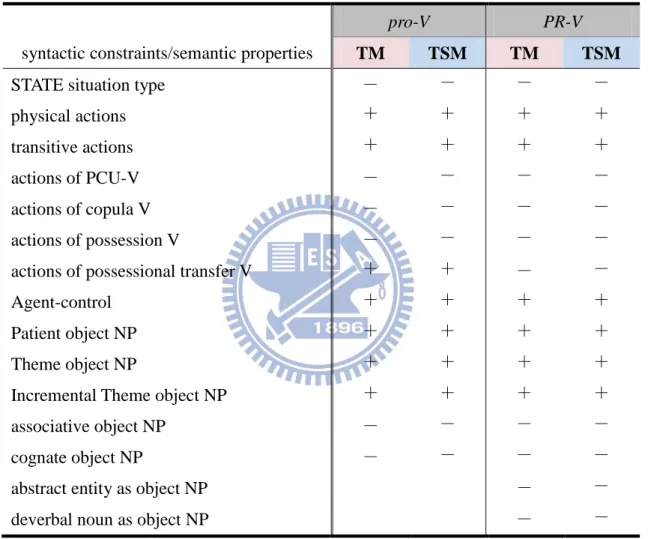
Tab. 3 syntactic constraints and semantic properties of the pro-V and PR-V YONG in TM and TSM ... 62
Tab. 4 Haitian words resulting from relexification of French form with Fongbe meaning .. 68
List of Figures
Fig. 1 Model of the symbolic structure of a construction in Radical Construction Grammar (Croft, 2001)... 8Fig. 2 The Image Schema of PR-V YONG ... 35
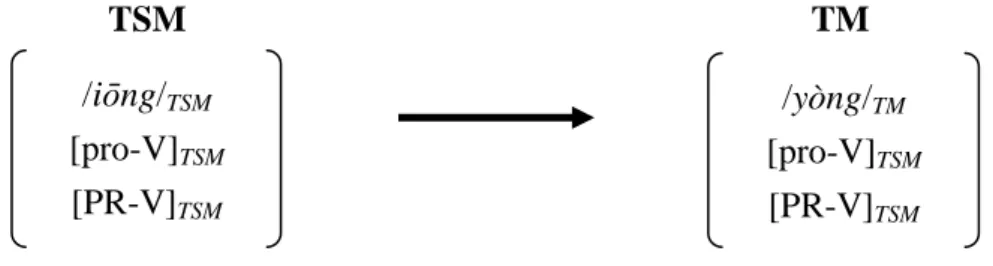
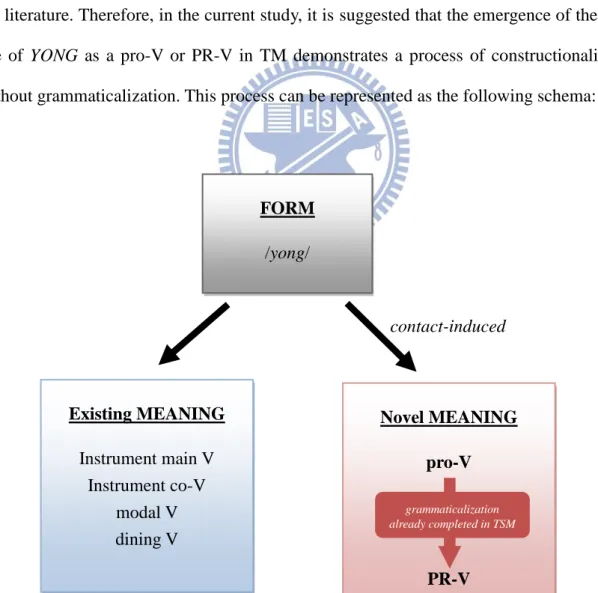
Fig. 3 Image schema of Relexification of pro-V and PR-V YONG from TSM to TM ... 69 Fig. 4 Schema of Constructionalization of the Novel Uses of YONG in Taiwan Mandarin . 71
List of Abbreviations
Abbreviation Marker Lemma
Caus. causative marker 令、讓、使、教
CEM consequent-event marker 就
CL classifier e.g. 個、鍋、件、本
DE DE complement 得
Disp. disposal marker 把
EPF experiential perfective aspectual marker 過
PAS passive marker 被
PF perfective aspectual marker 了、矣(TSM)
Purp. purposive marker 來/去
QM question marker 呢、嗎
RM realis marker 有
RP relational particle 的
PRG progressive aspectual marker 在
SI stative imperfective 著
Chapter 1
Introduction
Introduction
Verbal lexical semantics and diachronic syntactic changes have been two widely well-studied categories in Chinese linguistics. However, the interrelation between the two spheres has not been fully discussed. An integrated approach based on a unified theoretical framework is still needed to account for issues simultaneously involving the two spheres. So far, this need has not been perfectly satisfied yet. As Liu (2005) has noted, most lexical semanticists share a common assumption that the syntactic behavior of a verb, especially its argument expression, is determined by the meaning of the verb (cf. Levin, 1993; Pustejovsky, 1995. etc.). Based on this assumption, if a verb’s meaning changes, its syntactic behavior would change as well. By providing the case study of the emerging novel usage of YONG in Taiwan Mandarin, this study attempts to link verbal lexical semantics and syntactic change with an integrated theoretical framework, and thus achieve a unified explanation to the interrelation between these two linguistic areas.
1.1 The Issue
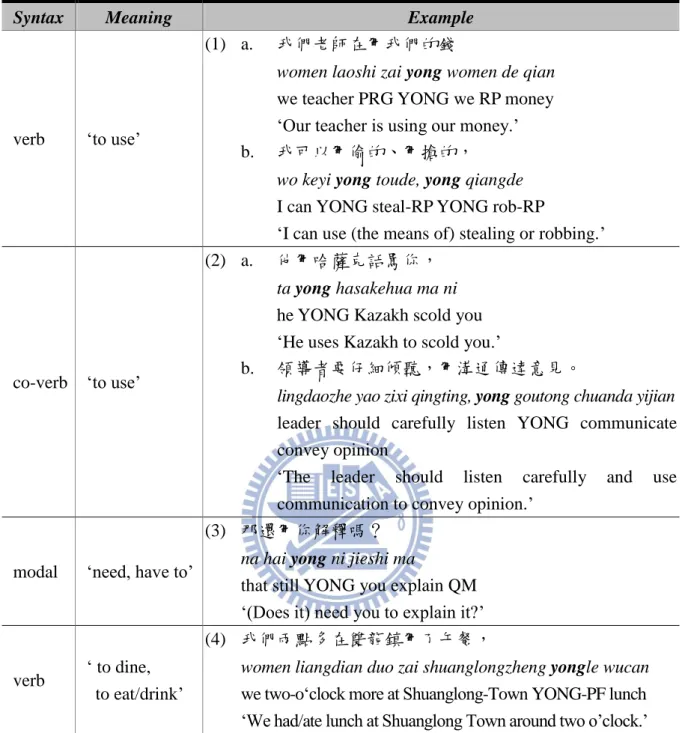
As a multi-function verb, 用 YONG is commonly used in Mandarin Chinese. In Sinica Corpus1, there exist various usages of YONG. YONG is prototypically used as a verb or a co-verb with the meaning ‘to use’. Based on this prototypical sense, it can be semantically extended to the use as a verb meaning ‘to dine/eat/drink’, or as a modal verb meaning ‘need/have to’. Examples are given in the following table:
1
Academia Sinica Balanced Corpus of Modern Chinese (Sinica Corpus) is developed by the CKIP group in Academia Sinica, Taiwan. It contains a total of 5 million words collected from 1981 to 1997. Among these 5
Syntax Meaning Example
verb ‘to use’
(1) a. 我們老師在用我們的錢
women laoshi zai yong women de qian
we teacher PRG YONG we RP money ‘Our teacher is using our money.’
b. 我可以用偷的、用搶的,
wo keyi yong toude, yong qiangde
I can YONG steal-RP YONG rob-RP
‘I can use (the means of) stealing or robbing.’
co-verb ‘to use’
(2) a. 他用哈薩克話罵你,
ta yong hasakehua ma ni
he YONG Kazakh scold you ‘He uses Kazakh to scold you.’
b. 領導者要仔細傾聽,用溝通傳達意見。
lingdaozhe yao zixi qingting, yong goutong chuanda yijian
leader should carefully listen YONG communicate convey opinion
‘The leader should listen carefully and use communication to convey opinion.’
modal ‘need, have to’
(3) 那還用你解釋嗎?
na hai yong ni jieshi ma
that still YONG you explain QM ‘(Does it) need you to explain it?’
verb ‘ to dine, to eat/drink’
(4) 我們兩點多在雙龍鎮用了午餐,
women liangdian duo zai shuanglongzheng yongle wucan
we two-o‘clock more at Shuanglong-Town YONG-PF lunch ‘We had/ate lunch at Shuanglong Town around two o’clock.’ Tab. 1 Functions of YONG in Sinica Corpus
The usage of YONG in (1) is viewed as a verb in Chao (1968) and in Li and Thompson (1981). It functions as an ordinary main verb taking an Instrument NP (我們的錢 women
de qian ‘our money’ in (1a)) or a Means VP (偷/搶 tou/qiang ‘steal/rob’ in (1b)) as its
object. In (2), YONG co-occurs with the main verb (罵 ma ‘to scold’ in (2a) and 傳達
chuanda ‘to convey’ in (2b)) and introduces the Instrument ( 哈薩克話 hasakehua
event coded by the main verb. This usage of YONG, with its preposition-like function in the [S + YONG + NP1 + V (+ NP2)] construction, is thus considered as a “co-verb” by Chao (1968), Yip and Don (2004), and Kwan (2011)2. In (3), YONG is used as a modal auxiliary meaning ‘need/have to’. It takes an object NP (你 ni ‘you’) as its complement. In (4),
YONG functions as a verb meaning ‘to dine/eat/drink’. It takes an object NP (e.g. 午餐
wucan ‘lunch’ in (4)) of the sense ‘meal/food/drink’ as its complement.
Recently, unlike those functions listed above, a special use of YONG has emerged in Taiwan Mandarin. Examples are provided in the following:
(5) a. 我實在很懶得洗碗,就叫我老公去用。 [Google, 2012/8/11]
wo shizai hen lan de xi wan, jiu jiao wo laogong qu yong
I really very lazy DE wash dish, CEM Caus. I husband Purp. YONG ‘I was too lazy to wash dishes. I asked my husband to do it.’
b. A:你可以幫我洗碗嗎? A: ni keyi bang wo xi wan ma A: you can help I wash dish QM
‘Can you wash the dishes for me?’
B:好,我來用。 B: hao, wo lai yong B: okay, I Purp. YONG
‘OK, I’ll do it/wash the dishes.
As in (5), the verb YONG can be used to substitute the previously-mentioned verb phrase xi wan ‘wash dishes’, functioning as a pro-form of this VP. Moreover, in some other cases, YONG can even be used independently without any “replaced verb” mentioned in the context, as in the following:
2
Li and Thompson (1974) suggested that verbs and co-verbs are two distinct categories and co-verbs are essentially prepositions. Rather than being viewed as a co-verb sentence, a sentence like (2) is considered as a serial verb construction by Li and Thompson (1974). YONG in (2) is thus regarded as an ordinary verb, not a co-verb, since it functions as the first verb in a serial verb construction rather than as a preposition taking a NP. However, as Kwan (2011) had noted that Chinese co-verbs do not form a homogeneous category and some co-verbs are more verbal (e.g. 在 zai, 幫 bang, 用 yong) while others are more prepositional (e.g. 從 cong, 沿 yan, 替 ti). That is, Chinese co-verbs have their intermediate categorical status between verbs and prepositions. Taking its dual categorical status into consideration, the usage of YONG in (2) therefore will be
(6) a. 喂我肚子餓了,幫我用早餐 [Google, 2012/10/2]
wei wo duzi ele bang wo yong zaocan
hey I stomach hungry-PF help I YONG breakfast ‘Hey! I am hungry. Prepare/cook breakfast for me!’
b. 最近很忙…一回家就要忙著用報告 [Google, 2012/12/24]
zuijin hen mang … yi hui jia jiu yao mangzhe yong baogao
recently very busy…once come-back home CEM should busy-SI YONG paper ‘I am very busy recently. Once I reached home, I have to continue to write my paper busily.’
c. 醫生一直用針去用我的韌帶, [Yam Blog, 2012/11/17]
yisheng yizhi yong zhen qu yong wo de rendai
doctor always use needle Purp. YONG I RP ligament ‘The doctor keeps using the needle to probe my ligament’
In (6), there is no any “replaced verb” in the context for YONG to refer to. YONG here does not indicate the actual specific event undertaken. The reading ‘prepare/cook’ in (6a), ‘writing’ in (6b) and ‘probe’ in (6c) of YONG can only be obtained via pragmatic inference or other contextual information. Noteworthily, in (6c), the second YONG is distinct from the first YONG. The first YONG is a co-verb meaning ‘to use’ and takes an Instrument NP 針
zhen ‘needle’ as its object while the second YONG is the novel use of YONG which depicts
the doctor’s action of probing the speaker’s ligament.
Compared with the existing uses of YONG, as listed in Tab. 1, it can be figured out that this special emerging use of YONG may be similar to or different from the existing uses in terms of their shared or distinct syntactic and semantic properties. Take the Instrument/Means verb and co-verb YONG for example, they are syntactically similar to the emerging use of YONG since they all can be used in VO structure, as shown in (1), (2) and (6). However, they are semantically different in that Instrument/Means verb and co-verb
use of YONG is underspecified. As to the modal auxiliary YONG, it is syntactically similar to the emerging use of YONG in the sense that they both serve for somewhat more grammatical, auxiliary-like function. Namely, the emerging YONG can be used for anaphoric function, as in (5), while the modal YONG is essentially an auxiliary. Nevertheless, they differ in their respective meanings. The modal YONG has the meaning ‘need/have to’, and the emergin YONG has an unspecified, contextually dependent meaning. Furthermore, they may also share same surface form but with their different semantics respectively. Consider the following potential ambiguous interpretation of the pattern 不用 了 buyongle:
(7) A:你今天要剪頭髮嗎? A: ni jintian yao jian toufa ma A: you today want cut hair QM
‘Do you want to have your hair cut today?’
B:不用了。 B: buyongle B: not YONG-PF
a. ‘I do not want to do it/have my hair cut’ b. ‘I do not need/have to have my hair cut.’
In (7), the pattern 不用了 buyongle may have two different interpretation (a) and (b). In (7a), YONG is interpreted as ‘do it’, or more precisely, ‘have my hair cut’. In other words, it is similar to the function of the emerging YONG in (5) since it substitutes and refers back to the forementioned VP 剪頭髮 jian toufa ‘have one’s hair cut’. In (7b), YONG functions as a modal auxiliary meaning ‘need/have to’. Since both the two readings (a) and (b) are possible for the same pattern 不用了 buyongle, the ambiguity thus arises. Finally, the emerging YONG is similar to the dining YONG in that they both share the pattern 用餐
yong can, as shown in (4) and (6). However, they are semantically different in their
respective meanings. In (4), YONG has the meaning ‘to dine/eat/drink’ while in (6), it has the contextual interpretation ‘to cook’. The only similarity in their semantics is that they do not have the prototypical sense of YONG, namely, the meaning ‘to use’.
From the observation above, it can be figured out that though these existing usages of
YONG may share some syntactic or semantic similarities with the emerging use of YONG,
they do not perfectly match in all respects with the emerging YONG. In other words, this emerging use of YONG, as shown in (5-6), is a wholly novel use of YONG due to the fact that it is not completely identical to the existing functions of YONG in all respects of its form and meaning. Furthermore, this novel usage of YONG has not been discussed in literatures. It is also not found in earlier-built corpora such as Sinica Corpus. Nevertheless, it is commonly used in Taiwan Mandarin nowadays, mostly in colloquial registers. It can be widely found in daily conversations and informal writings such as internet forums and personal blogs. Then, a number of questions arise: what is unique about this special usage of
YONG? What are its grammatical function and lexical semantics? Why and how does this
YONG come into being in Taiwan Mandarin? Is this novel usage a result of grammatical
change? If it is, what kind of change it may be?
1.2 Scope and Goal
To adequately answer the questions raised above, the scope of this thesis will be focused on the novel usage of YONG in Taiwan Mandarin. In other words, the two novel functions of YONG illustrated in examples (5-6) will be discussed in the current study. The first is the function of YONG which is used to substitute a forementioned VP in the previous context, as in (5). The second is the function of YONG which predicates the process done in a certain manner, rather than indicate the actual specific action or event done in a sentence, as in (6). The goal of this thesis is to answer the questions raised in the end of the previous section. That is, with an elaboration of its unique grammatical function and semantic properties, this study aims to explore the mechanism by which this novel use of YONG came into being in Taiwan Mandarin.
1.3 Theoretical Framework
To tackle the first research question: what is unique about the novel usage of YONG in terms of its grammatical function and semantic properties? three theoretical frameworks are adopted in the current study: Construction Grammar, Frame Semantics and Qualia Structure. Construction Grammar is used to define the form-meaning pairing of YONG and its associated pattern in which YONG is used. Frame Semantics is utilized to describe the semantics of YONG with the representation of the possible scenario in which various activities denoted by YONG take place. Qualia Structure is exploited to account for and differentiate the potential ambiguity of YONG in context by semantic coercion from the complement of YONG. To deal with the second research question (i.e. why, how and by what mechanism does this YONG come into being in Taiwan Mandarin?), constructional approach is also used to account for the emergence of the novel use of YONG in Taiwan Mandarin. By adopting constructional approach, the lexical semantics of YONG and its related grammatical change can thus be explained with a unified theoretical framework.
1.3.1 Construction Grammar
According to Goldberg (1995), the definition of a construction is that “C is a CONSTRUCTION iffdef C is a form-meaning pair <Fi, Si> such that some aspect of Fi or some aspect of Si is not strictly predictable from C’s component parts or from other previously established constructions.” In other words, constructions are defined as form-meaning pairings which serve as the basic units of language. Namely, a construction functions in the same way as a lexical item functions in language. Like lexical items, one construction thus has its own meaning and can endow a particular interpretation for its component parts. The English Ditransitive (double-object) Construction would be a
significant example (Goldberg, 1995): the form of the construction is [Subj V Obj1 Obj2], and the meaning of the construction is [X CAUSE Y to RECEIVE Z] (intended or actual transfer). For instance, the word “bake” is not essentially a verb coding actions of transfer. Nevertheless, in a sentence like “She baked him a cake”, the Ditransitive Construction would coerce its meaning on the verb “bake”. “Bake” here thus obtains the transfer sense from the Ditransitive Construction.
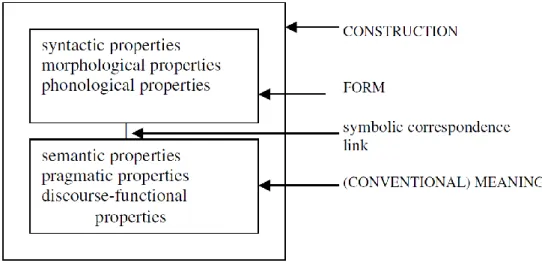
Taking a similar viewpoint, in Radical Construction Grammar, Croft (2001) defined constructions as “pairings of form and meaning that are at least partially arbitrary”. Constructions are thus symbolic units conceived as the model in the following:
Fig. 1 Model of the symbolic structure of a construction in Radical Construction Grammar (Croft, 2001)
For this reason, a construction can be a language unit of any size from individual words to larger phrasal pattern or even a sentence. Following this perspective, the lexical item YONG itself is definitely a form-meaning pairing and thus should be viewed as a construction. On the other hand, as shown in (6), the actual event in the [YONG + NP] pattern (e.g. 用早餐
yong zaocan ‘to prepare/cook breakfast’) is underspecified and the meaning of this pattern
is not strictly predictable from its internal components. Due to its opaque semantic interpretation, this pattern surely could be regarded as a construction. Besides, as shown in
(6), YONG may have various meanings like ‘to cook’, ‘to write’ and ‘to probe’. However, it is cognitively uneconomical to list all these meanings as polysemous senses of YONG because it would neglect the creative use of YONG in context and because “an elaborate construction should be able to economically predicate the coerced interpretation without burdening to list extra senses or rules in the lexicon” (Chang, 2005). The seemingly irrelevant contextual interpretations of YONG (i.e. ‘to cook’, ‘to write’ and ‘to probe’ in (6)) may share some semantic properties endowed by the [YONG + NP] pattern. Accordingly, the constructional approach is adequate to be exploited here to account for the meaning encoded in the novel use of YONG in its related patterns. In sum, Construction Grammar is used to define the form-meaning pairing of the novel use of YONG and its associated pattern in the current study.
Further more, since the emergence of this novel use of YONG in Taiwan Mandarin is essentially a grammatical change involving re-association of an existing form with a new meaning, the construction-based approach thus would be adequate to study the development of this novel YONG in Taiwan Mandarin.
1.3.2 Frame Semantics
Fillmore and Atkins (1992) have proposed that verbal semantics can only be acquired in reference to the associated semantic frame. A “semantic frame” is defined as “a structure background of experiences, beliefs or practices, constituting a kind of conceptual prerequisite for understanding the meaning” by Fillmore and Atkins (1992). In other words, a “semantic frame” is the conceptual structure, or more precisely, the image schema, which supports and motivates a word’s meaning. For instance, the “commercial transaction” frame contains four core participants (i.e. frame elements) involved in a commercial transaction event: BUYER, SELLER, MONEY and GOODS. The lexical semantics of a verb belonging
to this frame (e.g. buy, sell, spend and pay etc.) is thus characterized by virtue of its profiled frame elements.
Similar to the novel use of YONG in the current study, Liu (2005) has noted that a group of Mandarin verbs only “denote a manner, rather than naming a specific activity”. These verbs are “used to ‘set a frame’ for various activities to take place”. However, Liu (2005) also noted that these “frame-setting” verbs are unique in that “the frame is lexically inferred rather than syntactically realized with an array of arguments (‘frame elements’)”. She takes 趕 GAN for example, the semantic frame set by GAN may be spelled out with its four properties: Presupposition, Manner, Telicity and Agent-control. Since YONG and GAN share similar “frame-setting” functions, Frame Semantics surely could be adequately utilized to probe into its lexical semantics in the similar fashion. Therefore, in the current study, the frame-based approach will be exploited to depict the verbal semantics of the novel use of YONG.
1.3.3 Qualia Structure
According to Pustejovsky (1995), Qualia Structure specifies four essential dimensions of the meaning of a word:
CONSTITUTIVE: the relation between an object and its constituents, or proper parts. FORMAL: factors which distinguish the object within a larger domain.
TELIC: purpose and function of the object.
AGENTIVE: factors involved in the origin or “bring about” of an object.
As Pustejovsky (1995) has clarified, Qualia Structure not only characterizes our knowledge of words, but also suggests interpretations of words in context. Take the English verb “enjoy” for example:
(8) a. Mary enjoyed the movie last night. (watching) b. John quite enjoys his morning coffee. (drinking)
The different contextual meanings of “enjoy” are rendered from information of the complement. More specifically, it is the Telic role of “movie” and “coffee” that project the activities of “watching the movie” and “drinking coffee” respectively to the interpretation of the VP. In other words, “Qualia Structure provides a compositional means for meaning coercion based on characterizations of the four different roles: Constitutive, Formal, Telic, and Agentive.” (Liu, 2005).
Further more, another advantage of Qualia Structure is that it can solve the potential ambiguity in the interpretation of the predication in a sentence. For example, as illustrated in Pustejovsky (1991), the English sentence “John began a novel.” may have two possible readings:
(9) a. John began to read a novel. b. John began to write a novel.
The two distinct interpretations can be viewed as deriving from two distinct roles of the NP complement. More specifically, the Telic role [Telic = read] and the Agentive role [Agentive = write] of “novel” project the two interpretations ‘read’ and ‘write’ to (9a) and (9b) respectively.
As illustrated previously, the novel use of YONG does not specify the actual event undertaken. Instead, it only denotes the manner by which the activity is fulfilled. The crucial information about the “ellipsed” event is supplied by YONG’s complement object NP. Therefore, the application of Qualia Structure would be profitable to explain how contextual meanings of the predication in the associated pattern of YONG can be obtained
by semantic coercion of the complement’s pre-defined Qualia role. As a result, how the various contextual interpretation of YONG in (6) as ‘to cook’, ‘to write’ and ‘to probe’ in the [YONG + NP] construction are obtained can be efficiently accounted for via Qualia Structure. Thus, in this vein, by incorporating Construction Grammar and Qualia Structure, the potential semantic ambiguity of YONG in the same context can be differentiated and accounted for in a systematic way.
1.4 Database
An initial observation shows that the novel use of YONG is mainly used in informal registers, especially in casual speech or informal writing. This novel use of YONG is not found in the Sinica Corpus since it contains limited data from informal or colloquial registers and most of the data collection are from an earlier period (1981-1997) in which this special use of YONG had not been widely used in Taiwan Mandarin yet. In order to obtain more data from informal registers, internet resources such as personal blogs (e.g. Wretch Blog, Yahoo Blog), on-line search engines (Google Search) and the Bulletin Board System sites (PTT) are utilized as databases for analysis. Data from these internet resources are collected during the period from September 2011 to June 2013. Besides, since spoken data are usually disfluent due to factors like speech error, stutter, repetition, interruption and so on, made-up examples based on the author’s competence as a native speaker of Taiwan Mandarin is used for descriptive convenience. Since ungrammatical sentences cannot be found, made-up examples are also used for syntactic tests. Five native speakers of Taiwan Mandarin, aged from 19 to 29, who often use this special use of YONG are consulted for these made-up examples.
1.5 Organization of the Thesis
This thesis is organized in the following sequence. Chapter one is the introduction of the background information, elucidating the issue, scope and goal, database and theoretical frameworks of this thesis. Chapter two is the literature review. Chapter three and four explores the lexical semantics of the novel use of YONG in Taiwan Mandarin with elaboration of the findings in the data. In these chapters, Frame Semantics, Construction Grammar and Qualia Structure theories are adopted for the analysis. With the constructional approach, chapter five investigates the probable source, development, as well as the potential mechanisms by which the novel use of YONG came into being in Taiwan Mandarin. Lastly, chapter six is the conclusion, summarizing the findings and the theoretical analysis of the current study. In this chapter, the theoretical implication, the significance of this thesis and the possible direction for further researches are proposed as well.
Chapter 2
Literature Review
Literature Review
This chapter reviews previous researches on topics relevant to the novel use of YONG concerned in the current study. These topics are discussed from various theoretical perspectives in terms of their associated linguistic phenomena. Literatures in topics on English pro-verb do, Mandarin verbs of doing, and Mandarin frame-setting verbs, will be briefly reviewed in the following sections.
2.1 English Pro-verb Do
The novel usage of YONG in Taiwan Mandarin is reminiscent of a significant case: the English pro-verb do. Do is termed as “pro-verb” in virtue of its two particular functions: verbal anaphora (cf. Spears, 1991; Trask, 1993; Biber et al, 1999; Matthews, 2007; Crystal, 2008; Richards and Schmidt, 2010 etc.) and process referring (cf. Halliday, 1977; Biber et al, 1999).
In terms of its verbal anaphora function, do is termed as “pro-verb” due to the fact that it can be used to substitute a forementioned antecedent verb phrase in context. It functions as a VP pro-form to avoid redundant repetition of an identical VP expression in discourse. Briefly, do is termed as “pro-verb” for its substitution use. For instance, Spears (1991) defined a “pro-verb” as “a verbal construction using some form of the verb do to stand for a full verb phrase”. Biber (1999) further indicates that “In one common pattern, do combines with a following pronoun it or this/that to form a transitive pro-verb construction”. The following examples illustrate the verbal anaphora function of “pro-verb” do:
b. I asked Lisa to proofread the typescript, and she did so/did it. [Trask, 1993] c. Angela spills her coffee every morning. John does that too. [Spears, 1991]
In (1a), the verb do substitutes the forementioned VP like films. In (1b-c), do further combines with so, it and that, forming the phrases do so, do it and do that, to substitute the forementioned VP proofread the typescript in (1b) and spills her coffee every morning in (1c) respectively. Noteworthily, a “pro-verb” do substitutes for a full VP rather than for a single verb in the preceding context, as illustrated in the following example:
(2) A: Can you buy the book for me?
B: OK, I’ll do (it)/*I’ll do the book for you.
As shown in the examples above, it is the full VP buy the book for me that is substituted, not the single verb buy. Therefore, some linguists such as Trask (1993) suggested that the term “pro-VP” would be more recommended for this verbal anaphora function.
The Taiwan Mandarin YONG has such verbal anaphora function parallel to the English
do as well, as illustrated in the following:
(3) 我實在很懶得洗碗,就叫我老公去用。 [Google, 2012/8/11]
wo shizai hen lan de xi wan, jiu jiao wo laogong qu yong
I really very lazy DE wash dish, CEM Caus. I husband Purp. YONG ‘I was too lazy to wash dishes, so I asked my husband to do it.’
(4) A:你可以幫我買書嗎? A: ni keyi bang wo mai shu ma A: you can help I buy book QM
‘Can you buy the book for me?’
B1:好,我來用/*我來用書。
B1: hao, wo lai yong/*wo lai yong shu B1: okay, I Purp. YONG/I Purp. YONG book
As shown above, YONG replaces the forementioned VP 洗碗 xi wan ‘wash dishes’ and 買 書 mai shu ‘buy a book’. Similar to the case of do, in (4) YONG substitutes for the full VP
mai shu ‘buy a book’, rather than for the single verb 買 mai ‘buy’. In sum, the examples
above show that YONG and do are similar in terms of their verbal anaphora function.
In addition to the verbal anaphora function, do is also termed as “pro-verb” in virtue of its another significant function: process referring. When do is used for process-referring function, it does not specify the actual event or action fulfilled in the clause. Instead, do here express “any unidentified or unspecified process” (Halliday and Hasan, 1977). Namely, it serves for the function of “conveying a broad and undifferentiated meaning” (Quirk et al., 1985). Besides, since do here is not used for verbal anaphora, there is no “replaced verb” in the context. That is, do here “substitutes for a series of actions or events, rather than referring to a specific preceding verb” (Biber et al, 1999). The occurrence of do “does not necessarily involve an anaphoric or cataphoric reference” (Halliday and Hasan, 1977). Consider the following example from Biber et al (1999):
(5) A: Even Miss <teacher’s name> hates him. – Now, well you see, she o~, we was having this discussion about education and she goes Are you cynical about education Terry? He goes no. She goes oh! She goes why? And he goes I don’t know what cynical means.
B: <laughs>
A: I was saying ah no. And everyone in the class just cracked up. – Sometimes you woth—er whe— you wonder whether he does it on purpose. – He must do it on purpose, no one could be that thick.
Biber et al (1999) clarified that “In this conversation, the pro-verb expressions does it and
do it refer to Terry’s actions and speech, rather than substituting for a specific preceding
Similarly, YONG has such process-referring function parallel to do as well. As shown in the following example, YONG here does not substitute a specific verb in context. Instead, it expresses an unspecified event in the sentence. The intended reading ‘to cook’ is obtained via contextual inference.
(6) 我今天就用了一鍋咖哩 準備明天來吃~~~ [PixNet Blog, 2013/4/12]
wo jintian jiu yongle yiguo gali zhunbei mingtian lai chi
I today CEM YONG-PF one-pot curry prepare tomorrow Purp. eat ‘I cooked a pot of curry today for tomorrow.’
To summarize the discussion above, it is clear that the English do is termed as a “pro-verb” in terms of its two crucial functions: verbal anaphora and process referring. Considering the comparison between do and YONG, one crucial question is raised: if do is termed as a “pro-verb” by virtue of its verbal anaphora and process-referring function, can
YONG also be termed as a “pro-verb” in the same way since, like English do, it also has
these two functions?
2.2 Mandarin Verbs of Doing
Adopting a corpus-based approach, Wang (2004) explored the different usages of Mandarin verbs of doing 做 zuo, 弄 nong and 搞 gao. Wang’s (2004) examples of these three verbs are given in the following:
(7) a. 搞把戲/搞建設/搞清楚
gao baxi/gao jianshe/gao qingchu
GAO trick/GAO construction/GAO clear
‘to play tricks/to initiate construction/ to clarify something’
b. 弄稀飯/弄卷帶子/弄得清清楚楚
nong xifan/nong juan daizi/nong de qingqingchuchu
NONG rice porridge/NONG CL tape/NONG DE clear
c. 做老師/做功課/做茶壺/做決定/做得更好
zuo laoshi/zuo gongke/zuo chahu/zuo jueding/zuo de genghao
ZUO teacher/ZUO homework/ZUO pot/ZUO decision/ZUO DE better
to be a teacher/to do homework/to make pots/to make a decision/to do much better
According to Wang (2004), though these three verbs are near synonyms, they are not always interchangeable. By analyzing their complement types, the semantic properties can be figured out: zuo emphasizes the action of engaging in or creating and mainly collocates with the objectival type arguments; Nong exhibits the sense of handling and favors as its argument existing, concrete objects; Gao specifies the action of initiating and is usually associated with objects nouns denoting unusual, unconventional, or even unfavorable movements. Among the three verbs, ”nong acts more like a cohesion device or a pro-verb to substitute for verbs occurring in the previous text or for whatever verbs the speaker fails to retrieve” (Wang, 2004) , as in patterns like nong xifan ‘to make rice porridge’ in (7b). Moreover, gao tends to carry negative semantic prosody, while nong and zuo are basically neutral.
In her study, Wang (2004) provides a general overview covering the three frequently used Mandarin verbs of doing with corpus-based data presentation. However, one crucial issue remains undiscussed in her study: since a verb of doing may have different readings in different contexts, then, by what mechanisms are these various contextually inferred interpretations facilitated? To tackle this issue, a theory-based approach is needed for a systematic and effective account.
Focusing on the [V + NP] construction, Liu (2002) has noted that certain Mandarin transitive verbs do not explicitly and lexically denote activities or events undertaken. The “ellipsed” eventive information can only be inferred from the object NP. These verbs, including 搶 QIANG, 玩 WAN and 趕 GAN, function as pro-verbs1, as illustrated in the following examples (Liu, 2002):
(8) a. 搶銀行 QIANG yinhang ‘to rob a bank’
b. 搶生意 QIANG shengyi ‘to vie for business’
c. 搶掛號 QIANG guahao ‘to vie for the priority of registering’
(9) a. 玩遊戲 WAN youxi ‘to play a game’
b. 玩股票 WAN gupiao ‘to invest in the stock market’
c. 玩女人 WAN nuren ‘to womanize’
(10) a. 趕廟會 GAN miaohui ‘to rush to take part in the temple-festival’
b. 趕公車 GAN gongche ‘to rush to catch the bus’
c. 趕三點半 GAN san-dian-ban ‘to rush to get to the bank by 3:30’ d. 趕報告 GAN baogao ‘to rush to finish writing a paper’
Liu (2002) also noted that these verbs “all serve to set a frame, providing background assumptions and profiling a given manner that goes along with the actual event evoked by the noun phrase”. In her case study of 搶 QIANG (2002), QIANG evokes a semantic frame that highlights two essential concepts: COMPETITION and GAIN. The meaning of QIANG thus can be defined as “In the event of QIANG-NP (x), an activity (x) is carried out by means of COMPETITION for the purpose of GAINING a desirable target (y)”. Consequently, the three uses of QIANG (i.e. ‘to rob’, ‘to fight for scarce resource’ and ‘to gain priority for doing activity (x)’, as shown in (8)) can be viewed as variants of the same core semantic frame (COMPETITION + GAIN).
In another case study, Liu (2005) focus on the lexical semantics of pro-verb 趕 GAN in the [GAN + NP] construction. Similar as QIANG, GAN does not specify the actual activity undertaken but relies on its object NP to render its contextual interpretation. The NP following GAN are generally inanimate and can be divided into four sub-groups: a scheduled special event, a vehicle running on a fixed schedule, a lexically specified (overt) time expression, and an artifact to be produced by a deadline, as illustrated in (10) respectively. Though different types of NP render different interpretations of the actual events involved, since they share the same surface form [GAN + NP] in common, they would share one core sense regarding the [GAN + NP] constellation. Adopting a constructional approach, the interpretation of [GAN + NP] construction thus reads like: “to achieve a STATE by a certain TIME through a speedy engagement in an ACTIVITY” (Liu, 2005).
In the sense of frame semantics, Liu (2005) indicates that instead of predicating events as other ordinary verbs do, GAN is used to “set a frame” for various activities to take place. She also noted that “GAN (and other frame-setting verbs) is unique in that the frame is lexically inferred rather than syntactically realized with an array of arguments (‘frame elements’)” (Liu, 2005). The semantic frame of GAN thus can be spelled out with the following properties (Liu, 2005):
Presupposition: Normal pace of performing the activity is not enough. Manner: with an accelerating pace.
Telicity: The event is directed towards a goal, the projected Target State. Agent-control: The activity has to be volitional and under the agent’s control.
Since GAN is a pro-verb which only sets a frame but does not specify the actual activities involved, how and by what mechanism can contextual readings of these “ellipsed” activities be obtained? To solve this, Qualia Structure (Pustejovsky, 1995) is adopted by Liu (2005) to render the interpretations of the constructional predication by meaning coercion
based on the object NP’s profiled Qualia role on the four dimensions: Constitutive, Formal, Telic and Agentive. Examples from Liu (2005) are shown in the following:
(11) a. 趕公車 GAN gongche ‘rush to catch the bus’ Bus [Telic = running on a fixed schedule]
b. 趕報告 GAN baogao ‘rush to finish the paper’ Paper [Agentive = writing]
In (11a), it is the Telic role of 公車 gongche ‘bus’ coerced with GAN to give rise to the interpretation ‘rush to catch the bus’. Similarly, in (11b), through the semantic coercion of the Agentive role of 報告 baogao ‘paper’, the interpretation ‘rush to finish the paper’ is thus attained. Furthermore, Qualia Structure is also profitable in differentiate potential ambiguity. Take 趕比賽 GAN bisai for example (Liu, 2005):
(12) 趕比賽 GAN bisai ‘GAN (ball) games’
a. ‘rush to finish playing games’ game [Agentive = palying]
b. ‘rush to finish watching games’ game [Telic = entertaining/watching]
In (12), GAN bisai may have different interpretations, ‘to play a game’ or ‘to watch a game’, owing to the different profiled Qualia roles of the object NP bisai. The profiled Agentive role would facilitate the ‘playing’ reading, while the profiled Telic role would lead to the ‘watching’ reading.
In sum, by adopting the three approaches: Frame Semantics, Construction Grammar and Qualia Structure, Liu (2005) has established a systematic and effective model for dealing with lexical semantics of Mandarin “pro-verbs”. Following Liu’s approaches, Yu (2006) conducted a research on lexical semantics of Mandarin frame-evoking verbs 玩
WAN, 弄 NONG, and 搞 GAO in [V + NP] construction. Yu’s study (2006) also exhibits
that a fruitful result can be expected by taking advantage of these persuasive systematic theoretical frameworks.
2.4 Summary
English do is termed as “pro-verb” in terms of its two particular functions: verbal anaphora and process referring. Since the novel use of YONG in Taiwan Mandarin parallels
do in these two functions, can YONG be termed as “pro-verb” in the same vein, too? In
Mandarin Chinese, similar to YONG, a group of verbs, including 做 ZUO, 弄 NONG, 搞
GAO, 玩 WAN, 搶 QIANG, 趕 GAN and so forth, is viewed as “pro-verb” due to their
process-referring function (cf. Liu, 2002, 2005; Wang, 2004; Yu, 2006). From different perspectives, they are denominated with various terms. In terms of their syntactic and semantic properties shared with English “pro-verb” do, ZUO, NONG and GAO are considered as “verbs of doing” by Wang (2004). From the perspective of Frame Semantics, since these verbs only “set a frame, or denote a manner, rather than naming a specific activity” (Liu, 2005), they are thus termed as “frame-setting verbs” by Liu (2002, 2005), and as “frame-evoking verbs” by Yu (2006) respectively.
Adopting a corpus-based approach, Wang (2004) surveys three commonly used verbs of doing with a detailed elaboration in their syntactic and semantic properties. Nevertheless, systematic and effective approaches are still needed to further analyze and adequately present lexical semantics of Mandarin “pro-verbs”. Considering this, Liu (2002) has noted that “verbal semantics can only be adequately represented if constructionally coerced information is taken into consideration”. As demonstrated in Liu (2002, 2005) and Yu (2006), the multiple complementary approaches combining Frame Semantics, Construction Grammar and Qualia Structure are fairly profitable in dealing with such issues. Therefore, by adopting Liu’s approaches, the current study aims to explore lexical semantics of the novel use of YONG in Taiwan Mandarin.
Chapter 3
Lexical Semantics of PR-V YONG in TM
Lexical Semantics of PR-V YONG in TM
Before going further into the analysis of lexical semantics of the novel use of YONG in Taiwan Mandarin, one crucial question should be solved first. As asked in the previous chapter, since the novel use of YONG in Taiwan Mandarin parallels English “pro-verb” do in the verbal anaphora and process-referring function, can the term “pro-verb” be applied to
YONG in the same vein like do in English? As for the terminology of YONG, it should be
noted that the verbal anaphora do and the process-referring do are both termed as “pro-verb” in some literature in light of different considerations on different perspectives. For the verbal anaphora function, do is termed as “pro-verb” since it syntactically and semantically refers back to a previously mentioned VP in context. As for process-referring function, do is also termed as “pro-verb” since it is used with its general and wide-ranged meaning to sketchily denote a underspecified process undertaken in certain manner. In other words, verbal anaphora do is termed as “pro-verb” in terms of its syntactic and semantic function, while process-referring do is termed so for its semantic content. The two functions of do are similar in that they are both semantically unspecified. However, the verbal anaphora do is used to “substitute” a previously mentioned VP, so it syntactically functions as a real “pro-form”, but the process-referring do does not. Instead, it refers to an underspecified action and syntactically behaves like a main verb. Taking both syntactic and semantic perspectives into consideration, to adequately refer to YONG of these two functions, in the current study, the verbal anaphora YONG will be termed as “anaphoric pro-verb” hereafter (pro-V), and the process-referring YONG will be termed as ”process-referring verb” (PR-V) respectively.
Consequently, since the two functions of YONG are distinguished and clarified, the research questions of the current study could be further specified as following: what kind of VPs can be substituted by anaphoric pro-verb YONG? What is unique about the process-referring verb YONG in terms of its lexical semantics? And finally, what kind of process does this YONG refer to? In the coming chapters, lexical semantics of pro-V and PR-V YONG will be discussed respectively. In this current chapter, adopting Frame Semantics, Construction Grammar and Qualia Structrue as the main theoretical frameworks, lexical semantics of the PR-V YONG will be discussed in the first instance.
3.1 Findings
In this section, the syntactic constraints and semantic properties of PR-V YONG will be discussed. Typically, Mandarin verbs can be affixed with the four aspectual markers 了 le (perfective marker), 過 guo (experiential perfective marker), 在 zai (progressive marker), and 著 zhe (stative imperfective marker) (cf. Smith, 1991). As mentioned previously, PR-V YONG is syntactically used as a verb. Hence, PR-V YONG can also be construed with aspectual markers. Consider the following examples:
(1) a. 我今天就用了一鍋咖哩 準備明天來吃~~~ [PixNet Blog, 2013/4/12]
wo jintian jiu yongle yiguo gali zhunbei mingtian lai chi
I today CEM YONG-PF one-pot curry prepare tomorrow Purp. eat ‘I cooked a pot of curry today for tomorrow.’
b. 有人去過 AT5 用過頭髮嗎??? [Google, 2013/3/13]
you ren quguo AT5 yongguo toufa ma
have people go-EPF AT5 YONG-EPF hair QM
‘Has anyone ever been to AT5 Salon to cut/dye/perm hair?’
c. 這幾天都在用房間 好麻煩阿 [Google, 2012/11/5]
zhejitian dou zai yong fangjian hao mafan a
these-some-day all PRG YONG room very troublesome UFP
d. 把地上的血擦一擦...繼續用著我的報告... [Wretch Blog, 2012/11/17]
ba dishang de xie cayica … jixu yongzhe wo de baogao
Disp. floor-top RP blood wipe-one-wipe continue YONG-SI I RP paper ‘(I) wiped the bloodstain on the floor and continued writing my paper.’
On the other hand, the semantic properties of PR-V YONG can be discussed from two respects: the verbal event types as in (2-10), and the object NP types as in (11-17). First, in view of the verbal event types, PR-V YONG basically depicts dynamic actions. Processes of STATE situation type (cf. Smith, 1991) are not coded by pro-V YONG. In Mandarin Chinese, verbs of STATE type are commonly modified by degree adverbs (e.g. 有點羨慕
youdian xianmu a-little-envy ‘be a little envious of’, 很 / 十 分 / 非 常 喜 歡
hen/shifen/feichang xihuan very-like ‘like…very much’ etc.). Hence, YONG cannot be
modified by degree adverbs. This implies that 1) the *[ 有 點 / 很 / 十 分 / 非 常 用 ] *[youdian/hen/shifen/feichang yong] ‘a little/very YONG’ pattern is not allowed, and 2) mental activities will not be denoted by YONG. The most crucial feature of PR-V YONG is that it basically describes an event of both transitive and physical type. The notion “physical” here means that verbs of the following types are excluded:
1) perception-cognition-utterance verbs (PCU-V1) (See (4))
e.g. 聽 ting ’hear’, 發現 faxian ‘discover’, 相信 xiangxin ’believe’, 知道 zhidao ‘know’, 告訴 gaosu ‘tell’ , 解釋 jieshi ‘exaplain’ etc.
2) emotion verbs (See (5))
e.g. 愛 ai ‘love’, 羨慕 xianmu ‘envy’ etc.
3) copula verbs (See (6))
e.g. 當 dang ’be’, 變成 biancheng ‘become’, 擔任 danren ‘take the post of’ etc.
4) verbs of possesion (See (7)) e.g. 有 you ‘have’
1
Givon (1993) defines PCU verbs as “The subject of verbs in this important group either perceives or cognizes a state or event, or utters a proposition concerning a state or event”. Representative lemmas are see,
Consider the following examples:
A. transitive physical actions
(2) a. 有人去過 Mod`s hair 用頭髮過ㄇ2
??? [Google, 2012/10/2]
you ren quguo Mod’s hair yong toufa guo ma
have people go-EPF Mod’s-hair-Salon YONG hair EPF QM ‘Has anyone ever been to Mod’s hair Salon to cut/dye/perm hair?’
b. 最近都在用報告 狠3累...
[PixNet Blog, 2012/10/2]
zuijin dou zai yong baogao hen lei
recently all PRG YONG paper very tired
‘(I am) busy writing my papers recently. (I am) so tired.’
B. intransitive physical actions
(3) a. 他開心地*用/笑著。
ta kaixinde *yong/xiaozhe
he happily YONG/laugh-SI ‘He did/laugh happily’
b. 他*用/跳得很高。
ta *yong/tiao de hen gao
he YONG/jump DE very high ‘He does/jumps very high.’
C. transitive non-physical actions
(4) perception-cognition-utterance verbs (PCU-V) verbs of perception
a. 我*用/聽過這個故事。
wo *yong/tingguo zhege gushi
I YONG/hear-EPF this-CL story ‘I have done/heard about this story.’
b. 哥倫布*用/發現了新大陸。
gelunbu *yong/faxianle xindalu
Columbus YONG/discover-PF the-New-World
‘Columbus did/discovered the New World’
2 “ㄇ” is the uncareful typo of the Mandarin question marker “嗎” in the internet written context. 3
verbs of cognition
c. 我不*用/相信他的話。
wo bu *yong/xiangxin ta de hua
I not YONG/believe he RP word ‘I do not do/believe his words.’
d. 我不*用/知道畢氏定理。
wo bu *yong/zhidao bishidingli
I not YONG/know Pythagorean-Theorem ‘I do not do/know Pythagorean Theorem.’
verbs of utterance
e. 他*用/告訴我一個故事。
ta *yong/gaosu wo yige gushi
he YONG/tell I one-CL story ‘He did/told me a story.’
f. 請你*用/解釋原因。
qing ni *yong/jieshi yuanyin
please you YONG/explain reason ‘Please do/explain the reason.’
(5) emotion verbs
a. 我*用/愛巧克力。
wo *yong/ai qiaokeli
I YONG/love Chocolate ‘I do/love Chocolate.’
b. 他溫柔地*用/安慰我。
ta wenroude *yong/anwei wo
he tenderly YONG/comfort I ‘He tenderly did/comforted me.’
(6) copula verbs
a. 我要*用/當/變成大明星。
wo yao *yong/dang/biancheng damingxing
I want YONG/be/become super-star ‘I want to do/be/become a super star.’
b. 他以前*用/擔任過大學校長。
ta yiqian *yong/danrenguo daxue xiaozhang
he before YONG/serve-as EPF university president ‘He used to serve as the president of the university.’
(7) verbs of possession 我*用/有一枝筆。
wo *yong/you yizhi bi
I YONG/have one-CL pen ‘I do/have a pen.’
As shown above, transitivity and physicality are the most crucial properties of YONG. In other words, activities depicted by PR-V YONG must be both transitive and physical simultaneously, as in (A) (i.e. ‘to cut/dye/perm hair’ in (2a) and ‘to write papers’ in (2b)). VPs that lack either one of the two properties cannot be replaced by YONG. Hence, intransitive physical actions (as in (B)) or transitive non-physical actions (as in (C)) will not be depicted by PR-V YONG.
Besides, PR-V YONG must denote actions initiated by the Agent subject. Activities which cannot be initiated by the Agent subject cannot be represented by YONG. As in the examples below, since 中樂透 zhong letou ‘win the lottery’ and 得癌症 de yanzheng ‘get cancer’ are essentially uncontrollable activities, they cannot be expressed by PR-V YONG.
(8) a. 我*用/中了樂透。
wo *yong/zhongle letou
I YONG/win-PF lottery ‘I did/won the lottery.’
b. 我*用/得了癌症。
wo *yong/dele yanzheng
I YONG/get-PF cancer ‘I did/got cancer.’
Moreover, certain verbs may have causative/inchoative alternation (e.g. 搖 yao ‘to rock, wave’). Since PR-V YONG only denotes transitive activities, only causative use of these verbs could be substituted by YONG, as illustrated in the following:
(9) a. causative type
他輕輕地用著搖籃/扇子。
ta qingqingde yongzhe yaolan/shanzi
he gently YONG-SI cradle/fan
‘He gently rocks the cradle/waves the fan.’
b. inchoative type
*搖籃/扇子輕輕地用著。
*yaolan/shanzi qingqingde yongzhe cradle/fan gently YONG-SI
As demonstrated previously, PR-V YONG basically depicts transitive and physical events. Intransitive or non-physical events cannot be represented by PR-V YONG. However, certain types of events which may involve transitivity and physicality are not allowed to be depicted by PR-V YONG. For instance, PR-V YONG does not denote events of transfer of possession (e.g. 賣 mai ‘sell’, 偷 tou ‘steal’ , 借 jie ‘borrow’), as shown in the following:
(10) a. 我請了一個房仲幫我*用/賣房子。
wo qingle yige fangzhong bang wo *yong/mai fangzi
I hire-PF one-CL property-agency help I YONG/sell house ‘I hired a property agency to do it/sell my house for me.’
b. 他*用/偷了我的書。
ta *yong/toule wo de shu
he YONG/steal-PF I RP book ‘He stole my book.’
Second, from the perspective of the object NP types, the object NP of PR-V YONG can be a Patient, a Theme, or an Incremental Theme, as illustrated in the following:
(11) Patient object NP
a. 房東終於叫人來用冷氣ㄌ4 [Yahoo Blog, 2011/11/5]
fangdong zhongyu jiao ren lai yong lengqi le
landlord at-last call people Purp. YONG air-conditioner PF ‘At last the landlord called someone to fix the air conditioner.’
b. 一整個下午都在忙著用行李 [Yahoo Blog, 2011/12/11]
yizhengge xiawu dou zai mangzhe yong xingli
whole afternoon all PRG busy-SI YONG luggage ‘I was busy packaging my luggage all the afternoon.’
(12) Incremental Theme object NP
a. A 廚藝不錯 用了一個蛋糕要自己吃, [PTT, 2012/5/24]
A chuyi bucuo yongle yige dangao yao ziji chi
A culinary-skill good YONG-PF one-CL cake want oneself eat ‘A is good at baking and baked a cake for him/herself to eat.’
b. 我下午會回去用作業, [Plurk, 2012/5/24]
wo xiawu hui huiqu yong zuoye
I afternoon will come-back YONG homework
‘I will come back to write my homework in the afternoon.’
(13) Theme object NP
a. 我最近超忙,都在用學校的事。 [Yam Blog, 2012/5/13]
wo zuijin chao mang, dou zai yong xuexiao de shi
I recently super busy all PRG YONG school RP matter ‘I am very busy doing school matters recently.’
b. 今天一整天幾乎都在用教室佈置 [Wretch Blog, 2012/10/2]
jintian yizhengtian jihu dou zai yong jiaoshibuzhi
today all-day-long almost all PRG YONG classroom-decoration ‘Today, (I was) doing classroom decoration all day long.’
Noteworthily, the Theme object NP can only be matters, affairs, tasks or works that the Agent subject is engaged in.
Besides, the NP object of the PR-V YONG cannot be an associative object (co-Agent). In other words, PR-V YONG does not depict a reciprocal event. As shown in (14), 你遇見 他 ni yujian ta ‘you meet him’ can be semantically paraphrased into 他遇見你 ta yujian ni (‘he meets you’). Both 你 ni ‘you’ and 他 ta ‘he’ are conceptually equal Agents in the reciprocal event. They are different in that 他 ta is syntactically downgraded as a more patient-like object, while 你 ni retains its more Agent-like, syntactic subject status.