37
Antileukemic Activity of Selected Natural
Products in Taiwan
Lien-Chai Chiang,* Win Chiang,† Mei-Yin Chang,* Lean-Teik Ng§ and Chun-Ching Lin‡
*Graduate Institute of Medicine, †Department of Clinical Pathology and ‡Graduate Institute of Natural Products
Kaohsiung Medical University, Kaohsiung 807, Taiwan
§Department of Food Sanitation, Tajen Institute of Technology, Ping-Tung 907, Taiwan
Abstract: The aim of the present study was to evaluate the antileukemic activity of six chemical classes of pure compounds present in commonly used medicinal plants in Taiwan — such as the genus Plantago. Studies were conducted on a series of human leukemia and lymphoma cell lines. Results showed that water soluble compounds (aucubin, caffeic acid, chlorogenic acid, ferulic acid, p-coumaric acid and vanillic acid) exhibited a weak antileukemic activity (IC50: 26–56 µg/ml, SI: 2–11). On the other hand , water insoluble compounds such as triterpenoids (oleanolic acid and ursolic acid), monoterpene (linalool) and flavonoid (luteolin) possessed strong activity against human leukemia and lymphoma cell lines. Among them, linalool showed the strongest activity against histiocytic lymphoma cells U937 (IC50: 3.51 µg/ml, SI: 592.6) and Burkitt lymphoma cells P3HR1 (IC50: 4.21 µg/ml, SI: 494.1). Ursolic acid was effective against P3HR1 cells (IC50: 2.5 µg/ml, SI: 262.6) and chronic myelogenous leukemia cells K562 (IC50: 17.79 µg/ml, SI: 36.91), whereas oleanolic acid inhibited the growth of P3HR1 cells (IC50: 26.74 µg/ml, SI: 11.37). Luteolin exhibited effective activity against K562 cells (IC50: 18.96 µg/ml, SI: 5.14) and P3HR1 cells (IC50: 18.99 µg/ml, SI: 5.13). We conclude that terpenes and flavonoid in commonly used medicinal plants possess strong activity against lymphoma and leukemia cells, especially human lymphoma cells, suggesting the potential use of these compounds for treatment of lymphoma.
Keywords: Antileukemia; Plantago genus; Terpenes; Flavonoid.
Introduction
Cancer accounted for 24% of all deaths in the United States and approximately 40% of the population will be diagnosed with cancer at some point in their lifetime. An estimated more
© 2003 World Scientific Publishing Company
& Institute for Advanced Research in Asian Science and Medicine
Correspondence to: Dr. C.C. Lin, Graduate Institute of Natural Products, Kaohsiung Medical University, Kaohsiung 807, Taiwan, R.O.C. Tel: (+886) 7-312-1101 (ext. 2122), Fax: (+886) 7-313-5215, E-mail: [email protected]
L-C. CHIANG et al.
than one million new cases of cancer were diagnosed, and more than 0.5 million cancer-related deaths occurred (Miller et al., 1992). Cancer is the leading cause of death in the developing and developed countries. Cancer claims over six million lives globally each year (Pezzuto, 1997). Many commonly used medicinal plants in Taiwan (Lin and Kan,1990) contain biologically active compounds of six classes such as benzoic compound (vanillic acid), flavonoid (luteolin), iridoid glycoside (aucubin), phenolic compounds (caffeic acid, chlorogenic acid, ferulic acid and p-coumaric acid), monoterpene (linalool), and triterpenes (oleanolic acid and ursolic acid) (Fig. 1,Table 1) (Duke, 1992; Samuelsen, 2000).
Caffeic acid was reported to inhibit proliferation of leukemia cells (Jian et al., 1999; Sakagami et al., 1995), whereas luteolin was effective against leukemia, melanoma and carcinomas of pancreas, ovary, brain, kidney, lung, colon and stomach (Matsukawa et al., 1993; Molnar et al., 1981; Pettit et al., 1996; Post and Varma, 1992; Ramanathan et al., 1994). Oleanolic acid was active against leukemia and carcinomas of lung, breast, pancreas, colon and kidney (Njoku et al., 1997; Noda et al., 1997; Umehara et al., 1992). Ursolic acid has been reported to inhibit the growth of leukemia, melanoma, hepatoma and carcinomas of lung, ovary, colon, cervix and brain (Ahn et al., 1998; Baek et al., 1997; Kim et al., 1999 and 2000; Lin et al., 1990).
In searching natural products for potent antileukemic activity, we evaluated the cytotoxic activity of ten pure compounds derived from commonly used medicinal plants in Taiwan using five different human leukemia and lymphoma cell lines.
Table 1. Phytochemical Constituents of Common Medicinal Plants in Taiwan*
Medicinal Aucubin Caffeic Chlorogenic p-Coumaric Ferulic Linalool Luteolin Oleanolic Ursolic Vanillic
Plant Acid Acid Acid Acid Acid Acid Acid
Allium + + + + + + sativum L. Artemisia + + + + + + + dracunculus L. Capsicum + + + + annuum L. Curcuma + + + + longa L. Foeniculum + + + + + vulgare Miller Ocimum + + + + + + basilicum L. Plantago + + + asiatica L. Plantago + + + + + + + + + major L. Scutellaria baicalensis Geo. Zingiber + + + + + + officinale Ros. Ratio 2/10 8/10 5/10 8/10 5/10 8/10 3/10 3/10 3/10 5/10
O OH HO O OH OH Chemicals structure a. Flavonoid Luteolin b. Terpenoids H3C CH3 HO CH3 CH3 CH3 R2 R1 COOH R1= R2= Oleanolic acid -(CH3)2 -H Ursolic acid -CH3 -CH3 OH Linalool
c. Caffeic acid derivatives
R OH C OH O R= Ferulic acid -OCH3 p-coumaric acid -H
R= Caffeic acid -OH
Chlorogenic 1,3,4,5-Tetrahydroxy-acid cyclohexane carboxylic acid
d. Other organic acids
C R O OH HO COOH OH OCH3 Vanillic acid e. Iridoid glycoside O HO HO O glucose Aucubin
L-C. CHIANG et al.
Materials and Methods
Pure Compounds
Aucubin, chlorogenic acid and luteolin were purchased from Wako Pure Chemical Industries, Ltd., (Japan). 5-Fluorouracil, caffeic acid, ferulic acid, oleanolic acid, p-coumaric acid, ursolic acid and vanillic acid were obtained from Sigma-Aldrich Co. (St. Louis, MO, USA). Linalool was purchased from Carl Roth (Chemische Fabrik, karisruhe, French). XTT (12,3-bis [2-methoxy-4-nitro-5-sulfophenyl]-5-(phenylamino) carbonyl-2H-tetrarolium hydroxide) kits were purchased from Roche Diagnostics GmbH (Germany).
Culture of Human Leukemia and Lymphoma Cells
The promyelocytic leukemia cells HL-60 (ATCC CCL 240), chronic myelogenous leukemia cells K562 (ATCC CCL 243), acute lymphoblastic leukemia cells CCRF-CEM (ATCC CCL 119), histiocytic lymphoma cells U937 (ATCC CRL 1593) and Burkitt lymphoma cells P3HR1 (ATCC HTB 62) were purchased from the American Type Culture Collection (ATCC; Rockville, MD, USA). The normal human peripheral blood lymphocytes were supplied by the Blood Donor Center in Kaohsiung (Taiwan). Cells were grown in RPMI-1640 (Roswell Park Memorial Institute RPMI-1640) medium supplemented with 10% fetal calf serum (FCS), 100 units/ml penicillin G, 100 µg/ml streptomycin and 0.25 µg/ml amphotericin B (GIBCO, Grand Island, New York).
Cancer Cell Cytotoxicity with XTT-based Colorimetric Assay
All human cancer cell lines were seeded onto 96-well plates with a concentration of 1.4 × 10⁵ cells/ml and a volume of 90 µl per well. Different concentrations of pure compounds
were applied to culture wells in triplicate. DMSO was used as negative control. After incubation for 3 days at 37°C with a 5% CO2 incubator, the mixture of 0.1 ml PMS (Phenazine
methosulfate: electron-coupling reagent) and 5 ml XTT were added to each well with a volume of 50 µl. The trays were incubated for 2 hours to allow XTT formazan production. The optical densities were determined with the ELISA reader (Multiskan EX, Labsystems) at a test wavelength of 450 nm and a reference wavelength of 690 nm. Data were calculated as percentage of inhibition by the following formula: inhibition % = [100 − (ODt / ODs) × 100]%. ODt and ODs indicated the optical density of the test substances and the solvent control. The concentration of 50% cellular cytotoxicity of cancer cells (IC50) of test substances
were calculated (Chang et al., 2001).
Normal Cell Cytotoxicity
The normal human peripheral blood lymphocytes, supplied by the Blood Donor Center in Kaohsiung (Taiwan), were laid on Ficoll-Hypaque (Sigma-Aldrich), and centrifuged in 400 g at 25°C for 30 minutes. The cells at the interface were collected, washed three times,
and resuspended in RPMI 1640 medium supplemented with 10% FCS at a concentration of 2 ×10⁶ cells/ml. The cytotoxicity test with XTT-based colorimetric assay and calculation of
the concentration of 50% cytotoxicity (CC50) were done as described previously (Chang et al., 2001).
Statistical Analysis
The selectivity index (SI) was determined by the ratio of the CC50 to IC50. The effects of the
test compounds on inhibition of human cancer cell proliferation were statistically compared using the Student’s t-test.
Results
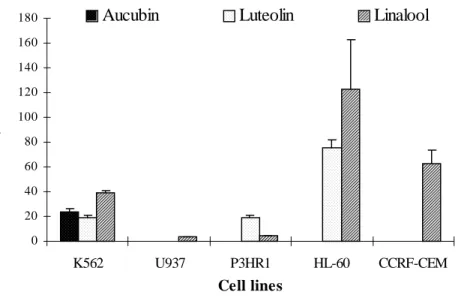
Among the ten pure compounds tested, monoterpene (linalool), triterpenoids (oleanolic acid and ursolic acid) and flavonoid (luteolin) possessed the strongest antileukemic activity (Figs. 2 to 4). Linalool was found to possess a broad-spectrum of activity and the strongest activity against histiocytic lymphoma U937 cells (IC50: 3.51 µg/ml) and Burkitt
lymphoma P3HR1 cells (IC50: 4.21 µg/ml). Ursolic acid exhibited potent antileukemic
activity against P3HR1 cells (IC50: 2.5 µg/ml) and chronic myelogenous leukemia K562
cells (IC50: 17.79 µg/ml). The water soluble compounds (aucubin, caffeic acid, chlorogenic
acid, ferulic acid, p-coumaric acid and vanillic acid) expressed a weak antileukemic activity (IC50: 26–56 µg/ml).
Figure 2. Antileukemic activity of aucubin, linalool and luteolin. Data were IC50 (the concentration of 50% cellular cytotoxicity of human tumor cells) of mean values obtained from three independent experiments and bars represented standard errors. Student’s t-test was used to evaluate the p value and the mark indicated a significant difference between test and DMSO control (*p < 0.05, **p < 0.01).
* * ** * ** 0 20 40 60 80 100 120 140 160 180 K562 U937 P3HR1 HL-60 CCRF-CEM Cell lines IC 50 (µ g/ml)
L-C. CHIANG et al.
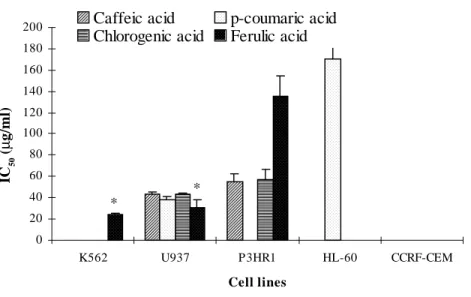
Figure 4. Antileukemic activity of phenolic compounds. Data were IC50 (the concentration of 50% cellular cytotoxicity of human tumor cells) of mean values obtained from three independent experiments and bars represented standard errors. Student’s t-test was used to evaluate the p value and the mark indicated a significant difference between test and DMSO control (*p < 0.05).
0 20 40 60 80 100 120 140 160 180 200 K562 U937 P3HR1 HL-60 CCRF-CEM Cell lines IC 50 ( ìg/m
Caffeic acid p-coumaric acid
Chlorogenic acid Ferulic acid
IC 50 ( µ g/ml) * * 0 20 40 60 80 100 120 140 160 180 K562 U937 P3HR1 HL-60 CCRF-CEM Cell lines IC 50 (µ g/ml)
Ursolic acid Oleanolic acid Vanillic acid
*
** *
Figure 3. Antileukemic activity of triterpenes and vanillic acid. Data were IC50 (the concentration of 50% cellular cytotoxicity of human tumor cells) of mean values obtained from three independent experiments and bars represented standard errors. Student’s t-test was used to evaluate the p value and the mark indicated a significant difference between test and DMSO control (*p < 0.05, **p < 0.01).
To evaluate whether test compounds affected human normal lymphocytes growth, human peripheral mononuclear cells were cultured with the test compounds or DMSO control. Results showed that the concentration (µg/ml) of 50% cytotoxicity (CC50) against normal
lymphocytes was in the order of: aucubin (44.68) < luteolin (97.50) < caffeic acid (109.13) < chlorogenic acid (111.52) < 5-fluorouracil (187.20) < vanillic acid (249.0) < ferulic acid (271.81) < p-coumaric acid (273.78) < oleanolic acid (304.0) < linalool (2080.0).
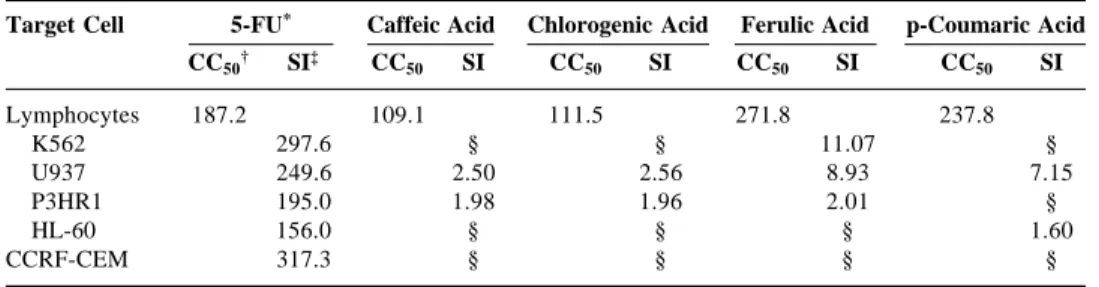
The assessments of antileukemic activity are shown in Tables 2 to 4. Results indicated that linalool possessed strong antileukemic activity, the order of activity against the various cell lines was U937 > P3HR1 > K562 > CCRF-CEM > HL-60 (SI = 592.6, 494.1, 52.75, 33.01 and 16.9, respectively). Flavonoid (luteolin) exhibited effective antileukemic activity against K562 cells (SI = 5.14) and P3HR1 cells (SI = 5.13) (Table 2). Triterpene (ursolic acid) showed a strong activity in inhibiting the proliferation of P3HR1 cells (SI = 262.6) and K562 cells (SI = 36.91) (Table 3). The water soluble phenolic compound (ferulic acid) exhibited a weak activity against the growth of K562 cells (SI = 11.07) and U937 cells (SI = 8.93) (Table 4).
Table 2. The Assessment of Antileukemic Activity of Aucubin, Linalool and Luteolin Target Cell 5-FU* Aucubin Linalool Luteolin
CC50† SI‡ CC50 SI CC50 SI CC50 SI Lymphocytes 187.2 44.7 2080.0 97.5 K562 297.6 1.69 52.75 5.14 U937 249.6 § 592.6 § P3HR1 195.0 § 494.1 5.13 HL-60 156.0 § 16.90 1.29 CCRF-CEM 317.3 § 33.01 §
*Control: positive control (5-fluorouracil, 5-FU), negative control (0.1% DMSO). †Theconcentration (µg/ml) of 50% cytotoxicity against normal human lymphocytes. ‡ Selective index (SI) = CC50 / IC50.
§SI < 1.0.
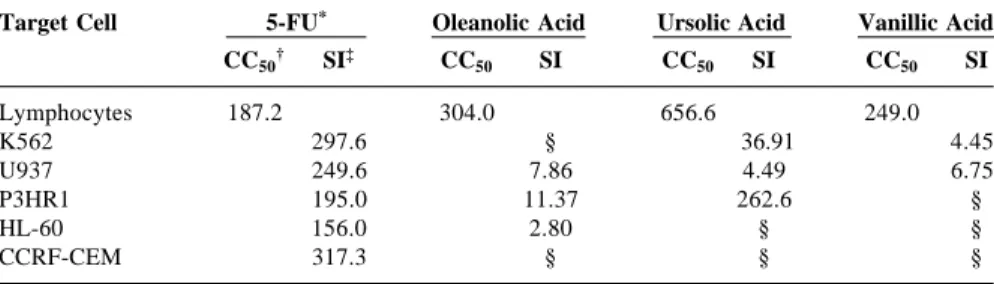
Table 3. The Assessment of Antileukemic Activity of Triterpenes and Vanillic Acid Target Cell 5-FU* Oleanolic Acid Ursolic Acid Vanillic Acid
CC50† SI‡ CC50 SI CC50 SI CC50 SI Lymphocytes 187.2 304.0 656.6 249.0 K562 297.6 § 36.91 4.45 U937 249.6 7.86 4.49 6.75 P3HR1 195.0 11.37 262.6 § HL-60 156.0 2.80 § § CCRF-CEM 317.3 § § §
*Control: positive control (5-fluorouracil, 5-FU), negative control (0.1% DMSO). †Theconcentration (µg/ml) of 50% cytotoxicity against normal human lymphocytes. ‡Selective index (SI) = CC50 / IC50.
L-C. CHIANG et al.
Table 4. The Assessment of Antileukemic Activity of Phenolic Compounds
Target Cell 5-FU* Caffeic Acid Chlorogenic Acid Ferulic Acid p-Coumaric Acid
CC50† SI‡ CC50 SI CC50 SI CC50 SI CC50 SI Lymphocytes 187.2 109.1 111.5 271.8 237.8 K562 297.6 § § 11.07 § U937 249.6 2.50 2.56 8.93 7.15 P3HR1 195.0 1.98 1.96 2.01 § HL-60 156.0 § § § 1.60 CCRF-CEM 317.3 § § § §
*Control: positive control (5-fluorouracil, 5-FU), negative control (0.1% DMSO). †Theconcentration (µg/ml) of 50% cytotoxicity against normal human lymphocytes. ‡Selective index (SI) = CC50 / IC50.
§SI < 1.0
Discussion
Many commonly used medicinal herbs in Taiwan have been shown to contain biologically active compounds of six classes such as benzoic compound (vanillic acid), flavonoid (luteolin), iridoid glycoside (aucubin), phenolic compounds (caffeic acid, p-coumaric acid, chlorogenic acid and ferulic acid) and triterpenes (oleanolic acid and ursolic acid) (Table 1) (Duke, 1992; Samuelsen, 2000). Luteolin was reported to inhibit proliferation of leukemia (P388, CEM, Raji, NK/LY), melanoma and carcinomas of pancreas, ovary, brain, kidney, lung, colon and stomach (Matsukawa et al., 1993; Molnar et al., 1981; Pettit et al., 1996; Post and Varma, 1992; Ramanathan et al., 1994). The present study showed a similar activity on cytotoxicity to Burkitt lymphoma (P3HR1) cells and chronic myelogenous leukemia (K562) cells (IC50 < 20 µg/ml, SI > 5.1) (Table 2).
Oleanolic acid was effective against leukemia (HL-60, M1) and carcinomas of lung, breast, pancreas, colon and kidney (Njoku et al., 1997; Noda et al., 1997; Umehara et al., 1992). In contrast to results reported by Umehara et al. (1992), oleanolic acid was found to possess a very weak activity against HL-60 cells (IC50 = 108.43 µg/ml), U937 cells (IC50 =
36.68 µg/ml) and P3HR1 cells (IC50 = 26.74 µg/ml) (Table 3). This discrepancy in results
between the two different studies could be due to the difference in the number of target cells and the evaluating method used in the study. Ursolic acid has been reported to inhibit proliferation of leukemia (HL-60, K562, P388, L1210), melanoma, hepatoma and carcinomas of lung, ovary, colon, cervix and brain (Ahn et al., 1998; Baek et al., 1997; Kim
et al., 1999 and 2000; Lin et al., 1990). In contrast to results reported by Baek et al. (1997),
ursolic acid exhibited no activity against HL-60 cells, but possessed potent activity in inhibiting the proliferation of K562 cells (IC50 = 17.79 µg/ml, SI = 36.91) and P3HR1 cells
(IC50 = 2.5 µg/ml, SI = 262.6) (Table 3). The discrimination in the results of ursolic acid
between the two different studies could be due to the difference in the number of HL-60 cells and the evaluating method used in the study. To our knowledge, the antileukemic activities of monoterpene (linalool) have never been reported. In the present study, we have shown that linalool possessed potent activity against histiocytic lymphoma cells U937 and Burkitt lymphoma P3HR1 cells.
Among the water soluble pure compounds, caffeic acid was reported to inhibit proliferation of leukemia (HL-60, U937) cells (Jian et al., 1999; Sakagami et al., 1995). However, our results showed no activity against HL-60 cells, but possessed a very weak activity against U937 (IC50 = 43.71 µg/ml) and P3HR1 (IC50 = 55.21 µg/ml) (Table 3). The
disagreement in anti-HL-60 results of caffeic acid between the two different studies could be due to the difference in the evaluating method and the number of target cells used in the study. Ferulic acid was effective in preventing mammary cancer (Shamon et al., 1994), but in this study it exhibited a weak cytotoxicity to K562 (IC50 = 24.56 µg/ml, SI = 11.07) and
U937 (IC50 = 30.43 µg/ml, SI = 8.93) (Table 4). p-Coumaric acid possessed a weak activity
against U937 cells (IC50 = 38.31 µg/ml, SI = 7.15) (Table 4).
Taken together, the present study has demonstrated that water insoluble pure compounds (monoterpene, triterpenes and flavonoid) possess strong antileukemic activities, especially linalool and human lymphoma cells, suggesting that they are both worth investigating in
vivo.
References
Ahn, K.S., M.S. Hahm and E.J. Park et al. Ursolic acid isolated from the fruit of Cratagus pinnatifida var. psilose is a protein kinase C inhibitor as well as a cytotoxic agent. Planta Med. 64: 468–470, 1998.
Baek, J.H., C.M. Kang and J.A. Kim et al. Intracellular Ca2+ release mediates ursolic acid-induced
apoptosis in human leukemic HL-60 cells. Int. J. Cancer 73: 725–728, 1997.
Chang, J.S., L.C. Chiang and C.C. Chen et al. Antileukemic activity of Bidens pilosa L. var. minor (Blume) Sherff and Houttuynia cordata Thunb. Am. J. Chin. Med. 29: 303–312, 2001. Duke, J.A. (ed.) Handbook of Phytochemical Constituents of GRAS Herbs and Other Economic Plants.
CRC Press, 1992, pp. 25–653.
Jian, H.Y., C.C. An and J. Feng et al. Effect of caffeic acid on the tumor cells U937 evaluated by an electrochemical voltammetric methods. Chin. Chem. Lett. 10: 781–782, 1999.
Kim, D.K., J.H. Baek and C.M. Kang et al. Apoptotic activity of ursolic acid may correlate with the inhibition of initiation of DNA replication. Int. J. Cancer 87: 629–636, 2000.
Kim, S.H., B.Z. Ahn and S.Y. Ryu. Antitumor effects of ursolic acid isolated from Oldanlamdia diffusa. Phytother. Res. 12: 553–556, 1999.
Lin, C.C and W.S. Kan. Medicinal plants used for the treatment of hepatitis in Taiwan. Am. J. Chin. Med. 18: 35–43,1990.
Lin, C.N., C.M. Lu and M.K. Cheng et al. The cytotoxic principle of Solanum incanum. J. Nat. Prod. 53: 513–516, 1990.
Matsukawa, Y., N. Marui and T. Sakai et al. Genistein arrests cell cycle progression at G2-M. Cancer Res. 53: 1328– 1331, 1993.
Miller, B.A., L.A.G. Reis and B.F. Hankey et al. (eds.) Cancer Statistics Review 1973–1989. National Cancer Institute, NIH Publication, 1992, pp. 92–2788.
Molnar, J., I. Beladi and K. Domonkos et al. Antitumor activity of flavonoids on NK/LY ascites tumor cells. Neoplasma 28: 11–18, 1981.
Njoku, C.J., L. Zeng and I.U. Asuzu et al. Oleanolic acid, a bioactive component of the leaves of Ocimun gratissimum (Lamiaceae). Int. J. Pharmacog. 35: 134–137, 1997.
L-C. CHIANG et al.
Noda, Y., T. Kaiya and K. Kohda et al. Enhanced cytotoxicity of some triterpenes toward leukemia L1210 cells cultured in low pH media: possibility of a new mode of cell killing. Chem. Pharm. Bull. 45: 1665–1670, 1997.
Pettit, G.R., M.S. Hoard and D.L. Doubek et al. Antineoplastic agents 338. The cancer cell growth inhibitory constituents of Terminalia arjuna (Combretaceae). J. Ethnopharmacol. 53: 57–63, 1996. Pezzuto, J.M. Plant-derived anticancer agents. Biochem. Pharmacol. 53: 121–133, 1997.
Post, J.F. and R.S. Varma. Growth inhibitory effects of bioflavonoids and related compounds on human leukemic CEM-C1 and CEM-C7 cells. Cancer Lett. 67: 207–213, 1992.
Ramanathan, R., N.P. Das and C.H. Tan. Effects of gamma-linolenic acid, flavonoids, and vitamins on cytotoxicity and lipid peroxidation. Free Radical Biol. Med. 16: 43–48, 1994.
Sakagami, H., N. Kuribayashi and M. Iida et al. Induction of DNA fragmentation by tannin- and lignin-related substances. Anticancer Res. 15: 2121–2128, 1995.
Samuelsen, A.B. The traditional uses, chemical constituents and biological activities of Plantago major L. A review. J. Ethnopharmacol. 71: 1–21, 2000.
Shamon, L.A., C. Chen and R.G. Mehta et al. A correlative approach for the identification of antimutagens that demonstrate chemopreventive activity. Anticancer Res. 14: 1775–1778, 1994. Umehara, K., R. Takagi and M. Kuroyanagi et al. Studies of differentiation-inducing activities of