~_N~_~ February 1995
Pattern Recognition
Letters
El .SEV II-~R Pattern Recognition Letters 16 ( 1995 ) 183-192Hierarchical image representation by mathematical morphology
subband decomposition
Soo-Chang Pei a,., Fei-Chin Chen b
a Department of Electrical Engineering, National Taiwan University, Taipei, Taiwan, ROC b Department of Electrical Engineering, China Junior College of Technology, Taipei, Taiwan, ROC
Received 6 January 1994; revised 30 August 1994
AbsUa~
An efficient subband image decomposition method by mathematical morphology has been proposed recently. This method decomposes the input signal spectrum into 4 subbands by using two separable structuring elements. Based on this method, a hierarchical image representation referred to as subband pyramid is described. This subband pyramid scheme preserves the number of pixels as in the original image, also the data structure itself is very compact. More importantly, morphological filtering manipulates the specific shape in the image, it only alters certain geometric details without affecting the remaining image struc- ture. When the resolution is reduced, no overall blurring is introduced in the image as the conventional linear filtering method does. This natural decomposition of multiple scale shapes might be a useful hierarchical representation for the images.
1. Introduction
A well known multiresolution image representa- tion is the pyramid. Burt and Adelson used them for image coding and hierarchical representation (Burt, 1981; Butt and Adelson, 1983) which allows analyz- ing the image at a certain resolution level, thus avoid- ing unnecessary fine details. The most pronounced advantage of such a code is its reversibility: the orig- inal image can be perfectly reconstructed from its La- placian pyramid representation. Also, some research works have been recently reported on this pyramid image decomposition using mathematical morphol- ogy (Toet, 1989). The problem with this Laplacian pyramid approach is that too many image samples are used to describe the original image. The total number o f pixels in the Laplacian pyramid is greater
* Corresponding author.
than that in the original image by a factor of about 4/3 (Kronander, 1987).
However, the subband pyramid (Kronander, 1987; Woods and O'Neil, 1986; Gharavi and Tabatabi, 1988) can overcome the above problem. The total number of pixels in the subband pyramid is equal to that in the original image, and the data structure it- self is very compact. An efficient subband image de- composition using mathematical morphology has been proposed recently by the authors (Pei and Chen, 1991 ). Four-subband decomposition has been widely used for image compression by means of the charac- teristic of each band. However, the implementation efficiency is decreased due to the multiplications of the linear quadrature mirror filtering. Thus, the mor- phological low-pass filters are used here instead of the linear quadrature mirror filters. The major advan- tages of the morphological approach over the con- ventional linear filtering approach are its direct geo- metric interpretations, simplicity and efficiency in the 0167-8655/95/$09.50 © 1995 Elsevier Science B.V. All riots reserved
184 S.-C. Pei, F.-C. Chen /Pattern Recognition Letters 16 (1995) 183-192
hardware implementation. However, no analysis and theory have been done so far to understand this sub- band morphological decomposition for image repre- sentation. This paper will describe and explain this hierarchical representation in details from a progres- sive morphological decomposition of simple shapes at each scales. The representation may consist of an ordered sequence of multiresolution images with progressive structure contents. This can provide a better basis and understanding for constructing mor- phological multiresolution representation for image analysis and computer vision. Moreover, global in-
formation can be used to impose constraints on local operations. Therefore, a hierarchical subband de- composition algorithm can be more efficient than operations performed on a single level. It will be very useful for signal processing and data compression.
The outline of this paper is organized as follows: Section 2 reviews mathematical morphology opera- tions on binary images and gray-level images briefly and shows the method of the subband decomposition for images using morphological filters. Section 3 dis- cusses the hierarchical representation of images by subband decomposition using mathematical mor-
O 0
O 0
0
0 0 0 0
0 0 0 0
0 ~ 0
O 0
0 0 0 0 0 0
O 0
0
0 0 0 0
0
0 0 0
0
X B X o B X o B d e n o t e s t h e o r i g i n o f t h e s t r u c t u r i n g e l e m e n t B. (a)O
X B X o B X o B (b)Fig. 1. Example of binary image morphology. (a) Erosion and dilation o f X b y B. (b) Opening and closing o f X b y B. (The dark solid curves correspond to the boundaries of the transformed sets. )
S.-C PeL F.-C Chen / Pattern Recognition Letters 16 (1995) 183-192 185
phology. Section 4 gives some image examples to show the effectiveness of this approach. The conclusions are made in Section 5 finally.
2. Subband decomposition using morphological filters The theory of mathematical morphology is based on set algebra (Serra, 1982 ). The basic operations on binary images can be extended to gray-level images (Serra, 1982; Haralick et al., 1987). Mathematical morphology provides an effective approach to ma- nipulate the shapes in the image. There are four basic operations: erosion, dilation, opening and closing.
2. I. Binary image morphology
Assume X (an original image) and B (a symmet- rical structuring element) are subsets of a two-di- mensional Euclidean space, let (X)b denote the translation of X by the vecto r b,
(X)b={y l y=x+b, xeX} . (1) Then the two most fundamental morphological op- erations, dilation and erosion, can be defined respec- tively, as follows:
X ~ B = U (X)b
beB
={y l y = x +b, xeX, beB} , (2) X G B = n (X)_ b
b~B
={Yl beBimplies ( y + b ) e X } . (3) Fig. 1 (a) shows the example of erosion and dilation of X by B. Dilation and erosion cause the expanding
or shrinking of areas when the structuring element has a disklike shape.
An opening is defined as an erosion followed by a dilation by the same structuring element and is shown as
XoB= ( X O B ) ~ B . (4)
On the other hand, we define a closing as a dilation followed by an erosion as
X e B = ( X~B)E3B. (5)
Opening on an image with a structuring element B can be pictured by moving B inside all the shapes in an image and marking only those places where B fits. Similarly, closings on an image with a structuring ele- ment B can be pictured by moving B around the out- side of an image with the result that the concave cor- ners are rounded and the convex corners remain square. An example of opening and closing of X by B is shown in Fig. 1 (b).
2.2. Gray-scale morphology
Morphological concepts can be extended to gray- scale images (Serra, 1982; Haralick et al., 1987).
Let the image X(x) be represented as a function of coordinates x. The analytical definitions of the gray- level morphology operations are as follows:
X ~ B = m a x [ X ( x - b ) +B(b) ] , (6) beB'
X @ B = m i n
[X(x+b)-B(b)
].
(7)
beB'
where the B ( b ) ' s are weights that are a function of b, and B' is the region of support of the structuring ele- ment B.
The opening and closing operations for gray-level
(a) (b) (c)
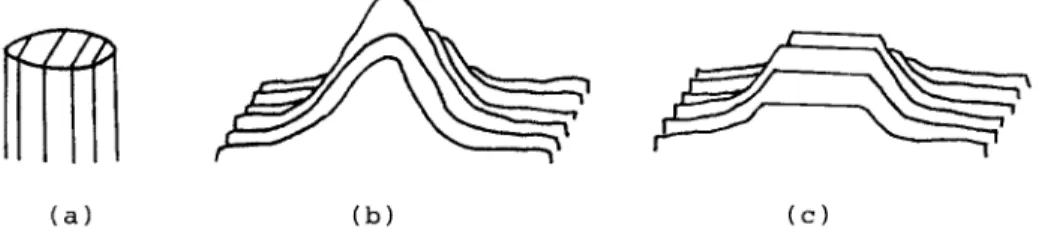
Fig. 2. Example of gray-level image morphology. (a) Disk shaped structuring element. (b) Gray-level image landscape. (c) Opening by a disk shaped structuring element.
186 S.-C. Pei, F.-C. Chen / Pattern Recognition Letters 16 (1995) 183-192 x ( m , n ) S t ' r u c t u r i n g e l e m e n t o & • o : o p e n i n g • : c l o s i n g
+<
>
"222~(ix5) S t r u c t u r i n g e l e m e n t o & •)
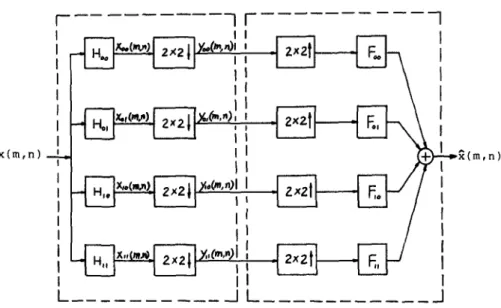
YOo(m,n) Y l o ( m , n ) .... g ( ix5 ) S t r u c t u r i n g e l e m e n t 0 & • Y o l ( m , n ) + Y l l ( m , n ) Fig. 3. System diagram of 4-band splitting using mathematical morphological analysis filter banks.images are defined similarly as in binary case, i.e.
X o B = ( X e B ) ~ B , (8)
X e B = ( X ~ B ) e B , (9)
In gray-level morphology the disk shaped structuring element shown in Fig. 2 (a) is three-dimensional. The result of a three-dimensional opening is to move the top areas under the top surface of the landscape in Fig. 2(b) defined by the image, and keep those areas where the disk shaped structuring element fits. Strongly peaked areas with widths less than the di- ameter of the disk shaped structuring element will flatten out as illustrated in Fig. 2 (c).
2.3. Four-subband decomposition
The input image is split into four rectangular bands as in Fig. 4. The overall analysis/synthesis system in four-subband coder is shown in Fig. 5. Now the mor- phological low-pass filters are used here instead of the linear quadrature mirror filters (Pei and Jaw, 1987).
t l Io 11 01 O0 01 t0 11
I
-'R.F i g . 4. Ideal 4-band splitting in 2-D subband coder.
Sequential alternating application of the morpholog- ical operations of opening and closing removes de- tails of the image that are small relative to the struc-
S.-C. Pei, F.-C. Chen / Pattern Recognition Letters 16 (1995) 183-192 . . . . I I x ( m , n ) - C ' l I I I I
i
l
I[
)~o(m,n)l- c a u
I I
I t _ _
I
I
I
I
I
I
I~
- ~ ( m , n )Fig. 5. System diagram of 2-D subband coder with 4 channel analysis/synthesis fdter banks.
187
lY°l¢mTn'l lyl ( 'nq
Fig. 6. Hierarchical representation of an image by four-subband decomposition. turing element. We call these alternating sequential
filters as morphological low-pass filters. The high-pass filter can be constructed with the original image X and the complement of the low-pass filter, - H o (X), as follows:
Ho(X)
= closing[opening(X) ] ,n~ (X) =X-Ho(X)
(10)
(11)
where
Ho(X)
and H~ (X) denote low-pass and high-pass filters, respectively. In analogy to the linear fil- ters one can imagine that the length and direction of the structuring elements will determine the passband bandwidth and spectrum orientations of the filters. The larger the structuring elements is, the narrower the filter passband becomes. Then 2-D filter banks in a four-subband coder are designed by a cascade op-
eration of the above I-D horizontal/vertical mot- phological filters, i.e.:
Hoo( X) = H[[ Hh( X) ] ,
Hol (X)=H'{[Hh(X) ],
Hio(X)=H'~[Hh(X) ],
H~ (X) =H'~[Hh(X) ],
(12)
(13)
(14)
(15)
where H/h and H7 for i= 0, 1 are the horizontal and vertical low-high-pass filters, and Hoo(X), Ho~ (X),
Hm(X), HI~ (X)
denote LL, LH, HL and HH filters of X, respectively. These 2D filters have the same al- gebraic properties of idempotence, increasing and duality as openings and closings.From Eq. (10), the 1-D morphological low-pass filter is
188
Fig. 7. Hierarchical representation of "Picture A'" by four-sub- band decomposition using mathematical morphology. (a) "Pic- ture A", original image x( m, n ). (b) yoo( m, n ), ylo( m, n ), Yoi ( m, n), yll (m, n). (c) y~o(m, n),ylo(m, n), y~l(rn, n),ylt(m, n).
S.oC. Pei, F.-C. Chen / Pattern Recognition Letters 16 (1995) 183-192 Ho (X) = closing [ opening (X) ]
= ( X o B ) o B (16)
where X is the original image and B is the structuring element. To prove the idempotence of H o ( X ) , we need to use the equation
X ~ 2 B = ( X @ 2 B ) o 2 B
= ( ( X ~ 2 B ) ~ 2 B ) ~ 2 B (17) which is Proposition 37 in (Haralick et al., 1987), and assume 2B to be represented as B O B . The Prop- osition 37 is proven on the binary morphology in (Haralick et al., 1987 ), but it is also true on the gray- scale morphology. Proof. H o ( H o ( X ) ) = ( ( ( X o B ) ,,B) o B ) ,,B = (( ( (( ( ( X e B ) ~B) e B ) e B ) G B ) ~ B ) ~ B ) O B = ( ( ( ( X G B ) @2B) G2B) ~ 2 B ) G B = ( ( X O B ) ~ 2 B ) e B = ( ( ( X e B ) ~ B ) e B ) e B = ( X o B ) . B = H o ( X ) .
The 1-D morphological high-pass filter, H ~ ( X ) = X - H o ( X ) , constructed with the original image X and the complement of the low-pass filter, is also idempotent. Proof. H, ( H , ( X ) ) = ( X - H o ( X ) ) - ( H o ( X - H o ( X ) ) ) = ( X - H o ( X ) ) - ( H o ( X ) - H o ( H o ( X ) )) = ( X - H o ( X ) ) - ( H o ( X ) - H o ( X ) ) = X - H o ( X ) = H , ( X ) .
Therefore, the 2-D fdters, Hoo( X ) , Ho~ ( X ) , Hlo( X ) and H ~ I ( X ) designed by a cascade operation of the
1-D low/high-pass filters are also idempotent. With mathematical morphology filtering, the complexity of filters design and implementation is greatly reduced. Also it can provide a unique geometric representa-
S.-C. Pei, F.-C. Chen /Pattern Recognition Letters 16 (I 995) 183-192 189 5
]'
4 (a D e t a i l e d s i z e of P i c t u r e A. 5 (b) E n l a r g e d s c a l e of the o b l i q u e b a r in P i c t u r e A. 0 0 19 0 0 0 0 ~ 0 0 (c) 5xl v e r t i c a l ) & ix5 ( h o r i z o n t a l ) s t r u c t u r i n g e l e m e n t s .Fig. 8 Detailed size of"Picture A" and structuring elements.
tion of an image by summarizing its shape and con- veying its size, orientation and connectivity. The sys- tem diagrams of four-subband splitting using morphological filters are shown in Fig. 3.
3. Hierarchical subband pyramid
The hierarchical representation of images by sub- band decomposition is referred to as a subband pyr- amid. Image analysis frequently requires a hierarchi- cal representation that consists of multiresolution images with progressive structure contents. Compar-
190 S.-C Pei, F.-C Chen / Pattern Recognition Letters 16 (1995) 183-192
ing the morphological filtering with the linear filter- ing approach, the conventional low-pass filter will re- move spatial frequencies which are higher than the Nyquist frequency of the sample spacing. This results in an overall blurring of the reduced image. How- ever, mathematical morphology directly operates on certain shapes without affecting the remaining image structure. Therefore, morphological filters are a bet- ter choice for constructing pyramids than conventa- tional low-pass filters. Based on the above four-sub- band image decomposition by using mathematical morphology, a four-subband pyramid is obtained by the following steps.
First, the original image
X(m, n)
is decomposed into four subbands, the lowest bandYoo(m, n)
= Hoo(X), the vertical band Yl0 (m, n) = HIO(X), the horizontal band Yot (m, n) = Hot (X), and the diago- nal band y~ ~ ( m, n ) = HI 1 (X), by the 2-D filter banks described in Eqs. ( 12 )- ( 15 ) and the procedures de- scribed in Fig. 3. The three high band images do not contain much details; further decomposition is no more necessary except for the lowest band. Then, the lowest band Yoo (m, n ) is decomposed into four sub- bands,
y~o(m, n), y~o(m, n), yll (m, n)
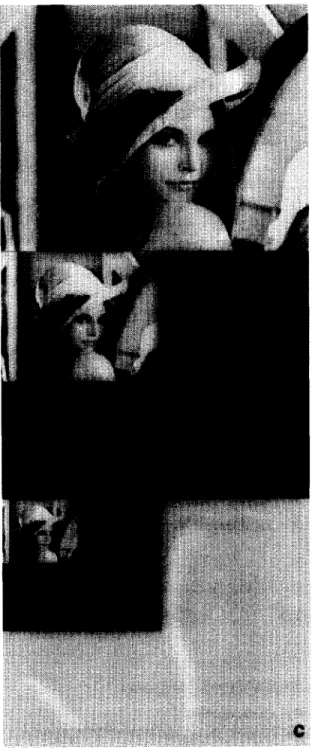
and Y lI (m, n), by the same procedures again. The hier- archical 4-subband decomposition is shown in Fig. 6.Fig. 9. Hierarchical representation of "Lena" image by four-sub- band decomposition using mathematical morphology. (a) "Lena", original image x(m, n). (b) yoo(m, n), Ylo(m, n), Yol (m, n ) , y l l ( m , n ) . (c)y~o(m,n),y~o(m, n), yol (m, i n ) , y H ( m , n). l
4. Experimental results and discussions
The "Picture A" in Fig. 7(a) is used in our exper- iments. The detailed size of Picture A is shown in Fig. 8. It consists of a diagonal and horizontal lines and several rectangles with different thickness. These rectangles are specially designed with some specific widths, and will be suitable for different level decom- positions. In the computer simulations, we have used a ( 1 × 5) horizontal structuring element and a (5 × 1 ) vertical structuring element at each level in the four- subband image decomposition. The experimental re- sults for the first level decomposition are shown in Fig. 7(b) as the horizontal/vertical resolution has been reduced by 2 by down-sampling operations. The central lowest band analysis image
Yoo(m, n)
con- tains the most information with some details being removed by morphological filtering. The vertical band and horizontal band analysis imagesYto(m, n)
and Yol(/'n, n)
have extracted the thin or narrow verticalS.-C. Pei, F.-C. Chen / Pattern Recognition Letters 16 (1995) 183-192
191
I
Input
Textures[
Images
1
Thresholding I
1
Morphological
I
Subband
Decomposition
I
Morphological
Subband
Decomposition
Feature
I
Extraction
I
Classification
I
Fig. 10. System diagram of texture classification based on hierarchical image representation by morphological subband decomposition.
and horizontal sharp edges of the bottom-right rect- angle very successfully. Also, the diagonal band anal- ysis image Yl i (m, n) shows the central diagonal edge and some sharp comers of the PiCture A. We notice that there is some residual structure of the central di- agonal edge existing in the vertical band image Y~o (m, n). This is due to the zig-zag nonperfectness inherent in digital straight lines. The central lowest band
Yoo (m, n) is further decomposed into four subbands
y~o(rn, n),ylo(m,n),y~l(m,n)
andyI,(m,n)
as shown in Fig. 7(c). The bottom-left rectangle with thicker or wider width has been decomposed again into two horizontal, vertical edges and sharp comers in each high band image. Now only the three black blocks still remain in the lowest band image. Notice that no overall blurring is introduced at each stage in192 S.-C Pei, F.-C Chen / Pattern Recognition Letters 16 (1995) 183-192 morphological filtering; the subband images remain
sharp as the original ones at each level.
The " L e n a " image in Fig. 9 (a) is decomposed by the same procedures as processed on "Picture A". The results are shown in Figs. 9 ( b ) and 9(c). The fine smallest details are restricted to the top level and p r o - gressively coarser details are restricted down to the bottom levels. From these results, it is evident that the hierarchical image representation (the subband pyramid) is very useful for signal analysis.
An application example of the hierarchical image representation is shown in Fig. 10, a system diagram o f texture classification based on hierarchical image representation by using morphological subband de- composition is introduced. Recently, a texture clas- sification based on a one-level morphological sub- band decomposition scheme, which was firstly proposed by the authors (Pei and Chen, 1991 ), is presented by K i m et al. (1993). The classification accuracy rate for 10 natural textures selected from Brodatz's (1966) texture album is very high in their experiments. We modify their approach by the hier- archical image representation scheme as shown in Fig. 10. Because of the hierarchical representation of tex- ture images, miltiresolution features of texture im- ages will be extracted, and the classification accuracy rate will be improved for future research works and experiments.
Moreover, the above experiments and analysis are very helpful for us to understand the four-subband decomposition procedures by mathematical mor- phology. This can provide a better basis and under- standing for constructing a morphological multire- solution representation for image analysis and computer vision.
5. Conclusions
In this paper, we have presented a method of the efficient four-subband image decomposition using
mathematical morphology. Based on this method a hierarchical representation of images is described. These efficient hierarchical representation schemes preserve the number ofpixels and remain sharp as in the original image, also the morphological operations involved are very simple, fast and well suitable for VLSI implementation. Some image examples are il- lustrated to show the effectiveness of this approach.
References
Brodatz, P. (1966). Textures: A Photographic Album for Artists and Designers. Dover, New York.
Butt, P.J. (1981). Fast filter transforms for image processing. Computer Graphics and Image Processing 16, 20-51. Butt, P.J. and E. Adelson (1983). The Laplacian pyramid as a
compact image code. IEEE Trans. Commun. 31,532-540. Gharavi, H. and A. Tabatabi (1988). Subband coding of
monochrome and color images. IEEE Trans. Circuits Syst. 35, 207-214.
Haralick, R.M, S.R. Sternberg and X. Zhuang (1987). Image analysis using mathematical morphology. IEEE Trans. Pattern Anal. MachineIntell. 9 (4), 532-550.
Kim, G.S., K.H. Do, ICH. Kwon, J.C. Shim and Y.H. Ha (1993). Texture classification using morphological pattern spectrum
based on morphological subband decomposition. 1993 Joint Technical Conf. on Circuits~Systems, Computers, and Communications, Nara, Japan, Aug. 1993, 212-216. Kronander, T. (1987). Sampling of bandpass pyramids. IEEE
Trans. Commun. 35, 125-127.
Pei, S.C. and F.C. Chen (1991). Subband decomposition of monochrome and color images by mathematical morphology. Opt. Engineering, July, 921-933.
Pei, S.C. and S.B. Jaw (1987). Design of 2D quadrature mirror FIR filters for image subband coding. IEEE Trans. Circuits Syst. 34, 438-441.
Serra, J. ( 1982 ). Image Analysis and Mathematical Morphology. Academic Press, London.
Toet, A. (1989). A morphological pyramid image decomposition. Pattern Recognition Lett. 9, 255-261.
Woods, J.W. and S.D. O'Neil (1986). Subband coding of images. IEEE Trans. Acoust. Speech Signal Process. 34, 1278-1288.